To this end, the European Union has created a unique instrument – the ACCESS4EU International Cooperation Initiatives – which aims to increase European researchers' awareness of third countries' financing options for international research projects. The INDIA GATE team has been painting a holistic picture of Indian Science & for three years.
Agency for the Promotion of European Research
The main objective of the INDIA GATE initiative is to increase science and technology cooperation between India and the European Union (hereafter EU) by creating a 'one-stop shop' for funding opportunities available in India to European organizations. The India-EU Science and Technology Agreement recognizes the mutual benefit of access to relevant funding programmes.
In fact, there are several initiatives to support the participation of Indian organizations in the Seventh Framework Programme. INDIA GATE aims to play a similar role for European organizations wishing to benefit from RTR funding sources from India, thereby accelerating EU-India scientific cooperation through increased participation of European organizations in Indian funding programs and contributing to greater EU-India mutual understanding relevant research systems.
HELP-FoRWARD
PARTNER
Council of Scientific and Industrial Research
Europa Media Non-Profit Ltd
EIRc consulting Private Limited
Indian Institute of Foreign Trade
PARTNER PARTNER
Resources
AND INNovATIoN sysTEm
Indian Science & Technology system
In this decade, the number of patent applications increased by about 250% (Source: Intellectual Property India, Annual Report 2009-10). However, agriculture, which is one of the main industries in the country, saw minimal enrollments of 0.5% (see figure below).
INDIA’s EDucATIoNAL sTRucTuRE
Indian Innovation system
This stimulates the need for frugal innovation in providing low-cost solutions to basic human needs. Not only is the Indian consumer base growing, but it is also extremely price sensitive and willing to experiment, sustaining the demand for frugal innovation.
The selco solar lamps
One of the best and world-famous cost-saving innovations from India is the Jaipur Leg, an artificial limb named after the inventor's locality - Jaipur. To reach the poorest, BMVSS kept the administrative cost down to 4%, while elsewhere it is 50 to 80% of the cost of limbs.
The Jaipur Foot
Moreover, Narayana Hrudayalaya has an innovative health insurance policy, under which people who cannot afford it are covered. The hospital's partnership with the Indian Space Research Organization (ISRO) has enabled its telemedicine services to reach even the remote areas of Tripura and Nagaland, besides the areas of southern Karnataka, by connecting them through the INSAT satellite . Now around 170 hospitals offer telemedicine network, thanks to the advanced technology and innovative ideas created by Narayana Hrudayalaya.
Narayana Hrudyalaya
At Narayana Hrudayalaya, patients are charged $1500 for heart surgeries compared to the $4500 that other heart hospitals charge on average, and in the US the cost goes as high as $45000. With these innovations around internal processes, Narayana Hrudayalaya performs about 30 heart surgeries a day compared to four to five in other major hospitals.
Aravind Eyecare
Mass production of the product was handled by Titan industries, the watch and precision equipment manufacturer, and after sales service and support was provided by Tata Business Support Solutions and Tata Teleservices. Tata Swach has been voted 'Product of the Year 2012' on the basis of a survey conducted by Nielsen with 30,000 consumers in 36 markets in the country.
Labor costs were significantly reduced because eight of the nine engineers were based in India. A commercially available chip was purchased at a quarter of the price instead of the conventional procedure followed: to customize the processing chips, which requires an 18-week advance order.
GE mAc 400 Electrocardiogram
Ӱ In the innovation component of the Center for Global Competitiveness Index of the World Economic Forum that also measures a country's innovativeness, India ranks 40th in 2011-12 and 42nd in 2010-11, an improvement of two points in a year. In the 2012 GII innovation efficiency index, India ranks second in the world, improving its position from the previous year, which was 9th 5.
National Innovation council: Inclusive Innovation
Clusters: existence and cooperation
- Innovation Clusters
In the financial year 2011-12, NIC set up seven CICs in different parts of the country, covering different industrial segments. In 2011-2012, the NIC set up seven cluster innovation centers in different parts of the country, covering different industrial segments.
Autocomponenet cluster
This growth phase in turn led to further entry of new entrepreneurs into the small-scale sector. Seven companies in the clusters are large, about 20 to 25 companies are medium-sized and the rest are small.
Pharmaceutical cluster
Innovation opportunities in Industry sectors
For example, providing clean and potable water to hundreds of millions in India at low cost. However, India's indigenous and innovative space sector exemplifies India's ability to achieve global recognition and standards.
Automotive Industry
According to SIAM statistics, 81% of the country's total R&D expenditure occurs in the western zone. Reddy's Labs and Lupine can quickly be a part of the government's motivated 'Jan Aushadhi' project.
Pharmaceuticals Industry
In the pharmaceutical industry, the private sector is one of the main participants in innovation activities. Some of the recent trends and opportunities being exploited by the Indian and foreign pharmaceutical companies are as follows.
Industry
Aerospace Industry
In the past, the Indian energy sector has been driven by fossil fuel energy, mainly coal. Energy demand is expected to increase to 5.2%, to keep up with the GDP growth rate of 8-10% in the coming years.
Energy Industry
As a result of these and other initiatives, more than 600 patents were filed in the energy sector in India during the period of which around 70% were in the arena of energy transmission and distribution. Along with the government bodies, the private sector is also increasing its investment in the energy sector.
Transport Industry
British construction companies have formed the British India Roads Group (BRIG) to ensure greater involvement of the UK highways construction sector in India's National Highways Development Project (NHDP). India has 4% of the world's water resources, while supporting 16% of the world's population. As a result, India needs a comprehensive water and wastewater management plan.
Water and Waste-water management
- Indian Science & Technology Programmes
Bilateral program/ Cooperation with member states Activities with the EU scholarship program Visiting scientists from abroad program (VSAP) New program Indigo Special program MINISTRY OF SCIENCE AND TECHNOLOGY. The Department of Science and Technology (DST) is a department within the Ministry of Science and Technology in India.
Bilateral Programme
It was established in May 1971, with the objective of promoting new fields of Science and Technology and playing the role of a nodal department for organizing, coordinating and promoting scientific and technological activities in the country. It also supports various researchers in India to attend conferences abroad and go on experimental work.
Department of science &
Technology (DsT)
The Department of Science and Technology (DST), the Indian government and the Netherlands Organization for Scientific Research (NWO) are jointly opening a call for proposals. The scientific and technological cooperation program is supported by the Federal Ministry of Science and Research (BMWF) on the Austrian side and by the Indian Ministry of Science.
Activities with EU
Project applicants will be notified of approvals or rejections after the Austro-Indian Joint Committee meeting sometime in the first quarter of 2013.
New Indigo Programme
Fellowship Programme
The institutions will then submit their recommended nominations to the Department of Science and Technology.
Specific Programme
The Department of Biotechnology (DBT) is a department of the Indian government, under the Ministry of Science and Technology, responsible for administering development and commercialization in the field of modern biology and biotechnology in India. The department has made significant achievements in the growth and application of biotechnology in broad areas of agriculture, health care, animal sciences, environment and industry.
Bilateral programmes
Department of Biotechnology
The costs of the European institutions are covered by the European country and those for the Indian partner institutions are covered by the DBT. In the past, DBT has had cooperation with the following countries: Belarus, Germany, Russia, Sweden, Switzerland, United Kingdom.
Visiting Scientist from Abroad Programme (VSAP)
A maximum of 50% of the contingency grant may be used by the visiting scientist to meet domestic travel expenses to visit one or two laboratories in the field of specialization in the country or other items of a contingent nature. For the most promising newly qualified post-doctoral researchers, to help them get an early start in launching their independent research careers, working in the best laboratories in India and supervision.
Fellowship Programme Ӱ Post doctorate fellowship
It is an autonomous body registered under the Registration of Societies Act of 1860. CSIR aims to provide industrial competitiveness, social welfare, strong S&T base for strategic sectors and the advancement of fundamental knowledge. International Science and Technology Affairs Division (ISTAD) plays the role of a bridge between CSIR and the scientific affairs of the other countries.
Council of Scientific &
The Council of Scientific and Industrial Research (CSIR) - the premier industrial R&D organization in India was established in 1942 by a resolution of the then Central Legislative Assembly. CSIR's 37 labs not only weave India into a giant network that impacts and adds quality to the life of every Indian, but CSIR is also part of the prestigious Global Research Alliance with the aim of leveraging global knowledge for global good. by applying global funding.
Industrial Research (csIR)
The home institution should confirm that the time the student spends and the work done during the internship is considered an essential part of the student's program of study. The student shall submit a brief proposal of the project to be carried out during the internship to a CSIR laboratory of his choice in India duly forwarded by his college/.
AWARD scHEmE
The SFS award winners will have an opportunity to stay for a minimum of 3 months, extendable up to 6 months in any of the CSIR laboratories in India. The duration of the awards may be suitably extended in future depending on the response to the scheme.
New Indigo programme
Information Technology – Information Technology Enabled Services (IT-ITeS) industry, which provides support for creating innovation / research and development (R&D), building a knowledge network and securing India's cyberspace.
Department of Information Technology
The Indian Council of Medical Research (ICMR), New Delhi, the apex body in India for formulating, coordinating and promoting biomedical research, is one of the oldest medical research bodies in the world. The costs of the European institutions are covered by the European country and those for the Indian partner institutions are covered by the ICMR.
Indian council of medical Research (IcmR)
All these efforts are undertaken with a view to reducing the overall burden of disease and promoting the health and well-being of the population. ICMR has bilateral science and technology (S&T) cooperation agreements with EU member states to facilitate collaboration in biomedical research.
An MoU between ICMR and George Institute for International Health, & Faculty of Medicine, University of Sydney, Australia was signed in November 2007 in Hyderabad for collaboration in the areas of public health and clinical aspects of chronic diseases, HIV/AIDS, road traffic injuries and health systems. This Indo-German collaboration has been expanded and pushed further in the field of infectious diseases, especially in translational research, by signing the renewed MOU between ICMR and HGF on 31 May 2012.
Fellowship programme
The UGC has the unique distinction of being the only grant-making agency in the country which has been given two responsibilities: to raise funds and to coordinate, determine and maintain standards in higher educational institutions. The UGC head office is located at Bahadur Shah Zafar Marg in New Delhi, with two additional offices operating from 35, Feroze Shah Road and South Campus of University of Delhi.
To ensure effective regional coverage across the country, the UGC has decentralized its operations by setting up six regional centers at Pune, Hyderabad, Kolkata, Bhopal, Guwahati and Bangalore.
DARE is India's premier agency for international cooperation in agricultural research and education. The department liaises with foreign governments, the UN, CGIAR and other multilateral agencies for cooperation in various areas of agricultural research.
Bilateral programme
DARE provides the necessary government linkages to the Indian Council of Agricultural Research (ICAR), the premier research organization with a scientific strength of about 25,000 and a nationwide network of 49 institutes, including 4 deemed university status, 6 National Bureaux, 18 National Research Centres, 24 Project Directorates, 89 All India Coordinated Research Projects and 45 Agricultural Universities spread across the country.
Department of Agricultural Research and Education (DARE)
Many countries have shown interest in collaborating with India for the promotion of new and renewable energy. The Ministry of New and Renewable Energy has interacted with developed and developing countries for cooperation in New and Renewable Energy.
The focus of the interaction for cooperation was to explore opportunities for the exchange of scientists to share experiences and for jointly taking up research, design, development, demonstration and production of new and sustainable energy systems/devices by R&D institutions/organizations from both countries and countries. thereby establishing institutional linkages between institutions of India and other countries. The Ministry of Environment and Forests (MoEF) is the nodal point in the central government's administrative structure for planning, promoting, coordinating and monitoring the implementation of India's environmental and forestry policies and programs.
Bilateral programm e
The Ministry of Food Processing Industries is the nodal Ministry of the Government of India for Food Processing Sector in India. In the era of economic liberalization where the private, public and cooperative sectors have to play their rightful role in the development of food processing sector, the Ministry acts as a catalyst to bring in greater investment in this sector, to guide and help the industry in a proper direction, encouraging exports and creating a conducive environment for the healthy growth of the food processing industry.
Bilateral programme
IISc also collaborates with private industry and research laboratories such as Center for Development of Advanced Computing, Google Inc, General Motors, Microsoft Research, IBM Research, Robert Bosch Foundation. Establishing cooperation between the two institutions in any field related to science and technology of common interest, especially in the field of electrical engineering, mechanical engineering, chemical engineering and applied mathematics, physics.
Indian Institute of science, Bangalore
To establish cooperation between the two institutions in any field related to science and technology of mutual interest and especially for joint research programs, holding of workshops, meetings and discussion forums, exchange of students and faculties. To establish cooperation between the two institutions in any field related to science and technology of mutual interest and especially in life sciences for joint research programs, exchange of students and faculties.
Specific Programme: DST-IISc Centenary Chair Professorship
To establish cooperation between the two institutions in any field related to science and technology of mutual interest and in particular Sustainability Science, Biological Sciences, Mathematical Sciences, Automobile and Vehicle Engineering, Physics and Astronomy. Establish cooperation between the two institutions in any field related to science and technology of mutual interest and in particular for Computational Mechanics, emphasizing non-grid methods; Dynamics of Influence; Penetration and fragmentation problems;
NEW INDIGo
S&T Cooperation between India and EU 27 Member States
Existing bilateral co-financing opportunities between India and the 27 EU member states are important sources of funding and opportunities for joint or research activities. Ӱ Experts concluded that cooperation between Member States and India in the field of science and technology does not depend on the agreement on science and technology between the EU and India.
Bilateral agreements between India and Eu 27 members states
Areas of Research cooperation
Funding
AusTRIA
India
In addition, they would be given a daily allowance for meals and out-of-pocket expenses: Rs. Currently, 13 projects are funded under this programme, with DBT serving as the funding body for this program together with the EU.
Networking pilot projects-DBT-EU: Center for Science and Innovation- Austria is one of the project partners of the multilateral project New Indigo which has launched a call for proposals under its Networking pilot program.
Recent s&T cooperation - 2011
The memorandum of understanding on cooperation in science and technology will be open to all areas of research of common interest. A memorandum of understanding on cooperation in space technology was signed between the two sides in November 1998.
The two sides agreed to cooperate in the fields of nano science and technology, life science, health care and agrobiotechnology, new sources of energy and clean energy, astronomy and astrophysics, environment and global change, technology transfer and innovation, mobility. researchers and innovators. In June 2007, DST and BELSPO from Belgium signed a federal agreement to support cooperation in
BELGIum
Economic and Trade Relations
Joint meetings
DsT- mEs (Bulgaria)
BuLGARIA
Funding Rules
India and Czech Republic S&T cooperation is mainly in the field of water technology cooperation. India is a space power and one of the four countries in the world with re-entry technology, having successfully launched and recovered a space capsule in 2007.
New Trade and Economic cooperation
DENmARK
DBT-Danish council for strategic Research
Important Bilateral Treaties and Agreements
In 1999, India and Estonia signed a joint business world agreement to increase investment and trade between the two countries. In 1999, the Agreement on Cooperation in the Field of Science and Technology entered into force.
EsToNIA
IFcPAR/cEFIPRA
India- France IcT cooperation
FRANcE
People-people contacts
Joint laboratories
Sophia Antipoli Foundation and Dr. Rajendra Jagdale, Managing Director of the Pune Technology Parks, decided to promote and further develop bilateral activities in the fields of science and industry, and develop relations between French competitive clusters, especially the province's cluster Alpes-Côte d'Azur region and the Indian clusters. The agreement also provides for the exchange of personnel between the two parks, the creation of a summer (winter) school, the organization of a seminar on management and innovation on the topics of intellectual property, technology transfer and the financing of young innovative companies.
FINLAND
DBT- Academy of Finland Research council
Researcher cooperation
Joint Research collaboration
Application procedure
DBT/DsT-Academy of Finland
Researcher mobility
The Indo German Science and Technology Committee meets every 18 months alternately once in Germany and once in India.
DsT-BmBF Research cooperation
Joint Research Projects
GERmANy
Both partners will contribute products and/or research results at a comparable scientific/technological level to the joint project. On the German side, IB will only provide the exchange visit related funding to the German partners.
DsT-DFG
However, in exceptional cases a support for the purchase of equipment may be considered (For example: in cases where the proposed research is being attempted for the first time in the country or the addition of a small piece of equipment will greatly facilitate the implementation of the project ). Certain limited consumption/emergency expenses up to Rs 2 lac/year may be considered on a case-by-case basis.
INsA-DFG Exchange of scientists cooperation
On the Indian side, it is expected that the basic infrastructure to implement the projects will be available at the implementing institution and therefore equipment purchases will generally not be financed.
DsT-DAAD
DsT-max Plank society
Indo-German science and Technology centre
BmBF-IcmR
The Indian Council of Medical Research (MoH & FW), Government of India, New Delhi and the International Bureau of the German Federal Ministry of Education and Research (IB-BMBF at DLR), Bonn are the nodal implementing agencies of the Indian and German sides respectively. For Indian scientists from the private sector, only local hospitality in Germany is available as part of the exchange visit from the German side;.
Indo- German centre on computer science
The main objective of the project is to promote Indo-German cooperation in the field of infectious diseases and to monitor the effective implementation of prescribed procedures and protocols by the Joint Steering Committee (JSC) and the Scientific Advisory Board (SAB). Somnath Chatterjee, made an official visit to Greece, also the President of the Republic of India Mr.
Areas of cooperation
In January 2008, Prime Minister Kostas Karamanlis paid an official visit to India, where he met with his Indian colleague Dr. Man Mohan Singh while promoting political, economic and technological cooperation between the two countries. The agreement forms the basis for trade in research and technology between the two countries' authorities.
GREEcE
Harmonious relations between the two countries have been confirmed, as well as their active cooperation, helping to create close friendly ties. Deputy Foreign Minister Petros Doukas and Indian Ambassador Dilip Sinha signed a protocol of exchange of instruments of ratification regarding the scientific and technological cooperation agreement between Greece and India.
Bilateral agreements
HuNGARy
Exchange of Scientific personnel
The Italian Foreign Minister and the Indian Minister of Science and Technology, in consultation with their respective research institutions, universities and industries, signed a Scientific and Technological Cooperation Agreement. Within the EP seminars, conferences, specialized trainings and workshop exhibitions were organized, which will witness the participation of prominent Italian and Indian personalities from the field of science and industry.
ITALy
27 Indo-Italian research projects have been approved for co-financing (including access of Indian researchers to Italian synchrotron facility – Elettra & Phase II of India-Trento Program for Advanced Scientific Research-ITPAR). The Executive Program for Scientific and Technological Cooperation between the Italian Republic and the Republic of India for 2012-2014.
The Executive Programme of Scientific and Technological Cooperation between the Italian Republic and the Republic of India for 2012-2014
Researchers from both countries have shown a mutual interest in establishing research links between research institutions in both countries.
Ireland’s future plans involving India
Agreements and upcoming opportunities
IRELAND
Indo-Latvian Economic and commercial Relation
Trade Relations
LATvIA
LITHuANIA
Lithuanian – Indian Forum to be established
Economic relations
Important Bilateral Treaties and Agreements with Luxembourg
11 th Economic Joint commission meeting
LuXEmBouRG
There has been no record of V&T agreements between India and Malta so far. Bilateral trade between the two countries increased nine-fold during the first three years of the 21st century, reaching US$97 million in 2003–04 and US$122 million in 2005–06.
Malta has also signed a bilateral trade agreement with the Indian government to avoid double taxation.
NETHERLANDs
Economic and trade cooperation
To facilitate cooperation, a joint advisory committee of representatives of the two organizations will be established to prepare a memorandum of agreement on mutual cooperation with implementation details. The first Indo-Polish agreement on this cooperation was signed in March 1974; then a new agreement (POC) was signed in S&T.
DsT-mNIsW
PoLAND
When a visit is of longer duration, the allowance will be paid in monthly installments @ Rs 8000/- per month. For visit periods between 21 days to a month, the allowance will be limited to Rs 8000/- only.
Important bilateral Agreements
The Indo-Portuguese S&T cooperation was initiated with the conclusion of the bilateral S&T cooperation agreement between two countries on 3 December 1998.
DsT-Foundation for science and Technology (FsT)
PoRTuGAL
Workshops
Post- Doctoral Fellowships
The Department of Science and Technology (DST) for the Government of the Republic of India and the National Scientific Research Authority for the Government of the Republic of Romania are the supporting agencies providing support to joint research projects involving exchange of visits under the Indian government. Romanian bilateral scientific cooperation program with special emphasis on further academic training and specialization of scientists/scholars.
Areas for cooperation
RomANIA
Each participant from each party will be allowed to benefit only one visit per year of the project. Sanctioned visits (ie maximum 6 from each side) will have to be completed within 3 years.
Important Bilateral treaties and Agreements
Three bilateral agreements - an agreement on economic cooperation, a program of cooperation in the field of culture and art for the period 2004-2007 and a memorandum of understanding between the National Small Industries Corporation Ltd. NSIC) India and National Small and Medium Enterprises Development Agency. Companies (NADSME) – were signed. In 2007, it was decided to organize meetings of the Joint Committee on Science and Technology to increase cooperation in the field of science and technology.
The Ministry of Science and Technology (DST) of India and the Ministry of Higher Education, Science and Technology (MHEST) and the Slovenian Research Agency are providing support for joint research projects with exchange of visits under the Indo-Slovenian Bilateral Scientific Cooperation Program with special emphasis on further academic training and specialization of scientists/scholars.
The mutual visits of the scientists must be balanced in number (up to 6 visits from each side spread over the entire duration of the 3-year project) and must generally only be for a short duration. Application Procedure: Joint research projects in the prescribed format, duly forwarded by the Head of the Institutions, must be submitted simultaneously by the Indian Project Leader to the Department of Science and Technology, New Delhi, and by the Slovenian Project Leader to the Slovenian Research. Agency, Slovenia.
Agreements
For Indian scientists: paid stay in the Postgraduate House plus per diems in accordance with the Slovenian regulations on the reimbursement of travel expenses, regardless of the short/longer visit. Project managers must submit an identical project document to their government organizations.
Research cooperation
Areas of research cooperation
Non s&T cooperation
Indo- spain Programme of cooperation
DsT- vINNovA
DBT-sweden s&T cooperation
This initiative is considered an important step in strengthening India-Sweden scientific cooperation, as pointed out by Sylvia Schwaag Serger, Director, International Cooperation and Networks, VINNOVA. This cooperation is an important step towards further strengthening cooperation between the two countries in the field of research and innovation.
This is a three-year program of activities designed to increase bilateral trade and investment between the UK and Indian ICT industries. India and Britain see significant growth potential in research, science and technology cooperation.
Britain and India are planning major science and technology deals to strengthen bilateral cooperation in medicine, R&D, ICT, energy and education, to the benefit of both countries. RCUK will contribute £4 million with a matching grant from the Department of Science and Technology (DST) India to promote this initiative.
India-uK statement of cooperation between India and united Kingdom on sustainable Transport
European Union and India cooperation in innovation
The solid partnership between the EU and India in science and technology is now being translated into high-quality and mutually beneficial cooperation programmes, projects and dialogues. On the EU side, science and technology cooperation with India is coordinated by the Strategic Forum for International Science and Technology Cooperation (SFIC) which developed India's Pilot Initiative on water and bioresources challenges, launched at the Stakeholder conference in Delhi EU/MS-India in November 2010.
- Indian participation in the 7th European Programme of Research &
- IDEAS
- PEOPLE
- EURATOM
This policy development process received a boost at the EU-India summit on 10 February 2012, when, at the initiative of the Indian side, a joint declaration on research and innovation was signed. The GSO can assist in guiding, coordinating and monitoring the implementation of the Indo-European partnership.
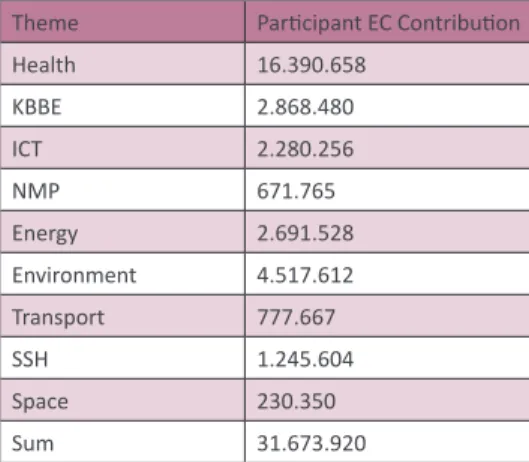
Which research theme do the Indians prefer?
Type of participants
IDEAs
PEoPLEEc contribution
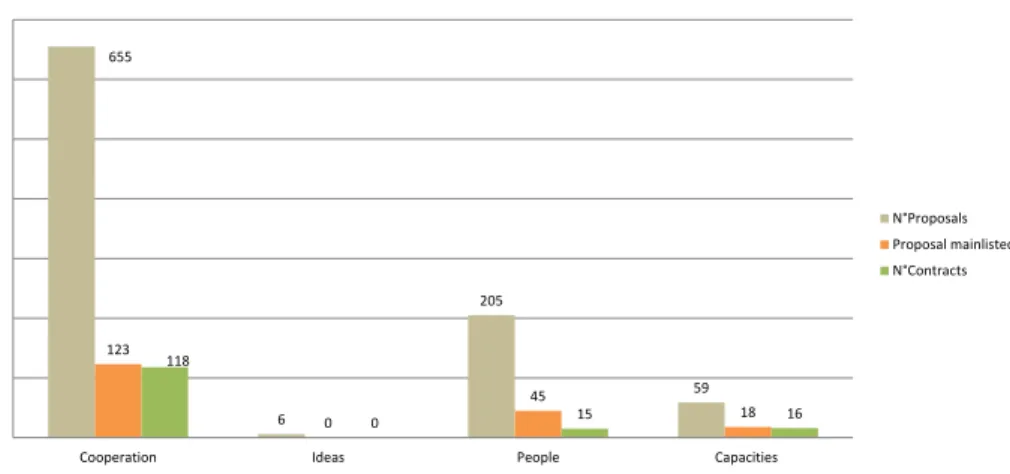
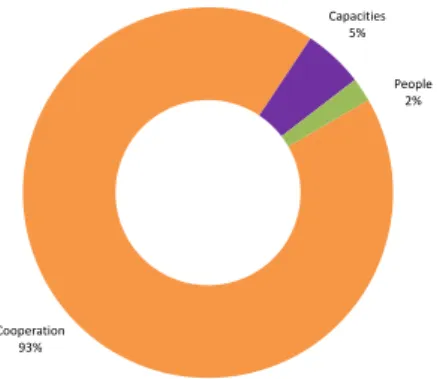
The most important proposals involving at least one Indian partner are 45 (including 55 Indian organizations), the 25% of the total proposals submitted, while the rejected proposals are the 71% of the total.
Ec contribution
CAPACITIES
In terms of contracts signed, the largest number of funded proposals (involving at least one Indian partner) also concerns the International Incoming Fellowships-IIFR. The highest number of proposals involving at least one Indian partner were contracted under the themes of Science in Society (7) and Research Infrastructure.
European industrial presence in India
On the economic front, ties have expanded and India and the EU have worked closely together to strengthen the multilateral trading system and pursue constructive dialogue on trade, investment and economic cooperation. It brings together a large and growing market of over one billion people with a growth rate of between 8 and 10% – one of the fastest growing economies in the world.
Eu-India trade and investment
As the largest democracies in the world, India and the EU share common values and beliefs that make them natural partners and factors of stability in the current world order. India and the EU share a belief in the fundamental importance of multilateralism under the UN Charter and the essential role of the UN in maintaining international peace and security, promoting economic and social progress for all people, and addressing global threats and challenges. .
European Business Group India (EBGI)
EBGI was launched in September 1997 at the initiative of European businessmen with the support of the Delegation of the European Commission to India. It is the representative body of European business interests in India and aims to provide a cornerstone for European companies to assist them in all aspects of growing their business in India.
The Eu-India FTA
Searching for new markets is the main criterion of 83 percent of companies for moving to India and sourcing is another important issue for 67 percent of companies. The licensing model is used by 13% of companies and the same percentage of companies use the franchise mode.
Problems Faced
Best practices
The domestic market opportunity
The off shoring opportunity
Obstacles for cooperation between European and Indian organisations in Science & technology
The European researchers highly appreciate the Indian partners' capabilities to deal with the technical aspects of the project and their compliance with the Consortium Agreement. They are also satisfied with the results achieved and the time the partners spend on the project.
Some European researchers believe that there are as many barriers to innovation in the EU than in India. In addition to the proposed areas, both sides stated that there are other areas that could be considered essential obstacles.
Additional obstacles presented by Indian participants
Additional obstacles presented by European participants
Business culture in Research & Innovation environment: Europe and India face-to-face
Working with people who come from a different culture is very challenging and knowing the differences that exist in the work environment and culture in general could be strategic to avoid insurmountable mistakes. While the southern EU countries are culturally more similar to India, the northern EU countries are more individualistic and formal.
EU-INDIA COOP initiatives: the Internet window and the info days
The EU-INDIA COOP is an initiative that builds on the positive experience of cooperation between European and Indian stakeholders developed in 2009 for the organization of the first EU-India S&T Cooperation Days in New Delhi. Thirteen projects active in EU-INDIA cooperation, including INDIA GATE, have so far been included in this initiative.
Eu - INDIA s&T cooP DAys 2009
Participants: 200 researchers from Europe and India had the opportunity to network, share experiences, establish a new partnership, attend FP7 training and a round table on common priorities. Ӱ International cooperation - coordinating scientific and political needs (the political context presented and the development of cooperation methods presented to the audience) Organizers: EUINEC, New INDIGO and INDIA GATE.
Eu - INDIA s&T cooP DAys 2011
Participants: 150 scientists, policymakers and private sector representatives from Europe and India to discuss the future of scientific technology and innovation. Services offered by supporting activities for EU-India cooperation (presented the services of five projects and initiatives committed to promoting and facilitating STI cooperation between the EU and India).
Eu - INDIA s&T cooP DAys 2012
Ӱ Keynote speeches: the future of EU-India STI cooperation (proposed the EU India STI cooperation as "a strategic partnership driven by principles of symmetry, parity and reciprocity the Indo-European partnership in research and innovation and the view of the European Commission on the recent developments in the EU's International Cooperation Policy in Research and Innovation). Ӱ Scientific conference and poster session (presentations of various scientific cooperation projects between Europe and India. Young scientists were also invited to present their research work as posters which would provide a better enabling integration of young scientists in EU-India cooperation).
List of Key institutions’ websites
European commission - DG Research - International cooperation
Participant Portal
ERA-NET
Ideal-IsT
Council of Scientific and Industrial Research (CSIR)
Department of Atomic Energy (DAE)
Department of Biotechnology (DBT)
Department of space (Dos)
Department of Telecommunication (DoT)
Department of science and Technology (DsT)
Department of Scientific and Industrial Research (DSIR)
Indian council of Agricultural Research (IcAR)
Indian council of medical Research (IcmR)