USO DE LAS TIC Y LOS PROYECTOS DE BUENAS PRÁCTICAS ERASMUS+
USE OF ICT AND ERASMUS+ GOOD PRACTICE PROJECTS
María Goretti Alonso de Castro
Education inspector in Madrid. Professor of Electronic Systems.
https://orcid.org/my-orcid?orcid=0000-0003-4745-9364
Francisco José García Peñalvo
University Professor of the Department of Computer Science and Automation at the University of Salamanca. (USAL). https://orcid.org/0000- 0001-9987-5584
Resumen
La sociedad actual se enfrenta a cambios constantes que requieren una adaptación continua, lo que tiene un impacto directo en la educación. Para preparar a las personas para el mercado laboral es fundamental la formación continua, el aprendizaje electrónico o eLearning y el uso de las TIC. En este sentido, se llevan a cabo numerosos proyectos educativos, como los proyectos internacionales del programa Erasmus+. Estos proyectos permiten abordar necesidades comunes con instituciones educativas de diferentes países, obteniendo resultados valiosos que pueden inspirar y transferirse a
otras instituciones similares. Los proyectos exitosos están disponibles en la Plataforma de Resultados de los Proyectos Erasmus+, algunos de ellos identificados como buenas prácticas que pueden servir como referencias.
No obstante, es importante tener en cuenta que se deben adaptar a los sujetos y contextos en los que se aplicarán. En este artículo se reflexionará sobre estos aspectos y se presentarán algunos ejemplos de proyectos exitosos y de qué modo la inspección educativa puede contribuir en el éxito de iniciativas similares en los centros educativos con los que trabaja.
Palabras clave: 5802 Organización y Planificación de la Educación, 3304 Tecnología de Los Ordenadores, Proyectos Europeos, buenas prácticas.
Abstract
Today's society faces constant changes that require continuous adaptation, which directly impacts education. To prepare people for the labor market, continuous training, electronic learning or eLearning, and the use of ICT are essential. In this sense, numerous educational projects are carried out, such as the international projects of the Erasmus+ Programme.
These projects make it possible to address everyday needs with educational institutions from different countries, obtaining valuable results that can inspire and be transferred to other similar institutions. Successful projects are available on the Erasmus+ Project Results Platform, some identified as good practices that can serve as references. However, it is essential to remember that they must be adapted to the subjects and contexts in which they will be applied. This article will reflect on these aspects and present examples of successful projects and how educational inspection can contribute to the number of similar initiatives in educational centers with their work.
Keywords: 5802 Educational Organization and Planning, 3304 Computer Technology, European projects, good practices.
INTRODUCTION
The education system must respond to social needs and must offer the resources that make it possible to train competent citizens. The Administration, foundations, universities and educational institutions, with the capacity to take on the challenge of training and providing educational resources, have a key role to play in meeting these needs and achieving the challenge of ensuring that no one is left out of the system (Fundación Telefónica, 2022a; García-Peñalvo, 2022).
In the wake of the situation experienced with COVID-19, deficiencies were detected in the system that have given rise to hard work for digital transformation with multiple proposals for digital strategies to be applied in educational institutions (García-Peñalvo, 2021).
Spain has one of the best levels of connectivity in the European Union (EU), being one of the three countries with the best connectivity; however, it has been observed that the level of resource utilization is not in line with the available connection and network infrastructure. Similarly, advanced technologies such as artificial intelligence or data mining are not well developed. When analyzing the educational centers, although most of them already have adequate levels of connection, there are significant differences between urban and rural areas, and there are prominent gaps in the digital competence of teachers in order to design and implement classroom projects, as well as a great need for digital educational resources (Fundación Telefónica, 2022b).
Information and Communication Technologies (ICT) have been implemented in the daily activity of people with operations that involve the use of specific applications, examples of which are: banking transactions,
electronic administration in public administration, online shopping. This fact makes it necessary to invest in the training of people so that they can participate effectively and efficiently in an increasingly digital world. In this regard, the report Trends Shaping Education 2022 (OECD, 2022a) of the OECD, shows how these rapid changes in the technological field are not always in line with the pressing social needs of a large part of the population who, in spite of greater connectivity, present situations of loneliness, especially in those cases where they do not have sufficient capacity to follow these trends. One way to help meet the challenges arising from society is through education, by preparing people to respond to new social challenges in a more secure way.
The Center for Research and Innovation (CERI) focuses on analyzing teaching and learning processes in diverse environments to meet the educational needs of the 21st century, which demand not only quantity but also quality in learning. In its research, CERI considers how to measure results, the impact of ICT in education and its effectiveness, the usefulness of educational reforms, among other aspects. In addition, it is important to take into account the rise of artificial intelligence and robotics and to look for references to adapt to this constantly changing environment (García- Peñalvo, 2023; OECD, 2021a).
In this sense, the response of the educational system to social demands makes it essential to equip both teachers and institutions with tools that enable them to carry out enriching projects with guarantees of success. One way to improve the preparation of teachers and organizations is to have examples of good practices and methodologies that are known to have worked, so that they can be taken as a reference and inspire teaching practices with certain guarantees of success. (García-Peñalvo & de la Pietra,
2022; Grupo de Trabajo de Directores TI - CRUE-TIC, 2017; Hilbert et al., 2020).
On the other hand, aware of these needs, the European Union (EU) provides resources to carry out educational projects with the use of ICTs to promote digital transformation. In this field, the Erasmus+ program subsidizes projects of this type, including among its priorities the inclusion of ICT in education, among others. It also has a database called Erasmus+ Project Results Platform (https://bit.ly/3n3MGyJ), in which all the projects, both from the previous program 2014-2020 and the current 2021-2027, can be consulted, reproduced, and transferred to the educational centers. A very interesting aspect is that the projects are labeled as good practice, successful experience and other recognitions (European Commission, 2022a), aspect that also helps to select projects that are considered to have greater impact or relevance by the national agencies coordinating the grants.
Therefore, given the wealth of information that can be extracted from these projects, it is essential to disseminate the results obtained so that they can be used as a reference point and contribute to improving educational processes (López Fuentes, 2011).
In short, clearly, teachers and trainers need to have the resources and adequate training to be able to create and implement educational projects that really improve the skills of the people they are addressing.
In this area, educational inspection plays an essential role in the process of training and implementation of projects in schools, helping to improve the quality of teaching and learning through advice, supervision and active collaboration (Campos Barrionuevo, 2017; Domínguez Guerra, 2022; Pérez Jiménez & García Ballesteros, 2022; Silva García, 2013; Torres Vizcaya, 2019).
For this reason, this article presents, firstly, the importance of taking into account good practices and the efficient use of ICT, and then presents the main findings of a study, conducted by the authors, which starts from these pillars and aims to propose a methodology for the design of projects that make efficient use of resources, based on successful examples of Erasmus+
projects that have been catalogued as good practices. It assesses how the understanding of these initiatives by the educational inspectorate can contribute to the success of educational projects in schools, within its area of influence. The article will end with the conclusions.
GOOD PRACTICE AS INSPIRATION
The use of good practices was originally a tool in the field of economics, but since the mid-1990s it has been extended to other sectors, including education and social policies. Several notable programs stand out, such as the program developed by the United Nations at the 1996 Cities Summit in Istanbul, which addresses good practices for improving the quality of life in cities, urban design, and sustainability (https://bit.ly/41UhaTd). In addition, UNESCO created a program called Educación para todos (“Education for all”) whose objective was focused on collecting examples of good practices focused on improving children's education as a starting point to achieve a future educational impact (Haggis et al., 1991; UNESCO, 2002, 2012a, 2012b).
To understand what constitutes a good practice, it is useful to start with its definition: an innovative experience that succeeds in solving a problem and, at the same time, improves the process (Jerí Rodríguez, 2008).
Moreover, it is important to know the characteristics of a good practice.
According to UNESCO's Management of Social Transformations (MOST)
Program (https://bit.ly/3ZgcdTU), there are four key attributes (https://bit.ly/3GgPG0N):
• Innovation: ability to offer new solutions to everyday problems or situations.
• Effectiveness: measurable, tangible, and positive impact.
• Sustainability: ability to be maintained over time and generate short, medium and long term effects.
• Replicability: possibility of serving as a model for new initiatives, projects, or actions and of being transferred to other contexts.
However, a good practice cannot be considered as something objective or static, since it depends to a large extent on the individuals and contexts in which it is to be implemented. Therefore, a detailed analysis is required to determine the extent to which the chosen good practice can be adapted to the setting in which it is to be transferred (Escudero Muñoz, 2009).
Within the scope of Erasmus+ projects, the national agencies —which act as coordinating institutions— are in charge of selecting those projects that are considered as good practices and/or successful experiences. For this purpose, they are based on the evaluation of interim and final reports carried out by external experts, considering previously established criteria, as well as their relationship with the priorities of the program in each call. It is important to emphasize that the usefulness of these practices is based on their ability to adapt to the needs and circumstances of the environment in which they are to be applied, either to initiate new projects or activities, or to use the results obtained.
In the new edition of the Erasmus+ program (2021-2027), two new distinctions have been incorporated: “European Language Label” and
“European Innovative Teaching Award”, which focus on specific areas related to language learning and good teaching practices.
EFFECTIVE USE OF ICT
The use of technologies has become increasingly indispensable in people's daily lives and the pandemic has spurred a considerable increase in their use in various fields, including education. Previously, education was primarily face-to-face, but during the confinement it had to be adapted to a remote format. This temporary change has had a major impact on the creation of digital environments that have endured, combining both face-to- face and online activities (Ccoa Mamani & Alvites Huamaní, 2021). Initially, it was a matter of survival, although little by little the use of digital tools in education is being improved.
To achieve an effective implementation of ICT in education, it is essential that both the educational administration and the institutions provide the entire educational community with a wide variety of digital educational resources. These resources should be used to design learning programs that are useful and diversified, capable of meeting the needs of each environment (Gértrudix et al., 2007). It is not enough to have access to a bank of resources, but it is also necessary to be able to design a plan to make appropriate use of them in classroom programming, thus ensuring adapted and diverse learning that meets the individual needs of each student.
1.1 TRAINING FOR AN EFFICIENT USE OF TOOLS
In light of the COVID-19 pandemic (Daniel, 2020; García-Peñalvo & Corell, 2020), has evidenced the importance of training teachers in the use of ICT to foster innovative teaching practices. This was also detected in the data collected in the latest 2018 edition of the TALIS study (OECD, 2020, 2021b, 2022b), which, while obtained before the COVID-19 crisis, remains relevant regarding ICT training in education. Below are some highlights from this study:
• The way in which teachers use ICT in their daily practice is influenced by various conditions of the institutions in which they work and the level of the educational system, as well as by their previous training in relation to the use of digital tools.
• Although teachers and school staff have emphasized the importance of ICT and digital technology training to improve teaching, merely providing more formal training does not guarantee desirable results. It is necessary for training to be effective and up- to-date so that teachers feel prepared to integrate and confidently apply ICT in their teaching practice and have an interest in keeping up to date in their pedagogical knowledge.
• Generally, students from disadvantaged backgrounds have fewer digital learning opportunities compared to those from more advantaged contexts, both at home and at school. One of the reasons behind this is the unequal distribution of teachers, who do not always possess the necessary characteristics to foster greater equity. Specifically, teachers are required to have digital skills and adequate training in teaching with ICTs to ensure equitable education for all.
Besides the above, teachers have expressed their interest in training in novel areas such as education for students with special needs, teaching in multicultural contexts and the use of ICTs in teaching. However, there are obstacles to be overcome, such as the lack of correspondence between what is required and what is provided in training programs, the incompatibility of work schedules with certain training activities, or the absence of support (OECD, 2019).
1.1 TEACHING AND INSTITUTIONAL DIGITALIZATION PLAN
Teacher training is essential to promote quality education in any area, especially in the use of ICT. To address this issue, the European Commission is promoting the Digital Education Action Plan and providing funding to member countries to provide resources and know-how to their teaching staff (European Commission, 2022a), recognizing the importance of teacher training in the use of ICT to improve education in Europe (European Commission, 2022b).
The Ministry of Education and Vocational Training has established the Framework of Reference for Digital Teaching Competence (Ministerio de Educación y Formación profesional, 2022), which includes a system of certification, accreditation and recognition of this skill (BOE, 2022b, 2022a).
This approach is in line with the importance of teacher training in the use of digital technologies and their application in teaching.
The promotion of teacher digitalization requires a clear institutional strategy. Within the framework of the Plan for Digitalization and Digital Competences of the Educational System (Plan #DigEdu) (INTEF, 2022), all Spanish educational centers have developed activities, training programs and institutional educational projects during the 2022-2023 academic year,
with the aim of promoting teamwork and an action consistent with the mission and objectives of each center. This plan has started in the academic year 2022-2023 and focuses on the professionalization of teachers in digital competences, as well as on the improvement of infrastructures and digital equipment in educational centers.
CONTRIBUTION OF ERASMUS+ GOOD PRACTICE PROJECTS TO THE USE OF ICT IN CENTERS
Participation in Erasmus+ projects has been an opportunity for many schools across Europe to improve their teaching practice and encourage innovation in their methodologies. Particularly, these projects have contributed to the introduction and use of ICT in the classroom, facilitating learning and collaboration between teachers and students. This is demonstrated in a study conducted on the results of a group of projects, catalogued as good practice, available in the PRPE+ (Alonso de Castro, 2020;
Alonso de Castro & García-Peñalvo, 2020, 2022b).
1.2 1.2 ERASMUS+ (PRPE+) PROJECT RESULTS PLATFORM
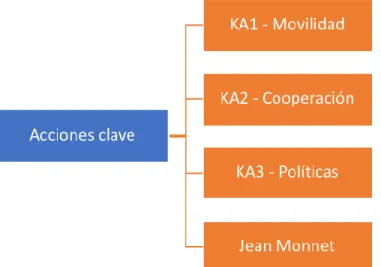
The indicated study is the basis of a doctoral thesis and focuses on the first edition of the Erasmus+ program (2014-2020) (https://bit.ly/3XcDXat), which is structured in five key actions, each targeting specific activities that are closely related to educational activity, in which educational inspection plays a prominent role:
- Key Action 1 aims to promote learning mobility activities, such as exchanges of students, teachers, and educational staff. This key action fosters cultural enrichment and the development of intercultural skills
among participants. It also contributes to the internationalization of education and the acquisition of key competencies by students.
- Key action 2 seeks to foster cooperation between organizations in the field of education, such as strategic partnerships, capacity building projects and knowledge alliances. It encourages collaboration, exchange of best practices and innovation in the field of education.
- Key action 3 is designed to fund actions to support education policy reforms promoted at the European level, such as comparative studies, policy analysis and policy dialogues. They seek to improve quality and equity in education systems across Europe.
- Jean Monnet key action, oriented to types of activities such as modules, chairs, projects and networks oriented to the understanding and promotion of the European Union and its policies.
- Key action for sport, which goes beyond the educational field and focuses on the promotion of social values through sport.
The new edition (2021-2027) has some changes, for example, the key action for sport is integrated into key actions 1 and 2. (https://bit.ly/3vCXcya) (Figura 1).
Figure 1. Key actions in Erasmus+ 2021-2027. Source: own elaboration
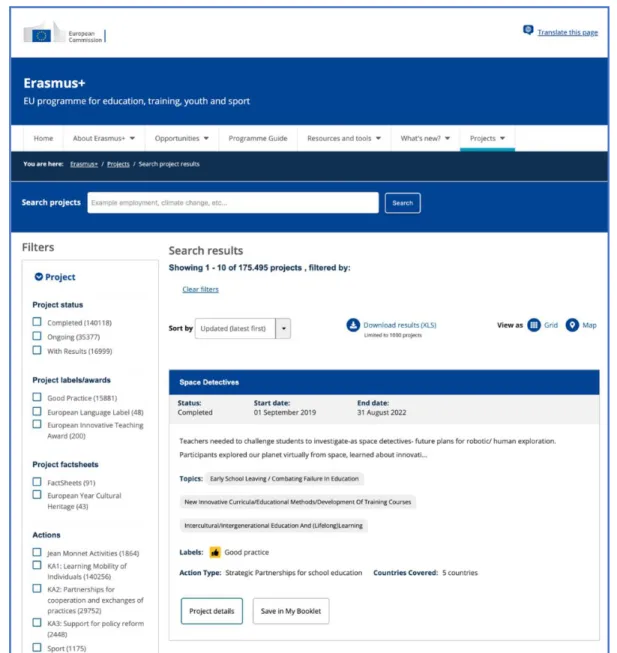
The projects developed under the Erasmus+ framework are documented in the Erasmus+ Projects Results Database (https://bit.ly/3H6qJUT), which is a platform providing information about the projects funded within the program and allowing access to their outcomes and assessments. In the case of key action 2 projects, dedicated to cooperation projects, the results must be uploaded to the platform as a mandatory requirement.
The platform has a search engine that enables users to locate projects using keywords, action, call year, status, country, theme, and type of results, among other criteria (Figure 2). Anyone can search for projects in their area of interest to find inspiration and make use of the resources generated within them.
Figure 2. Erasmus+ project results platform.
An interesting feature is that projects with a good impact, either in terms of their dissemination capacity or their relevance to educational policy issues, are labeled as “good practice” or “successful experience”. This is a very valuable resource for gathering information that can be used to carry out these projects in the classroom or to create new ones inspired by them. For this reason, research has been carried out on a group of specific projects with the aim of extracting lessons about the good results achieved by some of them.
1.3 EXAMPLES OF SUCCESSFUL PROJECTS
This section presents the projects that passed all the phases of the aforementioned study and that proved to have an impact that has lasted over time; in fact, most of them are implemented in the institutions and are being used today. They are examples that can serve as guidance and inspiration for both schools and the educational inspectorate and that can be adapted for application in other contexts.
The final goal of the research of the projects is to propose a working methodology for new projects, based on lessons learned from the selected projects. Knowing the factors that led these projects to be considered as good practice and, in some cases, as a successful experience is very useful as learning for educational improvement.
It also explores through them the usefulness of technology in achieving the educational objectives pursued, identifying areas in need of further research. For example, it examines how the use of ICTs can be better exploited and the extent to which ICTs contribute to the success of the projects analyzed.
Sector Project Highlighted results School
2017-1-DE03-KA219-035459 - Fun and Curriculum oriented Exercises for:
Information Technology
1) Logbook: linguistic survival guide.
2) Questionnaire available in school languages and in English.
3) Android application with the questionnaire Project website
eTwinning space.
School
(youth) 2016-1-PT02-KA205-003182 - Summer e-CHALLENGE:
Acquiring Soft & Digital Skills Through Non-Formal
Free-time Practices (SeC)
1) SeC e-learning platform.
2) SeC Dissemination Manual.
3) SeC Trainings.
4) Project website.
School Education
2017-1-PT01-KA201-035847 - Education in Mathematics in Game-based Immersive
Contexts
1) App Clash of Wizardry | Manual | The magic of training mathematics in a game (4 languages).
2) Class Tracking Activity.
3) Clash of Wizardry | Trailer.
4) Clash of Wizardry | Tutorial.
5) Android and Apple application Clash of Wizardry | Tutorial.
6) Different usability tests (8).
School
Education 2014-1-BG01-KA201-001435
- Choose Your Future 1) Online course: Online personal portfolio building (5 sections).
School
Education 2015-1-ES01-KA201-016210 - Development of skills through art and emotional
intelligence, to improve learning and situations of
social exclusion.
1) INTEGRATE methodology for the development of skills through art and emotional intelligence, to improve learning and situations of social exclusion.
School
Education 2017-1-ES01-KA219-038105 - take the e+train
1) Online platform with the materials in the eTwinning space.
2) Project website.
3) e+train history materials (video, methodology).
Vocational Education
2014-1-CY01-KA202-000274 - Infusing entrepreneurial skills in the corporate ICT environment - Intraprise
1) Report analyzing the state of the art of management practices and organizational culture in
the ICT sector in partner countries.
2) Report on intrapreneurship training needs in the ICT sector.
3) Theoretical framework of the Intrapreneurship Training program.
4) Learning/training material “INTRAPRISE”.
Higher Education
2016-1-PL01-KA203-026652 - Innovative Education towards Sustainable Food
Systems
1) Guide for innovative education towards sustainable food systems.
2) E-learning module 'Sustainable Diets and Food Systems
3) Intensive Curriculum 'Sustainable Diets and Food Systems'.
4) Educational materials for the Intensive Study Program 'Sustainable Diets and Food Systems'.
5) Program of Small Research Projects
6) Analysis of students' understanding of the 'Sustainable Food System' and expectations towards education within this subject area.
Higher
Education 2014-1-RO01-KA203-002940 - Massive open online courses with videos for palliative clinical field and
intercultural and multilingual medical
communication
1) Baseline research on palliative care procedures in the country.
2) National research on palliative medicine procedures in Romania, Belgium, Italy, and Spain.
3) Comprehensive interdisciplinary MOOC offering 20 fundamental palliative medicine procedures.
Adult Education
2017-1-EL01-KA204-036189 - Developing Skills in Dealing with Emergencies:
Civil protection for people
1) Compendium.
2) Greek and Italian survival guide for schools.
3) Report of the 1st questionnaire.
4) 2nd investigation for Civil Protection 5) Agreement for the continuation and extension of
cooperation. Creating a citizens' network for civil protection
6) The CPP project at the 12th annual International Conference in Seville.
7) About 112-3rd Aegaleo gymnasium – video.
8) European civil protection organizations.
9) Scenario of an earthquake simulation.
Vocational Education
2016-1-DE02-KA202-003273 - Fit for E-Commerce
1) E-commerce friendly - E-book in PDF format IO 1, 2 & 3.
2) E-book chapters:
- Creating an online store.
- Facilitating online marketing.
- Internet Programming Basics.
3) Manual.
Vocational
Education 2014-1-ES01-KA202-004368 - Training on Safety
Assessment and Management for New and
Innovative Children’s Products
1) SAMNIC presentation video.
2) SAMNIC project brochure in English, Spanish, Czech, Spanish.
3) MOOC - SAMNIC project website.
Vocational Education
2017-1-ES01-KA202-038232 - E-commerce of safe
children's products: a common view for SMEs, consumers, and authorities
1) e-COM 4 CHILDREN INTERACTIVE COMIC (EN, ES, CS, IT, PT).
2) e-COM 4 CHILDREN adaptive MOOC (EN, ES, CS, IT, PT).
3) e-COM 4 CHILDREN Training Materials (EN, ES, CS, IT, PT).
4) e-COM 4 CHILDREN INTERACTIVE COMIC VIEWS.
5) e-COM 4 CHILDREN ADAPTIVE MOOC BASIC USER'S GUIDE.
6) e-COM 4 KIDS video presentation 7) e-COM 4 CHILDREN project website 8) e-COM 4 CHILDREN project brochure in English,
Spanish and Italian.
9) e-COM 4 CHILDREN project website.
Table 1. Projects that have been involved in all phases of the research and have proven to be successful.
1.4 USE OF ICT IN ERASMUS+ PROJECTS
In the aforementioned study, significant aspects have been observed in relation to the use of ICT in educational projects, from the point of view of teachers, students and also in how useful the resources generated by the projects were during the pandemic. Specifically, in this last aspect, in the analysis carried out on the ICT tools highlighted and their usefulness during the pandemic (Alonso de Castro & García-Peñalvo, 2021b), in relation to e- learning (eLearning, ICT), one of the most relevant elements of the projects analyzed was the increase in the digital didactic resources available for the teaching and learning process (digital educational tool packages, interactive educational video games, robotics, digital methodological guides, curricular designs in the implementation of ICT, etc.).
In relation to the analysis carried out regarding ICT methodologies for teacher professional development in Erasmus+ projects related to eLearning (Alonso de Castro & García-Peñalvo, 2021a) it was noted that:
• Regarding the ICT tools used by teachers, the most frequent are those related to office automation management, basic skills and presentations, as well as collaboration platforms. Video and photo editing, the use of network resources and the digital learning environment also stand out.
• As for ICT devices, both laptops and desktops are the most commonly used, and depending on the educational environment, tablets and smartphones are also very common.
In the field of ICT and students, the methodologies most commonly used in the projects (Alonso de Castro & García-Peñalvo, 2021c) are characterized by the following points:
• Regarding the ICT tools used by students, those related to office automation, basic skills, as well as the use of network resources and platforms for collaboration and other tools related to digital educational games predominate.
• As for ICT devices, both laptops and desktops stand out, and according to sectors, smartphones and tablets are also widely used.
All the projects analyzed show that the use of ICTs is complementary to the objectives of the projects, and few of them use technology with advanced applications and functions.
In general, the applications used are tools with basic functionalities that make it possible to replace what was traditionally done on paper with a digital format. There is no in-depth study of data analysis techniques, computational thinking, robotics, or artificial intelligence, for example. This result coincides with the data collected in the International Computer and Information Literacy Study (ICILS), which also highlights a very superficial use of applications by teachers and students (Fraillon et al., 2014, 2020),
Finally, it should be noted that the study has detected some results that are key to the success of projects, such as the following:
• Focus on the real needs of the actors of the educational system to which they are addressed (students, teachers, management teams, families, inspection, Administration, etc.).
• Address innovative or novel aspects for the institutions and people for whom they are intended and for whom improvements are necessary.
• An adequate and efficient use of resources, with a good use of ICT.
• Test and implement the products or tools developed in the institutions for daily work.
1.5 PROJECT DESIGN METHODOLOGY
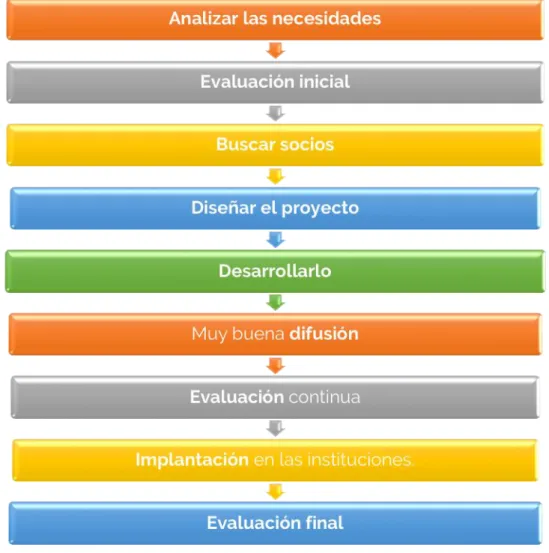
As previously indicated the goal of the study is to propose a project design methodology to ensure success and impact for the people and institutions targeted. The key areas are (Figure 3):
• Analyze the needs to be covered in the institutions.
• Initial evaluation to know the starting situation.
• Search for partners or people with common interests and needs.
• Design the project with milestones, objectives, activities, people in charge, etc.
• Develop it as planned, adapting it when required.
• To carry out very good dissemination throughout the whole process.
• Continuous evaluation in order to be able to adjust the processes throughout its development.
• Implementation of the projects in the daily work of the institutions.
• Final evaluation.
Figure 3. Phases for an efficient methodology in the development and implementation of projects. Own elaboration.
The detailed description of the methodological proposal (Alonso de Castro & García-Peñalvo, 2020, 2022a) will be available for consultation once the thesis is published, including an exhaustive analysis of the results. In addition, the main guidelines can be reviewed on a website created as a product of the thesis (https://bit.ly/3Etz0T3).
THE ROLE OF THE EDUCATION INSPECTORATE IN THE DEVELOPMENT OF PROJECTS IN CENTERS
Educational inspection plays a fundamental role in the process of formation and implementation of projects in educational centers. Its function goes beyond supervision; it also involves advice and support to improve teaching-learning processes. Some aspects related to the role of educational inspection in this context are highlighted below (Campos Barrionuevo, 2017;
Domínguez Guerra, 2022; Pérez Jiménez & García Ballesteros, 2022; Silva García, 2013; Torres Vizcaya, 2019):
• Advice and guidance to teachers and school management teams, as well as all other members of the school community. It helps to identify areas for improvement, suggest effective pedagogical strategies and provide resources to facilitate the implementation of educational projects.
• Supervision and evaluation of the projects implemented in schools. This involves analyzing their development, identifying possible challenges, and evaluating the impact of the initiatives on the teaching-learning process.
• Identification of the specific needs of each educational center in terms of resources, teacher training, infrastructure, etc. This allows for an adequate allocation of resources to meet those needs.
• Alignment with educational policies at the local, regional or national level. This ensures that efforts are directed toward the objectives and goals established in the educational framework embodied in the corresponding legislation.
• Encouragement of collaboration and teamwork among the different educational actors, including teachers, principals, families
and students, as well as other institutions related to the schools.
This facilitates the effective implementation of educational projects and maximizes their impact.
• Constructive feedback to teachers and management teams on the development and implementation of projects. This feedback helps to improve educational strategies and optimize results.
In the field of the use of ICT in education there are some key aspects that the educational inspectorate must consider (Cornax Castillo et al., 2013; Romero-García, 2018):
• ICT curriculum integration: assess how ICTs are integrated into the curriculum and how they align with educational objectives and learning goals. Verify if they are used to improve pedagogy and if they are adapted to students' needs and learning styles.
• Access and equity: analyze access to ICTs in educational institutions and ensure that all students have equal opportunities to use them. Assess whether strategies are being implemented to address the digital divide and ensure that students of all socioeconomic levels have access to technology.
• Training and professional development: review training and professional development programs for teachers in the effective use of ICTs. Verify whether teachers receive adequate support to integrate ICTs in a meaningful way into their pedagogical practices.
• Security and data protection: ensure that adequate security measures are being implemented to protect the privacy and security of student data. Evaluate policies and practices related to the safe and ethical use of technology by students and educational staff.
• Innovation and adaptability: encourage the adoption of innovative and creative approaches to the use of ICT to enhance teaching and learning. Assess how educational institutions are adapting to emerging technology trends and taking advantage of the opportunities they offer.
In order for the educational inspectorate to effectively fulfill these functions, it is crucial that they have a solid background and are familiar with the variety of educational programs, tools and educational innovations that are successfully implemented in different institutions and that can be implemented in schools. It is essential to understand how these programs can positively influence the improvement of teaching processes. (Ozkoidi Pérez & Albeniz Bratos, 2014; Tébar Cuesta, 2019).
In short, the education inspectorate plays an essential role in the process of training and implementation of ICT and educational projects in schools, contributing to improve the quality of teaching and learning through advice, supervision, and active collaboration. Therefore, it is highly beneficial for the educational inspectorate to have a deep knowledge about various methodologies, including those integrated in Erasmus+ projects. This implies a full understanding of how these methodologies can positively influence schools.
CONCLUSIONS
This article examines how technological advancements have profoundly transformed society and opened up a wide range of opportunities and challenges in all areas of life, including education. It is essential to continue advancing the use of ICT (Information and Communication Technologies) in the educational field to enhance the quality of teaching and prepare students for an increasingly digital world.
Furthermore, it analyzes how to fully harness the opportunities that ICT offers in education; it is crucial for educators to receive proper training and stay updated on the latest trends and technological tools. Continuous professional development should be a priority to ensure that educators have the necessary skills to effectively integrate ICT into their educational practices.
Likewise, it is indicated that the proper use of ICT in education can significantly contribute to improving the quality of teaching and learning, fostering student participation and collaboration, and preparing them for the workforce. However, it is important to consider that the use of ICT should not be an end in itself but rather a means to achieve specific pedagogical and educational objectives.
Furthermore, it delves into how Erasmus+ projects can play a pivotal role in promoting the effective use of ICT in education by enabling the exchange of best practices and collaboration among teachers and educational institutions from different countries. These projects can inspire and motivate educators to use ICT more effectively in their teaching practices, thus contributing to enhancing the quality of education.
In this regard, it is explained how certain examples of Erasmus+ projects that have been recognized as best practices in the use of ICT in education can serve as inspiration and references for other educators and educational institutions. These projects demonstrate how creative and effective use of ICT can enhance the quality of teaching and learning, providing students with the necessary skills and competencies for the digital world.
Finally, educational inspection must play a crucial role in promoting the effective use of ICT in education, as well as European educational programs, with Erasmus+ being a notable example. It is essential for inspectors to be trained and updated on the latest technological trends and tools, as well as on the educational projects that employ them, in order to assess and guide educational institutions effectively in this area. Inspection should encourage and acknowledge best practices in ICT use, the development of innovative projects, and assist educational institutions in improving their practices in this regard.
REFERENCES
• Alonso de Castro, M. G. (2020). Methodological guide for the successful use of digital technologies in education to improve learning through European educational projects. http://hdl.handle.net/10366/143565
• Alonso de Castro, M. G., & García-Peñalvo, F. J. (2020). Methodological guide for the successful use of digital technologies in education:
Improvement of learning through European educational projects. Eighth International Conference on Technological Ecosystems for Enhancing Multiculturality, 962-968. https://doi.org/10.1145/3434780.3436549
• Alonso de Castro, M. G., & García-Peñalvo, F. J. (2021a). ICT methodologies for teacher professional development in Erasmus+
projects related to eLearning. Proceedings XI JICV 2021. XI International Conference on Virtual Campus (Salamanca, Spain, September 30th – October 1st, 2021). http://hdl.handle.net/10366/148357
• Alonso de Castro, M. G., & García-Peñalvo, F. J. (2021b). ICT tools highlighted and their usefulness during the pandemic: Erasmus+ projects related to eLearning. Ninth International Conference on Technological Ecosystems for Enhancing Multiculturality (TEEM’21), 219-224.
https://doi.org/10.1145/3486011.3486450
• Alonso de Castro, M. G., & García-Peñalvo, F. J. (2021c). Most used ICT methodologies for student learning in Erasmus+ projects related to eLearning. Proceedings of the 2021 International Symposium on Computers in Education (SIIE) (23-24 September 2021, Málaga, Spain), A. Balderas, A. J.
Mendes and J. M. Dodero, Eds., USA: IEEE, 2021.
https://doi.org/10.1109/SIIE53363.2021.9583661
• Alonso de Castro, M. G., & García-Peñalvo, F. J. (2022a). Metodologías educativas de éxito: Proyectos Erasmus+ relacionados con e-learning o TIC. Campus Virtuales, 11(1), 95. https://doi.org/10.54988/cv.2022.1.1022
• Alonso de Castro, M. G., & García-Peñalvo, F. J. (2022b). Successful educational methodologies: Erasmus+ projects related to eLearning or ICT. Campus Virtuales, 11(1), 95. https://doi.org/10.54988/cv.2022.1.1022
• BOE. (2022a). Resolución de 1 de julio de 2022, de la Dirección General de Evaluación y Cooperación Territorial, por la que se publica el Acuerdo de la Conferencia Sectorial de Educación sobre la certificación, acreditación y reconocimiento de la competencia digital docente.
https://www.boe.es/diario_boe/txt.php?id=BOE-A-2022-11574
• BOE. (2022b). Resolución de 4 de mayo de 2022, de la Dirección General de Evaluación y Cooperación Territorial, por la que se publica el Acuerdo de la Conferencia Sectorial de Educación, sobre la actualización del marco de referencia de la competencia digital docente.
https://www.boe.es/eli/es/res/2022/05/04/(5)
• Campos Barrionuevo, B. (2017). Inspección educativa y calidad institucional (1a ed). Universitas.
• Ccoa Mamani, F. de M., & Alvites Huamaní, C. G. (2021). Herramientas Digitales para Entornos Educativos Virtuales. LEX - REVISTA DE LA FACULTAD DE DERECHO Y CIENCIAS POLÍTICAS, 19(27), 315.
https://doi.org/10.21503/lex.v19i27.2265
• Cornax Castillo, J. C., Río Palomino, J. M. del, & Sánchez Alcántara, J. D.
(2013). La supervisión del tratamiento de las TIC en los centros educativos. Avances en supervisión educativa. 2013, n. 19, noviembre ; 13 p.
https://doi.org/10.23824/ase.v0i19.129
• Daniel, S. J. (2020). Education and the COVID-19 pandemic. PROSPECTS, 49(1-2), 91-96. https://doi.org/10.1007/s11125-020-09464-3
• Domínguez Guerra, R. M. (2022). Los ejes principales de la inspección de educación al servicio de la mejora de los centros docentes. Supervisión
21, 53(53), 28.
https://usie.es/supervision21/index.php/Sp21/article/view/400
• Escudero Muñoz, J. M. (2009). Buenas prácticas y programas extraordinarios de atención al alumnado en riesgo de exclusión educativa. Revista de currículum y formación del profesorado, 13(3).
https://www.ugr.es/~recfpro/rev133ART4.pdf
• European Commission. (2022a). Erasmus+ Guía del Programa.
https://erasmus-plus.ec.europa.eu/es/erasmus-programme-guide
• European Commission. (2022b). ¿Qué es el Plan de Acción de Educación Digital? https://education.ec.europa.eu/es/focus-topics/digital- education/action-
plan#:~:text=El%20Plan%20de%20Acci%C3%B3n%20de%20Educaci%C3%B 3n%20Digital%20(2021%2D2027),UE%20a%20la%20era%20digital
• Fraillon, J., Ainley, J. G., Schulz, W., Friedman, T., & Duckworth, D. (2020).
Preparing for life in a digital world: IEA International Computer and Information Literacy Study 2018 International Report. Springer.
http://www.iea.nl
• Fraillon, J., Ainley, J., Schulz, W., Friedman, T., & Gebhardt, E. (2014).
Preparing for life in a digital age: The IEA International Computer and Information Literacy Study International report. Springer Berlin Heidelberg.
http://www.iea.nl
• Fundación Telefónica. (2022a). Libro Blanco de la Transformación Digital
del Tercer Sector. Fundación Telefónica.
https://www.fundaciontelefonica.com/cultura-
digital/publicaciones/libro-blanco-de-la-transformacion-digital-del- tercer-sector/751/#close
• Fundación Telefónica. (2022b). Sociedad Digital en España 2022 (Primera).
Penguin Random House Grupo Editorial.
https://publiadmin.fundaciontelefonica.com/media/publicaciones/760 /Sociedad_Digital_en_Espa%C3%B1a_2022.pdf
• García-Peñalvo, F. J. (2021). Transformación digital en las universidades:
Implicaciones de la pandemia de la COVID-19. Education in the Knowledge Society (EKS), 22, e25465. https://doi.org/10.14201/eks.25465
• García-Peñalvo, F. J. (2022). El sistema universitario ante la COVID-19:
Retrospectiva y prospectiva de la transformación digital. En Transformación digital de las Universidades. Hacia un futuro postpandemia (F. Llorens Largo&R. López-Meseguer (Eds.), Vol. 9, pp.
142-148). Universidad Internacional de La Rioja (UNIR).
http://repositorio.grial.eu/handle/grial/2567
• García-Peñalvo, F. J. (2023). La percepción de la Inteligencia Artificial en contextos educativos tras el lanzamiento de ChatGPT: Disrupción o pánico. Education in the Knowledge Society (EKS), 24, e31279.
https://doi.org/10.14201/eks.31279
• García-Peñalvo, F. J., & Corell, A. (2020). La COVID-19: ¿enzima de la transformación digital de la docencia o reflejo de una crisis metodológica y
competencial en la educación superior? 9.
http://hdl.handle.net/10366/144140
• García-Peñalvo, F. J., & de la Pietra, F. (2022). Cartera estratégica de proyectos: El instrumento institucional para la transformación digital.
Universídad. https://www.universidadsi.es/cartera-estrategica-de- proyectos-el-instrumento-institucional-para-la-transformacion-digital/
• Gértrudix, M., Álvarez, S., Galisteo, A., Gálvez, M. del C., & Gértrudix, F.
(2007). Actions in the design and development of digital educational objects: Institutional programmes. RUSC. Universities and Knowledge Society Journal, 4(1). https://doi.org/10.7238/rusc.v4i1.296
• Grupo de Trabajo de Directores TI - CRUE-TIC. (2017). Transformación Digital de las Universidades. TIC 360o. https://www.crue.org/wp- content/uploads/2020/02/Tendencias_TIC_2017.pdf
• Haggis, S. M., Fordham, P., & Windham, D. M. (Eds.). (1991). World Conference on Education for All. Unesco.
• Hilbert, M., Jalife Villalón, S. L., Rodríguez Armenta, C. E., Ruíz Martínez, P.
M., Llorens, F., Sánchez Osorio, C. C., & Chinkes, E. (2020). Estrategia y transformación digital de las universidades. Un enfoque para el gobierno universitario. Banco Interamericano de Desarrollo y de la Fundación Universia.
https://www.metared.org/content/dam/metared/pdf/Estrategia-y-
transformacion-de-las-univerdades-un-enfoque-para-el-gobierno- universitario.pdf
• INTEF. (2022). Plan de Digitalización y Competencias Digitales del Sistema Educativo (Plan #DigEdu). https://intef.es/Noticias/plan-de- digitalizacion-y-competencias-digitales-del-sistema-educativo-plan- digedu/
• Jerí Rodríguez, D. (2008). Buenas prácticas en el ámbito educativo y su orientación a la gestión del conocimiento. Educación, XVII(33).
https://dialnet.unirioja.es/descarga/articulo/5057024.pdf
• López Fuentes, R. (2011). Innovación docente e investigación educativa:
Máster Universitario de Educación Secundaria Obligatoria y Bachillerato, Formación Profesional y Enseñanza de Idiomas. GEU.
• Ministerio de Educación y Formación profesional. (2022). La competencia digital de los docentes será homologable en todo el país.
https://www.educacionyfp.gob.es/prensa/actualidad/2022/06/202206 23-sectorial.html
• OECD. (2019). How teachers update their teaching skills to cope with the rapidly changing world (Teaching in Focus 28; Teaching in Focus, Vol. 28).
https://doi.org/10.1787/282b9edd-en
• OECD. (2020). Teachers’ training and use of information and communications technology in the face of the COVID-19 crisis (Teaching in Focus 35; Teaching in Focus, Vol. 35). https://doi.org/10.1787/696e0661- en
• OECD. (2021a). AI and the Future of Skills, Volume 1: Capabilities and
Assessments. OECD. https://doi.org/10.1787/5ee71f34-en
• OECD. (2021b). Supporting teachers’ use of ICT in upper secondary classrooms during and after the COVID-19 pandemic (Teaching in Focus 41; Teaching in Focus, Vol. 41). https://doi.org/10.1787/5e5494ac-en
• OECD. (2022a). Trends Shaping Education 2022. OECD.
https://doi.org/10.1787/6ae8771a-en
• OECD. (2022b). What makes students’ access to digital learning more equitable? (Teaching in Focus 43; Teaching in Focus, Vol. 43).
https://doi.org/10.1787/e8107345-en
• Ozkoidi Pérez, J., & Albeniz Bratos, A. (2014). Formación de la inspección educativa: Mirando al futuro. Avances en Supervisión Educativa, 22.
https://doi.org/10.23824/ase.v0i22.50
• Pérez Jiménez, J. María., & García Ballesteros, P. E. (2022). La inspección de educación: Teoría crítica y práctica comprometida. Ministerio de Educación y Formación Profesional, Subdirección General de Atención al Ciudadano, Documentación y Publicaciones.
• Romero-García, M. Á. (2018). Uso de las TIC por la inspección educativa
en Andalucía. EDMETIC, 7(1), 275-296.
https://doi.org/10.21071/edmetic.v7i1.9969
• Silva García, B. P. (2013). El papel de la inspección escolar en la mejora de los resultados educativos. Educar, 49(1), 67.
https://doi.org/10.5565/rev/educar.11
• Tébar Cuesta, F. (2019). La Inspección de Educación mirando al futuro.
Revista de Educación, 384. https://doi.org/10.4438/1988-592X-RE-2019- 384-405
• Torres Vizcaya, M. (2019). La inspección educativa: Una mirada desde la experiencia. Editorial La Muralla, S.A.
• UNESCO (Ed.). (2002). La Educación para todos ¿Va el mundo por el buen
camino?, resumen del informe. Unesco.
https://unesdoc.unesco.org/ark:/48223/pf0000129777_spa
• UNESCO (Ed.). (2012a). Buenas prácticas de educación para el desarrollo
sostenible en la primera infancia. Unesco.
https://unesdoc.unesco.org/ark:/48223/pf0000217413_spa
• UNESCO (Ed.). (2012b). Buenas prácticas de educación para el desarrollo sostenible en materia de cambio climático. Unesco.
https://unesdoc.unesco.org/ark:/48223/pf0000220304_spa