d o c t r i n a
Use of robotic process automation for tax administrations and its impact on human rights
Uso de la automatización robótica de procesos para administraciones tributarias y su impacto en los derechos humanos
Antonio Faúndez-Ugalde and Rafael Mellado-Silva Pontificia Universidad Católica de Valparaíso, Chile
ABSTRACT In recent years, there have been notable advances in robotic process auto- mation (RPA), especially in cases of integration with commercial transactions in elec- tronic markets. Tax administrations have gathered this experience to be at the forefront of the new technological challenges. However, there are dubious regulatory areas re- garding the large amount of data that a tax administration can access through an RPA, whose lack of regulation can violate human rights. This research, precisely, accounts for the problems that can arise from the use of RPA by tax administrations, especially in cases where this type of tool is integrated with artificial intelligence. In this line, the results of this work show that the main difficulties that could arise are related to the transparency of the tax administration acts and possible discriminatory acts in the ap- plication of RPA.
KEYWORDS RPA, robots, tax, tax administrations, human rights.
RESUMEN En los últimos años se han producido avances notables en la automatización de procesos robóticos (RPA, por sus siglas en inglés), especialmente en casos de inte- gración con transacciones comerciales en mercados electrónicos. Las administraciones tributarias han acumulado esta experiencia para estar a la vanguardia, y así asumir los nuevos desafíos de las tecnologías. Sin embargo, existen dudosos ámbitos normativos ante la gran cantidad de datos a los que una administración tributaria puede acceder a través de una RPA, cuya falta de regulación puede transgredir los derechos humanos.
Esta investigación, precisamente, da cuenta de los problemas que pueden surgir del uso de RPA por parte de las administraciones tributarias, especialmente en los casos en los que este tipo de herramienta se integra con inteligencia artificial. En esta línea, los resul- tados de este trabajo muestran que las principales dificultades que podrían surgir están relacionadas con la transparencia de los actos de la administración tributaria y posibles actos discriminatorios en la aplicación de RPA.
PALABRAS CLAVE RPA, robots, fiscalidad, administraciones tributarias, derechos hu- manos.
Introduction
Robotic process automation (RPA), also known as “software robots”, is a set of soft- ware tools and platforms that interact with different information systems, aimed at automating tasks usually done manually. But why call such a solution “robotic” if the automation doesn’t use physical robots? The short answer is that “robotic” descri- bes the underlying process, not the automation; in other words, we are automating a process that is naturally robotic, even if humans perform it with manual labor (KPMG, 2018).
The international trend is to define RPA from the point of view of its purpose:
“replace human tasks in business processes by software (‘bots’) and that this software interacts with front-end systems similarly to human users” (Syed and others, 2020).
The IEEE Corporate Advisory Group (2017) defines RPA as the use of a
preconfigured software instance that uses business rules and predefined activity choreography to complete the autonomous execution of a combination of processes, activities, transactions, and tasks in one or more unrelated software systems to deli- ver a result or service with human exception management.
Studies indicate that RPA is an approach to automating processes within a broad pool of different technologies for process automation, each of which suits different processes and objectives (Willcocks and others, 2015). Thus, these so-called software robots access systems and perform tasks, for the most part, similar to humans or by imitating them (Hofmann and others, 2020; Moffitt and others, 2018; van der Aalst and others, 2018; Lacity and others, 2015).
Through the automation function provided by an RPA, a large amount of data can be processed, especially in integration with commercial transactions verified in electronic markets. In this way, RPA can use AI technologies to provide improved lo- gic, flexibility and adaptability in decision-making in business process environments (vom Brocke and others, 2018). This experience has begun to be considered by some governments as part of the modernization of public administration, where digitiza- tion plays an essential role in providing a better service to citizens. Studies in Ger- many have determined that RPA has considerable potential to improve administra- tive work processes and administrative modernization in general (Houy and others, 2019). However, there is still discussion about whether RPA is the right way to mo- dernize or if it might hinder real progress. And while using RPA can result in quick process execution, it can also make mistakes more quickly (Kirchmer, 2017), and it
can even fall into high-risk algorithmic inaccuracies for the business, for example, in cases where optical character recognition (OCR) techniques are used to extract data from forms through image recognition.
This scope of RPA in the government administration has also aroused interest by some tax administrations, which —as will be seen later— have chosen to intro- duce this type of tool in their strategic development plans as part of their auditing processes for taxpayers. This is the focus of this research, there are ambiguous areas regarding the large amount of data that a tax administration can access through an RPA, especially in cases where the tax audit is integrated with AI. Thus, the regulatory aspect is essential for applying an RPA by the tax administrations, since its absence may lead to the violation of taxpayers’ rights concerning the transparency and possi- ble discriminatory acts in the tax administration application of this type of tool. Due to this problem, the data submitted to an RPA is more susceptible to possible errors which may impact, directly or indirectly, the tax calculation base and the defect of the notified administrative act.
It is important to consider that the existing academic research lacks a theoretical and synoptic analysis of RPA (Hofmann and others, 2020; Syed and others, 2020).
The same criterion can be held about the use of the RPA in the field of tax law. At the international level, the judgment of February 5, 2020, of the District Court of The Hague declared that the algorithm applied by the Dutch Government through the Risk Indication System (SyRI) did not offer sufficient guarantees to consider that this specific system respects the necessary proportionality judgment that must overcome any interference in privacy by the provisions of article 8 of the European Convention on Human Rights. This shows the importance of having a normative regulation ma- naged by the State bodies in the use of new technologies, especially in tax law, where relevant principles, such as the legality and transparency of taxes. The RPA does not escape this requirement.
Because of the above, in the first part of this research all the collected academic background related to RPA will be considered using, mainly, the electronic database of Web of Science, Springer, and conferences on information systems. We will not limit the literature just to RPAs, as we will also examine its relationship with tech- nologies such as big data and AI. Based on this, the second part of the research will study the effects of the use of RPA by tax administrations, gathering the practical experience of the United Kingdom, Singapore, and Finland. The choice of said legis- lation is only due to the information gathered from reports from international orga- nizations that account for the use of RPA by those tax administrations. Subsequently, we will analyze the impacts against internationally recognized human rights genera- ted through the use of RPAs by tax administrations. Finally, it will report on the main conclusions of the study and its contribution to the literature of public international
law and its application to domestic law in each legislation. These methodological approaches will also inform future research on RPA.
Environments in the development of robotic process automation
Several manual operations that companies develop to collect data can now be quic- kly automated. More complex RPAs can integrate AI and machine learning to refine decision-making precision over time (Harrast, 2020). Demand for RPA technologies is rapidly increasing, and it is estimated that up to 90% of large and medium size organizations will opt for RPA solutions by 2020 (Tornbohm and Roy, 2018).1 Other studies estimate that in two years, European companies will double the use of RPA (ISG, 2018).2
The experience is diverse in RPA use, highlighting the field of financial transac- tion processing, information technology (IT) management, and online assistants’
automation. Some companies have used RPA in their back-office processes with bu- siness process outsourcing service providers, presenting productivity improvements by handling 21% more cases compared to a group of workers who did not use RPA (Aguirre and Rodríguez, 2017). In other cases, such as Xchanging —a business pro- cess and technology service provider in the insurance industry— the development of an RPA enabled the structured parts of the process to be executed, including finding errors, retrieving data online, creating the official sales record, and notifying brokers when the process is completed (Lacity and Willcocks, 2016). The same study revealed that before the use of RPA, a team of people used to take several days to complete 500 ads, but today a properly trained robot software that works in conjunct with people can do it in around 30 minutes with an error rate that tends to zero.
In general, the essential characteristics that differetiate an RPA from other auto- mation mechanisms are:
• It corresponds to software and not to a physical-automaton mechanism; that certainly means a license of this type for each robot (Santos and others, 2019).
• It is implemented on existing information systems, being an advantage of this the versatility and economic efficiency that the implementation supposes on other mechanisms that entail restructuring already existing administrative or computer equipment (van der Aalst and others, 2018).
• Along the same lines, they can constitute a low-cost preliminary step to the complete automation of a process that involves reengineering (Santos and others, 2019).
1. Available at https://t.ly/t0U3.
2. Available at https://t.ly/s7QQF.
• It involves a process to automate that must be based on static rules, with few exceptions and —a prior— with no margin for integration with cognitive or analytical capabilities.
• They differ from solutions such as scripts that merely open software and ex- tract information and software that records the actions of a user and then re- plicates them (for example, macros function in Microsoft Excel), in that they allow greater flexibility regarding tasks to be developed and that do not require programming by specialized IT personnel (Härd and Svensson, 2020).
• Due to their conformation, they do not store data in themselves but can use external warehouses such as a data warehouse or integration with database management systems present in the market (Santos and others, 2019).
• Finally, among the different scopes that the commercial providers of these sys- tems offer there is the possibility of integration with tools that generate value for the company, such as process mining software, machine learning, and AI (Santos and others, 2019).
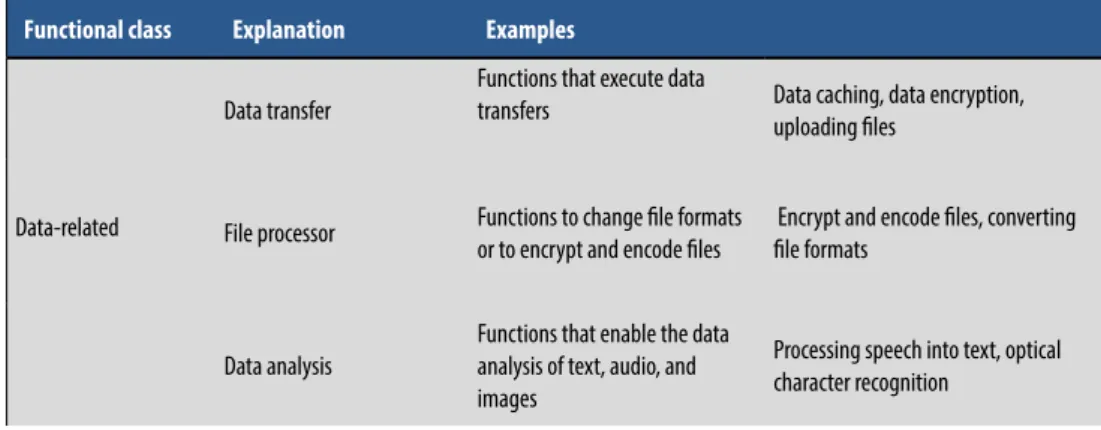
There may be different RPA tools, including data management, systems integra- tion, and process improvement. Specifically, the data-related functions allow data transfer, file format modification, and data analysis (Hofmann and others, 2020). In systems integration, it was already indicated that RPA allows access to applications and services automatically, such as process mining, machine learning, and AI. In terms of process-related functions, RPA includes event triggers and control flow ope- rators. Table 1 summarizes the functional classes of RPA.
Table 1. Functional classes of software robots (Hofmann and others, 2020).
Functional class Explanation Examples
Data-related
Data transfer Functions that execute data
transfers Data caching, data encryption,
uploading files
File processor Functions to change file formats or to encrypt and encode files
Encrypt and encode files, converting file formats
Data analysis Functions that enable the data analysis of text, audio, and images
Processing speech into text, optical character recognition
In an RPA case study in accounting systems, the work of an employee who was in charge of the accounts’ payment process was examined (Harrast, 2020). Before the application of RPA, employees received invoices as email attachments in PDF format.
They would later download the files, print a copy, and then enter the data into en- terprise resource planning (ERP) after reviewing each invoice and recalculating the totals; after, the clerk checked the system and compared the total invoices entered to a separate, manually computed total batch. If the totals agreed, the process was com- plete, and the invoices were filed pending payment by the payment officer. With an RPA, the system logs in with its credentials and opens the directory folder containing the PDF invoice attachments. The robot software proceeds to run a validation routine on the data to ensure that the calculations and totals are correct. Once all the invoice data are collected, the bot logs on to the accounts payable production system, naviga- tes to the appropriate transaction screen, and enters the invoices, one by one, into the appropriate fields; at the end of the process, the bot initiates an email summarizing the transactions.
This reflects the reduction of times in operations that were previously carried out manually by people, working the RPA twenty-four hours a day, seven days a week.
However, process automation via RPA does not rely on the premise of separating and isolating people and robots from one another but seeks to enable efficient interaction between them (Hofmann and others, 2020; Hallikainen and others, 2018; M. Lacity and Willcocks, 2016; van der Aalst and others, 2018). According to the Institute for Robotic Process Automation (IRPA, 2015), RPA technology is not part of a company’s
Functional class Explanation Examples
Integration-related
Application operator Functions to access or operate
other applications Change values in a spreadsheet, access the IS with credentials
(Cloud) service operator Functions to access or operate (cloud) services
Posting information on social media platforms
Input device operator Functions to imitate the human
use of input devices Click, drag, expand, close
Process-related
Event trigger Functions to wait for specified events to initiative further activities
Detecting file changes, trigger by image appearance, trigger by hot key
Control flow operator Functions to connect elements to
a choreography Loops, branches, user interactions
information technology infrastructure, but rather sits on top of it. Thus, it is argued that RPA does not perform cognitive automation or interpretation of data with pro- babilistic results but rather processes structured data with a single result (Lacity and Willcocks, 2016). For its part, the following business process criteria are suggested for the use of RPA: first, low cognitive requirements, that is, that the processes do not have an interpretive approach; second, large volume of data; third, access to multiple systems; fourth, limited exception handling; and fifth, that there are tasks prone to human errors due to manual work (Fung, 2014).
Undoubtedly, the application of RPA transcends different productive sectors of the industry, ranging from aeronautical engineering to human resource manage- ment, highlighting the application in financial and electronic commerce sectors. It is in this sense, that the implementation of RPA carried out by Zurich Insurance Group in 2018 (Altoros, 2018)3 stands out as an example in an industry that has deman- ding regulatory standards and also a constant demand for efficiency in the processes for part of the clients. Therefore, it was necessary to improve specific management indicators that would enhance the business; thus, it was estimated that using RPA will improve operational efficiency by up to 80%, having as an economic effect the reduction of 30% in its operational costs. As shown in figure 1, the critical impro- vement corresponds to the fact that by automating and integrating specific internal and external processes, machine learning could be added to extract data and external variables such as health data, income, accident rate, among others.
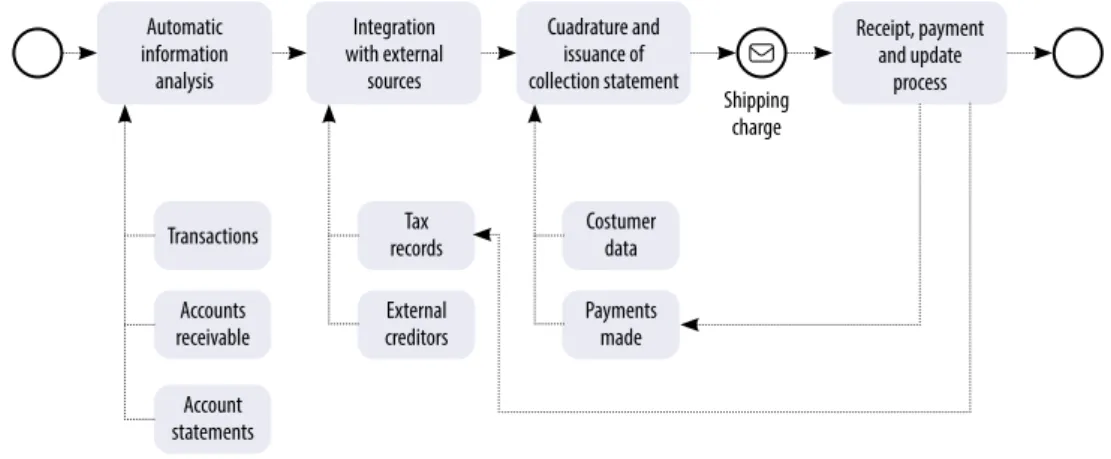
A newer case is that of the Royal Bank of Canada (RBC), which, being inserted in the financial sector, applied automation through RPA with great success (Compu- terweekly, 2020).4 It is essential to point out that the RBC is one of Canada’s largest financial institutions and that it has innovated in different areas of its processes using technology to improve service to its clients. In this way, it was sought to automate the accounts receivable process, not only at the accounting level but also by incor- porating the communication process the different collaborators through the delivery of invoices. Thus, this automation was able to carry out a transversal communica- tion avoiding that officials carry out repetitive activities. This exchange came directly from various sources of information that was able to be automatically synchronized through the use of external web services for the recognition of payments and access to an internal database. An example of this is what can be seen in figure 2, in which, in contrast to the previous case, it shows that the process of integration and synchro- nization of data sources is more significant and increases complexity. However, being automated also reduces the probability of error in contrast to manual executions.
3. Available at https://bit.ly/3IDH7PA.
4. Available at https://bit.ly/3MSFnoc.
Figure 1. RPA application case to the insurance industry by Zurich Policy
information query entry
Automatic information
analysis
Automatic information extracting using SQL
Integration with external
sources Zurich Data Warehouse
transactions tax
records Costumer
data
Account statements
Accounts
receivable External
creditors Payments
made Web Service
external Analysis of legal
regulations (legal variables)
Cuadrature and issuance of collection statement
Shipping charge
Policy issuance and shipping
Specialized agent analysis
Receipt, payment and update
process
Figure 2. RPA application process to collections at Royal Bank of Canada
In tax advice, there is information that demonstrates the use of RPA by the “big four”. For example, at Price Waterhouse Coopers (PwC) they began to apply RPA to facilitate standard tax compliance functions, which automatically read and extracted data from these PDF files, freeing up valuable time and activities, including review and analysis. In another example, a PwC tax professional used an RPA tool to prepare and file tax returns during 2019, saving up to 70% of time (Mezzio and others, 2019).5
KPMG (2018) has also developed tax technology solutions describing four catego- ries. The first category refers to the automation of the tax compliance process to gene-
5. Available at https://t.ly/Z_qQ.
rate tax returns from data collection, acquisition to payment, order to the collection, and from posting to reporting (general ledger accounting). The second category aims to show data, information, or results that the taxpayer needs to know to transform the data into knowledge that can then add value to the organization. The third cate- gory of solutions is called “workflow”, whose main objective is to create better con- trols, governance, or efficiencies on the completion of work tasks; for example, within the policy of an organization, it may be that the issuance of a particular invoice with value-added taxes (VAT) exceeding a certain amount requires the approval of a spe- cific tax administrator before issuing it to the customer, thus, a “workflow” manage- ment solution can be used to force this type of approval steps and be assigned based on who should be “responsible”, “accountable”, “consulted” or “informed”. Finally, the fourth category, indicates that solutions in categories one to three cannot be executed without having an adequate infrastructure to host the technology, thus, the fourth category of tax technology solutions is a part of the other three categories, where third-party providers software applications, programming language workbenches or cloud environments are developed. It is precisely in this fourth category where RPA can be developed, for example, in the case of tax software destined to configure a fol- der for each unique branch. Setup involves selecting by clicking the same six options for each folder, click once to create the folder and then click again to select the desired branch. Without this tool, it would require a tax professional to click 60,000 times just to set up the necessary folders to ensure compliance. But with an RPA, because the process is standard and repeatable, it can be automated using software reducing 60,000 clicks to a single click. Once programmed, with the push of a button, the bot will go through 60,000 steps in a fraction of the time and with much more precision than any human.
Use of robotic process automation by tax administrations Technological development of tax administrations
The OECD (2016) has suggested that all organizations, including tax authorities, keep pace with technological development and, as necessary, change their services and distribution for the best use of new technology. Recent studies show that com- puterized inspection systems contribute to better fiscal risk management (OECD, 2017). The impact on tax administrations has also been presented on digitalization, robotization, machine-to-machine (M2M) technologies and blockchain (Vishnevs- ky and Chekina, 2018). Studies in Spain conclude that in the face of massive data processing by the tax administration, the legislation must recognize the right of the interested party to access, rectify, delete and even oppose the processing of their personal data (Olivares, 2018). However, not only the right of access to information
should be considered, but also the right to be informed of the models, formulas or al- gorithms used to collect such information; allowing control of arbitrariness, and the exercise of the right of defense which is essential for this scenario (Faúndez-Ugalde and others, 2020).
But new technologies can also be used to improve taxpayer services and achieve tax compliance, and to implement new audit mechanisms, especially considering the large volume of data generated, known as big data (Vishnevsky and Chekina, 2018).
Currently, 19 of 22 countries surveyed in America, Asia Pacific, the Middle East and Africa, use big data tools as part of their taxpayer audit process (Gillis and others, 2015). In the United Kingdom, technological applications are used to better track tax revenues; Her Majesty’s Revenue and Customs (HMRC), the tax authority in the UK, introduced voice recognition technology for its mobile software in 2017 (KPMG, 2018). Whereas the Australian Government is conducting a comprehensive review aimed at strengthening government services (O’Neill, 2017). For its part, since 2000, the Internal Revenue Service (IRS) of the United States has restructured and moder- nized its operational divisions. For this, they improved data capture through infor- mation systems (Nolan, 2001). In addition, the IRS is trying to mitigate refund frauds by bringing in a new system, the Real-Time Tax System, which will assist in up-front quality checks on tax returns being filed with the IRS. They have also launched a mo- bile application providing various e-services, while interacting with taxpayers on so- cial media platforms such as Twitter, Facebook and YouTube as well (KPMG, 2018).
In Canada, studies based on big tax data have made it possible to assess on the one hand, the prevalence of delayed tax filing and the possible causes of such behavior;
on the other, the consequences of income tax reassessments and delayed tax filing for economic analysis that uses big tax data (Messacar, 2017).
The preceding demonstrates the importance of the automation of data processing carried out by tax administrations daily, which implies the requirement to adopt safe- guards mechanisms in order to achieve, as much as possible, the precision, accuracy, and integrity of the data collected. Therefore, the usefulness that can be derived from tools such as big data will depend on the trust of the processed data to prepare the tax returns or other administrative acts that serve as the basis for tax obligations.
The State Administration of Taxation (SAT) of China issued SAT Announcement Nº 10 on April 18, 2017, which gives taxpayers the option of being assisted, in an automated way, on the identification and correction of tax calculation errors, be- fore formally filing their annual tax returns. This tool has been integrated with the Golden Tax System Phase III (GTP III), that is, a Chinese tax management system that achieves online tax registration at the national level, allowing SAT to perform analysis and tax evaluations of multiple levels and multiple angles in big data (Zhou
and others, 2016).6 The system allows tax administrators to trace a firm’s economic activities from various sources and helps the auditor impute the firm’s true tax liabili- ty (Li and others, 2020). It is argued that GTP III strengthens the tax administrators’
capacity in four ways: first, it incorporates the value-added taxes (VAT) invoice sys- tem to give tax authorities access to information on the goods/services flow of a firm.
Second, GTP III system compels third-party information from banks, customs, so- cial insurance record and gives the tax administrators access to better information on firms. Third, GTP III provides increasing computation power of auditors to process the abundant information so they can more accurately detect high-risk firms. Lastly, GTP III lowers firms’ compliance costs because taxpayers do not need to report to multiple tax government agencies (Li and others, 2020).
While the findings of the indicated research suggest that modern information technology is a powerful tool to reduce the tax sheltering of companies that engage more in tax avoidance and evasion, at the same time, it is essential to consider that GTP III is sourced from tax returns, financial and accounting data, and other sworn statements, all of which could present difficulties if the data is not precise, exact, or complete. Therefore, the automation of large amounts of data, as occurs in GTP III, cannot exclude subsequent review processes that provide transparency to the process of determining tax obligations.
The same previous problem can occur in the cases of integrating this large amount of data with RPA, as we will see below.
Particular analysis of robotic process automation by tax administrations
So far, the functionalities of an RPA can be varied for the taxation field, being use- ful for data management, process improvement, and, mainly, it allows integrating systems by accessing applications and services automatically. In this way, tax admi- nistrations have tools that allow them to track the economic activities of taxpayers from different sources: electronic invoicing, sworn statements, tax returns, online applications, information from other public authorities, from other administrations through collaboration agreements and, especially, information that can be obtained in operations carried out in electronic markets.
The automation of all this data allows tax administrations to generate profiles of high-risk companies and carry out validation processes in the determination of ta- xes. Thus, for example, to carry out a VAT audit, the RPA could load in electronic spreadsheets, process data from the use of credit cards that operate in electronic mar- kets, reconcile financial statements with their tax returns, among other operations;
everything which can reduce times and make the audit more efficient.
6. Available at https://t.ly/2UHM.
The OECD (2019), in its comparative report for 2019, cites the United King- dom and Singapore as countries whose tax administrations manage to reduce costs through the implementation of RPA. In the case of the United Kingdom, the HMRC has become one of the tax administrations that has mostly innovated in using tech- nological tools for its management. RPA has made it possible to create pieces of soft- ware designed to automate manual processes, with a dashboard for over 7,500 contact center advisers which automatically opens relevant case files on screen. Thus, the use of RPA by HMRC for contact centers has reduced the amount of “clicks” by staff du- ring a call, from 66 clicks to just ten clicks (Holl, 2016).7 Likewise, he points out that the staff have reduced up to two minutes per call and have more time to dedicate to complex and interesting cases.
The RPA is also used in the employer registration process to validate data from online applications and provide a unique reference number to new employers, so they can start hiring for the first time (Merrick-Potter and Chrysochou, 2018).8 They also indicate that, if problems with the application are detected, RPA assigns cases to an “exceptions handling” team. Around 85% of applications are processed automa- tically, and employers who register with HMRC to start paying staff receive confir- mation three times faster than before. In addition, automated services like employer registration reduce processing costs by around 80%.
Thus, the introduction of automation technology such as RPA has enabled HMRC to integrate with artificial intelligence tools to investigate taxpayer operations. This is the case of the system called Connect, through which information intersections are made with automated data entry. Specifically, Connect performs three different functions gathered in an operating system: streamlined data collection, analysis and storage (Rigney, 2016).9 Therefore, Connect can incorporate a wide range of automa- ted data from different sources to identify fraud and tax evasion. Moreover, Connect identifies real-world entities in which data clusters around and looks at the com- monality in those areas that link the entities together; from that, it becomes easier to extrapolate someone who was the director of a number of companies, his family connections and, say, the companies that his wife is a director of, as well as any family trusts (Rigney, 2016).
Therefore, thanks to the technological development of HMRC, it is currently pos- sible to cross-check information obtained from tax returns, databases from other government entities, property records, financial information from credit cards, com- panies such as PayPal or Airbnb. These scopes that give greater efficiency to the ma- nagement of tax administrations must necessarily be in harmony with the regulatory
7. Available at https://t.ly/lkCR.
8. Available at https://t.ly/wKuX.
9. Available at https://t.ly/OyUu.
plan linked to the rights of taxpayers; the opposite may mean the lack of effectiveness of the act of inspection, as we will see later.
Singapore has been another country highlighted by the OECD (2019) as a de- veloper of technological tools for its management processes. As indicated in the 2017/2018 annual report of the Inland Revenue Authority of Singapore (IRAS, 2018),10 they began automating 38 processes through RPA in the areas of compliance checks, business processing, procurement services, and customer management services to expand the use of RPA at the enterprise level and develop capacities between IT sup- port personnel and other departments. This initiative is part of one of four strategic lines of a larger plan of the entity that seeks to further transform the experiences of both the taxpayer community, and the officials of a said fiscal entity, in this way ta- king advantage of Leveraging Analytics, Design, and Digitalization. One of its objec- tives was to build an adaptable and high-performance workforce in this plan, which motivated IRAS to be an early adopter of RPA at the organization level, certifying around 50 non-support IT users so they can automate processes (IMDA, 2018).11
The OECD (2017) has also reported the situation in Finland, where its tax admi- nistration introduced RPA technology that allows computer software configuration to capture and interpret existing applications to: process a transaction, data mani- pulation, triggering responses and communication with other digital systems. The OECD report highlights that the use of RPA for these activities offered the Finnish Tax Administration the potential to reduce the workload of these tasks in 52 years of effort per person, as well as the improvement in quality work and error reduction.
The same report highlights that Finnish Tax Administration has completed the de- velopment of its first demonstration of robots using processes in the tax audit work.
Thus, the robot applications are being used to undertake data quality checks and to assemble data from different sources, allowing Finnish Tax Administration to collect data from sources that are useful but currently take too long for their tax auditors to collect.
In general, it is estimated that the increase in the data processing capacity of go- vernments entails greater monitoring power, and therefore, taxpayers must maintain a higher level of diligence in the face of this degree of control, which will lead to a change in the role of tax professionals (Haines, 2020).12 As indicated at the beginning of this investigation, a critical point is presented here in the cases where said techno- logical tools impact on the determination of taxes, for which the public sector must be in harmony with tax regulations and constitutional principles that provide sup- port for compliance with tax obligations; that is, the use of technologies that directly
10. Available at https://t.ly/MK3k.
11. Available at https://t.ly/VEsP.
12. Available at https://bit.ly/433hkbD.
impacts the determination of taxes must be in strict adherence to the internationally recognized principle such as legality, equality, and tax capacity.
Robotic process automation and impact on human rights
Some researchers have raised the possibility that in the future public bodies could formulate laws with a robot (Coglianese and Lehr, 2017). This may not be so far away if, as we have already analyzed, the tax authorities are currently determining taxes by automating data, which means, certain legal rules are born through the use of RPA. However, this new form of management of the tax administrations implies leaving the processing of large amounts of data in the hands of technologies with many available sources, both analog and digital, which require control mechanisms against possible violations of human rights.13 Without this regulation, the efficiency in using technology for fiscal management may mean the lack of effectiveness of these legal acts.
In a United Nations (2019) report, the so-called “digital welfare state” has been proposed as a noble and altruistic company designed so that citizens can benefit from new technologies, experience more efficient governance, and enjoy a higher degree of well-being. However, it warns that, although the technologies are presented as “scien- tific” and neutral, they can embody values and hypotheses that are considerably di- fferent from human rights and even oppose them. Thus, government authorities such as the Prime Minister of the United Kingdom, among others, have spoken at the United Nations General Assembly on September 24, 2019, warning of the dangers of the digital age:
• risk of round-the-clock surveillance.
• perils of algorithmic decision-making.
• difficulty of appealing against computer-generated determinations.
• inability to plead extenuating circumstances when the decision maker is an algorithm.
The UN Report concludes that the reality is that governments have not effectively regulated the technology industry as if human rights were at stake, and the techno- logy sector continues to be an area practically free of human rights. In this sense the
13. Criticism has been leveled at the expression “human rights” (Barranco, 1996; Pérez, 2001). In its broadest conception, it constitutes a set of legitimate claims as attributes of every individual. In a more restrictive scope, the term “human rights” refers to certain attributes, faculties or capacities recognized to individuals. Although there has been a greater consensus on the expression “fundamental rights” as positive “human rights” (Aldunate, 2008), this work adopts a general scope as a category of individuals, in this case, in relation to the rights of taxpayers.
human rights community has not done an excellent job of convincing industry, go- vernment, or, apparently, society in general, that any future based on this technology will be less auspicious if it is not guided by the respect for human rights.
In this lies the importance that the tax administrations’ use of technology must find a normative regulation that safeguards human rights, although we also assume that the lack of national or international legislation implies a problem in itself. This does not remove the private sector’s commitment to go with the same obligation in the use of technologies in the face of the impact on society. Considering the above, we will now analyze the impact on the use of RPA by tax administrations in two areas of human rights: transparency and non-discrimination.
Transparency in the acts of the tax administrations
It should be remembered that the use of an RPA by tax administrations implies the requirement to adopt safeguard mechanisms to achieve, to the greatest extent possi- ble, the precision, accuracy, and integrity of the data collected. Tools such as big data generate an impact on the right to privacy and the right to protection of personal data and, thus, the use of personal information for the legitimate purposes for which it has been collected should be reduced to a minimum (Arellano, 2019). Therefore, in the face of the phenomenon of overcrowding in the use of personal data to make automa- ted decisions in the digital age, the right to the protection of personal data has been recognized internationally as well as, similar to it, the right to “transparency algorith- mic” (Azuaje and Finol, 2020). That is, explaining to people how and for what their data is used and what are the steps for making automated decisions (Cotino, 2017).
At the 36th International Conference of Data Protection and Privacy Authorities (DPPA, 2014)14 the Resolution on big data was issued which states that it is necessary:
to be transparent about what information is collected, how it is processed, for what purpose it will be used and if it will be transferred to third parties; to give people appropriate access to the collected data about them and to the information and de- cisions made with it, in order to correct the wrong information; and, to offer people, when appropriate, access to information on the primary inputs and criteria for deci- sion-making (algorithms) that have been used as the basis for the development of the profile. In the latter case, the information must be presented in a clear and understan- dable format, which according to Arellano (2019) means that not only information is given about the algorithm, but that it must be clear and accessible in the maximum number of formats.
Along these same lines, an opinion of the European Data Protection Supervisor (EDPS, 2016) was pronounced in 2016, indicating that users should be allowed a high
14. Available at https://bit.ly/424cjhN.
level of control over the way they use their data; data protection with user-friendly design should be built into products and services, and organizations should be more accountable for their actions. For its part, the European Parliament resolution15 of March 14, 2017 on “fundamental rights implications of big data”, declared that:
transparency should provide people with reliable information about the logic applied, the meaning and the expected consequences; and that it should include information about the data used for training in big data analysis and allow people to understand and control the decisions that affect them.
So, it can be assumed that an RPA may contain errors in the automation process, and therefore the reliance on the data will not be sufficient to prepare, for example, tax returns by the tax administration. Thus, the right of taxpayers to know, firstly, the steps that the tax administration has followed in the use of an RPA, and, secondly, the tax administration must explain to the taxpayers, in a clear and understandable format, how the software or the automation process of the collected data works, to confirm whether the tax determinations have been established correctly.
However, the right to algorithmic transparency, which has primarily been deve- loped in the EU, may encounter a collision with intellectual and industrial property, particularly when deemed necessary to reveal formulas or business secrets. This crea- tes an incredible difficulty for cases in which tax administrations contract external providers that implement RPA or other technologies, and, even more, in cases in which that provider resides abroad. Undoubtedly, under this situation, an internatio- nal consensus is required to establish how the right to transparency can prevail over the intellectual and industrial property.
Three possible solutions to the above collision of rights have been proposed (Azuaje and Finol, 2020): first, if confidentiality is contrary to transparency, it is con- venient, to analyze the possibility of adding some provisions for the current regula- tory systems that have protection with more flexible algorithms, through a special regime by which they can be public, explainable and protectable against copying without losing their economic value (for example, facilitating their patentability or a sui generis system for them). Second, the special regime relating to business secrets should be strengthened to include a catalog of limits and exceptions and provide the system with comprehensive and systematic regulation that improves legal certainty and offers adequate legal protection to all market operators. Third, these or other measures can be complemented with the adoption of certification systems giving ac- cess to certain control authorities, subject to strict confidentiality rules.
Without prejudice to the solutions proposed above, it is important to consider that the principle of transparency is linked to the probity of the public role and effective
15. Available at https://bit.ly/43ovl3t.
citizen control regarding the fulfillment of the general interest purposes that should govern the conduct of public authorities (Osorio and Vilches). Thus, the principle of transparency must be weighted with a higher standard as part of effective citizen control and, in the case that summons us, as part of the rights of taxpayers.
At the jurisprudential level, the judgment of February 5, 2020 of the District Court of The Hague is interesting, as it declared that the algorithm applied by the Dutch Go- vernment through the Risk Indication System, did not offer sufficient guarantees as to consider that this specific system respects the necessary proportionality judgment that must overcome any interference in privacy by the provisions of Article 8 of the European Convention on Human Rights.
On one hand, from the ruling, two essential arguments emerge that directly affect the right to transparency that has been developing. First, the Court considered that SyRI allowed the development of risk profiles based on historical, personal, or other data, thereby affecting the right to privacy. In this regard, the General Data Protection Regulation of the European Union indicates that profiling is any form of automated processing of personal data consisting of using personal data to evaluate certain per- sonal aspects of a natural person, particularly for analyzing or predicting aspects re- lated to professional performance, economic situation, health, personal preferences, interests, reliability, behavior, location or movements of a said natural person.
On the other hand, the Court gives the most significant weight of its argument to the principle of transparency (Lazcoz and Castillo, 2020), understanding that the State did not offer any information on the algorithmic model used by the tool, with which it is impossible to verify how a risk profile is formed or how the data proces- sing of those people who do not lead to risk profiles results. This confirms how the principle of transparency is essential for safeguarding the rights of the administered against the acts of a State.
Finally, within the trial, a report from the United Nations special rapporteur on extreme poverty and human rights was provided, which concluded that the deve- lopment of SyRI has a discriminatory and stigmatizing effect, as it is used in neigh- borhoods that were considered “problematic” (Alston, 2019).16 This last scope will be analyzed below as acts of discrimination that may derive from the use of technologies.
Acts of discrimination in the use of RPA
The predictive models derived from the use of technological tools applied by tax ad- ministrations in order to identify sources of tax evasion risks, can generate discrimi- natory biases when considering variables related to race, ethnicity, gender, and other categories. The European Union (2020) has identified public authorities that, using
16. Available at https://bit.ly/35tyTEJ.
technologies and algorithms in tax management, found a higher degree of errors in tax returns attributed to immigrants. This prompted further research on the variables used, resulting in people with recent identification numbers —regardless of whether they were nationals or immigrants— more often contained errors because they had never filed their taxes and did not know how to do it. This is a clear example in which automated decision-making can consolidate discriminatory practices that violate equality before the law.
This situation can also occur when a tax administration uses RPA to characterize taxpayers, qualifying them as “difficult to audit”, deciding to substitute the taxpayer for the tax obligation, and attributing a said quality to the subject who has benefi- ted from the tax service or the subject who has purchased a product. In this type of characterizations, variables related to tax returns, taxpayer address, business charac- teristics, suspension of activities for specific periods, among other sources, are used.
Thus, this type of characterization can lead to individual taxpayers’ stigmatization as “eventual” non-compliant with tax obligations and, consequently, impact credit ratings for the financing need of specific business projects. For the same reason, it is noted that a common problem with any statistical analysis in the use of technologies is that the analyst cannot know how close the test data is to new data realizations and, therefore, cannot predict how a model or algorithm will work in the “real world”
(Coglianese and Lehr, 2017).
The same previous case must also consider the dynamics of each taxpayer’s mar- ket and the financial behavior over time. In this sense, the random samples can show periods in which the taxpayer had suspended their activities for reasons beyond their control —such as, for example, due to the COVID-19 pandemic—, which does not mean that it becomes an “eventual” non-compliant with tax obligations. It is noted that temporary differences between test data and real-world data can be significant, as differences in the economy between previous years and the current year can affect the likelihood that people will engage in fraudulent tax practices (Coglianese and Lehr, 2017).
Conclusions and future research
In recent years, advances have been demonstrated in the use of RPA to process large amounts of data, especially in cases of integration with commercial transactions that take place in electronic marketplaces. Thus, an RPA can use AI technologies to pro- vide improved logic, flexibility, and adaptability in decision-making within business process environments. This extraordinary experience has been gathered by tax admi- nistrations that are at the forefront in assuming the new challenges of technologies, as its the case of the United Kingdom. However, research has also revealed dubious regulatory aspects when facing the vast amount of data that a tax administration can
access through an RPA, and mainly where it provides a system integration function of IA. In this sense, the lack of normative regulation can lead to the violation of tax- payers’ rights related to the transparency of the tax administration acts and possible discriminatory acts in applying this type of tool.
The right to algorithmic transparency and non-discrimination in the use of tech- nology by governments has been the great concern of the EU, since its absence may lead to the violation of human rights. Tax administrations do not escape this. And with this being the case, governments must introduce regulations in their legislation that protect taxpayers’ rights, as has been developed in this paper.
In the case of the right to transparency of the tax administrations’ acts, it can be assumed that an RPA may contain errors in the automation process and, therefore, trust in the data will not be enough to make the administrative act effective by a tax authority. In this sense, considering the statements on “fundamental rights implica- tions of big data” made at the 36th International Conference of Data Protection and Privacy Authorities, held in Mauritius in 2014, the Opinion of the European Data Protection Supervisor of 2016 and the European Parliament resolution of March 14, 2017 it is essential to assure the right of taxpayers to know, firstly, what have been the steps that the tax administration has followed in the use of an RPA, and, secondly, the tax administration must explain to taxpayers, in a clear and understandable format, how the software or the automation process, of the collected data works in a way that allows confirming whether the tax determinations have been established correctly.
Moreover, this research has also reported using predictive models derived from technological tools applied by tax administrations to identify sources of tax evasion risks. In this case, these models can generate discriminatory biases when considering variables related to tax returns, taxpayer’s address, business characteristics, suspen- sion of activities for specific periods, among other sources.
Considering that these normative guidelines are based on declarations of interna- tional organizations before what the EU issued recently, future research should consi- der studies of, particularly, how governments have introduced these guidelines inter- nally and, if said, how other experiences have impacted other regions in comparison.
References
Aguirre, Santiago and Alejandro Rodríguez (2017). “Automation of a Business Pro- cess Using Robotic Process Automation (RPA): A Case Study”. In Juan Carlos Figueroa-García, Eduyn López-Santana, José Luis Villa-Ramírez and Roberto Fe- rro-Escobar (editors), Applied Computer Sciences in Engineering, 742: 65-71. DOI:
10.1007/978-3-319-66963-2_7.
Aldunate, Eduardo (2008). Derechos Fundamentales. Santiago: Thomson Reuters.
Arellano, Wilma (2019). “El derecho a la transparencia algorítmica en big data e inteligencia artificial”. Revista General de Derecho Administrativo, 50. Available at https://bit.ly/3Mwo0Z2.
Azuaje, Michelle and Daniel Finol (2020). “Transparencia algorítmica y la propie- dad intelectual e industrial: tensiones y soluciones”. Revista la Propiedad Inmate- rial, 30: 111-146. DOI: 10.18601/16571959.n30.05.
Barranco, María del Carmen (1996). El discurso de los derechos. Del problema termi- nológico al debate conceptual. Madrid: Dykinson.
Coglianese, Cary and David Lehr (2017). “Regulating by robot: administrative deci- sion making in the machine-learning era”. Georgetown Law Journal, 105 (5): 1147- 1223. Available at https://bit.ly/3qb8NVP.
Cotino, Lorenzo (2017). “Big data e inteligencia artificial. Una aproximación a su tratamiento jurídico desde los derechos fundamentales”. Dilemata, 24: 131-150.
Available at https://bit.ly/3qaRgNr.
EDPS (2016). Dictamen del European Data Protection Supervisor, Diario Oficial de la Unión Europea. Available at https://bit.ly/45tuHna.
European Union (2020). “Getting the future right artificial intelligence and fun- damental rights”. European Union Agency for Fundamental Rights. Luxembourg:
Publications Office of the European Union. Available at https://bit.ly/4211pt3.
Faúndez-Ugalde, Antonio, Rafael Mellado-Silva and Eduardo Aldunate-Lizana (2020). “Use of artificial intelligence by tax administrations: An analysis regarding taxpayers’ rights in Latin American countries”. Computer Law & Security Review, 38: 1-13.
Fung, Han Ping. (2014). “Criteria, use cases and effects of information technology process automation (ITPA)”. Advances in Robotics & Automation, 3: 1-11.
Gillis, Tim., Adrienne McStocker and Alec Percival (2015). “Indirect tax compliance in an era of big data”. Tax Planning International: Indirect Taxes, 13 (3): 1-6.
Hallikainen, Petri, Riita Bekkhus and Shan L. Pan (2018). “How OpusCapita used internal RPA capabilities to offer services to clients”. MIS Quarterly Executive, 17:
41-52.
Härd, Joakim and Max Svensson (2020). How Organizational Structures Affect the Implementation of Robotic Process Automation. A Practical Case Study. Tesis para el grado de MSc en Ingeniería Mecánica, Universidad de Lünd. Available at https://bit.ly/3MVbp1o.
Harrast, Steven (2020). “Robotic process automation in accounting systems en Journal of Corporate”. Accounting and Finance, 31 (4): 209-213, DOI: 10.1002/
jcaf.22457.
Hofmann, Peter, Caroline Samp and Nils Urbach (2020). “Robotic process automa- tion”. Electronic Markets, 30: 99-106. DOI: 10.1007/s12525-019-00365-8.
Houy, Constantin, Maarten Hamberg and Peter Fettke (2019). “Robotic Process Au- tomation in Public Administrations”. In Michael Räckers and others (Editors), Digitalisierung von Staat und Verwaltung (pp. 62-74). Bonn: Gesellschaft für Informatik
IEEE Corporate Advisory Group (2017). “IEEE guide for terms and con- cepts in intelligent process automation”. IEE Std 2755-2017, 1-16. DOI: 10.1109/
IEEESTD.2017.8070671.
IRPA, Institute for Robotic Process Automation (2015). Introduction to Robotic Pro- cess Automation. Available at https://t.ly/aY4zM.
Kirchmer, Mathias (2017). “Robotic Process Automation – Pragmatic Solution or Dangerous Illusion?”. BTOES Insights (Business Transformation and Operational Excellence Summit Insights). Available at https://t.ly/sVFob.
KPMG (2018). Transforming the tax function through technology. Available at https://t.
ly/UgUFq.
Lacity, Mary and Leslie Willcocks (2016). “A new approach to automating services”.
MIT Sloan Management Review, 58 (1): 41-49. Available at https://t.ly/Ltir.
Lacity, Mary, Leslie Willcocks and Andrew Craig (2015). “Robotic process automa- tion at Telefónica O2”. The Outsourcing Unit Working Research Paper Series, 1-19.
Available at https://bit.ly/43lLgzW.
Lazcoz, Guillermo and José Antonio Castillo (2020). “Valoración algorítmica ante los derechos humanos y el Reglamento General de Protección de Datos: el caso SyRI”. Revista Chilena de Derecho y Tecnología, 9 (1): 207-225. Available at https://t.
ly/pQ_W.
Li, Jianjun, Xuan Wang and Yaping Wu (2020). “Can government improve tax com- pliance by adopting advanced information technology? Evidence from the Gol- den Tax Project III in China”. Economic Modelling, 93: 384-397. DOI: 10.1016/j.
econmod.2020.08.009.
Messacar, Derek (2017). “Big Tax Data and Economic Analysis: Effects of Personal Income Tax Reassessments and Delayed Tax Filing”. Canadian Public Policy, 43 (3): 261-283. DOI: 10.3138/cpp.2016-079.
Moffitt, Kevin, Andrea Rozario and Miklos Vasarhelyi (2018). “Robotic process au- tomation for auditing”. Journal of Emerging Technologies in Accounting, 15 (1): 1-10.
DOI: 10.2308/jeta-10589.
Nolan, Deborah. (2001). “Los sistemas de información de apoyo a la fiscalización”.
In Centro Interamericano de Administraciones Tributarias – CIAT (coord.), La función de fiscalización de la administración tributaria y el control de la evasión.
Santiago: CIAT. Available at https://t.ly/88XF.
O’Neill, Claire (2017). “Using digital delivery to enhance the integrity of tax sys- tems”. In OECD (compilator), Tax administration 2017: Comparative information
on OECD and other advanced and emerging economies. París: OECD Publishing.
DOI: 10.1787/tax_admin-2017-en.
OECD, Organization for Economic Co-operation and Development (2016). Tech- nologies for better tax administration: A practical guide for revenue bodies. Paris:
OECD Publishing. DOI: 10.1787/9789264256439-en.
—. (2017). Tax administration 2017: Comparative information on OECD and other advanced and emerging economies. Paris: OCDE Publishing. DOI: 10.1787/
tax_admin-2017-en.
—. (2019). Tax Administration 2019: Comparative Information on OECD and other Advanced and Emerging Economies. Paris: OECD Publishing. DOI:
10.1787/74d162b6-en.
Olivares, Bernardo. (2018). “Technological innovation within the Spanish tax ad- ministration and data subjects right to access: An opportunity knocks”. Computer Law & Security Review, 34 (3): 628-639. DOI: 10.1016/j.clsr.2017.11.012
Osorio, Cristóbal and Leonardo Vilches (2020). Derecho administrativo. Conceptos y principios. Santiago: Ediciones DER.
Pérez, Antonio (2001). Derechos humanos, estado de derecho y constitución. Madrid:
Tecnos.
Santos, Filipa, Rúben Pereira and José Vasconcelos (2019). “Toward robotic process automation implementation: an end-to-end perspective”. Business Process Mana- gement Journal, 26 (2): 405-420. DOI: 10.1108/BPMJ-12-2018-0380
Syed, Rehan and others (2020). “Robotic Process Automation: Contemporary themes and challenges”. Computers in Industry, 115. DOI: 10.1016/j.compind.2019.103162 UN, United Nations (2019). Report of the Special Rapporteur on extreme poverty
and human rights. A/74/493. Available at https://bit.ly/3qv7HnW.
van der Aalst, Wil M. P., Martin Bichler and Armin Heinzl (2018). “Robotic pro- cess automation”. Business & Information Systems Engineering, 60 (4): 269-272.
DOI: 10.1007/s12599-018-0542-4.
Vishnevsky, Valentine and Viktoriia Chekina (2018). “Robot vs. tax inspector or how the fourth industrial revolution will change the tax system: a review of problems and solutions”. Journal of Tax Reform, 4 (1): 6-26. DOI: 10.15826/jtr.2018.4.1.042.
vom Brocke, Jan, Wolfgang Maaß, Peter Buxmann, Alexander Maedche, Jan Marco Leimeister and Günter Pecht (2018). “Future Work and Enterprise Systems”. Busi- ness and Information Systems Engineering (BISE), 60 (4): 357-366.
Willcocks, Leslie, Mary Lacity and Andrew Craig (2015). “The IT function and ro- botic process automation”. The Outsourcing Unit Working Research Paper Series, 1-39.
Acknowledgements
This work is part of the Fondecyt Project initiation number 11200596, with special acknowledgments to the Agencia Nacional de Investigación y Desarrollo (ANID).
About the authors
Antonio Faúndez-Ugalde is Doctor of Law from the Pontifical Catholic Univer- sity of Valparaíso. He is a lawyer and lecturer in tax law at the Business School of the Pontifical Catholic University of Valparaíso. His email is: [email protected]
https://orcid.org/0000-0002-8468-3042.
Rafael Mellado-Silva has a master’s degree in computer science from the Pon- tifical Catholic University of Valparaíso. He is a computer engineer and lecturer in in- formation systems at the Business School of the Pontifical Catholic University of Valpa- raíso. His email is: [email protected] https://orcid.org/0000-0002-6143-2929.
La Revista de Chilena de Derecho y Tecnología es una publicación académica semestral del Centro de Estudios en Derecho Informático de la Facultad de Derecho de la Universidad de Chile, que tiene por objeto difundir en la comunidad jurídica los elementos necesarios para analizar y comprender los alcances y efectos que el desarrollo tecnológico y cultural han pro- ducido en la sociedad, especialmente su impacto en la ciencia jurídica.
director Daniel Álvarez Valenzuela ([email protected])
sitio web rchdt.uchile.cl correo electrónico [email protected] licencia de este artículo
Creative Commons Atribución Compartir Igual 4.0 Internacional
❦
La edición de textos, el diseño editorial y la conversión a formatos electrónicos de este artículo
estuvieron a cargo de Tipográfica (www.tipografica.io).