Using Simulation-based Optimization in the Context of IT Service Management Change Process
Mercedes Ruiza,∗, Javier Morenob, Bernab´e Dorronsoroa, Daniel Rodriguezb
aDept. of Computer Science and Engineering, University of Cadiz, 11519 - Puerto Real (Cadiz), Spain
bDept. of Computer Science, University of Alcala, 28871, Spain
Abstract
Today’s IT systems and IT processes must be ready to handle change in an efficient and responsive manner to allow businesses to both evolve and adapt to a changing world. In this paper we describe an approach that consists of usingsimulation based multi-objective optimization to select optimal ITIL change management process strategies that help IT managers achieve process efficiency as a Critical Success Factor (CSF). A multi-method simulation model, which is based on agent-based and discrete-event simulation paradigms, has been built to simulate the whole process lifecycle, since the change initiation until its closure. As most engineering problems, assuring an efficient delivery of the change management process requires optimizing simultaneously the corresponding Key Performance Indicators (KPIs) in which the process-efficiency CSF can be rolled down. In this paper, we show the results of applying two well-known Multi-Objective Evolutionary Algorithms, namely NSGA-II and SPEA2, to obtain a set of optimal solutions for the KPIs associated with delivering process efficiency as a CSF. We also compare the results obtained with the output from the single-objective optimization algorithm provided by the simulation tool. The experimental work included shows how the approach can provide the IT manager with a wide range of high quality solutions to support them in their decision-making towards CSF achievement.
Keywords: Service Management, Change Process, ITIL, Multi-objective optimization, Evolutionary algorithms, Simulation
∗Corresponding author
Email addresses: [email protected](Mercedes Ruiz),[email protected](Javier Moreno), [email protected](Bernab´e Dorronsoro),[email protected](Daniel Rodriguez)
1. Introduction
In our current digital world, Information Technology (IT) plays a crucial role to help organi- zations succeed in delivering value to their customers. In response to this growing dependence on technology, today’s IT organizations need to be both effective and efficient in transforming re- sources into valuable services. IT Service Management (ITSM) is defined as the strategic approach
5
to the design, delivery, management, and improvement of the way in which IT is used within an organization.
Since technology and the IT infrastructure are constantly changing and advancing in today’s world, organizations such as IT service providers must be ready and able to adapt themselves to evolving conditions if they want to remain competitive and innovative. To this end, the different
10
ITSM guides and standards provide guidance about how to manage change in a productive way, ensuring that new or modified IT services evolve along their lifecycle under a controlled and well- organized manner that keeps these services compliant with the business requirements.
There are different ITSM best-practice guides and standards that help organizations implement an ITSM strategy. A 2017 report, based on a survey of 261 IT leaders in large organizations around
15
the world [18], shows that the top five most used ITSM approaches are: Information Technology Infrastructure Library (ITIL) (47%) [3], Business Process Framework (eTOM) (36%) [48], Control Objectives for Information and Related Technologies (COBIT) (36%) [20], Microsoft Operations Framework (MOF) (34%) [33] and ISO/IEC 20000 (29%) [21].
Among all the existing ITSM guides, we focus in this work on the ITIL proposal, the most widely
20
used one. In fact, it is regarded by many as the de-facto standard for ITSM and its terminology is widely understood and used. ITIL follows a process-driven approach that is grounded in business experience. It offers a set of best practices for IT service management and delivery under an ITSM approach. The ITIL framework comprises the definition of 26 process areas used to describe how IT services evolve through the five main stages of their lifecycle. ITIL consists of five core
25
publications, namely, (i) Service Strategy, (ii) Service Design, (iii) Service Transition, (iv) Service Operation, and (v) Continual Service Improvement, each one dedicated to describe in depth each of the five stages of an IT service lifecycle.
The ITIL service transition stage is precisely aimed at helping organizations plan and manage the change of state of services in their lifecycle, in a controlled manner, minimizing the risks and
30
ensuring that the services meet the customer’s expectations and the business requirements [36].
One of the critical processes within service transition is change management. According to ITIL, the purpose of the change management process is to control the lifecycle of all changes, enabling beneficial changes to be made with minimum disruption to IT services [36]. The scope of change management covers changes to service assets and configuration items across the whole service
35
lifecycle. The process addresses all changes at all levels: strategic, tactical and operational.
Today’s organizations demand service changes to be performed in less and less time without compromising efficiency. Thus, efficient change management is essential, since the consequences associated with process inefficiency reach the customer. Low quality service changes often lead to new incidents that result in customer dissatisfaction.
40
Change management needs the involvement of several types of resources, with their correspon- dent costs. Among them, human resources are crucial for the outcomes of the process. These resources are commonly structured in IT support groups. Each one plays a different role in the process such as change initiators, developers, deployers, etc., that can be part of IT staff or working for third-party organizations. In practice, all these factors are combined to make the entire change
45
process highly unpredictable, where outcomes depend on complex interactions between different changes, people and groups, each of which, have their own priorities and objectives. Although ITIL and other ITSM frameworks provide important guidance, managing change in real organizations is a very complex process. Also, change management often requires optimizing several objectives simultaneously, such as maximizing the percentage of changes completed on time and minimizing
50
the change duration ratio and the number of resources used.
Therefore, change management is a complex problem that organizations need to handle in an effective way when coping with service transition processes. The goal is to perform the changes with the lowest impact on the Quality of Experience (QoE) perceived (as service disruption, incidents with other live services, or any other issue that might affect customers’ satisfaction), but also
55
with the lowest effort for the organization (as minimizing the cost of the change or the resources required). Often, the interests of organization and customers are in conflict, e.g., reducing the time required for the change management process leads to a cost rise for the organization. Optimization techniques can be very valuable tools used to both find high quality solutions to support decision- making and to ensure an efficient change management delivery.
60
Particularly, multi-objective optimization algorithms can effectively handle the optimization of different conflicting objectives simultaneously, offering a wide and diverse range of trade-off solu- tions to the problem, helping the IT manager to make the most appropriate decisions. In order to guide the search towards high-quality solutions for such a complex problem involving a large number of processes, interactions among them, and uncertainties, these algorithms must rely on ac-
65
curate simulations. This approach is explicitly proposed in frameworks to improve decision-making in the ITSM scope, such as the Sim4ITSM framework, which includes activities of simulation op- timization in the experimentation phase of the method [39].
The main contribution of this work is a novel application of the multi-objective simulation op- timization approach for the IT change management process problem aimed at supporting effective
70
decision making. To this end, we introduce a simulation approach that relies on both the agent- based and discrete event simulation paradigms to model the ITIL change process. We define the problem of optimizing process efficiency according to three main goals: 1) the size of the staff to perform the changes, 2) the change duration ratio, and 3) the percentage of changes completed, which are optimized simultaneously. The problem is tackled with two well-known Multi-Objective
75
Evolutionary Algorithms (MOEAs), NSGA-II and SPEA2. The MOEAs outperform the reference result provided by the single-objective optimization obtained from the simulation software used to build the simulation model. This research represents pioneering work related to the use of multi-objective approaches in simulation-based optimization in the context of ITSM.
The structure of the paper is organized as follows. Section 2 summarizes the works related to our
80
proposal. Section 3 describes the simulation model built for the ITIL change process. Section 4 introduces the MOEAs used in this study and the coupling structure followed to integrate the simulation software with the multi-objective optimization framework. Section 5 describes the experimental work performed. Finally, Section 6 outlines the conclusions and our further work.
2. Related Work
85
In this section, we cover the most relevant works related to our study. Section 2.1 addresses contributions focusing on the design of ITSM simulators. We present the results of a systematic search in the literature of simulation-based optimization in the context of ITSM in Section 2.2.
2.1. Simulation in ITSM
Simulators have been demonstrated to be very useful tools for decision support systems to help
90
decision makers in their activity. We can find many examples in the literature, with different fields of application as logistics [17], planning [41], economics [52, 8], or supply chains [19], among many others. The use of simulation modeling to address ITSM problems has been an active topic of research in the last years. The most relevant works in the scope of the service change management process are reviewed next, and we refer the reader to the work by Orta et al [39] for a more
95
comprehensive literature review.
In [32], authors describe a System Dynamics model to address the problem of low-performing IT operation by adopting and sustaining IT change and access controls. The simulation model built helped to validate “underlying observations that change and access controls simultaneously reduce the security risk and increase the efficiency and effectiveness of IT management and operations”.
100
Planning and scheduling of changes were identified among the main challenges in IT change management according to the results of a survey carried out by Hewlett Packard in 2006 [40]. The topic of the efficient management of a set of application changes under possible scheduling conflicts was addressed by Luo et al [31]. The authors use graph and queue modeling to simulate different scheduling heuristics and find their impact on the change completion time and the change capacity
105
of the system. The work finds the limit values for the degree of the scheduling conflicts and the cross-training of executing personnel that help keep the average change delay in the lowest level.
In addition to an efficient scheduling of changes, it is also very important to estimate the business impact of operational risk resulting from changes. One proposal that quantifies this impact in terms of financial loss was described by Setzer et al [42]. In this work, a probabilistic model for analyzing
110
the business impact of changes in a network of services is introduced together with a decision model for service changes scheduling with the aim of reducing the total expected change-related costs.
The proposal is then evaluated by using discrete event simulations of different scenarios.
Silva and Yaix [44] propose process simulation as a key element to guide the CIO and CEO in strategic business and IT alignment. They show the benefits of their proposal by simulating the
115
incident and problem management process from the COBIT framework (which are sub-processes of the change management process in the ITIL framework). In this case, the simulation model is built using ADOITR, which uses its own modeling language and provides basic simulation analysis
tools, such as cycle-time and resource-utilization reports.
Simulation has also been used as a means to generate data that help validate conceptual as-
120
sumptions. One example of this kind of application was reported by Cordeiro et al [11]. In this work, simulation is used to generate the change logs that are consumed during the mining process whose conceptual and technical feasibility is being proved. Yang et al [51] is another example of the use of simulated data to evaluate a proposal. In this case, the termsimulation is used with its most general meaning, that is, the data used to validate “a patch management framework based on
125
SLA-driven patch applicability analysis” is not real but mocked, i.e., simulated. Even though these works are in the context of improving some aspects of the change management process, their main contributions are not aimed at building simulation models. They make use of the term “simulation”
to denote that to test their proposals they are using data that imitates real-life ones. Therefore, they differentiate from our work since in our case, the simulation model is the core element of our
130
contribution aimed to design and test effective process improvement initiatives.
To the best of our knowledge, Thanheiser et al [47] is the only existing work describing the architecture of an agent-based simulation model developed to assess an IT service architecture with respect to service availability and service level management. Our research shares with Thanheiser et al [47] the use of the agent-based simulation to address problems in the IT service management
135
landscape. However, while Thanheiser et al’s work aims at building a simulator to help in the
”design-time assessment of an IT service architecture”, our work is focused on optimizing the execution of one key IT service management process: the service change management. Besides, while their work is focused on providing IT management with an assessment tool for particular service-oriented architecture implementations using agent-based simulation, our work is aimed at
140
helping IT management to improve their decision making by optimizing the simulation of the IT management processes, being the IT service change management process the focus of this work.
2.2. Simulation Optimization in ITSM
Simulation models allow the user to evaluate the outcomes of different process configurations and can help them find the combination of input values that lead to optimal process performance.
145
When the number of different process configurations one is interested in evaluating is very large, the number of alternative configurations to simulate and compare grows exponentially. In these cases, it is helpful to integrate simulation with optimization techniques [29]. Simulation optimization
Table 1: Keywords used for the search
Category Keywords
Information Technology Service Management ITSM, ITIL
Simulation Simulation, simulating, simulate
Optimization Optimization, optimization
Multi-objective Multi-objective
can be defined as the process of finding the best values for a number of decision variables of a system, where the performance is evaluated based on the output of a simulator that models the
150
system [37]. Simulation optimization is not a novel concept. Metaheuristics addressing problems that involve simulation are known assimheuristics[9, 25]. They have been widely used to deal with problems that require reproducing the behavior of real systems, where uncertainties can be present in different ways. Simheuristics have also been applied with multi-objective optimization [49]. Some application examples include problems related to mobile networks [15], production planning [35],
155
medicine [30], or water reservoir hedging [45], among many others.
In order to find similar research initiatives aimed at using simulation optimization in the scope of ITIL, and more specifically, in the scope of the change management process, we performed a methodical search of the literature. Our aim is not to perform a systematic literature review study, but to apply a rigorous method to our searches so that the relevant related works can be identified.
160
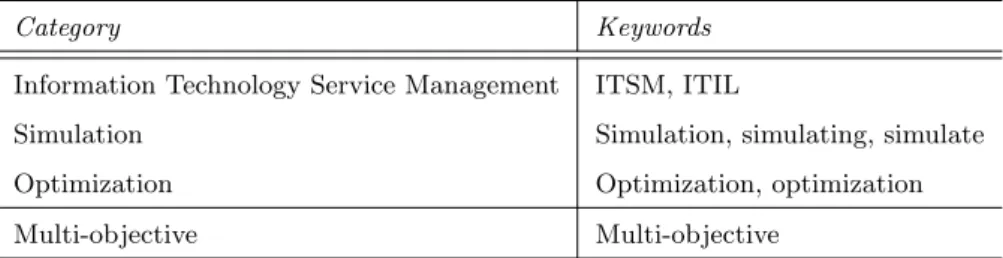
A set of different categories and keywords, together with their respective synonyms, acronyms, and alternative spellings was designed as shown in Table 1 with the keywords used for the searching process. When adding the keywordmulti-objective, there were no results.
The digital libraries (DL) where the searches were performed were: IEEE Xplore, ACM Digital Library, ScienceDirect, ISI Web of Knowledge, EI Compendex, SpringerLink, Inspec, Scopus and
165
Kluwer.
Only 14 papers where found by the searches conducted. In most of the papers retrieved, the term optimization is used in its most general meaning, far from any form of mathematical or meta-heuristic optimization. After removing three papers that were duplicated, the final number of papers retrieved in the search was 11. A first analysis of the papers retrieved, led us to discard 4
170
papers based on the fact that they were not properly related to the field of simulation optimization within the IT service management scope. This is the case of Xu et al [50], which describes the
current state and development plans for research and education on Services Sciences, Management and Engineering (SSME) in the Harbin Institute of Technology (HIT) or Amin et al [1], which introduces the ProCEMR method (Process-Centric Enterprise Modeling & Management) that
175
follows the process-centric application systems development style and integrates different services concerned with organization structure and IT applications to support, execute, or even automate the processes. Simulation and Optimization are among the components of this framework. They are also mentioned as part of the method described by Shrinivasan et al [43] that helps validate the intuitive direction and the polarity of a causal relationship among IT service Key Performance
180
Indicators (KPIs) and estimate the values of the KPIs. Finally, simulation is used as a means to assess a distributed IT management framework as described by Jiang [24].
The exclusion of these non-related works left us with only 7 papers that could be analyzed as truly related to the aim of our work, which is to find existing works that apply simulation-based optimization in the scope of IT service management, and more specifically the ITIL change process.
185
Most of the regular papers retrieved propose the use of simulation as a means to help decision- making or mitigate risks. The trade-off between energy-efficiency and resilience in communication networks is addressed by Cholda and Jaglarz [10] as a risk mitigation problem. In their work, the authors propose a method to find an optimal solution that mitigates risk by iteratively com- bining simulations and linear programming. The method is based on repeating a simplified risk
190
management cycle, where the optimization represents the risk control phase and the simulation represents the risk assessment. Risk mitigation and management is among the challenges of IT processes and among the priorities of IT governance activities carried out in organizations. Krey et al [27] deal with the importance of IT governance in the Swiss healthcare sector. They conclude that IT governance can help optimize the business processes in the medical as well as non-medical
195
areas of a hospital. This work highlights the importance of having specific process models for the health sector to optimize hospital strategies, making adequate business decisions and minimize risks. It does not propose any method of integrating simulation and optimization techniques in the IT processes of the healthcare sector and concludes with the necessity of carrying out a survey to find out the current status and spread of IT governance in the mentioned sector.
200
The incident management process has been the process that has attracted most of the research done applying simulation techniques. According to ITIL [22], incident management is“the process
through which IT support organizations manage to restore normal service operation after a service disruption”. Therefore, IT organizations need to measure the efficiency and effectiveness of their incident management strategies. Simulation can help design and assess the outcomes of different
205
strategies so that the organization can implement the ones that provide the best process results.
SYMIAN is a simulation -based decision support tool that helps to analyze and optimize the incident management process of IT support organizations [4]. SYMIAN is based on a discrete-event simulation model and therefore models the IT support organization as a queuing system. In their work, Bartolini and his colleagues introduce the tool and provide an experimental evaluation of
210
SYMIAN in a fictitious situation. Although the experimental results are intended to show how the tool optimizes the process outputs, there is no evidence of the application optimization techniques, and the results come from what seems to be scenario comparison rather than proper simulation optimization. In a later work [5], the same authors introduce HANNIBAL, a discrete-event sim- ulation tool that works together with SYMIAN for business impact analysis and improvement of
215
the incident management process. We share a similar motivation with this work since both initia- tives aim to find the values for process options that optimize the process outcomes. However, the simulation optimization methods used are substantially different. In [5], the user defines a set of business strategies and is interested in finding the one that best aligns with a business objective. A business objective is a function that can aggregate different objectives into a single function using
220
weights that represent the importance that the user gives to each objective. The tool performs a sequence of activities that starts with a complete simulation for each business strategy and calcu- lates its cost. After that, the optimization process consists on selecting the business strategy that has the best alignment to the business objective. In our approach, the user first sets the acceptable range for the decision variables and their constraints and then selects the outputs whose values
225
are to be either maximized or minimized together. Then, it is the multi-objective evolutionary algorithm, and not the user, who defines the best strategy, relying on simulations to obtain the process performance of all tentative solutions generated (i.e., process configurations). The process performance obtained by simulation is used to calculate the fitness of the tentative solution within the solution domain. Therefore, our approach does not evaluate several ad hoc strategies as in [5],
230
but it automatically generates and evaluates several tens of thousands of them.
Bartolini et al [6] deepen in the simulation modeling of a single IT support group. In this
case, the support group is modeled by using a discrete-event mode with multiple-priority queues.
This component is then integrated into SYMIAN simulation core to allow the users simulatewhat- if scenarios. In addition, the tool counts with an optimizer component materialized as an R
235
application. The optimizer allows to find the values for the model parameters that ”enable the most accurate reenactment of a real life support group”. To do that, the optimizer relies on a non- linear optimization algorithm based on the Limited memory Broyden-Fletcher-Goldfarb-Shanno (L-BFGS) algorithm [34] to minimize the Wilcoxon distance [34] between the simulation outputs and the real values collected from historic data. In this work, optimization is only used to guide
240
the inference of model parameters that make the simulation outputs reproduce closely the historic data collected, i.e. model calibration. The application of simulation-based optimization to improve process performance, which is our goal, is not among the aims of this work.
The remaining related works in the scope of the IT service management simulation optimization has been proposed by Orta et al [39], and Orta and Ruiz[38]. In their first work [39], the authors
245
offer a comprehensive review of the research papers that apply simulation modeling in the ITSM context, propose a decision-making framework based on simulation modeling to improve ITSM and illustrate the usefulness of this framework with two application cases including model simulations and optimization experiments to determine the optimal process configuration. In a following con- tribution, the authors propose a business-process and simulation-based method to support ITIL
250
implementation and present the results of an application case in the context of the incident man- agement process of a real company. In both works, the simulation optimization experiments were set in the scope of the ITIL incident management process and made use of the optimization engine implemented in OptQuestR to find the best process configuration that maximizes the number of incidents solved. These works serves as clear examples of single-objective simulation optimization
255
in the ITSM domain.
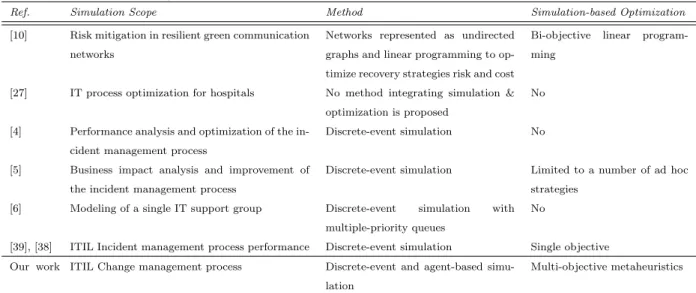
After the analysis of the previous works describing the use of simulation optimization in the scope of IT service management, we can conclude that this is a topic where very little research effort has been applied (see Table 2). In the small number of cases describing an application of simulation optimization, this has been of the single-objective category, despite the multi-objective
260
nature of the problem: in IT service management, it is usual that conflicting objectives (i.e., the KPIs) interact with each other in nonlinear ways. As a result, a multi-objective optimization
Table 2: Summary of relevant works related to ITIL Process optimization based on simulation
Ref. Simulation Scope Method Simulation-based Optimization
[10] Risk mitigation in resilient green communication networks
Networks represented as undirected graphs and linear programming to op- timize recovery strategies risk and cost
Bi-objective linear program- ming
[27] IT process optimization for hospitals No method integrating simulation &
optimization is proposed
No
[4] Performance analysis and optimization of the in- cident management process
Discrete-event simulation No
[5] Business impact analysis and improvement of the incident management process
Discrete-event simulation Limited to a number of ad hoc strategies
[6] Modeling of a single IT support group Discrete-event simulation with multiple-priority queues
No
[39], [38] ITIL Incident management process performance Discrete-event simulation Single objective Our work ITIL Change management process Discrete-event and agent-based simu-
lation
Multi-objective metaheuristics
approach seems to be more adequate in this domain. To the best of our knowledge, which is based on the findings of the systematic searches performed, our proposal is the first one that aims at using simulation-based multi-objective optimization to improve decision making in ITSM domain
265
and, more specifically, in the scope of the change management process.
3. Simulation Model for the ITIL Change Management Process
This section introduces briefly the change management process abstraction and describes the simulation model built following Law’s methodology [28]. The layout of the description is partly based on Kellner’s proposal for describing simulation models [26].
270
3.1. Process abstraction
This section provides a short introduction to the ITIL change management process with a focus on those aspects of the process that are especially relevant to the purpose of the model. A comprehensive description of the process can be found in the ITIL Service Transition Guide [36].
The ITIL definition of change is the addition, modification or removal of anything that could
275
have an effect on IT services [36]. Changes are requested by a formal proposal called RFC (Request for Change). A change can be requested by an individual or a business unit. ITIL describes three types of service change: a) Standard, a relatively common low-risk and pre-authorized change, b) Emergency, an urgent change to solve a critical situation, and c) Normal, a change that is neither
standard or urgent. Additionally, changes can be categorized depending on their cost and risk into
280
major, significant and minor changes. This classification helps identifying the suitable authority level to authorize and manage them. Once a RFC is produced, a change record is created. A change record is a record that contains all the information of the lifecycle of a particular change.
At a very high level, the ITIL change management process can be described as the processing and managing of change records from an open state to a closed state performed by different
285
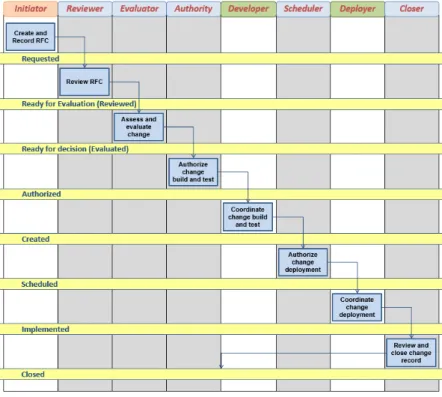
resources. Figure 1 shows the typical activities1 needed to manage an individual change, the roles involved in each one and the different states of the change lifecycle. These activities are: (a) Create and record the RFC; (b) Review the RFC, so that incomplete or wrongly routed changes can be consequently addressed; (c) Assess and evaluate the change, so that the business justification, impact, cost, etc. and relevant areas of interest and authority are evaluated; (d) Authorize the
290
change, so that the authorization/rejection for the change can be communicated, especially to the change initiator; (e) Plan updates, so that the scheduling information for task development and testing is completed; (f) Coordinate change implementation, so that the activities needed to implement the change are properly performed; and (g) Review and close change, so that the change and its documentation can be reviewed, the lessons learned gathered and the change can
295
be formally closed.
The coordinator of the change team and the main responsible for the process is the change manager who needs to ensure that all the activities are undertaken, documented and reviewed in an appropriate manner. The decisions of the change manager are supported by the Change Advisory Board (CAB) that gives approval to the requested changes and assistance in the assessment and
300
prioritization of changes.
3.2. Purpose and scope of the simulation model
The purpose of the simulation model is to help decision-making in the change process manage- ment of the service transition stage of the IT service lifecycle as defined by ITIL, with the aim of supporting decisions towards process efficiency. The model can be configured via a set of input
305
parameters to present the operational characteristics of real-world change management processes and provide output information related to the process typical Key Performance Indicators (KPIs).
1In order to provide an overall view of the process, the figure has been simplified. The implementation of the model takes into account the feedback loops in the management of each change.
Figure 1: ITIL change management process
Accordingly, the scope of the model is the whole of the process as described by ITIL: from change initiation to change closure.
3.3. Input parameters
310
The input parameters of the simulation model are used to tune the operation of the model to mimic that of the real-world change management process carried out in an organization. Different sets of parameter values enable the simulation of wide range of change processes using different scenarios. Since our intention is to make this simulation model highly configurable to simulate ITIL- based change management process from different organizations and be able to replicate multiple
315
adjustments to these change processes, the model accepts a large number of input parameters (a total of 136, between scalar and vectorial inputs). These input parameters help the model user tune the model to each particular process implementation, adjusting the model’s behavior to different situations and thus improving its flexibility. The model parameters have been selected by analyzing carefully the description of the IT service change process in the ITIL Service Transition guide [36]
320
and our experience with simulation model building for ITIL implementations [39, 38], with the aim
of providing a sufficiently flexible and highly adaptable model assuring that every parameter has a real-world counterpart.
In order to design the scenario the user is interested in simulating, the input parameters need to receive values. These values can be obtained from different sources. The most realistic simulation
325
outputs will be obtained when the model parameters are fed with real data that the organization has already collected. However, sometimes organizations do not count with either reliable data about the execution of their processes or the data available is not enough to provide all the input parameter values. In the absence of real data or in the case that the model is used to provide insights about a hypothetical situation, the users can provide subjective estimates for the model
330
inputs. On the other hand, when actual the data of the outputs of the model is available, running optimization experiments can help users to find the input parameters that fit such data, following what is known as a calibration process. Practically, the input parameters used to set a simulation experiment with this model are configured in an Excel spreadsheet that is loaded into the model at run time. Because it is not feasible to describe each of them individually in this paper, we outline
335
the different categories of inputs that the model accepts and provide some examples of parameters in each category.
• Change types. This group helps define the input stream of changes to be processed. Examples of inputs in this group are the change type, the change complexity factor and the range of configuration items affected by the change.
340
• Processing durations. The parameters grouped in this category help define the duration of each task of change processing, desegregated by change type and category. Providing an estimate for the duration of every task within a process execution implies a high level of uncertainty given the multiple factors of different nature that lead to a wide range of possible completion times. This is particularly true in tasks that can be performed within feedback
345
loops, like the ones in the service change process, since the number of repetitions of the task and the completion time of each execution is unpredictable. The problem of uncertain task durations has been traditionally overcome in management by estimating the probability distribution of the duration times. The triangular distribution of three-point distribution is commonly used to solve this estimation problem since it is easy to used and requires
350
only three estimates of minimum, most likely and maximum durations which should be
within the estimating capability of the IT manager [12, 29]. For this reason, tasks durations are modeled as a three-point estimation for the lower limit, upper limit and mode of a triangular distribution. At the beginning of a simulation run, the value for each task duration is stochastically calculated from its corresponding triangular distribution. The tasks included
355
in the model are the ones represented in Figure 1.
• Change resources. This group helps define the size and features of the resource pools available to process changes. Examples of inputs in this group are the number of change reviewers, the number of change developers, their processing efficiency, the number and timetable of each working shift and the resource allocation to working shifts.By processing efficiency, we
360
mean how well the processing task is performed, i.e. does it introduce errors or delays into the process? This is directly related to the skill of the resources performing the change processing tasks, i.e. how well they do their jobs. The value is provided as the probability that the resource has of introducing errors or delays in the process, measured in percent.
• Task parameters. This group helps define the tasks features such as their priorities in the
365
resource request queues. Examples of inputs in this group are the weighting factors applied to the priority of requests and to the priority of long running tasks, so that, during the simulation, resource monopolization can be avoided.
• Process decisions. This group of parameters help define the decisions made by the different roles with responsibility in the change management process, for instance, whether a change
370
is authorized or rejected. Examples of inputs in this group are the statistical distributions that define the activation probability of each decision component coded in the model imple- mentation.
There are other input parameters that help configure the general settings of the model such as the model time, the randomness etc. Since these are not particular inputs of the change process
375
management model, but general inputs applicable to every simulation model, they have not been described in this section.
3.4. Output variables
The output variables are the information elements needed to fulfill the purpose of the model.
Change process success can be studied under different and complementary dimensions. First, the
380
value dimension, which means that the process must assure the reduction of the negative impacts of change over the business. Second, the efficiency dimension, which means the process must be carried out in a timely and costly effective way. Third, the risk dimension, which means that changes must be handled in a risk-controlled way. Our simulation model is suitable to explore the efficiency dimension of the process as described above.
385
In order to provide meaningful outputs to help improve process efficiency, the outputs selected for this model are intended to serve as a basic for the calculation of the typical Key Performance Indicators (KPIs) suggested for the ITIL change management process [36]. It is important to notice that since this is a dynamic simulation model, the outputs do not only contain the values achieved at the end of the simulation, but are being updated dynamically during a simulation run. The user
390
interface of the model updates and represents graphically the evolution of the output variables selected by the user during the model run. The model outputs are grouped into the following categories:
• Change Counts by State. This category groups the outputs regarding the total number of change records that are currently in each change state (i.e. new, authorized, scheduled, etc.
395
See Figure 1 for the complete list of change states).
• Average Durations of Completed Changes by State. This category groups the outputs re- garding the 4M (Minimum, Maximum, Mean and Median) values for time that all completed change records have spent in each change estate.
• Percentage of Changes Completed on Time by Type. This category groups the outputs regard-
400
ing the ratio of changes completed on time divided by the total number of changes completed, both values separated by change type (i.e. major, significant, and minor).
• Percentage of Closed Changes by State. This category groups the outputs regarding the number of closed changes by state divided by the total number of closed changes.
• Number of Completed Changes by Type. This category groups the outputs regarding the
405
number of completed changes by type.
• Overall Percentage of Changes completed on Time. This category groups the outputs regard- ing the total number of changes completed on time divided by the total number of changes completed.
• Overall Process Step Count. This category groups the outputs regarding the 4M values for
410
the number of process steps taken by completed changes by change type.
• Change Duration. This category groups the outputs regarding the 4M values for the duration of all completed changes for each change type.
• Overall Actual/Predicted Duration Ratio. This category groups the outputs regarding the 4M values of the ratio of actual change duration divided by predicted duration for all completed
415
changes.
• Change Success Rate. Percentage of changes deemed successful at review/number of RFCs approved.
• Change Resource Utilization. This category groups the outputs regarding the percentage utilization of each resource type. It is measured as the ratio of the resources busy time
420
divided by its available working time.
• Total Change Hours Required. This category groups the outputs regarding the sum of the number of hours used per resource type across all work shifts.
For the aggregated variables, their values are based on a one-year window of data, i.e. at any moment in time the output variable value will be based on the last 365 days of a closed change
425
data.
3.5. Model implementation
The model is built under a multi method simulation approach with components built under the agent-based and the discrete-event simulation approaches. The AnyLogicTM modeling and simulation software has been used to seamlessly integrate these components into a single simulation
430
model. The combined usage of the different simulation methods allows us to take advantage of the strengths of each of the simulation approaches in modeling the ITIL change management pro- cess. After developing early prototypes under different simulation approaches (System Dynamics, Discrete-event and Agent-based), we decided that the agent-based approach was the most suitable to model the process. The early prototypes developed using the other simulation methods did not
435
provide as good representation of the reality of the change management process and resulted in excessively complex models, with little flexibility and difficult to update.
In this model, there are several agent types, each one representing each of the model’s logical sections. These agent types can be grouped logically into two groups: a) Change Record agent
type, and b) Change Processing Role agent type. The event- and time-driven behavior of the
440
agents in the model have been implemented using statecharts and action charts. Additionally, the discrete-event simulation method is used to implement the utilization of resources by the agents.
The following subsections provide detailed information about the different agent types and their behavior, as well as the different resource pools of the discrete-event model.
3.5.1. Change Record agents
445
In ITIL, a Change Record is created after receiving an RFC. It contains all the information regarding a single change and it is updated as the change lifecycle progresses. In our model, whenever an RFC is received, a new Change Record agent of the Change Record agent type is created and instantiated with the data of the RFC.
A Change Record agent type is implemented by two statecharts. Figure 2 shows the statechart
450
that describes the Change Record agent lifecycle. This statechart is based on the process flow for a normal change suggested by ITIL [36]. The boxes represent all the attainable states for a change record and the arrows represent all the allowable transitions between those states. Both forward and backward transitions between states are included to cover all possible outcomes (i.e.
successful or non-successful) in the normal change process. Composite states have been added to
455
give a logical grouping of states and to add clarity to some of the state transitions. Additionally, a second statechart is used to control the processing steps inside each change lifecycle state (see Figure 3). This statechart keeps track of the progress of its enclosing change record. It allows processing to be paused (e.g. due to the end of the scheduled working periods or interruptions to process higher priority tasks), resumed again at a later time (e.g. when a suitable resource is
460
available), until it is verified that the processing step has completed.
3.5.2. Change Processing Role agents
There are seven generalized roles that describe the tasks in the ITIL change management process: 1) initiator, who raises the request for a change, 2) practitioner, who submits requests for evaluation, 3) approver, who formally authorizes changes, 4) scheduler, who plans and schedule
465
changes, 5) developer, who procure, develop, build and test whatever is needed for the change, 6) deployer, who take built and tested solutions and implement them in the target environment, and 7) closer, who reviews the change and formally closes it. A comprehensive list of the tasks
Figure 2: Change Record agent type — Lifecycle statechart
Figure 3: Change Record agent type — Processing steps statechart
performed by each role can be found in the ITIL Service Transition guide [36].
To model the tasks performed by each change processing role, a particular agent type, with
470
its correspondent statecharts, has been created. Change record processing is carried out by a population of agents of these agent types. For a given change, its current state change record lifecycle state determines which change processing role and therefore which change processing agent should be processing the change to make it progress to the next lifecycle state.
To add realism, task processing within the simulation model can only occur when there are
475
resources available and only during the resource’s scheduled work times. The agents compete with each other to obtain resources from their assigned resource pools in order to perform the required change processing tasks on the change records. The model reproduces the common situation that occurs when the processing of longer running tasks get interrupted by higher priority tasks and lower priority tasks have to wait for others to complete before they can be advanced. In addition,
480
at the end of each scheduled work period, processing will stop and will not start again until the start of the next scheduled period.
3.5.3. Change Processing resources
In the model, each of the change roles requiring change management resources sends a resource request to a queue. From there, as resources become available, the resource requests are selected in
485
priority order, the resource is assigned and the task processing is performed. When the processing of the task has completed, the resource is released and becomes available again for any other queued requests. This queuing and task assignment functionality has been developed as a discrete-event model and embedded inside the agent-based model.
Each resource pool is constrained by the number of people compromising the group and by
490
the group work schedule. The actual number of resources in each resource pool and their different shifts are configured using the input parameters of the model and thus can be varied during the simulation experiments.
During a simulation run, the user interface represents the real-time evolution of the main output variables as well as allows the user to make changes to the most relevant input parameters so that
495
questions of theWhat if...? type can be analyzed.
Simulation modeling serves as a valuable technique towards ITIL implementation, especially in the process design, analysis and improvement phases [38]. In the particular case of the change
management process, the model presented in this work enables the IT change manager to perform different types of simulation studies such as interactive simulations, parameter variation experi-
500
ments, sensitivity analyses and optimization experiments that can help such managers improve their decisions in real-life situations, such as deciding on the prioritization strategies applied to evaluate the change requests, the size and features of the resources used or the activities designed to improve the duration of the change processing tasks.
4. Metaheuristics and Simulation-based Optimization
505
Metaheuristics [46] are a family of approximate techniques for solving optimization problems, capable of providing accurate solutions to difficult problems in reasonable time. Evolutionary Algorithms (EAs) are particularly suitable metaheuristics to solve Multi-objective Optimization Problems (MOP) [13]. One reason for that is that they deal simultaneously with a set of tenta- tive solutions (the so-called population) that is evolved, allowing them to capture the dominance
510
relations among solutions, helping to efficiently guide the search towards the Pareto-optimal front.
Indeed, EAs can find good approximations of Pareto optimal set in a single run [13].
4.1. Metaheuristics Algorithms
As previously stated, a large number of problems within the software engineering domain can be solved with metaheuristic techniques. Among their many different applications, they can be used to
515
solve MOP, which are those involving multiple and conflicting objective functions simultaneously.
In general, the solutions for MOPs form a Pareto front of non-dominated solutions, which can be formally defined as follows.
Given the minimization of n components fk, k = 1, . . . , n, of a vector function f of a vector variablex in D, i.e.,f(x) = (f1(x), . . . , fn(x)), and subject to inequality and equality constraints
520
(gj(x)≥0, j = 1, . . . , J andhk(x) = 0, k= 1, . . . , K):
Definition 1. Pareto Dominance. A vector ~u= (u1, . . . , uk) dominates a vector~v= (v1, . . . , vk), denoted by~u~v iff~uis partially less than~v, i.e.,∀i∈(1, . . . , k), ui ≤vi∧ ∃i∈(1, . . . , k) :ui < vi
(assuming minimization of all objectives).
ThePareto frontis the set of optimal solutions, for which no objective can be improved without
525
worsening at least one of the other objectives.
We have selected two well-known multi- objective evolutionary algorithms from the literature to solve the proposed problem, NSGA-II [14] and SPEA2 [53]. Although, there are more recent algorithms discussed in the literature, these two are among the most frequently used, and are still considered state of the art even though they were published more than fifteen years ago.
530
The Non-dominated Sorting Genetic Algorithm II, NSGA-II [14], is a Genetic Algorithm (GA) that assigns a fitness value to individuals according to their dominance level (through Ranking method) and diversity (thanks to Crowding technique). In every generation, a new population (with the same size as the original one) is created through the iterative application of the genetic operators. The next generation population is created by merging the two populations using the
535
Ranking and Crowding methods to select the most promising solutions for the search process.
Ranking orders solutions according to the dominance concept. Crowding assigns higher fitness to those solutions that are more isolated, representing the areas of the Pareto front approximation that are less explored.
The Strength Pareto Evolutionary Algorithm 2, SPEA2 [53], makes use of an external archive
540
to store the best non-dominated solutions found. The size of the archive is limited, therefore the algorithm implements a mechanism to keep the most promising solutions when it becomes full.
For that, the strength of individuals is defined in terms of the number of other individuals they dominate in the population. A fitness value is assigned to every individual, computed as the sum of its strength raw fitness and a density estimation, so that individuals with the lowest fitness can
545
be discarded, if needed. The algorithm evolves the population through the iterative application of the variation operators on the individuals, storing all generated non-dominated solutions in the archive. After every generation, the population of the next generation is built from the current population and the archive, using the previously defined fitness to discard less promising solutions.
In this work, we use the implementation provided by the jMetal2framework [16], a metaheuristic
550
algorithm framework that implements many of the current state of the art MOEAs, including NSGA-II and SPEA2. We also used the parameter settings proposed in the original papers, with the exception of the population and archive sizes that was set to 50 solutions. The termination condition of the algorithms was set to 5,000 iterations.
2https://github.com/jMetal/jMetal
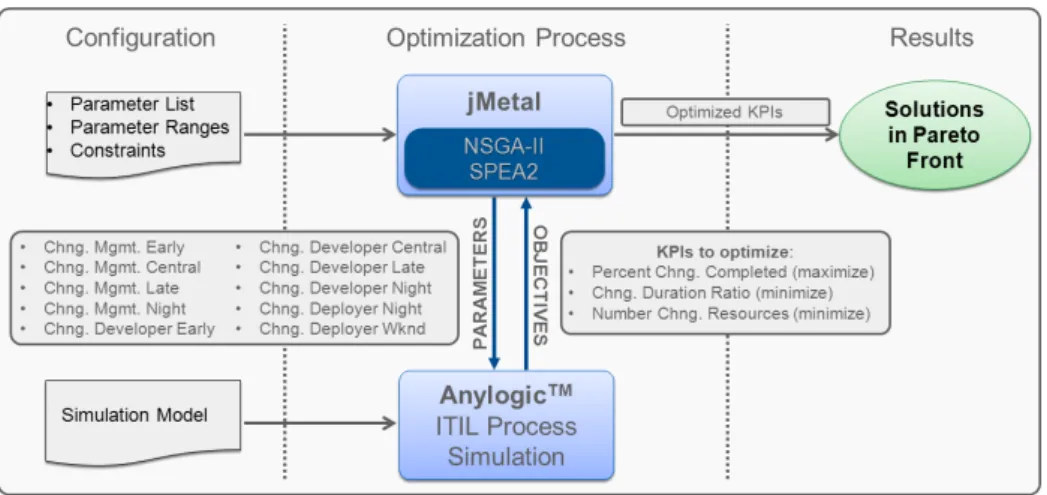
Figure 4: Interaction between jMetal and AnylogicTM
4.2. Linking AnylogicTM and jMetal
555
The interaction we built between AnylogicTM simulator and jMetal optimization framework is show in Figure 4. As previously said, we use in this work NSGA-II and SPEA2 algorithms, among those provided in jMetal. These algorithms follow an iterative process in which new solutions (a solution in our context is an assignment of values to the decision variables, presented later in Table 3) are continuously being created by applying stochastic genetic operators on the solutions
560
in the population. Every time a new solution is generated, AnylogicTM parameters are configured as described by the solution, and the simulation is run. Once the simulation is finished, jMetal takes the values of the defined KPIs from AnylogicTM, and use them as the fitness of the solution.
The communication between jMetal and AnyLogicTMis carried out using the Google Protocol Buffers3 to serialize the data to be exchanged between both applications as a TCP/IP client-server
565
framework. In this way, AnyLogicTM acts as the server and, after starting the execution, executes via shell command the jMetal experiment and waits for a jMetal message. When AnyLogicTM re- ceives a jMetal message, it runs a simulation experiment with the received variables and returns the simulation output to jMetal, that waits for the simulation results in order to evaluate the solution.
This loop is repeated until jMetal reaches the stopping criteria and closes the communication. This
570
approach has been also applied by other authors such as Beham et al [7] to link AnylogicTM with HeuristicLab4, another optimization framework.
3https://developers.google.com/protocol-buffers/
4http://dev.heuristiclab.com/
5. Experimental Work
In this section, we describe the experimental work carried out to perform multi-objective sim- ulation optimization on the simulation model created. First, we introduce the motivation and
575
formulation of the problem; next, we show the optimal solutions found by both (i) AnylogicTM(as standalone tool with its built-in optimizer) and (ii) combining AnylogicTM and jMetal for multi- objective simulation optimization.
5.1. Problem formulation
ITIL recommends each organization to define their own Critical Sucess Factors (CSFs) to
580
achieve their particular mission, objectives or goals. The ITIL Service Transition Glossary defines a CSF as“Something that must happen if a Process, Project, Plan, or IT Service is to succeed”[36].
Basically, a CSF can be understood as a hig-level goal critical for the success of the organization.
Given the strategic nature of CSFs, they are often tracked and measured in terms of a set of Key Performance Indicators (KPIs). KPIs can be defined as the most important metrics used to report
585
on process performance that contribute to measure the achievement of CSFs. Thus each CSF will have a small set of KPIs associated. Frequently, CSFs are qualitative and meant to answer the question What should be done to achieve success? Complementarily, KPIs are quantitative and meant to answer the questionAre we successful?
For the purpose of this study, we will consider an IT service organization with a set of CSFs
590
defined. Let us assume that among their CSFs, there is one related to delivering process efficiency.
This decision is based upon the widely accepted assumption that every organization should success in delivering efficient processes.
The problem of IT change process efficiency can be defined as another instance of the well- known time-cost-quality triangle, in which three conflicting factors need to be optimized in order
595
to achieve efficiency [2, 23]. Under this consideration, the KPIs that can be associated with delivering an effective IT service change process are:
• KPI 1: Percentage of changes completed successfully within the time estimates, as a measure of the time factor. The higher the value of this KPI, the better for the process efficiency.
• KPI 2: Actual change duration/estimated change duration, as a measure of internal quality.
600
The lower the value of this KPI, the better for the process efficiency.
• KPI 3: Overall number of resources utilized, as a measure of cost. The lower the value of this KPI, the better for the process efficiency.
Before using the simulation model to show how multi-objective simulation optimization can help decision-makers achieving efficiency-based CSF, it is necessary to establish the simulation
605
scenario that will serve as the foundation for this experiment. One of the critical decisions that change process managers need to make relates to the configuration of the process staff, as different staff configurations may lead to different outcomes. We assume that the staff involved in the fulfillment of the change management process have the following roles (besides the initiator, the practitioner, the approver,a and the closer): a) change management, b) change developer, and c)
610
change deployer. For each role, let us assume there are four possible basic shifts:
• Central, from 9 am to 6 pm, with one-hour break at 1 pm.
• Early, from 6 am to 3 pm, with one-hour break at 10 am.
• Late, from 2 pm to 11 pm, with one-hour break at 6 pm.
• Night, from 10 pm to 7 am, with a break at 2 am.
615
For change developers, there is a special shift:
• Weekend, Saturdays and Sundays, 7 am to 10 pm, with one-hour breaks at noon and 5 pm.
We are interested in finding the optimal combination of staff resulting in the best possible solution towards the achievement of the CSF measured in terms of the KPIs previously described.
An optimization process can help in finding these values by running repetitive simulations of the
620
model, each with different values in the input parameters and locating the values that solve the problem. For this particular study, the optimization parameters, i.e., decision variables, selected are the ones defining the number of people per role who are working on each of the working shifts.
In order to propose a realistic simulation scenario, and based on our own experience, we set the problem variables and their range of allowed values as listed below. However, users will probably
625
need to adjust the values of these parameters in order to tailor the simulation to his/her own particular needs.
• Bounds for change management central staff: cmC ∈[1,3]
• Bounds for change management early staff: cmE∈[0,2]
• Bounds for change management late staff: cmL∈[0,2]
630
• Bounds for change management night staff: cmN ∈[0,1]
• Bounds for change developer central staff: cDvC ∈[3,14]
• Bounds for change developer early staff: cDvE∈[0,1]
• Bounds for change developer late staff: cDvL∈[0,11]
• Bounds for change developer night staff: cDvN ∈[0,3]
635
• Bounds for change deployer night staff: cDpN ∈[1,5]
• Bounds for change deployer weekend staff: cDpW ∈[1,5]
Not every combination of values for the optimization parameters is acceptable in a real-life situation. For this reason, we also need to add some constraints upon the values of the optimization parameters. The constraints set for the optimization experiments performed is formally defined as:
640
• The change management staff cannot exceed 3 workers: cmC+cmE+cmL+cmN ≤3
• The change developer staff cannot exceed 14 workers: cDvC+cDvE+cDvL+cDvN ≤14
• The change deployer staff cannot exceed 6 workers: cDpN +cDpW ≤6
Formally, our problem is defined as the optimization of the following three functions:
fKP I1= arg max
P|C|
i=1xi
|C| ×100
xi =
1 ifti ≤eti 0 otherwise
(1)
645
fKP I2= arg min
|C|
X
i=1
ti
eti
(2)
fKP I3= arg min{cmC+cmE+cmL+cmN+cDvC+cDvE+cDvL+cDvN+cDpN+cDpW}
(3) where C is the set of required changes,ti is the real time required to process change i and eti is the estimated time to process changei.
It is important to note that, as described in Section 3.3, the number of working shifts, their
650
respective timetable and the allocation of staff to each shift can be configured by using the different input parameters of the simulation model. The values shown in this section are only intended to
Figure 5: AnylogicTMoptimization via OptQuestTMsoftware
illustrate a possible configuration of the process within an IT organization that is based on the authors’ experience and the information found in the available literature. Similarly, the configura- tion of the parameters range and constraints is also illustrative and can be adapted to the values
655
of interest in any given particular situation.
5.2. AnylogicTM optimization
AnylogicTM simulation software comes with OptQuestTM 5 optimization engine. This opti- mization tool helps to find the values of model parameters that maximize or minimize the model’s objective function. Figure 5 depicts this process.
660
We used AnylogicTMoptimization facilities to find a solution for the problem previously stated.
However, the type of simulation-based optimization problem that one can solve with AnylogicTMfalls in the category of single-objective optimization. For this reason, we created a simulation optimiza- tion experiment in AnylogicTM that minimizes the total number of staff involved in the change process, while assuring that at least 90% of the changes are completed on time.
665
5.3. Multi-objective optimization
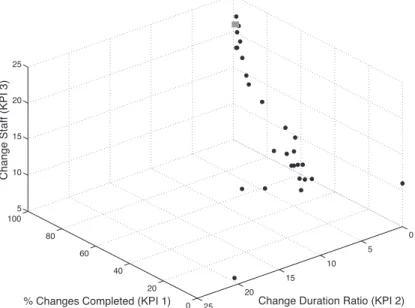
We executed six independent runs of NSGA-II and SPEA2 to find accurate trade-off solutions to our problem. The simulation process is shown in Figure 4. From all the solutions found in the different runs of the two algorithms, we built a single Pareto front containing all best non- dominated solutions. The resulting Pareto front is composed of 27 highly accurate solutions, and
670
it is shown in Figure 6 (the solution provided by the optimizer embedded in AnylogicTMis plotted as a gray square for reference). In this figure, we can observe that 89% of the solutions require a change duration ratio less than 5.0. Additionally, it can be seen that those solutions with the highest percentage of changes completed are, as it could be expected, the more expensive ones
5http://www.opttek.com/OptQuest
0 20 40 60 80 100
0 5 10 15 20 25 5
10 15 20 25
Change Duration Ratio (KPI 2)
% Changes Completed (KPI 1)
Change Staff (KPI 3)
Figure 6: Pareto front of the best non-dominated solutions found. The solution found by AnylogicTM optimizer is represented as a gray square.
(i.e., the ones requiring the highest number of staff). The solutions with more than 80% changes
675
completed on time require at least 15 persons.
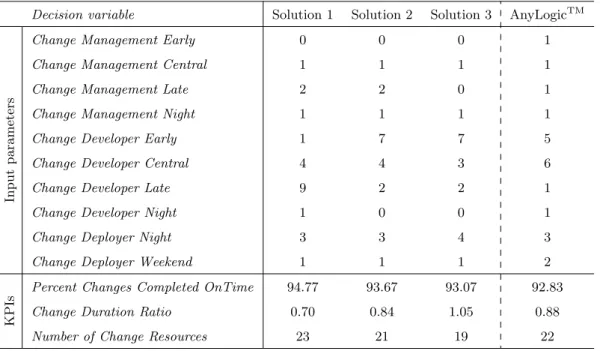
Furthermore, we are interested in analyzing our solutions, and compare them versus the one reported by AnyLogicTM. To so so, we select a subset of three solutions we consider interesting, out of the 27 ones in the Pareto front approximation we computed, just like a decision maker would do. We also defined and followed some ad hoc criteria. The selected solutions are shown in Table 3,
680
and we consider they are interesting solutions for the organization for the following reasons:
• Solution 1. The one with the best percentage of completed changes on time (KPI 1).
• Solution 2. We first select the 30% best solutions from the Pareto front, according to the percentage of changes completed on time (KPI 1). From those solutions, we keep the 30%
best solutions that minimize the duration ratio (KPI 2). Finally, from this resulting set, the
685
solution that needs the minimum number of staff was selected as Solution 2 (KPI 3).
• Solution 3. We choose the 30% best solutions from the Pareto front in terms of the duration ratio (KPI 2) and, among them, we further select the 30% best solutions guided by the number of staff were selected (KPI 3). Solution 3 is the one maximizing the percentage of changes completed on time (KPI 1) from the selected ones.
690