Neotropical Helminthology, 2023, vol. 17 (2), XX-XX.
1
DOI: http://dx.doi.org/10.24039/rnh20231721650 2
Este artículo es publicado por la revista Neotropical Helminthology de la Facultad de Ciencias Naturales y Matemática, Universidad
3
Nacional Federico Villarreal, Lima, Perú auspiciado por la Asociación Peruana de Helmintología e Invertebrados Afines (APHIA).
4
Este es un artículo de acceso abierto, distribuido bajo los términos de la licencia Creative Commons Atribución 4.0 Internacional (CC
5
BY 4.0) [https:// creativecommons.org/licenses/by/4.0/deed.es] que permite el uso, distribución y reproducción en cualquier medio,
6
siempre que la obra original sea debidamente citada de su fuente original.
7
8 9
SPECIES OF MONOGENOIDEA FROM CICHLIDS WITH COMMERCIAL 10
IMPORTANCE IN THE PERUVIAN AMAZON 11
ESPECIES DE MONOGENOIDEA DE CÍCLIDOS CON IMPORTANCIA COMERCIAL 12
EN LA AMAZONIA PERUANA 13
Germán Augusto Murrieta-Morey1,2*; Kevin Morgan Ruiz-Tafur1; Alana Lislea de 14
Sousa 2; José Lisbinio Cruz-Guimaraes3; Carlos Alfredo Tuesta Rojas4; Linda 15
Julissa Hualinga Vela4; Shachy Marcela Chucuya Garcia4; Hilmer Angélica Dávila 16
Pizango4; Manuel Enrique Navas Vásquez4; Rossana Cubas Guerra4 & Enrique 17
Ríos Isern4 18
19
1Instituto de Investigaciones de la Amazonía Peruana (IIAP), Laboratorio de 20
Parasitología y Sanidad Acuícola, Iquitos, Loreto-Peru, Carretera Iquitos-Nauta, Km 21
4.5 – San Juan Bautista, Iquitos, 0784, Loreto, Perú. [email protected] / 22
2 Universidade Estudual do Maranhão (UEMA). Programa de Pós graduação em 24
Ciência Animal (PPGCA), Cidade Universitária Paulo IV, São Luis, 65055-310, 25
Maranhão-Brasil. [email protected] 26
3Universidad Científica del Perú, Av. José A. Quiñonez, Km 2.5 – San Juan Bautista, 27
16007, Iquitos, Loreto-Peru. [email protected] 28
4Universidad Nacional de la Amazonía Peruana (UNAP), Sargento Lores, 385, 16002, 29
Iquitos, Loreto-Peru. [email protected] / [email protected] / 30
[email protected] / [email protected] / 31
[email protected] / [email protected] / 32
*Corresponding author: [email protected] 34
35
Titulillo: Monogenoidea from cichlids in the Peruvian Amazon 36
37
Germán Augusto Murrieta-Morey: https://orcid.org/0000-0001-6244-2654 38
Kevin Morgan Ruiz-Tafur: https://orcid.org/0000-0002-8412-7564 39
Alana Lislea-de Sousa: https://orcid.org/0000-0002-0920-2560 40
José Lisbinio Cruz-Guimaraes: https://orcid.org/0000-0002-9497-0037 41
Carlos Alfredo Tuesta-Rojas: https://orcid.org/0000-0002-1961-3574 42
Linda Julissa Hualinga-Vela: https://orcid.org/0009-0005-3642-8222 43
Shachy Marcela Chucuya-Garcia: https://orcid.org/0009-0002-2311-8709 44
Hilmer Angélica Dávila-Pizango: https://orcid.org/0009-0003-0100-2366 45
Manuel Enrique Navas-Vásquez: https://orcid.org/0009-0008-1448-2334 46
Rossana Cubas-Guerra: https://orcid.org/0000-0002-3745-4861 47
Enrique Ríos-Isern: https://orcid.org/0009-0005-6277-6941 48
49 50
51
ABSTRACT 52
In the Peruvian Amazon, species of the Cichlidae constitute a valuable resource for 53
fisheries and aquaculture activities. Due to the importance of cichlids in this region 54
and the constant interest in conduct studies focused on the biodiversity of 55
monogenoids, the present study aimed to present a checklist of monogenoids from 56
the gills of cichlids with importance in aquaculture in the Peruvian Amazon. Thirteen 57
species of cichlids were analyzed from November 2020 to May 2023 from different 58
water bodies in the Peruvian Amazon. There were identified five species of Gussevia 59
Kohn & Paperna, 1964; eight morphospecies of Gussevia (Gussevia sp. 1 to sp. 8);
60
four species of Sciadicleithrum Kritsky, Thatcher & Boeger, 1989; eight 61
morphospecies of Sciadicleithrum; one species of Biotodomella Morey, Arimuya &
62
Boeger, 2019 and one species of Trinidactylus Hanek, Molnár & Fernando, 1974.
63
Taxonomic studies should continue in order to describe the 16 morpho-species 64
recorded in this investigation, contributing to the knowledge of the biodiversity of 65
monogenoids in the Peruvian Amazon.
66
Keywords: Cichlidae – ectoparasites – gills – monogenoids – pisciculture 67
68
RESUMEN 69
En la Amazonía peruana, las especies de Cichlidae constituyen un valioso recurso 70
para las actividades pesqueras y acuícolas. Debido a la importancia de los cíclidos 71
en esta región y al constante interés en realizar estudios enfocados en la 72
biodiversidad de monogénoideos, el presente estudio tuvo como objetivo presentar 73
una lista de verificación de monogénoideos de las branquias de cíclidos con 74
importancia en la acuicultura de la Amazonía peruana. Se analizaron 13 especies de 75
cíclidos desde noviembre del 2020 hasta mayo del 2023 de diferentes cuerpos de 76
agua de la Amazonía peruana. Se identificaron cinco especies de Gussevia Kohn &
77
Paperna, 1964; ocho morfoespecies de Gussevia (Gussevia sp. 1 a sp. 8); cuatro 78
especies de Sciadicleithrum Kritsky, Thatcher & Boeger, 1989; ocho morfoespecies 79
de Sciadicleithrum; una especie de Biotodomella Morey, Arimuya & Boeger, 2019 y 80
una especie de Trinidactylus Hanek, Molnár & Fernando, 1974. Los estudios 81
taxonómicos deben continuar para describir las 16 morfoespecies registradas en 82
esta investigación, contribuyendo al conocimiento de la biodiversidad de 83
monogénidos en la Amazonía peruana.
84
Palabras claves: branquias – Cichlidae – ectoparásitos –monogenoideos – 85
piscicultura 86
87
INTRODUCTION 88
In the last five years in the Peruvian Amazon, various studies have been 89
carried out in order to identify monogenoids from fish gills; thus; fish species have 90
been captured from natural environments such as rivers, lakes, streams, ponds, as 91
well as samples of fish from pisciculture and city markets (Acosta et al., 2019;
92
Mendoza-Palmero et al., 2019; Morey et al., 2019a; Morey et al., 2019b; Morey et al., 93
2020a; Morey et al., 2020b; Mendoza-Palmero et al., 2020; Morey, 2021; Morey et al., 94
2021a; Morey et al., 2021b; Quispe et al., 2021; Feronato et al., 2022; Chota et al., 95
2022; Morey et al., 2023; Olortegui-Zegarra et al., 2023).
96
Fish are an important resource for Amazonian inhabitants. These are used as 97
a source of animal protein and also as resources to generate economic income 98
through their sale, both in the fish market for human consumption and in the 99
ornamental market (Garcia et al., 2021). The latter generates millions of dollars 100
annually in fish export activities from the Peruvian Amazon to different countries in 101
North America, Europe and Asia (Garcia et al., 2021).
102
According to Garcia et al. (2018), 78 species of fish are sold in city markets as 103
meat for human consumption. Of the total number of registered species, eight 104
correspond to cichlids. In addition to fish farming for the production of animal protein, 105
Garcia et al. (2021) mention the ornamental activity, with 212 fish species reported;
106
among which, 54 correspond to ornamental cichlids (Garcia et al., 2021).
107
Cichlids are fish of colorful colors, different sizes and shapes, being highly 108
appreciated by aquarists and hobbyists throughout the world. The capture, breeding, 109
management and commercialization of these fish generates an interesting flow in the 110
Peruvian Amazon that links the fisherman with the collectors, exporters and 111
importers (Garcia et al., 2021). This flow constitutes for many Amazon families, a 112
form of economic income for their livelihood, so it is important to know the parasites 113
present in these fish, creating information baselines that allow not only to know the 114
existing biodiversity, to identify and describe new species of parasites, but also, 115
allow further studies of ecology, control and prevention of parasitic diseases, among 116
others (Garcia et al., 2021)..
117
Among the main risks identified in the aquaculture activity in the Peruvian 118
Amazon, health problems caused by infestations of monogenoids (Monogenoidea) 119
stand out (Morey, 2019). This group of parasites can cause various damage to the 120
gills, leading the fish to die from suffocation. Thus, due to the importance of cichlids 121
in the Peruvian Amazon and the constant interest in conduct studies focused on the 122
biodiversity of monogenoids, the present study aimed to present a checklist of 123
monogenoids from the gills of cichlids with importance in aquaculture in Loreto, 124
Peru.
125 126
MATERIAL AND METHODS 127
Fish host species were obtained from November 2020 to May 2023 from 128
different water bodies in the Peruvian Amazon. Excursions were made as part of 129
researches focused on the registration and identification of monogenoids from the 130
gills of cichlids with commercial importance in the Peruvian Amazonia. Some of the 131
collected species are used in aquaculture for human consumption and others are 132
important as ornamental fish, being exported from Iquitos-Peru to different countries 133
around the world.
134
Thirteen species were collected: the bigeye cichlid Acaronia nassa (Heckel, 135
1840), the saddle cichlid Aequidens tetramerus (Heckel 1840), the greenstreaked 136
eartheater Biotodoma cupido (Heckel 1840), the bujurquina Bujurquina 137
peregrinabunda Kullander 1986, the peacock bass Cichla monoculus Spix & Agassiz 138
1831, the amazon cichlid Cichlasoma amazonarum Kullander 1983, the red-finned 139
Pike Crenicichla johanna Heckel 1840, the severum Heros efasciatus Heckel 1840, 140
the emerald cichlid Hypselecara temporalis (Günther 1862), the flag cichlid 141
Mesonauta mirificus Kullander & Silfvergrip 1991, the angel fish Pterophyllum 142
scalare (Schultze 1823), the demon eartheater Satanoperca jurupari (Heckel 1840) 143
and the discus Symphysodon tarzoo Lyons 1959. Morphological characters were 144
used for the taxonomical identification of fish-hosts, according to Garcia et al. (2018;
145
2021).
146
Fish were kept alive until their parasitological examination. In the laboratory, 147
gill archers were removed and placed in vials containing hot water (65 °C). Each vial 148
was shaken vigorously and 96% ethanol was added. The content of each vial was 149
examined using a dissecting microscope and helminths were removed from the gills 150
or sediment using dissection needles. Some specimens were mounted on slides 151
using Hoyer’s medium to determine the haptoral structures (bars, anchors and 152
hooks) and male copulatory organ (MCO) and the accessory piece. Others 153
specimens were stained with Gomori’s trichrome (Humason, 1979; Boeger & Vianna, 154
2006) and mounted in Canada balsam to determine internal organs. Some specimens 155
were preserved in ethanol 96%for future DNA analyses. All procedures were 156
conducted in the “Laboratorio de Parasitología y Sanidad Acuícola” of the “Instituto 157
de Investigaciones de la Amazonía Peruana” (IIAP) in Iquitos, Peru. Pictures of the 158
parasites were taken by using a digital camera LEICA ICC50 W attached to a 159
microscope LEICA DM750. Data were processed by using a LEICA Application Suite 160
(LAS) EZ.
161
Vouchers of parasites were deposited in the collection of parasites belonging 162
to “Laboratorio de Parasitología y Sanidad Acuícola” from “Instituto de 163
Investigaciones de la Amazonía Peruana (IIAP), Iquitos, Loreto-Peru.
164
Ethic aspects: Statement on ethical approval from an ethics committee and 165
license for working with fish species were followed according to the following 166
resolutions: Resolution No132-2014-GRL-DIREPRO; Resolution No21-2016 GRL- 167
DIREPRO; and PTH-068-16-PECSANIPES.
168 169
RESULTS 170
List of Monogenoidea by host belonging to CICHLIIFORMES: CICHLIDAE 171
172
Host: Acaronia nassa (Heckel, 1840) 173
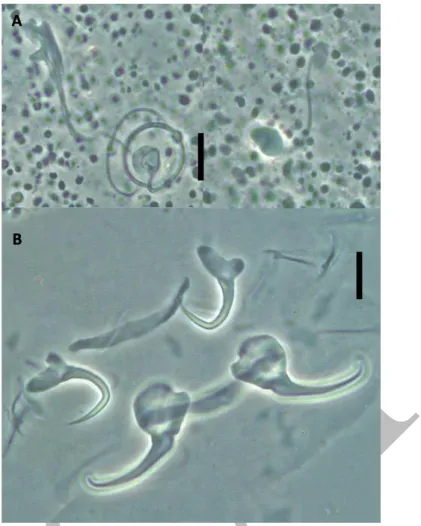
Gussevia sp. 1 (Fig. 1) 174
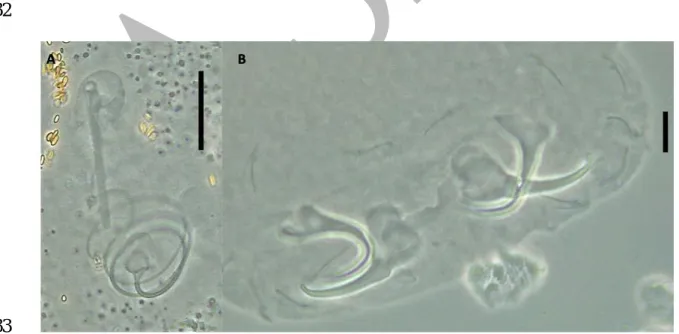
Gussevia sp. 2 (Fig. 2) 175
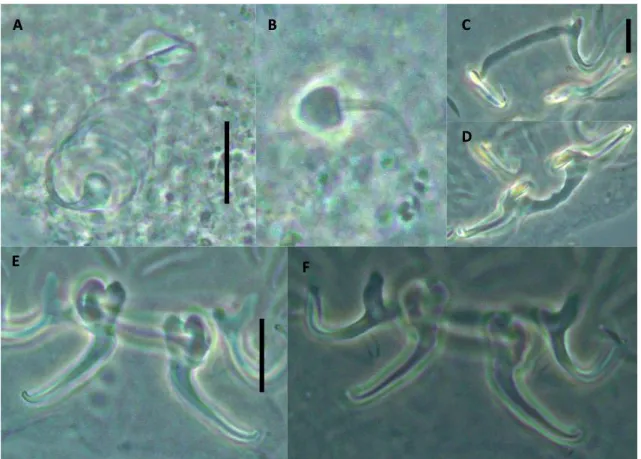
Gussevia sp. 3 (Fig. 3) 176
Locality: Huachana pond, Nanay River (3°43'43.50"S, 73°16'38.22"W) 177
178
Host: Aequidens tetramerus (Heckel, 1840) 179
Gussevia cichlassomatis (Molnár, Hanek & Fernando, 1974) (Fig. 4) 180
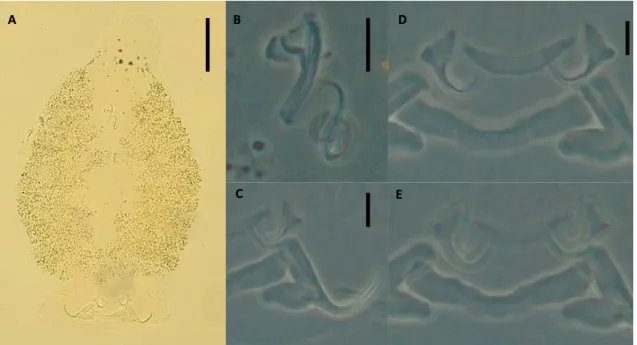
Gussevia sp. 4 (Fig. 5) 181
Gussevia sp. 5 (Fig. 6) 182
Sciadicleithrum sp. 1 (Fig. 7) 183
Locality: Lindero stream, Nanay River (3°55'16.31"S, 73°22'14.16"W) 184
185
Host: Biotodoma cupido (Heckel, 1840) 186
Biotodomella mirospinata Morey, Arimuya & Boeger, 2019 (Fig. 8) 187
Sciadicleithrum sp. 2 (Fig. 9) 188
Locality: Shiruycaño pond, Nanay River (3°45'2.10"S, 73°17'16.28"W) 189
190
Host: Bujurquina peregrinabunda Kullander, 1896 191
Sciadicleithrum sp. 3 (Fig. 10) 192
Sciadicleithrum sp. 4 (Fig. 11) 193
Locality: Tanshi Stream (3°54'33.85"S, 73°24'37.65"W).
194 195
Host: Cichla monoculus Spix & Agassiz, 1831 196
Sciadicleithrum umbilicum Kritsky, Thatcher & Boeger, 1989 (Fig. 12) 197
Locality: Huachana pond, Nanay River (3°43'43.50"S, 73°16'38.22"W).
198 199
Host: Cichlassoma amazonarum Kullander, 1983 200
Gussevia cichlassomatis (Molnár, Hanek & Fernando, 1974) (Fig. 13) 201
Gussevia alii (Fig. 14) 202
Gussevia sp. 6 (Fig. 15) 203
Gussevia sp. 7 (Fig. 16) 204
Sciadicleithrum variabilum (Mizelle & Kritsky, 1969) (Fig. 17) 205
Trinidactylus cichlasomatis Hanek, Molnár & Fernando, 1974 (Fig. 18) 206
Locality: Huachana pond, Nanay River (3°43'43.50"S, 73°16'38.22"W) 207
208
Host: Crenicichla johanna Heckel, 1840 209
Sciadicleithrum sp. 5 (Fig. 19) 210
Sciadicleithrum sp. 6 (Fig. 20) 211
Locality: Huachana pond, Nanay River (3°43'43.50"S, 73°16'38.22"W) 212
213
Host: Heros efasciatus Heckel, 1840 214
Gussevia dispar Kritsky, Thatcher & Boeger, 1986 (Fig. 21) 215
Gussevia disparoides Kritsky, Thatcher & Boeger, 1986 (Fig. 22) 216
Gussevia sp. 8 (Fig. 23) 217
Sciadicleithrum variabilum (Mizelle & Kritsky, 1969) (Fig. 24) 218
Locality: Huachana pond, Nanay River (3°43'43.50"S, 73°16'38.22"W) 219
220
Host: Hypselecara temporalis (Günther, 1862) 221
Sciadicleithrum sp. 7 (Fig. 25) 222
Locality: Lindero stream, Nanay River (3°55'16.31"S, 73°22'14.16"W) 223
224
Host: Mesonauta mirificus Kullander & Silfvergrip, 1991 225
Sciadicleithrum sp. 8 (Fig. 26) 226
Locality: Huachana pond, Nanay River (3°43'43.50"S, 73°16'38.22"W) 227
228
Host: Pterophyllum scalare (Schultze, 1823) 229
Gussevia spiralocirra Kohn & Paperna, 1964 (Fig. 27) 230
Sciadicleithrum iphthimum Kritsky, Thatcher & Boeger, 1989 (Fig. 28) 231
Locality: Huachana pond, Nanay River (3°43'43.50"S, 73°16'38.22"W) 232
233
Host: Satanoperca jurupari (Heckel, 1840) 234
Sciadicleithrum satanopercae Yamada, Takemoto, Bellay & Pavanelli, 2009 (Fig. 29) 235
Locality: Shiruycaño pond, Nanay River (3°45'2.10"S, 73°17'16.28"W) 236
237
Host: Symphysodon tarzoo Lyons, 1959 238
Sciadicleithrum variabilum (Mizelle & Kritsky, 1969) (Fig. 30) 239
Locality: Tipishca pond, Nanay River (3°47'16.01"S, 73°21'18.81"W).
240 241
Pictures of fish-hosts are presented in Fig. 31.
242 243
DISCUSSION 244
An estimation of 800 freshwater fish species is recorded for the Peruvian Amazon 245
(Ortega et al., 2010), with 78 valid species reported as fish used for human 246
consumption (Garcia et al., 2018) and 212 used as ornamental fish (Garcia et al., 247
2021). Despite the commercial importance that fish have for the Peruvian Amazon, 248
to date, few studies have been carried out focused on cataloging the parasitic fauna 249
of these fish. For the Peruvian Amazon, the study carried out by Morey et al. (2023) 250
was the first reporting monogenoids parasitizing fish species used for aquaculture 251
purposes. The present study constitutes the second check list of these group of 252
parasites infesting fish host species, and the first, that shows a detailed list of 253
parasitic monogenoids from the gills of cichlids with economic importance for this 254
region of Peru.
255
With the studies conducted by Morey et al. (2023), the number of species of 256
Monogenoidea was estimated in 114; in this study, we present 16 possible new 257
species: named as Gussevia sp. 1 from Gussevia sp. 8 and Sciadicleithrum sp. 1 258
from Sciadicleithrum sp. 8. Morphologic characteristics observed in the sclerotized 259
structures of the haptor and copulatory complex led us to assume that they are 260
species not yet described for these two genera of monogenoids that parasitize the 261
gills of cichlids.
262
For A. nassa it was reported only one species of Monogenoidea: G.
263
disparoides, parasitizing the gills of specimens collected from the Igarapé Fortaleza 264
basin, Amapá state, Brazil. (Tavares-Dias et al., 2019). In the present study, we 265
reported three morphospecies of Gussevia Kohn & Paperna, 1964, assuming that 266
they are not yet described.
267
For A. tetramerus, G. disparoides and G. alioides were found parasitizing the 268
gills of fish collected from the lower Jari River, State of Amapá, Brazil (Borges et al., 269
2019). In the present study we identified G. cichlassomatis and four morphospecies, 270
three belonging to Gussevia and one to Sciadicleithrum Kritsky, Thatcher & Boeger, 271
1989.
272
For B. cupido the only record of monogenoids parasitizing this fish species 273
were cited by Morey et al. (2019) who discovered and described B. mirospinata from 274
specimens collected in natural environment in Loreto, Peru. In the present study, we 275
reported for the second time to B. mirospinata and additionally, a morphospecies of 276
Sciadicleithrum from the gills of B. cupido.
277
For species belonging to Bujurquina Kullander, 1986, there are non-records 278
about their parasitic fauna. Bujurquina spp. are predominantly found in rivers of the 279
western Amazon, with high diversity in Ecuador and Peru (Koblmüller et al., 2023).
280
According to these authors, studies conducted provided evidence for multiple 281
undescribed, locally endemic species. The results of the present study, with the 282
evidence of two morphospecies of Sciadicleithrum contributes to the first 283
monogenoids reported for a species of Bujurquina.
284
For C. monoculus, the following monogenoids have been cited in Peru: G.
285
arilla, G. longihaptor, G. undulata, G. tucunarense, S. ergensi, S. uncinatum, S.
286
umbilicum and Tucunarella cichlae (Mathews et al., 2012; Seidlová, 2019; Ortiz et al., 287
2020; Morey et al., 2023). In the present study, working with specimens collected in 288
the Nanay River, there were found only one species: S. umbilicum.
289
For C. amazonarum collected in Peru, Rozkošná (2008) found G.
290
cichlasomatis, G. disparoides, S. variabilum, T. cichlasomatis; Rozkošná (2010) 291
reported G. disparoides, G. tucunarense and Sciadicleithrum sp; Mendoza-Franco et 292
al. (2010) found G. disparoides; Lo et al. (2011) reported the presence of a species 293
belonging to the Dactylogyridae. Seidlová (2019), recorded G. disparoides, S.
294
variabilum, T. cichlasomatis and two morphospecies of Gussevia and one of 295
Sciadicleithrum. In the present study, we found G. cichlasomatis, S. variabilum and 296
T. cichlasomatis, as some of the aforementioned authors. In addition, we present G.
297
alli as a new record on this fish host and two morphospecies belonging to Gussevia.
298
Probably, the morpho species found by (Seidlová, 2019) are the same found in the 299
present study.
300
For species of Crenicichla Heckel, 1840, some studies have been conducted 301
in Brazil: for C. niederleinii (Holmberg, 1891) and C. britskii Kullander, 1982 from the 302
Paraná River, the monogenoidean S. joanae has been recorded (Yamada et al., 303
2009); the same species was found by Tavares-Dias et al. (2019) on C. lugubris 304
Heckel, 1840 and C. saxatilis (Linnaeus, 1758). For Peru, the first records of 305
monogenoids parasitizing a species from Crenicichla are presented in the present 306
study, indicating two morphospecies of Sciadicleithrum from the gills of C. johanna.
307
For species of Heros, Cohen et al. (2013) cited three monogenoids from the 308
gills of H. severos from Brazil: G. alioides, G. dispar and G. disparoides. Tavares- 309
Dias et al. (2019) found G. disparoides on the gills of fish from the Igarapé Fortaleza 310
basin, Amapá state, Brazil. In the present study, G. dispar, G. disparoides were also 311
recorded. Sciadicleithrum variabilum is cited for the first time for this fish-host and a 312
morphospecies of Gussevia was also found.
313
For H. temporalis there are no records concerning to monogenoids. The 314
present study provides the first record of a monogenoid parasitizing this fish species.
315
We recorded one morphospecies of Sciadicleithrum in the gills of this fish.
316
For species of Mesonauta Günther, 1862, there are few records about 317
monogenoids parasitizing their gills. In Brazil, S. joanae was found in the gills of M.
318
acora (Castelnau, 1855) collected from the Igarapé Fortaleza, Amapá, Brazil 319
(Bittencourt et al., 2014). In the present study, the morphospecies Sciadicleithrum 320
sp. was recorded from the gills of M. mirificus, being the first record of a parasite for 321
this fish species.
322
For P. scalare collected in Brazil, two species are cited: G. spiralocirra and S.
323
iphitium (see Cohen et al., 2013). In Peru, the only record of a monogenoid 324
parasitizing the gills of P. scalare was the research conducted by Seidlová (2019). In 325
the present study, we reported G. spiralocirra and S. iphitium, being the last parasite 326
cited for the first time for a fish-host from the Peruvian Amazon.
327
For S. jurupai collected in Brazil, two species of Sciadicleithrum were found:
328
S. satanopercae (Melo et al., 2012, Cohen et al., 2013, Bittencourt et al., 2014) and S.
329
edgari (Paschoal et al., 2016). In the Peruvian Amazon, the researchers conducted 330
by Rozkošná (2008, 2010) recorded the presence of S. satanopercae on the gills. In 331
the present study, this parasite species was also found, being to date the only 332
monogenoid parasitizing this host species from Peru.
333
For Symphysodon Heckel, 1840, Cohen et al. (2013) cited the presence of S.
334
variabilum parasitizing the gills of S. discus from Brazil. For studies conducted in 335
Peru, Aguinaga et al. (2015) reported the presence of one species of Monogenoidea 336
from the gills of S. aequifasciatus, Rozkošná (2008, 2010), recorded S. variabilum from 337
S. discus. In the present study, S. variabilum is recorded for the first time parasitizing 338
the gills of a species of Symphysodon collected from Peru.
339
Taxonomic studies must continue in the Peruvian Amazon, since the number 340
of new species that are being discovered and described is increasing as more 341
research is carried out in this territory. This shows that the number of monogenoid 342
species to be discovered is still quite large and deserves special attention.
343
Additionally, it is important to study the fish parasites that have commercial 344
importance in the Peruvian Amazon, since knowing the parasites present in the fish 345
creates important baselines that will allow other types of studies to be carried out, 346
such as ecological, sanitary, among others.
347 348
ACKNOWLEDGEMENTS 349
We thank the project Acuicultura from Instituto de Investigaciones de la Amazonía 350
Peruana for their assistance in the field study.
351
Data sharing is not applicable to this article as no new data were created or analyzed 352
in this study.
353 354
Author contributions: CRediT (Contributor Roles Taxonomy) 355
GAMM = Germán Augusto Murrieta-Morey 356
KMRT = Kevin Morgan Ruíz-Tafur 357
ALDS = Alana Lislea-De Sousa 358
JLCG = José Lisbinio Cruz-Guimaraes 359
JHV = Julissa Hualinga-Vela 360
SMCG = Sachy Marcela Chucuya-García 361
HADP = Hilmer Angélica Dávila-Pizango 362
MENV = Manuel Enrique Navas-Vásquez 363
RCG = Rossana Cubas-Guerra 364
ERI = Enrique Rios-Isern 365
366
Conceptualization: GAMM 367
Data curation: GAMM 368
Formal Analysis: GAMM, KMRT, JLCG, JHV, SMCG, HADP, MENV 369
Funding acquisition: RCG, ERI 370
Investigation: GAMM, KMRT, JLCG, JHV, SMCG, HADP, MENV 371
Methodology: GAMM, RCG, ERI 372
Project administration: ALDS 373
Resources: GAMM 374
Software: GAMM 375
Supervision: GAMM, ALDS 376
Validation: GAMM 377
Visualization: GAMM 378
Writing – original draft: GAMM, ALDS 379
Writing – review & editing: GAMM, ALDS 380
381
BIBLIOGRAPHIC REFERENCES 382
Acosta, A. A., Mendoza-Palmero, C. A., da Silva, R. J., & Scholz, T. (2019). A new 383
genus and four new species of dactylogyrids (Monogenea), gill parasites of 384
pimelodid catfishes (Siluriformes: Pimelodidae) in South America and the 385
reassignment of Urocleidoides megorchis Mizelle et Kritsky, 1969. Folia 386
Parasitologica, 66, 1-12.
387
Aguinaga, J. Y., Marcusso, P. F., Claudiano, G. D. S., Lima, B. T. M., Sebastião, F. D.
388
A., Fernandes, J. B. K., & Moraes, J. R. (2015). Infestação parasitária em 389
ciclídeos ornamentais da Amazônia de Peru, Revista brasileira de 390
Parasitología Veterinaria, 24, 82-86.
391
Bittencourt, L. S., Pinheiro, D. A., Cárdenas, M. Q. B., Fernandes, M. B. M., &
392
Tavares-Dias, M. (2014). Parasites of native Cichlidae populations and 393
invasive Oreochromis niloticus (Linnaeus, 1758) in tributary of Amazonas 394
River (Brazil). Revista brasileira de Parasitología Veterinaria, 23, 44–54.
395
Boeger, W. A., & Vianna, R. T. (2006). Monogenoidea. Chapter 3. Amazon fish 396
parasites (Second edition), 2nd ed. 1. Pensoft Series Faunisticas, Plön, pp. 42- 397
116.
398
Borges, W. F., Santos, G. G., Oliveira, M. S. B., & Tavares-Dias, M. (2019). Parasites 399
in gills of Aequidens tetramerus, Cichlid from the lower Jari River, a tributary 400
of the Amazon River, Northern Brazil., Boletim do Instituto de Pesca, 45(1), 401
e485.
402
Cohen, S. C., Justo, M. C. N., & Kohn, A. (2013). South American Monogenoidea 403
parasites of Fishes, Amphibians and Reptiles. Oficina de Livros, Rio de 404
Janeiro, Brasil, 659pp.
405
Feronato, S. G., Razzolini, E., Morey, G. A. M., & Boeger, W. A. (2022). Neotropical 406
Monogenoidea 64. Cosmetocleithrum falsunilatum sp. n. (Monogenoidea, 407
Dactylogyridae) parasite of the gills of Megalodoras uranoscopus 408
(Siluriformes, Doradidae) from the Solimoes river, near Iquitos, 409
Peru. Systematic Parasitology, 99(3), 341-346.
410
García, C.R.D, Sánchez Riveiro, H., Flores Silva, M.A., Mejía de Loayza, E., Angulo 411
Chávez, C., Castro Ruiz, D., Estivals, G., García Vásquez, A., Nolorbe 412
Payahua, C., Vargas Dávila, G., Núnez, J., Mariac, C., Duponchelle, F., &
413
Renno, J.F. (2018). Peces de consumo de la Amazonía peruana. In: Instituto 414
de Investigaciones de la Amazonía Peruana, Instituto de Investigaciones de 415
la Amazonía Peruana, Iquitos, Perú, 112pp.
416
García, C.R.D, Estivals, G. Mejia, J. Flores, M. Angulo, C. Sánchez, H., Nolorbe, C.
417
Chuquipiondo, C., Castro-Ruiz, D., García, A., Ortega, H., Pinedo, L., Oliveira, 418
C., Römer, U., Mariac, C., Duponchelle, F., & Renno, J.F. (2021). Peces 419
Ornamentales de la Amazonia Peruana. Instituto de Investigaciones de la 420
Amazonia Peruana (IIAP). Iquitos, Perú, 503pp.
421
Humason G.L. (1979). Animal Tissue Techniques. W.H. Freeman Co., San Francisco, 422
USA, 661 pp.
423
Koblmüller, S., Albertson, R. C., Genner, M. J., Takahashi, T., & Sefc, K. M. (2023).
424
Preface: advances in cichlid research V: behavior, ecology, and evolutionary 425
biology. Hydrobiologia, 850, 2139-2147.
426
Lo, J., Chávez, A., Contreras, G., Sandoval, N., & Llerena, C. (2011). Ectoparásitos 427
en bujurqui (Cichlasoma amazonarum; Pisces: Cichlidae) criados en 428
estanques artificiales. Revista de Investigaciones Veterinarias del Peru, 22, 429
351-359.
430
Mathews, P.D., Delgado, J. P. M., & Orbe, R. I. (2012). Massive infestation by 431
Gussevia undulata (Platyhelminthes: Monogenea: Dactylogyridae) in 432
fingerlings of Cichla monoculus cultured in the Peruvian Amazon. Neotropical 433
Helminthology, 6, 231-237.
434
Melo, M. F. C., Santos, J. N., & Santos, C. P. (2012). Sciadicleithrum juruparii n. sp.
435
(Monogenea: Ancyrocephalidae) from the gills of Satanoperca jurupari 436
(Heckel) (Osteichthyes: Cichlidae) in the Guamá River, Amazon Delta, Brazil.
437
Systematic Parasitology, 82, 125–129.
438
Mendoza-Franco, E. F., Scholz, T., & Rozkošná, P. (2010). Tucunarella n. gen. and 439
other dactylogyrids (Monogenoidea) from cichlid fish (Perciformes) from 440
Peruvian Amazonia. Journal of Parasitology, 6, 491-498.
441
Mendoza-Palmero, C.A., Mendoza-Franco, E.F., Acosta, A.A., & Scholz, T. (2019).
442
Walteriella n. g. (Monogenoidea: Dactylogyridae) from the gills of pimelodid 443
catfishes (Siluriformes: Pimelodidae) from the Peruvian Amazonia based on 444
morphological and molecular data. Systematic Parasitology, 96, 441–452.
445
Mendoza-Palmero, C.A., Rossin, M.A., Irigoitia, M.M., & Scholz, T., (2020). A new 446
species of Ameloblastella Kritsky, Mendoza-Franco & Scholz, 2000 447
(Monogenoidea: Dactylogyridae) from south American freshwater catfishes 448
(Siluriformes: Pimelodidae). Systematic Parasitology, 97, 357–367.
449
Morey, G.A.M. (2019). Parasitología en peces de la Amazonía: fundamentos y 450
técnicas parasitológicas, profilaxis, diagnóstico y tratamiento. Instituto de 451
Investigaciones de la Amazonía Peruana. Instituto de Investigaciones de la 452
Amazonía Peruana (IIAP).
453
Morey, G.A.M., Aliano, A.M.B., & Grandez, F.A.G. (2019ª). New species of 454
Dactylogyridae Bychowsky, 1933 infecting the gills of Myloplus schomburgkii 455
(Jardine) and Colossoma macropomum (Cuvier) in the Peruvian Amazon.
456
Systematic Parasitology, 96, 511–519.
457
Morey, G., Arimuya, M., & Boeger, W. (2019b). Biotodomella mirospinata gen. Nov., 458
sp. Nov. (Polyonchoinea: Dactylogyridae): a parasite of the gills of Biotodoma 459
cupido (Cichliformes: Cichlidae), from the Peruvian Amazon. Zoologia 460
(Curitiba) 36, e38455.
461
Morey, G.A.M., Cachique, J.C.Z., & Babilonia, J.J.S. (2020a). Cosmetocleithrum 462
gigas sp. n. (Monogenoidea: Dactylogyridae) from the gills of Oxidoras niger 463
(Siluriformes: Doradidae) from the Peruvian Amazon. Biologia 75, 701–704.
464
Morey, G., Ramirez, C., Cachique, J., Chu, L., Rodriguez, P., & Pereira, J., (2020b).
465
Mortality of Arapaima gigas (Schinz, 1822) (Arapaimidae) caused by 466
Dawestrema cycloancistrium Price & Nowling, 1967 (monogenoidea) from 467
fish-ponds in the Peruvian Amazon and the use of salt for its treatment.
468
Neotropical Helminthology, 13, 233–241.
469
Morey, G.A.M. (2021). Three new species of Philocorydoras Suriano, 1986 470
(Monogenoidea: Dactylogyridae) infecting the gills of callichthyids 471
(Actinopterygii: Callichthyidae) from the Peruvian Amazonia. Systematic 472
Parasitology, 98, 503–511.
473
Morey, G.A.M., Sol, L.G.S., & Cachique, J.C.Z. (2021a). New species and records of 474
Anacanthorus (Monogenoidea: Dactylogyridae) from the gills of Brycon 475
amazonicus (Characiformes: Bryconidae) in the Peruvian Amazon.
476
Systematic Parasitology, 98, 85–97.
477
Morey, G. A. M., Flores-Villacorta, L. L., Yalán-Villafana, R., & Chuquipiondo- 478
Guardia, C. (2021b). Boegeriella conica Mendoza-Palmero, Mendoza-Franco, 479
Acosta & Scholz, 2019 (Monogenoidea: Dactylogyridae) parasitizing the gills 480
of “lince cat” Platynematichthys notatus (Siluriformes: Pimelodidae) collected 481
in Iquitos, Peru. Neotropical Helminthology, 15, 85-90.
482
Morey, G. A. M., Rojas, C. A. T., Chu, L. A. R., Arellano, H. S., & Figeroa, G. S. C.
483
(2023). Species of Monogenoidea from fish species used in aquaculture in the 484
Peruvian Amazonia. Aquaculture, 563, 738947.
485
Olortegui-Zegarra, D. L., Tuesta-Rojas, C. A., & Morey, G.A. (2023). Morfometría de 486
Dawestrema cycloancistrium (Dactylogyridae: Monogenoidea) colectados de 487
Arapaima gigas (Schinz, 1822)“Paiche”(Osteoglossiformes: Arapaimidae) 488
provenientes de estanques piscícolas, Loreto-Perú." Revista 489
Agrotecnológica Amazónica, 3, e508.
490
Ortega, H., Hidalgo, M., Correa, V., Espino, J., Chocano, L., Trevejo, G., Meza- 491
Vargas, V., Cortijo, A., Quispe, R., & Cortijo, A. (2010). Lista anotada de los 492
peces de aguas continentales del Perú: Estado actual del conocimiento, 493
distribución, usos y aspectos de conservación. Ministerio del Ambiente.
494
Ortiz, H. A., Pizango Paima, E., & Ruiz-Frias, R. 2020. Ectoparásitos monogeneos en 495
juveniles de Cichla monoculus (Cichlidae) de la cocha Tarapoto, río Nanay, 496
Perú. Revista de Investigaciones Veterinarias del Perú, 31, e15713.
497
Quispe, D., Mondragon-Martínez, A., Rojas-De-Los-Santos, E., Garcia- Candela, E., 498
Babilonia-Medina, J., & Martínez-Rojas, R. (2021). A new species of 499
Mymarothecium tantaliani n. sp (Monogenea: Dactylogiridae) in the gills of 500
Gamitana Colossoma macropomum (Cuvier) from Madre de Dios, Peru. Acta 501
Parasitologica, 66, 34–38.
502
Chota, H., Cubas Guerra, R., Tuesta Rojas, C. A., & Morey, G. M. (2022). Metazoarios 503
parásitos de Triportheus angulatus (Spix & Agassiz, 1829)“sardina”
504
adquiridos en el mercado “Belén” Iquitos, Perú. Neotropical Helminthology, 505
16, 37-48.
506
Rozkošná, P. (2008). Monogenea cichlidní ryby Cichlasoma amazonarum z peruánské 507
Amazonie. [Monogenea of the cichlid fish Cichlasoma amazonarum from 508
Peruvian Amazonia], Faculty of Science, University of South Bohemia, České 509
Budějovice, Czech Republic.
510
Rozkošná, P. (2010). Monogenea cichlidních ryb peruánské Amazonie. [Monogenea 511
of the cichlid fishes from Peruvian Amazonia], Faculty of Science, University 512
of South Bohemia, České Budějovice, Czech Republic.
513
Seidlová, L. (2019). Diverzita žaberních monogeneí vybraných cichlid z povodí 514
Amazonky. [Diversity of gill monogeneans of selected cichlids in the Amazon 515
basin], https://is.muni.cz/th/bbwat/
516
Tavares-Dias, M., Gomes, G. S., & Amanaja, I. (2019). Protozoários e metazoários 517
parasitos de sete espécies de Cichlidae da bacia Igarapé Fortaleza, estado 518
do Amapá (Brasil). Biota Amazônia, 9, 29-32.
519
Received October 6, 2023.
520
Accepted December 4, 2023.
521
522
523
524
525
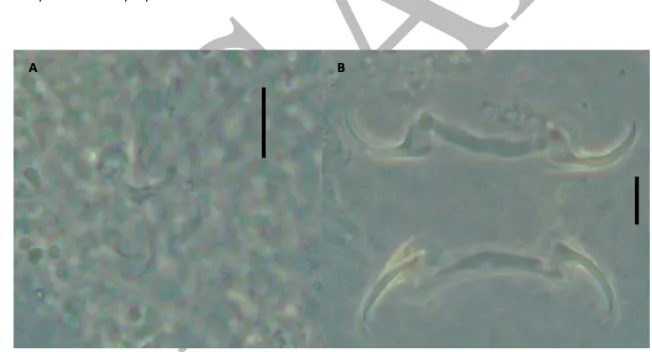
Figure 1. Gussevia sp. 1 collected from Acaronia nassa. Copulatory complex (A), 526
structures of haptor (B). Scale bar: 40 m.
527
528
Figure 2. Gussevia sp. 2 collected from Acaronia nassa. Ventral view whole body 529
(A), Copulatory complex (B), Vagina (C), Egg (D), Structures of haptor (E). Scale bar:
530
A = 100 m. B-E = 40 m.
531 532
533
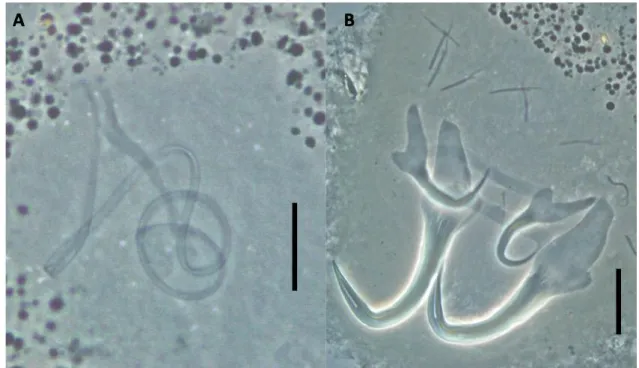
Figure 3. Gussevia sp. 3 collected from Acaronia nassa. Copulatory complex (A), 534
Structures of haptor (B). Scale bar: A = 20 m, B = 10 m.
535 536
537
538
539
Figure 4. Gussevia cichlassomatis collected from Aequidens tetramerus.
540
Copulatory complex (A), Vagina (B), Ventral bar and ventral anchors (C), Dorsal bar 541
(D), Dorsal anchors (E), Haptor (F). Scale bar: A,B = 20 m, C = 10 m, E, F = 20 m.
542 543
544 545
546
Figure 5. Gussevia sp. 4 collected from Aequidens tetramerus. Ventral view of whole 547
body (A), Copulatory complex (B), Vagina (C), Haptor ventral view (D), Haptor dorsal 548
view (E). Scale bar: A= 50 m, B, C = 20 m, D, E = 20 m.
549 550 551 552
553
Figure 6. Gussevia sp. 5 collected from Aequidens tetramerus. Ventral view of whole 554
body (A), Copulatory complex (B), Ventral and dorsal anchors (C), Ventral bar and 555
ventral anchors (D), Dorsal bar and dorsal anchors (E). Scale bar: A= 50 m, B = 20 556
m, C = 20 m, D, E = 10 m.
557 558
559
Figure 7. Sciadicleithrum sp. 1. Copulatory complex (A), Haptor (B). Scale Bar: A = 560
20 m, B = 10 m.
561
562
Figure 8. Biotodomella mirospinata collected from Biotodoma cupido. Copulatory 563
complex (A), Haptor (B), Ventral anchors and ventral hooks (C), Ventral anchors, 564
dorsal bar and dorsal anchors (D). Scale bar: A = 30 m, B = 40 m, C, D = 20 m.
565
566
Figure 9. Sciadicleithrum sp. 2 collected from Biotodoma cupido. Copulatory 567
complex (A), Haptor (B). Scale bar: A = 20 m, B = 20 m.
568 569
570
571
Figure 10. Sciadicleithrum sp. 3 collected from Bujurquina peregrinabunda.
572
Copulatory complex (A), Egg (B), Haptor (C). Scale bar: A = 20 m, B = 40 m, C = 40 573
m.
574 575
576
Figure 11. Sciadicleithrum sp. 4 collected from Bujurquina peregrinabunda.
577
Copulatory complex (A), Vagina (B), Haptor (C). Scale bar: A, B = 30 m, C = 40 m.
578 579
580 Figure 12. Sciadicleithrum umbilicum from Cichla monoculus. Ventral view of 581
whole body (A), Copulatory complex (B), Ventral bar and anchors (C), Dorsal bar 582
and anchors (D). Scale bar: A = 50 m, B = 50 m, C, D = 20 m.
583 584 585
586 Figure 13. Gussevia cichlassomatis from Cichlasoma amazonarum. Ventral view 587
of whole body (A), Anterior part of body showing the pharynx and copulatory 588
complex (B), Copulatory complex (C), Vagina (D), Ventral bar and anchors (E), 589
Dorsal bar and anchors (F). Scale bar: A = 100 m, B = 40 m, C, D = 10 m, E, F=
590
20 m.
591 592
593 Figure 14. Gussevia alii from Cichlasoma amazonarum. Ventral view of whole 594
body (A), Copulatory complex (B), Ventral bar and anchors (C), Vagina (D), Dorsal 595
bar and anchors (E). Scale bar: A = 100 m, B = 20 m, C-E = 20 m.
596 597
598 Figure 15. Gussevia sp. 6 from Cichlasoma amazonarum. Ventral view of whole 599
body (A), Anterior part of body showing the eyes and pharynx (B), Copulatory 600
complex (C), Haptor (D). Scale bar: A = 200 m, B-D = 20 m.
601 602
603 Figure 16. Gussevia sp. 7 from Cichlasoma amazonarum. Anterior part of body 604
showing the copulatory complex and vagina (A), Vagina (B), Dorsal bar and anchors 605
(C), Ventral bar and anchors (D). Scale bar: A = 20 m, B-D = 15 m.
606 607
608 Figure 17. Sciadicleithrum variabilum from Cichlasoma amazonarum. Ventral view 609
of whole body (A), Copulatory complex (B), Vagina (C), Haptor (D). Scale bar: A = 100 610
m, B, C = 30 m, D = 20 m.
611 612
613 Figure 18. Trinidactylus cichlassomatis from Cichlasoma amazonarum. Copulatory 614
complex (A), Haptor. Scale bar: A = 30 m, B = 20 m.
615 616
617 Figure 19. Sciadicleithrum sp. 5 from Crenicichla johanna. Ventral view of whole 618
body (A), Copulatory complex (B), Haptor (C). Scale bar: A = 100 m, B = 40 m, C = 619
20 m.
620
621
622 Figure 20. Sciadicleithrum sp. 6 from Crenicichla johanna. Ventral view of whole 623
body (A), Copulatory complex (B), Haptor (C). Scale bar: A = 100 m, B = 40 m, C = 624
30 m.
625 626
627 Figure 21. Gussevia dispar from Heros efasciatus. Ventral view of whole body (A), 628
Copulatory complex (B), Vagina (C), Ventral bar and anchors (D), Dorsal bar and 629
anchors (E). Scale bar: A = 100 m, B, C = 20 m, D, E = 40 m.
630 631
632 Figure 22. Gussevia disparoides from Heros efasciatus. Ventral view of whole body 633
(A), Copulatory complex (B), Vagina (C), Haptor (D). Scale bar: A = 200 m, B, C = 30 634
m, D = 20 m.
635
636 Figure 23. Gussevia sp. 8 from Heros efasciatus. Copulatory complex (A), Vagina 637
(B), Haptor (C). Scale bar: A, B = 40 m, C = 20 m.
638 639
640 Figure 24. Sciadicleithrum variabilum from Heros efasciatus. Ventral view of whole 641
body (A), Copulatory complex (B), Vagina (C), Ventral bar and anchors (D), Dorsal 642
bar and anchors (E). Scale bar: A = 200 m, B, C = 30 m, D, E = 20 m.
643 644 645
646 647 648 649
650 Figure 25. Sciadicleithrum sp. 7 from Hypselecara temporalis. Anterior part of body 651
(A), Copulatory complex (B), Vagina (C), Haptor (D), Ventral anchors and hooks (E).
652
Scale bar: A = 40 m, B, C= 20 m, D = 40 m, E = 20 m.
653
654 Figure 26. Sciadicleithrum sp. 8 from Mesonauta mirificus. Anterior part of body (A), 655
Posterior part of body showing the haptor (B), Ventral bar, anchors and hooks (C), 656
Dorsal bar and anchors (D), Copulatory complex (E), Vagina (F). Scale bar: A = 40 657
m, B = 40 m, C, D = 20 m, E, F = 20 m.
658 659 660 661 662 663
664 Figure 27. Gussevia spiralocirra from Pterophyllum scalare. Anterior part of body 665
(A), Copulatory complex and vagina (B), Haptor (C), Structures of haptor: bars, 666
anchors and hooks (D). Scale bar: A = 40 m, B = 20 m., C = 50 m, D = 40 m.
667 668
669 Figure 28. Sciadicleithrum iphitium from Pterophyllum scalare. Ventral view of 670
whole body (A), Egg (B), Copulatory complex (C), Ventral bar and anchors (D), 671
Dorsal bar and anchors (E). Scale bar: A = 200 m, B = 40 m, C = 20 m, D, E = 40 672
m.
673
674 Figure 29. Sciadicleithrum satanopercae from Satanoperca jurupari. Anterior part of 675
body (A), Copulatory complex (B), Egg (C), Vagina (D), Ventral bar, anchors and 676
hooks (E), Dorsal bar and anchors (E). Scale bar: A, B = 20 m, C = 10 m, C-F = 30 677
m.
678 679 680 681
682 Figure 30. Sciadicleithrum variabilum from Symphysodon tarzoo. Egg and 683
copulatory complex (A), Copulatory complex (B), Haptor (C). Scale bar: A = 40 m, B 684
= 30 m, C = 40 m.
685 686 687
688 Figure 31. Cichlids hosts of species of Monogenoidea. Acaronia nassa (A), 689
Aequidens tetramerus (B), Biotodoma cupido (C), Bujurquina peregrinabunda (D), 690
Cichla monoculus (E), Cichlasoma amazonarum (F), Crenicichla johanna (G), Heros 691
efasciatus (H), Hypselecara temporalis (I), Mesonauta mirificus (J), Pterophyllum 692
scalare (K), Satanoperca jurupari (I), Symphysodon tarzoo (M).
693 694 695 696 697 698 699