Western Mediterranean planktonic foraminifera events and millennial climatic variability during the last 70 kyr
M. Pe¤rez-Folgado
a;,F.J. Sierro
a,J.A. Flores
a,I. Cacho
b,J.O. Grimalt
c, R. Zahn
d,N. Shackleton
ba Department of Geology, University of Salamanca, Plaza de la Merced, 37008 Salamanca, Spain
b University of Cambridge, The Goldwin Laboratory, Pembroke Street, Cambridge CB2 3SA, UK
c Department of Environmental Chemistry, Institute of Chemical and Environmental Research (CSIC), Jordi Girona, 18, 08034 Barcelona, Spain
d G.R.C. Marine Geosciences, Department of Stratigraphy and Paleontology, University of Barcelona, 08071 Barcelona, Spain
Received 12 June 2002; received in revised form 14 October 2002; accepted 16 October 2002
Abstract
Detailed study of associations of planktonic foraminifera in cores MD95-2043 and ODP 977,located in the Alboran Sea (Mediterranean Sea),has allowed the identification of 29 new faunal events,defined by abrupt changes in the abundances ofNeogloboquadrina pachyderma(right and left coiling), Turborotalita quinqueloba,Globorotalia scitula,Globorotalia inflata,Globigerina bulloidesandGlobigerinoides ruber(white and pink varieties). The age model for ODP 977 was based on that of MD95-2043 [Cacho et al. (1999),Paleoceanogr. 14,698^705],on the isotopic stratigraphy,and on two AMS14C measurements. Sea Surface Temperatures (SSTs) were estimated for the last 54 kyr using the Modern Analog Technique (MAT) and were compared with the SSTs provided by the Uk370 method. The Uk370 record is very similar to the MAT annual mean temperature record for the last 8 kyr. However,for older times alkenone-derived temperatures are consistently higher than the annual MAT temperatures. This offset may be due to an underestimation of the SST provided by the planktonic foraminiferal method for glacial times,to an overestimation of the Uk370 record,or to changes in the seasonal production of alkenones. Most of the variability in the fauna is related to the millennial variability of Heinrich and Dansgaard^Oeschger (D^O) events. During Heinrich events (HEs) and most of the other D^O stadials, G. bulloides, T. quinqueloba and G. scitula increased,while N. pachyderma(right coiling),G. inflata andG. ruber decreased. By contrast,N. pachyderma(left coiling) was only abundant in the HEs. The main component of the associations ^N. pachyderma (right coiling) ^ follows a general trend similar to that of sea-level and N18O. This species reached its highest abundance during the Last Glacial Maximum,when sea-level was at a lower position. The occurrence of a shallower nutricline owing to a shallowing of the interface between Atlantic inflowing and Mediterranean outflowing waters could have favoured the development of neogloboquadrinids in the vicinity of the Strait of Gibraltar.
C 2002 Elsevier Science B.V. All rights reserved.
Keywords: Late Quaternary ; millennial variability; planktonic foraminifera biostratigraphy; western Mediterranean; palaeotemper- atures; palaeoceanography
* Corresponding author. Tel. : +34-923-294497; Fax: +34-923-294514.
E-mail address:[email protected](M. Pe¤rez-Folgado).
Marine Micropaleontology 48 (2003) 49^70
R
Available online at www.sciencedirect.com
www.elsevier.com/locate/marmicro
1. Introduction
The Mediterranean Sea is a semi-enclosed mar- ginal basin connected with the Atlantic through the Strait of Gibraltar,a threshold with a depth of 284 m (Bryden and Kinder,1991). Its negative water balance (precipitation+evaporation60;Be- thoux,1979) results in an anti-estuarine circula- tion responsible for the oligotrophic Mediterra- nean conditions. Likewise,because it is a closed basin located in a temperate climatic belt,all cli- matic events are usually ampli¢ed with respect to the surrounding basins.
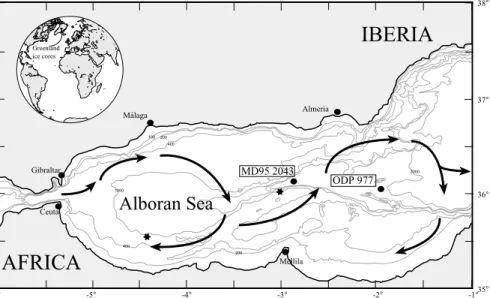
In the Alboran Sea,the Modi¢ed Atlantic Water (MAW) £ows into the Mediterranean at the surface (Fig. 1),while the Mediterranean Out-
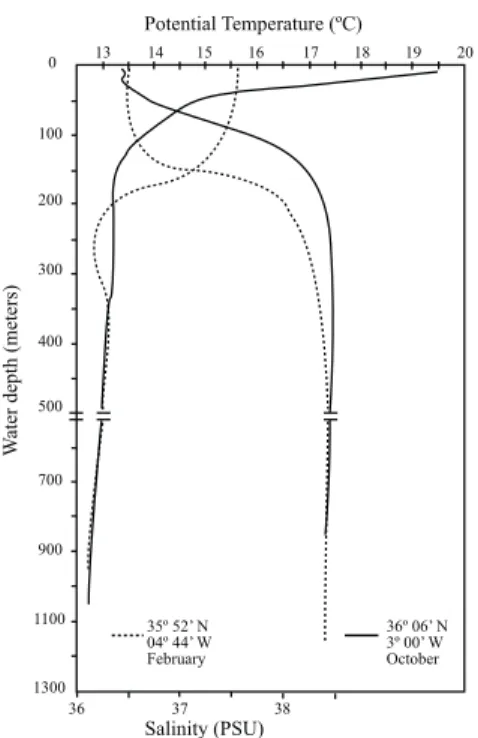
£owing Water (MOW) £ows out of the Mediter- ranean at depth. The MAW forms an almost ho- mohaline band (36.5x),extending to 150^200 m depth,which in winter is almost homothermal (15‡C) (Fig. 2;Parrilla and Kinder,1987 ; Tintore¤
et al.,1988). This water mass describes two anti- cyclonic gyres ^ western and eastern (Fig. 1) ^ which are the most characteristic features of the sur¢cial circulation in the Alboran Sea,especially the western gyre (Parrilla,1984; Heburn and La Violette,1990). Below the MAW,the Levantine
Intermediate Water (LIW),down to an approxi- mate depth of 600 m (Fig. 2),and the deep water formed in the Gulf of Lyon (Western Mediterra- nean Deep Water,WMDW) are the main compo- nents of the MOW,which £ows out of the Med- iterranean through the Strait of Gibraltar. These two water masses (LIW and WMDW) have high salinities (about 38.5%) although the WMDW is slightly colder (12.90‡C) than the LIW (13.2‡C), as may be seen in Fig. 2 (Parrilla and Kinder, 1987).
The Alboran Sea is one of the most productive regions in the Mediterranean due to the interac- tion between in£owing MAW and out£owing in- termediate Mediterranean water. The position of the anticyclonic gyres governs the water depth of the pycnocline,located at the site of interference between MAW and MOW. This pycnocline is deeper towards the central part of the gyres,while isopicnals rise in the cyclonic structures that ap- pear at the North side of the basin,particularly in the upwelling o¡ the coast of Ma¤laga,favouring the nutrient supply to surface waters (Rodr|¤guez et al.,1998). The upwelled nutrients in the north are then advected towards the south,following the paths of the main gyres (Garc|¤a-Gorriz and Carr,2001). Nutrients are also supplied to the
Fig. 1. Location of cores ODP 977 and MD95-2043 in the Alboran Sea. The ¢gure shows the main features of the current circu- lation,governed by the entry of surface waters through the Strait of Gibraltar,and the formation of anticyclonic gyres (Heburn and La Violette,1990). Black asterisks mark the location of points inFig. 2.
MARMIC 907 28-3-03 Cyaan Magenta Geel Zwart M. Pe¤rez-Folgado et al. / Marine Micropaleontology 48 (2003) 49^70 50
surface by eddy-induced upwelling occurring at the periphery of the gyre path (Garc|¤a-Gorriz and Carr,2001). Based on the temporal distribu- tion of pigment concentrations in the Alboran Sea,two main regimes of primary production have been distinguished (Garc|¤a-Gorriz and Carr,2001): the bloom regime (from November to March),linked to the winter destrati¢cation, and the non-bloomperiod (from May to Septem- ber),when surface water strati¢cation prevails in the Alboran Sea and nutrients are mainly ad- vected from the di¡erent upwelling zones.
In the past few years,several biostratigraphic works have been published concerning the Pleis- tocene^Holocene of the Mediterranean (Pujol and Vergnaud-Grazzini,1989 ; Capotondi et al.,1999).
Recently,however,climatic and palaeoceano- graphic studies undertaken within the IMAGES programme have aimed at monitoring the climatic variations at millennial scale,meaning that it has been necessary to develop more precise age mod- els that will allow researchers to obtain reliable correlations.
The aims of the present work are to de¢ne a biostratigraphy and process-oriented faunal inter- pretation at millennial scale,in a region that is very sensitive to the exchange transports in the Strait of Gibraltar,and also to assess the applic- ability of the stratigraphic framework to general western Mediterranean faunal studies. Based on a well-established age model (by use of oxygen iso- tope stratigraphy and 14C-dated ages) and a high resolution study of the planktonic foraminifera fauna in two cores from the Alboran Sea (ODP 977 and MD95 2043),we attempt to de¢ne a se- ries of bio-events,most of them common to both cores. The identi¢cation of these bio-events in other more or less distant cores could permit a precise correlation among them and facilitate pa- laeoclimatic and/or palaeoceanographic interpre- tations for the last 70 kyr.
2. Materials and methods
MD95-2043 is a piston core,of which the ¢rst 17 m were studied. It was recovered from the eastern part of the Alboran Sea (36‡8P598QN,
2‡37P269QW ; 1841 m water depth) by the R/V Marion Dufresneduring the 1995 IMAGES cruise (Fig. 1). ODP 977 was recovered during leg 161 of the Ocean Drilling Program carried out in the western Mediterranean. It is located to the south of Cabo de Gata (Spain),also in the eastern Al- boran Basin (36‡1.9PN,1‡57.3PW ; 1984 m water depth). For this core,the ¢rst 27 m were studied, although here we only o¡er results for the ¢rst 13 m.
In both cores,systematic samplings were made for the study of the microfauna at an average distance of 10 cm. The samples for the analysis of planktonic foraminifera were washed through a 62-Wm sieve and dry-sieved again through a 150- Wm mesh. The residues (s150Wm) were split the number of times necessary to obtain an aliquot fraction of some 350 specimens,which were counted and identi¢ed (Appendix Tables 1 and 2 as Marine Micropaleontology Online Background Dataset1). To calculate the abundance ofNeoglo- boquadrina pachyderma left coiling (l.c.),an ali- quot of around 1000 specimens was analysed (Ap- pendix Table 11). Oxygen and carbon isotope measurements were performed on the planktonic foraminifer Globigerina bulloides and on the benthic foraminifer Cibicidoides spp. In core MD95-2043,analyses were made on a SIRA mass spectrometer on the 300^355-Wm fraction (Cacho et al.,19991),while samples from ODP 977 were measured on a Finnigan MAT 251 De- vice at the University of Kiel,the size of the frac- tion being 250^355 Wm (AppendixTable 31).
Seasonal palaeotemperatures in MD95-2043 were obtained using the Modern Analog Method (MAT ; Hutson,1980 ; Prell,1985). This method uses a statistic distance (in our case,the ‘squared chord distance’ ; Overpeck et al.,1985) called the
‘dissimilarity index’,which gives the relationship between fossil and current assemblages. The ¢nal palaeo-SST is the weighted mean of the ten best analogs. The database used here was that ofKal- lel et al. (1997) for the Mediterranean Sea,which comprises 253 coretop samples (130 from the Mediterranean Sea,and 123 from the North
1 http ://www.elsevier.com/locate/marmicro
Atlantic Ocean). The average ‘dissimilarity’ ob- tained was 0.13 (varying between 0 and 0.4), and the mean error for all the reconstructions was V 1.85‡C.
Finally,to check the relationship between the di¡erent species of planktonic foraminifera,we performed a Principal Component Analysis (PCA) on samples from ODP 977.
3. Age model
The age model for core MD95-2043 was estab- lished by Cacho et al. (1999) and is based on 21 AMS 14C measurements and on isotopic stratig- raphy. The age model for ODP 977 is based on two AMS14C measurements corresponding to the uppermost Holocene,the oxygen isotope results, and the accurate correlation of some planktonic
foraminiferal events between this core and core MD95-2043 (seeTable 1). The AMS14C analyses were performed on the planktonic foraminifer Globigerina bulloidesand were calibrated to calen- dar years (Stuiver et al.,1998),using the Calib 4.1 programme. The oxygen isotope curves of both cores (Fig. 3) allowed us to identify the Last Gla- ciation (Marine Isotope Stage 2,MIS 2),together with isotope events 3.1 and 3.13 (Cacho et al., 1999 ; Martinson et al.,1987).
The sharp cold climatic events associated with massive discharges of icebergs,known as Heinrich Events (HEs),have been identi¢ed throughout the North Atlantic (Heinrich,1988 ; Bond et al., 1992 ; Grousset et al.,1993 ; Lebreiro et al., 1996 ; Cayre et al.,1999). Ice Rafted Debris (IRD) accompanying the melting of the icebergs has been recognised as far as the Portuguese mar- gin (Zahn et al.,1997),the Gulf of Ca¤diz,(Cacho et al.,2001; Reguera,2001; Colmenero,2001), and the Moroccan continental margin (Kudrass and Thiede,1970; Kudrass,1973).
To date no IRD record has been identi¢ed in the Mediterranean. However, Neogloboquadrina pachyderma (l.c.) proliferated in the Alboran Sea when conditions became favourable,especially when sea surface temperatures lowered during the HEs.Cacho et al. (1999) identi¢ed and dated
36º 06’ N 3º 00’ W October 0
100
200
300
400
500
700
900
1100
1300
36 37 38
Water depth (meters)
13 14 15 16 17 18 19 20
Potential Temperature (ºC)
Salinity (PSU) 35º 52’ N 04º 44’ W February
Fig. 2. Distribution of surface temperatures and salinity with depth at two points in the Alboran Sea during two di¡erent seasons of the year. The ¢rst 150^200 m of water correspond to Modi¢ed Atlantic Water; down to a depth of approxi- mately 600 m is the Levantine Intermediate Water. The rest
^ down to the sea £oor ^ corresponds to Western Mediterra- nean Deep Water. AfterParrilla and Kinder,1987. The loca- tions are marked inFig. 1by black asterisks.
Table 1
Age model pointers for ODP 977
Depth ODP 977 Event Age Reference
(m) (calendar years)
0.202 AMS
14C
1159 Stuiver et al.,1998
0.605 AMS
14C
4220 Stuiver et al.,1998
2.952 HE1 15207 Cacho et al.,1999
4.150 HE2 23403 Cacho et al.,1999
5.212 HE3 30122 Cacho et al.,1999
7.615 HE4 38845 Cacho et al.,1999
9.553 HE5 45031 Cacho et al.,1999
12.404 HE6 65987 (*)
HE pointers are de¢ned in event terminations in Neoglobo- quadrina pachyderma (l.c) curve,except for HE6,where the maximum abundance point in N. pachyderma (l.c.) percent- age has been used. (*)Bond et al.,1992,1993; Grousset et al.,1993; Lebreiro et al.,1996; Manighetti et al.,1995; Pa- terne et al.,1999; Chapman and Shackleton,1998; van Kre- veld et al.,1996; Cayre et al.,1999.
MARMIC 907 28-3-03 Cyaan Magenta Geel Zwart M. Pe¤rez-Folgado et al. / Marine Micropaleontology 48 (2003) 49^70 52
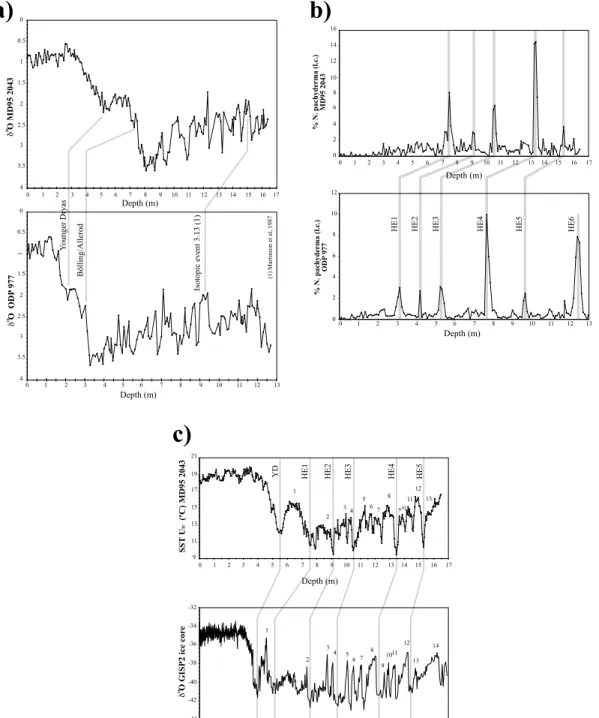
Fig. 3. Age model for core ODP 977. (a) Comparison of the isotopic results (N18O) from core MD95-2043 (Cacho et al.,1999) with those for core ODP 977,highlighting the events used for the correlation. (b) Correlation between the curves of relative abundance ofNeogloboquadrina pachyderma (l.c.) in both cores. The peaks in abundance have been correlated with HE1^HE6.
(c) Correlation between theN18O curve in Greenland Ice Core GISP2 and the temperature curve obtained using the alkenone technique in MD95-2043 (Cacho et al.,1999). Numbers mark the di¡erent D^O interstadials,recognisable in both cores.
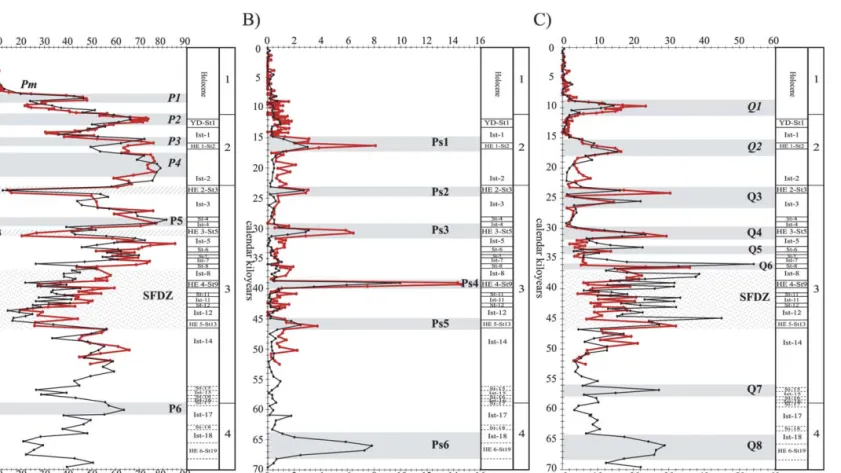
Fig. 4. Quantitative variations of planktonic foraminifera assemblages in cores MD95-2043 (red line) and ODP 977 (black line). The columns at the right of the ¢g- ure show the di¡erent stadials (St) and interstadials (Ist) of the D^O events,together with HEs,and the di¡erent isotopic stages. From St-13 downward,the di¡er- ent St and Ist are marked in dashed lines owing to the reduced age control below 54 kyr in core ODP 977 (see text). The di¡erent zones identi¢ed in the cores are delimited by solid grey bands (maxima in abundance),striped ones (minima in abundance),or only by name (bio-events). Pujol and Vergnaud-Grazzini (1989) events are in italics. Abbreviation: SFDZ,Small Foraminifera Dominance Zone. (A)Neogloboquadrina pachyderma(right coiling). (B)N. pachyderma(left coiling).
(C)Turborotalita quinqueloba. (D)Globorotalia scitula. (E)Globorotalia in£ata. (F)Globigerina bulloides. (G)Globigerinoides ruberwhite. (G)G. ruberpink.
MARMIC90728-3-03CyaanMagentaGeelZwart M.Pe¤rez-Folgadoetal./MarineMicropaleontology48(2003)49^7054
Fig.4(Continued).
the ¢rst ¢ve HEs in core MD94-2043. These were recognised as signi¢cant decreases in SSTs and sharp increases in the polar speciesN. pachyderma l.c. In core ODP 977,these in£uxes of N. pachy- dermal.c. also appear and were used to locate the HEs (Fig. 3b). Since HE6 is only recorded in core 977,we gave it an average age based on the di¡er- ent ages provided for this event in the North At- lantic and Mediterranean (Bond et al.,1992, 1993 ; Grousset et al.,1993; Lebreiro et al., 1996 ; Manighetti et al.,1995; Paterne et al., 1999 ; Chapman and Shackleton,1998 ; van Kre- veld et al.,1996 ; Cayre et al.,1999; seeTable 1).
HEs are linked with maximum cooling during the rapid climatic £uctuations de¢ned in ice cores from Greenland (Dansgaard et al.,1993 ; Grootes et al.,1993),known as D^O cycles (Bond et al., 1993). These variations in atmospheric tempera- ture over Greenland have been linked to changes
in surface temperature of the waters of the Albor- an Sea (Cacho et al.,1999; Fig. 3c). In the SST curve of core MD95-2043,obtained with the al- kenone technique,it is thus possible to identify the last 13 D^O cycles (Cacho et al.,1999). This correlation (Fig. 3c) serves as a basis for identify- ing the relationships between these D^O events and the faunal variations in the cores (Fig. 4).
It should be stressed that the age model of ODP 977 is well established up to 54 kyr (since it is essentially based on the correlation with core MD95-2043) whereas up to 70 kyr there may be some uncertainties in the age model. This is why in Fig. 4 and Table 2 the D^O events below 54 kyr are only shown by a dotted line.
According to our age model,an average time resolution of 510 yr per sample is obtained for the ODP 977 core. The temporal resolution for core MD95-2043 is 320 yr per sample.
Fig. 4 (Continued).
MARMIC 907 28-3-03 Cyaan Magenta Geel Zwart M. Pe¤rez-Folgado et al. / Marine Micropaleontology 48 (2003) 49^70 56
4. Results
4.1. High resolution planktonic foraminifera biostratigraphy in the Alboran Sea during the last glacial^interglacial period
By studying the variations in the associations of
planktonic foraminifera in the westernmost part of the Mediterranean Sea,we were able to identify up to 48 biological events in the last 70 kyr,of which 29 are newly de¢ned (Fig. 4A^H).
Around 22 species were found in each core, although if the varieties and di¡erent coiling types are included this number rises to 26. The dextral
Table 2
Planktonic foraminifera events and their relation with D^O stadials and interstadials
Light grey bands in the stratigraphy correspond with cold stadials,and white ones with warm interstadials.Pujol and Vergnaud- Grazzini (1989)events are in italics.
and sinistral coilings of Globorotalia truncatuli- noides, Globorotalia scitula andNeogloboquadrina pachyderma were considered,together with the white and pink varieties of Globigerinoides ruber.
The group known as ‘N. pachyderma^N. dutertrei integrade’ was also included.
The current association in the Alboran Sea,de- duced from the coretops,mainly comprisesGlobi- gerina bulloides and Globorotalia in£ata. The ¢rst of these is the most abundant today (more than 40%) and together they represent more than 70%
of the association. Globigerinoides ruber white,a species from warmer habitats (tropical and sub- tropical),may represent up to 17% of the associ- ation. The rest of the species appear with lower percentages.
Based on previous studies by Pujol and Verg- naud-Grazzini (1989),and going farther back in time,we identi¢ed a series of characteristic changes in the most important species of plank- tonic foraminifera. Following the nomenclature introduced by Pujol and Vergnaud-Grazzini (1989) for each species,we identi¢ed zones de¢n- ing intervals of time in which certain species reach values well above or well below the average. The upper or lower limits of these zones are marked by sharp changes in abundance that can be used to de¢ne the true bio-events.
To de¢ne the age intervals in which each faunal event occurred,as a reference we always used the variations in the taxa in core MD95-2043,the age model of which is best established. Exceptions are those events that occurred between 54 and 70 kyr, which only appear in core ODP 977,for which we used the age model of this core. All the events can be seen in Tables 2 and 3,and in Fig. 4.
4.1.1. Neogloboquadrina pachydermaright coiling At present,this subpolar species is not very abundant (3%),but the mean of the last 70 kyr reaches 43% of the fossil assemblage,being one of the principal species of the planktonic foraminif- era association. This mean is punctuated by sev- eral characteristic maxima and minima,which we used to de¢ne a series of zones. The maximum values (higher than 80%) are reached in the Last Glacial Maximum (LGM) and the minimum val- ues in the Upper Holocene.
Pujol and Vergnaud-Grazzini (1989) de¢ned four major zones : maxima P1,P2,P3 and P4 and the minimum of the Holocene (bio-event Pm). All of them can be recognised in the two cores (Fig. 4A),and another four zones ^ two of high abundance (P5 and P6) and two of low abundance (Pm2 and Pm3) ^ were identi¢ed (Ta- bles 2 and 3; Fig. 4A). To delimit the age of occurrence of zone P6,we used core ODP 977 since it is the only one in which it is recorded (Fig. 4). The decrease in abundance of this species during the Holocene (bio-event Pm) is a remark- able event that occurred at 7.7 kyr,coinciding with Globorotalia in£ata bio-event I.
4.1.2. Neogloboquadrina pachyderma left coiling The mean abundance of this small polar species is very low in the record (1.15% in MD95-2043 and 0.84% in ODP 977),although it displays some short and prominent in£uxes that may reach as high as 14.5% in MD95-2043 and almost 10%
in ODP 977,which occurred during HEs (Cacho et al.,1999). Thus,we de¢ne zones Ps1 to Ps5 in core MD95-2043 and zones Ps1 to Ps6 in core ODP 977 (Fig. 4B;Tables 2 and 3). In both cores, the maximum abundance is reached in zone Ps4.
4.1.3. Turborotalita quinqueloba
This small subpolar species (Be¤,1977) is very rare in modern samples and becomes common in the Alboran Sea at 7.7 kyr. Its mean abundance is not very high (11.41% in ODP 977 and 7.39% in MD95-2043),although it may represent the prin- cipal component of the assemblage in some of the events de¢ned (Fig. 4C). Zones Q1 and Q2,de-
¢ned by Pujol and Vergnaud-Grazzini (1989), were identi¢ed and,going back in time,we de¢ne zones Q3^Q8 (Fig. 4C).
Zone Q5 was recognised by a maximum in abundance that occurred at 33.8 kyr in MD95- 2043,and at 33.2 kyr in ODP 977. This o¡set is due to small errors in the age model,since a con- stant sedimentation rate between the control points was assumed,which is not always necessar- ily the case. The same is true for the maximum in zone Q6,which in ODP 977 may represent more than 50% of the association of planktonic forami- nifera. The maximum abundance of this species
MARMIC 907 28-3-03 Cyaan Magenta Geel Zwart M. Pe¤rez-Folgado et al. / Marine Micropaleontology 48 (2003) 49^70 58
Table 3
Calendar ages (in kyr) of all planktonic foraminifera zones identi¢ed in cores MD 95-2043 and ODP 977
Pujol and Vergnaud-Grazzini (1989)events are in italics.
5 4 3 2
1 Winter SST Spring SST U37k’ SST Autumn SST Summer SST 6 Annual SST
B) A)
Cal. age (kyr)
9 11 13 15 17 19 21
7
5 25 23
0 2 4 6 8 10 12 14 16 18 20 22 24 26 28 30 32 34 36 38 40 42 44 46 48 50 52 54
SST (ºC) MD95-2043
5
4
3 2
1
2
1 3
HE 1-St2 HE 2-St3 HE 3-St5 HE 4-St9 HE 5-St13
YD-St1 St-4 St-6 St-7 St-8 St-11 St-12Ist-1 Ist-2 Ist-3 Ist-4 Ist-5 Ist-6 Ist-8 Ist-12
Holocene Ist-7 Ist-11
3
6
SST (ºC) MD95-2043
Cal. age (kyr)
0 10 20 30 40 50
15
5
250 10 20 30 40 50
YD- St 1 HE 1- St 2 HE 2- St 3 HE 3- St 5 HE 4- St 9 HE 5- St 13
17 19 21 23
13 11 9 7
0 0.2 0.4
Dissimilarity index
MARMIC 907 28-3-03 Cyaan Magenta Geel Zwart M. Pe¤rez-Folgado et al. / Marine Micropaleontology 48 (2003) 49^70 60
recorded in zone Q8,at 66 kyr,is coeval with zone Ps6 (Fig. 4C; Table 3).
4.1.4. Globorotalia scitula
This globorotalid is not very abundant in the cores ; the maxima hardly surpass 12 and 9% of the assemblage (in ODP 977 and MD95-2043,re- spectively) and the average ranges around 1.4%.
G. scituladisappears from MD95-2043 at 9.5 kyr, but in core ODP 977 this disappearance occurs slightly later,at 8.4 kyr (Fig. 4D).
Zones Sc4 and Sc5 occur close to zones Q5 and Q6 (Fig. 4; Tables 2 and 3),and the small dis- crepancies between both cores are due to minor errors in the age model.
4.1.5. Small Foraminifera Dominance Zone This is an interval of 10 kyr that we have called the ‘Small Foraminifera Dominance Zone’ (SFDZ) because the assemblage is dominated by small spe- cies such as Turborotalita quinqueloba and Globi- gerinita glutinata,accompanied by a high percent- age of Globorotalia scitula. This zone ranges between 36.7 and 46.7 kyr (Table 3),within MIS 3,and is characterised by sharp £uctuations in the abundance of the dominant species (Fig. 4).
Neogloboquadrina pachyderma (right coiling,r.c.) tends to decrease while G. scitula increases in abundance along the zone,and T. quinqueloba
£uctuates around 14% in MD95-2043 and 22%
in ODP 977 (Fig. 4). The limits of the zone (36.7 and 46.7 kyr) are fairly precise and coincide in all three taxa and in both cores (Table 3).
4.1.6. Globorotalia in£ata
The current abundance of this species is very signi¢cant in the Alboran Sea today (more than 30% of the association). It has been a signi¢cant component of the foraminiferal assemblage since 7.7 kyr ago,when it replaced Neogloboquadrina pachyderma (r.c.),which decreased sharply at that time. This change has already been reported byPujol and Vergnaud-Grazzini (1989)as event I.
During the last glaciationG. in£ata is rare. How- ever,at certain times (zones I2 to I5) the species is relatively abundant (Tables 2 and 3; Fig. 4E).
Zone I5 contains several signi¢cant minima at 42.9 and 42 kyr (Fig. 4E).
4.1.7. Globigerina bulloides
This is the dominant species in current associ- ations,reaching around 40% in both coretops,
Table 4
Results of PCA carried out on ODP 977 samples
Species/factor load Factor 1 Factor 2 Factor 3 Factor 4 Factor 5
O. universa 0.006 0.024 30.001 0.001 0.073
G. ruber rosea 30.009 0.085 0.003 0.061 0.143
G. ruber alba 30.045 0.169 0.019 0.176 0.946
G. trilobus 30.005 0.006 0.003 0.003 0.046
G. sacculifer 30.002 0.002 0.001 0.000 0.014
G. bulloides 30.053 0.366 30.078 330.919 0.105
T. quinqueloba 30.137 30.088 330.959 0.051 0.008
N. pachyderma(l.c.) 30.006 30.008 30.041 30.009 0.001
N. pachyderma(r.c.) 0.988 0.008 30.139 30.036 0.054
G. in£ata 0.010 0.904 30.056 0.337 30.239
G. scitula 30.019 0.022 330.156 0.042 30.004
G. glutinata 0.001 0.033 330.152 0.038 30.004
Variance (%) 56.45 10.76 12.20 16.45 3.72
Accumulated variance (%) 56.45 62.22 79.42 95.87 99.60
Fig. 5. Palaeotemperatures obtained with the MAT,and comparison with Uk370 SST in core MD95-2043. (A) Seasonal palaeo-SST (thin lines) and alkenone SST (thick line). Winter correspond to the February temperature,Spring is the April^May mean,Au- tumn is the October^November mean,and Summer is the August temperature. (B) Comparison between the Uk370 SST record (grey line) and MAT annual mean SST record (black line). The dissimilarity index of MAT reconstructions is also shown.
although the maxima (about 58%) are recorded at 14 kyr in MD95-2043 and at 57.6 kyr in ODP 977 (zone B6). Events B0 and B1,de¢ned by Pujol and Vergnaud-Grazzini (1989),appear in both cores and are the starting points for the de¢nition of zones B2,B3,B4,B5 and B6 (Fig. 4F).
In the Late Holocene,the signi¢cant rise in G. bulloidesoccurring at 5.6 kyr de¢ned bio-event B0,the age of which coincides with that reported by Pujol and Vergnaud-Grazzini (1989). How- ever,the age of 13 kyr reported by these authors for event B1 is slightly younger than that obtained in this work. These chronological discrepancies may be due to the di¡erent resolutions of the two studies. In zone B2 there are two small mini- ma at 24.1 and 25.6 kyr (seeFig. 4F). Zone B5 is recorded towards the base of the interval studied in core MD95-2043,although according to the ODP 977 record its extent may be greater (Fig.
4F).
4.1.8. Globigerinoides ruber white
This species,which normally appears in warm waters (Be¤,1977 ; Hemleben et al.,1989),is fre- quent in the Holocene but decreases in abundance at 12 kyr. Pujol and Vergnaud-Grazzini (1989) de¢ned two events (R0 and Ra). The maximum abundance of this species observed within zone R0 is coeval with the sharp decrease in Globoro- talia in£ata,(event I),as reported by Pujol and Vergnaud-Grazzini (1989). Below event Ra,we de¢ne the Ra2 and Ra3 zones,the latter only in core ODP 977 (Tables 2 and 3; Fig. 4G). In the SFDZ,sharp variations of up to 3% in G. ruber white can be observed,(Fig. 4G).
4.1.9. Globigerinoides ruber pink
This pink variety is less abundant than the white one and usually thrives in warmer waters.
It is only present during the Holocene,disappear- ing at 11.2 kyr in MD95-2043 and at 10.4 kyr in Site 977. Its abundance is always low,never reaching 12%. Pujol and Vergnaud-Grazzini (1989) de¢ne Rr as the ¢rst local occurrence of G. ruber pink. We maintain this de¢nition, although we employ a slightly di¡erent terminol- ogy,using the term R1 to refer to Rr ; R1b to refer to the maximum values following it,and
R1c to refer to the last maximum reached in the Late Holocene (Tables 2 and 3; Fig. 4H).
Between zones R1b and R1a (Fig. 4H),at 8.2 kyr,there is a more or less sharp minimum,which coincides with the minimum between zones Ra and R0 (Fig. 4G).
4.2. Palaeotemperature reconstruction in core MD95-2043
The SST reconstruction carried out in core MD95-2043 with the MAT (Fig. 5) based on the analysis of the foraminiferal assemblages allowed us to obtain temperature estimations for the dif- ferent seasons and compare these results with those derived from the alkenone record (Cacho et al.,1999). The mean errors are : V 1.58‡C for winter temperatures ; V 1.66‡C for spring data ; higher for summer results ( V 2.26‡C),and V 1.92 for autumn values.
For the last 8 kyr,the temperatures obtained with the Uk370 and MAT methods are very stable.
The coretop SST estimations for the di¡erent sea- sons (14.5‡C for winter,16.6‡C for spring,24.4‡C for summer and 19.6‡C for autumn) correspond closely to the Recent temperatures in this region (14.6‡C for winter,16.8‡C for spring,24.3‡C for summer and 19.7‡C for autumn ; Levitus,1982).
The Uk370 SST estimation for the coretop is 18.8‡C ; a temperature between modern spring and au- tumn SSTs (Fig. 5). The seasonal gradient (the average di¡erence between summer and winter temperatures) during the last 8 kyr is around 10‡C (Fig. 5),which is very similar to that existing today.
The full glacial^late interglacial temperature contrast is also much higher in the summer tem- peratures,which decreased more (12‡C) than win- ter temperatures (8‡C) ; the same glacial^intergla- cial di¡erence is 9‡C in the Uk370 record.
Seasonality during the last glacial is on average 5‡C,in contrast to the di¡erence of 10‡C observed today and for the last 8 kyr in the Alboran Sea.
This reduced seasonality was mainly due to the cooler summer temperatures during the glacial pe- riod (Fig. 5).
During the last glacial (MIS 2 and 3),the tem- perature record points to ¢ve prominent cooling
MARMIC 907 28-3-03 Cyaan Magenta Geel Zwart M. Pe¤rez-Folgado et al. / Marine Micropaleontology 48 (2003) 49^70 62
events corresponding to HE1 to HE5. Sea surface temperatures estimated with the MAT are very similar for all Heinrich events,reaching values of around 7‡C for the winter seasons,which is well below the 9^10‡C estimated by the alkenone method. HE4 is the coldest (below 7‡C) and HE5 the warmest (around 8‡C).
4.3. Planktonic foraminifera assemblages in ODP 977 core samples
The ¢ve factors resulting from PCA analysis of the ODP 977 samples (Table 4) explain 99.6% of the total variance of the sample. The ¢rst and most important factor (factor 1) accounts for 56.5% of the variance and is represented by the
species Neogloboquadrina pachyderma (r.c.). Fac- tors 3 and 4 together account for 30% of the variance and are controlled byTurborotalita quin- queloba,Globorotalia scitulaandGlobigerinita glu- tinata (factor 3) and Globigerina bulloides (factor 4). Factors 2 and 5 explain about 15% of the total variance and have high loadings in the species Globorotalia in£ata (factor 2) and Globigerinoides ruber white and G. ruber pink (factor 5). Fig. 6 shows the plot of the three groups of species de- duced. Factors 1 and 3 reach the highest values during glacial times (MIS 2,3 and part of 4) but decrease during the Holocene and some of the warmer interstadials,when factors 2 (G. in£ata) and 5 (G. ruber) increase (Fig. 6). By contrast, factor 4 (G. bulloides) is signi¢cant both during glacial and interglacial times.
5. Discussion
5.1. Biostratigraphic correlation with other areas in the Mediterranean
We identi¢ed all the bio-events and phases or ecozones recognised by Pujol and Vergnaud- Grazzini (1989) over the past 18 kyr,although the order of the bio-events (in ‘phase 5’ and
‘phase 4’) is slightly di¡erent since zone Q1 occurs before the events ofGlobigerinoides ruber(Rr and Ra),whereas Pujol and Vergnaud-Grazzini (1989) recorded the opposite (¢rst Ra and Rr and then zone Q1 ; table IV,p. 167). In any case,the reso- lution of their study was considerably more lim- ited than in the present one,which could a¡ect the ages of the tops and bases of the zones.
Other authors (e.g.Sba⁄ et al.,2001 ; Capoton- di et al.,1999 ; Hayes et al.,1999 ; Jorissen et al., 1993) have analysed the biostratigraphy of the last glacial^interglacial transition in the Mediterra- nean.
Capotondi et al. (1999)established ten ecozones for the last 23 kyr in the Tyrrhenian Sea and eight in the Adriatic Sea (last 15 kyr) based on the study of the distribution of planktonic foraminif- era in 60 cores. Direct comparison with our own results is di⁄cult because Capotondi et al. (1999) carried out semi-quantitative analyses of the
Fig. 6. Percentage of di¡erent factors derived from PCA car- ried out on core ODP 977. The factors were associated ac- cording to the ecological requirements of the species charac- terising them.
s63-Wm fraction,which ^ in particular ^ could increase the abundance of small species such as Turborotalita quinquelobaorGlobigerinita glutina- ta. However,some of the faunal variations used to de¢ne each ecozone can be identi¢ed here. Eco- zones 9 and 10 ofCapotondi et al. (1999)can be correlated with HE1 and HE2. Concerning the other ecozones,it is only possible to compare some faunal variations that are similar in both records,such as the increase inNeogloboquadrina pachyderma(r.c.) during the YD (zone P2),or the rapid increase in both varieties ofGlobigerinoides ruber(zones Ra and R1a) during the Termination Ib (T1b). At this moment,the Recent fauna ap- pears,being di¡erent in the Alboran Sea and in the Tyrrhenian and Adriatic (Capotondi et al., 1999). The Recent fauna of the Alboran Sea, characterised by high percentages of Globorotalia in£ata and low values of N. pachyderma r.c.,de- veloped at 7.7 kyr,linked to the establishment of the oceanographic fronts associated with the semi- permanent anticyclonic gyres (Rohling et al., 1995).
Jorissen et al. (1993) divided the Late Pleisto- cene^Holocene of the Adriatic Sea succession into three zones on the basis of the frequencies of the planktonic fauna (Zones I,II and III). The limits between these zones,which approximately coin- cide with Terminations Ia (the II/III limit) and Ib (the I/II limit),can also be recognised in our cores. The limit between zones II and III is situ- ated before Sc1 (Fig. 4D) and the limit between zones I and II would be situated close to the Ra zone (Fig. 4G),at 9.5 kyr,preceding an increase in the SPRUDTS group (Globigerinella siphoni- fera, Hastigerina pelagica, Globigerina rubescens, Orbulina universa, Globigerina digitata, Globigeri- noides tenellus and Globigerinoides sacculifer; Jo- rissen et al.,1993).
In a recent work by Sba⁄ et al. (2001),the authors distinguish nine ‘association biozones’ in the Tyrrhenian Sea over the past 34 kyr. The au- thors de¢ne the biozones on the basis of the ap- pearance or disappearance of speci¢c taxa,such that it is possible to establish a direct comparison between these ‘association biozones’ of the Tyr- rhenian Sea and our own biological events in the Alboran Sea. Most of the changes in the Tyrrhe-
nian fauna can be identi¢ed in the westernmost Mediterranean,with the exception of certain spe- ci¢c changes such as the increase in Globigeri- noides ruberwhite during Interstadial D^O 5 (Bi- ozone 9 ofSba⁄ et al.,2001),or the decrease in Globorotalia in£ata in the Holocene (Biozone 2), which do not appear in our cores. These authors record the disappearance ofGloborotalia scitulain Biozone 3,at about 11 kyr. The diachronism in the disappearance of this species in the western Mediterranean,proposed by Hayes et al. (1999), is con¢rmed by our data,since G. scitula ¢rst disappears at 9.5 kyr in core MD95-2043 and, shortly afterwards,at 8.4 kyr in core ODP 977, although in the latter it re-appears at 6.1 kyr.
Hayes et al. (1999) stated that the planktonic foraminifera biostratigraphy may be a useful tool, although ^ in some cases ^ only at a local scale.
While some of the faunal changes,such as those a¡ectingGlobigerinoides ruber, Globorotalia scitu- la,the SPRUDTS group,etc. (Jorissen et al., 1993 ; Hayes et al.,1999 ; Capotondi et al., 1999 ; Pujol and Vergnaud-Grazzini,1989 ; Sba⁄
et al.,2001; this study),were synchronous in the central and western Mediterranean,other taxa such as the neogloboquadrinids,or Globorotalia in£ata and Turborotalita quinqueloba followed an abundance distribution pattern that was related to the regional climatic and hydrographic character- istics of the Mediterranean sub-basin in which they developed.
PCA Factors 1 (N. pachydermar.c.),3 (Turbor- otalita quinqueloba, Globorotalia scitula) and 4 (Globigerina bulloides) are linked to the subpolar planktonic foraminifera assemblage,while the other two factors (factor 2, Globorotalia in£ata and factor 5, Globigerinoides ruber) are undoubt- edly related to the transitional and subtropical assemblages in the Atlantic Ocean (Be¤,1977 ; Hemleben et al.,1989).
5.2. Seasonal palaeotemperatures in the Alboran Sea and their relationship with Uk370 palaeo-SST
Analysis of the relative composition of C-37 unsaturated alkenones (Uk370 index) in core MD95-2043 provided a continuous record of SSTs for the last 54 kyr (Cacho et al.,1999).
MARMIC 907 28-3-03 Cyaan Magenta Geel Zwart M. Pe¤rez-Folgado et al. / Marine Micropaleontology 48 (2003) 49^70 64
Alkenones are long-chain methyl ketones pro- duced by cocolithophoral algae. In the present ocean,the principal producer is thought to be Emiliania huxleyi (Volkman et al.,1980) and therefore the quality of the temperature estima- tions obtained with these organic compounds are undoubtedly controlled by the seasonal pro- duction and sedimentation of this coccolith spe- cies.
A ¢rst short-term cooling event is seen at around 8.2 kyr both in the Uk370 and MAT records.
This cooling was particularly signi¢cant during summer,when a temperature drop of around 4‡C occurred. A decrease in abundance of warm-water species Globigerinoides ruber (white and pink ; Fig. 4G,H),accompanied by an in- crease in cool-water speciesNeogloboquadrina pa- chyderma (r.c.) (P1 event ; Fig. 4A),are also re- corded in this interval. This 8.2-kyr Holocene cooling has been broadly recognised in Greenland ice core records (Dansgaard et al.,1993 ; Grootes et al.,1993; Alley et al.,1997) and in additional western Mediterranean cores (Cacho et al.,2001).
A second and more prominent cooling event oc- curred during the Younger Dryas,a¡ecting summer temperatures in particular,which dropped from around 24‡C at 8 kyr to 14‡C at 12 kyr. This temperature reduction of 10‡C con- trasts with that seen with the Uk370 method (7‡C).
By contrast,the magnitude of the winter temper- ature cooling is around 5‡C.
As already seen in the alkenone record (Cacho et al.,1999),temperature also fell during the cold D^O stadial events but this drop was less intense, supporting the existence of a mechanism of am- pli¢cation leading to more severe coolings during the HEs,as already stated byCacho et al. (1999).
Nevertheless,the fact that MAT^SST decrease to similar values (around 7‡C) throughout the HE could be representative of a non-analog situation, probably due to the calibration of the data set, despite the low dissimilarities obtained during such events (Fig. 5B). This SST reduction to 7‡C during winter is also recorded during HE6 (ODP 977 ; unpublished data).
The coretop SST estimation provided by the Uk370 method is close to the average annual SST for this region,which in turn lies close to the
autumn temperatures (Fig. 5B). This situation can be extended down until 8 kyr and during the Bo«lling^AllerZd,where the Uk370 SST record lies between the spring and autumn MAT records (Fig. 5). Before 8 kyr,however,the SST record of Uk370 is generally slightly or well above the autumn MAT record,approaching or even surpassing summer temperatures during MIS 3. The same is true in ODP 977 (unpublished data). In partic- ular,during some of the most prominent intersta- dials,such as Ist 8,Ist 12 and Ist 14,the temper- atures estimated with the alkenone method are higher than summer temperatures based on fora- miniferal counts. Nevertheless,the temperatures of the alkenone record approach the autumn tem- peratures during most of the HEs. The magnitude of the thermal change between these prominent interstadials and the Stadials of HE5 and HE4 is higher in the Uk370 record (4‡C ; Cacho et al., 1999) than in the MAT average annual record (2.5‡C). These changes suggest that seasonal var- iations in alkenone production may have played a signi¢cant role in the Uk370 records.
The correspondence between the alkenone SST record and the autumn^spring MAT record for the last 8 kyr,a situation similar to that existing today,may be explained by the present seasonal production and accumulation of Emiliania hux- leyi,the main alkenone producer,which is mainly concentrated in spring (55%),autumn (21%) and summer (18%),while its winter production is very low (6%) (Ba¤rcena et al.,in preparation). How- ever,before 8 kyr,and particularly during MIS 2 and 3 and the most prominent D^O interstadials, a reduction in the relative contribution of winter and spring alkenone export production with re- spect to its summer and autumn £uxes could have occurred. In any case,further studies would be necessary to better understand the relation be- tween alkenone production andE. huxleyiblooms in the Alboran Sea.
In the Tyrrhenian Sea,Sba⁄ et al. (2001)made comparisons between MAT and Uk370 SST for the last 34 kyr. They observed a relatively close match between the alkenone records and the autumn and spring MAT records,con¢rming the existence of two coccolith blooms along the year in the central Mediterranean (Sba⁄ et al.,2001).
5.3. Response of the planktonic foraminiferal fauna to millennial variability in the Alboran Sea
The strong seasonal contrast between summer and winter temperatures prevailing today in the western Mediterranean and the high in£ow vol- ume of Atlantic surface waters lead to strong water strati¢cation during the non-bloom regime and to the formation of a deep pycnocline be- tween the MAW and the Mediterranean waters.
This favours the growth of symbiont-bearing oli- gotrophic foraminifera (e.g. Globigerinoides rub- er),particularly in late summer,whileGlobigerina bulloides proliferates during spring and early summer,when surface waters are fertilised by nu- trients advected from the upwelling in the north or through the eddy-induced upwelling along the gyre margin. On the other hand, Globorotalia in-
£ata dominates the planktonic assemblage during winter (the bloom regime ; Garc|¤a-Gorriz and Carr,2001),in particular along the frontal sys- tems between the Atlantic in£ow and Mediterra- nean waters (Pujol and Vergnaud-Grazzini,1995 ; Rohling et al.,1995; Ba¤rcena et al.,in prepara- tion).
This planktonic foraminiferal assemblage char- acteristic of the present hydrographic conditions has prevailed in the Alboran sea from about 8 kyr ago,when Globorotalia in£atareplacedNeoglobo- quadrina pachyderma (r.c.). Rohling et al. (1995) linked this event to the establishment of the mod- ern front-dominated conditions in the Alboran Sea,when the in£ow volume of Atlantic water was close to the present volume. However,before that time the planktonic foraminifera assemblage was dominated byN. pachyderma (r.c.),Globiger- ina bulloides and Turborotalita quinqueloba (Fig.
4),comprising more than 80% of the association.
The general pattern of abundance ofNeoglobo- quadrina pachyderma (r.c.) (Fig. 4A) follows a similar trend to the record of glacial^interglacial SST changes during the last 70 kyr. This trend is similar to the global variation in sea-level (as can be inferred from theN18O curve ;Fig. 3); the low- est abundances occurred during the Holocene, while maximum percentages were reached at the time of the lowest sea-level,in the LGM.
Throughout MIS 3,a downward decrease in
abundance is seen. Today, N. pachyderma (r.c.) thrives in cool waters (612‡C),in particular in oceanographic regions where a shallow nutricline favours the formation of a Deep Chlorophyll Maximum (DCM) (Be¤ and Tolderlund,1971 ; Fairbanks and Wiebe,1980). At present,these conditions do not occur in the Alboran Sea (Par- rilla and Kinder,1987) because the pycnocline is located at 150^200 m water depth,which is the base of the Atlantic in£owing waters,well below the euphotic layer (Fig. 2). However,this species is currently abundant in the Gulf of Lions in late winter (Pujol and Vergnaud-Grazzini,1995 ; Roh- ling et al.,1995),when the pycnocline rises,facil- itating the advection of nutrients into the eu- photic zone. Moreover,Alboran Sea winter temperatures reach 14.5‡C,whereas in the Gulf of Lions,winter temperatures only reach 12.5‡C, nearer the neogloboquadrinid temperature thresh- old.
However,during the LGM sea-level was on average some 120 m lower than today (Fairbanks, 1989) and the temperature of the Alboran Sea was between 6.5 and 10‡C lower than in the Late Ho- locene (Fig. 5). Because the threshold of Gibraltar has a depth of less than 300 m (Bryden and Kind- er,1991),a lowering of the sea-level by 120 m would have reduced the Atlantic in£ow (Rohling and Bryden,1994),with the subsequent rising of the thermo-nutricline,represented by the interface between the MAW and the MOW. This shallower nutricline,particularly during winter (the bloom season),could have favoured the development of Neogloboquadrina pachyderma (r.c.) instead of Globorotalia in£ata,which also grows in that sea- son. Furthermore,the cooling of surface waters during summer and the lower temperature gra- dient between surface Atlantic waters and the in- termediate Mediterranean waters would have re- sulted in a weaker pycnocline,increasing the vertical mixing and the advection of nutrients into the euphotic layer (Rohling et al.,1995).
Globorotalia in£ata,currently linked to the At- lantic in£ow jet in the Alboran Sea,has been a signi¢cant component of the foraminiferal assem- blage in the late Holocene,the Bo«lling^AllerZd, and during substage 3.1,which are time-periods characterised by signi¢cant decreases inNeoglobo-
MARMIC 907 28-3-03 Cyaan Magenta Geel Zwart M. Pe¤rez-Folgado et al. / Marine Micropaleontology 48 (2003) 49^70 66
quadrina pachyderma (r.c.). The relatively global high sea-levels during these times suggest that these events were associated with higher in£ow volumes of Atlantic waters and warmer surface water temperatures in the Alboran Sea.
Besides the glacial to interglacial changes,mil- lennial climatic variability also had a strong im- pact on the foraminiferal assemblages in the Al- boran Sea,particularly during the HEs. These events,which have been identi¢ed in the North Atlantic through the presence of IRD or geo- chemical markers (Bond et al.,1992,1993 ; Grousset et al.,1993),were recognised here by prominent in£uxes inNeogloboquadrina pachyder- ma (l.c.) (Ps1^Ps6) (see also Rohling et al.,1998 ; Cacho et al.,1999). This species has been typically linked to sea ice and polar and subpolar waters, both in the Antarctic and Arctic seas (Hemleben et al.,1989; Be¤ and Tolderlund,1971 ; Reynolds and Thunell,1986 ; Dieckmann et al.,1991 ; Jo- hannessen et al.,1994). The presence of this spe- cies during the HE but not during the other sta- dials,indicates that the optimum oceanographic conditions for this species (e.g. low SST) were only reached at those times.
Although Neogloboquadrina pachyderma (r.c.) was typically abundant in glacial times,it de- creased signi¢cantly during the HE (Fig. 5) (for example in zones Pm2 and Pm3),with the excep- tion of HE1,where it increased (zone P3 ; Fig.
4A),and was partially replaced by the species grouped in factor 3 (Turborotalita quinqueloba, Globorotalia scitula and Globigerinita glutinata), together with N. pachyderma (l.c.) and factor 4 (Globigerina bulloides,except in HE1). For exam- ple,zones Pm2,Ps2,part of Q3,Sc2 and part of B2 occurred during HE2,while zones Pm3,Ps3, Q4,Sc3 and B3 correspond to HE3 (Fig. 4). Dur- ing these cold episodes of MIS 3,the winter SST fell to below 7‡C (Fig. 5),such that although there was a shallow nutricline the in£ow of North Atlantic cool subpolar waters partially inhibited the growth ofN. pachyderma(r.c.),favouring oth- er species such as N. pachyderma l.c or T. quin- queloba. Today, T. quinqueloba develops in cold, well-mixed sur¢cial waters associated with a cer- tain degree of turbulence (Johannessen et al., 1994). When conditions became milder (intersta-
dials), N. pachyderma (r.c.) dominated the fossil association once again.
Very high values of Turborotalita quinqueloba are reached in both MD95-2043 and ODP 977 (maximum 54%,36.4 kyr ago,zone Q6 in ODP 977),mainly in the zone of rapid variations in the SFDZ and,in general,in MIS 3. These rapid
£uctuations in the abundance of T. quinqueloba (Fig. 4C) are related to the millennial changes of the D^O stadials and interstadials in this period.
For MIS 3,Hayes et al. (1999)andRohling et al.
(1998) also recorded high percentages of T. quin- queloba in core BC15 in the Gulf of Lyon while Capotondi et al. (1999) found percentages higher than 80% in all their cores for the last 23 kyr, although the latter information is not useful for the present study owing to the di¡erence in sieve mesh size used for the analysis. Sba⁄ et al. (2001) found percentages close to 30% in the Tyrrhenian Sea for 32 kyr.
During the D^O stadials not related to HEs,no increases in Neogloboquadrina pachyderma (l.c.) can be seen,whereas Turborotalita quinqueloba and Globorotalia scitula increase (for example, zones Q5 and Sc4 occurring during Stadial 6, and zones Q6 and Sc5 in Stadial 8 ; Fig. 4C and D) and N. pachyderma (r.c.) decreases,although this decrease is not as sharp as during the HEs (Fig. 4A). Globigerina bulloides increases during the HEs and during Stadials 11 and 12,and de- creases in frequency during the rest of the cold periods (Fig. 4F). This species seems to be linked to the upwelling events occurring during the spring and early summer (the non-bloom period ; Hemleben et al.,1989 ; Pujol and Vergnaud-Graz- zini,1995). The cooling of surface waters during summer,together with the shallow position of the base of the MAW and the consequent reduction in vertical density gradients during the HE and cold stadial events,could have caused increase advection of nutrients into the euphotic zone, stimulating the proliferation of G. bulloides. By contrast, Globorotalia in£ata declined in abun- dance during the HE and some D^O stadials.
Other species,such as Globigerinoides ruber, although rare during the glacial period,are sensi- tive to the D-O events. G. ruber white increases relatively ^ not more than 4% ^ during the main
interstadials from 5 to 12 (Fig. 4G) and almost disappears during the HEs. G. ruber pink was only present in the Alboran Sea during the past 8.5 kyr. The temperatures reached during intersta- dials were not su⁄ciently high and/or the condi- tions of the Mediterranean did not reach su⁄cient stability for this species to develop.
6. Conclusions
Study of the associations of planktonic forami- nifera in two cores obtained in the Alboran Sea (western Mediterranean) provides a continuous record of the faunal changes over the past 70 kyr. A high resolution sampling allowed us to identify and de¢ne 48 bio-events,29 of which are newly de¢ned. These events are de¢ned by sharp changes in the abundance of species such asNeo- globoquadrina pachyderma(right and left coiling), Turborotalita quinqueloba, Globorotalia scitula, Globorotalia in£ata,Globigerina bulloidesandGlo- bigerinoides ruber(white and pink). Moreover,we have recognised an interval of dominance of small foraminifera (the SFDZ),as well as T. quinquelo- ba and G. scitula,between 36.7 and 46.7 kyr.
Most of these events are related to the millen- nial climatic variability and can be easily corre- lated with the HEs and D^O events recorded in Greenland. During the HEs, Neogloboquadrina pachyderma (l.c.), Turborotalita quinqueloba, Glo- bigerina bulloides and Globorotalia scitula in- creased sharply,whereas others,such asN. pachy- derma (r.c.), Globorotalia in£ata and Globigeri- noides ruber,tended to disappear.
During the other D^O stadials,with the excep- tion ofNeogloboquadrina pachyderma(l.c.),some- thing similar occurred in the faunal associations of the western Mediterranean. The interstadials are recorded by small increases in G. ruber alba, between 32 and 46 kyr.
Over the past 70 kyr,with the exception of the Late Holocene, Neogloboquadrina pachyderma (r.c.) has been the main component of the associ- ations of planktonic foraminifera,owing to the shallow position of the interface between Atlantic and Mediterranean waters,linked to the low po- sition of the sea-level at that time. From the
LGM up to 7.7 kyr BP,as the sea-level was rising, N. pachyderma decreased in abundance until it was replaced by Globorotalia in£ata and current hydrographic conditions were established in the Alboran Sea. We suggest that a rapid deepening of the nutricline and pycnocline,linked to the interference between the Atlantic in£owing waters and the MOW,could have favoured this replace- ment.
During the main D^O stadials (including HEs), the presence of cool surface waters with a certain degree of turbulence led the surface species Tur- borotalita quinqueloba and,during HEs,the polar species Neogloboquadrina pachyderma (l.c.) to prosper. When SST increased,in the interstadials, N. pachyderma (r.c.) again dominated the fossil association.
The MAT method was used to estimate SST over the last 54 kyr,which were compared with the Uk370 temperature record. During the last gla- cial (MIS 2 and 3) ¢ve prominent cooling events are recorded,corresponding to the HE1^5. Winter temperatures during the HE were around 7‡C, well below the 9^10‡C estimated with the alke- none technique. Whereas for the Late Holocene (last 8 kyr),the temperatures obtained by means of the Uk370 method are very similar to the MAT autumn and annual mean temperatures,during glacial times,and particularly during MIS 3,the temperatures provided by the Uk370 method are close to the summer SST based on MAT estima- tions. This could be due either to small errors in the two methods used for the estimations or to changes in the seasonal production of alkenones.
Acknowledgements
This work was funded by DGCYT projects PB- 98-0288,FEDER 1FD1997-1148 (CLI),and BTE2002-04670,and by the Spanish Government FPI Grant FP96 11964731. We thank the ODP programme for providing the ODP 977 samples and the R/VMarion Dufresneand IMAGES pro- gramme for core MD95-2043. We also gratefully thank A. Mackensen,E.J. Rohling and an anon- ymous reviewer for their helpful comments to this manuscript.
MARMIC 907 28-3-03 Cyaan Magenta Geel Zwart M. Pe¤rez-Folgado et al. / Marine Micropaleontology 48 (2003) 49^70 68
Appendix A
Taxonomic list of the species used in the text.
Taxonomic features are those of Hemleben et al.
(1989) for extant species.
Neogloboquadrina pachyderma (Ehrenberg, 1861)
Turborotalita quinqueloba (Natland,1938) Globorotalia scitula (Brady,1822)
Globorotalia in£ata (d’Orbigny,1839) Globigerina bulloides (d’Orbigny,1826) Globigerinoides ruber(d’Orbigny,1839) Globigerinita glutinata (Egger,1895)
References
Alley,R.B.,Mayewski,P.A.,Sowers,T.,Stuiver,M.,Taylor, K.C.,Clarck,P.U.,1997. Holocene climate instability: A prominent,widespread 8200 yr ago. Geology 25,483^486.
Be¤,A.W.H.,1977. An ecological,zoogeographic and taxo- nomic review of recent planktonic foraminifera. In: Ram- say,A.T.S.,(Ed.) Oceanic Micropaleontology,Vol. 1. Aca- demic Press,London,pp. 1^100.
Be¤,A.W.H.,Tolderlund D.S.,1971. Distribution and ecology of living planktonic foraminifera in surface waters of the Atlantic and Indian Oceans. In: Funnel,B.M.,Riedel, W.R. (Eds.),The Micropaleontology of Oceans. Cambridge University Press,London,pp. 105^149.
Bethoux,J.P.,1979. Budgets of the Mediterranean Sea. Their dependence on the local climate and on the characteristics of the Atlantic waters. Oceanol. Acta 2,157^163.
Bond,G.,Heinrich,H.,Broecker,W.,Labeyrie,L.,McMa- nus,J.,Andrews,J.,Huon,S.,Jantschik,R.,Clasen,S., Simet,C.,Tedesco,K.,Klas,M.,Bonani,G.,Ivy,S., 1992. Evidences for massive discharges of icebergs into the North Atlantic ocean during the last glacial period. Nature 360,245^249.
Bond,G.,Broecker,W.,Johsen,S.,McManus,J.,Labeyrie, L.,Jouzel,J.,Bonani,G.,1993. Correlations between cli- mate records from North Atlantic sediments and Greenland ice. Nature 365,143^147.
Bryden,H.L.,Kinder,T.H.,1991. Steady two-layer exchange through the Strait of Gibraltar. Deep-Sea Res. 38,S445^
S463.
Cacho,I.,Grimalt,J.O.,Pelejero,C.,Canals,M.,Sierro,F.J., Flores,J.A.,Shackleton,N.,1999. Dansgaard^Oeschger and Heinrich event imprints in Alboran Sea paleotemperatures.
Paleoceanography 14,698^705.
Cacho,I.,Grimalt,J.O.,Canals,M.,Sba⁄,L.,Shackleton, N.J.,Scho«nfeld,J.,Zahn,R.,2001. Variability of the west- ern Mediterranean Sea surface temperature during the last 25,000 years and its connection with the Northern Hemi- sphere climatic changes. Paleoceanography 16,40^52.
Capotondi,L.,Borsetti,A.M.,Morigi,C.,1999. Foraminiferal ecozones,a high resolution proxy for the Late Quaternary biochronology in the Central Mediterranean Sea. Mar.
Geol. 153,253^274.
Cayre,O.,Lancelot,Y.,Vincent,E.,Hall,M.A.,1999. Pale- oceanographic reconstructions from planktic foraminifera o¡ the Iberian Margin: temperature,salinity,and Heinrich Events. Paleoceanography 14,384^396.
Chapman,M.R.,Shackleton,N.J.,1998. Millennial-scale £uc- tuations in North Atlantic heat £ux during the last 150,000 years. Earth Planet. Sci. Lett. 159,57^70.
Colmenero,E.,2001. Paleoceanograf|¤a y estratigraf|¤a de alta resolucio¤n en el Golfo de Ca¤diz en los u¤ltimos 40.000 an‹os mediante el estudio de cocolitofo¤ridos. Tesis de Licencia- tura,Univ. of Salamanca.
Dansgaard,W.,Johnsen,S.J.,Clausen,H.B.,Dahl-Jensen,D., Gunderstrup,N.S.,Hammer,C.V.,Hvidberg,C.S.,Ste¡en- sen,J.P.,Sveinbjornsdottin,A.E.,Jouzel,J.,Bard,G.,1993.
Evidence for general instability of past climate from a 250 kyr ice-core record. Nature 364,218^220.
Dieckmann,G.S.,Spindler,M.,Lange,M.A.,Ackley,S.F., Eicken,H.,1991. Antarctic sea ice: a habitat for the fora- minifer Neogloboquadrina pachyderma. J. Foraminif. Res.
21,182^189.
Fairbanks,R.G.,Wiebe,P.H.,1980. Foraminifera and Chlo- rophyll Maximum: vertical distribution,seasonal succession, and paleoceanographic signi¢cance. Science 209,1524^1526.
Fairbanks,R.G.,1989. 17,000-year glacio^eustatic sea level record: in£uence of glacial melting rates on the Younger Dryas event and deep-ocean circulation. Nature 342,637^
642.
Garc|¤a-Gorriz,E.,Carr,M.E.,2001. Physical control of phy- toplankton distributions in the Alboran Sea: A numerical and satellite approach. J. Geophys. Res. C 106,16795^
16805.
Grootes,P.M.,Stuiver,M.,White,J.W.C.,Johnsen,S.,Jou- zel,J.,1993. Comparison of oxygen isotope records from the GISP2 and GRIP Greenland ice cores. Nature 366,552^554.
Grousset,F.E.,Labeyrie,L.,Sinko,J.A.,Cremer,M.,Bond, G.,Duprat,J.,Cortijo,E.,Huon,S.,1993. Patterns of ice- rafted detritus in the Glacial North Atlantic (40^55‡N). Pa- leoceanography 8,175^192.
Hayes,A.,Rohling,E.J.,De Rijk,S.,Kroon,D.,Zachariasse, W.J.,1999. Mediterranean planktic foraminiferal faunas during the last glacial cycle. Mar. Geol. 153,239^252.
Heburn,G.W.,La Violette,P.E.,1990. Variations in the struc- ture of the Anticyclonic Gyres found in the Alboran Sea.
J. Geophys. Res. C 95,1599^1613.
Heinrich,H.,1988. Origin and consequences of cyclic ice raft- ing in the Northeast Atlantic Ocean during the past 130,000 years. Quat. Res. 29,142^152.
Hemleben,C.,Spindler,M.,Anderson,O.R.,1989. Modern Planktic Foraminifera. New York.
Hutson,W.H.,1980. The Agulhas Current during the Late Pleistocene : Analysis of modern faunal analogs. Science 207,64^66.
Johannessen,T.,Jansen,E.,Flatoy,A.,Ravelo,A.C.,1994.