
Who Are Persons With Disabilities?
- women
- Children
- older People
- Refugees And People who Are internally displaced or stateless
- indigenous People
- Migrants or ethnic/Religious Minorities
- People in extreme Poverty (urban And Rural)
- People with diverse sexual orientations
- People living with hiv-Aids
According to the Convention on the Rights of Persons with Disabilities, disabled children and their families have the right to an adequate standard of living, including. This means that disabled people who are LGBTQ are also exposed to discrimination in the housing sector.
Where Do Persons With Disabilities Live?
- Persons who Are homeless
- living in institutions, Psychiatric hospitals And other Congregate housing
- living with Their families, Relatives, or guardians
- living independently (with some or no support)
Persons with disabilities in Africa may also live in less formal or established congregation housing or prayer camps. As with the number of persons with disabilities living in institutions, there is not accurate data from most countries on the number of persons with disabilities living with their families as children or adults.
Impact Of Urbanization On Persons With Disabilities
- housing At The Centre of urban sustainable development
- what Are The urbanization Trends?
- how do These Trends Affect Persons with disabilities in urban And Rural environments?
The challenges faced by disabled people in urban areas are exacerbated if they belong to the broad category of the urban underclass - the urban poor. Full and effective participation and inclusion in society of persons with disabilities is one of the eight general principles governing the CRPD.
The International Covenant On Economic, Social And Cultural Rights (ICESCR)
The contribution of the CRPD to the understanding of the right to adequate housing for persons with disabilities. Disabled people face many obstacles in exercising their right to adequate housing. The committee noted a gap in socio-economic status between the disabled and the non-disabled.
Measures should be taken to ensure that persons with disabilities have access to certificates and benefits. Individuals with disabilities are generally more vulnerable to infection because of the risks of.
The contribution of CRPD with respect to understanding the
- social Protection
- Principle of non-discrimination
- equal Recognition before The law
- Principle of Participation
- Access To information
- Principle of equality of opportunity
- Right To live independently And in The Community
- Right To Accessible housing
Discrimination/Barriers In Realizing The Right To Adequate Housing
- discrimination in legislation And Policies
- denial of Right To live independently And in Community
- Presence of environmental barriers
- lack of Participation And Access To Resources And opportunities
- lack of Monitoring And Complaint Mechanisms
Indigenous persons with disabilities face barriers in relation to legislation and housing policy due to the lack of availability of government subsidized housing or housing of sufficient quality. In some countries, persons with disabilities are required to live in certain facilities in order to receive support.241. In other countries, the Committee noted a gap in benefits, resources or services between rural and urban persons with disabilities.244.
CESCR has pointed out that physical barriers and lack of suitable facilities create an environment that denies persons with disabilities equal opportunities.258. The CRPD Committee has noted that States parties lack strategies and funding to make the environment more accessible for persons with disabilities.
Discrimination Against Women With Disabilities, Especially Violence As Barrier To Adequate Housing
Violence against girls and women with disabilities occurs in the home, but also in schools, residential institutions and in facilities for the disabled. Virtually all women and girls with disabilities were beaten in their homes; and 25 per cent These have included a lack of legal protection,298 a lack of information about "risks of violence against women with disabilities, including sterilization, sexual and economic exploitation, and abuse and trafficking"299 and efforts to hide women and girls with disabilities and a tendency to to prevent them from obtaining documentation.300 Such actions have the effect of hampering their ability to participate in activities in society.
The Committee expressed concern about the high prevalence of violence and sexual abuse against women and girls with disabilities living in institutions in several countries, 302 and expressed concern about the absence of effective mechanisms to detect violence against women and girls with disabilities and repel. . The CRPD Committee noted the lack of training of "police and other interlocutors." transition to independent living.312.
Children With Disabilities (And Respect For Home And Family)
- Right to life and vulnerability to Abuse
- discrimination in law (de Jure) And in Practice (de facto)
- lack of data
- living in institutions
- lack of Physical Access To buildings And services
- lack of Participation of Children with disabilities in decisions That Affect Them
In many countries, there is a lack of data on children with disabilities and/or a lack of information on what States Parties are doing to combat discrimination against children with disabilities and other marginalized groups. The CRPD Committee found that poverty leads to abandonment and separation of children with special needs from their families. As a result, disabled children are still subject to institutional placement.334 The CRC Committee and the CRPD Committee identified three main issues related to the institutionalization of disabled children: poor living conditions, lack of monitoring and lack of support services (including family support) in community.335.
The CRPD Committee has found that protocols for the registration of shelters and other residential centers for children with disabilities are lacking, and that there is a lack of supervision of the conditions in those environments.338 A lack of supervision in institutions is also a source of concern. been care. Lack of participation of children with disabilities in decisions affecting them. Disabilities in decisions affecting them.
Discrimination In Legislation And Policies
- Adopt And enforce non-discrimination legislation And Policies
- ensure Access To economic Resources And opportunities
- develop Plans for deinstitutionalization And Recognize legal Capacity
- Take Measures To eliminate violence Against women And Children with disabilities
- Prevent demolitions And improve security of Tenure
- Provide Training And education
General Comment 5 of the Committee on Economic, Social and Cultural Rights (CESCR) and Article 28 of the CRPD have recognized the importance of "income maintenance schemes", poverty relief and support for families of persons with disabilities. Take measures to eliminate violence against women and children with disabilities women and children with disabilities. The CRPD Committee has called for measures to prevent and eliminate all forms of domestic or institutional violence against women, children and girls with disabilities.373 As part of this process, the conditions of trafficked women and children must be reviewed and alternative housing arrangements made for those who were trafficked, neglected or living by begging.
The CRPD recognizes that persons with disabilities have been arbitrarily deprived of their property and have suffered other violations of their property security.375 As noted above in the section on women with disabilities, they are more vulnerable to forced eviction. This included a high rate of demolition of informal settlements, the use of force during such demolitions and the resulting homelessness of vulnerable persons, including the disabled.377.
Denial Of Right To Live Independently And In The Community
- Take Measures To Provide Choice And support
- develop And Provide services in The Community
The Special Rapporteur on Adequate Housing found that the demolition of informal settlements affects persons with disabilities.376 During his visit to Kazakhstan, the Special Rapporteur on Adequate Housing noted several ways in which the right to adequate housing for persons with disabilities was threatened. For persons with disabilities in physical and mental development and for chronic patients, suitable accommodation means staying in homes adapted to special needs; close to services, care and facilities that enable them to carry out daily tasks; and being close to friends, relatives or the community that is essential to living a dignified and free life. The CRPD Committee concluded that it is necessary to provide personal assistance services and to change the legislation so that disabled people can choose where and with whom they will live.388 It also recommended the introduction of comprehensive programs that would enable disabled people to access many services at home, housing and community support services.389 Social assistance programs should provide fair and sufficient financial assistance that should be based on specific characteristics and needs and not on.
The summary report from the Academic Network of European Disability Experts provided essential guidance on what considerations are needed to facilitate independent and community living.393 Finally, the National Disability Authority in Ireland led a study to identify quality indicators of life that can be used for designing and measuring services for supporting independent living for people with intellectual disabilities. 394. The Committee of the Convention on the Rights of Persons with Disabilities emphasized the need to engage authorities at all levels, but especially at the local level, to facilitate the development and provision of accessible services.
Presence Of Environmental Barriers
- ensure housing is habitable And services Are Available
- ensure Accessible housing stock is Available And Affordable
- ensure Adequate location And Accessible Transportation
Accessibility audits should be carried out in all health facilities and support centers to ensure accessibility, especially in rural areas. Finally, sign language and information in alternative formats must be available to ensure access to public services. Monitoring provisions and penalties for non-compliance must be part of this legal framework.
Quotas set aside for social housing financing for persons with disabilities must be brought into line with the actual percentage. People with disabilities want to be close to schools, employment, social services and health care.
Lack Of Participation
- involve Persons with disabilities in decisions That Affect Them
A good location for disabled people is just as important as for disabled people.
Lack Of Monitoring And Complaint Mechanisms
- gather, Analyze And use data for Planning And Monitoring
- develop effective Complaint Mechanisms
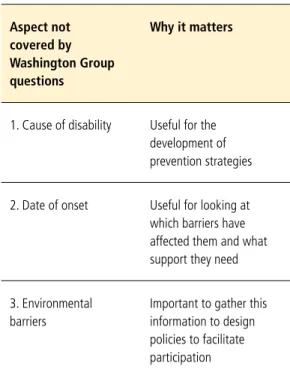
The Washington Group has a short and extended set of questions that governments can use to gather information on people with disabilities. However, data are needed not only on people with disabilities, but also on the barriers they face.433 While continued use of the Washington Group questions would help enormously, there are three aspects that this does not cover:434. Monitoring procedures should be established to prevent acts of substitution of information and communication, especially in decision-making mechanisms regarding persons with intellectual and mental disabilities.435 Likewise, mechanisms are needed to monitor leveling measures, including the achievement of public sector quotas. of persons with disabilities or other similar affirmative measures in the private sector as well as efforts to collect data and monitor programs for other doubly marginalized groups, such as Roma with disabilities or indigenous persons with disabilities. 436.
Advisory councils of persons with disabilities can be established and provided with sufficient resources to be involved in the development, implementation and monitoring of legislation and policies.437 There must also be a mechanism for the facilitation and coordination of matters related to the implementation of the CRPD. and independent national human rights institutions.438 Such mechanisms must also function at the subnational level.439. States parties must establish and implement protocols to register, monitor and track the conditions in all remaining institutions and ensure that an independent mechanism is empowered to detect and respond to cases of abuse.440 Such bodies should have sufficient powers to conduct and impose investigations. sanctions on public or private bodies that commit acts of discrimination, including forms of intersectional discrimination.441 Legal remedies must be in place to enable persons with disabilities to submit complaints related to discrimination on the basis of disability.442 Complaints of discrimination on more than one ground should be permissible, with higher levels of compensation established for victims of such discrimination, as well as the imposition of higher penalties for offenders.443 The costs of legal proceedings should be waived or reduced for victims of disability discrimination to ensure.
Intersectional Lens
Develop effective complaint mechanisms Independent complaint mechanisms must be Independent complaint mechanisms must be in place.
Inclusion In The Post 2015 Development Agenda
HIV-AIDS-positive persons with disabilities face numerous obstacles in obtaining safe and adequate housing. Persons with disabilities are often excluded from education on the assumption that they do not need it. Relevant stakeholders should involve persons with disabilities in their assessment of the rights of each of those populations.
It is essential that relevant stakeholders include persons with disabilities in their review of the rights of each of those populations. Committee on the Rights of the Child (2006), CRC/C/gC/9, The Rights of Children with Disabilities. Thematic study on the right of persons with disabilities to live independently and be included in the community, A/hRC/28/37.
Report of the Special Rapporteur on the rights of persons with disabilities (2015), A/70/297, accessed at http://www.un.org/en/ga/search/view_doc.
