6.863J Natural Language Processing Lecture 6: part-of-speech tagging to
parsing
Instructor: Robert C. Berwick
The Menu Bar
• Administrivia:
• Schedule alert: Lab1 due next today Lab 2, posted Feb 24; due the Weds after this –
March 5 (web only – can post pdf)
• Agenda:
• Finish up POS tagging – Brill method
• From tagging to parsing: from linear representations to hierarchical
representations
Two approaches
1. Noisy Channel Model (statistical) –
2. Deterministic baseline tagger composed with a cascade of fixup transducers
These two approaches will the guts of Lab 2
(lots of others: decision trees, …)
Summary
• We are modeling p(word seq, tag seq)
• The tags are hidden, but we see the words
• Is tag sequence X likely with these words?
• Noisy channel model is a “Hidden Markov Model”:
Start PN Verb Det Noun Prep Noun Pre Bill directed a cortege of autos thro
0.4 0.6
0.001
probs from tag bigram model
probs from unigram
replacement
Finding the best path from start to stop
• Use dynamic programming
• What is best path from Start to each node?
• Work from left to right
• Each node stores its best path from Start (as probability plus one backpointer)
Det:the 0.32Det Start Adj
Noun
Stop Det
Adj Noun
Det Adj Noun
Det Adj Noun
Adj:directed… Noun:autos…
ε 0.2
Adj:directed…
Adj:cool 0.0009
Noun:cool 0.007
Method: Viterbi algorithm
• For each path reaching state s at step (word) t, we compute a path probability. We call the max of these viterbi(s,t)
• [Base step] Compute viterbi(0,0)=1
• [Induction step] Compute viterbi(s',t+1),
assuming we know viterbi(s,t) for all s
Viterbi recursion
path-prob(s'|s,t) = viterbi(s,t) * a[s,s']
probability of path to max path score * transition probability s’ through s for state s at time t s →s’
viterbi(s',t+1) = max s ∈STATES path-prob(s' | s,t)
Viterbi Method…
• This is almost correct…but again, we need to factor in the unigram prob of a state s’
emitting a particular word w given an observation of that surface word w
• So the correct formula for the path prob to s’ from s is:
path-prob(s'|s,t) = viterbi(s,t) * a[s,s'] * bs’ (ot)
Bigram
transition prob Unigram
output prob at Path prob so far to s
Finally…
• As before, we want to find the max path probability, over all states s:
max s ∈STATES path-prob(s' | s,t)
Or as in your text…p. 179
Find the path probability Find the max so far
Two approaches
1. Noisy Channel Model (statistical) – what’s that?? (we will have to learn some statistics)
2. Deterministic baseline tagger composed
with a cascade of fixup transducers
Fixup approach: Brill tagging (a kind of transformation-based
learning)
Another FST Paradigm:
Successive Fixups
• Like successive markups but alter
• Morphology
• Phonology
• Part-of-speech tagging
• …
1
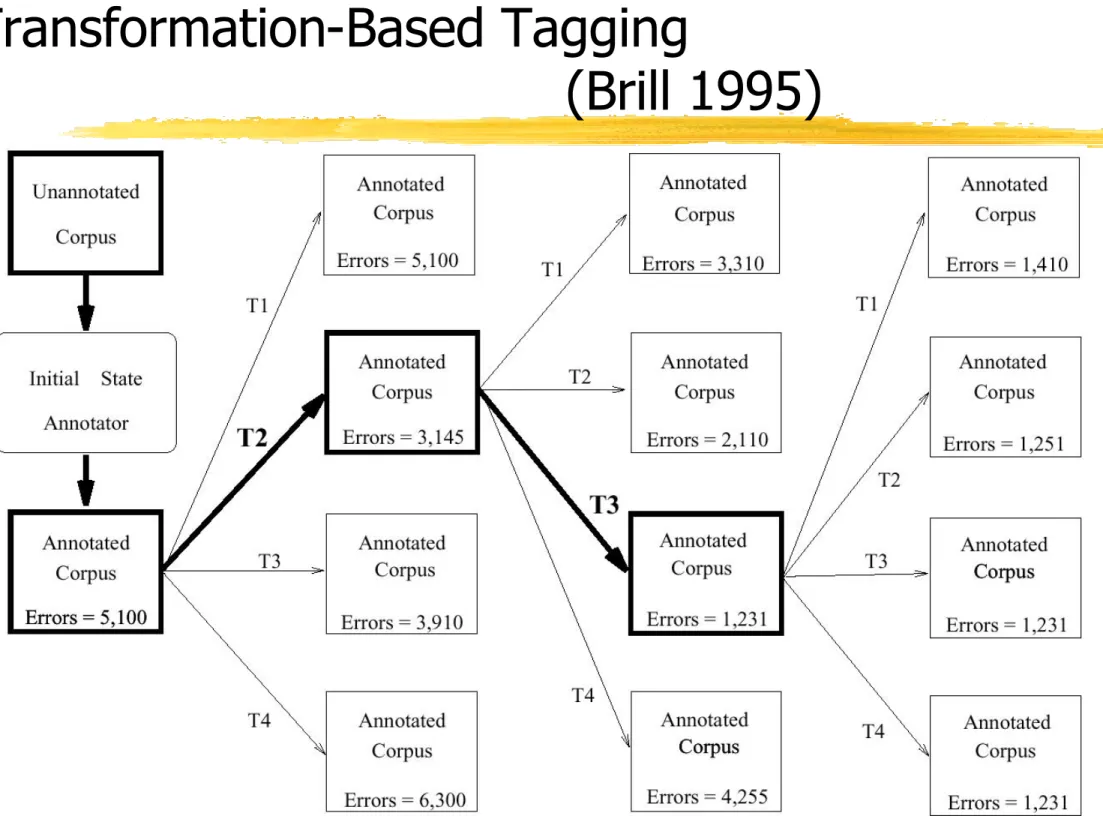
Transformation-Based Tagging
(Brill 1995)
figure from Brill’s thesis
Transformation based tagging
• Combines symbolic and stochastic approaches:
uses machine learning to refine its tags, via several passes
• Analogy: painting a picture, use finer and finer brushes - start with broad brusch that covers a lot of the canvas, but colors areas that will have to be repainted. Next layer colors less, but also makes fewer mistakes, and so on.
• Similarly: tag using broadest (most general) rule; then an narrower rule, that changes a
Applying the rules
1. First label every word with its most-likely tag (as we saw, this gets 90% right…!) for example, in Brown corpus, race is most likely to be a Noun:
P(NN|race)= 0.98 P(VB|race)= 0.02
2. …expected/VBZ to/TO race/NN tomorrow/NN
…the/DT race/NN for/IN outer/JJ space/NN
3. Use transformational (learned) rules to change tags:
Change NN to VB when the previous tag is TO TO race/VB
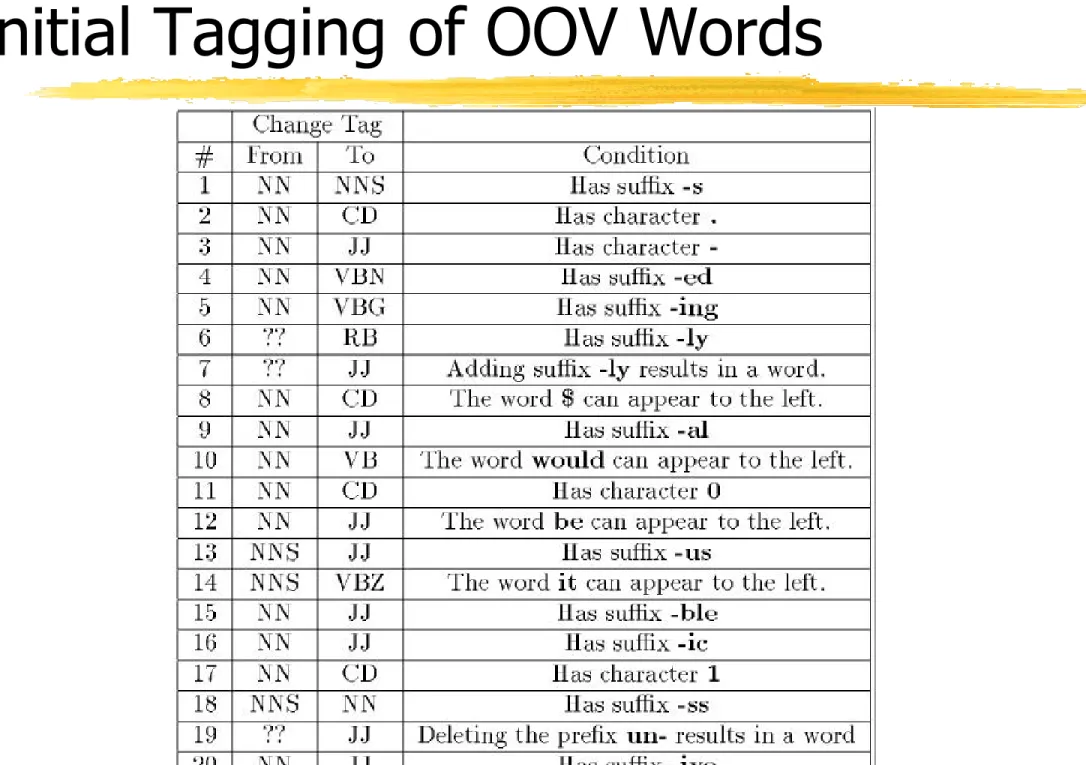
Initial Tagging of OOV Words
figure from Brill’s thesis
(supervised) learning pudding - How?
• 3 stages
1. Start by labeling every word with most-likely tag
2. Then examine every possible transformation, and selects one that results in most improved tagging
3. Finally, re-tags data according to this rule
4. Repeat 1-3 until some stopping criterion (no new improvement, or small improvement)
• Output is ordered list of transformations that constitute a tagging procedure
How this works
• Set of possible ‘transforms’ is infinite, e.g.,
“transform NN to VB if the previous word was MicrosoftWindoze & word braindead occurs between 17 and 158 words before that ”
• To limit: start with small set of abstracted
transforms, or templates
Templates used: Change a to b when…
Variables a, b, z, w, range over parts of speech
Method
1. Call Get-best-transform with list of potential templates; this calls
2. Get-best-instance which instantiates each template over all its variables (given specific values for where we are)
3. Try it out, see what score is (improvement over known tagged system -- supervised
learning); pick best one locally
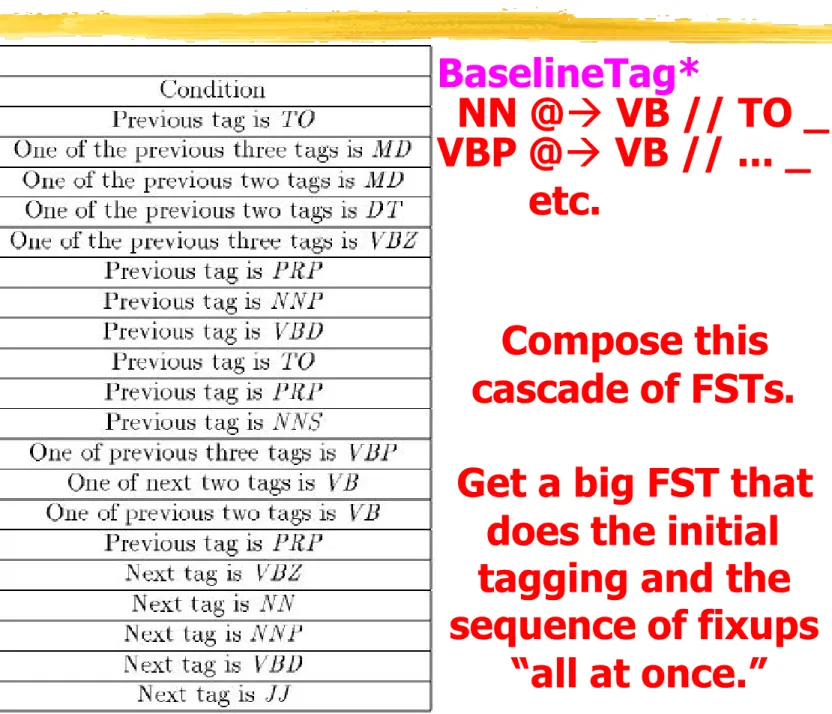
nonlexicalized rules learned by
TBL tagger
Transformations Learned
figure from Brill’s thesis
NN @Æ VB // TO _ VBP @Æ VB // ... _
etc.
Compose this cascade of FSTs.
Get a big FST that BaselineTag*
Error analysis: what’s hard for taggers
• Common errors (> 4%)
• NN vs .NNP (proper vs. other nouns) vs. JJ (adjective): hard to distinguish prenominally;
important to distinguish esp. for information extraction
• RP vs. RB vs IN: all can appear in sequences immed. after verb
• VBD vs. VBN vs. JJ: distinguish past tense, past participles (raced vs. was raced vs. the out raced horse)
What’s hard
• Unknown words
• Order 0 idea: equally likely over all parts of speech
• Better idea: same distribution as ‘Things seen once’
estimator of ‘things never seen’ - theory for this done by Turing (again!)
• Hapax legomenon
• Assume distribution of unknown words is like this
• But most powerful methods make use of how word is
Or unknown language
• Vse schastlivye sen’i pokhozhi brug na
druga, kazhdaja neschastlivaja sem’ja
neschastliva po-svoemu
Most powerful unknown word detectors
• 3 inflectional endings ( -ed, -s, -ing ); 32 derivational endings ( -ion, etc.);
capitalization; hyphenation
• More generally: should use morphological analysis! (and some kind of machine
learning approach)
• How hard is this? We don’t know - we
actually don’t know how children do this,
either (they make mistakes)
Laboratory 2
• Goals:
1. Use both HMM and Brill taggers
2. Find errors that both make, relative to genre
3. Compare performance – use of kappa &
‘confusion matrix’
4. All the slings & arrows of corpora – use
Brown/Upenn corpus tags
J. text, p. 297 Fig 8.6
1M words 60K tag counts
Coda on kids
C: “Mommy, nobody don’t like me”
A: No, say, “nobody likes me”
C: Nobody don’t likes me A: Say, “nobody likes me”
C: Nobody don’t likes me
Parsing words - review
• We are mapping between surface, underlying forms
• Sometimes, information is ‘invisible’ (I.e., erased e, or an underlying/surface 0)
• There is ambiguity (more than one parse)
From lines to hierarchical respresentions…
• From this:
morph-ology
• To this: VP VP
[head=vouloir,...]V V
[head=vouloir, tense=Present,num=SG, person=P3]
... ...
veut veut
the problem
What can’t linear relations represent?
• wine dark sea → (wine (dark sea)) or ((wine dark) sea) ?
• deep blue sky
• Can fsa’s represent this?
• Not really: algebraically, defined as being associative (doesn’t matter about
concatenation order)
So, from linear relations… to
hierarchies
Det The
N plan
to
VP
VP
V
swallow
NP Wanda
V has
V been
V
thrilling
NP Otto NP
VP
VP VP
S
N
Examples
NP Verb
VP NP
S Verb
→thrills
VP
→Verb NP
S
→NP VP
Parsing for fsa’s: keep track of what ‘next state’ we could be in at each step
NB: ambiguity = > 1 path through network
= > 1 sequence of states (‘parses’) fruit flies like a banana
fruit
fruit flies flies
0 1 2 3
0 4
5 like
like ε
a
banana
FSA Terminology
• Transition function: next state unique = deterministic fsa
• Transition relation: > 1 next state = nondeterministic fsa
fruit flies like a banana fruit
fruit flies flies
0 1 2 3
0 4
5 like
like ε
a
banana
Methods for parsing
• How do we handle ambiguity?
• Methods:
1. Backtrack
2. Convert to deterministic machine (ndfsa → dfsa):
offline compilation
3. Pursue all paths in parallel: online computation (“state set” method)
4. Use lookahead
FSA terminology
• Input alphabet, Σ; transition mapping, δ;
finite set of states, Q ; start state q
0; set of final states, q
f• δ (q, s) → q’
• Transition function: next state unique = deterministic fsa
• Transition relation: > 1 next state =
nondeterministic fsa
State-set method: simulate a nondeterministic fsa
• Compute all the possible next states the machine can be in at a step = state-set
• Denote this by Si = set of states machine can be in after analyzing i tokens
• Algorithm has 3 parts: (1) Initialize; (2) Loop;
(3) Final state?
• Initialize: S0 denotes initial set of states we’re in, before we start parsing, that is, q0
Loop: S S
State-set parsing
Accept/reject Final:
Compute Si from Si-1
1. For each word wi , i=1,2,…,n 2.
3. Si← ε−closure(Si )
4. if Si = ∅ then halt & reject else continue
Loop:
Compute initial state set, S0 1. S0←q0
2. S0← ε−closure(S0 ) Initialize:
1 ( , )
i q Si i
S ← ∪ ∈ − δ q w
What’s the minimal data
structure we need for this?
• [S, i ] where S = denotes set of states we
could be in; i denotes current point we’re at in sentence
• As we’ll see, we can use this same
representation for parsing w/ more complex
networks (grammars) - we just need to add one new piece of information for state names
• In network form
• In rule form: qi α qk β
Example
fruit flies like a banana fruit
fruit flies
flies 1 2 3 4
5 like
like ε
a
banana 0 fruit
fruit
0 1
fruit flies
flies fruit
fruit
flies
0 2
ε 3
like like
like flies
flies
1 a
4
a
like
like 2 ε 3
banana
banana 4
5 a
Use backpointers to keep track of the different paths (parses):
S0:[0] S1:[0,1] S2:[1, 2, 3] S3:[2, 3] S4:[4] S5:[5]
State set 0 State set f
When is it better to convert at
compile time vs. run time? (for fsa)
• Run time : compute next state set on the fly
• Compile time : do it once and for all
• When would this difference show up in
natural languages (if at all)?
Where do the fsa states come from?
• States are equivalence classes of words
(tokens) under the operation of substitution
• Linguistic formulation (Wells, 1947, pp. 81- 82): “A word A belongs to the class
determined by the environment ____X if AX is either an utterance or occurs as a part of
some utterance” (distributional analysis)
X-files: fragments from an alien language
1. Gore lost the election
2. Gore will lose the election 3. Gore could lose the election 4. Gore should lose the election 5. Gore did lose the election
6. Gore could have lost the election 7. Gore should have lost the election 8. Gore will have lost the election
9. Gore could have been losing the election 10. Gore should have been losing the election 11. Gore will have been losing the election
More X-files
14. Bush lost the election
15. Bush will lose the election 16. Bush could lose the election 17. Bush should lose the election 18. Bush did lose the election
19. Bush could have lost the election 20. Bush should have lost the election 21. Bush will have lost the election
22. Bush could have been losing the election 23. Bush should have been losing the election
Formally…
• Definition. A binary relation between sets A, B, is a subset (possibly empty) of A x B
• Definition. Strings k,r are left-substitutable in a language L, if, for all strings w defined over Σ∗, kw∈L iff rw ∈L
• Fact. Left-substitutability is an equivalence relation (reflexive, transitive, symmetric)
• Definition. An equivalence relation over Σ is finite rank if it divides Σ into finitely many equivalence classes
• Definition. A binary relation R is called right- invariant if, for all p,r ∈ Σ∗, pRr⇒ pwRrw
And formally…
• Fact. A right-invariant relation R is an equivalence relation
• Theorem (Myhill-Nerode, 1956)
Theorem (Myhill-Nerode, 1956).
• Let L⊆Σ∗. Then the following 3 propositions are equivalent:
1. L is generated (accepted) by some finite- state automaton (finite transition network);
2. L is the union of certain equivalence classes of a right-invariant equivalence relation of
finite rank
3. Let the equivalence relation R be defined as follows: xRy iff x and y are left-substitutable in L. Then this relation R is of finite-rank and is right-invariant [this is Wells’ definition]
Finite # of bins = finite state
• Gives easy way to show what is not finite-state
• Eg, a
ncb
n, for all n> 0
• Proof by contradiction.
Suppose there was such an FSA. By the theorem,
this FSA is of finite rank, and classifies all strings in Σ∗ into one of a finite number of classes.
By the pigeonhole principle, there must exist some string ai s.t. aj with j ≠ i is in the same equivalence
Why not fsa’s forever?
• Can’t yield the right set of strings= weak generative capacity (antiantimissle…)
• Can’t yield the right set of structures = strong generative capacity ( dark blue sky )
• How do these failures show up?
A more complex fsa
0 1
2
3
5 6 7
12 4
the guy
guy have
will, can
will, can
eats
ice-cream
eaten eating
be
eat
been has, have
has, have
is, are
is been
been is,
are
Conversion to deterministic machine
0 1
the
2,3
4,8
7
11
12 guy
is
will
be
eaten
ice-cream
10,11
eats eat
6, 7, 10, 11
ice-cream being
being
being
have, has
been 5,9
eating
6,1011 eating
eating
eaten eaten have
What are we missing here?
We are missing the symmetry
0 1
2
3
5 6 7
8 11
12
10 4
9
the guy
guy have
will, can
will, can
eats
ice-cream
eaten eating
be
eat
be have
been
been being
has, have
has, have
is, are
is been
been is,
are
Having a poor representation…
• Shows up in having duplicated states (with no other connection to each other)
• System would be ‘just as complex’= have the same size (what is size of automaton?) even if the network were not symmetric
• So we have failed to capture this regularity &
the network could be compressed
• How?
Compressability reveals rendundancy (pattern)that we have missed
Active:
+
Rule that flips network=
Passive:
Aka “transformational grammar”
But it’s worse than that… more redundancy even so
the guy
Bush Bush
the guy saw
So, obvious programming approach:
Subnetworks as subroutines, to compress the description
the guy
Bush Bush
the guy saw
saw the guy
Bush Sentence:
Noun
phrase: “splice out” common
subnets
Could be worse…
1 2
the, these those,
first
e
every most,
e,
15
16
5
4 twodozen,
e e
very
books the,
e e
two
some
first some,
e e
e,
a this,
e first e
e every two
e
two 0
3 10
beautiful 12
11
17 most,
7
e
6
14
13 beautiful that
Noun “specifiers”
Could be raining…
It could be even worse…
1 2
the, these those,
first
e
every most,
e,
15
16
5
4 twodozen,
e e
very
books the,
e e
very beautiful
e
two
some
first some,
e e
e,
a this,
e first
book e
e every two
e
two 0
3 10
beautiful 12
11
8
17 most,
7
e
e 6
14
13 beautiful that
1 2
the, thesethose, first
e
every most,
e,
15 16
5 4 twodozen,
e e
very
books the,
e e
very beautiful e
two
some first some,
e e
e,
a this,
efirst
book e
e every two
e
two 0
3 10
beautiful 12
11
8
9
17 most,
7
e
e 6
14 13
beautiful that
saw
Noun specifiers
Examples
NP Verb
VP NP
S Verb
→thrills
VP
→Verb NP
S
→NP VP
The notion of a common subnetwork
• Equivalent to the notion of a phrase
• A Noun Phrase (NP)
• Defined by substitution class of a sequence of words (aka “a constituent”) - extension
beyond substitution of single words
• A phrase iff we can interchangeably substitute that sequence of words regardless of context
• So also gives us the notion of a context-free grammar (CFG)
Constituents, aka phrases
• Building blocks that are units of words concatenated together
• Why?
• Ans:
1. They act together (i.e., behave alike
under operations) - what operations?
The deepest lesson
• Claim: all apparently nonadjacent
relationships in languge can be reduced to adjacent ones via projection to a new
level of representation
• (In one sense, vacuous; in another, deep)
• Example: Subject-Verb agreement (agreement generally)
• Example: so-called wh- movement
Gaps (“deep” grammar!)
• Pretend “kiss” is a pure transitive verb.
• Is “the president kissed” grammatical?
• If so, what type of phrase is it?
• the sandwich that
• I wonder what
• What else has
the president kissed e
Sally said the president kissed e Sally consumed the pickle with e
Examples
• The guy that we know in Somerville likes ice- cream
• Who did the guy who lives in Somerville see
__?
SNP+sing VP+sing The guy S
that we know in Som.
V NP
likes
ice-cream
The deep reason why
• Machinery of the mind: based only on
concatenation of adjacent elements - not on ‘counting’ eg., “take the 7th element &
move it…”
• Runs through all of linguistic
representations (stress, metrical patterns, phonology, syntax, …)
• Strong constraint on what we have to
Constituents
• Basic ‘is-a’ relation
• Act as ‘whole units’ -
• I want this student to solve the problem
• ?? Student, I want this to solve the problem
• This student, I want to solve the problem
• Sometimes, we don’t see whole constituents…book titles (claimed as objection to constituency):
• Sometimes a Great Notion
• The Fire Next Time
• Why might that be?