10.34: Numerical Methods Applied to
Chemical Engineering
Finite Volume Methods
Constructing Simulations of PDEs
1
Recap
•
von Neumann stability analysis•
Finite volume methods2
3
•
Generally used for conservation equations of the form:•
is the density of a conserved quantity•
is the flux density of a conserved quantity•
The integral version of such an equation is:Finite Volume Method
@ b
@ t = r · j + r (x, t)
b(x, t) j(x, t)
d dt
Z
V ⇤
b(x, t) dV = Z
S⇤
n · j(x, t) dS + Z
r (x, t) dV
V ⇤
d B
⇤(t) = F
⇤(t) + R
⇤(t)
dt
ACC IN/OUT GEN/Cor
*
ON4
•
•
What are each of these terms?• B
⇤(t) = V
⇤¯ b
⇤(t)
• R
⇤(t) = V
⇤r ¯
⇤(t)
• F
⇤(t) = X F
k(t) =
k2faces⇤ k2
X A
⇤k(n
k•
faces⇤· j)(t)
the sum of fluxes through each face of the volume *
d ¯ b
⇤V
⇤= F
k(t) + V
⇤r ¯
⇤(t) dt
•
We want to solve for by approximating the reaction and flux terms. Let’s construct low order approximations physically.d B
⇤(t) = F
⇤(t) + R
⇤(t)
dt
ACC IN/OUT GEN/CON*
¯ b(t)
X
k2faces⇤
Finite Volume Method
Conservation within a finite volume:
5
*
@ b
@ t = r · j + r(x, t)
d ¯ b
⇤V
⇤=
dt
k2X F
k(t) + V
⇤r ¯
⇤(t)
faces⇤
Finite Volume Method
6
*
@ t = r · j + r(x, t)
d ¯ b
⇤V
⇤=
dt
k2X F
k(t) + V
⇤r ¯
⇤(t)
faces⇤
Finite Volume Method
@ b
7
@ b
@ t = r · j + r(x, t)
d ¯ b
⇤V
⇤= X
F
k(t) + V
⇤r ¯
⇤(t)
, France
dt
k2faces⇤*
Geometrica: INRIA
Finite Volume Method
© INRIA. All rights reserved. This content is excluded from our Creative Commons license. For more information, see https://ocw.mit.edu/help/faq-fair-use/.
8
d ¯ b
⇤V
⇤=
dt
k2X F
k(t) + V
⇤r ¯
⇤(t)
faces⇤
Cardiff et al. J Biomech Eng 136(1), 2013
*
Finite Volume Method
@ b
@ t = r · j + r(x, t)
© Cardiff, Philip et al. License: cc by-nc-nd. Some rights reserved. This content is excluded from our CreativeCommons license. For more information, see https://ocw.mit.edu/help/faq-fair-use/.
9
Numerical Solution of PDEs
L
Step 1: domain decomposition finite difference: nodes
i, j
W
10
Numerical Solution of PDEs
L W
Step 1: domain decomposition finite volume: cells
i, j
L
11W
Numerical Solution of PDEs
Step 1: domain decomposition
finite element: elements (local basis functions)
i, j
12
Numerical Solution of PDEs
Step 1: domain decomposition
Always choose the spacing between nodes/dimensions of cells to match the physics.
Never pick a certain number of nodes or cells a priori. That number is irrelevant.
13
19
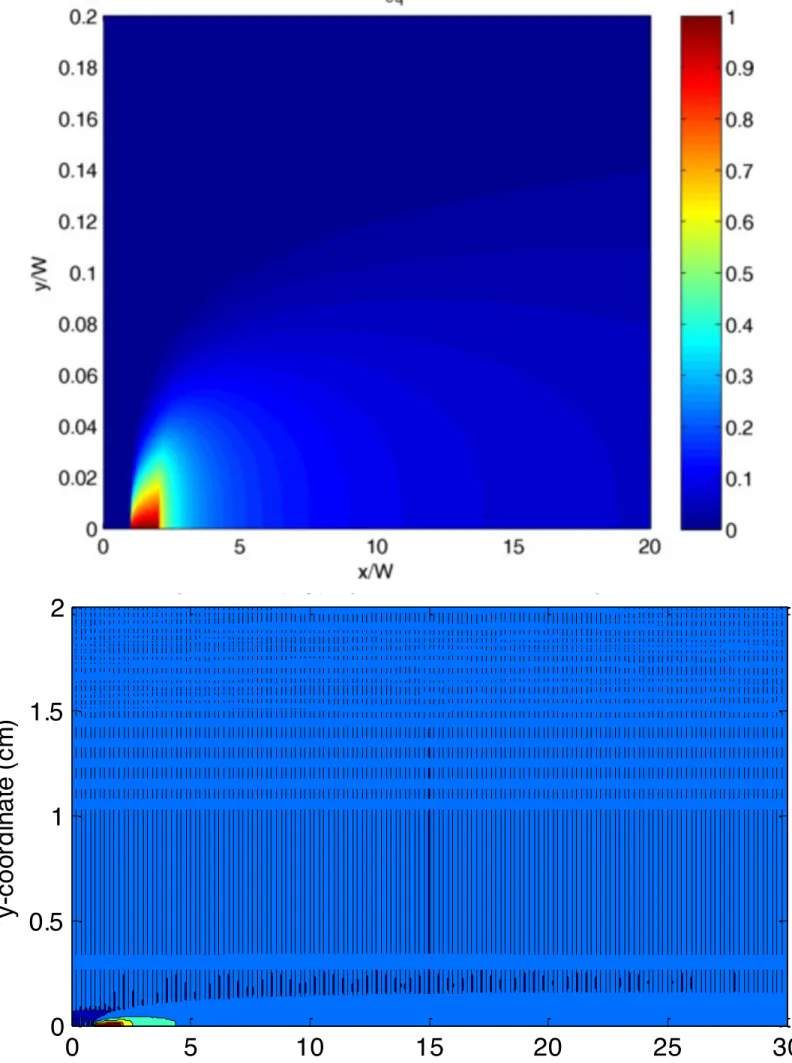
x-coordinate (cm)
cm)( etanidrocoy-
Concentration profile in (x,y)-space. Thin medical implant at x [1,2] cm.
0 5 10 15 20 25 30
0 0.5 1 1.5 2
-2 0 2 4 6 x 10⁸ -4
x-coordinate (cm)
y-coordinate (cm)
Close-up of concentration profile in (x,y)-space.
R = 30, B = 2, N = 300. Semi-infinite boundary condition at x=R and y=B: Dirichlet zero concentration.
0 2 4 6 8 10
0 0.02 0.04 0.06 0.08 0.1
-2 0 2 4 6 x 10⁸ -4
Figure 6.2 Concentration profile using Dirichlet boundary condition for x = R and y = B. R = 30 cm, B = 2 cm, and N = 300.
14
Numerical Solution of PDEs
Step 2: formulate an equation to be satisfied at each node/cell
15
Numerical Solution of PDEs
Step 2: formulate an equation to be satisfied at each node/cell Example: at interior node/cell i,j
r
2c = 0
equation i,j:
c
i+1,j+ c
i 1,j+ c
i,j 1+ c
i,j+14c
i,j= 0
16
Numerical Solution of PDEs
Step 2: formulate an equation to be satisfied at each node/cell Example: at boundary node/cell i,j
equation i,j:
c = 1
c
i,j1 = 0
17
Numerical Solution of PDEs
Step 3: solve the system of equations formulated at each node/cell for the value of unknown function at each node/cell
f (c) = 0
If equations are linear, use linear iterative methodsIf equations are nonlinear, use nonlinear iterative methods
18
Numerical Solution of PDEs
Step 3: solve the system of equations formulated at each node/cell for the value of unknown function at each node/cell
f (c) = 0
must be a vector of the unknowns must be a vector of the equationsc
f
19
Numerical Solution of PDEs
1 N
xN
y1 2
i j
Indexing
k = i + (j 1)N
xc
i,j+1= c
k+Nxc
k= c
i,j ork = j + (i 1)N
yc
i,j+1= c
k+13,
20
Numerical Solution of PDEs
y
1 , 2
i j
Indexing
1 N
xN
k = i + (j 1)N
xf
k(c) = f
i,j(c)
ork = j + (i 1)N
y3
21
Numerical Solution of PDEs
N
y1 2
j
Indexing
1 N
xk = i + (j 1)N
xf
k(c) = f
i,j(c)
ork = j + (i 1)N
y3,
i
22
Numerical Solution of PDEs
N
xy
N
zN
c
l= c
i,j,k, l =?
Exercise: write a single index for finite difference nodes in a cubic domain with (Nx, Ny, Nz) nodes in each cartesian direction
Numerical Solution of PDEs
Exercise: write a single index for finite difference nodes in a cubic domain with (Nx, Ny, Nz) nodes in each cartesian direction
N
xN
yN
zc
l= c
i,j,k, l = i + (j 1)N
x+ (k 1)N
xN
y23
Numerical Solution of PDEs
Example: solve the diffusion equation in 2-D on a square with side = 1.
r
2c = 0 c = 0
c = 0
c = 0
c = 1
f (c) = 0
24
25
Numerical Solution of PDEs
Example: solve the diffusion equation in 2-D on a square with side = 1.
h = 1 / 10; % Spacing between finite difference nodes Nx = 1 + 1 / h; % Number of nodes in x-direction
Ny = Nx; % Number of nodes in y-direction
c0 = zeros( Nx * Ny, 1 ); % Initial guess for solution
c = fsolve( @( c ) my_func( c, Nx, Ny ), c0 ); % Find root of FD equations
26
Numerical Solution of PDEs
Example: solve the diffusion equation in 2-D on a square with side = 1.
function f = my_func( c, Nx, Ny )
% Loop over all nodes for i = 1:Nx
for j = 1:Ny
k = i + ( j - 1 ) * Nx; % Compound index
% Boundary nodes if ( i == 1 )
f( k ) = c( k );
elseif ( i == Nx ) f( k ) = c( k );
elseif( j == 1 )
f( k ) = c( k ) - 1;
elseif( j == Ny ) f( k ) = c( k );
% Interior nodes else
f( k ) = c( k + 1 ) + c( k - 1 ) + c( k - Nx ) + c( k + Nx ) - 4*c( k );
end;
end;
end;
27
Numerical Solution of PDEs
Example: solve the diffusion equation in 2-D on a square with side = 1.
0 0.1 0.2 0.3 0.4 0.5 0.6 0.7 0.8 0.9 1
0 0.1 0.2 0.3 0.4 0.5 0.6 0.7 0.8 0.9 1
0.08 seconds to solve
h = 1/10
28
Numerical Solution of PDEs
Example: solve the diffusion equation in 2-D on a square with side = 1.
0 0.1 0.2 0.3 0.4 0.5 0.6 0.7 0.8 0.9 1
0 0.1 0.2 0.3 0.4 0.5 0.6 0.7 0.8 0.9 1
h = 1/100
700 seconds to solve!
Why is it almost 10,000x slower?
29
Numerical Solution of PDEs
Example: solve the diffusion equation in 2-D on a square with side = 1.
f (c) = 0 = Ac b
function [ Ac, b ] = my_func( c, Nx, Ny ) Ac = sparse( Nx * Ny, 1 );
b = sparse( Nx * Ny, 1 );
% Loop over all nodes for i = 1:Nx
for j = 1:Ny
k = i + ( j - 1 ) * Nx; % Compound index
% Boundary nodes if ( i == 1 )
Ac( k ) = c( k );
elseif ( i == Nx ) Ac( k ) = c( k );
elseif( j == 1 )
Ac( k ) = c( k );
b( k ) = 1;
elseif( j == Ny ) Ac( k ) = c( k );
% Interior nodes else
Ac( k ) = c( k + 1 ) + c( k - 1 ) + c( k - Nx ) + c( k + Nx ) - 4*c( k );
end;
end;
end;
30
Numerical Solution of PDEs
Example: solve the diffusion equation in 2-D on a square with side = 1.
h = 1 / 10; % Spacing between finite difference nodes Nx = 1 + 1 / h; % Number of nodes in x-direction
Ny = Nx; % Number of nodes in y-direction
% Calculate RHS of Ac = b
[ Ac, b ] = my_func( zeros( Nx * Ny, 1 ), Nx, Ny );
% Find solution of linear FD equations using the an iterative method
% This is gmres (generalized minimum residual). Other choices include
% bicgstab (conjugate gradient), minres (minimum residual), etc.
% The requires a function that returns A*c given c.
c = gmres( @( c ) my_func( c, Nx, Ny ), b, 100, 1e-6, 100 );
31
Numerical Solution of PDEs
Example: solve the diffusion equation in 2-D on a square with side = 1.
0.015 seconds to solve!
0 0.1 0.2 0.3 0.4 0.5 0.6 0.7 0.8 0.9 1
0 0.1 0.2 0.3 0.4 0.5 0.6 0.7 0.8 0.9
1
h = 1/10
32
Numerical Solution of PDEs
Example: solve the diffusion equation in 2-D on a square with side = 1.
5 seconds to solve!
0 0.1 0.2 0.3 0.4 0.5 0.6 0.7 0.8 0.9 1
0 0.1 0.2 0.3 0.4 0.5 0.6 0.7 0.8 0.9
1
h = 1/100
33
Numerical Solution of PDEs
Example: solve the diffusion equation in 2-D on a square with side = 1.
function [ Ac, b ] = my_func( c, Nx, Ny ) Ac = sparse( Nx * Ny, 1 );
b = sparse( Nx * Ny, 1 );
k = i + (j 1)N
x% Define indices of boundary points and interior points bottom = [ 1:Nx ];
top = Nx*Ny - [ 1:Nx ];
left = [ 1:Nx:Nx*Ny ];
right = [ Nx:Nx:Nx*Ny ];
interior = setdiff( [ 1:Nx*Ny ], [ left, right, bottom, top ] );
Ac( left ) = c( left );
Ac( right ) = c( right );
Ac( top ) = c( top );
Ac( bottom ) = c( bottom );
b( bottom ) = 1;
A( interior ) = c( interior - 1 ) + c( interior + 1 ) + c( interior - Nx ) + c( interior + Nx ) … - 4 * c( interior );
f (c) = 0 = Ac b
34
Numerical Solution of PDEs
Example: solve the diffusion equation in 2-D on a square with side = 1.
1.2 seconds to solve!
0 0.1 0.2 0.3 0.4 0.5 0.6 0.7 0.8 0.9 1
0 0.1 0.2 0.3 0.4 0.5 0.6 0.7 0.8 0.9
1
h = 1/100
MIT OpenCourseWare https://ocw.mit.edu
10.34 Numerical Methods Applied to Chemical Engineering
Fall 2015
For information about citing these materials or our Terms of Use, visit: https://ocw.mit.edu/terms.