The model combined the effects of FP and other determinants as control variables (RER, external debt and TOT) on dynamic adjustments of CAB. We acknowledge that this work was carried out by Babatunde Israel Ekundayo in the Department of Economics, Faculty of Social Sciences, University of Ibadan, Ibadan.
Statement of the Problem
What determines current account behavior in SSA and whether the determinants are consistent with basic economic fundamentals. What is the relationship between current account balance and fiscal policy in SSA economies.
Objectives of the Study
Furthermore, the development of the external sector profile in some SSA countries also reveals a periodic deficit in the balance of payments. Furthermore, Calderon et al., (2002) and Adedeji et al., (2005) argued that developing countries were characterized by an incessant increase in external debt, dismal growth rates, heavy dependence on foreign aid, insufficient private and public savings, huge exports of primary products and major distortions in the economy, to name just a few.
Justification for the Research
In addition, an in-depth study of the relationship between fiscal policy and the current account of the balance of payments could be of help in SSA, as the economies are plagued by fiscal dominance. In addition to this, the study examined the dynamic relationships that exist between the current account and its other determinants in SSA.
Scope of the Study
This study has adopted methodologies that are capable of evaluating the dynamic behavior of the current account balance, taking into account the main factors that may be important in determining the current account balance in the KLSH. The interpretive methodology in this thesis embraced the development of an empirically testable model within an Intertemporal Current Account (ICA) framework that was modified to capture the salient determinants of the current account balance in SSA.
Outline of the Thesis
Apart from the broad rationale for data collection, which is to gain efficiency, the choice of countries is guided by the desire to limit attention to sub-Saharan African countries and also by the availability of reliable data on the macroeconomic variables used in the study. . PROFILES OF FISCAL POLICY AND THE CURRENT ACCOUNT BALANCE IN SELECTED SUB-SAHARAN AFRICA (SSA) COUNTRIES.
Introduction
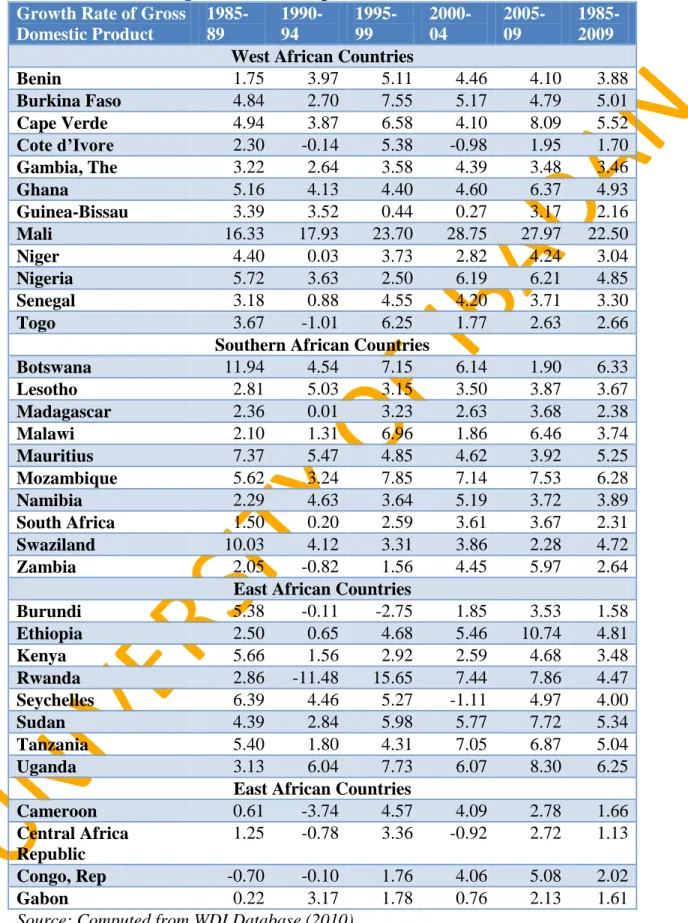
The Macroeconomic Performances in sub-Saharan Africa Economies
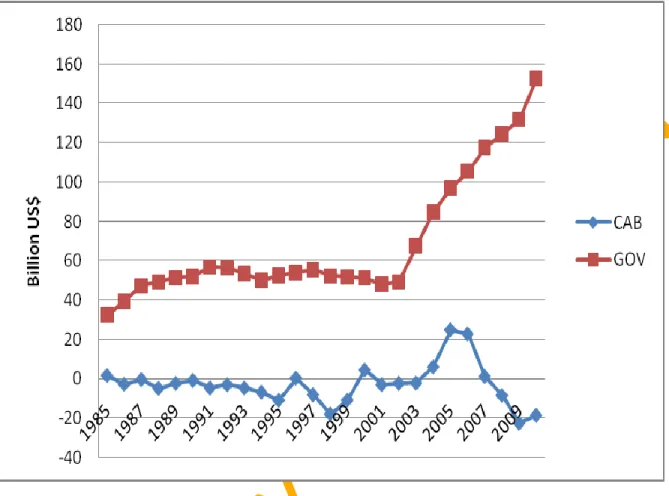
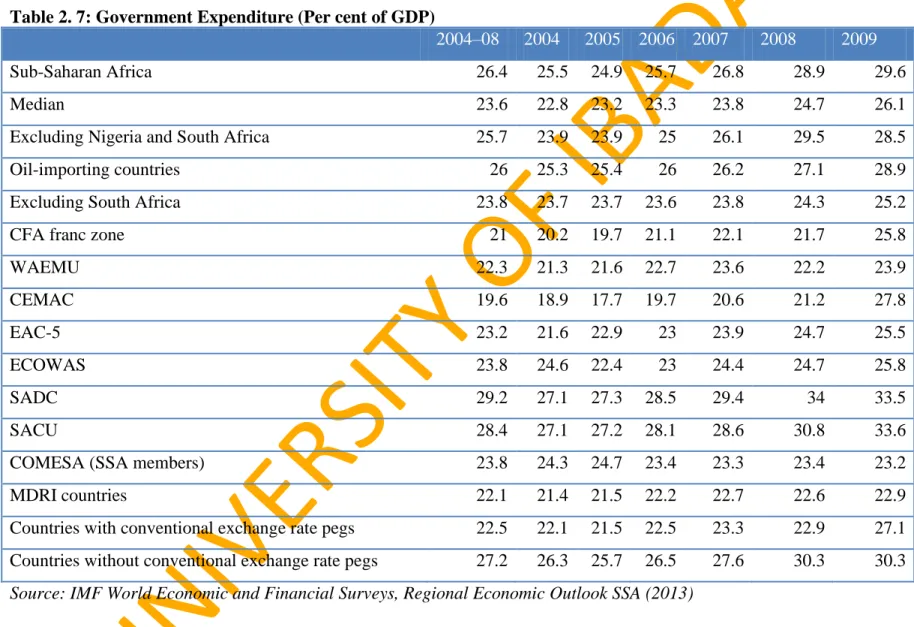
Despite the financial crisis in 2008, public spending in the region increased significantly. The collective analysis of the behavior of fiscal policy (here represented by public expenditure) and the current account of the balance of payments in SSA concealed some striking features exhibited by the individual countries in the region.

Stylised Facts on Similarities and Differences Exhibited by Fiscal Policy and the
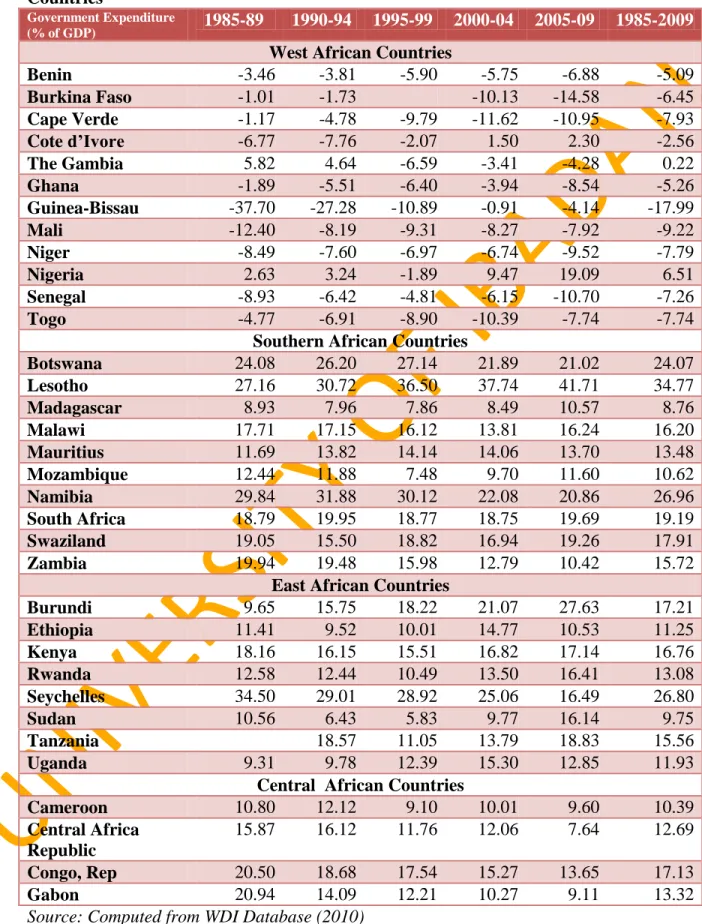
Patterns of Fiscal Policy
For example, between 1980 and 2010, we witnessed at least fifteen natural disasters that resulted in the deaths of about ninety-seven people, but the disasters affected at least 2 million people. The opposite was the case in some countries, where the GDP growth rate overtook the growth rate of government expenditures in previous years, which means a downward trend in the curve of public expenditures as a percentage of GDP.

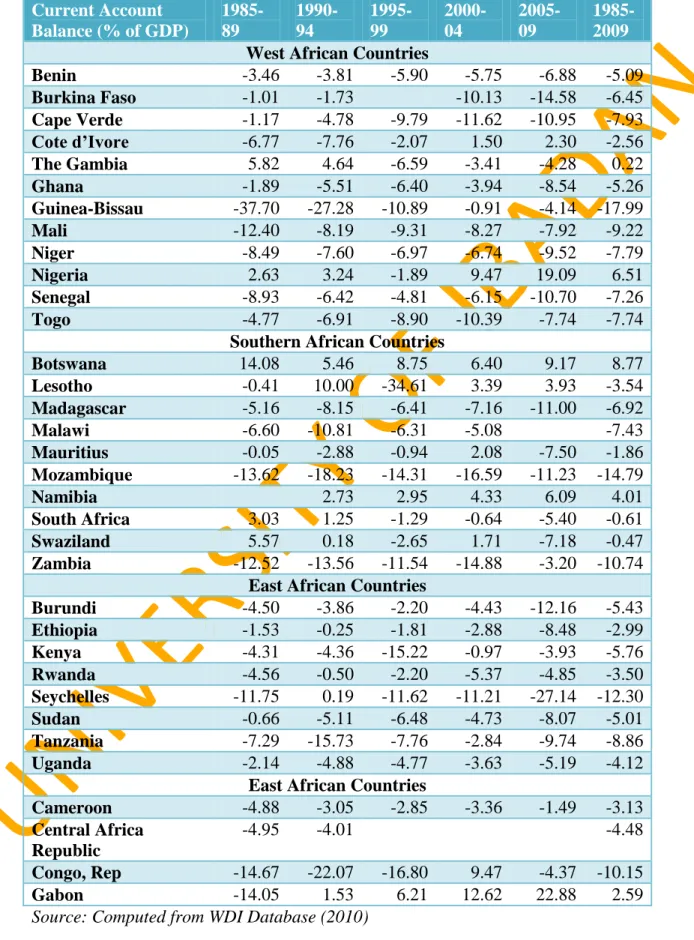
Patterns of the Current Account Balance
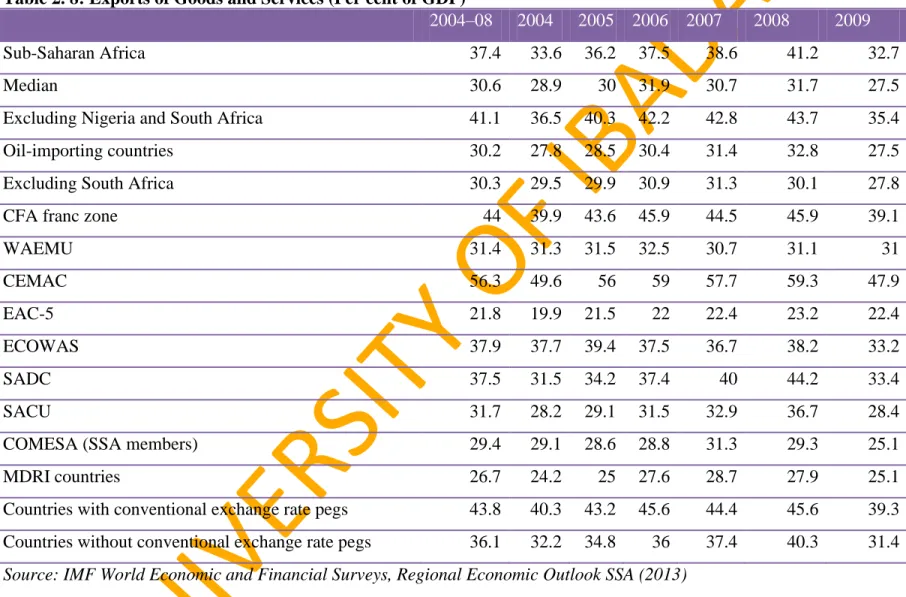
The cases of the Democratic Republic of the Congo and the Seychelles are of particular interest among this class, they experienced various disturbances in the development of their current accounts. Only a few countries experienced current account surpluses in most of the years considered in this study.

Specific Experience of Fiscal Policy and the Current Account Balance in SSA
- Kenya
- Botswana
- Cameroon
- South Africa
- Nigeria
Developments in public expenditure and the balance of payments' current items moved in opposite directions, as shown in Figure 2.9. Unlike other SSA countries, developments in public expenditure and the current account in Nigeria appear to be moving in the same direction.

Introduction
The Current Account and its Determinants
Introduction
This gives the authorities more reason to be concerned about the short-term behavior of the current account balance. The second argument stems from the uncertainty in predicting a country's ability to generate sufficient revenue in the future to repay its current debt obligations.
Theories of Current Account Balance Determinations
The modern model of the current account balance is based on the inter-temporal framework. This implies that unexpected temporary drop in output in a small open economy will cause deterioration in the current account balance (see Campbell and Shiller, 1987; Sheffrin and Woo, 1990; Milbourne and Otto, 1992; Otto, 1992).
Fiscal Policy and its Measures
Meaning and Economic Implications of Fiscal Policy Position and its
Durability tests are very sensitive to the quality and quantity of data used and to the statistical procedures applied to the data (Croce and Juan-Ramon, 2003). Empirical findings regarding sustainability tests have not been consistent, even when applied to the same countries and periods (see Croce and Juan-Ramon, 2003). The debt-to-GDP approach to measure sustainability has been extended in the context of an operationally simple recursive algorithm derived from the law of motion of the debt-to-GDP ratio subject to the government's reaction function (Croce and Juan-Ramon, 2003).
The Inter-temporal Model of the Current Account
Seminal works on the Inter-temporal Model of the Current Account
It is thus argued that changes in trading conditions should be included in the models used to analyze the behavior of the current account balance (see: Obstfeld 1982; Svensson and Razin 1983; and Persson and Svensson 1985). The third school of thought concerns the impact of temporary and permanent changes in government expenditure on the current account balance. Together, the four schools of thought formed a framework that used the current account balance as an input for deriving the optimal timing of external liabilities (Dornbusch 1983; Hercowitz 1986).
Assumptions of the Inter-temporal Model of the Current Account and the
He concluded that the basic consumption smoothing hypothesis model does not correctly explain the fluctuation in the current account of the balance of payments. In the study, he observed that the consumption smoothing hypothesis did not adequately explain the dynamic behavior of the small open economy. This recurring current item, combined with the development of the external debt, shows the need for a framework to assess whether the current balance is too large.
Fiscal Policy and the Current Account
Theoretical Studies
The real exchange rate channel of fiscal policy intervention in the current account balance can be seen through changes in relative international prices. The interest rate channel of the fiscal policy effect on the current account balance has also been identified in the literature. Alternatively, the relative effectiveness of the identified channels of fiscal policy influence on the current account balance is determined by the assumptions of the model.
Methodological Issues
In particular, the research used methodologies capable of limiting the likely bias that can arise when data from many cross-sections are pooled.
Synthetic Summary of some Empirical Literature
There was an inherent self-regulatory mechanism in the current account balance of all sampled countries except China. A model was formulated that expressed the current account balance as a function of internal factors (budget deficits and real effective exchange rates) and external factors (the deterioration of the terms of trade, the growth rate of industrial countries, the foreign real interest rate). Two theoretical arguments are prominent about the relationship between the current account balance and fiscal policy.
Introduction
Theoretical Framework
The representative maximizes equation (4.8) given that the current or initial net foreign asset position has been optimally chosen by the next period's net foreign asset decision. Equation (4.16) implies that when there is a possibility that the real interest rate and the discount rate are not equal, consumption is not necessarily a random walk. Most structural time series studies of the intertemporal approach to the current account balance essentially test the fundamental equation expressed in equation (4.22).
Empirical Implementation
Models Specification
It is measured in real terms as a percentage of the current account balance. It is measured as a percentage of net national savings of gross national income. The consistency of the GMM estimator depends on whether the lagged values of the explanatory variables are valid instruments in the current account balance regression.
Estimation Procedures
This approach helps answer the question of the magnitude of the impact of current account determinants on the current account balance. It helps quantify the magnitude of the impact of government expenditure and other control variables on the current account balance. 38 Of the thirty-four (34) countries selected, five (5) are from oil-exporting countries, eleven (11) from middle-income countries, fourteen (14) from low-income and fragile countries and twelve (12) are from fragile countries .
Data Sources
Introduction
Statistical Properties of the Variables
The current items and other variables have excess kurtosis, indicating a higher peak than a normal distribution.

Stationarity Test
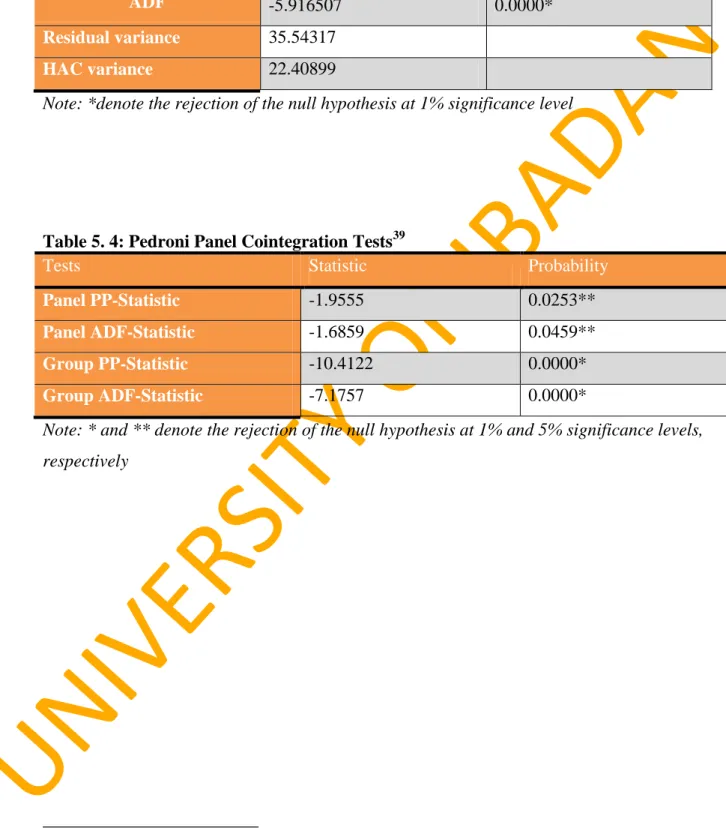
Tests for Cointegration
Two of the variables introduced by investments (TOT and SAV) were omitted from the test. This indicated that the current account balance, government expenditure and other determinants of the current account balance are combined, indicating the existence of a long-run relationship. This implied the existence of a long-run relationship between public expenditure, the current account balance and its other determinants in SSA.
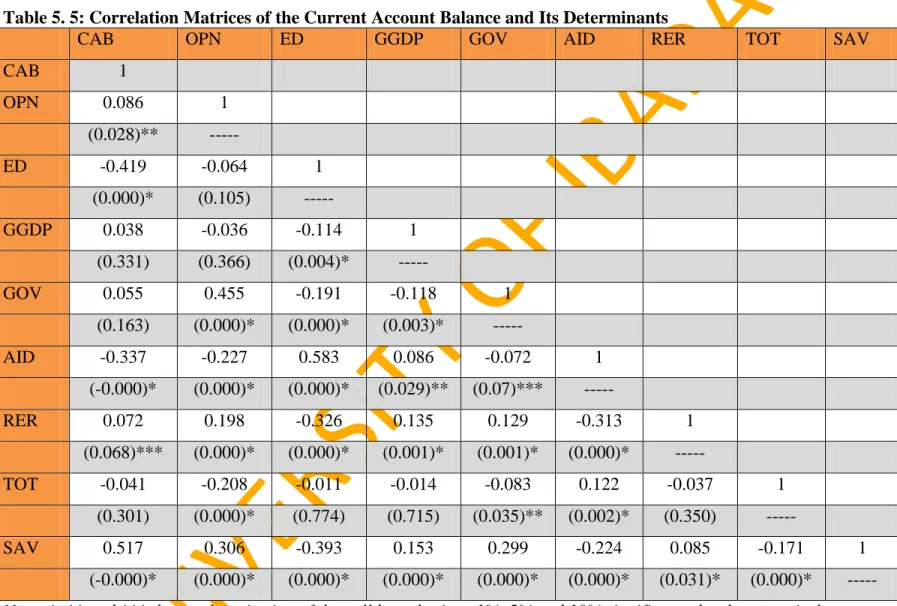
Correlation Analysis
This finding also applied to the short-term impact of government expenditures on the current account balance. The estimate of DFE current account balance coefficients for selected middle-income countries is shown in Table 5.8. Domestic production growth has a negative and significant coefficient in the dynamic model of the current account balance in SSA.
Dynamics of the Current Account Balance
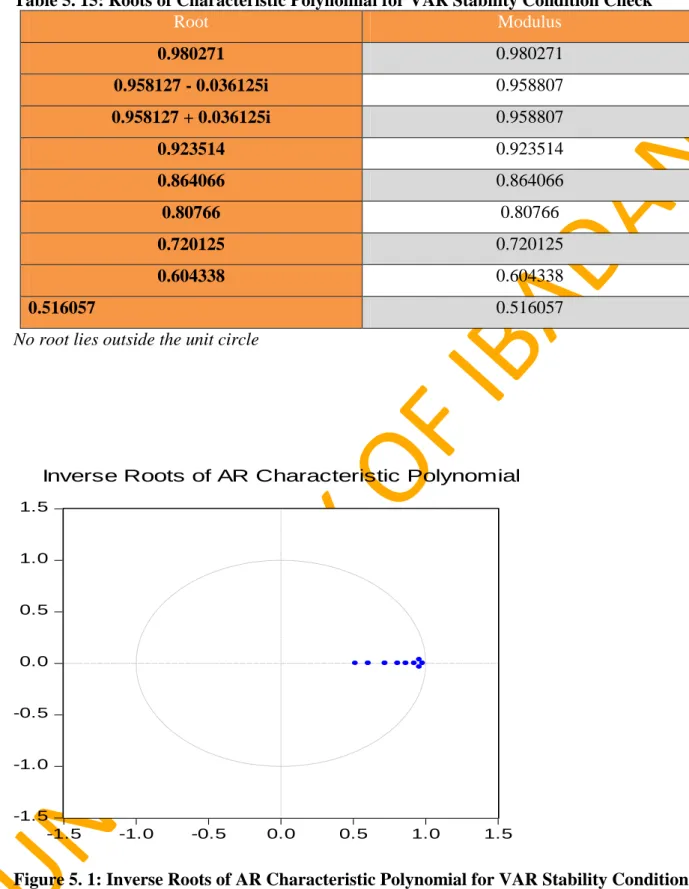
Initially, the positive shock of domestic production significantly improved the current account balance in the first year. The dynamic response of the current account balance to a positive shock of trade openness in SSA is shown in Figure 5.4. The dynamic response of the current account balance to the external debt shock is shown in Figure 5.8.
Introduction
Summary of Research Findings
The current account balance was found to have a significant linear relationship with trade openness, external debt, aid, the real exchange rate and domestic savings. The short-term impact of government spending on the current account balance was positive in fragile countries, but negative in other subgroups. The external debt coefficient implied a change of up to a fiftieth improvement in the current account balance.
Policy Recommendations
The dynamic effects of other current account determinants on the evolution of the current account balance in sub-Saharan countries were also identified. The simulation result indicates that the response of the current account balance to the terms of trade, domestic savings and aid flows shocks are mixed.
Conclusion
Investments and the current account in the short and long run, International Finance Discussion Papers, (647). An empirical analysis of the impact of the budget deficit on the current account balance in Cameroon. Fiscal deficits, investments and current account; Intertemporal Disequilibrium Analysis, mimeo, World Bank.