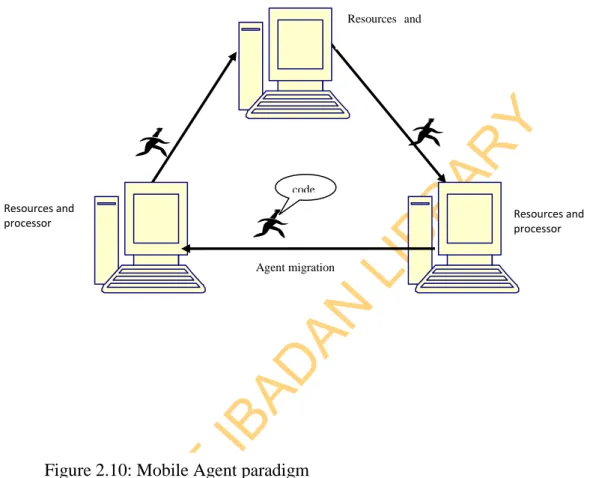
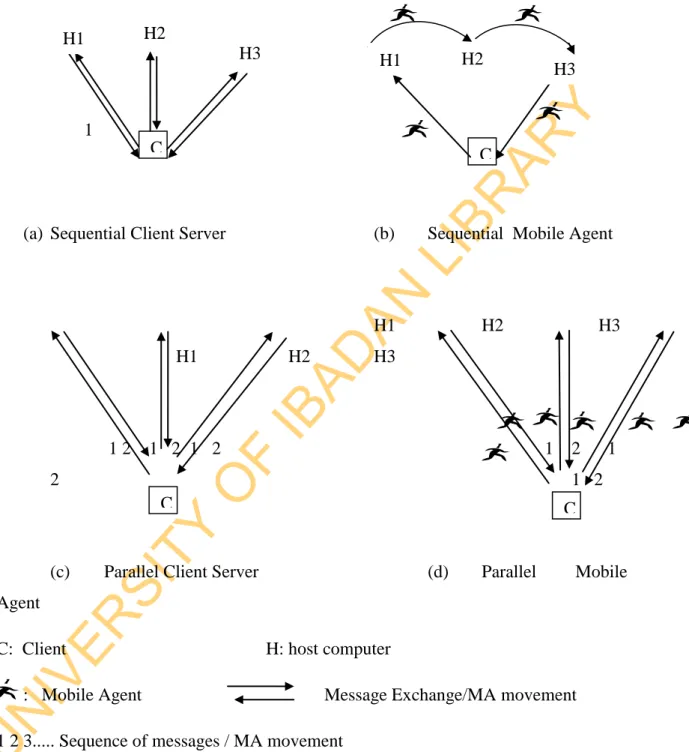
Further steps from the client-server introduced mobile agent technology of the software agents in the field of artificial intelligence. Mobile agent paradigm has been proposed as an alternative to client server paradigm for distributed applications (Aderounmu, 2001; Seng, 1999; Dale and DeRoure, 1997).
Rationale for the Research
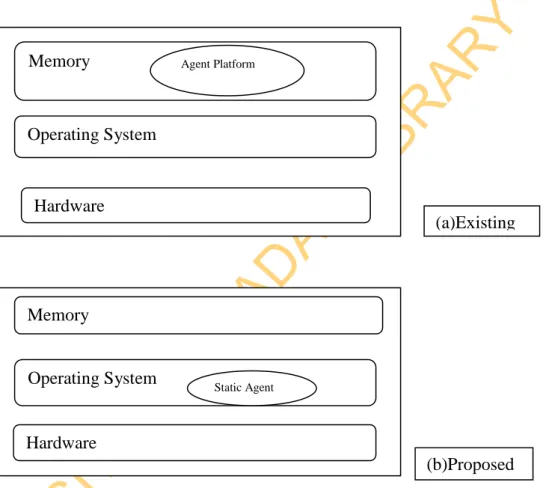
To reduce the heavy dependence of mobile agents on agent platforms installed on the computers, mobile agents can communicate directly with the operating system, since all computers run an operating system. The direct interaction of mobile agents with the operating system has several advantages compared to existing interactions with agent platforms.
Statement of the Problem
To address the problem of lack of interoperability, the embedded mobile agent allows mobile agents to interact directly with the operating systems of the computers they are intended to run. The focus of this research is to eliminate the static agent previously installed in memory and make mobile agents interact directly with the operating system.
Research Aim and Objectives
To handle the increasing amount of information available on the Internet, mobile agent technology has proven to be effective (Clark and Lazarou, 1997). Embedded mobile agent takes advantage of the fact that all computers run an operating system and attempts to make agents part of the operating system.
Research Methodology
Scope and Limitation
The popularity of the Windows operating system in this part of the world and the ability Windows offers programmers to make software available in kernel mode motivate the choice of Windows. An attempt is made to extend the services of the operating system in kernel mode and not to program the operating system.
Arrangement of the Thesis
This chapter presents the background concepts of the work and the latest review of literature on information retrieval, software agents and theoretical aspects of mobile agents. This includes a survey of the existing agent systems for information retrieval, existing agent platforms and some shortcomings in the existing systems that motivated the need for this study.
Overview of Information Technology
The Information Technology Association of America has defined information technology as the study, design, development, use, implementation, support, or management of computer-based information systems, especially software applications and computer hardware (Proctor, 2011). Also, information technology enables access to information from various sources regardless of their physical location, which is achieved through increased penetration and use of the Internet (Seng, 1999).
Computer Network
Classification of Computer Networks
Local Area Network (LAN): Consists of a small group of computers and communication devices interconnected within a limited geographic area, such as a building or campus, no more than one kilometer apart (Tanenbaum, 2003). Wide Area Network (WAN): is a group of interconnected LANs over a large geographic area, often a country and a continent (Tanenbaum, 2003).
Computer Network Topology
However, the ring network has a single point of failure, and any change to the network nodes affects the performance of the entire network. Star-wired bus combines two or more star topologies connected by a bus trunk that acts as the backbone of the network, as shown in Figure 2.6(b).
Software Agents
Distributed System Paradigms
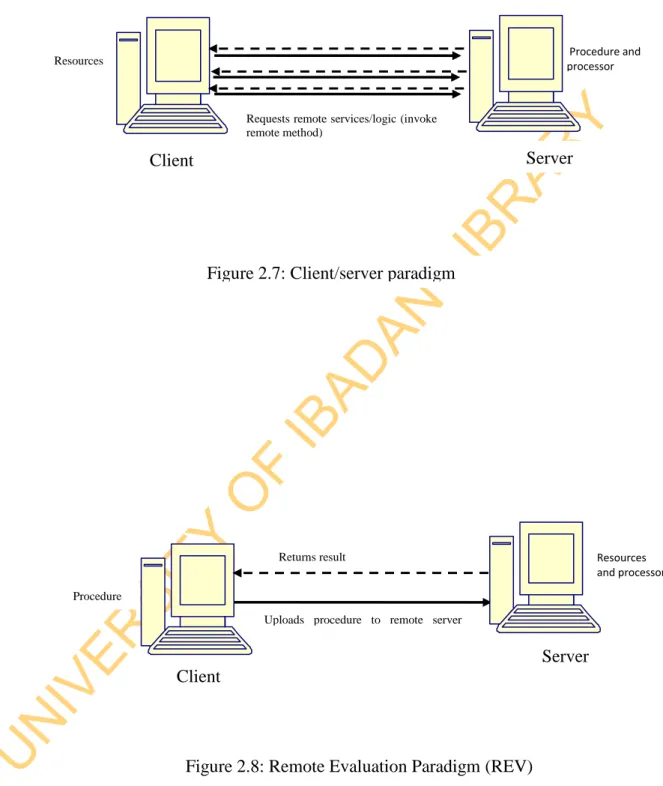
In REV, the code fragment is mobile and is sent from the client to the server for execution. In CoD, the code fragment is mobile and is sent from the server to the client.
Characteristics of Agents
Depending on the requirements of the application being developed, allowing fast transfer between nodes of a network. Communication can take place asynchronously (based on datagram) and synchronously using RPC or shared files or resources. xiii) Adaptability: The agent must be sensitive to various traffic conditions, connections and topologies of a computer network, as well as to the diversity of resources available in each node (Braun and Rossak, 2005).
Types of Agent
Nwana, 1996). ii) Intelligence or adaptation: agents are able to adapt to the environment they find themselves in and learn from user experience and patterns. Based on these three behavioral components, software agents are categorized according to Nwana (1996) and as depicted in Figure 2.12 as:. i) Collaborative agents: emphasize autonomy and cooperation with other agents to perform their tasks.
Mobile Agent Technology
- Strength of Mobile Agent Paradigm
- Issues Associated with Mobile Agents
- Security Issues with Mobile Agent Technology (MAT)
- Protection Methods Against Security Threats
Mobile Agent System (MAS) is the computational framework that implements the mobile agent paradigm, and it provides services and primitives that assist in the use, implementation, and execution of system development using the mobile agent paradigm (Roberto, 2001). This is serious in mobile agent systems as agent platform has access to the agent's code, state and data (Admassu, 2008).
Mobile Agent Platform
Mobile Agent Platform Architecture
Pears (2005) defines an agent server as a server process running on hosts that are ready to host a mobile agent. Agent management manages mobile agent initiation, termination, resume, and termination, and routing of requests to the transport and communications manager.
Mobile Agent Systems Interoperability
Fortino and Russo (2003) proposed a java-based framework for interoperability between java-based mobile agent systems. The framework allows interoperability of execution, migration and interaction of Java-based mobile agent systems.
Standardization of Mobile Agent Systems
FIPA specifies languages, message ordering, ontology, protocols, specifies communication between agents and has an associated formal semantics in what is known as FIPA-Agent Communication Language (FIPA-ACL). Services provide support services for agents and include the standard services of agent directory services, message transport services, and service directory services.
Multi-Agent Systems
- Motivation for Multi-Agent System
- The Agent Framework Design
- Mobility Strategies
- Itinerary Implementation Strategies
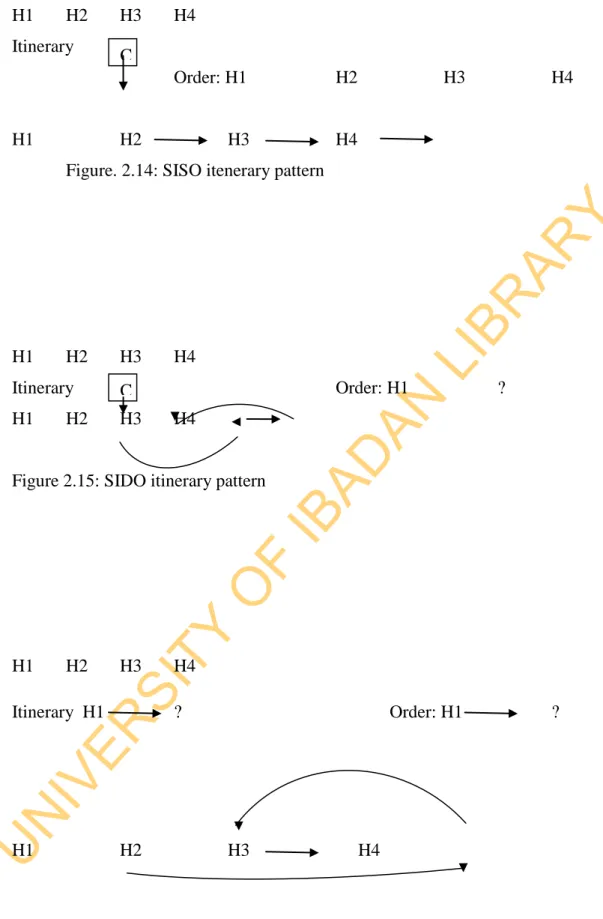
The agent receives an itinerary at the source agency that shows the sequence of agencies to visit. This model is unique in that the mobile proxy can move along with the agent.
A Survey of Mobile Agents Systems
- JADE: Java Agent Development Framework
- Grasshopper
- Agent Tcl (D‟Agents)
- Aglet
- TACOMA: Tromso And COrnell Moving Agents
- Telescript/Odyssey
- Voyager
An aglet is a combination of the applet model and the agent model, which in principle adds mobility to applets. A telename consists of an authority that identifies the owner of the agent and identity that distinguishes an agent from another agent of the same authority.
Windows XP Operating System
- Windows Operating System Service
- Peculiarity of Service Applicationn
- Service Control Manager (SCM)
- Windows XP Service Lifecycle
The main method for the service application must issue the Run command for the services contained in the project. The Run method loads the services in the service control manager on the appropriate server.

Introduction to Information Retrieval
Evolution of Information Retrieval
84 The invention of word processing and time-sharing systems in the 1970s led to a mass of text in machine-readable form, starting full-text retrieval systems. In the year 2010s, the fulfillment of Bush's prediction is being exploited, a lot of conversion to machine readable forms has been done but not completed.
Overview of Information Retrieval (IR)
The acquisition of information experienced a boom especially in the USA, where it was proposed that a computer network could bring information closer to students, and digital libraries were also developed, where the distributed search for information originated. Information retrieval systems must support three basic processes that are very important: (i) how to represent each document (indexing), (ii) how to represent the user's information needs in a form suitable for use by a computer (query formulation). ) and (iii) matching or comparing the two representations.
DISTRIBUTED INFORMATION RETRIEVAL (DIR)
Information Retrieval Model
IR systems store both a representation of documents and questions. There are several such representations, each is useful in developing specific information retrieval tools. Common models include the vector space model, the generalized vector space model, the (improved) topic-based vector space model, the extended Boolean model and latent semantic indexing (latent semantic analysis).
Boolean Retrieval Model
It is easy to implement and computationally efficient. v) However, the Boolean model does not provide a ranking of the retrieved documents based on relevance. Despite these shortcomings, the Boolean model is still used by popular systems; it is the standard model for today's large-scale, operational retrieval systems and many of the major online information services use it, such as PubMed (Yepes, 2009). .
Ranked Retrieval Models
91 each term in each document and query is expected to contribute a weight Wt,d to the document result, which is estimated as a combination of the term frequency and the inverse of the document frequency. Documents are ordered in this vector space using the cosine of the angle between the query vectors and the documents in the collection.
Mobile Agent Architecture for Information Retrieval
Existing Agent Based Information Retrieval
Knowbot provides a single query language to access a variety of information sources and serves as an agent for the user (Finin and Nicholas, 2000). Letizia is implemented in Macintosh Common Lisp and uses Netscape as its web browser and user interface.
Related Works
Results obtained showed that the efficiency of mobile agent can be improved by improving its structure. Processing took a shorter period of time using the recorded agent information provided to enhance the mobile agent.
Overview of Proposed Approach
The work involves sending so many slave agents on the network, which consumes a lot of network bandwidth. 100 number of agents roaming the network at each time to one type to conserve network bandwidth.
Introduction
The Agent System Model
The agent platform is installed in memory on top of the operating system running on the host and runs in user mode; this obviously consumes memory and increases access time. An attempt is made to provide a solution to these problems by designing a lightweight agent as part of the operating systems to run in the core of the operating system, to free up memory and reduce access time.
Proposed Embedded Mobile Agent (EMA)
The Internal Structure of Agent
In this research work, the knowledge base consists of information retrieval terminologies. The knowledge creation process learns from the knowledge stored in the knowledge base and the inference engine combines the learned knowledge with the existing knowledge to make decisions.
Mobile Agent Components
Knowledge base: consists of the agent's intelligence, defines the agent's area of expertise and the terminologies for interacting with that agent. The agent environments in this study are given unique names that correspond to the name of the computer on which the agent environment is located.
The architcture of the proposed system
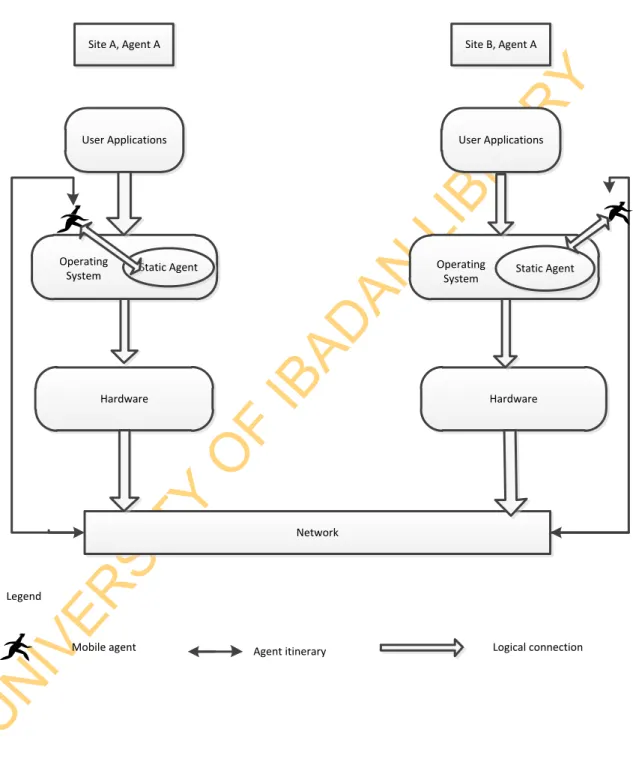
The mobile agent is supplied with the list of nodes to be visited and the user query. The static agent provides a runtime execution for the mobile agent depending on the access level granted to it.
Communication Pattern
Communication at the Initializing Node (Origin)
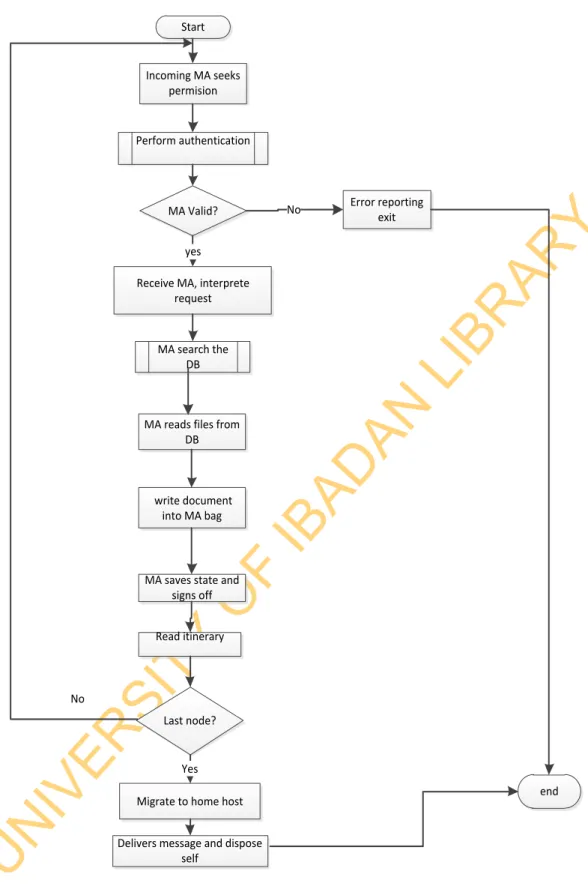
Users send their requests to the static agent which searches its local files for remote sites likely to have information relevant to the user's request. The mobile agent initiates a move() and moves to the first host in its iteneray, executes its task, adds result to its bag and moves to the next node in its itinerary.
Communication at Remote Host
The static agent interprets and represents the query in a format understandable to the agents and initiates the migration of the mobile agent. The mobile agent takes its route and negotiates access to the network to complete its tasks.
Agent information
Mobile Agent Migration
123 (iii) Serialization: the agent is transformed into a stream of flat bytes consisting of the agent's data and state information. The value of the agent's state is also stored. v) Migrate the agent: the serialized agent is transferred to the receiver using a migration protocol, HTTP over TCP/IP in this case.

Database Design
It also captures the state of the agent to know the point of suspension. iv). Encode data: the current state of all variables (data) of the agent is serialized, i.e. their current values are written to an external persistent representation.
Performance Evaluation
- Service Delay
- Memory Utilization
- Denial of Service
- Fault Tolerance
- Turn Around Time
Wait time: is the time interval between the arrival of a request at the destination and the start of execution. Activation time is the total time it takes the agent to be activated, that is, the time interval between when the agent arrives on a host and the start of its operation.
Conclusion
Introduction
This section presents the simulation program developed to provide performance evaluation of the proposed embedded mobile agent (EMA) against an existing scheme (JADE). Agent speed is highly dependent on network bandwidth and/or network speed.
The System Overview
System Components
Weather manager
The stored attributes are location: the city or town of interest, Temperature: the degree of hotness or coldness of the location, and atmospheric conditions.
Db server
Class config
The Embedded Mobile Agent (EMA) Implementation
- Static agent
- Mobile Agent
- Agent server
- Agent Creation
- Agent Removal
- Migration Process
- Agent action
- System Installation Procedure
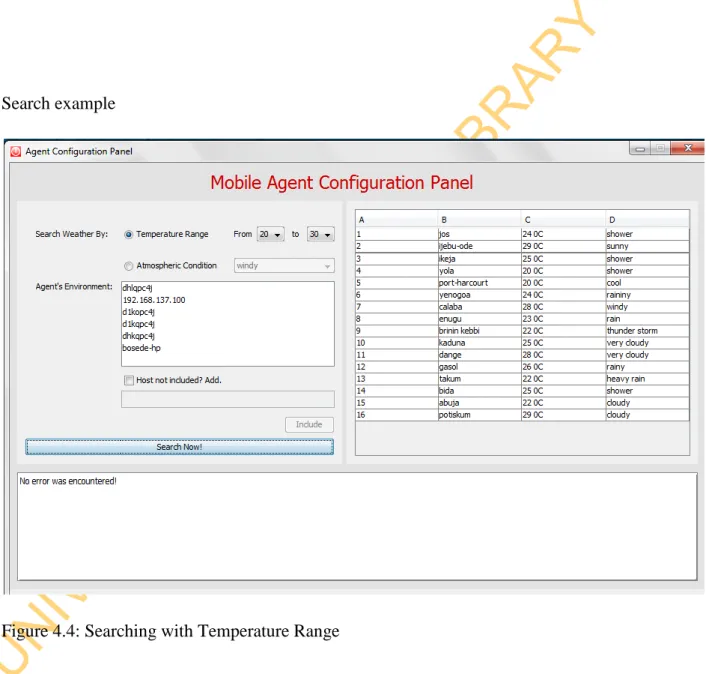
After migration, the agent runs the run() class that calls the initDB() method that connects the agent to the database. The logStatus() is initiated to indicate the status of the connection to the database or otherwise. To the right of the window is the results window, which should display the results of the search.
Performance model of the Proposed System and JADE
Performance also includes the reliability of the system, for example its availability and unavailability times or the times between failures and the functional aspects of performance that include the correctness of solutions and efficiency with minimal discomfort or physical efforts, this is supported by Kotsis (1999) ) . The traditional performance evaluation of computer systems begins with the characterization of the system under study and a characterization of the load.
Simulation and Analysis of Results
- Service Delay versus Number of hosts
- Memory utilization versus the number of nodes
- Denial of service versus number of request per service
- Fault tolerance
- Turnaround Time
Service latency was measured against the number of hosts in the network for both schemes. When measuring fault tolerance, fault recovery times were measured for different numbers of nodes.

Statistical Analyses
T-Test and Correlation
168 Table 4.6 shows the analysis of data, the mean value of both systems for each of the performance parameters, their standard deviation about the mean value and standard error of means. The results obtained show that there is a strong positive to perfect positive correlation between the two systems for the tested parameters.
Student‟s Independent T-Test
Interpretation of Results
For the service delay of the two systems, the t-value is 7.937 and the p-value of 0.000 indicates that the test is statistically significant. For the memory usage of both systems, the t-value is 5.745 and the p-value of 0.000 indicates that the test is statistically significant.
Summary
This is followed by the conclusions and finally we discuss a number of future research directions identified in the work. 175 (iv) Direction times for errors in relation to the number of nodes. v) Handling time in relation to the number of hosts visited.
Contribution to Knowledge
Conclusion
This saves memory that would otherwise be used for the agent platform, reduces access time for agent operations, reduces turnaround times for the mobile agent, and increases the fault tolerance of the system as a whole. The fact that the agent is embedded in the operating system running on the host computer reduces the complexity of the agent technology that the operating system hides from the user, allows agents from different manufacturers with different designs and languages to interoperate, and makes the system portable. in different organizations.
Recommendations for Future Research
Performance comparison of remote procedure calls and mobile agent approaches to control and data transfer in a distributed computing environment. Integrating mobile agent technology with multi-agent systems for distributed traffic detection and management systems.