In tern a tio n a l A dvisoi
p . - -u___ *
Professor , Professor Rc M r. N ig el "Hall
P rofesses K M r. Jc Dr: Chair D r.M offal M r. A ut
Dr. iLeonorah T|.Nyaruwata (Zimbabwe) M r.E d m oss|M tetw af(Zim babwe) ' Professor L o y e m o r e M b is (U S A )
x - t • . v&L r l ’$ 3 ® * * **V-
--- u * s s 0 n - ' - - y— —
jpfoMtil!
l l X v i . - J—» V.AX LW1 f u l l r v v i r .v i S .1 w U '
*. ■- ' v . c
en Lyons (United Kingdom)
1 ] srn . A t, . . -
fiogwa N y o n i (Zim babwe)
Z: Tarusikirwa (Zim babwe)
Afri. j. soc. work Print ISSN-1563-3934 Onflne ISSN 2409-5605
UNIVERSITY OF IBADAN LIBRARY
EDITORIAL NOTE
I am glad to bring to you Volume 5 Number 1 o f the African Journal o f Social Work (AJSW). In my previous editorial, I indicated that the AJSW was seeking indexing at regional and international level. Our first application was with the African Journals Online (AJOL). The application is still pending but we are hopeful we will meet their requirements.
In this issue, the first article came from Ajelerea Ajewumi and Lydia Yemisi in Nigeria. Their study examined the adoption and utilization o f programme communication variables in community development projects. They argued that low participation in community development has been attributed to the ineffective dissemination o f specific community development information to community members.
Descriptive survey research design was adopted and multi-stage sampling procedure was used to select 300 respondents. Self- structured questionnaire and Focus Group Discussion (FGD) was used to collect data fo r the study. Data from demographic were analysed using percentages while Pearson Product Correlation Moment were used to analyse the hypotheses. The findings revealed that there was a positive significant relationship between adoption o f communication and usage o f programme communication. The result also established that there was a positive significant relationship between adoption o f programme communication and citizen participation in community development projects. The study concluded that social and community mobilisation is a potent factor in ensuring citizen participation in the life cycle o f community development programmes. The study recommended that change agents should pay attention to these communication variables at every stage o f a project's life cycle in mobilizing and disseminating development information.
African Journal o f Social Work, 5(1), June 2015
UNIVERSITY OF IBADAN LIBRARY
African societies have been known fo r their strong fam ily support systems that view children as society's fu tu re and as an important fa b ric i f hum anity is to be perpetuating itself, argue Francis Maushe and m yself in the third paper. The fam ily system in Zimbabwe has undergone some changes owing to devastating effects o f H IV and AID S and the economic meltdown that beset the country from 2000 through to 2015. In a normal Zimbabwean set up, children were supposed to be catered fo r by adult members o f their immediate fa m ily fir s t and foremost. The extended fa m ily and to some extend the com munity were expected to be alternate carers. Now there is a new fa m ily set up: the child headed household (CHH). This research em ployed qualitative methods to establish the daily experiences o f 10 CHH. The research established that CHH fa c e d immense difficulty in providing fo r their daily needs including food, education and clothing. They also lack psychosocial support such as guidance, love, belonging and protection. They note that while they were still loosely integrated in the extendedfam ily system, they were mostly on their own when it came to fending fo r the family. One participant noted “...our fa th e r ’s relatives could have taken us in, but I guess they are also heavily constrained. We take each day as it comes. We are on our own but we have not allowed our situation to extinguish the desire o f success in us. We do not blame them. We have to move on our own ",
Ruth Ololade Akinwumi and Jacob Kehinde Mojoyinola researched on social w ork and music therapy. They argued that music therapy helps in a wide range o f pain conditions, prim arily by its ability to improve mood, encourage relaxation and increase threshold.
Therefore the study exam ined how effective m usic therapy was in the psychosocial management o f patients with Spinal Cord Injury. The study was carried out am ong 120 registered members o f the Spinal C ord Injury Association o f Nigeria Rehabilitation Center located in Amuwo-O dofin in Lagos. The participants were purposively selected. Pre-test/post-test quasi experimental research design was adopted f o r the study. The participants received music therapy sessions in groups twice in a week fo r eight consecutive weeks.
Goals included reducing pain, increasing m ood and spiritual well-
African Journal o f Social Work, 5(1), June 2015 iii
UNIVERSITY OF IBADAN LIBRARY
being, as well as improving their overall quality o f life. Pain, physical well-being, social well-being, emotional well-being, mental
well-being and spiritual well-being were assessed at the end o f the 8th week. Five hypotheses were tested at 0.05 level o f significance, using One Way Analysis o f Variance (ANOVA). Findings from the study established that music therapy significantly reduced the pain experienced by spinal cord injury patients. It was also established that music therapy significantly enhanced physical, social, and spiritual well-beings o f the spinal cord injury patients. However, music therapy did not significantly enhance the psychological well
being o f the spinal cord injury patients; though the result was positive. The study recommended that medical social workers should incorporate music therapy into array o f social services rendered to patients and relatives. Also, administrators o f hospitals, hospices and rehabilitation homes should establish Music Units fo r the benefits o f patients and relatives.
Majekodunmi Ajala provided the fourth paper on organisational justice. Majekodunmi contents that economic institutionalisation o f
work with its attended problematic side effects like ineffectiveness, straitjacketing o f workers and reduced innovation makes management look fo r the corollary points o f sense o f duty (organisational justice) as operation parameters in the workplace fo r greater benefits o f trust and commitment o f staffers. It is against this background that this study investigated the influence o f organisational justice on organisational commitment in manufacturing firm s in Ibadan, Oyo State, Nigeria. The descriptive survey research design o f ex-post facto type was used fo r the study.
Two hundred andfifty (250) employees were randomly selected from five manufacturing firms from Industrial Estates in Ibadan, Oyo States. The respondents span across the four major job levels from senior management, middle management, supervisory and junior staff. The main instrument used fo r the study was a questionnaire tagged “Organisational Justice and Organisational Commitment
African Journal of Social Work, 5(1), June 2015 IV
UNIVERSITY OF IBADAN LIBRARY
Questionnaire - OJOCQ" with five sub-sections. Frequency counts and percentages were used to analyse the demographic characteristics o f the respondents while Pearson Product Moment Correlation and Multiple Regression Analysis were used to analyse the research questions and hypotheses at 0.05 level o f significance.
Findings from the study showed that the joint contribution o f the independent variables to the dependent variable was significant (F
= 163.165). It was fo u n d that there was significant and positive relationship between distributive justice and organisational commitment, (r = .697) Furthermore, there was significant positive relationship between procedural justice and organisational commitment (r = .739) and that there was significant positive relationship between interactional justice and organisational commitment (r = . 715). It was recommended that industrial social workers should advocate on behalf o f employees and ensure that management o f organisations give room fo r fa ir and ju st procedures (procedural justice and distributive justice) coupled with proper interaction (interactional justice) so that employees will be able to give better response to the organisation in terms o f commitment, positive behaviour and increased productivity.
This issue has a b rief communication from Liberia. March 2015 marked L iberia’s Social Work Month which was celebrated under the global theme: “Promoting the Dignity and Worth o f All Peoples.
In celebrating this month, Sam Togba Slewion wrote this brief communication to give recognition to an effort which has manifested into giving a unified voice to older people in Liberia.
Lastly, I want to inform you that AJSW has initiated the process o f finding a substantive editor. It is expected that the Editor will start
this role in 2016 and will serve fo r two years.
African Journal o f Social Work, 5(1), June 2015
UNIVERSITY OF IBADAN LIBRARY
CONTENTS PAGE
Journal policy... i Editorial note... ... ii Articles
ADOPTION AND UTILIZATION OF PROGRAMME COMMUNICATION VARIABLES IN COMMUNITY
DEVELOPMENT PROJECTS IN SOUTH-WEST, NIGERIA.. 1-32 Ajewumi Ajelerea, University o f Ibadan, Nigeria
Yemisi Lydia Olaleye, University o f Ibadan, Nigeria
“WE ARE ON OUR OWN”: CHALLENGES FACING CHILD HEADED HOUSEHOLDS (CHH), A CASE OF SEKE RURAL AREA IN ZIMBABWE... 33-60 Maushe Francis, Bindura University, Zimbabwe
Mugumbate Jacob, University o f Newcastle, Australia
EFFECTIVENESS OF MUSIC THERAPY IN THE PSYCHO
SOCIAL MANAGEMENT OF PATIENTS WITH SPINAL CORD INJURY... 61-91 Akinwumi, Ruth Ololade, University o f Ibadan, Nigeria Mojoyinola, Jacob Kehinde, University o f Ibadan, Nigeria
African Journal o f Social Work, 5(1), June 2015 iv
UNIVERSITY OF IBADAN LIBRARY
THE INFLUENCE OF ORGANISATIONAL JUSTICE ON EMPLOYEES' COMMITMENT IN MANUFACTURING FIRMS IN OYO STATE, NIGERIA: IMPLICATIONS FOR INDUSTRIAL SOCIAL W ORK...92-130 Ajala, E. Majekodunmi, University o f Ibadan, Nigeria
BRIEF COMMUNICATION: GIVING OLDER PEOPLE A VOICE IN LIBERIA, WEST AFRICA... 131-137 Slewion Sam Togba, United Methodist University, Liberia
M anuscript guidelines 138
African Journal o f Social W ork, 5(1), June 2015 iv
UNIVERSITY OF IBADAN LIBRARY
THE INFLUENCE OF ORGANISATIONAL JUSTICE ON EMPLOYEES' COMMITMENT IN
MANUFACTURING FIRMS IN OYO STATE, NIGERIA: IMPLICATIONS FOR INDUSTRIAL
SOCIAL WORK
Ajala, E. Majekodunmi, PhD ABSTRACT
Economic institutionalisation of work with its attended problematic side effects like ineffectiveness, straitjacketing of workers and reduced innovation makes management look for the corollary points of sense of duty (organisational justice) as operation parameters in the workplace for greater benefits of trust and commitment of staffers. It is against this background that this study investigated the influence of organisational justice on organisational commitment in manufacturing firms in Ibadan, Oyo State, Nigeria. The descriptive survey research design of ex-post facto type was used for the study.
Two hundred and fifty (250) employees were randomly selected from five manufacturing firms from Industrial Estates in Ibadan, Oyo States. The respondents span across the four major job levels from senior management, middle management, supervisory and junior staff. The main instrument used for the study was a questionnaire tagged “Organisational Justice and Organisational Commitment Questionnaire - OJOCQ” with five sub-sections. Frequency counts and percentages were used to analyse the demographic characteristics of the respondents while Pearson Product Moment Correlation and Multiple Regression Analysis were used to analyse the research questions and hypotheses at 0.05 level of significance.
Findings from the study showed that the joint contribution of the independent variables to the dependent variable was significant (F
= 163.165). It was found that there was significant and positive relationship between distributive justice and organisational commitment. (r = .697) Furthermore, there was significant positive relationship between procedural justice and organisational commitment (r = .739) and that there was significant positive relationship between interactional justice and organisational
UNIVERSITY OF IBADAN LIBRARY
commitment (r = .715). It was recommended that industrial social workers should advocate on behalf of employees and ensure that management of organisations give room for fair and just procedures (procedural justice and distributive justice) coupled with proper interaction (interactional justice) so that employees will be able to give better response to the organisation in terms of commitment, positive behaviour and increased productivity.
KEY TERMS: Industrial social work, procedural justice, distributive justice, interactional justice, organisational commitment, manufacturing firms, Nigeria
UNIVERSITY OF IBADAN LIBRARY
Department of Social Work, Faculty of Education, University of Ibadan, Ibadan, Nigeria. Tel. No.
+2348035653135 Email: [email protected]
INTRODUCTION
Business organisations are assumed to be basically economic institutions where exchanges of monetary payment for the performance of concrete tasks are basis for operation (Barley & Kunda, 1992). However, adherence to this thought without consideration of other possibilities has problematic side effects. For example, merit pay is sometimes ineffective (Pfeffer & Sutton, 2006), downsizing often has pernicious long-term effects (Pfeffer, 1998), and bureaucratic management can straitjacket workers and reduce innovation (Cropanzano, Bowen & Gilliland, 2007). Managements of workplaces sensing the aforementioned negative effect of economic institutionalisation of work are now looking into the corollary points of sense of duty (organisational justice) as operation parameters in the workplace for greater benefits of trust and commitment of staffers.
Organisational justice is a personal evaluation about the ethical and moral standing of managerial conduct. The
UNIVERSITY OF IBADAN LIBRARY
implication is that producing justice at the workplace requires that management should take the perspective of an employee (Cropanzano, Bowen & Gilliland, 2007).
Also, Baldwin (2006) sees the term organisational justice asreferring to the extent to which employees’ perceive workplace procedure, interaction and outcomes to be fair in nature. These perceptions can influence attitudes and behaviour for good or bad which in turn will have impact on employees’ performance, commitment and organisational success. People in all facet of life are naturally attentive to the justice of events and situations in their everyday lives, across a variety of contexts (Tabibnia, Satpute & Lieberman, 2008).
Furthermore, the concept of organisational justice has been discovered by various Work Psychologists under three distinct, though overlapping, as distributive, procedural and interactional.
These three forms of organisational justice tend to be correlated (Cropanzano, Bowen & Gilliland, 2007). They can be treated as three components of overall fairness
UNIVERSITY OF IBADAN LIBRARY
(Ambrose & Arnaud, 2005; Ambrose & Schminke, 2007) and the three components can work together. Each of the components has unique elements necessary for discussions in the utilisation of organisational justice in the work place (see Table 1 below).
Table 1: Components of Organizational Justice
1. Distributive Justice: Appropriateness of outcomes.
• Equity: Rewarding employees based on their contributions.
• Equality: Providing each employee roughly the same compensation.
• Need: Providing a benefit based on one’s personal requirements.
2. Procedural Justice: Appropriateness of the allocation process
• Consistency: All employees are treated the same.
• Lack of Bias: No person or group is singled out for discrimination or ill-treatment.
• Accuracy: Decisions are based on accurate information.
• Representation of all Concerned: Appropriate stakeholders have input into a decision.
• Correction: There is an appeal process or other mechanism for fixing mistakes.
• Ethics: Norms of professional conduct are not violated.
UNIVERSITY OF IBADAN LIBRARY
3. Interactional Justice: Appropriateness of the treatment one receives from authority figures.
• Interpersonal Justice: Treating an employee with dignity, courtesy, and respect.
• Informational Justice: Sharing relevant information with employees.
Source: Cropanzona, Bowen, and Gilliland, (2007)
Distributive Justice (DJ): Distributive Justice refers to outcomes being distributed proportional to inputs based on equity principle. It is the subjective evaluation of the employees’ to the extent to which outcomes such as wages, promotions, work roles and workloads are distributed fairly to the employees (Colquitt, Conlon, Wesson, Porter & Ng, 2001). To achieve distributive justice if they are applied appropriately, three allocation rules are to be applied, they are equality (to each the same), equity (to each in accordance with contributions) and need (to each in accordance with the most urgency) (Cropanzano, et al., 2007). Therefore, distributive justice focuses on the degree of perceived fairness in the distribution and allocation of outcomes within an
UNIVERSITY OF IBADAN LIBRARY
organisation based upon the inputs (Price, Mueller, 1986;
Rani, Garg & Rastogi, 2012).
Procedural Justice (PJ): Procedural Justice refers to the procedures/means by which outcomes are allocated, but not specifically to the outcomes themselves (Cropanzones, et al., 2007). The emphasis here is on the importance of fairness of the methods or procedure used (descision criteria, control of the process) at workplace (Thibaut & Walker, 1975: Folger & Konovsky, 1989;
and Greenberg, 1990). Leventhal (1980); Leventhal, Karuza & Fry (1980) established core attributes that make procedures just. These are consistency, lack of bias, accuracy, correlation, representation of all concerned and consistency with ethical norms.
Procedural justice is positively associated with the cognitive, affective and behavioural reactions at workplace, and enhances employees’ psychological wellbeing with reputation feeling of life satisfaction by the employees (Elovainio, Kivimaki & Vahtera, 2002) and commitment to the job. Kim and Mauborgue (2005) stated that fair processes lead to intellectual and
UNIVERSITY OF IBADAN LIBRARY
emotional recognition which in turn create the trust and commitment that build voluntary cooperation in strategy execution of goals.
Interactional Justice (IJ): Interactional justice exists when decision makers treat people with respect and sensitivity and explains the rationale for decisions thoroughly.
Therefore, interactional justice is the treatment that an individual or employees receives as decisions are made (Bies & Moag, 1986; Moorman, 1991 and Colquitt et al., 2001). Colquitt et al., (2001) suggested that interactional justice should be broken into two components namely interpersonal and informational justice. Interpersonal justice refers to the respect and dignity with which one treats another while informational justice refers to whether one is truthful and provides adequate justifications when things go badly. Bies and Moag (1986) identify some key aspects of interactional justice which can enhance people’s perceptions of fair treatments. They are truthfulness (information given must be realistic and accurate, presented in an open and forth right manner), respect (employees treated with
UNIVERSITY OF IBADAN LIBRARY
dignity), propriety (statements and questions should never be improper or involve prejudicial elements such as racism or sexism) and justification (when a perceived injustice has occurred, giving explanation or apology can reduce or eliminate the sense of anger generated.
Organisational Commitment: Porter, Steers, Mowday and Boulian (1974) defined commitment as the relative strength of an individual’s identification with and involvement in a particular organisation. They indicated that commitment has three components namely: an employee’s belief in and acceptance of organisational goals and values; his/her willingness to work towards accomplishing the organisation’s goals; his/her strong desire to continue as organisation member.
Meyer and Allen (1991) discussed three components of organisational commitment namely: affective, continuance and normative. According to them organisational members who are affectively committed to the workplace continue to work for the organisation because they want to. Therefore, affective commitment is
UNIVERSITY OF IBADAN LIBRARY
the employee’s emotional attachment to, identification with and involvement in the organisation. Beck and Wilson (2000) stated that employees that are committed to the organisation on the affective level because they view their personal employment relationship have been congruent to the goals and values of the organisation.
In defining continuance commitment, Meyer and Allen (1991) looked at the calculative effect of the individual’s perception or weighing of costs and risks associated with leaving the current organisation. They further stated that continuance commitment of employees is based on their commitment because they need to do so. So, continuance commitment is instrumental attachment to the organisation based on individual’s association assessment of economic benefit gained (Beck and Wilson, 2000).
Normative commitment is a feeling of obligation to continue employment (Meyer and Allen, 1991). This normative component is viewed as the commitment employees consider morally right to stay in the company
UNIVERSITY OF IBADAN LIBRARY
regardless of the satisfaction derived from the organisation over time. Therefore, briefly put, commitment reflects in the forms of employee’s intention to say or leave the organisation, though it may be moderated with factors like opportunities available outside and normative pressure to stay on the job (Arif Hassan, 2002).
Therefore, Meyer, Allen and Smith (1993) submitted that common to the three types of commitment, is the view that commitment is a psychological state that characterizes the employee’s relationship with the organization, and has implication for the decision to continue or stop membership in the organization.
Employees with a strong affective commitment remain with an organization because they want to, those with a strong continuance commitment remain because they have to, and those with a strong normative commitment remain because they feel they ought to (stay).
Lambert, Hogan and Griffin (2007) refers to organisational commitment as the state in which
UNIVERSITY OF IBADAN LIBRARY
employees’ sense of loyalty with their respective organisation aligned themselves with organisational goals and values it. Therefore, fairness and justice offers opportunity to employees to have sense of belonging which is an element of organisational commitment.
However, some researchers have shown correlation between distributive justice, procedural justice and interactional justice. For instance, Lambert et al., (2007) found that procedural justice and distributive justice significantly contributed to employees’ organisational commitment.
Sweeney and McFarlin (1993) in their two-factor model found that procedural justice is a better predictor of organisational commitment when compared with distributive justice. This finding was further supported by the finding of Cohen-Charash and Spector (2001) that procedural justice has significant positive relationship with organisational commitment. Arif Hassan (2002) while investigating how perception of equity and justice come to play on employees’ commitment to the organisation and intent to leave using the banking
UNIVERSITY OF IBADAN LIBRARY
industry found that both distributive and procedural justice made significant contributions to employees’
organisational commitment and intent to leave. Colquitt et al., (2001) in meta-analytical review of organisational justice literature, pointed out that distributive and procedural justice were significant predictors of organisational commitment.
Also, Nazim and Shahid (2012) in investigating the relationship between organisational justice and organisational commitment and turnover intentions, established that both distributive justice perception and procedural justice perception had a significant relationship with organisational commitment and turnover intentions. Fariha, Sardar and Mozafar (2013) in investigating the relationship between organisational justice and organisational commitment of the staff of directorate of Youth and Sport of Chahar Mahal va Bakhtiari established that distributive justice, procedural justice and interactional justice have significant relationship with organisational commitment.
UNIVERSITY OF IBADAN LIBRARY
Furthermore, Akanbi and Ofoegbu (2013) while looking into impact of perceived organisational justice on organisational commitment of a food and beverages firm in Nigeria established that both distributive justice and procedural justice have significant relationship with organisational commitment. In another study by Bakhshi, Kumar and Rani (2009) it was found that there is positive relationship between distributive and procedural justice with organisational commitment of medical college employees in India. Interdem with other findings, Najafi et al., (2011) found that educational experts of different universities had higher commitment levels by the provision of organisational justice. Ponnu and Chuah (2010) while investigating organisational commitment, organisational justice and employee turnover in Malaysia established that there is significant, strong and positive relationship between the organisational justice (procedural justice and distributive justice) and organisational commitment.
Also, Rhodes and Strees (1981) in their research found that pay equity was the most important contributor to the
UNIVERSITY OF IBADAN LIBRARY
prediction of organisational commitment for a group of cooperative employees, but was not o significant predictor of commitment for a group of conventional employees. Moreover, Quarles (1994), in examining promotion opportunities and evaluation criteria as mechanisms for affecting internal auditors commitment, job satisfaction and turnover intention found that satisfaction with promotion opportunities (distributive justice) and satisfaction with evaluation criteria used (procedural justice) directly correlated with organisational commitment for the respective groups. It is also seen from the research conducted by Zaman, Ali and Ali (2010) on private teachers in Pakistan that distributive justice and procedure justice had positive impact on organisational commitment.
STATEMENT OF PROBLEM
Employees in the manufacturing sectors are usually susceptible to change of jobs based on the fact that their skills are usually required in other similar firms and are usually enticed by would-be employers. Hence, their rate of turnover may be more frequent. Efforts are being
UNIVERSITY OF IBADAN LIBRARY
made by management to retain these employees haven considered the cost of training and retraining when employees leave and new once is employed. The commitment of employees to organisations therefore call for concern, it is against this background that this study raises the following research questions and hypotheses to test whether there is correlation between organisational justice and organisational commitment in manufacturing firms in Oyo States, Nigeria.
RESEARCH QUESTIONS
(a): What is the join effect of distributive justice, procedural justice and interactional justice on organisational commitment in manufacturing firms in Ibadan, Oyo State, Nigeria?
(b): What is the relative contribution of distributive justice, procedural justice, and interactional justice to organisational commitment in manufacturing firms in Ibadan, Oyo State, Nigeria?
HYPOTHESES
UNIVERSITY OF IBADAN LIBRARY
1. There is no significant relationship between distributive justice and organisational commitment in manufacturing firms in Oyo State, Nigeria.
2. There is no significant relationship between procedural justice and organisational commitment in manufacturing firms in Oyo State, Nigeria.
3. There is no significant relationship between interactional justice and organisational commitment in manufacturing firms in Oyo State, Nigeria.
METHODOLOGY
Research Design: The descriptive research design of ex- post facto type was used for the study. It is found to be appropriate because the variables were not manipulated and it was easy to collect factual information about the independent and independent variables.
Population: The population of this study consists of all employees from manufacturing firms in Oyo States, Nigeria.
UNIVERSITY OF IBADAN LIBRARY
Sample and Sampling Technique: 300 employees were randomly selected from five manufacturing firms from Industrial Estates in Ibadan, Oyo States. Sixty respondents were randomly selected from each firm.
Ibadan industrial estates of Oluyole, Eleyele and Ife Road were chosen because they represent the core concentration points for manufacturing firms in Oyo State. The respondents span across the three major job levels of senior management, middle management, and junior staff.
Research Instrument: The main instrument used for the study is a questionnaire tagged “Organisational Justice and Organisational Commitment Questionnaire - OJOCQ” with five sub-sections. Section A measured the demographic characteristics of the respondents. Sections B, C, D, and E measured Distributive Justice (DJ), Procedural Justice (PJ), Interactional Justice (IJ), and Organisational Commitment (OC) with a responding format of 4-point rating scale ranging from strongly
UNIVERSITY OF IBADAN LIBRARY
agree (SA) = 4, agree (A) = 3, disagree (D) = 2 to strongly disagree (SD) = 1.
Distributive Justice Scale (DJS): The instrument consists of five items measuring employees’ perceptions of distributive justice. The items were adopted from Niehoff and Moorman (1993) “Justice as a Mediator of the relationship between Methods of Monitoring and Organisational Citizenship Behaviour”. The adopted section after revalidation had a reliability value of 0.76.
Procedural Justice Scale (PJS): The instrument consists of five items adopted from Niehoff and Moorman (1993)
“Justice as a Mediator of the relationship between Methods of Monitoring and Organisational Citizenship Behaviour”. The adopted section after revalidation had a reliability value of 0.85.
Interactional Justice Scale (IJS): The instrument consists of nine items measuring the perceptions of the employees on interactional justice. The items were drawn from Niehoff and Moorman (1993) “Justice as a Mediator of the relationship between Methods of Monitoring and
UNIVERSITY OF IBADAN LIBRARY
Organisational Citizenship Behaviour”. The adopted interactional justice scale had reliability coefficient of 0.91.
Organization Commitment Scale (OCS): This consists of nine items adopted from Cook and Wall (1980) “Net work attitude measures of trust, organisational commitment and personal non-fulfilment Scale” The revalidated reliability coefficient for OCS for this study gave 0.79 cronbach alpha coefficient.
Administration of the Questionnaire: Of the three hundred questionnaires administered, two hundred and eighty-seven were returned, properly filled and found useful for analysis. Frequency counts and percentages were used to analyse the demographic characteristics of the respondents while Pearson Product Moment Correlation and Multiple Regression Analysis were used to analyse the research questions and hypotheses at 0.05 level of significance.
UNIVERSITY OF IBADAN LIBRARY
FINDINGS AND DISCUSSIONS
Participants demographic characteristics: Findings from the study showed that 80 (27.9%) were junior staff, 154 (53.6%) were middle level while 53 (18.5%) were management level. Of these respondents, 167 were male while 120 were female. The ages of the respondents ranged between 19 and 55 years with a mean age of 32.4 years. 177 respondents (61.6%) had tertiary education qualifications, 78(27.2%) had secondary certificates and 32(11.2%) had primary education. The least qualification of the respondents was the primary school certificate and the highest was doctorate degree. Meaning that, all the respondents are literate and could understand the questionnaire properly. The minimum work experience of respondent is 4 years; hence the issue of organisational citizenship behaviour is not strange to them.
Research Question (a): What is the joint effect of distributive justice, procedural justice and interactional justice on organisational commitment?
UNIVERSITY OF IBADAN LIBRARY
Table 2: Multiple regression analysis showing the joint effect of distributive justice, procedural justice and interactional justice on organisational commitment
R R Square Adjusted
R Square
Std. Error of the Estimate
.796 .634 .630 3.8777
A N O V A
M Sum of
Squares
DF Mean Square
F Sig. R
Rg Rs T
7360.350 4255.351 11615.707
3 283 286
2453.450 15.037
163.165 .000 Sig.
Key: M=model, Rg=regression, Rs=residual, T=Total, R=Remark
Table 2 shows a simple linear regression of the joint contribution of the three independent variables (distributive justice, procedural justice and interactional justice) to the prediction of the dependent variable (organisational commitment). The model summary in Table 2 reveals a coefficient of multiple correlation (R = .796, multiple R2 = .634 and adjusted R2 = .630.
This means that 63.0% of the variance in organisational commitment was accounted for by three predictor variables when taken together and the rest of 37% may be attributed to other factors. Furthermore, the analysis of variance for the regression yielded F-ratio of 163.165
UNIVERSITY OF IBADAN LIBRARY
(significant at 0.05 level), implying that the joint contribution of the independent variables to the dependent variable was significant and that other variables not included in this model may have accounted for the remaining variance.
Research Question (b): What is the relative contribution of distributive justice, procedural justice and interactional justice to organisational commitment?
Table 3: The relative contribution of distributive justice, procedural justice and interactional justice on organisational commitment
Model Unstandardized Coefficient
Stand.
Coefficient
T Sig.
B Std.
Error
Beta Contribution (Constant)
DJ PJ IJ
1.612 .342 .383 .281
1.337 .063 .068 .068
.287 .343 .251
1.206 5.450 5.597 4.159
.229 .000 .000 .000 Key: DJ=Distributive justice, PJ=procedural justice, IJ=Interactional justice
Table 3 revealed the relative contribution of distributive justice, procedural justice and interactional justice on
UNIVERSITY OF IBADAN LIBRARY
organisational commitment as shown by the beta weights in the descending order: Procedural Justice (β = .343, t = 5.597, P < 0.05), Distributive Justice (β = .287, t = 5.450, P < 0.05), and Interactional Justice (β = .251, t = 4.159, P < 0.05).
The above results in Table 3 showed that procedural justice was the most influential in determining manufacturing organisational commitment, followed by distributive justice and finally by interactional justice.
From Tables 2 and 3 above, results showed that there was significant, strong and positive relationship between procedural justice, distributive justice and interactional justice and organisational commitment. It is therefore seen that when employees have high perception of organisational justice (procedural justice, distributive justice and interactional justice) about their workplace their organisational commitment will be high. This finding is in line with the findings of McFarlin and Sweeney, (1992) that distributive justice is a more important predictor of personal outcomes such as pay
UNIVERSITY OF IBADAN LIBRARY
satisfaction, whereas procedural justice have strong effects of attitudes about institutions or authorities such as organisational commitment and trust in management (Folger and Konosvky, (1989); McFarlin and Sweeney, (1992). Also, the finding of this study is supported by the finding of Schminke, Ambrose & Noel, (1997) that both procedural justice and distributive justice contribute to individuals’ perceptions of organisational fairness and subsequent organisational commitment. Furthermore, the above finding corroborates the findings of Aryee, Budhwar and Chen (2002); Ramamoorthy and Flood, (2004) that procedural and distributive justice was linked to higher level of organisational commitment.
Hypotheses
Ho1: There is no significant relationship between distributive justice and organisational commitment in manufacturing firms in Oyo State, Nigeria.
UNIVERSITY OF IBADAN LIBRARY
Table 4: The relationship between distributive justice and organisational commitment
Variable Mean Std. Dev. N R P Remark Distributive
justice Organisational Commitment
28.5854
30.5122
5.3551
6.3729
287 .697 .000 Sig.
From Table 4, it is shown that there was significant relationship between distributive justice and organisational commitment. (r = .697, n = 287, P < .05).
The result shows that distributive justice influenced the organisational commitment in the study. The null hypothesis is rejected. This means that employees who have perception of distributive justice towards their organisation have high organisational commitment. This in is line with the finding of Akanbi and Ofoegbu (2013) that there is a significant relationship between distributive justice and organisational commitment.
Furthermore, this finding was in line with the finding of Arif Hassan (2002) that both distributive and procedural justice made significant contributions to employees’
organisational commitment and intent to leave. Also, the
UNIVERSITY OF IBADAN LIBRARY
above result corroborates the finding of Nazim and Shahid (2012) that both distributive justice perception and procedural justice perception had a significant relationship with organisational commitment and turnover intentions.
Ho2: There is no significant relationship between procedural justice and organisational commitment in manufacturing firms in Oyo State, Nigeria.
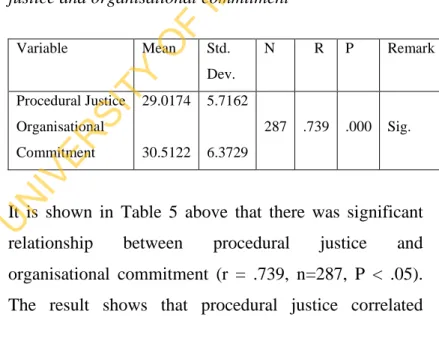
Table 5: The significant relationship between procedural justice and organisational commitment
Variable Mean Std.
Dev.
N R P Remark
Procedural Justice Organisational Commitment
29.0174
30.5122
5.7162
6.3729
287 .739 .000 Sig.
It is shown in Table 5 above that there was significant relationship between procedural justice and organisational commitment (r = .739, n=287, P < .05).
The result shows that procedural justice correlated
UNIVERSITY OF IBADAN LIBRARY
positively with organisational commitment in the workplace. Thus, the Null hypothesis is rejected. This in is line with the finding of Akanbi and Ofoegbu (2013) that there is a significant relationship between procedural justice and organisational commitment. Sweeney and McFarlin (1993) lend credence to this finding when they found that procedural justice is a better predictor of organisational commitment when compared with distributive justice. Also the finding was further supported by Cohen-Charash and Spector (2001);
Colquitt et al., (2001) that procedural justice have significant positive relationship with organisational commitment. Moreover, the finding above was confirmed by the finding of Nazim and Shahid (2012) that both distributive justice perception and procedural justice perception had a significant relationship with organisational commitment and turnover intentions.
Ho3: There is no significant relationship between interactional justice and organisational commitment in manufacturing firms in Oyo State, Nigeria.
UNIVERSITY OF IBADAN LIBRARY
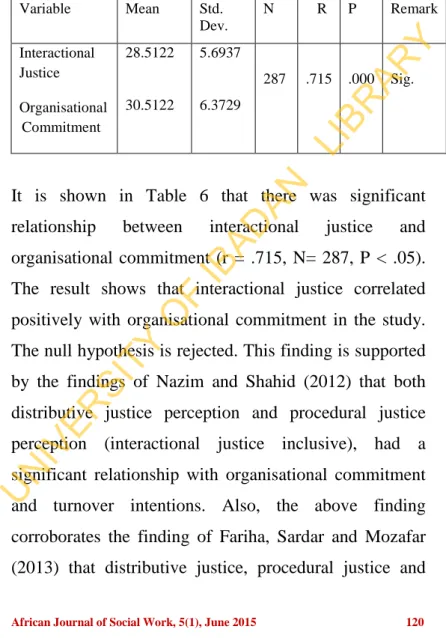
Table 6: The significant relationship between interactional justice and organisational commitment
Variable Mean Std.
Dev.
N R P Remark
Interactional Justice Organisational
Commitment
28.5122
30.5122
5.6937
6.3729
287 .715 .000 Sig.
It is shown in Table 6 that there was significant relationship between interactional justice and organisational commitment (r = .715, N= 287, P < .05).
The result shows that interactional justice correlated positively with organisational commitment in the study.
The null hypothesis is rejected. This finding is supported by the findings of Nazim and Shahid (2012) that both distributive justice perception and procedural justice perception (interactional justice inclusive), had a significant relationship with organisational commitment and turnover intentions. Also, the above finding corroborates the finding of Fariha, Sardar and Mozafar (2013) that distributive justice, procedural justice and
UNIVERSITY OF IBADAN LIBRARY
interactional justice have significant relationship between organisational justice and organisational commitment.
IMPLICATIONS FOR INDUSTRIAL SOCIAL WORKERS
Industrial social workers should ensure that management of organisations give room for fair and just procedures (procedural justice and distributive justice) coupled with proper interaction (interactional justice) so that employees will be able to give better responses to the organisation in terms of commitment, positive behaviour and increased productivity.
Industrial social workers should enhance organisational justice through advocacy with management so as to improve employees’ job satisfaction, organisational commitment and retention.
All these will guarantee employees increase in performance, increase in organisational output and sustenance of both the organisation and the employees.
UNIVERSITY OF IBADAN LIBRARY
RECOMMENDATIONS
Employers should always ensure the presence of organisational justice in the workplace so as to create powerful benefits for the organisation in terms of trust and commitment from the employees.
That employers should have and put into practice organisational justice in dealing with their employees so as to bring about committed employees who will eventually see to the survival of the organisation through improved performance.
Managers and supervisors should develop; maintain proper and appropriate policies, and procedures that ensure organisational justice with a resultant development of organisational commitment from employees.
CONCLUSION
From the research it is ascertained that organisational justice led to strong organisational commitment. This clearly shows that when perceived organisational justice
UNIVERSITY OF IBADAN LIBRARY
exist in the workplace, there is the generation of strong feeling of obligation towards their work organisation and become more committed to their work. Therefore, it can be concluded that fair procedures for job decisions, with appropriate allocation of resources and fair communication of decisions will result in high organisational commitment and increase in organisational productivity.
REFERENCES
Akanbi, P. A. & Ofoegbu, O. E. (2013). Impact of perceived organisational justice on organisational commitment of a food and beverage firm in Nigeria.
International Journal of Humanities and Social Science, 3(14), 207 -218.
Ambrose, M.L., & Arnaud, A. (2005). Are procedural justice and distributive justice conceptually distinct? In J.A. Colquitt & J. Greenberg (Eds.), Handbook of organizational justice. Mahwah, NJ: Lawrence Erlbaum Associates.
Ambrose, M.L., & Schminke, M. (2007). Examining justice climate: Issues of fit, simplicity, and content. In F.
Dansereau & F.J. Yammarino (Eds.), Research in multilevel issues. Oxford, England: Elsiever.
UNIVERSITY OF IBADAN LIBRARY
Arif Hassan (2002). Organisational justice as a determinant of organisational commitment and intention to leave. Asian Academy of Management Journal, 7(2), 55 – 66.
Aryee, S., Budhwah, S. P. & Chen, X. Z. (2002). Trust as a mediator of the relationship between organizational justice and work outcomes: Test of a Social exchange model. Journal of Organizational Behaviour. 23(3), 267- 285.
Bakhshi, A. Kumar, K. & Rani, E. (2009).
Organisational justice perception as predictor of job satisfaction and organisational commitment.
International Journal of Business Management, 4(9), 145 – 154.
Barley, S.R., & Kunda, G. (1992). Design and devotion:
Surges of rational and normative ideologies of control in managerial discourse. Administrative Science Quarterly, 37, 363-399.
Beck, N. M. & Wilson, J. H. (2000). Development of affective organizational commitment: A cross-sequential examination of change with tenure. Journal of
Vocational Behavior. 56, 114-136.
Bies R.J., & Moag J.S. (1986). International justice:
Communication criteria of fairness. In R.J. Lewicki, B.H.
Sheppard, B.H. Bazerman (Eds.), Research on negotiation in organizations. Greenwich, CT: JAI Press.
UNIVERSITY OF IBADAN LIBRARY
Cohen-Charash, Y., & Spector, P.E. (2001). The role of justice in organizations: A meta-analysis. Organizational Behaviour and Human Decision Processes, 86, 278-321.
Colquitt, J.A., Conlon, D.E., Wesson, M.J., Porter, C. &
Ng, K.Y. (2001). Justice at the millennium: A meta- analytic review of 25years of organisational justice research. Journal of Applied Psychology, 86, 425-445.
Cook, J. & Wall, T. (1980). Net work attitude measures of trust, organisational commitment and personal non-fulfilment Scale. Journal of Occupational Psychology, 53, 39 – 52.
Cropanzano, R., Bowen, D.E. & Gilliland, S.W. (2007).
The Management of Organisational Justice. Academy of Management Perspectives, 21, 34-48.
Elovainio, M., Kivimaki, M. & Vahtera, J. (2002).
Organisational Justice: Evidence of a new psychological predictor of Health. American Journal of Public Health, 92(1), 105-108.
Fariba, R., Sardar, M. & Mozafar, Y. (2013).
Relationship of organisational justice and organisational commitment of the staff in general directorate of youth and sports in Chahar Mahal Va Bakhtiari Province.
European Journal of Experimental Biology, 3(3), 696 – 700.
Folger, R. & Konovsky, M. (1989). Effects of procedural and distributive justice on reactions to pay raise
UNIVERSITY OF IBADAN LIBRARY
decisions. Academy of Management Journal, 32(1), 115- 130.
Greenberg, J. (1990). Organisational Justice: Yesterday, Today and Tomorrow, Journal of Management, 16:399- 432.
Homans, G.C. (1961). Social Behaviour: Its elementary forms. New York: Harcourt Brace and World.
Kim, C. W. & Mauborgne., R. (1998). Procedural Justice, Strategic Decision Making, and the Knowledge Economy. StrategicManagement Journal, 19 (4), 323- 338.
Lambert, E. G., Hogan, N. L. & Griffin, m. l. (2007). The impact of distributive and procedural justice on correctional staff job stress, job satisfaction and organisational commitment. Journal of Criminal Justice.
35, 644 - 656.
Leventhal, G. S., Karuza, J. & Fry, W. R. (1980).
Beyond fairness: A theory of allocation preferences. In, G. Mikula (ed.), Justice and Social Interaction. New York:Spinger-Verlag.
McFarlin, D. B. & Sweeney, P. D. (1992). Distributive and procedural justice as predictors of satisfaction with personal and organisational outcomes. Academy of Management Journal, 35(3), 626 – 637.
UNIVERSITY OF IBADAN LIBRARY
Meyer, J. P. & Allen, N. J. (1991). A Three-Component Conceptualisation of Organisational Commitment.
Human Resource Management Review, Vol. 1, pp. 61- 98.
Meyer, J. P.; Allen, N. J. & Smith, C. A. (1993).
Commitment to Organisations and Occupations:
Extension and Test of a Three-Component Conceptualization. Journal of Applied Psychology, Vol.78 No.4, pp. 538-551.
Moorman, R. H. (1991). Relationship between organizational justice and organizational citizenship behaviours: Do fairness perceptions influence employee citizenship? Journal of Applied Psychology, 76, 845-855.
Najafi, S., Noruzy, A., Azar, K.H., Sajad Nazari-Shir Kouhi, N. S. & Dalvard, R. M. (2011). Investigating the relationship between organisational justice, psychological empowerment, job satisfaction, organisational commitment and organisational citizenship behaviour: An empirical model. African Journal of Business Management, 5(13), 5241 – 5248.
Nazim, A. & Shahid, J. (2012). Relationship between organisational justice and organisational commitment and turnover intentions amongst medical representatives of pharmaceuticals companies of Pakistan. Journal of Management Sciences, 6(2), 201 -212.
UNIVERSITY OF IBADAN LIBRARY
Niehoff, B.P. & Moorman, R.H. (1993). Justice as a moderator of the relationship between methods of monitoring and organisational citizenship behaviour.
Academy of Management Journal, 36(3), 527 – 556.
Pfeffer, J., & Sutton, R.I. (2006). Hard facts, dangerous half-truths, and total nonsense: Profiting from evidence- based management. Cambridge, MA: Harvard Business School Press.
Pfeffer, P. (1998). The human equation: Building profits by putting people first. Cambridge, MA: Harvard Business School Press.
Ponnu, C. H. & Chuah, C. C. (2010). Organisational commitment, organisational justice and employy turnover in Malaysia. African Journal of Business Management, 4(13), 2676 – 2692.
Porter, L. W., Steers, R. M., Mowday, R. T. & Boulian, P. V. (1974). Organisational commitment, job satisfaction, and turnover among psychiatric technicians.
Journal of Applied Psychology, 59, 603 – 609.
Quarles, R. (1994). An examination of promotion opportunities and evaluation criteria as mechanisms for affecting internal auditors commitment, job satisfaction and turnover intention. Journal of Managerial Issues, 6(21), 176 – 194.
Ramamoorthy, N. & Flood, P. C. (2004). Gender and employee attitude: The role of organisational justice
UNIVERSITY OF IBADAN LIBRARY
perceptions. British Journal of Management, 15, 247 – 258.
Rani, R., Garg, P. & Rastogi, R. (2012). Organisational Justice and Psychological wellbeing of Police employees: A relationship study. International Journal of Advances in Management and Economics. 1, 5, 183- 194.
Rhodes, S & Steers, R (1981). Conventional vs worker- owned organizations'. Human Relations, 34(1), 1013- 1035.
Schminke, M., Ambrose, M. L. & Noel, T.W. (1997).
The effect of ethical frameworks on perception of
organisational justice. Academy of Management Journal, 40(5), 1110 – 1207.
Sweeney, P. D. & McFarlin, D. B. (1993). Workers’
evaluations of the ‘ends’ and the ‘means’: An examination of four models of distributive and procedural justice. Organisational Behaviour and Human Decision Process, 55, 23 – 40.
Tabibnia, G., Satpute, A. B., & Lieberman, M. D. (2008).
The sunny side of fairness: Preference fairness activates reward circuity (and disregarding unfairness activates self-control circuity). Psychological Science, 19, 339- 347.
UNIVERSITY OF IBADAN LIBRARY
Thibaut J., & Walker, L. (1975). Procedural Justice: A Psychological Analysis. Hillsdale, NJ: Lawrence Erlbaum Associates.
Zaman, G., Ali, N., & Ali, N. (2010). Impact of Organizational Justice on Employees Outcomes: An Empirical Evidence. Abasyn Journal of Social Sciences, Vol. 3 (1), 44 – 53.