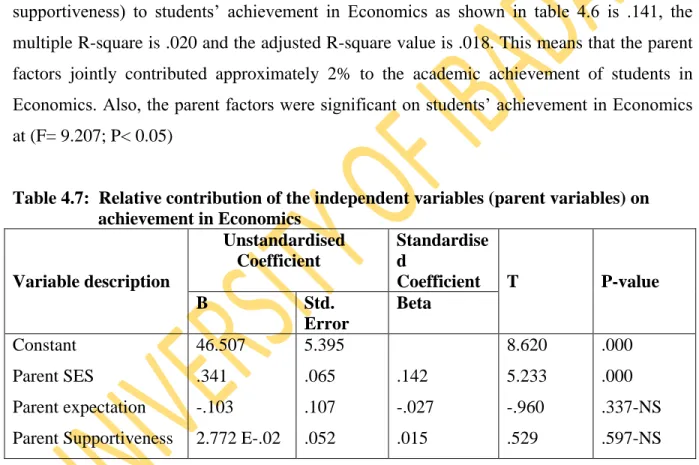
This expansion of the curriculum content of Economics may also have contributed to the poor performance of students in Economics (Obemeata, 1992). This means that the socio-economic status of parents somehow affects the academic performance of the students in Economics.

Statement of the Problem
Examining parental expectations is important when identifying and trying to understand factors that contribute to students' academic performance in secondary schools in Nigeria. Research has attempted to identify factors responsible for fluctuating student performance in high school economics.
Research Questions
This study examined the extent to which parental factors (parental support, socioeconomic status, expectations) and students' psychosocial variables (self-efficacy and self-regulation) influence high school students' academic performance in economics and attitudes toward economics in the determine Enugu state. Nigeria. The study also examined how students' perception of parental support relates to their academic performance and attitudes in secondary schools in Enugu State.
Scope of the Study
In economics, there is no significant difference in the achievements of students from urban and rural schools. There is no significant difference in the attitude towards economics between students of urban and rural schools.
Significance of the Study
This literature review will provide a critical analysis of those issues in the study, i.e. parental factors and students' variables as they relate to the students' learning outcomes in Economics. Walstad's (2000) survey paper in the Journal of Economic Literature directly addresses the use of supplementary material in the teaching of high school economics.
Socio-Economic Background and Learning outcome
This means that intelligence behavior can be a product of the socio-economic status to which an individual belongs. In a study by Lloyd (2002) conducted in West Bengal, socio-economic status was one of the main factors responsible for low achievement in general science.
Parental Supportiveness and Learning Outcome
It is also possible that the parent does not have much interest in the school or their child's education. The parent will have an increased sense of pride in the school and the community.
Establish a daily family routine, for example: providing time and a quiet place to study, assigning responsibilities for household chores, consistent time of getting up and going to bed, eating dinner together. From their analysis of data collected through a large national survey conducted by the National Center for Education Statistics, Zimmerman and Kitsantas (2005) found that providing study space was one of three family characteristics that were significantly associated with student achievement .
Model the value of learning, self-discipline, and hard work, examples: communicating through questioning and conversation, demonstrating that achievement comes from working
Self-Regulation and Learning Outcome
Most self-regulated learning definitions and models include strategies, processes, responses used by students to improve their academic performance. In all definitions, all students attempt to improve their academic performance by using self-regulated processes (Zimmerman, 2001). In literature there are relationships between self-regulated learning behavior and academic performance in and attitude towards Economics.
Research literature has indicated that self-regulated learning is correlated with students' academic performance in various learning contexts. Teaching self-regulated learning to primary school students can lead to an increase in their academic performance. Moreover, classroom teachers can solve their students' learning problems by implementing self-regulated learning activities.
Self-Efficacy and Learning Outcome
To regulate cognition and learning effectively, students must develop a sense of self-efficacy. Self-efficacy is hypothesized to influence individual choice regarding activities, effort, persistence, and achievement (Schunk, 1995). From Covington's studies it can be concluded that self-efficacy plays a critical role in educational achievement.
In the case of education, self-efficacy is seen to be associated with effort, persistence, and achievement. Multon, Brown and Lent, (1991) (cited in Chemers et al, 2001) found that self-efficacy was related both to academic achievement and to persistence. Bandura (1994) stated that self-efficacy beliefs play a key role in the self-regulation of motivation.
Students Attitude towards Economics and Academic Achievement
Overall, the improvement in the academic performance of economics participants of the students exposed to self-efficacy training cannot be isolated from the improvement in their skills through their exposure to the training. For example, Hodgin (2001) showed that on average a small number of students who were not good enough in Economics achieved high scores on the attitude test. Furthermore, Broughton (2003) argued that attitudes toward the economy can also be influenced by informational messages about performance in the economy.
As a result, it appears that the less apprehensive students are, the more they will enjoy the subject and the better they will perform in economics. It is also very important for students to have the right attitudes and perceptions towards economics courses in order for them to excel in economics. They found a statistically significant and positive correlation between the students' pre-course attitude and the course grade in economics when they examined the students' interest in the subject and its applicability to university and post-secondary work.
Theoretical Background
- Social Cognitive Theory
- Summary and Gaps in the Existing Literature
These parental factors, namely parental socioeconomic status, support, and expectation, have been shown to be strong predictors of intelligence and academic achievement outcomes (Gonzalez, 2001). Also, self-regulation of cognition and behavior is an important aspect of student learning and academic performance in the classroom context (Corno & Mandinach, 1983; Corno & Rohrkemper, 1985). Research has also shown that student self-efficacy perceptions are related to student self-monitoring (Kuhl, 1985; Pearl, Bryan & Herzog, 1983) and student academic achievement (Schunk, 1995).
However, little attention has been paid to the relationship between self-efficacy, self-regulation and student achievement. The literature reviewed showed that parental factors and student psycho-social factors improve student academic achievement. Thus, the unfilled gaps in the existing literature are the relationship between parental factors, students' psycho-social factors, and students' academic achievement.
Research Design
Parent Factors
Student Psycho-Social Variables
Student Learning Outcomes
Sampling Procedures and Samples
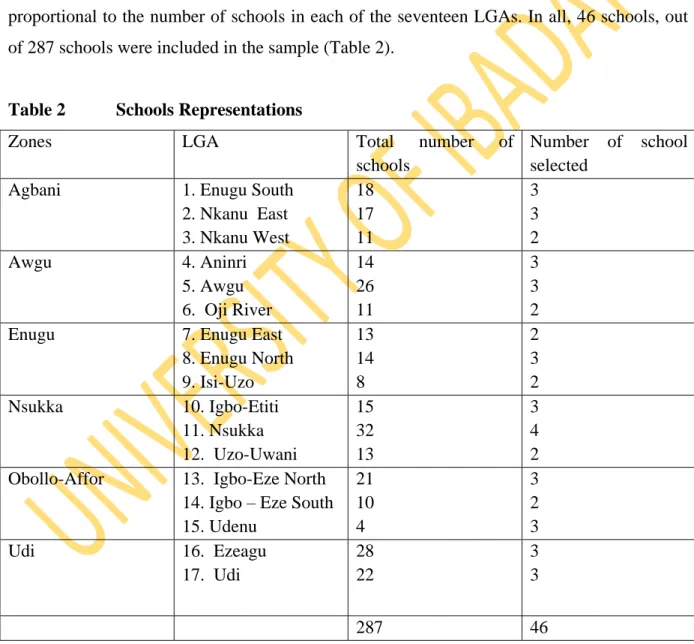
At the local government level, 20% of the total number of schools in each of the seventeen LGUs was used to arrive at a sample proportional to the number of schools in each of the seventeen LGUs. Simple random sampling (voting) was however used to select an arm of the SS II class that was used, if there was more than one arm in a secondary school. Where the students in the selected group are more than 40, the random sampling method was also used to select 40 from the total number of students in the class.
Instrumentation
Parents’ Questionnaire (PQ)
Students’ Perception Scale (SPS)
Economics Achievement Test (EAT)
Students’ Questionnaire (SQ)
Students Attitude Towards Economics (SATE)
Validation of the Instruments
Method of Data Analysis
Data Collection Procedure
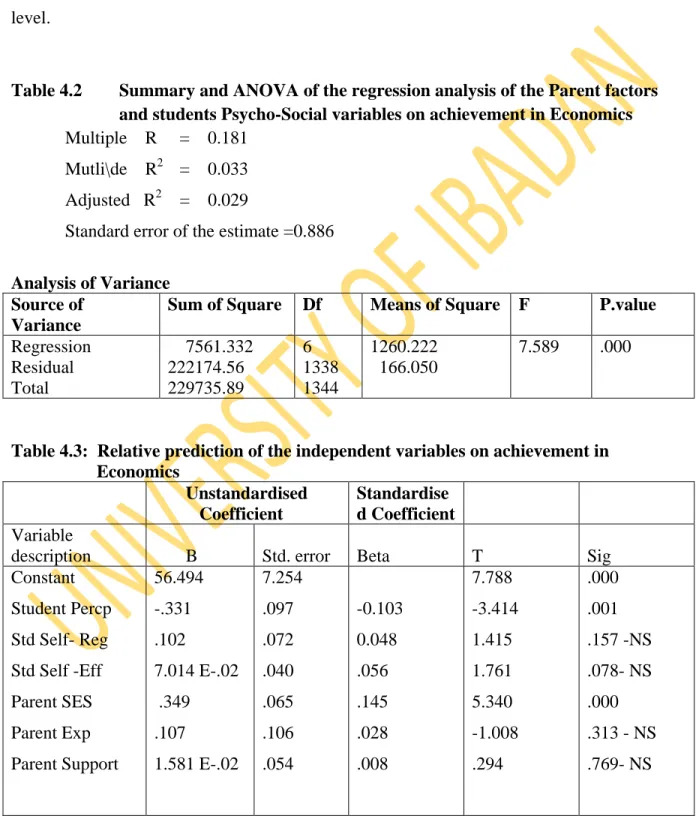
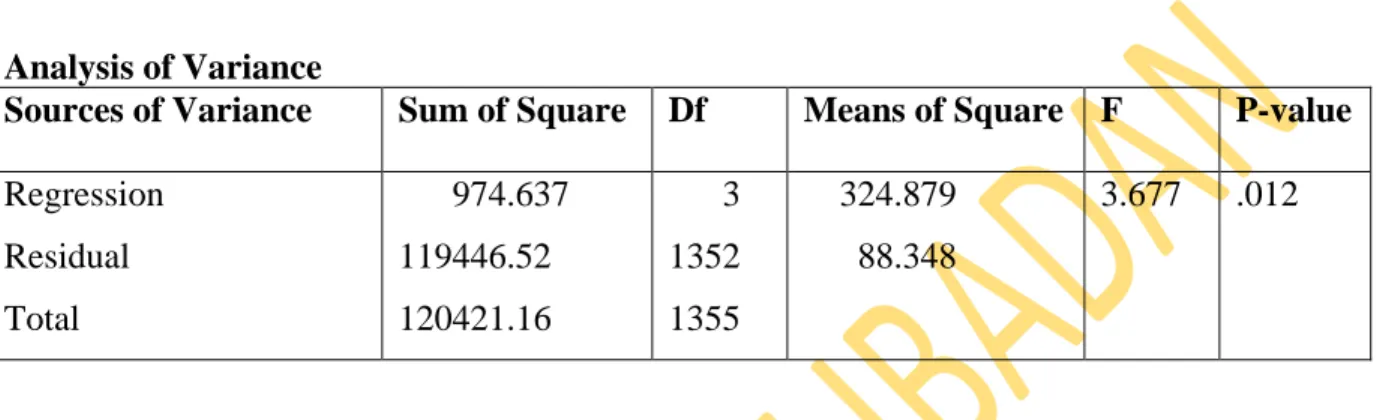
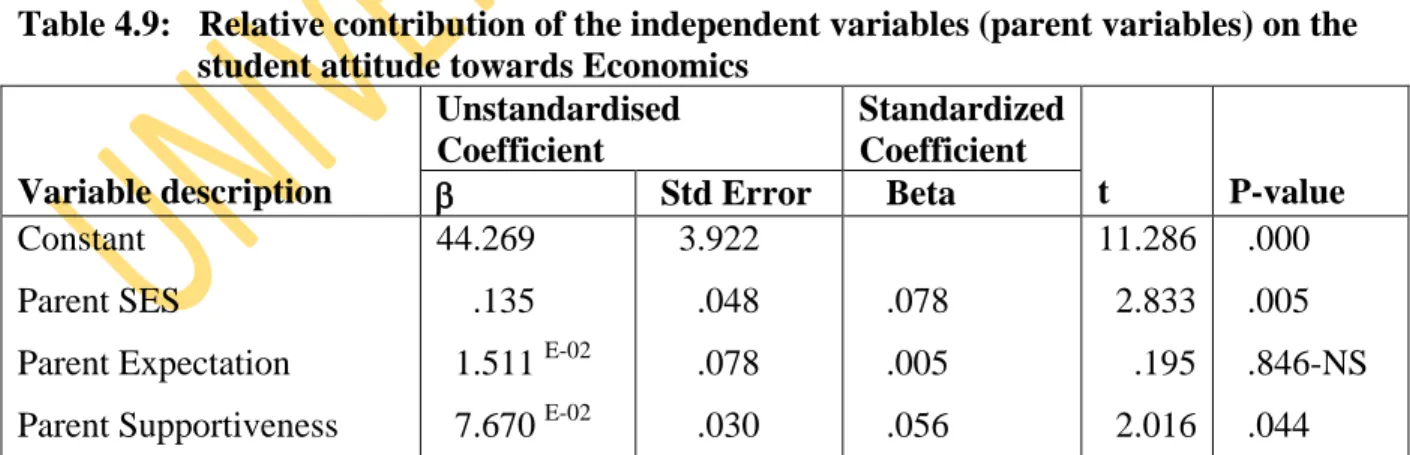
Table 4.2 also shows the analysis of variance of the multiple regression data. The findings of this study show that parental factors and students' psychosocial variables significantly influence students' achievement in economics. Two of the independent variables are significant and have positive relative contributions to students' attitudes toward economics.
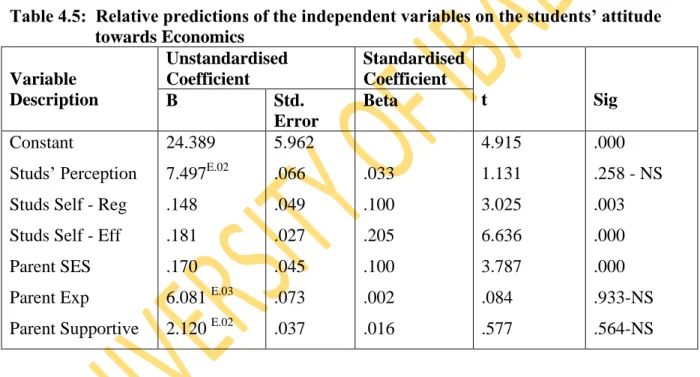
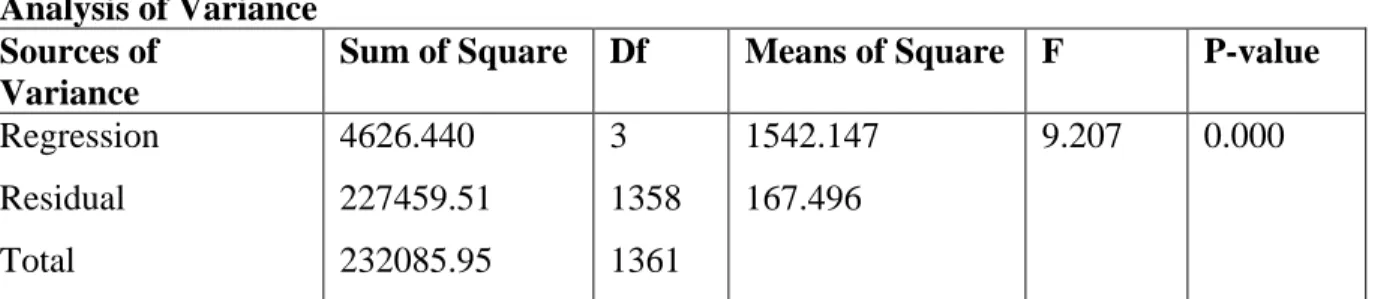
-Social variables (students' perception of parental support, self-efficacy and self-regulation) on their. i) Performance in the economy (ii) Attitude towards the economy. The findings of this study show that there is a significant joint contribution of students' psychosocial variables on students' attitudes toward economics. The findings of this study further reveal the relative contribution of students' psychosocial variables to students' attitudes toward economics.
A high attitude towards finance may therefore have led to an increase in the student's academic performance. In addition, self-regulation may have increased not only attitudes toward economics, but also beliefs about economic self-efficacy.
There is no significant difference in the mean attitude scores between students from urban and rural schools
Summary of findings
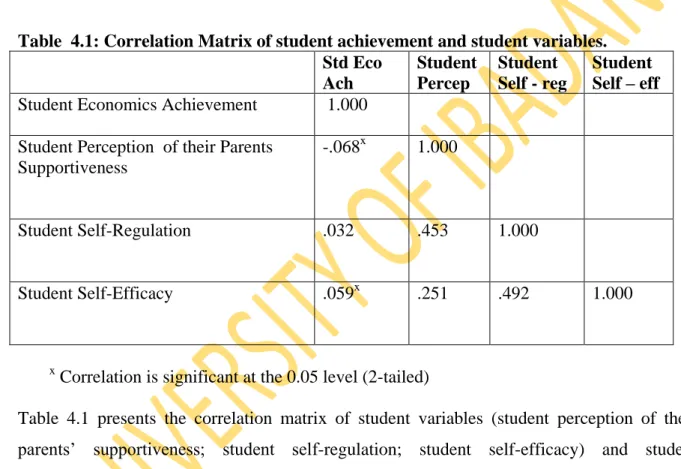
Students' perception of parental support has a significant but negative relationship with students' performance in economics. There is a low relationship between students' attitudes towards economics and their performance in economics. The students' psychosocial variables contributed only 1.3% to students' academic performance in economics;
The students' psychosocial variables contributed 8.2 percent to the attitude of the students towards Economics. Out of the three variables that students designated as psychosocial variables in accordance with students' attitude towards Economics, two variables are statistically significant. These were students' self-regulation and students' self-efficacy while the remaining one variable is not significant.
Implications
Parents must fully support their children, as parental support is a very important way to improve schools; students also have higher grades, higher test scores, better school attendance and greater motivation;. Parents should be involved in their children's education at all levels of advocacy, as decision makers, as resource providers and as home teachers;. Parents should not only participate in their children's education, but they should encourage their children with high expectations, i.e. with the expectation that their children will be successful in school.
Parents should increasingly support home learning activities and find opportunities to teach, role model and guide their children. Parents should model the value of learning, self-discipline and hard work, i.e. communication through questioning and conversation, demonstrate this. Parents should encourage reading, writing and conversations between family members, i.e. reading, listening to the child's reading and talking about what has been read.
Limitations to Study
Suggestions for Further Research
Science, Economics of," The new Pal grave Dictionary of Economics, 2nd Edition, Basingstoke and New York: Pal grave Macmillan. Exploring the Accuracy and Predictability of Self-Efficacy Beliefs in Seventh Grade Mathematics Students. The Impact of Family Functioning on African American Male Academic performance: A review and clarification of the empirical literature.
An approach to testing the effectiveness of teaching and learning economics in high school. The Neighborhoods They live In: The effects of Neighborhood Residence of the wealthy Journal of Educational Research, 95(4). Please give your opinion for each statement by placing a tick [ √ ] in one of the columns representing your opinion.
Please give your opinion for each statement by placing a tick [ ] in any of the columns that represent your opinion;. Please give your opinion for each statement by ticking [√ ] in any of the columns that represent your opinion.