Lecture 23 Spring 2006 1
DRUG TARGETING
Getting Vaccines to Dendritic Cells
ANNOUNCEMENTS:
Last Time: DNA vaccination
Today: Targeting particles/molecules to cells
Delivering activation signals to dendritic cells in vaccines
Reading: P. Carter, ‘Improving the efficacy of antibody-based cancer therapies,’ Nat. Rev. Cancer 1 118 (2001)
Supplementary Reading:
What is drug targeting?
Figure removed due to copyright restrictions.
Please see: Wickham. Nature Medicine9, no. 1 (2003): 135.
Lecture 23 Spring 2006 3
Motivation for drug targeting: General
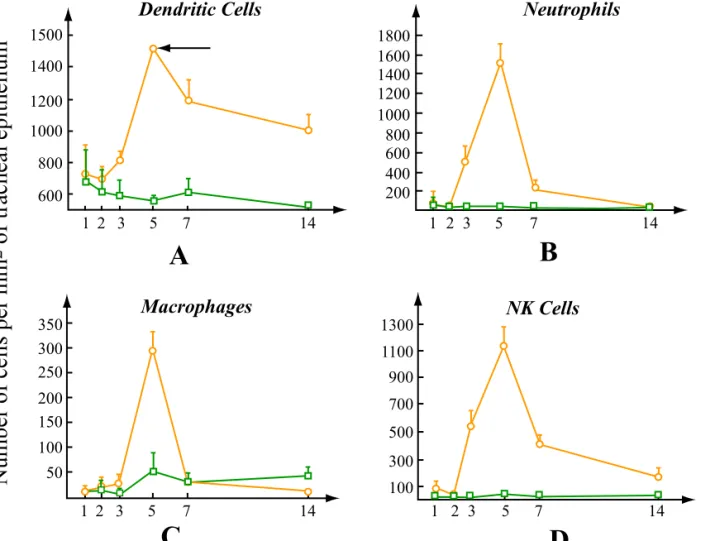
Motivation for drug targeting: Vaccines
1500 1400 1200 1000 800 600
1 2 3 5 7 14
1 2 3 5 7 14
1 2 3 5 7 14
1 2 3 5 7 14
200400 600800 1000 12001400 16001800
350 300 250 200 150 100 50
1300 1100 900 700 500 300 100
Dendritic Cells Neutrophils
Macrophages NK Cells
N um be r o f c el ls p er m m
2o f t ra ch ea l e pi th el iu m
A B
C D
Figure by MIT OCW.
Lecture 23 Spring 2006 5
Approaches to targeted drug activity 1) Targeted delivery of active agent
2) Targeted activation of agent
3) ‘Reverse’ targeting
Major approaches for targeted delivery 1) receptor-ligand targeting
2) Pre-targeting
3) Antibody-based targeting
Lecture 23 Spring 2006 7
Example approaches: receptor-ligand-mediated targeting to vasculature
Mimicking lymphocyte responses to inflammation:
Figure removed due to copyright restrictions.
Please see: Figure 1 in Hogg, et al. J Cell Sc116 (2003): 4695-4705.
Example approaches: receptor-ligand-mediated targeting to vasculature
Site of inflammation
IL-1β TNF
sialyl lewis
Xreceptor Therapeutic cargo
Mimicking lymphocyte responses to inflammation:
(D. Hammer, U. Penn.)
Lecture 23 Spring 2006 9
Example approaches: receptor-ligand-mediated targeting to vasculature
Mimicking lymphocyte responses to inflammation:
Figure removed due to copyright restrictions.
Please see: Figure 2 in Cao, Y., and L. Lam. “Bispecific Anitbody Conjugates in Therapeutics.”Adv Drug Delib Rev55 (2003): 171-97.
Pre-targeting drug delivery with bispecific antibodies
Figure removed due to copyright restrictions.
Please see: Figure 2 in Eniola, A. O., and D. A. Hammer. Biomaterials26 (2005): 661.
Lecture 23 Spring 2006 11
Antibody-based targeting
-SH FAb/FAb’
F c receptor macrophage
General structure of IgA, IgE, IgD, IgG:
~5 nm
Image removed due to copyright restrictions.
L L
H H
VL
VH
CL CL
S-S
S-S CH1
CH2 CH2
CH3 CH3
CH1
S-S S-S
H H
Carbohydrate Flexible hinge region
} } Fc
VH VL
FR1 CDR1
CDR2
CDR3 FR2
FR3
FR4
Key features of the protein structure of (Human lgG1) immunoglobulin molecules
Figure by MIT OCW.
L H
VL
VH
CL S-S
CH1
S S - -
Figure by MIT OCW.
Generation of monoclonal antibodies against selected molecular targets
Figure removed due to copyright restrictions.
Please see: Figures 4-12 in Elgert, K. D. Immunology: Understanding the Immune System. New York, NY: Wiley-Liss, 1996.
Lecture 23 Spring 2006 13
Synthesizing antibodies which avoid recognition by the immune system
Figure removed due to copyright restrictions.
Please see: Figures 2 in Allen, T.M. "Ligand-targeted therapeutics in anticancer therapy."
Nat Rev Cancer 2 (2002): 750-63.
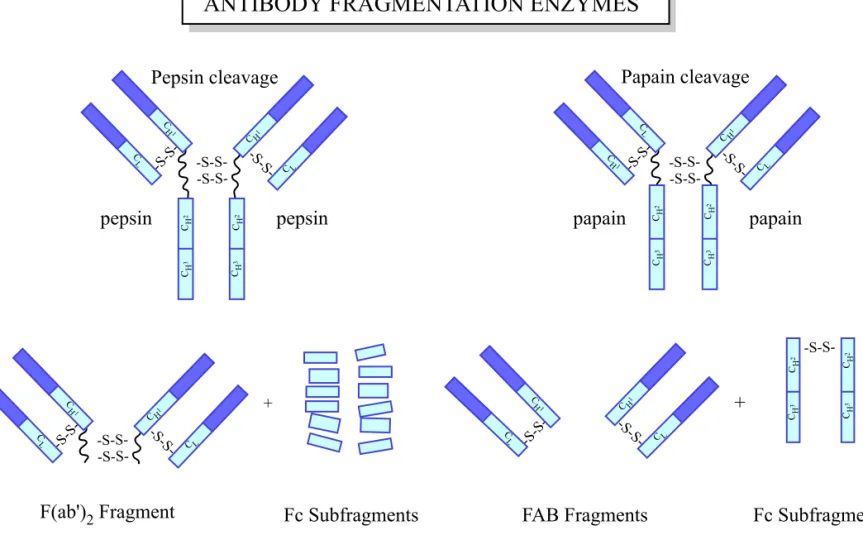
Strategies for conjugation of antibodies to biomaterials
Fc Subfragments
+
-S-S-
-S-S- -S-S- -S-S-S-S- -
-S-S-
-S-S-
FAB Fragments
papain papain
Papain cleavage
-S-S- -S-S- -S-S-S-S- -
pepsin pepsin
Pepsin cleavage
-S-S- -S-S- -S-S-S-S- -
+
Fc Subfragments
CH1
CH1
CH1
CH1
CH2 CH2 CH2
CH3 CH3 CH3
CH2 CH2 CH2
CH3 CH3 CH3
CH1
CH1
CH1
CH1 CL
CL
CL
CL CL
CL
CL
CL
F(ab')2 Fragment
ANTIBODY FRAGMENTATION ENZYMES
Figure by MIT OCW.
Lecture 23 Spring 2006 15
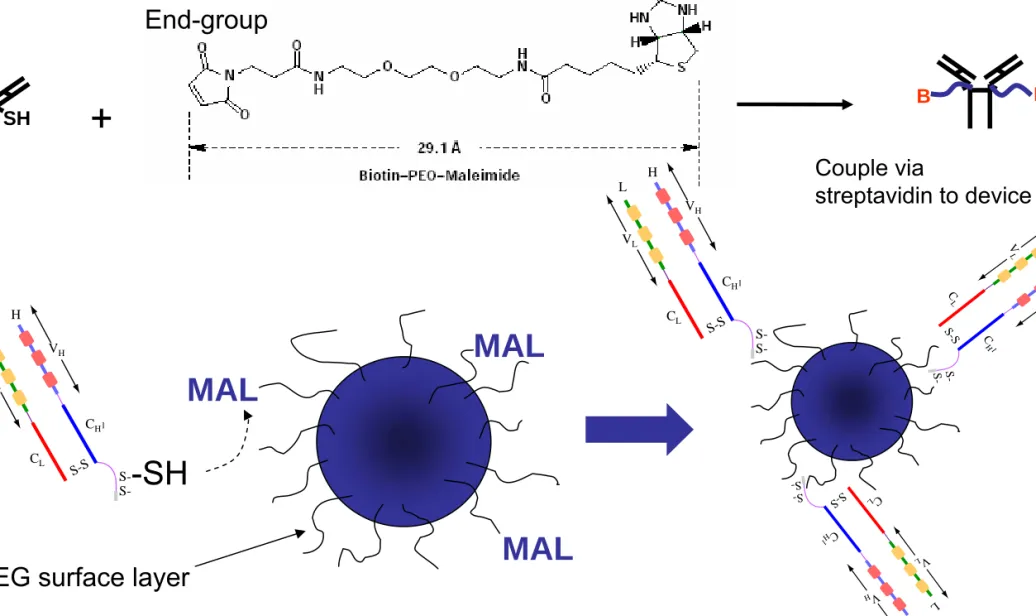
Strategies for conjugation of antibodies to biomaterials
SH
HS
+
B BCouple via
streptavidin to device
-SH
Maleimide End-group
MAL
PEG surface layer
MAL
MAL
L H
VL
VH
CL S-S
CH1
S S - -
L H
VL
VH
CL S-S
CH1
S- S-
L H V
L
V
H
C
L
S-S C
H 1
S- S-
L H
V
L
V
H L C S-S
C
H 1
S- S-
Figures by MIT OCW.
Results from mAb-targeting
Graph removed due to copyright restrictions.
Please see: Park, J. W., et al. “Anti-HER2
Immunoliposomes: Enhanced Efficacy Attributable to Targeted Delivery.” Clin Cancer Res8 (2002): 1172-81.
Figure removed due to copyright restrictions.
Please see: Figure 4 in Daan, J. A. et al. “N Anotechnological Approaches for the Delivery of Macromolecules.”J Controlled Release 87, 81 (2003).
Lecture 23 Spring 2006 17
Application Cellular target Molecular target
Targeting ligand
Ligand type Anti-cancer
therapy Various tumor cells
Neovascular tissue
Folate receptor EGF receptor
B-FN(fibronectin isoform)
Folate EGF
anti-B-FN antibody
Protein ligand for target receptor preferentially expressed on target cells antibody against fibronectin isoform only expressed during embryonic development and in aggressive tumors Anti-cancer
therapy, pulmonary, cardiovascular, andinflammatory diseases
Endothelial
cells E-selectin
P-selectin sialyl LewisX
receptor receptor expressed at sites of inflammation
Anti-cancer therapy (leukemias and B cell
lymphomas)
Transformed B
lymphocytes CD20 Anti-CD20
antibody Antibody against target cell-surface protein unique to target class of cells (e.g. B cells) Anti-cancer
therapy (T cell lymphomas)
Transformed T
lymphocytes IL-2Rα (interleukin-2 receptor a chain
Anti-IL-2Rα
antibody Antibody against target cell-surface protein not expressed on normal resting cells
Cytotoxic drugs
Anti-tumor cytokines
AraC
Doxorubicin
Interleukin-2
Interleukin-12
Table removed due to copyright restrictions.
Please see: Table 1 in Allen, T. M. “Ligand Targeted Therapeutics in Anticancer Therapy.” Nat Rev Cancer2 (2002): 750-63.
Lecture 23 Spring 2006 19
Example approaches: targeted activation of active agent
Antibody-directed enzyme prodrug therapy (ADEPT):
TUMOR CELL
‘Reverse targeting’
Bringing cells to the drug
Lecture 23 Spring 2006 21 Lecture 23 Spring 2006
4) Activation of naïve T cells in the lymph nodes Infection site
1) Attraction to sites of infection
2) Antigen loading and
activation
3) Trafficking to lymph
nodes Infected cells
1) Chemotaxis:
Migration ‘up’ concentration gradients of chemoattractant
Targeting dendritic cells to
vaccines: ‘Reverse targeting’ to
mimic infection site recruitment
Targeting dendritic cells to vaccines
Attraction of target cells to device via chemotaxis:
(Kumamoto et al. 2002) Dendritic cells
~1-3 per 100 cells in most tissues MIP-3β-releasing rod
Ova-releasing rod
Poly(ethylene-co-vinyl acetate) rods
Advantages relative to bolus chemoattractant injection:
Lecture 23 Spring 2006 23
Images removed due to copyright restrictions.
Please see: Kumamotos, T., et al. ”Induction of Tumor-specific Protective Immunity by in Situ Langerhans Cell Vaccine." Nat Biotechnol20 (2002): 64-9.
3 mm
~1 mm
1.2 mm
collagen gel
‘Vaccination site’ source well
CH C O
O CH
C O
O
CH2 CH3
CH3
C O
H2 C
C O
O O
x y
PLGA
Images removed due to copyright restrictions.
Please see: Zhao, X., et al. Biomaterials26 (2005): 5048.
Lecture 23 Spring 2006 25
Dendritic cell attraction, antigen loading, and activation
Antigen-delivery nanoparticles
chemokine
Alginate microsphere
DCs
CaCl
2solution
Wash alginate
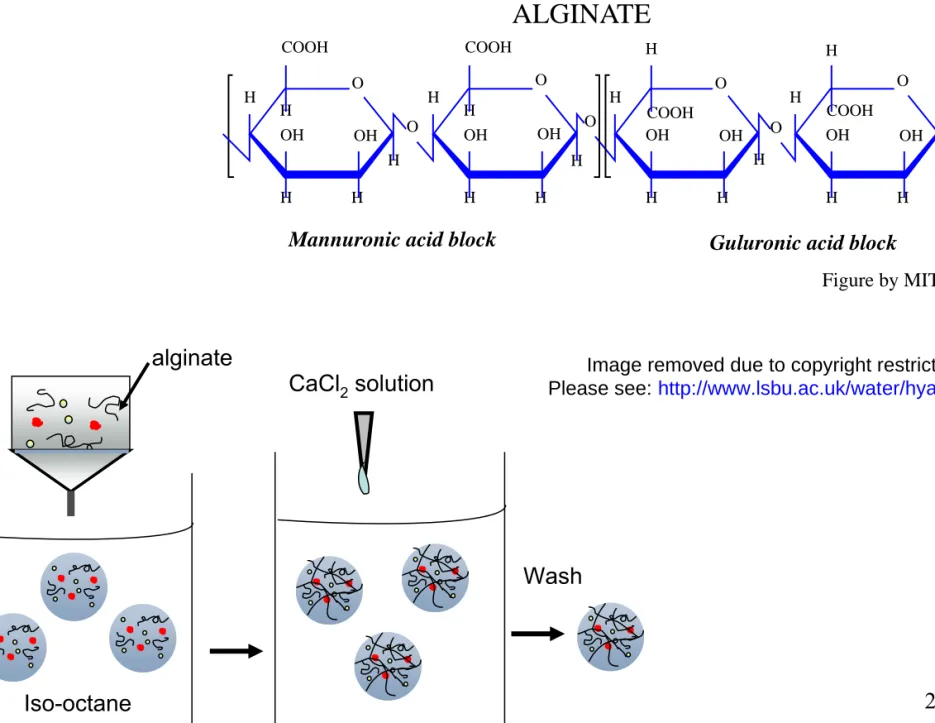
How to encapsulate multiple factors under mild conditions for ‘reverse targeting’?
Image removed due to copyright restrictions.
Please see: http://www.lsbu.ac.uk/water/hyalg.html COOH
O
OH OH
H
H H
H
H H
COOH
OH OH
H
H H
H
COOH
OH OH
H
H H
H
H
COOH
OH OH
H
H H
H
H O
O O O
O O O
Mannuronic acid block Guluronic acid block
ALGINATE
Figure by MIT OCW.
Lecture 23 Spring 2006 27 Fluorescent nanoparticles Fluorescent chemokine
0 20 40 60 80 100
0 1 2 3 4 5 6 7
Time (Days)
% MIP-3α Released
-200 -100 0 100 200
-200 -100 0 100 200
x- distance from bead
y- distance from bead
-200 -100 0 100 200
-200 -100 0 100 200
x- distance from bead
y- distance from bead
Migration Histogram N=100
0 5 10 15 20 25
25 75 125
175 225
275 325
375 425
Distance (μm)
# Cells
collagen gel
Lecture 23 Spring 2006 29 Amount of DQ-ovalbumin internalized
Alginate microspheres loaded with:
# cells
Antigen nanoparticles Antigen nanoparticles + MIP-3α
3.9% 17.9%
Issues in targeted delivery
Lecture 23 Spring 2006 31
Further Reading
1. Stayton, P. S. et al. Molecular engineering of proteins and polymers for targeting and intracellular delivery of therapeutics. J Control Release 65, 203-20 (2000).
2. Eniola, A. O. & Hammer, D. A. Artificial polymeric cells for targeted drug delivery. J Control Release 87, 15-22 (2003).
3. Halin, C. et al. Enhancement of the antitumor activity of interleukin-12 by targeted delivery to neovasculature. Nat Biotechnol 20, 264-9 (2002).
4. Pardridge, W. M. Drug and gene targeting to the brain with molecular Trojan horses. Nat Rev Drug Discov 1, 131- 9 (2002).
5. Wickham, T. J. Ligand-directed targeting of genes to the site of disease. Nat Med 9, 135-9 (2003).
6. Shi, G., Guo, W., Stephenson, S. M. & Lee, R. J. Efficient intracellular drug and gene delivery using folate
receptor-targeted pH-sensitive liposomes composed of cationic/anionic lipid combinations. J Control Release 80, 309-19 (2002).
7. Sakhalkar, H. S. et al. Leukocyte-inspired biodegradable particles that selectively and avidly adhere to inflamed endothelium in vitro and in vivo. Proc Natl Acad Sci U S A 100, 15895-900 (2003).
8. Allen, T. M. Ligand-targeted therapeutics in anticancer therapy. Nat Rev Cancer 2, 750-63 (2002).
9. Vingerhoeds, M. H. et al. Immunoliposome-mediated targeting of doxorubicin to human ovarian carcinoma in vitro and in vivo. Br J Cancer 74, 1023-9 (1996).
10. Nassander, U. K. et al. In vivo targeting of OV-TL 3 immunoliposomes to ascitic ovarian carcinoma cells (OVCAR- 3) in athymic nude mice. Cancer Res 52, 646-53 (1992).
11. Crommelin, D. J. et al. Nanotechnological approaches for the delivery of macromolecules. J Control Release 87, 81-8 (2003).
12. Elgert, K. D. Immunology: Understanding the Immune System (Wiley-Liss, New York, 1996).
13. Wittrup, K. D. Protein engineering by cell-surface display. Curr Opin Biotechnol 12, 395-9 (2001).
14. Cao, Y. & Lam, L. Bispecific antibody conjugates in therapeutics. Adv Drug Deliv Rev 55, 171-97 (2003).
15. Park, J. W. et al. Anti-HER2 immunoliposomes: enhanced efficacy attributable to targeted delivery. Clin Cancer Res 8, 1172-81 (2002).
16. Hong, K. et al. Anti-HER2 immunoliposomes for targeted drug delivery. Ann N Y Acad Sci 886, 293-6 (1999).
17. Kumamoto, T. et al. Induction of tumor-specific protective immunity by in situ Langerhans cell vaccine. Nat Biotechnol 20, 64-9 (2002).
Further Reading
1. Varga, C. M., Hong, K. & Lauffenburger, D. A. Quantitative analysis of synthetic gene delivery vector design properties. Mol Ther 4, 438-46 (2001).
2. Varga, C. M., Wickham, T. J. & Lauffenburger, D. A. Receptor-mediated targeting of gene delivery vectors:
insights from molecular mechanisms for improved vehicle design. Biotechnol Bioeng 70, 593-605 (2000).
3. Segura, T. & Shea, L. D. Materials for non-viral gene delivery. Annual Review of Materials Research 31, 25-46 (2001).
4. Segura, T. & Shea, L. D. Surface-tethered DNA complexes for enhanced gene delivery. Bioconjugate Chemistry 13, 621-629 (2002).
5. Vijayanathan, V., Thomas, T. & Thomas, T. J. DNA nanoparticles and development of DNA delivery vehicles for gene therapy. Biochemistry 41, 14085-94 (2002).
6. Demeneix, B. et al. Gene transfer with lipospermines and polyethylenimines. Adv Drug Deliv Rev 30, 85-95 (1998).
7. Boussif, O. et al. A versatile vector for gene and oligonucleotide transfer into cells in culture and in vivo:
polyethylenimine. Proc Natl Acad Sci U S A 92, 7297-301 (1995).
8. Zanta, M. A., Boussif, O., Adib, A. & Behr, J. P. In vitro gene delivery to hepatocytes with galactosylated polyethylenimine. Bioconjug Chem 8, 839-44 (1997).
9. Rungsardthong, U. et al. Effect of polymer ionization on the interaction with DNA in nonviral gene delivery systems. Biomacromolecules 4, 683-90 (2003).
10. Rungsardthong, U. et al. Copolymers of amine methacrylate with poly(ethylene glycol) as vectors for gene therapy. J Control Release 73, 359-80 (2001).
11. Oupicky, D., Parker, A. L. & Seymour, L. W. Laterally stabilized complexes of DNA with linear reducible polycations: strategy for triggered intracellular activation of DNA delivery vectors. J Am Chem Soc 124, 8-9 (2002).
12. Ewert, K. et al. Cationic lipid-DNA complexes for gene therapy: understanding the relationship between complex structure and gene delivery pathways at the molecular level. Curr Med Chem 11, 133-49 (2004).
13. Martin-Herranz, A. et al. Surface functionalized cationic lipid-DNA complexes for gene delivery: PEGylated lamellar complexes exhibit distinct DNA-DNA interaction regimes. Biophys J 86, 1160-8 (2004).
14. Bonifaz, L. C. et al. In Vivo Targeting of Antigens to Maturing Dendritic Cells via the DEC-205 Receptor Improves T Cell Vaccination. J Exp Med 199, 815-24 (2004).
15. Kircheis, R., Wightman, L. & Wagner, E. Design and gene delivery activity of modified polyethylenimines.
Advanced Drug Delivery Reviews 53, 341-358 (2001).