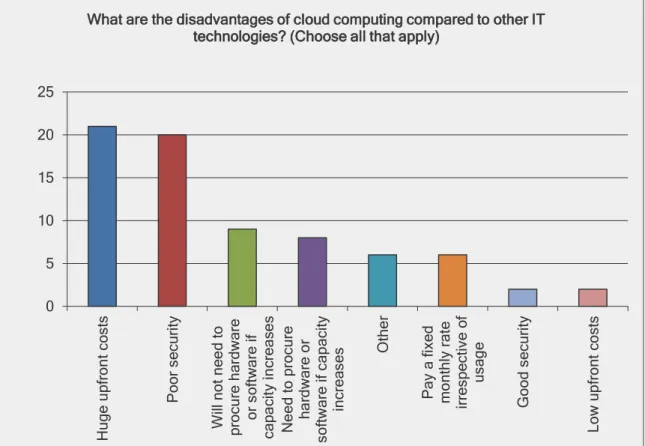
Cloud computing is an option to help the government, but adoption of cloud computing is slow. Poor security is the number one drawback; and a government department must ensure that data in cloud computing is secure.
Introduction
- What is Cloud Computing?
- Why focus on the SA Government
- Contribution and Limitation
- Research Goals
- Summary of Dissertation
The dissertation research was approached by first reviewing the current literature on cloud computing and the SA government. The primary research method used was a quantitative methodology (survey) to determine the perceptions of cloud computing within the SA government.
Literature Review
- Introduction
- What is Cloud Computing?
- Advantages of Cloud Computing
- Electronic Government
- Issues in Cloud Computing
- Summary
The growth of cloud computing (accessing computing resources delivered through networks rather than running software or storing data on a local computer) exemplifies this shift to the cloud (Bughin, Chui & Manyika 2010). Wyld (2009) and Armbrust, Fox, Griffith, Joseph, Katz, Konwinski, Lee, Patterson, Rabkin, Stoica & Zaharia (2010) describe the key issues facing government leaders in the transition to using cloud computing:. 1) The need for scalability.
Research Design
- Research Objectives
- Research Question
- Research Approach
- Target Audience
- Survey
- Process and Design
- Method for Analysis
- Response Rate
- Final Survey
The 2nd survey had more respondents as the survey was updated with feedback from the 1st survey and a wider audience had to give their opinion before. The 1st draft of the survey design was completed on October 4, 2013, and respondents received the survey via email.
Data Results and Analysis
Responses
A response rate of 48% is acceptable for this study and the survey was hosted on a secure server by a survey service provider. The survey was completed on November 7, 2013, and this data was transferred to a Microsoft Excel spreadsheet.
Results Approach
General
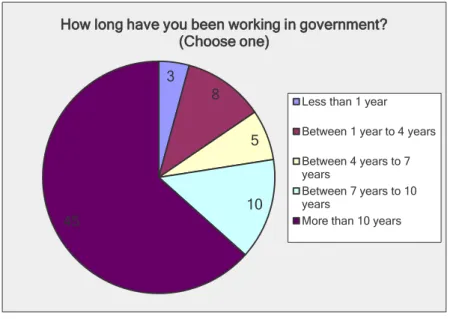
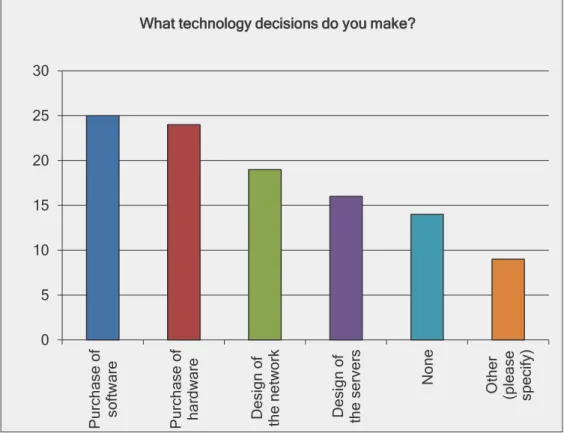
To assess decision-making in government services, respondents indicated what the decisions they make regarding technology were. The results in Figure 6 show that the largest response was in the purchase of software and the least in network planning. The results in Figure 7 show that the 45 respondents who have been in government for more than 10 years are well represented.
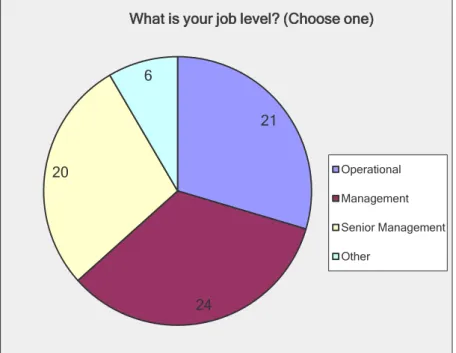
Respondents with more than ten years of service show that management constitutes the majority, indicating that management in government is the easiest path to promotion. Respondents could choose from four options and the results in Figure 8 show that the majority of responses are between 1,000 and 3,000 and the next range is between 3,000 and 10,000 – the combined results are 54 respondents. This implies that the survey is representative of the national level and only covers a small part of the provincial level (6 respondents).
45 respondents work for more than 10 years in the government and the majority of respondents are from medium to large departments with 62 respondents in national departments.
User Perspectives
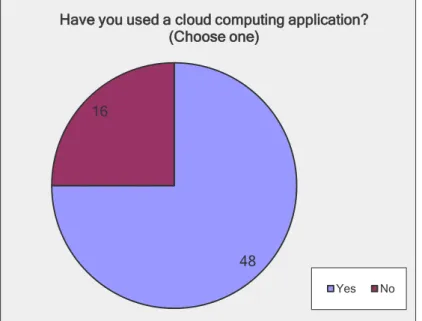
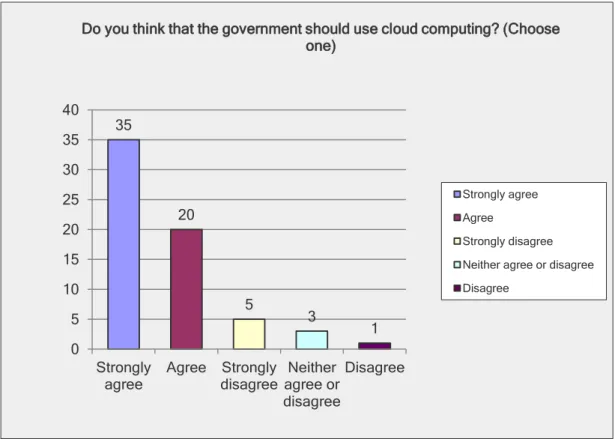
In Figure 11, 55 respondents supported the use of cloud computing by the government, while 4 respondents disagreed about the use of cloud computing. Respondents in larger departments with 1,000 or more employees were more in favor of cloud computing. Respondents were presented with two options to determine whether they have used a cloud computing application, so they may already have an idea of the pros and cons.
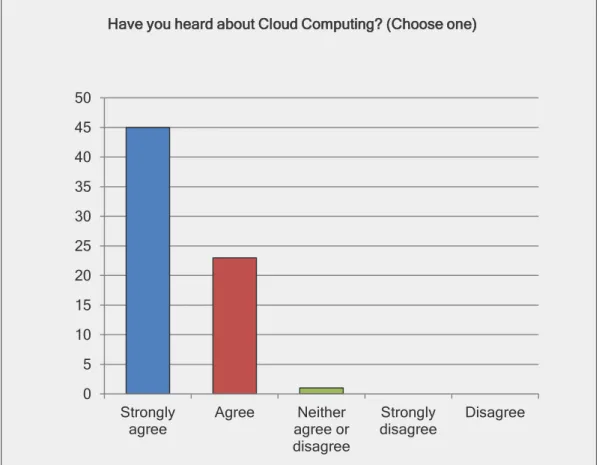
The two options: yes or no; and 48 respondents chose that they use a cloud computing application. They may also not be fully aware that they could have used a cloud computing application without knowing that it is a cloud service, for example: Gmail, Yahoo mail, Dropbox and even this. 68 respondents had heard of cloud computing and many of the larger departments (1,000 and more employees) were in favor of cloud computing being used in government.
Cloud computing services are readily available over the Internet and the majority of respondents indicated that they had used this service.
Cloud Computing Opportunities
The new paradigm is that you can "rent" the software you need over the Internet and pay only for what you use. To understand the change in behavior from the old approach to the new approach, Figure 15 shows that 49 respondents are willing to use the new approach by renting the software while 6 respondents will not change to use the cloud computing software by continue using the traditional way. This is an indication that users are adapting to the new way of working as they understand the benefits of using cloud services.
The HR, Procurement and Project Management software will likely move to the cloud. The government community cloud is where the cloud infrastructure is provided for exclusive use by a specific community of consumers from the various government departments who have shared concerns (eg mission, security requirements, policy and compliance considerations). To gain a better understanding of government priorities, respondents were asked to select the software they thought should move to the cloud and then select the software that could move to the cloud to gain government buy-in.
What software do you want to deploy immediately in the cloud so you can use it to drive more government buy-in?
Adoption of Cloud Computing
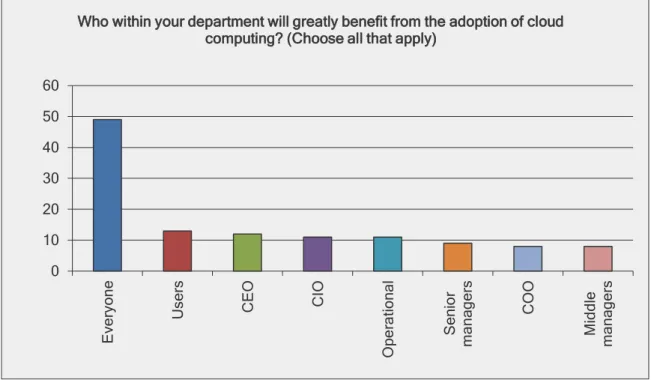
Cloud computing has many advantages and the respondents had to think about who within the department will benefit the most from the adoption of cloud computing. The adoption of new technology will have an impact on the citizens and the respondents had to evaluate the impact of the adoption of cloud computing. The respondents see the value of creating and having standards and policies that will help with the adoption of cloud computing.
71% of those who chose option 3 (Scalability of infrastructure, reduce costs while paying for what is used and to ensure business continuity) also strongly agree or agree with standards and policies that will help the introduction of cloud computing. Need to develop standards and/or policies to help adopt cloud computing. This shows that the respondents are aware of the important drivers of cloud computing which will also help in the adoption of cloud computing.
The key drivers for cloud computing adoption are infrastructure scalability, reducing costs, and ensuring cloud computing business continuity.
Administrator Perspectives
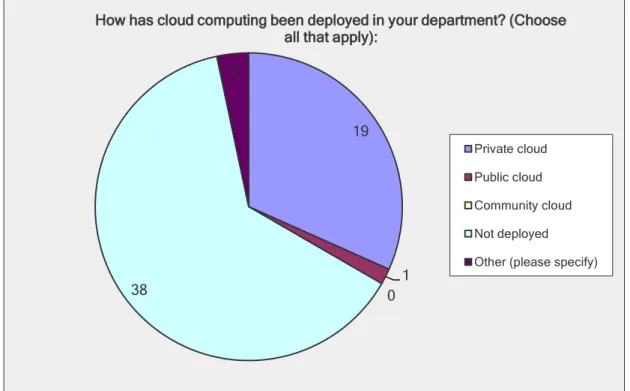
To determine which cloud computing deployments are more prominent in government, respondents had a choice of five options to choose from. The results in Figure 25 show that cloud is not deployed by 38 of the respondents and 21 respondents have deployed cloud computing for private and public cloud accounts - These are mainly from the national level departments. Which option should be deployed to ensure that the cloud computing hardware, software and network are in place.
They were asked which option should be deployed to ensure that the cloud computing hardware, software and network are in place and the results in Figure 26 show that 39 respondents are aware of this. Cloud computing has three different paradigms: Infrastructure as a Service (IaaS), Platform as a Service (PaaS) and Software as a Service (SaaS). 53 Respondents understand basic cloud computing management capabilities, showing that the majority of respondents are aware of cloud computing.
There is an understanding of the different phases of cloud computing with 39 respondents agreeing that the hardware, software and networking of cloud computing is done in the IaaS phase.
Cloud Computing Challenges
Majority (18 respondents) agree that cloud computing is secure, while 12 respondents neither agree nor disagree. It is clear that the department needs to ensure data security in cloud computing. How will you ensure that the technology you use for cloud computing remains relevant and does not become obsolete as technology advances.
Do you think the investment in adopting cloud computing is worth it? One of the biggest drivers for the adoption of cloud computing is the cost savings and the respondents had to estimate the cost savings through IaaS (not managing hardware), PaaS (not managing stacks or frameworks) and SaaS (not managing service software). One of the major drivers for the adoption of cloud computing is the cost savings.
To determine the skills required to adopt cloud computing, respondents could contribute to the solution to determine the skills needed for cloud computing.
Overall Research Summary
They are aware of the phases (IaaS, PaaS and SaaS) to build cloud computing capabilities; and. The main concerns with cloud computing deployments have been the migration of legacy or legacy applications to cloud readiness. A life cycle management approach will be applied to the technology and also to track technology trends in the industry;.
The skills will be mapped to the applications and technology they intend to implement; and. The skills will need to be transferred and have a development plan to retrain the people and to move people with obsolete skills to other areas within IT, if they cannot be retrained. 24% indicated that ECM software is the software they are most likely to want to deploy immediately in cloud computing.
Conclusion
The responsibility for cloud computing adoption should lie with top management, such as: CEO, COO or CIO. The majority of government users believe that cloud computing will deliver cost savings of 10% to 20%, highlighting a major driver for cloud computing adoption. There are concerns about the cloud computing model, such as performance, compliance, private clouds, integration and costs.
The main issues associated with cloud computing adoption include: application migration, old or outdated applications, and change management issues. The literature shows that there is a great push for cloud computing as one of the most important technological trends of the moment. Users will be impacted by the adoption of cloud computing and respondents indicated that new ways of working and training users are the top two priorities.
The lack of knowledge of some of the respondents about the basic concepts in cloud computing;.
Future Research
Hashizume, K., Rosado, D.G., Fernandez-Medina, E., en Fernandez, E.B., 2013, 'An analysis of security issues for cloud computing', Journal of Internet Services and Applications 2013 4:5. Hofmann, P., 2010, 'The Limits of Public Clouds for Business Applications', Internet Computing, IEEE, volume: 14, uitgawe: 6, VSA. Kostoska, M., Gusev, M., en Ristov, S., 2013, 'A New Cloud Services Portability Platform', 24ste DAAAM Internasionale Simposium oor Intelligente Vervaardiging en Outomatisering, 2013.
Nkhoma, M., and Dang, D., 2013, "Factors Contributing to Cloud Computing Adoption: A Technology, Organization and Environment Framework Approach", International Journal of Information Systems and Engineering (IJISE), vol. Reddy, S., 2011, 'Detailed Description of Cloud Computing', viewed 20 February 2014 at http://www.techyv.com/article/detailed-description-cloud-computing. Ryan, RD., 2011, "Cloud Computing Privacy Concerns on Our Doorstep", Communications of the ACM, Vol. 54, UK.
Spector, MJ, 2013, 'Trends and research issues in educational technology', The Malaysian online journal of educational technology, Vol 1 Issue 3, Malaysia.