Health-related quality of life concept
Purpose of study
Justification of study
Study objectives
Describe the HR-QoL of students with physical and sensory impairments attending special and integrated schools in Ibadan. Compare the HR-QoL of students with physical and sensory impairments attending special and integrated schools in Ibadan.
Research questions
Null Hypothesis (Ho): There is no significant difference in the HR-QoL of students with physical and sensory disabilities attending special and integrated schools in Ibadan. Description of the average HR-QoL scores of the students with the different forms of physical disabilities. Null Hypothesis (Ho): There is no significant difference in the MH-Col of students with specific forms of physical disability.
A significant difference was found in HR-QoL for students with different types of physical disabilities in integrated and special schools. The HR-QoL of students in integrated schools with reduced limbs was found to be significantly higher than those in special schools. Mean HR-QoL domain scores of male and female SwPSI in special schools and integrated schools in Ibadan.
Variables associated with HR-QoL of students with physical and sensory disabilities attending special and integrated schools in Ibadan. In this study, the SwPSI in integrated schools had a relatively higher HR-QoL score than those in the special schools. The HR-QoL of students in integrated schools with reduced limbs was found to be significantly higher than those in special schools.
Pupils with physical and sensory impairments in integrated schools had higher HR-QoL scores than their peers in special schools. Conversely, the SwPSI in special schools had a higher score in the mental health domain of HR-QoL.
Null Hypothesis
Scope of study
Operational definition of terms
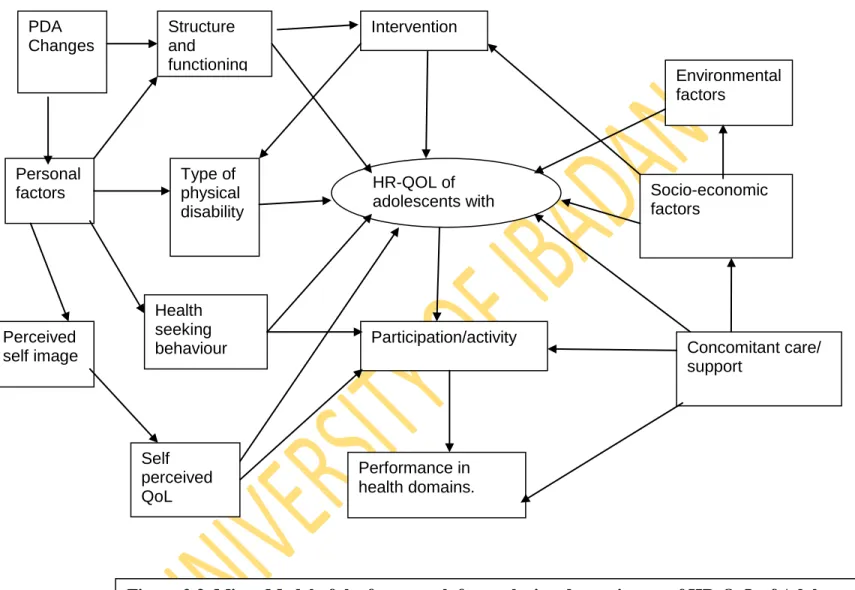
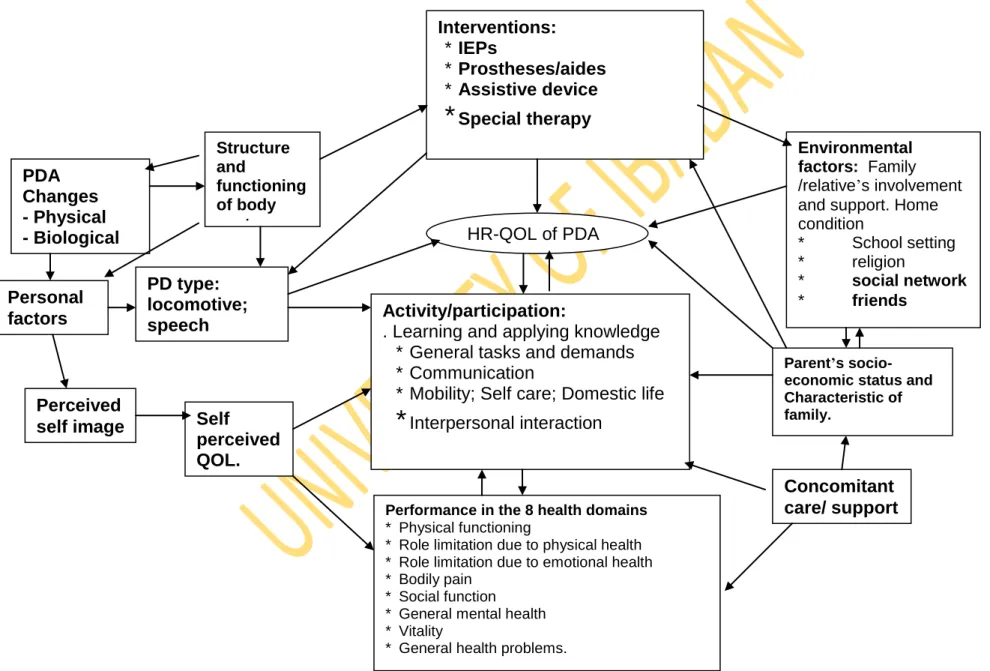
Micro model of the framework for exploring determinants of HR-QoL for youth with disabilities. A significant difference in HR-QoL for the two comparison groups was determined using independent t-test. Null hypothesis (Ho): There is no statistically significant difference between the HR-QoL domain scores for students attending special schools and integrated schools.
Average HR-QoL domain scores of SwPSI in integrated schools and special HR-QoL domains School. Null Hypothesis (Ho): There is no statistically significant difference in HR-QoL domains of SwPSI with different forms of physical disability attending special and integrated schools. Analysis of variance showed that there is a significant difference in the following areas of HR-QoL of students with different forms of physical disability attending special and integrated schools: general participation, performance in physical activities, general health and vitality (Table 4.8).
Null hypothesis (Ho): There is no statistically significant difference between the results of the HR-QoL domain of students with single and multiple physical disabilities. In contrast, those with hearing impairment in special schools had significantly higher HR-QoL than those in integrated schools. When HR-QoL domains were considered, students with more physical impairments scored higher in mental health (although not statistically different).
This study was designed to describe and compare MH-Col of students attending special and integrated schools in order to establish a basis for the segregation or inclusion of students with physical disabilities in special or integrated schools. It was discovered that there is no significant difference between HR-Col of students with physical disabilities attending special and integrated schools in Ibadan, although students in integrated schools had higher HR-Col.
Historical Overview of QoL studies
Disability
One third of people with disabilities are children and two thirds of them have preventable disabilities (Peat 1997). For example, less than 2% of people with disabilities have access to rehabilitation and less than 5% have access to education (Elwan 1999; Miles 1999).
Physical disabilities
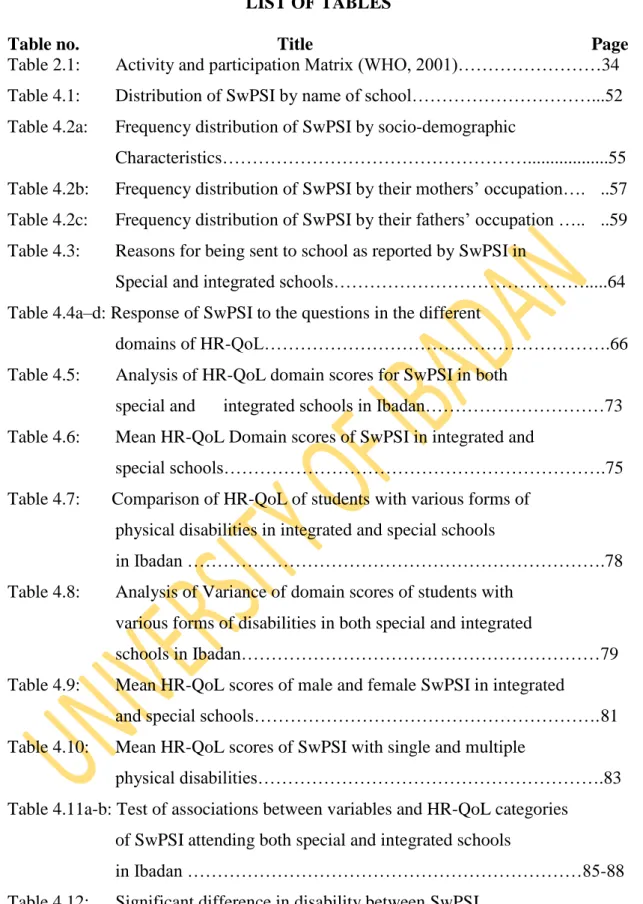
No statistically significant difference was found in the HR-QoL domain scores of male and female SwPSI attending special and integrated schools in Ibadan (p>0.05) (reflected in Table 4.9). This study showed no significant difference between the HR-QoL categories of SwPSI in special and integrated schools (table 4.11c, graph 4.4).
Causes of physical disabilities and sensory impairments.…
Impact of Disability
People with disabilities are poor because they are denied access and the most basic opportunities for human development, ie. education, income and self-. However, persons with disabilities have the capacity to become productive citizens and contribute to national development (Edmonds, 2005).
The evolution of Disability Explanatory Model
Challenges faced by students with Physical Disabilities
Quality of Life Concept
Current Issues relating Measuring HR-QoL of
Measuring HR-QoL of Adolescents with Physical Disabilities
Research has shown that children with physical disabilities are less likely than their peers without physical disabilities to smoke, drink, and use drugs (Steele et al., 1996). Adolescent children with physical disabilities have significantly more positive attitudes toward parents, teachers, and classmates (Stevens et al., 1996).
Disability models
The focus is on overcoming environmental barriers that prevent the full participation of disabled people in their communities. This is a new model built on the social model, but which includes elements of the medical model.
Provisions of education for persons with disability
One of these commendable efforts is the promulgation of Section 10 of the 4th edition of the National Education Policy (2004), which provides guidelines on special education for students with special needs. In this model, students with special needs are educated with their normal peers for at least half of the day.
Model of Human Functioning and Disability (WHO-ICF model)
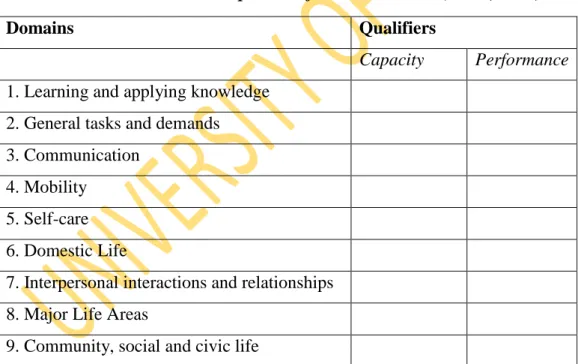
These are two terms that WHO has introduced as qualifiers of the Activities and Participation component of the new ICF. Service providers should be aware of the possibility of these differences in the activity and participation levels of the children they see (Stewart and Rosenbaum, 2003).
Conceptual framework
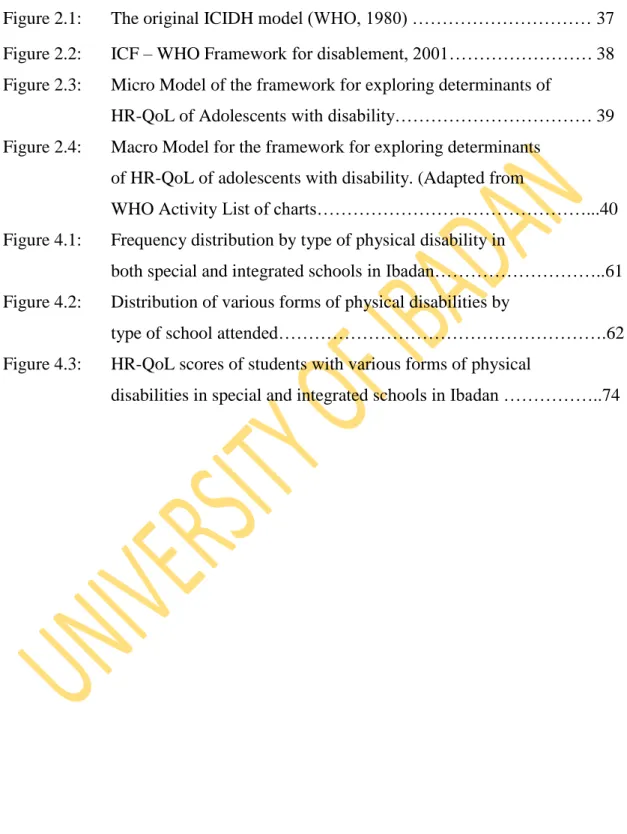
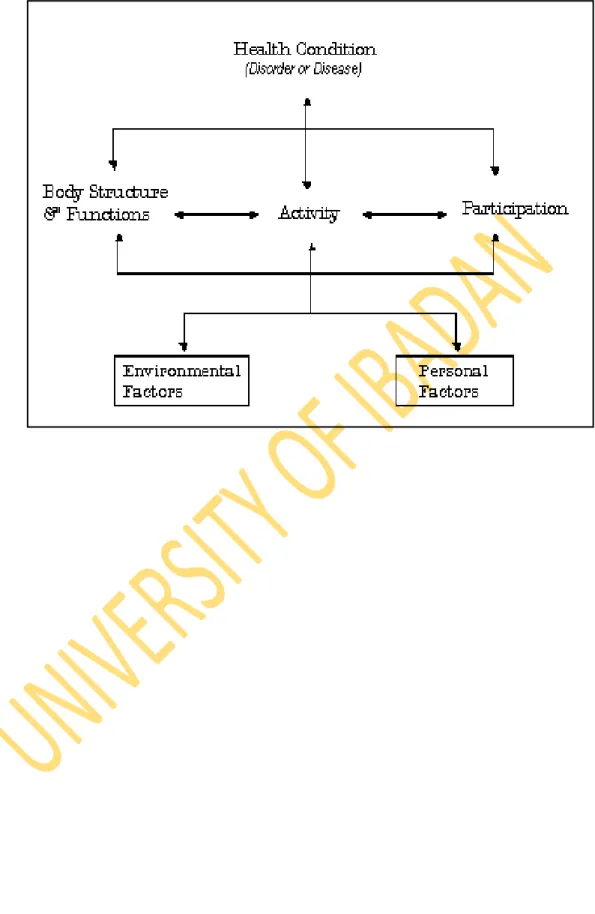
It also appears to be recognized as a framework that promotes recognition of the role of environmental factors in all aspects of health and functioning. It is very important to note that the relationship between the elements of the model for conceptual framework in this study goes beyond a one-way or two-way relationship;.
The SF36 scoring system
As reflected in the macro model conceptual framework, a combination of the 36-item Short-Form Health Survey (SF-36), (see Appendix V), which consists of 36 items; This study will use a disease-nonspecific, self-reported measure that assesses patients' HR-QoL and that of WHO-ICF, 2001. The items on the original SF-36 scale for assessing the quality of life of people with disabilities have been adapted to this study. This is reflected in the questionnaire items for this study for the domains of quality of life, namely performance level in general activities, general health, mental health, vitality and general participation, as well as in the developed conceptual model (Figures 2.2, 2.3 and 2.4 ;).
QoL is often seen as a continuum, therefore, according to (Brown and Gordon, 1999); at the center of the continuum are correlational or predictive models. In the SF36 scoring system, the scales are therefore assessed quantitatively, each based on responses to two to ten multiple-choice questions, and a score between 0 and 100 is then calculated based on well-defined guidelines, with a higher score indicating a indicating better health status (Freeman et al, 1996 and Rothwell et al, 1997). The scores of the two dimensions and the total SF36 score are based on mathematical averages of the scale components.
It is important to note that the vitality and general health scales are overlapping components of both the physical health and mental health dimensions.
Location of study
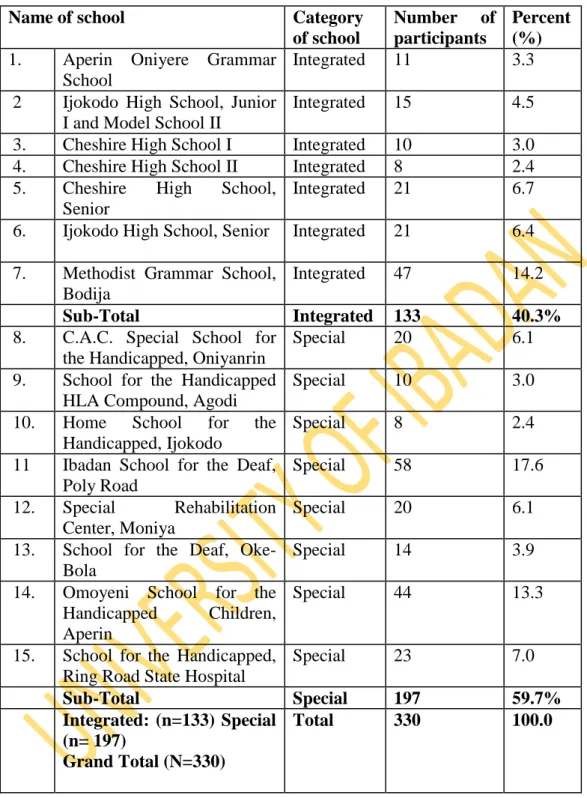
Sample size determination
However, to make up for losses/incompleteness of questionnaire (about 25%), the sample size was increased to 150 for each comparison group.
Inclusion criteria
Exclusion criteria
Population of interest
Sampling technique
Instrument
Factors to be considered in this study were aggregated, as indicated in the different sections of the questionnaire, including environmental factors (family and school environments), personal factors, socio-economic status of parents, type of physical disability and interventions/ PEI. Missing values or unanswered items in the questionnaire were considered as '0', therefore, a person-specific mean HR-QoL score was calculated based on the existing responses. SwPSI scores of 0 - 27 points were categorized as those with low HR-QoL while those scoring between 28 – 55 points were considered as those with moderate HR-QoL.
Expert opinions were obtained from direct carers/teachers in special and integrated schools and staff of the Ministry of Special Education and Social Welfare, Oyo Ibadan State Secretariat. In order to ensure content validity, the instrument was carefully reviewed by experts who reviewed the questionnaire against the research objectives, and then removed ambiguous and irrelevant items from the questionnaire. Face validity was achieved by clarifying the questionnaire items, presenting them in simple terms and translating the questionnaire items into Yoruba to facilitate understanding and ease of questionnaire completion (Appendix VII).
For reliability, the questionnaire was pre-tested (n=43) and analyzed to determine the intra-class correlation coefficient using the Kappa test and Cronbach coefficient.
Data collection procedures
Method of data analysis
Ethical considerations
Individual Right to Participation/Withdrawal: Only SwPSI who agreed to participate in this study were enrolled in the study. There was no penalty for not participating in the study or for interrupting the interview without completing the questionnaire completely. Names or traces of the identity of the participants were not reflected in any way.
Anonymity was maintained when obtaining student personal data from teachers/coordinators. Benefits: The information gained will be used to inform policy on strategies to be used in the delivery of effective services to SwPSIs in Ibadan, Oyo State and Nigeria at large. They must be patient in dealing with each of the participants as it may take some time to answer the questions on the call.
Any explanation must be within the context of the study and in accordance with the stated objectives.
Study limitations
Students with different forms of physical disabilities/disabilities in integrated schools had higher HR-QoL scores except those with hearing, speech and other types of physical deformities (Table 4.7). Those with hearing impairment in special schools had significantly higher HR-QoL while those with multiple physical disabilities in integrated schools had significantly higher HR-QoL scores. This study revealed that there is no significant difference in the HR Quality of SwPSI in special and integrated schools in Ibadan and that those in integrated schools only have a relatively higher average HR-QS score than their counterparts in special schools.
The severity of physical disability should be controlled while delineating HR-QoL by SwPSI in both integrated and special schools.