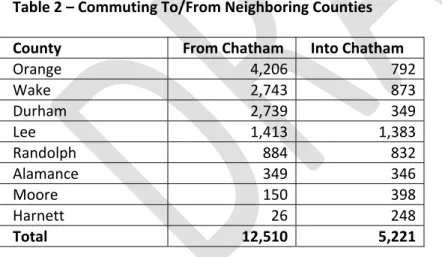
The selection committee included Chatham County Sustainable Transportation Planner, a representative of the Triangle Area Rural Planning Organization and Chatham County's acting planning director. Although part of Northeast Chatham County is part of the Raleigh-Durham-Chapel Hill Metropolitan Statistical Area (MSA), it is generally considered a rural county. According to the 2000 census, 12,510 Chatham County residents traveled to one of eight contiguous counties to work.
Like all North Carolina counties, Chatham County government does not build or maintain any of these. Four miles of the trail run through Chatham County with a double surface of asphalt and compacted screenings. Sister-to-Sister has been providing transportation services to Chatham County residents since March 2001.
The services offered through Chatham County Schools consist of the Exceptional Children's Program, the Homeless Student Program, and School Choice. Chatham County is included in the Regional Transit Blueprint sponsored by the Durham Chapel Hill Carrboro Metropolitan Planning Organization, the Triangle J Council of Governments, the Triangle Transit Authority and other agencies.
Funding for Transportation
Environment Pollutants
State Policy
The purpose of the Fund was to provide "transportation projects of statewide and regional importance that relieve congestion and improve mobility across all modes of transportation." The Department of Transportation will use the Mobility Fund to fund transportation projects, selected by the Department, of statewide and regional importance that alleviate congestion and improve mobility across all modes of transportation. The funding comes from unused gap funds and reductions in the amount of money transferred from the Highway Trust Fund to the General Fund.
The importance of this Fund and its funding criteria is that it falls outside the established equity formula that has been in place since the 1989 Highway Trust Fund. It allows joint transportation projects to stand on their own merits, based on high-growth areas and preferential considerations given to projects eligible for Congestion Relief and Intermodal Transportation 21st Century Fund. In 2010, the NC General Assembly established the Sustainable Communities Task Force, to help state leaders think about sustainable development and “strategic use of resources to plan and enable healthy and equitable development without compromising natural systems and the needs of endangering future generations of North Carolinians.” .
Through the Task Force, state lawmakers seek to encourage better transportation choices, increase transit orientation and mixed-use. leverage the development, and preservation and enhancement of the unique characteristics of rural, urban, and suburban communities by investing in healthy, safe, and livable neighborhoods. The NC Board of Transportation and the NC DOT have recently recognized the importance of developing a balanced road network and transportation system. Comprehensive highway policies and guidelines are quickly gaining momentum among states, MPOs, counties, and municipalities as they design roads that serve citizens who drive and those who don't.
The policy requires planners and designers to consider and incorporate multimodal alternatives into the planning and improvement of all transportation projects within the county's growth area, unless. As a partner in the development and realization of their visions, the Ministry aims to help local communities, by enabling long-term planning, to optimize connectivity, network interdependence, context-sensitive options and multimodal alternatives. NC DOT July 2009 Board of Transportation Complete Street Policy, . www.bytrain.org/fra/general/ncdot_streets_policy.pdf).
NC DOT has established an advisory group to further refine the implementation policy and develop improved road design guidelines.
Summary
Chapter 3: Values, Goals and Strategies
Goal 1: The Chatham TAB is a viable means for public participation in transportation decisions Public Participation Strategies
Goal 2: The Chatham TAB provides guidance/recommendations to BOC and county staff on policies and plans related to transportation
Goal 3: The Chatham TAB provides meaningful guidance/recommendations to BOC and county staff in prioritizing transportation projects that impact Chatham residents
Goal 4: The Chatham TAB collaborates with existing agencies to provide convenient and accessible transportation services
Goal 5: The Chatham TAB measure and assess status and quality of transportation system Quality Strategies
Goal 6: The Chatham TAB provides credible public education on transportation issues relevant to Chatham County
Appendix 1
Appendix 2
Appendix 3
Appendix 4
CTN Cross County Route: Travels from Siler City to Pittsboro, to UNC-CH and back, three times a day on weekdays, with 8 stops in each direction, including a park-and-ride at the Wal-mart in Siler City and Lowe's Home Improvement in Pittsboro. CHT PX Route: Travels from UNC-CH to Pittsboro and back six times a day on weekdays, with approximately 6 stops in each direction, including a park-and-ride at Lowe's Home Improvement in Pittsboro. CTN Pittsboro Area: Provides paratransit service to the general public within the city and up to 4 miles outside the city limits.
CTN Siler City Area: Provides paratransit service to the general public within the city and up to 2.5 miles outside the city limits. Project Health Rides: This program, started in November 2009, is available to County residents age 60 and older, as well as those age 18 and older with a disability or health. It is a voucher program where human service agencies, such as the Council on Aging, provide a voucher that requests CTN services on behalf of the client.
CTN provides these services on a subscription basis to Central Carolina Community College, Chatham County Department of Social Services, Chatham County Health Department, Chatham County Partnership for Children, Chatham County Together, Chatham Trades, Family Resource Center, Laurels of Chatham, Lee County Industries, and Siler City Care and Rehabilitation. Private Entities: There are a few private entities in Chatham County that offer transportation services, such as Sister to Sister in Siler City and Thompson & Little Transportation in Bear Creek.
Appendix 5
Appendix 6
Multimodal
The State-funded Spot Safety Program, part of the HSIP, provides funding for small improvement projects to address safety, potential safety and operational issues. The maximum allowable contribution from Spot Safety funds per project is $250,000, and other sources of money (such as small construction or contingency funds) often help fund these projects. The Hazard Elimination Program, part of the HSIP, is used to develop major improvement projects to address safety and potential safety issues.
Roads
The Governor's Highway Safety Program (GHSP) provides "seed" funding for highway safety projects or programs. All projects are expected to make significant progress in reducing traffic accidents, injuries and fatalities, which is a condition for continued funding. In addition, funding may not be used to replace or replace existing expenditures, nor may it be used to carry out the grantee's general operating expenses.
Transit
In addition, funding cannot be used to replace or replace existing expenses, nor can it be used to meet the beneficiary's general operating expenses. www.ncdot.gov/programs/GHSP .. wheelchairs; and 2) expanded service, such as service beyond the required quarter-mile ADA service buffer on either side of established routes, new ADA feeder services, or new volunteer driver programs. The North Carolina Congestion Relief and Intermodal 21st Century Transportation Fund (House Bill 148, signed into law August 2009) gives local governments the authority to impose a ¼ cent sales tax and/or vehicle registration fees to fund public transportation. The Regional and Intercity Program provides up to 50% of the net operating costs for intercity bus service in underserved areas of North Carolina that connect to the national intercity network, and provides state funds for Travelers.
The Rural Planning Program is a federal and state program that funds up to 100% of the cost of regional feasibility studies and up to 90% for implementation plans or local planning studies. The Public Transportation Grants Program is a state program with several purposes: to provide matching funds for statewide NCDOT grants and local federal capital and planning grants; fund short-term demonstration projects and those ineligible for federal funding; and, fund the Trainee and Intern Programs and the Transportation Demand Management Program. Trainee and intern programs provide up to 90% of eligible costs for the work experience of selected recent graduates. trainees) and graduate students (trainees) in public transport.
The Transportation Demand Management (TDM) Program is a combination of federal congestion mitigation and air quality (CMAQ).
Bicycle, Pedestrian and Others
Appendix 7
The 21st Century Transportation Committee was established by the President Pro Tempore of the Senate and the Speaker of the House of Representatives, pursuant to the 2007 U.S. Representatives to the General Assembly. By 2030, North Carolina is expected to become the seventh most populous state are of the country. According to a 2006 TRIP report on the Interstate Highway system, 57% of all urban highway miles in North Carolina and 47% of rural highway miles are congested.
North Carolina currently has more than 2,500 structurally deficient bridges and ranks 41st out of the 50 states for bridge deficiencies. The North Carolina Department of Transportation estimates it needs to replace 400 bridges annually to reduce the number of structurally deficient bridges. However, the national level accounts for 49 percent of the needs while carrying 50 percent of all traffic, the regional level 12 percent of the needs and 15 percent of the traffic, and the sub-regional level 39 percent of the needs and 35 percent of the traffic.
The initial project funded by the Mobility Fund will be the widening and improvement of Interstate 85 north of the Yadkin River Bridge. 136‐188, as enacted by this act, and shall report to the Joint Legislative Committee on Transportation Oversight on the development of selection criteria. Currituck Bridge, fifteen million dollars is transferred to the North Carolina Movement Fund, as authorized by this act, to be used for Phase II of the Yadkin River Bridge project.
The importance of this Fund and the criteria for funding is that it falls outside of the fixed equity formula created by the Highway Trust Fund of 1989 and allows joint transportation projects to stand on their own merits based on growth areas. high and preferential consideration as given to overcrowding. 21st Century Intermodal Transportation and Aid Fund Eligible Projects. The General Assembly notes that the rapid growth of North Carolina's urban and suburban areas and the economic challenges facing many of the state's urban centers, rural and smaller areas. communities create a significant need for the strategic use of resources to plan and accommodate healthy and equitable development without compromising natural systems and the needs of future generations of North Carolinians. The General Assembly finds that the following principles describe sustainable development for North Carolina communities:
A Sustainable Communities Task Force has been established within the North Carolina Department of Commerce to lead and support the state's sustainable communities initiatives.