“Ceci n’est pas une pipe”:
A Comparison of French and U.S. Health Research on the Neurodevelopmental and Epigenetic Effects of Tobacco Exposure on Vulnerable Populations
Laurie Hwang
A Thesis submitted to the Department of Romance Studies
& Duke Global Health Institute for honors Duke University
Durham, North Carolina April 2016
Thesis Committee Deborah Jenson
Professor of Romance Studies and Global Health Co-Director, “Brain & Society,” Bass Connections
Deborah Reisinger
Assistant Professor of the Practice of Romance Studies
Director of Cultures and Languages across the Curriculum, Romance Studies Christelle Gonthier
Lecturing Fellow in the Department of Romance Studies Eric Green
Assistant Professor of the Practice of Global Health Rochelle Schwartz-Bloom
Professor in the Department of Pharmacology & Cancer Biology Professor of Psychiatry and Behavioral Sciences
Co-Director of Bass Connections, “Environmental Effects on Cognitive Development”
Abstract:
This thesis explores how cultural beliefs and practices influence biomedical research landscapes in two high resource cultural contexts, the US and the Euro-American
francophone world. First, I examine how cultural mores have differently shaped the pace of research engagement in the two economically advanced societies with advanced “Western”
health research infrastructure and shared scientific goals. Through examining historical and global discourses of ADHD and perceptions of the disorder, I argue that the diagnosis we call
“Attention Deficit Hyperactivity Disorder (ADHD)” is not a novel phenomenon of modern times, nor is its epidemic limited to the US. I then propose that different conceptions of liberty, approaches to public health, and realities of social and political systems all contribute to the divergence of social movements, regulations, and research. Finally, I suggest a cross- cultural approach to the science of tobacco’s effect on the developing brain as an essential conceptual change to advance the current understanding of the disorder and reducing global health disparities.
TABLE OF CONTENTS
Abstract………...……….3
Acknowledgements………....5 Introduction
Intercultural Approaches to Global Health Problems of Tobacco Exposure………..6 Chapter One
Current Research on the Effects of Environmental Tobacco Smoke Exposure on ADHD Development……….13 Chapter Two
Changing Discourses of ADHD and Perceptions of the Disorder………28 Chapter Three
Freedom and Tobacco Control………..………35 Chapter Four
Cross-cultural Understanding of Tobacco Smoke Exposure and ADHD……….49 Bibliography...57
Acknowledgements:
I am deeply grateful to the many individuals who have encouraged and inspired me
throughout my time at Duke. Without your guidance and support, I would have not been able to complete this thesis.
Firstly, I would like to express my sincere gratitude to my thesis advisor, Dr. Deborah Jenson.
Thank you for introducing me to Bass Connections. Your continuous support, patience, encouragement, and immense knowledge have been invaluable. Your cross-cultural approach to research helped me in all the time of research and writing of this thesis. I could not have asked for a better advisor and mentor for my thesis.
Besides my advisor, I would like to thank the rest of my thesis committee. Dr. Eric Green taught me the essence of qualitative and quantitative methods in conducting research. Dr.
Deborah Reisinger, as an expert of French literature and cultural studies, shared her wisdom and insights into the cross-cultural understanding of ADHD. Dr. Christelle Gonthier inspired me to explore the beauty of French language and culture over the six weeks of Duke in Paris, one of my favorite moments in life. Dr. Rochelle Schwartz-Bloom, the team leader of our Bass Connections project, “Environmental Effects on Cognitive Development,” allowed me to navigate through various research opportunities and motivated me to widen my research from multidisciplinary perspectives.
I would like to thank my fellow Bass Connections team members and Duke in Paris students for their curiosity, intelligence, and energy. You all inspired me and challenged me to grow as a critical thinker and a problem solver.
Last but not the least, I am grateful to my family and friends for unconditionally supporting my passion and pursuit of my dreams. Mom and Dad, I am incredibly fortunate to have you as amazing role models and as parents. Alexis and Lauren, I am thankful for all the beautiful memories we share. I would not have been able to make it this far without you two. You made Duke feel like home.
Introduction
Intercultural Approaches to Global Health Problems of Tobacco Exposure
Attention-deficit hyperactivity disorder (ADHD) is a cognitive and developmental disorder. Common symptoms of ADHD include inattention, impulsiveness, and hyperactivity.
A recent meta-analysis by Polanczyk et al. (2007) estimated the worldwide prevalence of ADHD to be 5.29%. Children with ADHD experience a significant social, emotional, and economic burden (Bernfort at al., 2008). According to the National Resource Center on ADHD, these problems often persist into adolescence and adulthood. Young people with ADHD have reported a distorted sense of self and low self-esteem (Krueger & Kendall, 2001) and “are at increased risk of academic failure, dropping out of school or college, teenage pregnancy, and criminal behavior[s]” (Harpin, 2005).
Although few studies of ADHD have been carried out in low resource countries, there is reason to believe that exposures to environmental hazards and other forms of adversity may cause a disproportionate burden of ADHD on socioeconomically and politically marginalized populations. Russell et al. (2013) detected a strong association between children with ADHD diagnosis and their socioeconomic disadvantages, a finding that resonates with results from a wide range of studies (i.e., Döpfner et al., 2008; Ford et al., 2007). This principle may also hold for vulnerable populations within any given society. Paula Braveman (2006) clarifies that health disparities refer to differences in which “disadvantaged social groups
systematically experience worse health or greater health risks more than advantaged social groups. Health disparities include differences between the most advantaged group in a given category – i.e., the wealthiest, the most powerful racial/ ethnic group – and all others, not only between the best and worst-off groups” (p.180).
This thesis considers ADHD as a global health problem, which I address in two specific high resource cultural contexts, the US and France (with limited comparison of France with a selection of socioeconomically similar francophone regions). These regions
and impact of ADHD. A disparity of research could be defined in several ways, but this thesis focuses on the difference in the emphasis and amount of research. Part of the work of global health is not only to address discrepancies of health and health care access by economically high and low resource countries, but also to consider disparities of health research in cultural context, and their capacity to generate health disparities. Culturally grounded comparisons of ADHD research could be carried out in any set of world locations, but I will hypothesize in this thesis that the discrepancies in research documented here provide evidence of the culture- bound variance of health research and policy, even in economically advanced countries like the US and France.
Since the late 20th century, numerous studies from a variety of world locations have investigated the etiology of ADHD in an effort to find better ways to treat the disease and reduce the likelihood of developing it. For instance, Das and his colleagues (2011) examined the role of genetics and gene-environment interaction in the etiology of ADHD among eastern Indians”; Ercan and his colleagues (2013) conducted a 4-year longitudinal study to examine the prevalence and diagnostic stability of ADHD and Oppositional Defiant Disorder (ODD) among Turkish children; Sharma and Couture (2014) studied “the pathophysiology, etiology, and treatment of ADHD” through a literature search and meta-analysis of data from 137 articles across the globe.
The National Institute of Mental Health states that ADHD often runs in families and that ADHD susceptibility is in part hereditary. According to the CDC’s latest description of the disorder, updated in January 2016, potential non-genetic causes and risk factors of ADHD include, but are not limited to: brain injury, environmental exposures, alcohol and tobacco use during pregnancy, premature delivery, and low birth weight. Low resource demographics may suffer particularly strong associations to some or all of the above risk factors. Out of this series of possible causes and risk factors, my thesis will focus on one specific problem within the category of environmental exposures: environmental effects on neurodevelopment stemming from fetal exposure to tobacco residues during gestation.
Smoking and ADHD are directly related in several ways. First, individuals with ADHD are prone to adopt smoking, be less successful with cessation, and have a higher risk of relapse than those without ADHD (McClernon & Kollins, 2008). By stimulating dopamine release in the striatum, nicotine has been shown to help improve attention of regular smokers (Brody et al., 2004). Therefore, it is plausible that some ADHD patients experience
therapeutic effects from the dopamine stimulated by nicotine, and may smoke more than individuals without ADHD. In fact, Fuemmeler et al. (2011) found through their population- based study of over 15,197 subjects that among current regular smokers, self-reported ADHD symptoms were significantly associated with the number of cigarettes smoked per day, suggesting a link between ADHD and higher risk for tobacco use.
Second, mounting evidence suggests the association between smoking during pregnancy and an increased risk of ADHD in the offspring (Shea & Steiner, 2008). Upon reviewing twenty-four studies on nicotine (tobacco smoking) published between 1973 and 2002, Linnet et al. (2003) concluded that exposure to tobacco smoke in utero is likely to predict the development of ADHD and emergence of ADHD-related symptoms in children.
Environmental tobacco exposure can also cause changes in gene expression through a process known as epigenetics. Introduced by the English developmental biologist and
geneticist C.H. Waddington in the early 1940s, the term epigenetics refers to the addition or removal of molecules that are attached to DNA or genes. These molecules direct the genes to work so that cells and bodies function normally. However, environmental factors may change the way these molecules are added or removed to genes, thereby changing the gene
expression which may lead the development of pathology. In this regard, environmental toxins like exposure to environmental tobacco smoke (ETS) may disrupt brain development in-utero and later impact the child’s cognitive and behavioral capacities (Mill & Petronis, 2008). Not only can such changes in gene expression increase one’s risk of
neurodevelopmental problems (among other health challenges), but this enhanced risk also can be passed on to one’s offspring.
The Duke University Center for Study of Neurodevelopment and Improving Children’s Health following Environmental tobacco Smoke exposure (NICHES) at Duke University researches how exposure to environmental tobacco smoke (ETS) affects children’s neurodevelopment, resulting in cognitive dysfunction. Specifically, they investigate how the damaged genes caused by exposure to ETS may increase the likelihood of developing ADHD in children, and how this can yield transgenerational vulnerabilities in neurodevelopment.
This thesis builds on the foundation of my experiences as a student researcher in the Duke NICHES Community Outreach & Translation Core (COTC). Beginning in July 2014, I participated in an ongoing Bass Connections research project called Community Education About Smoke Exposure (CEASE). The team is composed of two primary investigators – Dr.
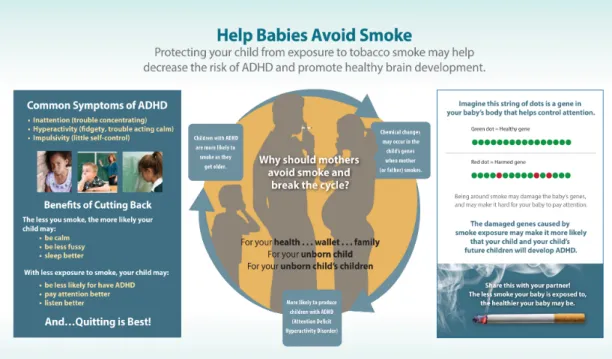
Rochelle Schwartz-Bloom, Professor of Pharmacology, and Dr. Paul Bloom, Senior Fellow at the Center of the Advancement of Social Entrepreneurship --as well as four undergraduates, including myself. The main objective of our CEASE project has been to develop effective communication strategies to educate the public about the effects of tobacco smoke exposure on developing ADHD in children. Working with Professor Craig Roberts at the Duke Institute for Brain Sciences, we first developed an infographic (see Figure 1) to increase the
accessibility of scientific information regarding ADHD, as well as the epigenetic link between tobacco smoke exposure and children’s neurodevelopmental problems.
Figure 1. Infographic explaining the epigenetic link between tobacco smoke and ADHD
We then designed a randomized-controlled trial to field-test the impact of the infographic in comparison to the impact of a control brochure from the CDC. From October to November 2014, we implemented the study, to measure pregnant women’s (and their family’s) understanding of scientific information on the brochures, as well as the effectiveness of our health communication strategies. Our survey was conducted at two Durham clinics and another in Cannes, France, and our respondents were divided into three major groups based on their first languages: English, Spanish, and French. Although this paper does not incorporate data from the survey, my interaction with diverse groups of pregnant women triggered me to explore the cultural variance in attitudes towards smoking behaviors and awareness of childhood neurodevelopmental problems like ADHD, and how such discrepancies affect relevant research, legislation, and social advocacy processes.
Based on my humanities background as a French major, my scientific research experiences, and strong interests in tackling global health challenges by means of effective communication, I was then inspired to compare U.S. cultural, legal, and research approaches
France and other high-resource francophone countries. This paper engages with diverse research methodologies, synthesizing several disciplinary foundations through comparative literature reviews and critical analyses.
My research explores how cultural beliefs and practices influence biomedical
research landscapes in the U.S. and France. The complex ways in which culture affects public reactions, as well as health research of tobacco exposure and ADHD are evident in a series of relevant social movements, regulations and research. My goal is to examine how cultural mores in the U.S., in comparison with those in France, have differently shaped not only social attitudes towards smoking behaviors and regulations of the sale and use of tobacco products, but also the pace of research engagement, even in two economically advanced societies with advanced “Western” health research infrastructure and shared scientific goals.
In particular, I will argue that different conceptions of liberty and private and public spaces, approaches to public health, and realities of social and political systems all contribute to the divergence of research on tobacco smoking and ADHD between the U.S. and France.
What are the global health implications of this discrepancy across countries? Would the cultural variance around tobacco smoking place certain populations at a higher risk of experiencing the multifaceted burdens of ADHD than others? How should we address this problem and work towards minimizing health disparities? It is imperative that health initiatives in both the U.S. and France understand the costs of the disorder and seriously consider the interplay of cultural factors on the struggle for laws that regulate tobacco smoking in order to advance research and ultimately protect the health of younger and future generations.
Even a few years’ difference in research engagement with the epigenetics of neurodevelopmental susceptibility to ADHD from prenatal tobacco exposure is significant.
The cultural differences involved in the French delay to engage in research on the topic, having to do with valorization of social traditions, a sense of the sanctity of the individual and of “private liberty” – “[liberté individuelle],” may, tragically, be completely compatible with French psychological resistance to the idea that an adult social habit could harm unborn
children and even subsequent generations. It is the specific connection of environmental tobacco smoke exposure to neurodevelopmental pathology, notably ADHD, that has lagged years behind work done not only in the United States or Asia, but in other high resource francophone regions such as France, Switzerland, and Quebec, Canada. However, recent studies are documenting widespread support for laws limiting public exposure to tobacco smoke in France, and many scientific articles and websites refer in urgent terms to the prenatal and postnatal health risks of early tobacco exposure. However, the potential effects of early tobacco exposure on developing ADHD remain unaddressed and deserve more attention.
Chapter one
Current Research on the Effects of Environmental Tobacco Smoke Exposure on ADHD Development
Human cognition is not just a matter of intelligence and effort; it is filtered by
attention, which is closely linked to brain mechanisms. Italian neuroscientists Laila Craighero and Giacomo Rizzolatti point out in Neurobiology of Attention (2005):
“Traditionally, attention was conceived as a cognitive mechanism subserved by specific, dedicated anatomical centers independent of those involved in data
processing and action execution. Attention mechanism was seen either as unitary or as formed by two or more independent anatomical circuits” (p. 181).
However, the notion of attention systems separated from those for other physical and cognitive functions has been challenged. For example, according to the premotor theory of attention introduced by Rizzolatti and his colleagues (1987), spatial attention results from activation of the motor system, and “shifts of attention are achieved by planning goal-directed actions such as reaches and eye-movements” (Smith & Schenk, 2012, p. 10).
The American cognitive scientist Stephen Gorsberg further supports the importance of a mechanistic understanding of attention in Neurobiology of Attention (2005):
“Attention is a behavioral concept, but one whose properties arise from brain mechanisms (…) Building brain-behavior links for processes of attention is
particularly challenging because attention is typically a modulatory process that can sensitize, or prime, an observer to expect an object to occur at a given location or with particular stimulus properties (…)” (p.652).
According to the Adaptive Resonance Theory (ART) developed by S. Grossberg, “attentive processes within neocortex help to stabilize cortical learning and memory through time so that they are not catastrophically overwritten by the new stimuli with which they are continually bombarded” (p.652).
The interconnectedness of brain mechanisms with attention and the modulatory role that attention plays in cortical self-organization and stability points to the possibility that the deficit or malfunctioning of attention may lead to problems regarding learning and executive functions.
Symptoms of attention deficit hyperactivity disorder (ADHD) are not limited to individuals’ problems related to inattention, impulsivity, and hyperactivity. Due to their behavioral problems, individuals with ADHD may have trouble building and maintaining relationships with authority figures such as parents, caregivers, and educators, as well as their siblings and peers. Their difficulty to stay still and lack of attention also interrupt their academic functioning and performance, which could lower their self-esteem and adversely affect their well-being (Krueger & Kendall, 2001).
ADHD Research
Over the past decade in many high resource research environments worldwide, there has been an exponential increase in research efforts to understand the etiology of ADHD in order to help patients better manage their symptoms, as well as to prevent the onset of the disorder. Although the exact causes and risk factors of ADHD remain unknown, the
accumulation of knowledge has shown that genetics plays an important role. Upon reviewing 20 twin studies from the U.S., Australia, Scandinavia, and the European Union, Faraone and his colleagues reported a mean heritability of 76%, demonstrating ADHD as one of the most heritable disorders (Faraone et al., 2005; Mick & Faraone, 2008). In addition to documenting the heritability of ADHD, researchers are investigating the contribution of environmental hazards to the etiology of ADHD. Numerous studies underscore the interplay of genetic and
environmental factors, such as toxins in utero and pregnancy and delivery complications, factoring in the severity and maintenance of ADHD (Linnet et al., 2003; Barkley, 2014).
Results from brain imaging studies indicate that children with ADHD have
abnormalities that are not found among children without ADHD. According to Linnet and his colleagues (2003), those features include dopaminergic midbrain dysfunction at the level of the dopaminergic nuclei, decreased regional cerebral blood flow in parts of the prefrontal cortex, and alterations in prefrontal cortical asymmetry, right frontal-striatal circuitry, and the cerebellum. Although the exact mechanisms behind these neurophysiological differences and ADHD have not been found yet, the extant data implicate dysfunction in the front-subcortical pathways that control attention and motor behavior, which may lead to the development of ADHD (Faraone & Biederman, 1998).
Mounting evidence has proposed maternal smoking during pregnancy as a potential risk factor for ADHD. Upon reviewing 6 case-control studies of prenatal exposure to tobacco smoke, Linnet and his colleagues (2003) concluded that prenatal maternal smoking was associated with a fourfold higher risk of ADHD in the offspring. Similarly, another review of 13 population-based and 6 case-control studies found that prenatally exposed children were more than twice as likely to develop ADHD as children who were never exposed to smoke (Langley et al., 2005). Upon conducting a cross-national survey in six European countries including Turkey, Romania, Bulgaria, Lithuania, Germany and the Netherlands, Kovess et al.
(2015) found that:
“there is an association between maternal smoking and offspring probably ADHD that is stronger than that of paternal smoking during the pregnancy period and offspring probable ADHD; to the extent that confounding is shared between parents, these results are consistent with a potential intrauterine influence of smoking on inattention and hyperactivity symptoms” (p. 926).
This means that mothers’ tobacco use during pregnancy may pose a greater threat to offspring ADHD than that of fathers. Therefore, the convergence of these findings reinforces that tobacco use of mothers during pregnancy is “a serious and increasing global pediatric issue”
related to ADHD (Lando et al., 2010).
Although the association between maternal smoking during pregnancy and the development of ADHD has been receiving an increasing amount of attention in the literature, relatively little is currently known about the effects of postnatal tobacco smoke exposure on child brain development. The brain’s basic structure is formed by the 38th week of gestation, but human brains are not fully developed at birth and continue to undergo critical
development between zero and five years after birth (Marsh et al., 2008; Pagani, 2013).
Additionally, given that young children have a higher metabolism and may absorb a greater amount of infiltrates from secondhand smoke than adolescents and adults, exposure to secondhand smoke during infancy could be even more harmful than maternal smoking during pregnancy, argues Linda Pagani, a Canadian researcher at the School of Psychoeducation at the University of Montreal. In this regard, maternal smoking is especially detrimental to infants and young children, potentially even more so than to fetuses, disrupting their neurological growth and development. Such exposure could lead to the development of ADHD along with other executive function problems and cognitive challenges.
In 2011, the WHO recognized children’s exposure to secondhand tobacco smoke (SHS) as a global health concern. Secondhand tobacco smoke refers to the following: 1) inhalation of tobacco smoke in the air; 2) 80-85% of the side stream smoke coming from burning tip of a cigarette; 3) up to 10 times more burdened with toxic substances – i.e., carcinogens – than mainstream smoke. Important factors for inhalative absorption of secondhand tobacco smoke include: concentration of pollutants in air, size of particles and content of pollutants, respiratory rate, effective pulmonary absorption, and duration of
exposure. The prevalence of infant passive smoking differs between countries and in different environments – i.e., urban vs. rural, socioeconomic classes. However, according to the Global
Youth Tobacco Survey conducted in 137 countries, almost half of the world’s children were exposed to secondhand smoke both at home (46.8%) and outside the home (47.8%).
As part of a 2007 National Survey on Children’s Health, a recent population-based study conducted in the United States on neurodevelopmental risk stemming from tobacco exposure focused on 4.8 million children who had been documented as exposed to secondhand smoke in the home (Kabir et al., 2011). For their research, Kabir and his colleagues examined the association between parent-reported postnatal secondhand tobacco smoke exposure in the home and neurobehavioral disorders including ADHD, learning disabilities, and conduct disorders. They found that children exposed to secondhand smoke at home were 50% more likely to have more than two childhood neurobehavioral disorders, than children who were not exposed to secondhand smoke at all.
The health consequences of pre- and postnatal exposure to environmental tobacco smoke (ETS) are particularly well accepted, in both the US and France, with respect to physiological symptoms or non-brain based diseases. “The respiratory risk associated with parental smoking [is regarded as] the greatest during fetal development and the first several years of life” (p. 1007), which may lead to decreased lung growth and increased rates of respiratory tract infections, otitis media, and childhood asthma (DiFranza et al., 2004). In comparison to the risk of physical problems, nevertheless, the potential role of ETS exposure in the development of neurobehavioral disorders such as ADHD used to be much less known.
However, for the past two decades in the United States and several other high resource scientific research environments around the world, there has been increasing investment in study of the association between environmental tobacco exposure in early life and behavioral problems, as well as neurocognitive decrements.
It is possible that the growth of American research into ADHD and its etiology, especially environmental exposure to tobacco smoke, has stemmed from the increase of research funding into the field. In fact, the number of research findings is closely linked to the amount of funding, which is not a coincidence. Funding is a key factor that determines research topics, incentivizes researchers, and ultimately facilitates the entire research process.
Without sufficient funding, researchers would not be able to initiate, continue, or replicate a study, regardless of their interests.
Beginning in 2002, the National Center on Birth Defects and Developmental Disabilities (NCBDDD) of the Center for Disease Control (CDC) funded one of the largest community-based, epidemiologic studies of the ADHD Project to Learn about ADHD in Youth (PLAY). With the support of the CDC, Wolraich and his colleagues (2014) were able to screen 10,427 children from four school districts across South Carolina and Oklahoma, through which they observed high ADHD prevalence rates of 8.7% in SC and 10.6% in OK.
The CDC also sponsors the National Resource Center on ADHD for a program of Children and Adults with Attention-Deficit/Hyperactivity Disorder (CHADD). CHADD works towards disseminating evidence-based information about ADHD to the public via their bimonthly magazine Attention and annual international conference. According to their website, CHADD continually encourages the public and private sectors to devote more resources to research into the causes, diagnosis of, and treatments for ADHD.
Along with the CDC’s initiative to better understand ADHD, and its causes and effects, increasing attention has been drawn to the etiology of ADHD, which has attracted more funding to this field accordingly. In 2013, Duke Medicine launched a new research program to investigate the relationship between exposure to ETS during pregnancy and childhood and ADHD in children. According to an article written by Duke Medicine News and Communications:
“Funded jointly by the National Institute of Environmental Health Sciences (NIEHS), part of the National Institutes of Health, and the U.S. Environmental Protection Agency (EPA), the Center for Study of Neurodevelopment and Improving Children’s Health following Environmental tobacco Smoke exposure (NICHES) at Duke [has received] approximately $7.8 million from 2013 to 2018.”
NICHES researchers are studying the relationship between tobacco smoke exposure during pregnancy and childhood, and the development of ADHD. There are three projects involved, each with distinctive objectives: 1) identify children with ADHD of mothers who smoke during pregnancy; 2) study which genes are changed in animals exposed to tobacco smoke during pregnancy; 3) compare genes of child study participants from the human and animal subjects. Together, scientists in the NICHES center aim to identify the genes affected by tobacco smoke in children that may lead to ADHD and increase the public awareness about the effects of tobacco smoke exposure on children.
As part of the Community Outreach & Translation Core (COTC) of this nationally funded program, my colleagues and I used findings from the three ongoing projects to develop an infographic and a website explaining the effects of ETS on brain development, and the potential connection to cognitive dysfunction and behavioral problems. We also visited two OB/GYN clinics in Durham to field-test the infographic, in comparison to that of the CDC, to gather data from 236 pregnant women and their families. Upon their completion of the questionnaire, we paid $5 to compensate for each of our participants’ time. For the comparable set of survey targeting physicians from the same clinics, we paid a $1,000 honorarium to each clinic. Last semester, we hosted an Instagram contest to promote community engagement into learning more about ADHD and ETS. Participants were expected to submit a photo entry with caption demonstrating their understanding of the information on our website and/or the infographic mentioned above. Originally, we had planned to choose up to 10 winners who would be granted $200, respectively. We received 22 qualitative entries across the Duke and Durham communities, and after careful consideration and consultation with NICHES investigators, as well as communications professionals at Duke, we selected 7 winners. Recently, we launched an online Qualtrics survey using a crowdsourcing database from Amazon Turk (mTurk) to evaluate the power of social media in framing and spreading the health message regarding the link between ADHD and ETS. We have collected data from over 1,200 participants, and each of them received $1.20 for completing our survey. We are planning to initiate another mTurk survey to replicate our
study, for which we would pay about $1,000 in total. Without the considerable amount of monetary support from the NIEHS and the EPA, NICHES investigators and our COTC team would have had difficulty conducting studies, collecting and analyzing data.
The growth of ADHD research in the U.S. did not happen overnight. The
convergence of efforts from diverse groups to call for funding, further understanding, and educate the public have culminated in the research regarding ADHD. The importance of funding in facilitating research into ADHD cannot be underestimated, as exemplified by NICHES at Duke. This accumulation of knowledge has resulted in the advanced
understanding of the etiology of ADHD, and the efforts to understand the causes and effects of the disorder are constantly growing.
Is ADHD an American Disorder?
Based on the synergy between increased funding and research interest, ADHD has been extensively studied in the U.S. This has led to advanced understanding of the behavioral symptoms of ADHD, as well as the exploration of effective prevention and treatment of the disorder.
However, as Faraone and his colleagues (2003) describe,
“The predominance of American research into ADHD over the past 40 years has led to the impression that ADHD is largely an American disorder and is much less prevalent elsewhere. This impression was reinforced by the perception that ADHD may stem from social and cultural factors that are most common in American society” (p.104).
One of the sociocultural factors that may contribute to the perception of ADHD as
“an American disorder” is the steep increase of the use of psychopharmacological medical treatments in this country. Methylphenidate (MPH), also known as Ritalin, is a central
in particular ADHD. While the use of MPH has significantly increased across the globe over the past decade, the United States accounts for more than 80 per cent of the world’s MPH consumption (United Nations International Narcotics Control Board, 2014). There is widespread concern that the excessive consumption of MPH amongst Americans may have resulted from the inadequacy of ADHD diagnoses, as well as over-diagnosis and over- prescription of MPH (Singh, 2002). In effect, distrust of “Big Pharma” can lead to an assumption that a highly heritable, neurodevelopmental disorder with a well-documented neurophysiological signature is a culture-bound syndrome.
Furthermore, though the immaturity of children is a biological fact, the way one culture interprets this immaturity could be different from the way another does, argue Timimi and Taylor (2003). It is possible that an American tendency to conceptualize normal
behaviors as abnormal could lead to the excessive medicalization of children’s behaviors. By viewing the indicator of immaturity as a treatable disorder, Americans might be relying excessively on doctors and drugs.
Furthermore, Richard J. DeGrandpre proposes in Ritalin Nation: Rapid-Fire Culture and the Transformation of Human Consciousness (1999) that psychostimulants provide children with the speed they both need and want to thrive in a fast, competitive, high-sensory culture. DeGrandpre considers a “rapid-fire [American] culture” as the driving force behind Americans’ heavy reliance on drug treatments for ADHD, arguing that ADHD is not a medical disorder, but rather a “sensory addiction” (1999, p.215). As Timimi and Taylor (2003) argue, “by acting as agents of social control and stifling diversity in children, [Americans] are [perhaps] victimizing millions of children and their families by putting children on highly addictive drugs that have no proven long-term benefit” (p.184).
Social and cultural factors may indeed play a significant role in the high prevalence of ADHD in the U.S., and therefore deserve careful evaluation and assessment. However, the notion that Americans are at a higher risk of experiencing ADHD than others has been successfully challenged and refuted. Through comparing factor analyses from different studies of children from the U.S., U.K., Australia, New Zealand, and Canada, Taylor
observed the cross-cultural coherence of descriptions of restlessness and distractibility that correspond to the factor of hyperactivity, as well as the consistency of the scores on this hyperactivity factor across these studies. Based on these findings, Taylor and Sandberg (1984) concluded that, “the national differences in rates of diagnosed hyperactivity are likely to reflect diagnostic inconsistency rather than true differences in children’s behavior” (p.143).
In this regard, the observed difference in previous studies might reflect differences in the interpretation of children’s behaviors rather than true differences in behaviors between children from the U.S. and other countries.
Furthermore, as Polanczyk and his colleagues (2007) concluded based on their comprehensive literature review, 5.29% of children worldwide suffer from ADHD. Their study adds clear support to the argument that ADHD is not an American disorder but rather prevalent worldwide. In this regard, classifying ADHD as an American disorder runs the risk of neglecting children and adults with ADHD in the rest of the world, as well as the social, emotional, and economic burden that may be significantly disrupting their daily lives.
Research Trends in the Euro-American Francophone World
Although mounting evidence suggests that ADHD destabilizes the health and success of children and adults all over the world, this change in awareness has not readily translated into all advanced research countries. As discussed in the previous chapter, a considerable number of large studies regarding ADHD, as well as its etiology and effects, are being published in the U.S. and a number of other global high resource research environments.
The francophone world is vast and includes many countries formerly colonized by France, such as Haiti, Senegal, and Viet Nam. Typically, former colonies in which the majority of the inhabitants descend from an enslaved labor force do not currently consist of high resource research environments. The same inequality that is initiated and maintained by racial prejudice in colonial and/or slave holding powers may persist, after the abolition of slavery or the overthrow of colonial rule, in a blighting of economic opportunity. Conditions
connection to the most elite educational and research environments. Inequality leads to disparities in health, and in the capacity of local higher educational, research, and health systems to address health disparities.
Western European and American nations (particularly the United States within the Americas) profited disproportionately in the modern era from colonial and slave-holding practices. My research in this thesis, carried out in dialogue with my thesis advisor, French Professor Deborah Jenson, has focused on the high resource research environments of the regions associated with that “hegemonic” privilege: France, Switzerland, and Quebec, Canada. We expected that France would have the most research related to the topic in this francophone Euro-American cohort, but in reality, it was quite the opposite. There are minor differences between the French, Swiss, and French Canadian engagements with ADHD and tobacco. The common issue is the delay and paucity of research in the Euro-American francophone sphere, compared to research in an array of the US. It is impossible to demonstrate that something one has not found does not exist; in fact, the Euro-American francophone world is progressively joining the research discourse.
France has published its first hesitant “respiratory epidemiology” study linking tobacco exposure and pediatric behavioral problems (not referred to overly as ADHD). A Canadian researcher mentioned above, Linda Pagani began to publish her research on the topic in 2013, and a Swiss researcher on a German team published an article on the topic in 2014. With her colleague Caroline Fitzpatrick, Pagani (2013) observed the link between long- term postnatal nicotine exposure and children’s subsequent development of physical
aggression and antisocial behaviors. Natalie Holz and her colleagues (2014) found a long- term effect of prenatal exposure to tobacco smoke on neural activity similar to ADHD.
The French study by Julie Chastang, Isabella Annesi-Maesano, and their colleagues (2015) noted that, in comparison with the consequences of ETS in the form of physical symptoms or diseases such as asthma or sudden infant death syndrome, the potential role of ETS exposure in the development of child behavioral problems is relatively unaddressed in literature. Therefore, in order to examine the association between pre- and postnatal ETS
exposure and behavioral problems in schoolchildren, the researchers conducted cross- sectional studies in six French communities – Bordeaux, Clermont-Ferrand, Creteil,
Marseille, Strasbourg, and Reims – chosen for the contrast in their air quality. The researchers defined pre- and postnatal ETS exposure for “children whose mothers had smoked during pregnancy and whose family had reported smoking at home at 1 year of age or at the moment of the study” (p.3). From this nationally representative sample of 5221 children, the
researchers found that an association between early tobacco smoke exposure, and emotional and conduct behavioral problems in children. A stronger association was found “among children who were exposed during [both] the pre- and postnatal periods than among children who were exposed to during the postnatal period only” (p.7).
The researchers measured children’s behavioral outcomes, using the Strengths and Difficulties Questionnaire (SDQ), a questionnaire often used in Southern European countries to assess mental and behavioral strengths and difficulties in children between 3 and 16 years old (Marzocchi et al., 2004). According to the official SDQ website sdqinfo.com, all versions of the SDQ ask about 25 attributes, which are divided among 5 scales: emotional symptoms, conduct problems, hyperactivity/ inattention, peer relationship problems, and prosocial behavioral. However, the researchers did not include all of the items on the SDQ, choosing to measure only emotional symptoms and conduct problems. This way, they left out the three attributes including hyperactivity/inattention, peer relationship problems, and prosocial behaviors, which could have been equally, if not more, related to the early exposure to ETS.
Of course, the selection of Chastang and his colleagues’ cannot be viewed as representative of the general public’s and other researchers’ approach to children’s behavioral problems.
However, it is well documented that French people view and conceptualize children’s behavioral symptoms differently from Americans. Emotional and conduct problems might matter more to French people, whereas Americans would hardly disregard problems like hyperactivity/inattention under the notion of ADHD. This may further explain the
discrepancy of research focus on the relationship between ETS and behavioral problems in
Despite the difference in emphasis from that of the American studies, the study by Chastang and her colleagues (2015) demonstrate that French researchers, just like their American peers, are not only cognizant of but also getting more invested in the link between ETS and children’s behavioral problems. However, the question of whether the way the French view these behavioral problems is consistent with, or at least similar to, the way the American do, still remains. The observed problems in children from the current study are not necessarily interpreted as symptoms of a disorder, which distinguishes it from other similar American studies in which authors tend to suggest a potential link to a disorder and call for further attention. The discrepancy of explanation could, in fact, be attributed to the two countries’ different approaches to ADHD.
As Marilyn Wedge writes in her article, “Why French Kids Don’t Have ADHD”
(2012), whereas Americans consider ADHD as a biological disorder that is caused by a biological dysfunction such as a chemical imbalance in the child’s brain, the French views ADHD from a psychosocial and situational context. Accordingly, it is more common for French doctors to examine a child’s social background in order to understand the underlying cause of child distress, as opposed to dysfunctions in the brain. Additionally, although the majority of American psychiatrists treat ADHD with psychostimulant medications, it is illegal to prescribe those psychostimulants to any child under 6 years old in France, as described in Andrew Porterfield’s article, “ADHD Mystery: Claims of No Attention Deficit Disorder in France Challenged” (2015); instead, French psychiatrists tend to treat the disorder with psychotherapy or family counseling. Therefore, even if children in France exhibit the same behavioral problems as their American peers, the French valorization of social traditions and resistance to the biological understanding of the disorder may be leading to the French delay to engage in research on the connection between ETS and ADHD.
Considering the cultural differences between the U.S. and France in terms of
understanding and treating ADHD, it was not surprising that the association between ETS and children’s behavioral problems has just started to make appearance in the French literature.
However, despite its proximity to the U.S., I thought Canada would have a lot more in
common with France because Canadians share some aspect of the French culture. But
contrary to my speculation, there seems to have been slightly more discussions about the topic amongst Canadian researchers, with some spread from academic work to media reports.
Using a prospective birth cohort design, the two Canadian researchers, Pagani and Fitzpatrick (2013), examined the contribution of long-term postnatal nicotine exposure on children’s subsequent development of antisocial behaviors. Compared to those who did not have any type of exposure to tobacco smoke, children who were continuously and
intermittently exposed to secondhand smoke from 17 to 86 months were significantly more likely to exhibit physical aggression and antisocial behaviors by the end of fourth grade.
Furthermore, Pagani (2014) has conducted a comprehensive literature review,
“address[ing] the link between ETS and the development of ADHD, both as symptoms and as part of a mental health disorder in childhood” (p. 195). The confluence of findings in Pagani’s study suggests the developmental neurotoxicity of tobacco smoke exposure:
“early childhood nicotine exposure modulates synaptic plasticity and likely underlies both endogenous cholinergic transmissions to alter cellular, physiological and behavioral processes during critical periods of development (Heath et al., 2010).
Structural deficits and epigenetics also play an important role in the relationship between tobacco smoke exposure and early neurobehavioral development” (p.203).
Although their research interest in the long-term effects of tobacco smoke exposure on the development of children’s behavioral problems corresponds to that of American researchers, and is generally published in English to reach the broader scientific community, Pagani and Fitzpatrick are francophone researchers and teachers in their Quebec universities.
Their study may not constitute a ground swell of change of the research discourse in the Euro- American francophone world, but it does constitute an instance of change.
Unlike in the U.S. where ADHD is widely discussed and a significant amount of
unaddressed in the Euro-American francophone world. To perfectly exemplify the discrepancy, a leading U.S. nonprofit Children and Adults with Attention
Deficit/Hyperactivity Disorder (CHADD) receives funding from many sources and their total revenue in FY 14 was $2,455,552. Contrastingly, all of the activities of Hyper-Supers – TDAH France, the French equivalent to CHADD, are entirely funded by members of the association or carried out voluntarily.
The significant disparity in ADHD research between the U.S. and high-resource francophone countries generates the following questions: What accounts for the discrepancy and/or delay? Were the French less aware of symptoms related to ADHD? ADHD is known as a neurodevelopmental disorder in the U.S., but is it defined differently in the francophone world?
Chapter Two
Changing Discourses of ADHD and Perceptions of the Disorder
The Diagnostic Criteria of ADHD
Considerable research investigates possible culture-bound elements of the ADHD diagnosis and even critiques its helpfulness. Timimi and Taylor (2003) argue that,
“In modern Western culture many factors adversely affect the mental health of children and their families. These include mother blame (mothers are usually the ones who shoulder responsibility for their children), pressure on schools, a breakdown in the moral authority of adults, parents being put in a double bind on the question of discipline, family life being busy and ‘hyperactive’ (…)” (p.184).
Attention deficit hyperactivity disorder (ADHD) is widely discussed across the globe.
The definition of ADHD has changed over time and, in fact, as Lange et al. (2010) note, the contemporary concept of ADHD is relatively new. The term ADHD first appeared in 1987 when the American Psychological Association (APA) released a revised version of the DSM- III. ADHD had not been included in the APA’s first version of DSM, which was published in 1952. Though the DSM-II (1968) included hyperkinetic impulse disorder and the first version of the DSM-III (1980) attention deficit disorder (ADD), scientists used to consider
hyperactivity as a rare symptom of the disorder, which led to the division of ADD into two subtypes: ADD with and without hyperactivity. However, in 1987, the APA removed the hyperactivity distinction in the revised DSM-III version and changed the name to attention deficit hyperactivity disorder (ADHD).
Three years before the term ADD was created and a decade before ADHD first appeared in the DSM, the term hyperkinetic disorder (HKD), which is equivalent to ADHD, was first included in the International Classification of Mental and Behavioral Disorders 9th
guidelines developed with the European Network for Hyperkinetic Disorders (EUNETHYDIS). This classification system defines HKD as a persistent and severe impairment of psychological development, characterized by “early onset, a combination of overactive, poorly modulated behavior with market inattention and lack of persistent task involvement, and pervasiveness over situations and persistence over time of these behavioral characteristics” (World Health Organization, 1993).
ICD and DSM generally tend to capture the same children with the same difficulties, notes Dr. Scott Kollins in the Department of Psychology and Neuroscience at Duke
University. This perspective is espoused by Tripp and his colleagues (1999) who describe the correlates of each classification system’s diagnosis: “Though DSM-IV criteria identify a broader group of children than those identified by ICD-10, there is substantial overlap
between the groups formed with these different criteria” (p.156). However, Kollins underlines that it is important to keep in mind that these classification systems are clinical and
descriptive but not necessarily defined empirically in a rigorous fashion. As such, the diagnoses themselves can be fallible. This is why it is important to look at phenotypes for exposure from both a categorical and a longitudinal perspective, which is what NICHES investigators at Duke are pursuing.
The history of the two main classification systems for diagnosing the disorder, the ICD-10 and the APA’s DSM-V, confirms that ADHD is not a novel phenomenon, nor its discussion limited to the U.S. As Thome and Jacobs (2004) maintain, ADHD is not merely a
“‘trendy’ diagnosis of modern times” (p.303), but rather a problem that has impacted upon generations, as should be expected of a heritable disorder that can also be an epigenetic susceptibility following environmental exposure to neurotoxic substances. The accumulation of knowledge and empirical interventions over the last two centuries has led to the current recognition of ADHD as a global health concern and advanced understanding of causes, effects, and treatments of the disorder.
Although the term ADHD itself has come into use only recently, the condition was not absent from the medical sphere. In fact, symptoms suggestive of ADHD have been well
documented since the nineteenth century. Some of the early accounts bear resemblance to the triad of ADHD symptoms: hyperactivity, inattention, and impulsivity. Therefore, the early depictions of ADHD are an indispensable source for understanding the conceptual history, changing perception and research progress of ADHD.
Heinrich Hoffmann’s Struwwelpeter
Struwwelpeter, written by the German physician Heinrich Hoffmann in 1844, is considered as one of the most significant documents in the history of ADHD. Hoffman’s illustration of misbehaving children corresponds to the characteristic features of children and adolescents with ADHD. In the story of Fidgety Philipp, Hoffman describes symptoms of attention deficit, impulsivity, and hyperactivity in Philipp. For instance, Philipp cannot sit still at the table, constantly fidgeting and squirming despite the admonitions of his parents
(Thome, 2004). His “persistent pattern(s) of excessive motor activity” and “impulsive behavior” result in the disruption of dinner and “cause significant mental distress within the family” (Thome, 2004). Additionally, in the story of Johnny Look-in-the-Air, Hoffmann portrays a boy demonstrating symptoms of inattention (Lange et al., 2010). Johnny is “easily distracted by extraneous stimuli,” such as “l the sky and the clouds that floated by”
(Hoffmann, 1846).
As Lange and his colleagues describe (2010), Hoffmann’s Struwwelpeter is represented as an “allegory for children [and adolescents] with ADHD” (p.243). Of course, the stories within Struwwelpeter do not perfectly align with the current diagnostic criteria of ADHD. Considering that the notion of ADHD did not exist at his time, Hoffmann might not have necessarily viewed the children’s behaviors in his book as an anomaly. However, unlike his contemporaries who tended to attribute children’s demonstrations of inattention and hyperactivity merely to “childish innocence,” Hoffmann took a different approach, perceiving of them as a problem. As Sigmund Freud praised a century later, Hoffmann understood sexual and other complexes in children, and his innovative perspective has greatly contributed to the
Early Descriptions of ADHD in the French Literature
Hoffmann’s contribution to the development of the concept of ADHD is clear and widely recognized. However, the notion of “mental instability” developed by French doctors in the late 19th century is not as well documented and therefore remains unrecognized. As Bader and Hadjikhani (2013) put,
“Writings from this period show that in France, the emergence of the concept of ADHD, according to modern terminology, comes from the notion of ‘mental
instability’ introduced in 1885 under the leadership of Désiré-Magloire Bourneville at the Hospital Bicêtre in Paris” (p.12).
Bourneville closely examined children and adolescents who had been labeled “abnormal” and placed in medical and educational institutions. Based on his observations, Bourneville vividly depicted their symptoms of inattention, impulsivity, and hyperactivity, corresponding to the current diagnostic criteria of ADHD: “we cannot give him any package, he will forget it, leave it on a bench or in the omnibus” (Bourneville, 1888). Bourneville’s letter to the Director of Education of the Seine (1897) includes interesting illustrations of unstable children that resonate with the current concept of ADHD:
“The unstable (…) never stay still, they get up from the table at any time without cause. (…) Shortly after starting in the apprenticeship in a profession that they have chosen themselves, they want to change (…). They have sudden impulses, escape from school, from their parent’s house, wander for more or less time (…)” (Bader &
Hadjikhani, p. 13).
Interestingly, Bourneville also noticed that despite their “exuberant physical
mobility,” these children did not seem to have reduced intellectual mobility. This observation
aligns with the accounts of the British pediatrician George Still who is regarded as “the first author to describe the behavioral condition in children that most closely approximates what is today known as ADHD” (Barkley & Peters, 2012, p.1). Still brought attention to the cases of children who could not control their behavior but had normal intelligence.
Inspired by Bourneville, Georges Paul-Boncour and Jean Philippe further elaborated upon symptoms of “instability” in their book published 1905, The Mental Abnormalities in Schoolchildren: “Mentally abnormal children (…) cannot fix their attention either to listen, to answer, or to understand (…) their attention occurs randomly on any occasion and suddenly disappears” (p.45). Paul-Boncour and Philippe also explained the adverse effects of the lack of attention on the unstable children’s behaviors as follows: “they speak loudly and carry out all the ideas that come to their mind without worrying about any supervision” (p.48). It is noteworthy that the two doctors were also aware of the fact that these symptoms suggestive of ADHD by our standards continue throughout life and that they thought these symptoms derived from cerebral dysfunctions and pathologies (Bader & Hadjikhani, 2013).
Early clinical accounts of Bourneville, Paul-Boncour, and Philippe demonstrate French physicians’ efforts to address the problems of “mental instability” and identify them as a disorder. However, since the 1950s, the notion of mental instability and its effects on
behaviors have been interpreted in a different context in France. In light of the psychoanalytic paradigm constructed by Sigmund Freud, French psychiatrists approached symptoms of instability based on the semiotic principles, extrapolating unconscious meaning and delving into psychic conflicts of patients (Bader & Hadjikhani, 2013). As strong advocates for psychoanalysis, the psychiatrists have kept problems related to “mental instability” away from public eyes and rejected other perspectives on the disorder.
“All neurobiological dimensions have been either simply disregarded, or barely taken into account, and most psychiatrists have been opposing approaches which attempted to connect descriptive accounts of symptoms with brain functioning and their
The rigidity of the psychoanalytical paradigm coupled with French scholars’ hesitance to explore new schools of thought may have resulted in the French delayed engagement in the open discussion and research progress of ADHD.
“However, since 2000, the possibility of a multidimensional understanding of ADHD has started to emerge in French-speaking countries that more appropriately accounts for the neurobiological components and for the new therapeutic approaches to this disorder” (Bader & Hadjikhani, 2013, p.15).
Given that the prevalence of ADHD is similar around the world and the disorder occurs in between 3.5% to 5.6% of French youth (Lecendreux et al., 2011), it is promising that ADHD is becoming more recognized and approached from different angles in the francophone society.
Sir George Still
The Goulstonian lectures of Sir George Frederic Still on some abnormal psychical conditions in children are considered as the “scientific starting point of the history of ADHD”
(Lange et al., 2010, p. 243). The British physician Still asserted that children’s behaviors that correspond to the ADHD criteria nowadays derive from “an abnormal defect of moral control in children.” Moral control was defined as “the control of action in conformity with the idea of the good of all (…) (that) is dependent upon three psychical factors, a cognitive relation to environment, moral consciousness, and volition” (Still, 1902). Still attributed the lack of moral control to the two factors – cognitive relation to environment and moral consciousness – as intellectual capacities, the problems of which could be found among mentally retarded children. However, Still noticed that some affected children could not control their behavior without intellectual malfunctioning, which comprise the cases regarded as “historical descriptions of ADHD.” Still further divided the cases of children without intellectual
malfunctioning into two groups: 1) “children with morbid defect of moral control associates with physical disease, such as a cerebral tumor, meningitis, epilepsy, head injury or typhoid fever,” and 2) "children with a “defect of moral control as a morbid manifestation, without general impairment of intellect and without physical disease.” Although Still’s concept of
“moral control” is not consistent with the present notion of ADHD, his differentiation between troubled children with and without physical burden was “the origin of later concepts of brain damage, minimal cerebral dysfunction, and hyperactivity as historical precursors to ADHD (Lange et al., 2010; Rothenberger & Neumärker, 2005).
Chapter Three
Freedom, Health and Tobacco Control
The boundaries and content of conceptions of individual freedom differ across cultures and individuals. In some cultures, individuals may face greater pressures than in other cultures to sacrifice their freedom for the greater social good. However, in some other cultures, individuals would not easily give up their choices because their society values privacy as a great social good, and does not necessarily expect them to change certain areas of voluntary social behavior even if it is associated with health risks. Furthermore, the same health risks could be perceived very differently in one culture than in another, depending on the way each culture addresses public health. This chapter examines how cultural conceptions of freedom coupled with approaches to public health have differently affected the upsurge of antismoking social movements and regulations in the U.S. and France.
American Boundaries of Liberty
In his Utilitarian treatise On Liberty, the English philosopher John Stuart Mill (1865) proposed, “The only purpose for which power can be rightfully exercised over any member of a civilized community, against his will, is to prevent harm to others” (p.6). This belief that an individual’s liberty ends when his or her action harms others is deeply ingrained in American society.
The First Amendment to the United States Constitution guarantees the free exercise of religion, the freedom of speech and of the press, and the right of citizens to peaceably assemble and to petition their government (Cornell University). However, these protected freedoms could be limited when an individual’s or a group’s free act inflicts harm on others.
For the purpose of preventing the generation and perpetuation of harms, the U.S. Supreme Court constricts the unlimited abuse of freedom. This thesis proposes that such societal agreement to draw appropriate limits to free acts of individuals has propelled the rise of social
movements and regulations in the U.S. that restrict the freedom of smokers whose behavior has been unrelentingly infringing the rights of nonsmokers.
The 1964 U.S. Surgeon General Luther L. Terry report’s on smoking, which concluded that “Cigarette smoking is a health hazard of sufficient importance in the U.S. to warrant appropriate remedial action,” marked the beginning of contemporary governmental control of tobacco. Over the next 40 years a wide range of legislative and regulatory action at all levels of government sought to restrict an activity that had become widely recognized as the leading cause of preventable diseases in the U.S.
Initially, the governmental efforts to control smoking were primarily focused on empowering smokers to make informed decisions about their habit, assuming that smokers would give up their habit if properly informed about the health risks associated with cigarette smoking such as lung cancer, heart disease, emphysema, and bronchitis. In an attempt to effectively educate the public about the health costs of smoking, the Federal Trade
Commission (FTC) announced that it would require warnings on cigarette packages and in advertisements that cigarette smoking is dangerous to health (Bailey, 2004). Although this emphasis on public education may have increased the public awareness about the health consequences of smoking, knowledge did not immediately translate into behavioral change or policy action. A considerable number of smokers were still smoking, and the government could hardly take action regarding tobacco control because of the three primary reasons.
First, according to Brandt (1989), “by the late 1970s, the antismoking forces foundered on a traditional American libertarian ethic: ‘It’s my body and I’ll do with it as I please’” (p.167). In accordance with this cultural attitude, governmental intervention beyond the level of education was regarded as “unjustifiable intrusion into individual decisions (p.167).” As Brandt underlines, “it was one thing for the government to inform the public about the dangers of smoking, quite another to restrict or ban the behavior” (p.167).
Second, the tobacco industry exercised its political power to preempt the FTC from strongly enforcing restrictions on the use and sales of tobacco. The tobacco industry achieved
Washington to help with the fight. Enactment of the Federal Cigarette Labeling and
Advertising Act of 1965 is testimony to the tobacco industry’s victory. The law required the warning “Caution: Smoking May Be Hazardous to Your Health” to be placed only in a small print on only one side of a cigarette packet, forbade state or local governments from
mandating additional labeling requirement, and suspended the FTC’s authority to require health warnings on cigarette advertising for three years (Bailey, 2004). As Elizabeth Drew described in her article, “The Quiet Victory of the Cigarette Lobby: How It Found the Best Filter Yet – Congress,” in The Atlantic, it was “an unabashed act to protect private industry from government regulation.”
In addition to the cultural resistance and heavy lobbying by the tobacco industry, the emphasis on tobacco consumer education did not sufficiently, if at all, address the burden of nonsmokers. As a result of the increased warnings and advertisements, the public became more cognizant of the fact that tobacco smoking poses a threat to smokers; however, the health messaging was largely oriented towards those who smoke voluntarily that the burden of those are involuntarily exposed to smoke remained unnoticed.
Accordingly, antismoking activists began to take a different approach. Instead of narrowly focusing on smokers and hoping them to make informed decisions for their health, they redefined smoking as a social hygiene issue, which poses a serious risk to the public health. In conjunction with this new conceptualization of tobacco smoke, the scope of health problems related to smoking was also broadened from individual diseases to epidemics, including cholera, polio, or malaria, justifying the government to take stronger action. The changing framing of cigarette smoking from informed choice to social hygiene gained more legitimate support by the 1986 Surgeon General’s report, which asserted, “involuntary smoking is a cause of disease, including lung cancer, in healthy nonsmokers” and those who experience prolonged exposure to others’ tobacco smoke have significantly elevated risks of incurring cancer, heart, and lung ailments, along with eye and respiratory irritation. The report was supported by subsequent epidemiological studies that provided sufficient evidence of the
link between ETS and health problems (Robbins et al., 1993; Marbury et al., 1993; Wogan, 1992).
In light of the harm principle that one’s liberty ends when one’s action harms another’s liberty, the potential infliction of harms on nonsmokers undermined the notion of
“informed choice” of smokers. The possibility that smokers’ free action to smoke might harm healthy nonsmokers provided a means of denouncing smokers for causing harms to others and putting legal constraints on their behaviors. As the Tobacco Institute demonstrated in 1978,
“What the smoker does to himself may be his business, but what the smoke does to the nonsmoker is quite a different matter.”
American Tobacco Control
The accrued findings about the link between ETS and harm on nonsmokers encouraged antismoking activists to demand more stringent governmental restrictions on smoking. By mid-1988, 320 local communities had adopted laws restricting smoking in public places, up from 90 in 1985 (U.S. Department of Health and Human Services, 1989).
“Cigarette smoking was banned from virtually every domestic airline flight beginning in early 1990” (Brandt, 1990, p.145).
Along with these legislative transformations facilitated by activists, the federal government has taken more aggressive approaches to tobacco smoking by passing laws, such as Federal Cigarette Labeling and Advertising Act signed in 1965, Public Health Cigarette Smoking Act in 1970, and Wendell H. Ford Aviation Investment and Reform Act in 2000, to name a few. Currently, both federal laws and state-level regulations that control tobacco use are strictly enforced to protect the health of nonsmokers and ultimately create a healthier future for all Americans.
The Family Smoking Prevention and Tobacco Control Act (Tobacco Control Act) (2009) authorizes Food and Drug Administration (FDA) to regulate the manufacture, distribution, and marketing of tobacco products (Food and Drug Administration). First, the