UNIT 4, MODULE 2:
Interpreting and Implementing
Assessment Results
Passage Reading Fluency Subtest:
Grade 7 BOY Examiner’s Packet
Directions
Passage 1
“I want you to read this passage out loud and do your best reading. If you get stuck or come to a word you cannot read, I will tell you the word so you can keep reading. When I say ‘Stop,’ I will ask you to tell me about what you read. Do you understand? ... Okay, you will begin as soon as I turn the page.”
• Read the title of the passage.
• Start timing when the student says the first word.
• As he or she is reading, mark any words incorrect that are misread (i.e., substitutions, omissions, reversals, skips, or numerals read incorrectly).
• If the student hesitates for more than 3 seconds on a word, mark it as an error. Provide the word and then say, “Go on.”
• If the student skips a line, stop and redirect the student to the beginning of the line. Count the first word of the line as an error. Do not stop the timer.
• After 60 seconds, say, “Stop.” Circle the last word read.
• If the student finishes all the words before the time is up, note the time required to read all the words.
• COMPREHENSION RETELL: Give the initial retell prompt: “Can you tell me everything you remember reading in the passage?” Each time the student pauses, use the follow-up prompt (“Do you remember anything else?”) until the student can recall no other information.
Passages 2 & 3
“Now try this passage: (Title). Ready? ... Begin.”
Follow guidelines listed above.
Texas Middle School Fluency Assessment—Version 2.0 © 2010 Texas Education Agency, University of Houston, and The University of Texas System
These materials are copyrighted © by and are the property of the Texas Education Agency, the University of Houston, and The University of Texas System and may not be reproduced without their written permission, except by Texas public school educators in Texas under the following conditions:
1. any portion reproduced will be used exclusively for nonprofit educational purposes;
2. any portion reproduced will be reproduced in its entirety and remain unedited, unaltered, and unchanged in any way; and 3. no monetary charge is made for the reproduced materials or any document containing them; however, a reasonable charge to
cover only the cost of reproduction and distribution may be charged.
7th Grade Passages
Beginning of Year (BOY) Examiner Packet
Passage 1 Laura
Passage 2 A Wonderful Friendship
Passage 3 Spreading Wildflowers
Record Sheet: Passage Reading Fluency
Student Name Date Gender
Examiner (and Title) School Grade
Passage 1
Last word read Word number
Time in seconds Number of errors
Number of words read correctly (60 x ) ÷ = Words correct per minute (WCPM) EQUATED SCORE Comprehension Retell
Recalled idea units Maximum possible idea units ÷ = PASSAGE RETELL SCORE
Passage 2
Last word read Word number
Time in seconds Number of errors
Number of words read correctly (60 x ) ÷ = WCPM EQUATED SCORE Comprehension Retell
Recalled idea units Maximum possible idea units ÷ = PASSAGE RETELL SCORE
Laura
A Wonderful Friendship
Scoring continues on the next page.
About…um…a girl that were…they moved where the father gets a job. Then they move to Kansas, but I don’t know where, and they had another girl. And when Laura was 13, they moved back to…oh…Wisconsee. And…uh…Carol was another…was a young author.
again 60
123 9 114 114
This young girl couldn’t hear, and they went to this scientist who helped her to see if she could talk or hear. And she couldn’t even talk, and he might do sign language.
Joe Sample 9/2/10
Patricia Professional, teacher Texas MS 7
M
Bell 60
141 11 130 130
Record Sheet: Passage Reading Fluency (cont.)
Student Name
Passage 3
Last word read Word number
Time in seconds Number of errors
Number of words read correctly (60 x ) ÷ = WCPM EQUATED SCORE Comprehension Retell
Recalled idea units Maximum possible idea units ÷ = PASSAGE RETELL SCORE
Total equated scores (add all ’s) Divide by 3 for AVERAGE EQUATED SCORE
Total passage retell scores (add all ’s) Divide by 3 for AVERAGE RETELL SCORE
Spreading Wildflowers
This girl named Claudia was born in 1972, I think, and she was like...she liked the flowers. And they were waiting for the flowers to grow, and some people wanted to mow it.
Joe Sample
President 60
141 15 126 126
Laura
Lexile: 600 – 7th Grade BOY #1 Source: TPRI
Laura Ingalls Wilder is a famous author. She wrote children’s books about pioneer life in the late 19th Century. Laura was born in 1867 in a log house in Wisconsin. She was the second daughter of Charles and Caroline Ingalls. Laura had an older sister named Mary. They were very close. The Ingalls family moved frequently. They went wherever their father could find a job. Shortly after Laura’s birth, the family moved to Missouri. A few years later, they moved to Kansas to start their own farm. A third daughter, Carrie, was born there. When Laura was 13, they left Kansas and returned to Wisconsin to be near family.
The girls were happy to be there, but their father longed to farm again. So, four years later, in 1874, the family moved to Walnut Grove, Minnesota. They built a house and farmed the land. The three girls had many adventures there. But the family suffered many tragedies as well. During their first year there, Charles had grown a good wheat crop. It was destroyed by grasshoppers. This was repeated the next year as well. The family was blessed by a baby boy in 1875, but he died of an illness at only 9 months. The family suffered yet another tragedy when Mary lost her eyesight as a result of a stroke. That same year, Charles took a job with the railroad. They moved to De Smet in the Dakota Territories. When the railroad job was finished, they acquired some land. He began to farm again. A harsh winter made farming difficult that first year. But they persevered and were able to save enough money to send Mary to a school for the blind.
When Laura was 15, she earned her teaching certificate. She began teaching at a small school several miles from her home. It was at this time that she met a farmer named Almanzo Wilder.
They married three years later. They had a healthy baby girl named Rose. They had many misfortunes as well, however. Severe storms ruined their crops. This forced them into debt.
Almanzo worked hard in the fields, but he got sick and became crippled. During this time, Laura was pregnant with their second child. He died shortly after birth, unnamed. Soon after, their house burned down when something in the kitchen caught fire.
The family then moved to Florida, where the warm conditions improved Almanzo’s health. They eventually returned to De Smet. But, in 1894, they relocated to Missouri. Here they would spend the rest of their lives. They bought a farm there and prospered.
Laura was a great storyteller. Her daughter Rose convinced her to write her stories so that other children could enjoy them too. Laura did so. In all, she wrote seven children’s books. These comprised her Little House series. They have been widely read and admired. She and Almanzo 17
35 52 67 85 102 109 128 145 161 178 199 217 237 253 270 283 299 317 333 347 364 380 389 403 419 431 448 464
Texas Middle School Fluency Assessment—Version 2.0 © 2010 Texas Education Agency, University of Houston, and The University of Texas System
479 500 507
spent the rest of their lives at their Missouri farm. Laura died in 1957, at the age of 90. Their farm is now open for people to visit.
Texas Middle School Fluency Assessment—Version 2.0 © 2010 Texas Education Agency, University of Houston, and The University of Texas System
A Wonderful Friendship
TCLD Title: A Wonderful Friendship Lexile: 800 – 7th Grade BOY #2
Source: TAAS 2000
Helen Keller was a young girl who couldn’t see or hear. Alexander Graham Bell was the famous scientist who invented the telephone. These two famous people not only knew each other, but together they also opened up new worlds of conversation.
Helen Keller was born in 1880. When she was a baby, she lost her sight and hearing. Because of her inability to hear, she did not learn how to speak. Even so, it was clear that she was an intelligent child and was eager to learn. Keller’s family did everything they could to find a way to educate her.
When Helen Keller was six years old, her parents took her to see Alexander Graham Bell. He was well known for his inventions. He was also a teacher of deaf people. He considered teaching to be his most important work.
Bell recognized Keller’s intelligence. At his suggestion her parents hired a private teacher named Anne Sullivan. She worked with Keller every day. Through her persistence Sullivan was able to teach Keller words and their meanings. With a great deal of constant work, Sullivan taught Keller how to read and write. One of the first letters Keller wrote was to Bell.
Bell encouraged Keller to learn as much as she could. Sometimes they would go on rides or visit the zoo. They also shared a love of books. Bell would tell her stories by using his fingers to spell the letters of words in her hand.
One day Bell told Keller about his invention called the telephone. He explained how it was enriching lives. People all over the world benefited by being able to talk to each other when they were in separate places. Although Keller could not use the phone without help, she understood that it was important.
Bell opened a school for deaf students and formed an information center to help people understand the needs and abilities of deaf people. Keller was very interested in Bell’s work with deaf children.
Keller had worked hard and set goals for herself. Because she wanted to help Bell by telling other people about his work, she decided to take lessons to learn to speak. When she felt comfortable speaking in public, she gave a speech at Bell’s information center. She told the audience how happy she was to be able to speak to them about Bell’s work with deaf people.
17 32 41 59 80 98 100 118 136 140 154 169 185 200 218 238 245 261 279 295 298 314 331 349 366 382
Texas Middle School Fluency Assessment—Version 2.0 © 2010 Texas Education Agency, University of Houston, and The University of Texas System
398 413 430 447 450 467 474
Bell’s invention of the telephone helped hearing people talk to each other. His teaching helped deaf people talk to each other and to the hearing world. His support and instruction helped Keller express herself by writing and even speaking. Helen Keller went on to finish college and became a well-known writer.
When she wrote a book about her life, Helen Keller dedicated it to Alexander Graham Bell. This was a symbol of their lasting friendship.
Texas Middle School Fluency Assessment—Version 2.0 © 2010 Texas Education Agency, University of Houston, and The University of Texas System
Spreading Wildflowers
TCLD Title: Spreading Wildflowers Lexile: 910 – 7th Grade BOY #3
Source: TAAS 2001
Claudia Taylor was born in Karnack, Texas, in 1912. As a young child she was given the nickname Lady Bird. She grew up in the country, and it was there that her lifelong love of nature began.
Throughout her childhood and adult years, she has enjoyed being outdoors, looking for the beautiful flowers that grow naturally in open fields.
In 1929 the state of Texas started a wildflower program. The highway department waited for the flowers to go to seed before they were mowed. Then the seeds would spread and grow into plants the next year. Lady Bird enjoyed exploring the countryside in search of different wildflowers. She continued to do so after moving to Austin in 1930 to attend the University of Texas. Four years later Lady Bird married Lyndon B. Johnson.
In 1964 Lyndon Johnson was running for President of the United States. As he and his wife traveled around the country, Lady Bird saw beauty as well as blight. Some areas suffered from neglect and ugliness. When Lady Bird’s husband won the election, she wanted to do something to make the nation’s capital look more beautiful. The following year she found a way to do that.
Lady Bird helped set up the Committee for a More Beautiful Capital. She was chosen to head the group of volunteers. They met once a month at the White House to discuss ideas and make plans.
They decided their program could be successful only if people in the community were willing to get involved. To attract attention, volunteers planted flowers around the city in hundreds of places that many people passed each day. They encouraged businesses to plant grass, shrubs, and flowers.
They organized cleanups and fix-up projects in neighborhoods. They also tried to improve school yards and playgrounds. The committee gave awards each year to neighborhoods, businesses, and public spaces.
The ideas of the committee quickly spread across the country. Some states began setting up their own programs to preserve flowers and to plant new ones. Thanks to Lady Bird, many of these programs included wildflowers. In the state of Texas, people continued to strengthen the program that had been adopted almost 40 years before the committee began its work.
The Johnsons returned to Texas in 1969. Lady Bird wanted to do something to encourage more people to plant wildflowers. She knew that little was known about growing these flowers in gardens and that more research needed to be done.
18 37 51 59 75 93 108 126 133 150 166 182 199 217 235 251 266 281 296 309 311 327 344 358 371 387 402
Texas Middle School Fluency Assessment—Version 2.0 © 2010 Texas Education Agency, University of Houston, and The University of Texas System
411 430 448 465 485 500 514 532 536
In 1970 Lady Bird began a project to make the city of Austin more lovely. A variety of colorful flowers and trees were planted along the banks of a major river. Trails for hiking and biking were also added. This project helped inspire the idea for building a center for studying native plants. In 1982 Lady Bird gave a large sum of money and 60 acres of land near Austin to build the National Wildflower Research Center. The purpose of the center was to learn about wildflowers and share new information with interested people everywhere. In 1998 Lady Bird was honored for her tireless efforts to make our nation more beautiful. The name of the center was changed to the Lady Bird Johnson Wildflower Center.
Texas Middle School Fluency Assessment—Version 2.0 © 2010 Texas Education Agency, University of Houston, and The University of Texas System
Grade 7 Passage Reading Fluency Equating Table BOY −
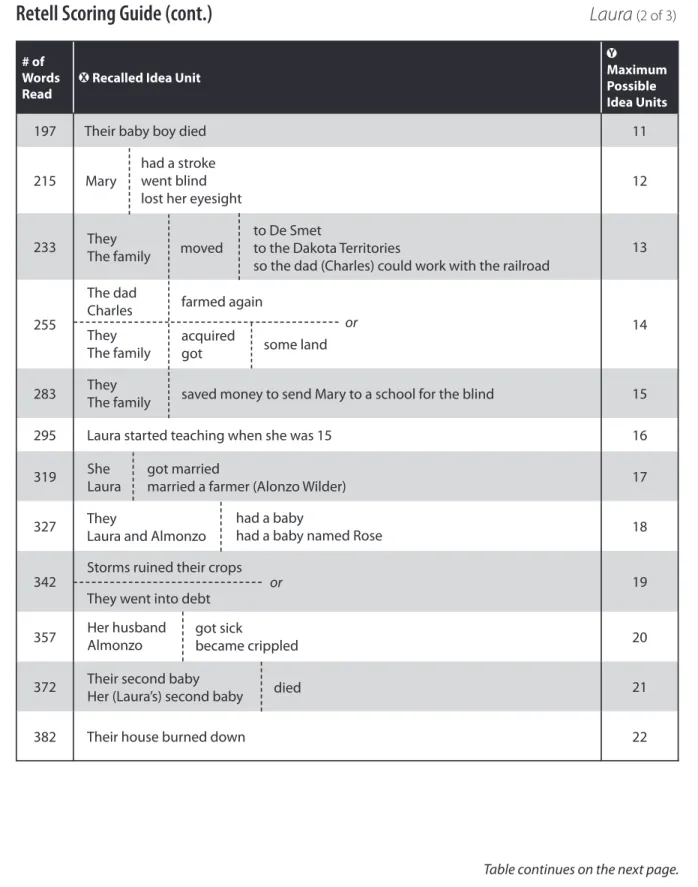
Laura
Texas Middle School Fluency Assessment—Version 2.0 © 2010 Texas Education Agency, University of Houston, and The University of Texas System
# of Words Read
Recalled Idea Unit Maximum
Possible Idea Units
7 1
24 2
37 3
65 4
72 5
82 6
105 7
122 8
151 9
176 10
A girl A lady Laura
writer author was a
wrote children’s books in a log house in Wisconsin in 1867 She
Laura
was close to her older sister had an older sister named Mary She
Laura
had to move work
a job They
Her family
Retell Scoring Guide
They Her family
after Laura was born to Missouri
or
moved
to start a farm to Kansas
where her sister Carrie was born back to Wisconsin
to be near family was born
Table continues on the next page.
Each row of the table represents an idea unit and is worth 1 point.
so her wherever their
They Her family
had many adventures The girls
The kids
Laura and her sisters ate destroyed Grasshoppers
Bugs
moved
They Her family They Her family
in 1874
to Walnut Grove to Minnesota
their crops their wheat crop moved
moved
Laura
(page 1 of 3)
because her dad didn’t have dad
father could find get Charles
Caroline was the second daughter of
or
Her dad/father Charles
wanted
longed to farm
or
# of Words
Read Recalled Idea Unit Maximum
Possible Idea Units
197 Their baby boy died 11
215 12
233 13
255 14
283 15
295 Laura started teaching when she was 15 16
319 17
327 18
342 19
357 20
372 21
382 Their house burned down 22
Storms ruined their crops They went into debt Her husband Almonzo
to De Smet
to the Dakota Territories
so the dad (Charles) could work with the railroad farmed again
They The family
got married
married a farmer (Alonzo Wilder)
or got sick
became crippled
Retell Scoring Guide (cont.) Laura
(2 of 3)moved The dad
Charles
She Laura They
Laura and Almonzo
had a baby
had a baby named Rose
Their second baby
Her (Laura’s) second baby died
saved money to send Mary to a school for the blind They
The family
Table continues on the next page.
had a stroke went blind lost her eyesight Mary
some land They
The family acquired got
or
# of Words
Read Recalled Idea Unit Maximum
Possible Idea Units
395 23
424 24
436 25
463 26
493 27
Retell Scoring Guide (cont.) Laura
(3 of 3)or
seven books
the Little House series books read by many people She
Laura wrote
She Laura
in 1957 at the age of 90 died
They
Laura and Almonzo
bought a farm settled down
spent the rest of their lives in Missouri
Her (Laura’s) daughter Rose
wanted convinced They
Laura and Almonzo
around a lot to Florida to De Smet moved
Laura could tell stories was a storyteller
or
Laura to write her stories
books people
loved liked admired
or
Their farm is open
available to visit
Grade 7 Passage Reading Fluency Equating Table BOY −
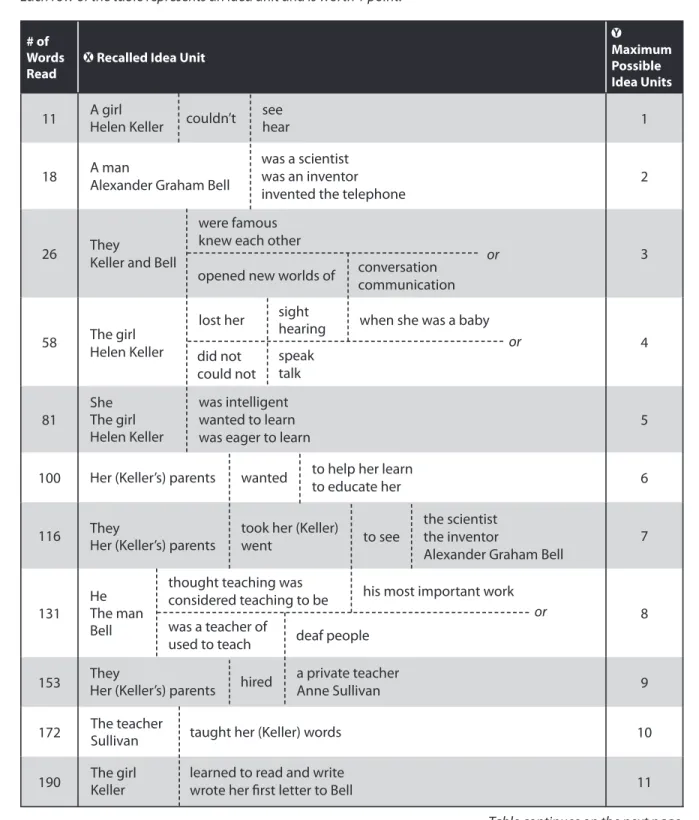
A Wonderful Friendship
Texas Middle School Fluency Assessment—Version 2.0 © 2010 Texas Education Agency, University of Houston, and The University of Texas System
# of Words
Read Recalled Idea Unit Maximum
Possible Idea Units
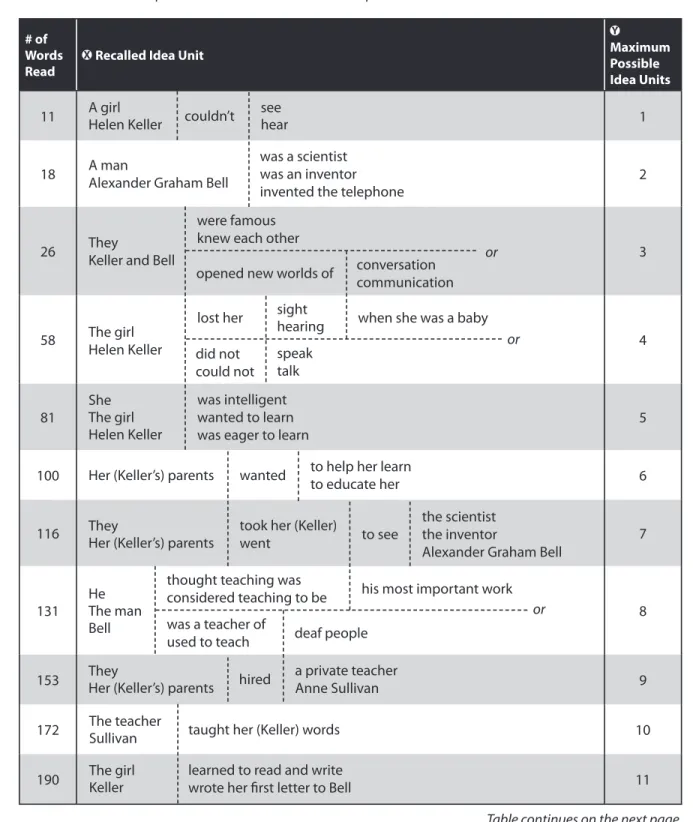
11
1
18 2
26 3
58 4
81 5
100 6
116 7
131 8
153 9
172 10
190 11
A girl
Helen Keller see
couldn’t hear A man
Alexander Graham Bell
opened new worlds of They
Keller and Bell
did not could not The girl
Helen Keller
Retell Scoring Guide
She The girl Helen Keller
was a scientist was an inventor invented the telephone
Table continues on the next page.
Each row of the table represents an idea unit and is worth 1 point.
speak talk
Her (Keller’s) parents
was intelligent wanted to learn was eager to learn
He The man Bell
a private teacher Anne Sullivan
to help her learn to educate her wanted
took her (Keller) went
They
Her (Keller’s) parents
the scientist the inventor
Alexander Graham Bell thought teaching was
considered teaching to be
The teacher
Sullivan taught her (Keller) words The girl
Keller learned to read and write wrote her first letter to Bell
A Wonderful Friendship
(page 1 of 2)
were famous knew each other
conversation communication
or
to see
his most important work
They
Her (Keller’s) parents hired sight hearing
lost her when she was a baby
or
was a teacher of
used to teach deaf people
or
# of Words
Read Recalled Idea Unit Maximum
Possible Idea Units
205 12
236 13
256 14
277 15
305 16
321 17
362 18
395 19
424 20
444 21
466 22
She Keller
let people
Retell Scoring Guide (cont.) A Wonderful Friendship
(2 of 2)The telephone
started an information center to tell people about the deaf He
Bell told her (Keller) about inventing the telephone
He
Bell opened a school for deaf He
Bell
decided
set a goal to learn how to speak to take lessons in speaking
gave a speech about Bell’s work at his information center He
Bell helped hearing and deaf people talk to each other
became a writer
to Bell all over the world
in different places talk to each other students
people children
She Keller
She Keller She Keller
finished
graduated college or dedicated her autobiography
a book about her life He
Bell told her (Keller) stories his hands his fingers with
using encouraged her (Keller) to learn He
Bell
Keller’s Her
book about her life
autobiography was a symbol of her friendship with Bell
or
Grade 7 Passage Reading Fluency Equating Table BOY −
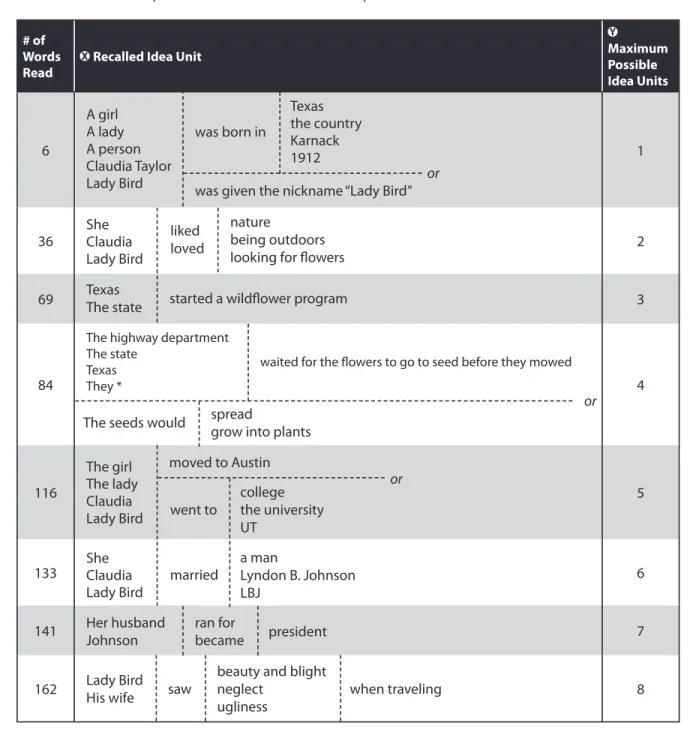
Spreading Wildflowers
Texas Middle School Fluency Assessment—Version 2.0 © 2010 Texas Education Agency, University of Houston, and The University of Texas System
# of Words
Read Recalled Idea Unit Maximum
Possible Idea Units
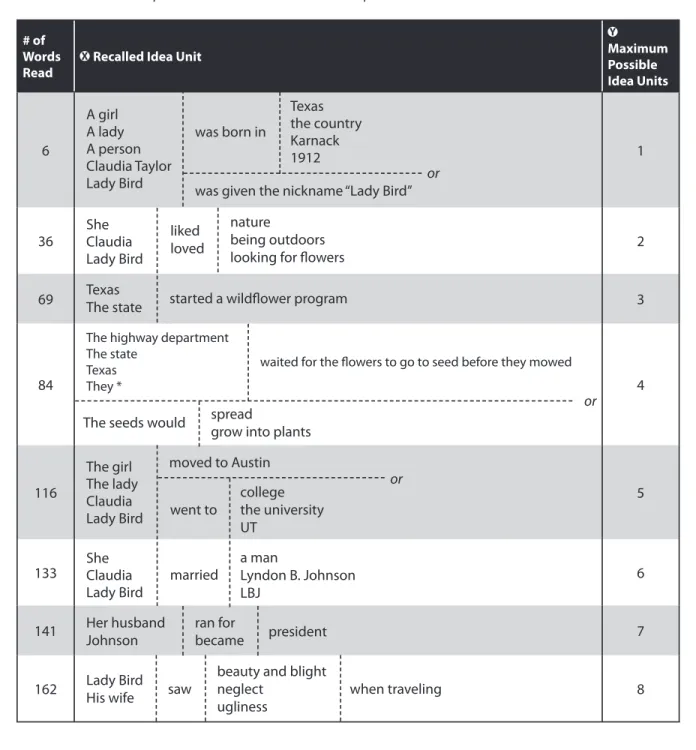
6 1
36 2
69 3
84 4
116 5
133 6
141 7
162 8
A girl A lady A person Claudia Taylor Lady Bird
Texas the country Karnack 1912 was born in
was given the nickname “Lady Bird”
nature
being outdoors looking for flowers She
Claudia Lady Bird
started a wildflower program Texas
The state
waited for the flowers to go to seed before they mowed The highway department
The state Texas They *
Retell Scoring Guide
The girl The lady Claudia Lady Bird
moved to Austin college the university UT
went to
or
or
or
married
a man
Lyndon B. Johnson LBJ
Her husband Johnson
ran for
became president liked
loved
Lady Bird His wife saw
Table continues on the next page.
Each row of the table represents an idea unit and is worth 1 point.
spread
grow into plants
She Claudia Lady Bird
Spreading Wildflowers
(page 1 of 3)
The seeds would
* The pronoun "they" is acceptable only if the student is clearly referring to the highway department or the state of Texas.
beauty and blight neglect
ugliness when traveling
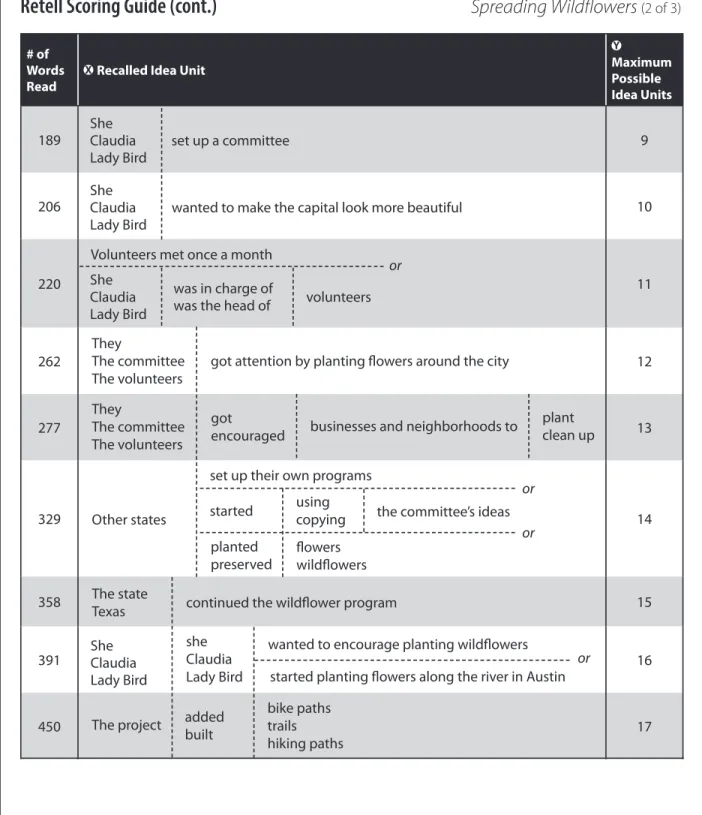
# of Words
Read Recalled Idea Unit Maximum
Possible Idea Units
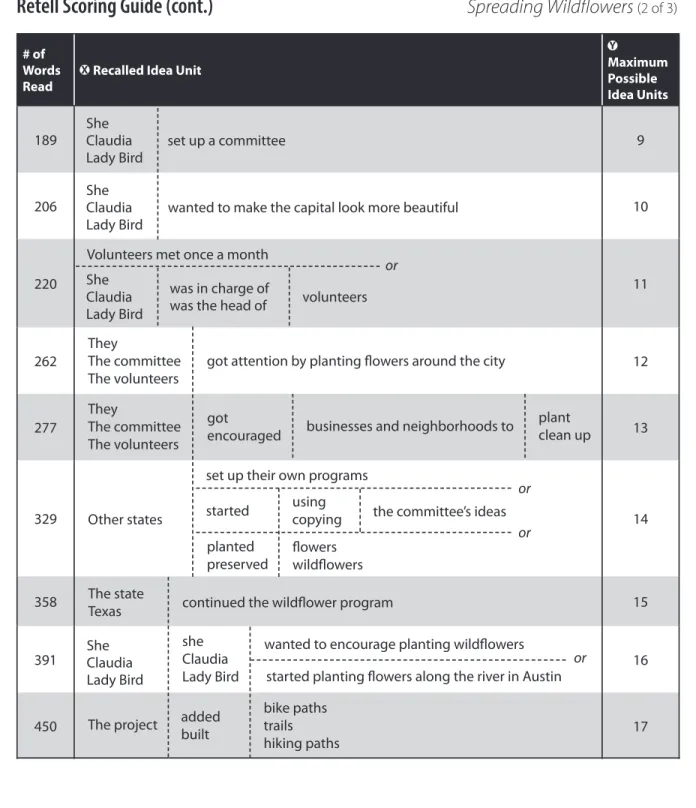
189 9
206 10
220 11
262 12
277 13
329 14
358 15
391 16
450 17
flowers wildflowers The state
Texas continued the wildflower program
wanted to encourage planting wildflowers she
Claudia
Lady Bird started planting flowers along the river in Austin Other states
got attention by planting flowers around the city
businesses and neighborhoods to They
The committee The volunteers
plant clean up They
The committee The volunteers
started planted or preserved
or
The project bike paths
trails hiking paths added
built
the committee’s ideas using
copying
Retell Scoring Guide (cont.) Spreading Wildflowers
(2 of 3)set up a committee She
Claudia Lady Bird
wanted to make the capital look more beautiful She
Claudia Lady Bird
Volunteers met once a month She
Claudia Lady Bird
was in charge of
was the head of volunteers or
got
encouraged
set up their own programs
or
She Claudia Lady Bird
Table continues on the next page.
# of Words Read
Recalled Idea Unit Maximum
Possible Idea Units
464 18
533 19
The center was named after Lady Bird
The center’s name was changed to the Lady Bird Johnson Wildflower Center The project inspired building
creating a center for studying native plants
or
or started a center for
She Claudia Lady Bird
sharing information about studying
learning about
flowers plants wildflowers
Retell Scoring Guide (cont.) Spreading Wildflowers (3 of 3)
Word Reading Fluency Subtest:
Grade 7 BOY Examiner’s Packet
Directions
Easy Word List
Say, “I want you to read this word list out loud and do your best reading. Begin at the top, and read down the list as fast as you can until I tell you to stop. If you come to a word you cannot read, just skip it and go to the next word. If you skip more than one word, point to the word you are reading next. Do you understand? ... Okay, you will begin as soon as I turn the page.”
• Start timing when the student says the first word.
• As he or she is reading, mark any words incorrect that are misread or skipped.
• If the student hesitates for more than 3 seconds on a word, mark it incorrect and say,
“Go on” or “Try the next word.”
• After 60 seconds, say, “Stop.” Circle the last word read.
• If the student finishes all the words before the time is up, note the time required to read all the words.
• If, before the time is up, the student indicates that he or she cannot read any more words, say, “Look over the whole list to see if there are any more words you can read.” If the student then indicates that he or she can read no more words, circle the last word read, record the time, and stop testing.
Moderate & Challenging Word Lists
“Now try this list. Ready? ... Begin.”
Follow guidelines listed above.
Texas Middle School Fluency Assessment—Version 2.0 © 2010 Texas Education Agency, University of Houston, and The University of Texas System
These materials are copyrighted © by and are the property of the Texas Education Agency, the University of Houston, and The University of Texas System and may not be reproduced without their written permission, except by Texas public school educators in Texas under the following conditions:
1. any portion reproduced will be used exclusively for nonprofit educational purposes;
2. any portion reproduced will be reproduced in its entirety and remain unedited, unaltered, and unchanged in any way; and 3. no monetary charge is made for the reproduced materials or any document containing them; however, a reasonable charge to
cover only the cost of reproduction and distribution may be charged.
Beginning of Year (BOY) Word Lists
Examiner Packet
Easy Word List 1
Moderate Word List 8
Challenging Word List 15
Record Sheet: Word Reading Fluency
Student Name Date Gender
Examiner (and Title) School Grade
Easy
Last word read Word number
Time in seconds Number of errors
Number of words read correctly (60 x ) ÷ = Words correct per minute (WCPM) EQUATED SCORE
Moderate
Last word read Word number
Time in seconds Number of errors
Number of words read correctly (60 x ) ÷ = Words correct per minute (WCPM) EQUATED SCORE
Challenging
Last word read Word number
Time in seconds Number of errors
Number of words read correctly (60 x ) ÷ = Words correct per minute (WCPM) EQUATED SCORE
Total equated scores (add all ’s) Divide by 3 for AVERAGE EQUATED SCORE
Word List 1
Word List 8
Word List 15
Joe Sample
hall 60
34 11 23 23
contain 60
32 12 20 20
extracted 60
30
16
14
14
Beginning of Year (BOY)
Easy List
Word List 1
1 GUESS 2 INDIA 3 ADMIT 4 GROWS 5 VOICE 6 BURST 7 GAME 8 DIRT 9 THICK 10 ADULT 11 CATS 12 ADAM 13 BABY 14 WING 15 DIM 16 MAYBE 17 COAST 18 SLEPT 19 LIES 20 COACH 21 COAT 22 DYING 23 TYPE 24 AVOID 25 PILE 26 SEVEN 27 STAY 28 BIRDS 29 WIRE 30 WOUND 31 ADD 32 SINK 33 ROUTE 34 HALL 35 TRUTH 36 SIZES 37 FLAT 38 LINES39 TRUST 40 COSTS 41 CLOUD 42 BASED 43 FORTY 44 FRESH 45 WASH 46 SILK 47 NANCY 48 FAINT 49 LAY 50 WISE 51 CAST 52 SAVED 53 JOY 54 WOOD 55 FEELS 56 VARY 57 SWEPT 58 HOUR 59 DAILY 60 WON 61 SLIP 62 NEAT 63 MASS 64 FENCE 65 RODE 66 REAL 67 TRACK 68 OBEY 69 IMAGE 70 LOOKS 71 PINK 72 TERM 73 NET 74 HIT 75 CANAL 76 TIRED
77 TRAIN 78 SPITE 79 NOON 80 SEAS 81 DOORS 82 FRAME 83 PAIN 84 FILM 85 WIND 86 GUIDE 87 MILD 88 ALONE 89 FLOAT 90 NICE 91 EARN 92 WAVES 93 ROLE 94 AUNT 95 STRAW 96 TOWNS 97 PLAY 98 SANDY 99 WALL 100 MAPS 101 GIVES 102 STONE 103 ARM 104 SIR 105 HOLES 106 FAST 107 TOUGH 108 SHADE 109 CAPE 110 BENT 111 LORD 112 DIET 113 JAR 114 COUNT
115 GIFT 116 TENSE 117 GOD 118 YARDS 119 PAPER 120 HABIT 121 THIN 122 AWARE 123 DAMP 124 DANCE 125 THROW 126 WORRY 127 FILE 128 SHIP 129 TEACH 130 TENT 131 CARE 132 TAIL 133 DIG 134 RATE 135 TUBES 136 BLOOD 137 MINES 138 SKY 139 STAR 140 BOAT 141 LOW 142 BEGIN 143 SHAPE 144 AID 145 ROOTS 146 MINE 147 OWNED 148 PER 149 TRUNK 150 PORT
Texas Middle School Fluency Assessment—Version 2.0 © 2010 Texas Education Agency, University of Houston, and The University of Texas System
1. GREEKS 2. CONCERN 3. OXYGEN 4. COTTON 5. ATLANTIC 6. MARTIN 7. FEMALE 8. COMFORTABLE 9. ANNOUNCED 10. HIGHEST 11. POINTS 12. CHOICE 13. PROPERLY 14. DETERMINE 15. BREAKFAST 16. MARKET 17. NIGHTS 18. SPIRITS 19. PEOPLE’S 20. EARTH’S 21. COLONY 22. HUSBAND 23. EUROPEANS 24. HUNDREDS 25. INSECTS 26. WILLIAM 27. SERIES 28. TISSUE 29. STEADILY 30. TRAVELED 31. SOMEBODY 32. CONTAIN 33. GRADUALLY 34. GATHERING 35. YESTERDAY 36. CREATURE 37. CARVED 38. MEMBER
39. DESTROY 40. PLANETS 41. MEDICAL 42. MILLIONS 43. REPORT 44. PERFECTLY 45. SHAKING 46. SOUTHERN 47. CATTLE 48. SHADOW 49. TRAFFIC 50. UNDERSTOOD 51. DESCRIPTION 52. ESTABLISHED 53. WILDERNESS 54. SEASON 55. DAUGHTER 56. EXCITEMENT 57. PARTLY 58. STRUGGLE 59. CLASSES 60. MOTHER’S 61. CHARLES 62. COMMUNICATE 63. LOCATE 64. DETAIL 65. CREATE 66. ARTICLE 67. FARMERS 68. BRIDGE 69. HIGHWAY 70. GOVERNOR 71. ALUMINUM 72. CAPTAIN 73. MOTION 74. SUGGESTED 75. SLEEPING 76. SPEECH
77. PLAYED 78. BESIDES 79. SHAPES 80. DANGEROUS 81. GATHERED 82. SILVER 83. OWNERS 84. RISING 85. BOTTLE 86. GREATEST 87. CONTINENTS 88. STAYED 89. SPINNING 90. ISLANDS 91. PASSES 92. CONTINENT 93. ELEMENT 94. FOOTBALL 95. PLEASURE 96. HANDED 97. MOSTLY 98. CONTINUES 99. ELECTRONS 100. PRODUCT 101. THOUGHTS 102. SKILLS 103. CHARGE 104. MISTAKE 105. EVERYBODY 106. DEEPLY 107. HADN’T 108. NODDED 109. STOMACH 110. MYSTERIOUS 111. SQUARE 112. COLONISTS 113. PASSENGERS 114. MOUNTED
115. PALACE 116. SATURDAY 117. LOCATION 118. FINGER 119. OFFICIALS 120. FASTENED 121. SHOULDERS 122. PROPERTY 123. DRIVER 124. ATTACK 125. STRUCTURE 126. SHARED 127. UNIVERSITY 128. POPULAR 129. PUZZLED 130. NATIVE 131. NEIGHBOR 132. REGIONS 133. INCLUDES 134. FORESTS 135. NOTEBOOK 136. HANGING 137. BRANCHES 138. REMOVED 139. PREPARING 140. EXTREMELY 141. EXPLORERS 142. AIRPLANE 143. DRIVEN 144. O’CLOCK 145. INSTANCE 146. SENSES 147. INVENTION 148. FIERCE 149. SLAVES 150. COUNTRYSIDE
Beginning of Year (BOY)
ModEratE List Word List 8
Texas Middle School Fluency Assessment—Version 2.0 © 2010 Texas Education Agency, University of Houston, and The University of Texas System
1. TOMORROW’S 2. SHAN’T 3. MATTED 4. IRRITATION 5. HIKING 6. WHISKED 7. MARQUIS 8. MOWGLI 9. NURSED 10. EXTREMES 11. SNORING 12. MELODY 13. IDEALS 14. BEAMING 15. MINNOWS 16. SCREENED 17. GLIMMER 18. PITIFUL 19. CIVILIANS 20. ESTUARY 21. CONSULTING 22. TROLLEY 23. SHAVING 24. MILDER 25. THEATRE 26. HOBBLED 27. FEATHERED 28. HEADMASTER 29. LASSIE 30. EXTRACTED 31. CAMBRIDGE 32. UNDERFOOT 33. COLLEAGUES 34. CLEVERNESS 35. PROMPT 36. REFRESHING 37. CHANTED 38. LEAKED
39. GANGES 40. HOMELY 41. CONIFERS 42. INDIANS’
43. CORPSES 44. OUTGROWN 45. PREFIX 46. DEFENDING 47. IRRITABLE 48. VIRGIN 49. LUNCHEON 50. SAUSAGE 51. COMPARES 52. MULTIPLIED 53. APPLESAUCE 54. ENGRAVED 55. DESCEND 56. AROUSE 57. ROME’S 58. WHIRLPOOL 59. SPARSE 60. REVIEWS 61. GRADUATING 62. BYZANTINE 63. SPOKES 64. JULIAN 65. STARES 66. KNOCKS 67. SHOPPERS 68. SLEIGH 69. CANADIANS 70. INDONESIA 71. RANCHER 72. WELCOMING 73. GYMNASIUM 74. PROVOKED 75. UNFOLD 76. CHARLESTON
77. HUNDREDTH 78. SPRINGFIELD 79. PICKLE 80. BLONDE 81. ARCHES 82. GREENISH 83. SNOWSHOES 84. DOMINATED 85. POSSESSIVE 86. WINDOWSILL 87. JANITOR 88. ATTICUS 89. SQUEAK 90. STEEPLY 91. INSIGHT 92. DOROTHEA 93. CHEMISTS 94. LEAKING 95. HARDENS 96. TRANSITION 97. PARTIAL 98. SPRINKLE 99. IODINE 100. CLEVERLY 101. LIMPING 102. ESCORTED 103. MATTHIAS 104. SPECIMEN 105. TYRANT 106. REVEALING 107. GLUCOSE 108. WINKING 109. ICICLES 110. PARADES 111. JENKINS 112. PEELING 113. PUBLISH 114. COMMENCED
115. GRETEL 116. DIRECTS 117. MORMON 118. NEPTUNE 119. OTTERS 120. FACULTY 121. THAT’LL 122. CITIZENSHIP 123. RAPPED 124. SPLINTERED 125. FIRST-AID 126. INQUIRIES 127. FULFILLED 128. PLEADING 129. GRATEFULLY 130. MONARCHY 131. DIALECT 132. HARDEN 133. WREATH 134. DEMOCRATS 135. EXPORTED 136. OSWALD 137. SNAKE’S 138. GLIMPSED 139. UNDERLINE 140. BRAZILIAN 141. JOHANN 142. ALTERNATE 143. COMPLEXION 144. ICE-CREAM 145. SICKENING 146. MARTHA’S 147. LOVINGLY 148. BRAMBLES 149. SCREECHING 150. ADAM’S
Beginning of Year (BOY)
chaLLENgiNg List Word List 15
Texas Middle School Fluency Assessment—Version 2.0 © 2010 Texas Education Agency, University of Houston, and The University of Texas System
Grade 7 Word Reading Fluency Equating Table BOY −
Word List #1 Easy
Texas Middle School Fluency Assessment—Version 1.1 © 2009 Texas Education Agency, University of Houston, and The University of Texas System
Grade 7 Word Reading Fluency Equating Table BOY −
Word List #8 Moderate
Texas Middle School Fluency Assessment—Version 1.1 © 2009 Texas Education Agency, University of Houston, and The University of Texas System
Grade 7 Word Reading Fluency Equating Table BOY − Word List #15 Challenging
Texas Middle School Fluency Assessment—Version 1.1 © 2009 Texas Education Agency, University of Houston, and The University of Texas System
Guidelines for Interpreting the TMSFA Results
BEGINNING OF YEAR
Average Equated Score
RANGE DECODING FLUENCY COMPREHENSION
Needs Identified Decoding, Fluency, and Comprehension
Fluency and
Comprehension Comprehension
Grade 6
TMSFA Word Lists < 55 56–73 > 74
TMSFA Passage Fluency < 88 89–113 > 114
Grade 7
TMSFA Word Lists < 58 59–75 > 76
TMSFA Passage Fluency < 89 90–118 > 119
Grade 8
TMSFA Word Lists < 64 65–86 > 87
TMSFA Passage Fluency < 101 102–124 > 125
MIDDLE OF YEAR
Average Equated Score
RANGE DECODING FLUENCY COMPREHENSION
Needs Identified Decoding, Fluency, and Comprehension
Fluency and
Comprehension Comprehension
Grade 6
TMSFA Word Lists < 59 60–78 > 79
TMSFA Passage Fluency < 97 98–121 > 122
Grade 7
TMSFA Word Lists < 63 64–84 > 85
TMSFA Passage Fluency < 106 107–129 > 130
Grade 8
TMSFA Word Lists < 70 71–92 > 93
TMSFA Passage Fluency < 120 121–143 > 144
Chart continues on the next page.
Average Equated
Score RANGE DECODING FLUENCY COMPREHENSION
Needs Identified Decoding, Fluency, and Comprehension
Fluency and
Comprehension Comprehension
Grade 6
TMSFA Word Lists < 63 64–83 > 84
TMSFA Passage Fluency < 100 101–130 > 131
Grade 7
TMSFA Word Lists < 66 67–90 > 91
TMSFA Passage Fluency < 110 111–140 > 141
Grade 8
TMSFA Word Lists < 70 71–95 > 96
TMSFA Passage Fluency < 130 131–155 > 156
Grouping Students by Average Equated Scores and Average Retell Scores
Decoding and Fluency (Average Equated Score)
Retell Comprehension
(Average Retell Score) Interpretation
Low
Average equated score in the Decoding range or lower two-thirds of the Fluency range
Low
Average retell score of less than 40%
Group A
Students who are struggling with all component skills simultaneously
Low
Average equated score in the Decoding range or lower two-thirds of the Fluency range
High
Average retell score of greater than 40%
Group B
Most common for students with dyslexia (Note: These results do NOT qualify a student for services)
High
Average equated score in the upper third of the Fluency range or in the Comprehension range
Low
Average retell score of less than 40%
Group C
Most common for students who almost failed or barely failed the state reading assessment
High
Average equated score in the upper third of the Fluency range or in the Comprehension range
High
Average retell score of greater than 40%
Group D
Potentially a “false positive,”
meaning the student failed
the state assessment but
does not need intervention
outside of Tier I
Sample Record Sheets
for Susie Sunshine and Herbie Helpme
Record Sheet: Passage Reading Fluency
Student Name Date Gender
Examiner (and Title) School Grade
Passage 1
Last word read Word number
Time in seconds Number of errors
Number of words read correctly (60 x ) ÷ = Words correct per minute (WCPM) EQUATED SCORE Comprehension Retell
Recalled idea units Maximum possible idea units ÷ = PASSAGE RETELL SCORE
Passage 2
Last word read Word number
Time in seconds Number of errors
Number of words read correctly (60 x ) ÷ = WCPM EQUATED SCORE Comprehension Retell
Recalled idea units Maximum possible idea units ÷ = PASSAGE RETELL SCORE
Laura
A Wonderful Friendship
Scoring continues on the next page.
That Laura and his family moved to Kansas because in Wisconsin there was no more work for the father. And they do their job in Wisconsin.
returned 60
103 8 95 95
It was about a girl who couldn’t see or hear. And she had a friend. He was a scientist. She wanted to learn because she didn’t know how to speak.
Susie Sunshine 9/2/10
Patricia Professional, teacher Texas MS 7
F
way 60
94 2 92 92 107
90
Record Sheet: Passage Reading Fluency (cont.)
Student Name
Passage 3
Last word read Word number
Time in seconds Number of errors
Number of words read correctly (60 x ) ÷ = WCPM EQUATED SCORE Comprehension Retell
Recalled idea units Maximum possible idea units ÷ = PASSAGE RETELL SCORE
Total equated scores (add all ’s) Divide by 3 for AVERAGE EQUATED SCORE
Total passage retell scores (add all ’s) Divide by 3 for AVERAGE RETELL SCORE
Spreading Wildflowers
Claudia Taylor was born in Texas and loved flowers. They started planting flowers on the highways. She went to UT when she moved to Austin.
Susie Sunshine
years 60
125 9 116 116 129
326 109
Record Sheet: Passage Reading Fluency
Student Name Date Gender
Examiner (and Title) School Grade
Passage 1
Last word read Word number
Time in seconds Number of errors
Number of words read correctly (60 x ) ÷ = Words correct per minute (WCPM) EQUATED SCORE Comprehension Retell
Recalled idea units Maximum possible idea units ÷ = PASSAGE RETELL SCORE
Passage 2
Last word read Word number
Time in seconds Number of errors
Number of words read correctly (60 x ) ÷ = WCPM EQUATED SCORE Comprehension Retell
Recalled idea units Maximum possible idea units ÷ = PASSAGE RETELL SCORE
Laura
A Wonderful Friendship
Scoring continues on the next page.
Laura and their sister Mary. That...Laura had a older sister named Mary and then they moved to Missouri for a few years.
And they put their own farm in Kansas. She lived in the long house.
farm 60
87 14 73 86
There was a girl named Helen Keller. A young girl. She couldn’t hear.
Herbie Helpme 9/2/10
Patricia Professional, teacher Texas MS 7
M
they 60
92 10 82 82 86
78
Record Sheet: Passage Reading Fluency (cont.)
Student Name
Passage 3
Last word read Word number
Time in seconds Number of errors
Number of words read correctly (60 x ) ÷ = WCPM EQUATED SCORE Comprehension Retell
Recalled idea units Maximum possible idea units ÷ = PASSAGE RETELL SCORE
Total equated scores (add all ’s) Divide by 3 for AVERAGE EQUATED SCORE
Total passage retell scores (add all ’s) Divide by 3 for AVERAGE RETELL SCORE
Spreading Wildflowers
Lady Bird liked her flowers. They started protecting the wildflowers.
Herbie Helpme
would 60
88 11 79 79 87
251 84