GLOBAL AND
REGIONAL FINANCIAL SAFETY NETS:
LESSONS FROM EUROPE AND ASIA
CHANGYONG RHEE, LEA SUMULONG AND SHAHIN VALLÉE
Highlights
• The Asian financial crisis (1997) and the European crisis (2009) have both contributed to the development and deepening of regio- nal safety net arrangements. This paper analyses the relationships between global and regional financial safety nets, and uncovers the potential tensions and operational challenges associated with the involvement of several institutional players with potentially diffe- rent interests, analytical biases and governance. The G20 has ack- nowledged the importance of these new players for the international monetary system, but the principles for cooperation between the IMF and regional financing arrangements are far too broad and ad hocto contribute to a coherent and effective architecture. This paper tries to establish some lessons learned from the Asian financial cri- sis in 1997 and the current European crisis in order to enhance the effectiveness, efficiency, equity and governance of these arrange- ments. In particular, it proposes changes to the IMF articles of agree- ment to allow for lending or guarantees to regional arrangements directly and it establishes some key desirable features and prac- tices of regional mechanisms that should be adopted everywhere to ensure some global consistency, particularly in the field of ma- croeconomic surveillance, programme design and conditionality.
Changyong Rheeis the chief economist of the Asian Development Bank. Lea Sumulongis senior economics officer at the Economics and Research Department of the Asian Development Bank. Shahin Vallée was appointed to the Cabinet of European Council President Herman Van Rompuy as economic advisor in July 2012. He was visiting fellow at Bruegel from October 2010 to June 2012. The authors thank C.
Randall Henning, Yoichi Nemoto, Mark Sobel, Edwin Truman and two anonymous reviewers for their comments on an earlier draft, and Ryan Jacildo for excellent research assistance.
BRUE GEL WORKING P APER 2013/06
NOVEMBER 2013
This working paper appeared as chapter 7 in Responding to Financial Crisis: Lessons from Asia Then, the United States and Europe Now (2013), edited by Changyong Rhee and Adam S. Posen and copublished by the Peterson Institute for International Economics and Asian Development Bank. Financial support for this project from the Asian Development Bank is gratefully acknowledged.
Copyright © 2013 by the Asian Development Bank. The views expressed in this working paper are those of the author(s) and do not necessarily reflect the views and policies of the Asian Development Bank (ADB) or its Board of Governors or the governments they represent. ADB does not guarantee the accuracy of the data included in this publication and accepts no responsibility for any consequence of their use. By making any designation of or reference to a particular territory or geographic area, or by using the term
“country” in this document, ADB does not intend to make any judgements as to the legal or other status of any territory or area. ADB encourages printing or copying information exclusively for personal and non-commercial use with proper acknowledgement of ADB.
Users are restricted from reselling, redistributing, or creating derivative works for commercial purposes without the express, written consent of ADB. Note: In this paper, “$”
refers to US dollars.
The failings of the international monetary system in the 1970s and the rise of financial globalisation may well have increased the volatility of economic cycles (Rodrik 1997, Scheve and Slaughter 2001, Krugman 1991). In the last 20 years, the Asian crisis in 1997, the global financial crisis in 2008, and the European crisis in 2009 stand out as having been particularly deep and widespread, causing considerable loss in output in a number of countries. As a result, the demand for insurance against these shocks has grown and the shortcomings of the existing insurance mechanisms have been exposed. The Bretton Woods institutions, and in particular the International Monetary Fund (IMF), met these demands imperfectly, and as a result alternative insurance mechanisms – both national and regional – have been developed over the years.
Even though this process of regionalisation of monetary cooperation started in the 1970s, in recent years both the Asian crisis and more recently the European crisis have decisively contributed to the establishment of regional safety net arrangements as a necessary complement to international arrangements. The 2008 global financial crisis has substantially improved the pre-existing international financial safety net architecture to address financial crises with liquidity tools designed for pre-emptive actions. In addition, the central banking community has shown a remarkable ability during the crisis, albeit in an ad-hoc fashion, to coordinate currency swap arrangements in order to improve liquidity conditions and ensure appropriate circulation of key international reserve currencies when the financial system was failing to do so. Yet, those initiatives have by no means discouraged regionalisation.
Coexistence and joint interventions between regional financial safety nets and global financial safety nets, whether they be central bank currency lines or more standard IMF instruments, pose a number of important questions about their combined efficiency and effectiveness in ensuring the stability of the international monetary system. In particular, the actual cooperation between different levels of surveillance and financial assistance, conditionality frameworks, analytical perspectives, accountability structures, and sometimes political objectives can lead to tensions that might undermine the potency of these safety nets and leave fragilities in the monetary system.
This paper reviews the evolution of the existing regional safety nets and compares their institutional framework and modes of operation. The aim is to identify challenges and highlight the existing and potential fault lines in their nascent architecture. The chapter proposes changes to both regional and
international safety nets in order to improve their complementarity and subsidiarity and thereby maximise their effectiveness.
The rise of regional arrangements
The history and political economy of regional financial arrangements allow the establishment of two clear categories of regional arrangements that respond to two distinct but complementary sets of shortcomings in the international monetary system and global financial safety net architecture.
Two generations of regional financial cooperation
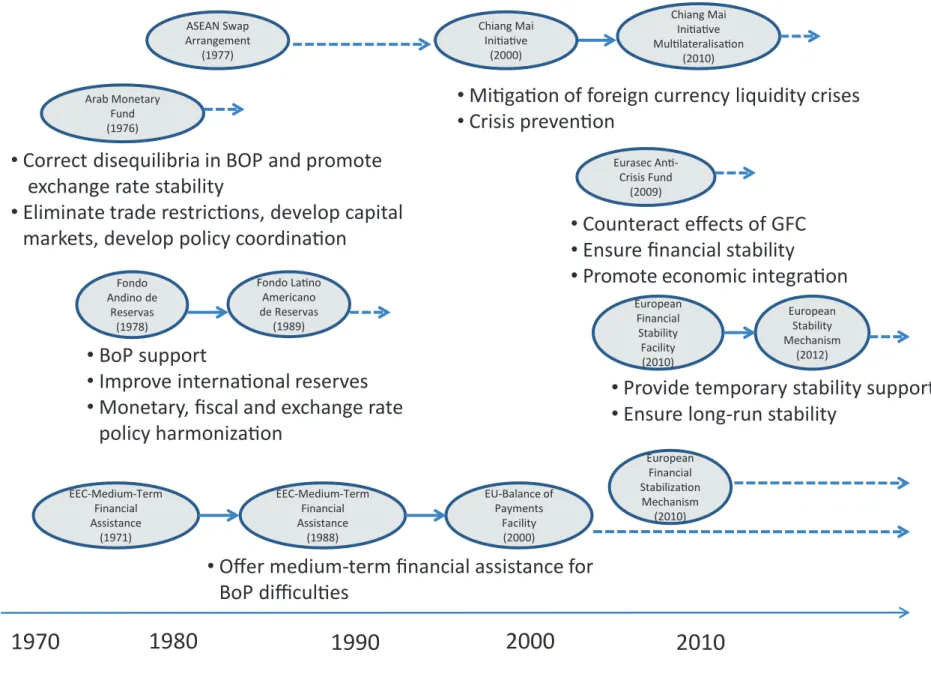
The first generation of regional arrangements rose in response to the emergence of cracks in the international monetary system (Figure 1). The end of the Gold Standard in 1971 and the economic shakeup created by the oil shock in 1973-74 raised new doubts and fears across the world about the ability of the Bretton Woods institutions to fulfil their role. They had indeed not been designed to deliver financial safety nets in a world of acute monetary instability. The creation of regional arrangements is clearly tied to this. In Europe, the Werner Plan, for example, was first and foremost designed to respond to global monetary instability and ended up with the creation of the “European currency snake” and the European Medium-Term Financial Assistance in 1971. Such regional responses emerged across the world, with the Arab Monetary Fund created in 1976, the Association of Southeast Asian Nations (ASEAN) Swap Arrangement in 1977, and the Latin American Reserve Fund (established as the Andean Reserve Fund) in 1978.
In many ways, regional monetary cooperation was first and foremost a response to global monetary instability and was primarily designed to contain its effect on the European continent (James 2013, Mourlon-Druol 2012). Several waves of devaluation, the Werner Report, the Exchange Rate Mechanism, and the Committee of Central Bankers eventually kick-started the process that effectively embedded monetary cooperation in the monetary unification process. However, the 2009-10 European crisis would come to challenge the idea that a single currency would allow monetary stability without the need for regional financial arrangements outside a common central bank.
In Latin America, the creation of the Latin American Reserve Fund (Fondo Latinoamericano de Reservas, or FLAR), established initially in 1978 as the Andean Reserve Fund (Fondo Andino de
Fondo Andino de
Reservas (1978) Arab Monetary
Fund (1976)
1970 1980 1990 2000 2010
Chiang Mai Initiative
(2000)
Eurasec Anti- Crisis Fund
(2009)
European Financial Stability Facility (2010)
European Stability Mechanism
(2012)
• BoP support
• Improve international reserves
• Monetary, fiscal and exchange rate policy harmonization
• Correct disequilibria in BOP and promote exchange rate stability
• Eliminate trade restrictions, develop capital markets, develop policy coordination
• Mitigation of foreign currency liquidity crises
• Crisis prevention
• Counteract effects of GFC
• Ensure financial stability
• Promote economic integration
• Provide temporary stability support
• Ensure long-run stability
EU-Balance of Payments
Facility (2000) EEC-Medium-Term
Financial Assistance
(1988)
• Offer medium-term financial assistance for BoP difficulties
Fondo Latino Americano de Reservas
(1989)
Chiang Mai Initiative Multilateralisation
(2010)
EEC-Medium-Term Financial Assistance
(1971)
European Financial Stabilization Mechanism (2010) ASEAN Swap
Arrangement (1977)
Figure 1: Evolution of regional arrangements to date
ASEAN = Association of Southeast Asian Nations; EEC = European Economic Community; EURASEC = Eurasian Economic Community
a. In 1988 the Medium-Term Financial Assistance and Community Loan Mechanism was merged into a single Medium-Term Financial Assistance Facility.
Source: Authors’ illustration.
Reservas or FAR), was gradually expanded to a greater number of members. However, it is interesting to note that it never really evolved into a full-fledged arrangement encompassing all of Latin America and in particular large countries like Mexico, Brazil, or Argentina1.
The Arab Monetary Fund (AMF), which was initially the monetary incarnation of the Arab League, was established in 1976 with the political objective of gradually creating a single currency, which never happened. As Pierre Van den Boogaerde (1991) showed, the initial objective and the central financing role of the AMF were largely diluted by a number of alternative financing vehicles that provided other forms of balance of payments assistance to countries of the region.
The second generation of regional financial arrangements – which includes the Chiang Mai Initiative (CMI), the Eurasian Economic Community (EURASEC) Anti-Crisis Fund (ACF), and the European regional financial safety nets – was the result of regional financial crises after the 1980s in a number of places, starting with Latin America. The regionalisation wave of the late 1990s was largely driven first by the precedent created by the IMF programme for Mexico in 1995 and then by the consequences of the Asian crisis in 1997. Mexico planted an important seed with the North American Framework Agreement (NAFA), which made an important contribution to the overall Mexican programme2. In reality, this was more of a bilateral support than a truly regional initiative, but it established the need to go beyond standard IMF support and explains at least partially why the Latin American crises of the 1980s didn’t lead to a deepening and broadening of the regional arrangement in Latin America itself.
This had important consequences globally and in Asia in particular, where dependence on the IMF, and the goodwill of the United States as the key power-broker on its Executive Board, became evident and of concern. According to Phillip Lipscy (2003), the idea of an Asian Monetary Fund was first floated by Japanese authorities in late 1996. Doubtful about the US commitment to Asia, Japanese authorities took the lead in forging an “Asian consensus” on the issue. The plan then was to set up a fund with
1 Several conjectures can be made owing to both politics and economics. Mexico probably became so integrated with the United States that it came to enjoy, especially after the conclusion of the North American Free Trade Agreement, a special relationship with the United States that ensured a form of bilateral solidarity that would surely surpass any regional arrangement. Brazil and Argentina always entertained somewhat rival relations, which didn’t help a joint initiative, and they were both large enough to be the natural anchor of the regional system but potentially economically too fragile to risk the undertaking. As a result, FLAR remained a relatively limited initiative for small countries. But this is slowly changing and there are increasing discussions for Mexico and others to now join and expand it (Lombardi 2012).
2 NAFA was established in April 1994, enlarging prior bilateral swap agreements among Canada, Mexico, and the United States. The agreement serves as the rubric for the separate bilateral agreements. The Exchange Stabilization Fund, an intervention device of the US Treasury, also maintains a credit line with Mexico that requires a letter of comfort by the IMF managing director when used.
resources amounting to $100 billion to be shared by the 10 interim member economies3. In reality, this was not very consensual until the Asian crisis hit in 1997 and profoundly changed the terms of the debate. The political rejection of the IMF programmes and deep-seated criticism of its programme conditionality (IMF 2003) contributed to increasing the focus on the liquidity dimension of the Asian crisis, which motivated the establishment of preemptive and regional instruments.
Asia’s sour experience with the IMF created an economic and political shock that called for a bold initiative to strengthen supplementary and alternative methods of cooperation in addressing financial crisis outside of the IMF. The original Asian Monetary Fund proposal didn’t prosper because of political concerns surrounding the role of the yen in this regional arrangement. Instead, a series of bilateral swap arrangements was originally formed among the ASEAN-5 – Indonesia, Malaysia, the Philippines, Singapore, and Thailand – and the Plus Three countries – Japan, the Republic of Korea, and the People’s Republic of China (PRC)4. This was the beginning of a more ambitious and competing form of regionalisation that would come to be expanded quite meaningfully not only in Asia but also, in another form, and at a later stage, in Europe.
The Asian and European experiences Asia
The embryo of an Asian regional safety net arrangement has existed since 1977, when the five founding members of the ASEAN signed the ASEAN Swap Arrangement (ASA)5. Following the Asian crisis and after aborted discussion on the creation of an Asian Monetary Fund, Japan launched the New Miyazawa Initiative in October 1998 amounting to about $35 billion, which was targeted at stabilising the foreign exchange markets of Indonesia, the Republic of Korea, Malaysia, the Philippines, and Thailand6. The initiative was particularly valuable in containing instability in Malaysia’s financial sector, since that country had refused an IMF Stand-By Arrangement. The Japanese manoeuvre was deemed somewhat mutinous, since the IMF was very critical of Malaysia’s approach. But it also
3 The PRC; Hong Kong, China; Japan; the Republic of Korea; Australia; Indonesia; Malaysia; Singapore; Thailand; and the Philippines.
4 Brunei Darussalam, Cambodia, the Lao People’s Democratic Republic, Myanmar, and Viet Nam joined the regional arrangements with the other ASEAN countries in 2000 and with the Plus Three countries with the establishment of the Chiang Mai Initiative Multilateralization in 2008.
5 The founding members are Indonesia, Malaysia, the Philippines, Singapore, and Thailand.
6 The 'old' Miyazawa initiative was a 1987 proposal by Japan’s Minister of Finance Miyazawa Kiichi to resolve the debt crisis in Latin America that involved expanding the roles of the IMF and the World Bank in international financial affairs. While the Brady Plan was favored over Miyazawa’s, some of its vital provisions were patterned after the latter (Horisaka 1989).
cemented the idea that Asia could gather enough resources to sandbag itself during a crisis period so long as Asian countries were united and managed to roll out timely and credible support mechanisms.
In Asian countries under IMF programmes, the conditionality associated with the loans included severe fiscal cuts, deep structural reforms, and substantial increases in interest rates to stabilise currency markets. The economic and social cost of the adjustment was so high and abrupt that it provoked social unrest in a number of countries. This would reverberate strongly in the months that followed and leave a lasting scar in relations between Asian countries and the IMF7.
This experience fuelled both a willingness to self-insure through accelerated reserve accumulation and to strengthen regional arrangements to reduce the reliance on global financial safety nets. Building on this lesson, the CMI was formalised in May 2000 during the ASEAN+3 Finance Ministers Meeting8. It largely built on the original ASA and bilateral swap agreements involving the PRC, Japan, and the Republic of Korea but was grounded in a broader programme that also included developing Asia’s local currency bond market and introduced a regional economic review and policy dialogue to enhance the region’s surveillance mechanism (Kawai and Houser 2007). The initiative included the new ASEAN members, increasing the total number of parties to the arrangement from 5 to 10. Table A.1 in the appendix highlights the evolution of the CMI.
The question of cooperation between the CMI and the IMF quickly became quite heated, with a number of countries arguing that strong ties to the Fund would defeat the initial purpose of the initiative (Korea Institute of Finance, 2012), but the ties were kept nonetheless both to mitigate moral hazard (Sussangkarn, 2011) and to ensure some consistency with conditionality attached to the IMF’s own programmes.
After the formal creation of the CMI in 2000, the era of Great Moderation that followed to some degree doused further ambitions to strengthen regional arrangements. As a result, when the global financial crisis hit in 2008, the Asian regional financial safety net proved too modest to play a meaningful role.
7 In the case of Indonesia, the government’s tight fiscal position forced it to cut back on subsidies on food and fuel. But with the reduction in government price support, food and fuel costs skyrocketed, resulting in weeks of social unrest in the country and the eventual resignation of President Suharto, who had held power for over three decades.
8 Earlier in 1997, the Manila Framework Group was established by 14 Asia-Pacific and North American economies: Australia;
Brunei Darussalam; Canada; the PRC; Hong Kong, China; Indonesia; Japan; the Republic of Korea; Malaysia; New Zealand;
the Philippines; Singapore; Thailand; and the United States. The purpose of the framework was information exchange and surveillance, with support from the IMF, the World Bank, and the Asian Development Bank. But since it had no formal status and included both Asian and non-Asian economies, the framework proved to be ineffective as a regional surveillance forum and was terminated in 2004. ASEAN+3 meetings superseded the Manila Framework Group meetings (Moon and Rhee 2012).
Indeed, instead of seeking support under CMI, the Bank of Korea and the Monetary Authority of Singapore sought a swap agreement with the US Federal Reserve for some $30 billion each. The Republic of Korea concluded bilateral agreements with Japan and the PRC that were not related to the CMI. Similarly, Indonesia established separate bilateral swap lines with Japan and the PRC to shore up its crisis buffer and did not resort to the CMI for credit support (Sussangkarn, 2011).
The plan to consolidate the bilateral swap arrangements and form a single, more solid, and effective reserve pooling mechanism – which had initially been put forward by the finance ministers of the ASEAN+3 in May 2007 in Kyoto – was accelerated and evolved in several iterations before the final version was laid out more than two years later. In December 2009, the CMI was multilateralised and the ASEAN+3 representatives signed the Chiang Mai Initiative Multilateralisation (CMIM) Agreement, which effectively became binding on March 24, 2010 (BSP, 2012). These successive transformations have strengthened the initiative, but it remains largely untested. In addition, other aspects of any credible regional financial arrangement, such as surveillance capacity and coordination of some basic economic policies, remain relatively embryonic.
Europe
The history of European financial safety nets cannot be dissociated from the history of European monetary integration. With this perspective in mind, it dates back to the late 1960s and has been an ongoing debate to this day. The history of European political integration at every turn is marked by failed projects or actual mechanisms of financial solidarity, ranging from loose exchange rate arrangements to the project of a full-fledged European Monetary Fund. The advent of the monetary union was precisely designed to reduce the need for financial safety nets within the euro area. But the architectural deficiencies of the euro area and the lack of internal transfers have required the establishment of alternative mutual insurance mechanisms since the onset of the euro crisis in 2010.
In 2008, when the global financial crisis hit, Hungary had accumulated important external imbalances and large foreign exchange exposures. It had to seek financial assistance almost immediately and initiated contacts with the IMF. The total absence of coordination with European authorities came as an initial shock because it showed that despite decades of intense economic, political, and monetary integration, EU countries could still come to require international financial assistance. The experience pushed European institutions to unearth a forgotten provision of the Maastricht Treaty to provide
financial assistance through the Balance of Payments Assistance Facility9. This created preliminary and at first ad-hoc coordination between the IMF and the European Commission, which was then rediscovering design and monitoring of macroeconomic adjustment programmes.
Despite the rapid use of this facility and the emergence of a framework of cooperation with the IMF, contagion from the global financial crisis continued for months and prompted some Eastern European leaders to seek broader and more pre-emptive support10, which failed. However, beyond official sector participation, there was a relatively rapid realisation that cross-border banking and financial retrenchment could become a major source of financial disruption and effectively propagate the crisis further – including back to the core of Europe, as large European banks were heavily exposed to Eastern Europe through vast and dense networks of branches and subsidiaries. In response, in late February 2009, under the leadership of the European Bank for Reconstruction and Development (EBRD), the European Investment Bank (EIB) and the World Bank decided to establish what was known as the Vienna Initiative. This was designed as a joint multilateral and private sector coordination and enforcement mechanism to reduce the risk of banking sector sudden stops. In particular, it compelled cross-border European banks to continue to provide appropriate liquidity to their branches and subsidiaries in Central and Eastern Europe. The formalisation of such an arrangement11 quite early in the crisis has certainly proven the case for coordination of financial institutions in emerging-market economies, especially when a relatively small number of institutions have a disproportionate impact on capital flows.
But with the crisis spreading to the euro area, starting with Greece in the fall of 2010, new regional arrangements proved necessary. The lack of instruments forced European officials to first consider bilateral assistance from member states. The idea of involving the IMF was initially violently rejected
9 The possibility of granting mutual assistance to a member state with difficulties with its balance of payments is laid down in Article 143 of the treaty. The facility to provide medium-term financial assistance was established by Council Regulation (EC) No. 332/2002. The maximum amount of the facility was increased to €25 billion in December 2008 and further to €50 billion in May 2009 (from €12 billion originally).
10 The Hungarian prime minister, in particular, tried to draw his peers and European leaders together to set up large international support for Eastern Europe. His proposal was eventually turned down by an informal European Council meeting on March 1, 2009, for lack of support by his peers. (The Czech Republic and Poland in particular feared the stigma associated with such an initiative.) See Balazs Penz and Agnes Lovasz, “Hungary Seeks $230 Billion Eastern Aid; World Bank Raises Funds,” Bloomberg News, February 27, 2012, www.bloomberg.com/apps/news?pid=
newsarchive&refer=home&sid=aPVyz3WPsLZw (accessed on July 13, 2013).
11 The Joint International Financial Institutions initiative was announced on February 25, 2009, with a combined
commitment of €25 billion. It was subsequently increased, but only a small portion of these funds were actually committed and disbursed. For a final report on the initiative, see De Haas et al. (2012).
on intellectual and political grounds12 but proved inevitable. In a number of successive iterations, more solid regional arrangements were designed (Bijlsma and Vallée 2012). Table A.2 in the appendix shows the evolution of European regional financial safety nets.
The new international and regional safety net architecture
Following the momentum created by the Asian crisis and the bold call for the establishment of an Asian regional financial safety net, the Group of Seven (G-7) tried in 1998 to reform the monetary system by improving the provision of liquidity ex ante. This brought deep changes at the IMF, following what was called the Summers Call13. It led to the creation of a set of new facilities that specifically addressed capital account crises (the Supplemental Reserve Facility and the Contingent Credit Line, for instance), which for lack of use were retired in 2004. These instruments were sorely missed in 2008 when the crisis hit, but the intellectual work had been done in the late 1990s and therefore under emergency conditions the approach to global financial safety nets was quickly and profoundly overhauled. This included two essential but somewhat independent moves: a profound redesign of the IMF toolkit and an extraordinary extension of global currency swap lines between central banks. These instruments could have largely addressed shortcomings of the international monetary system that the regional arrangements were striving to overcome, but they did not.
Revamped global financial safety nets
Central Bank Currency Swap Arrangements. Central banks played an important role very early during the financial crisis, overcoming their dramatic hesitations dating to the 1930s. They not only acted with rapid non-standard expansionary actions but also displayed a high degree of cooperation and coordination that clearly helped in allaying market stress by ensuring that widespread access to liquidity contained the worst effects of financial distress. Without determined action, it is not clear that IMF facilities, given the resources available then, could have prevented full-blown banking and balance of payments crises in a number of advanced and emerging economies.
12 European Central Bank President Jean-Claude Trichet and Executive Board member Lorenzo Bini Smaghi were among those most opposed to involving the IMF in the euro area.
13 Lawrence Summers, “Priorities for a 21st Century Global Financial System,” remarks at Yale University, New Haven, CT, US Department of the Treasury press release, September 22, 1999, www.treasury.gov/press-center/press-
releases/Pages/ls111.aspx (accessed on July 1, 2013).
Because of the central role of the dollar in the international financial system, the US Federal Reserve played a pivotal role in the establishment and expansion of these agreements. It agreed to a first temporary reciprocal currency arrangement with the European Central Bank (ECB) and the Swiss National Bank (SNB) in December 2007 for $20 billion and $4 billion, respectively. Access to dollar liquidity in Europe had become difficult as early as the summer of 2007 following the decision by a large European bank to freeze assets on some funds it could not value properly for lack of liquidity in the US mortgage market. This first arrangement was gradually expanded in size and scope as market stress deepened and eventually covered 14 central banks and represented some $620 billion in outstanding volumes. Note that after October 2008, the Federal Reserve agreed to full allotment auctions for the four leading central banks: ECB, SNB, Bank of Japan (BOJ), and Bank of England (BOE), effectively giving unlimited dollar liquidity to these counter-parties.
Interestingly, these swap arrangements were extended to some key emerging-economy central banks (Banco de Mexico, Banco Central do Brasil, Monetary Authority of Singapore, and Bank of Korea) prior to the creation of the IMF’s Flexible Credit Line (FCL). The countries were selected on the basis of their economic fundamentals because these arrangements had no conditionality, and considering their importance as regional financial hubs capable of playing an important role in the financial stability of their respective regions.
Linda Goldberg, Craig Kennedy, and Jason Miu (2010) have demonstrated the effectiveness of these arrangements in allaying funding pressures internationally. William Allen and Richhild Moessner (2010) have also shown the extent to which these arrangements were targeted precisely to those countries that were facing the biggest challenges, as indicated by currency mismatches in their financial systems’ balance sheets. However, little has been said of other bilateral swaps like those provided by the ECB or the PRC. The ECB’s foreign exchange swaps were remarkably modest and in some cases (e.g., Poland and Hungary) replaced by liquidity operations against eligible euro collateral rather than real unsecured foreign exchange swap arrangements like those the Federal Reserve extended. The PRC’s bilateral swap arrangements came later but became substantial in size and scope.
However, they quickly appeared to be designed to serve the more medium-term objective of promoting the use of the renminbi in bilateral trade rather than addressing short-term liquidity and financial stability concerns (Rhee and Sumulong, 2013).
IMF Lending Toolkit. Broadly speaking, the overhaul of the previous IMF credit support system was driven by two new important events. The first was the realisation that financial crises not only were affecting emerging economies but also could wreak havoc in large advanced economies. As a result, the financial support needed could be extremely large and could test the limits of IMF lending programmes. Second, it became clear that global imbalances and reserve accumulation for the purpose of self-insurance were a sign of defiance of the global financial safety net architecture that needed to be confronted. This doesn’t mean that excess reserve accumulation was only a response to deficiencies in the international monetary system as in many places it certainly served a mercantilist undertaking, but it forced to address global imbalances that would otherwise remain a permanently threatening feature of the global economy.
In April 2009, the London Group of Twenty (G-20) Summit jump-started a debate about a complete redesign of the IMF’s policies and crisis instruments. Further extensive deliberations were held during 2010 and concluded with the G-20 Summit in Seoul. The Republic of Korea proposed the strengthening of global safety nets as one of its key priorities under its presidency (Rhee, 2011). Unlike in 1997, the recent liquidity crisis episode emanated from liquidity shortages in global banks, starting with those in the United States. Ironically, it was the Republic of Korea’s bilateral swap arrangement with the US Federal Reserve that eventually stabilised the domestic financial market. The Republic of Korea recognised the importance of having an ex ante crisis prevention mechanism and initially proposed the institutionalisation of swap lines as a major goal of strengthening the global safety net. Given the resistance it met, however, the Republic of Korea shifted its focus to strengthening the IMF lending toolkits.
The process of strengthening IMF lending toolkits and moving in the direction of ex ante crisis prevention instruments instead of an ex post crisis resolution mechanism unearthed a number of political and economic challenges, including moral hazard considerations, stigma, credibility, and financing constraints. Despite these challenges, the IMF and the G-20 were able to agree, in a relatively short period of time, to triple the IMF’s lending capacity from $250 billion to $750 billion; devise and establish instruments that profoundly changed the existing IMF toolkit, particularly the creation of the FCL and then the Precautionary Credit Line (PCL), which was eventually replaced with the Precautionary and Liquidity Line (PLL); extend high access programmes; and extend special drawing rights (SDR) allocation of $250 billion. These combined measures were thought to clearly lay out the
eligibility criteria and make them sufficiently stringent to reduce risks of moral hazard while also supporting potential “crisis bystanders.”
The FCL was made available in March 2009 mainly to serve member countries’ actual and imminent financing needs. The PCL, on the other hand, was only formally offered in August 2010 to deal with the contingent financing requirements of member countries (IMF, 2011). The PLL was introduced in November 2011 to replace and broaden the scope of the PCL (IMF, 2012). However, in the IMF’s own assessment, members using the new credit lines remained fairly limited, potentially because of the remaining stigma associated with their use (IMF, 2011).
Regional financial safety nets
This substantial strengthening of global financial safety nets, which addressed a number of shortcomings that regional arrangements had been trying to solve since the 1970s, could well have weakened the case for regional arrangements. But this did not happen and the distinctly European crisis that started in 2010 confirmed maybe once and for all the need for a more decentralised safety net architecture relying on regionalism. Indeed, despite the many improvements to the global financial safety nets, their economic and political limitations justified stronger regional mechanisms. Table 1 presents some key characteristics of existing regional financial safety nets.
Although the European Stability Mechanism (ESM) was a latecomer, it appears to be the strongest of all existing regional arrangements in terms of legal basis, fund size, paid-in capital, and leverage capacity.
Together with the ACF, European financial arrangements hold the distinction of being based on treaties, compared with the other regional arrangements that are based simply on agreements. The European financial arrangements also are the biggest, with the ESM and European Financial Stability Facility (EFSF) having a combined lending ceiling of €700 billion as of July 2013, €80 billion of which is pledged by member states and the balance to be raised from capital markets. In terms of GDP, the ESM accounts for over 5 percent of members’ GDP, compared with less than 1 percent for the other regional financial arrangements (IMF, 2013a). Except for the ACF and CMIM, all the other regional arrangements have the option to issue bonds.
In terms of lending instruments, most regional financial arrangements offer loans, guarantees, and swaps. Maturities vary from short-term instruments (e.g., 30 days for the treasury credit offered by the
Table 1: Key characteristics of existing regional financial arrangements
Regional financial arrangement
Number of members
Legal basis
Fund size
Paid-in capital/pledge
With option
to issue bonds?
Instruments
Arab Monetary Fund (Middle East) 22 Agreement $2.7 billion
600 million Arab dinars
Yes -Automatic loan -Ordinary loan -Extended loan -Compensatory loan
-Structural Adjustment Facility -Short-term liquidity
Latin American Reserve Fund (Fundo Latino Americano de Reservas, FLAR)
7 Agreement $3.28
billion
$2.28 billion Yes -Balance of payments credit -Foreign debt restructuring -Liquidity credit
-Contingent credit -Treasury credit European Union Balance of
Payments Facility 27 Treaty €50
billion €50 billion Yes Loan/credit line Chiang Mai Initiative
Multilateralization (ASEAN+3)
13 Agreement $240
billion
Pledge No -Swap, precautionary line
-Swap, stability facility EURASEC Anti-Crisis Fund (Central
Asia)
6 Treaty $8.513
billion
$8.513 billion No -Stabilization credit -Sovereign loans European Stability Mechanism (euro
area) 17 Treaty €500
billion €80 billion Yes -Loan
-Credit line (PCCL and ECCL) -SMSF
European Financial Stabilization Mechanism (European Union)
27 Agreement €60
billion
Backed by EU budget
Yes -Loan
-Credit line European Financial Stability Facility
(euro area)
17 Agreement €440
billiona
Yes -Loan
-Credit line (PCCL and ECCL) -SMSF
ASEAN+3 = Association of Southeast Asian Nations plus the People’s Republic of China, Japan, and the Republic of Korea; SMSF = Secondary Market Support Facility;
PCCL = Precautionary Conditioned Credit Line; ECCL = Enhanced Conditions Credit Line.
a. Combined lending ceiling of the European Stability Mechanism and European Financial Stability Facility will be €700 billion in July 2013 with €80 billion pledged by member states and the balance to be raised from the capital markets.
Source: Authors’ compilation.
FLAR) to very long-term ones (up to 20 years for the low-income stabilisation credit offered by the ACF), depending on the objective and type of lending instrument. Interest rates are either fixed or floating. Meanwhile, only the CMIM and ESM have ex ante crisis prevention facilities. In all regional financial safety nets, conditionality is usually mentioned, but not specified in detail. In fact, except for the CMIM and the European regional financial arrangements, linkage with the IMF is optional. For the CMIM, the IMF delinked portion was increased to 30 percent in 2012 with a view to increasing it to 40 percent in 2014 subject to review should conditions warrant.
The mandate and capacity for surveillance also differ widely. The AMF undertakes no surveillance but has periodic consultations with members on their economic conditions. The FLAR introduced a macroeconomic surveillance programme in July 2011, which is in the process of being fully implemented. It includes monitoring of financial and banking stability conditions for use in providing advice to member countries. The CMIM, after incorporating the surveillance mechanism of ASEAN+3 Economic Review and Policy Dialogue in May 2005, established the ASEAN+3 Macroeconomic Research Office (AMRO) in April 2011 as an independent regional surveillance unit to monitor economic conditions of member economies, which will in turn have input into CMIM decision making.
Similarly, the ACF has outsourced the surveillance function to the Eurasian Development Bank, which manages ACF funds. In the European Union, ESM surveillance complements the new framework for reinforced economic surveillance, which includes a stronger focus on debt sustainability and more effective enforcement measures, and focuses on prevention that should substantially reduce the probability of a crisis emerging in the future.
As regards fund utilisation, the CMIM remains the only arrangement untapped since its inception. The AMF has provided structural loans to Jordan, Morocco, and Mauritania. The FLAR has extended financial credit to Bolivia, Colombia, Costa Rica, Ecuador, Peru, Uruguay, and Venezuela. The ACF has provided financial credit to Belarus and Tajikistan. The ESM is to be used in Cyprus for the first time, but the EFSF has been used for programmes in Greece, Ireland, Portugal, and Spain.
Cooperation challenges and policy prescriptions
The evolving landscape of regional arrangements combined with profound changes to global financial safety nets poses the important question of cooperation. Indeed, both the IMF and the G-20 endorsed the use of regional arrangements and made them an integral, if shaky and uncertain, part of the global
financial architecture. The International Monetary and Financial Committee first spoke of the importance for the IMF to cooperate with regional arrangements in October 2010. In November 2010, G-20 leaders asked G-20 finance ministers and central bank governors to explore “ways to improve collaboration between regional financial arrangements and the IMF across all possible areas” (G-20, 2010). A set of broad and nonbinding principles were effectively delivered and endorsed during the Cannes G-20 Summit in the fall of 201114. Further work is under way and expected in the context of the Russian presidency of the G-20 with more concrete guidelines to be agreed upon during the G-20 meeting of the leaders in St. Petersburg in the fall of 2013.
C. Randall Henning (2011) explained that the rationale for cooperation between regional and global arrangements essentially rested on the need to (1) limit risks of arbitrage between arrangements, especially in cases where they overlap; (2) avoid redundancy over and above what competition can justify; (3) align interest to ensure that resources are additive; and (4) organise some form of division of labour between institutions both in the conduct of surveillance and in programme monitoring and financing. Building on these issues, we discuss key challenges related to cooperation and highlight a few policy prescriptions.
Strengthening existing global and regional arrangements
Before improving collaboration between global and regional financial safety nets, strengthening both regional and global arrangements might be an important prerequisite to ensure the stability of the international monetary system.
The global financial crisis brought important lessons to bear so as to improve tools and policies for global financial safety nets. The European crisis in particular, and the developments of its own safety nets through the crisis, also provides a testing case for regional safety nets globally.
Global arrangements
The divergences in approaches, purposes, and network and second-order effects of these foreign exchange swap arrangements beg the question of their governance. Indeed, they can be seen either
14 The G-20 Cannes Communiqué states: “We have agreed on actions and principles that will help reap the benefits from financial integration and increase the resilience against volatile capital flows. This includes coherent conclusions to guide us in the management of capital flows, common principles for cooperation between the IMF and Regional Financial Arrangements, and an action plan for local currency bond markets” (G-20 2011).
as a substitute for the more ambitious high-access instruments provided by the IMF, or as a complement. But in both cases, devising effective global financial safety nets requires a degree of predictability that these ad hoc and discretionary arrangements do not offer. In addition, if the sense of emergency and responsibility was clearly present during the global financial crisis, one cannot rule out that under political pressure from the US Congress, for instance, the Federal Reserve would have been far more parsimonious, with potentially significant consequences for financial stability globally.
In 2011, in preparation of the G-20 Seoul Summit, the IMF tried to argue that these bilateral and ad hoc foreign exchange swap lines should be multilateralised in order to increase their effectiveness and improve their governance. But these ideas have been met with great scepticism by the central banking community, which expressed reluctance and concern over seeing such operations with potential important implications for domestic monetary expansion handed over to governments sitting on the board of the IMF. However, this debate might not necessarily be closed forever, and alternative arrangements for coordinating these swap arrangements, while respecting the autonomy, independence, and discretion of central banks, could be promoted.
Regional arrangements
Improve the Legal and Financial Structure. Legally, the CMIM is an institution based on agreements by member countries and has no identity under corporate law. As such, it is marred with legal uncertainty. The recent commitment by the ASEAN+3 economies to strengthen the CMIM, which was announced at the ASEAN+3 Finance Ministers’ meeting in May 2013 in Delhi, is a welcome development. The agreement to involve central bank governors in CMIM decision making and to ensure the CMIM’s operational readiness is a positive development. In addition, work will continue “to consider ways to seek an effective cooperative relationship with the IMF and other multilateral financial institutions in the areas of surveillance, liquidity support arrangement and capacity development”
(ASEAN, 2013). Financially, CMIM funding is based on pledges with no paid-in capital, unlike the case of the ESM, which is an intergovernmental treaty and has significant paid-in capital. Due to this inherent weakness, the CMIM has been criticised as being untested, and there is constant suspicion that pledges might not be honoured promptly enough to prevent spillovers when a crisis starts.
Securing a strong financial structure backed by meaningful paid-in capital seems to be the urgent step necessary to secure market confidence in the CMIM.
Improve Precautionary and Multi-country Lending Capacity. The stigma effect is not necessarily a unique problem for IMF loans. Even if swaps under the CMIM can have more flexible conditionality, best efforts should be made to reduce the stigma effect, particularly on ex ante programmes. A few options have been considered to mitigate stigma, such as via a multi-country lending offer. By making unilateral and simultaneous offers of financial assistance to several countries with good policy track records (but with the capacity to propagate shocks), the CMIM could communicate to the public that the credit lines are provided for an ex ante crisis prevention purpose. The swap lines extended by the US Federal Reserve on October 29, 2008, to four countries – Brazil, Mexico, the Republic of Korea, and Singapore – are good examples. The IMF also introduced the multi-country FCL in 2011. Multi-country swap offers could play a complementary role to that played by large central banks, but would have the advantage of being formally institutionalised compared with the ad-hoc nature of central bank swap lines. They would also be able to address more flexibly members’ needs beyond central banks’ narrow mandates.
Improve Predictability. Once a crisis has started and the market is in panic, it will be difficult to reverse market perceptions even by saying that programmes offered by regional financial safety nets are for prevention purposes. Markets are likely to focus only on negative news, and any indication that the CMIM is considering extending credit lines to a specific country could itself propagate a vicious circle.
To avoid this, a pre-qualification system can be considered using a set of transparent “Maastricht-like”
criteria particularly for the CMIM’s Precautionary Credit Lines. The pre-qualification criteria and the resulting list of eligible countries need not be made public. Assessing whether countries meet the pre- qualification criteria can be done regularly and privately within the institution. A rule-based pre- qualification mechanism would improve the effectiveness of the qualification process and reduce the stigma effect.
Predicating qualification for the multi-country swap offer on systemic importance and strong fundamentals, as well as on having offers of liquidity extended unilaterally and simultaneously to all qualified countries, would address the first-mover problem and reduce the stigma effect associated with accessing resources from the IMF.
Build Capacity for Surveillance. Surveillance capacity is critical for well-functioning regional financial arrangements. The AMRO was created to undertake surveillance that will support CMIM decision making. However, the organisation is still in an incipient stage. Currently, it needs more human capital
and stronger research and monitoring capacities. These will take time. In the interim, the CMIM should tap the resources of international financial institutions in the areas of surveillance and capacity development.
Collaboration between the IMF and regional financial arrangements
If anything, the most recent global crisis, and in particular the European experience, has underscored the difficulties associated with cooperation between regional and global safety nets. There was initially a clear reluctance to involve the IMF in Europe in general and in the euro area in particular. However, the lack of immediately actionable instruments, the slow political and institutional response in Europe, and the superior expertise of the IMF in addressing balance of payments crises and designing policy conditionality made its involvement inevitable. This collaboration has now been formally institutionalised.
In Asia, at the onset of the financial crisis, the CMI was also not in a position to play its role alone, therefore making other forms of support necessary, which could certainly have led to the involvement of the IMF had the economic situation warranted.
Similarly, in Latin America, Domenico Lombardi (2012) described how the case of Peru from 1978 to the 1990s illustrated alternatively a high degree of cooperation between the FLAR and the IMF (1978- 84), then a situation of conflict when the former became the only lender as Peru accumulated arrears vis-à-vis the IMF, and finally a new phase of cooperation in the 1990s under President Alberto Fujimori.
Cooperation challenges
In Europe, cooperation challenges and divergences have in reality been more widespread than is often reported.
In Latvia, the IMF quickly reached the conclusion that the programme would not be sustainable without a currency devaluation, which the European Commission opposed for economic but probably also for political reasons. The IMF effectively suspended disbursement for six months, which could have completely derailed the economics of the programme.
In Ireland, the IMF had recommended and supported the Irish government in its willingness to bail in banks’ bondholders to strengthen the capital position of the banks without stretching public finances excessively. This time it was the ECB, another key stakeholder in programme design and monitoring (although not a financial contributor), that resisted bail-in on financial stability grounds for the rest of the euro area.
In Greece, the IMF realised relatively quickly that the first Greek programme would not be sustainable and that a form of debt reduction would be necessary. European authorities resisted it for a long time until a private sector involvement deal was reached in July 2011 and eventually augmented twice. The IMF then went on to press a form of debt forgiveness by official lenders in order to bring debt back to a more sustainable position, which was granted imperfectly in November of 2012.
In Spain, the IMF was considering the extension of the precautionary programme for a long time at the end of 2011 and early in 2012, but this did not gain enough political support in Europe. The situation deteriorated so rapidly that the suitability of a precautionary programme vanished, making way for a financial sector assistance programme with macroeconomic conditionality in which the IMF was not a formal party, although it accepted to play a role in the monitoring.
Finally, in Cyprus, the IMF and European authorities had quite divergent views in terms of both the definition of a sustainable debt trajectory for a small economy like Cyprus and the best way to restructure a banking system that for the most part had become insolvent. Hence, disagreements and tensions in programme design and monitoring were in reality much more the rule than the exception, and they were not exactly benign because they sometimes compounded divergences of views between European member states.
These numerous examples illustrate the inherent complexity in organising inter-institutional cooperation in an ad-hoc fashion. The IMF (2013b, 22) itself recognises that “differences of views that arise from fundamentally differing institutional mandates and priorities will continue to pose challenges.” Despite these tensions and disagreements, the experience of cooperation between the IMF and European authorities has generally been operationally effective. But it is unclear the extent to which it can be replicated in other regions.
Policymakers outside Europe, and in Asia in particular, remain of the view that the degree of cooperation attained in Europe can hardly be replicated in other parts of the world and would lead to much more confrontational situations. The experiences of the Latin American and Asian crises leave the overwhelming impression that regional views would not be heard in particular because of the governance of the IMF, in which emerging economies are in a minority and are largely absent from senior management. In addition, because emerging economies cannot print a global reserve currency to finance their adjustment process, their dependency on global financial safety nets would always be far greater than that of Europe. The challenges standing before effective cooperation are multidimensional. They range from conditionality to programme financing by way of surveillance. In this sense Europe has enjoyed a relatively unique set of economic and political circumstances that have probably provided a lot of room for negotiation and made cooperation between regional safety nets and the IMF far smoother and more balanced than it can be in any other region of the world.
Conditionality and programme design
Conditionality is at the heart of every adjustment programme. It is also essential to devise effective and credible qualification criteria for ex ante liquidity support. In most cases, it is perceived as both a deterrent meant to steer governments away from unsustainable economic policies and as a corrective instrument to adjust economic imbalances. Yet the rise of regional arrangements can be explained by tensions surrounding conditionality – which was rightly or wrongly regarded as inadequate. The Independent Evaluation Office of the IMF (2003) itself highlighted a number of deficiencies of IMF conditionality, in particular its expansion into policy areas that were neither critical nor directly linked to the success of the adjustment programme. On the other hand, the introduction of regional actors with competing conditionality should not be an occasion to weaken and distort IMF conditionality to a point that it undermines the effectiveness and success of associated programmes.
This calls for a real clarification of the division of labour between the global and regional arrangements.
The early evaluation by the IMF (2013c) of the Greek programme and the objections it engendered from the European Commission, as well as an early assessment of programmes in Greece, Portugal, and Ireland by Jean Pisani-Ferry, André Sapir, and Guntram Wolff (2013), allow for drawing some lessons learned about governance and programme design with regional financial arrangements and the IMF. The European experience is also particularly interesting in the sense that the IMF evolved from being a majority lender in Hungary to a relatively small contributor in Cyprus in a framework that, at
least formally, did not lead to evident weakening of policy conditionality. The IMF (2013c) also highlighted important lessons learned for programme design that could actually justify a stronger engagement with regional arrangements and some complementarity. Indeed, lack of ownership of reforms and institutional weaknesses were considered important sources of programme failure—
areas where regional arrangements might have a comparative advantage. But this issue of the linkages of conditionality remains very controversial.
In the case of Europe, linkages with IMF conditionality are tight and mandatory, but Europe in principle has important leverage over the IMF because of the latter’s governance structure, which creates some symmetry in their relations. This is not the case for other regional groupings. In the case of Asia, for example, the CMIM is gradually reducing the proportion of its lending that requires linkage to IMF programmes. Whether the ultimate target for the IMF-delinked portion should be zero is an unsettled issue. Considering that links to IMF programmes are generally optional in other regional financial arrangements, the CMIM is also moving in this direction, gradually reducing its formal linkages with the IMF commensurate with its improving surveillance capacity.
Decentralised and complementary surveillance
The European crisis has demonstrated the limits of regional as well as international surveillance, both of which by and large missed the importance of the fundamental financial and external imbalances that were building up in a number of economies. A real and comprehensive post mortem of surveillance capacities has not yet been undertaken, although Pisani-Ferry, Sapir, and Wolff (2011) highlighted how IMF surveillance suffered from substantial shortcomings in the years preceding the crisis despite the existence of formal surveillance instruments.
As shareholders of the IMF, countries are subject to regular bilateral IMF surveillance. However, regional arrangements are also developing their own surveillance apparatus. To the extent that surveillance is inextricably linked to programme conditionality, regional financial arrangements have to develop strong independent surveillance capacity using local and regional knowledge to complement the IMF’s global surveillance. This will in turn prove key to establishing the regional conditionality framework, which can be combined with IMF conditionality in cases of programme cofinancing.
At the regional level, over the last decade the European Commission had probably devised the most expansive and intrusive machinery for conducting macroeconomic surveillance combining outcome as well as policy analysis and recommendations. Yet the crisis has shown its relative ineffectiveness, which raises very important questions about the trust and confidence that should be granted to surveillance in general and regional surveillance in particular. Profound ongoing changes to the economic governance framework – including constitutional fiscal rules, a system risk board, and other far-reaching preventive and corrective mechanisms – could significantly improve surveillance and monitoring by the European regional financial arrangements. Whether that will actually happen remains to be seen.
Against the backdrop of the European experience, the nascent surveillance apparatus in Asia appears extremely modest. Having been established only in April 2011, the AMRO is still in the process of building up its capacity. Currently, its relatively small staffing may not seem sufficient to effectively meet its mandate15, which is “to prepare quarterly consolidated reports on the overall macroeconomic assessment of the region as well as on individual countries.” During a time of crisis the mandate is “to provide an analysis of the economic and financial situation of the CMIM Swap Requesting Country; to monitor the use and impact of the funds disbursed under the CMIM Agreement; and monitor the compliance by the CMIM Swap Requesting Country with any lending covenants to the CMIM Agreement16. In the interim, partnering with the IMF in the field of surveillance may be necessary while AMRO continues to strengthen its capacity.
Beyond Europe and Asia, building regional surveillance institutions with very different levels of analytical capacity and political backing raises important issues, particularly in terms of the potential division of labour between regional and global surveillance. It is not clear what part of surveillance would be best undertaken at the regional or at the global level.
What appears clear, however, is that surveillance of regional blocs covered by regional financial safety nets should be under scrutiny by the IMF, as is the case with the European Monetary Union. Whether
15 The AMRO is governed by an executive committee composed of deputy finance ministers and central bank heads of member economies. The committee provides the general direction for the entire institution and is responsible for
designating the members of the advisory panel and the AMRO director. The advisory panel, on the other hand, comprises six representatives from the member states: one each from the PRC, Japan, and the Republic of Korea, and three from ASEAN. It generally gives technical, strategic, and professional guidance to AMRO but is independent from AMRO staff members (Hill and Menon 2012). The AMRO director is the top technocrat of the institution and is in charge of overseeing specific organization functions that are presently carried out by 12 professional staff, two technical assistants, and five administrative staff (Siregar and Chabchitrchaidol 2013).
16 See the AMRO website at www.amro-asia.org (accessed on July 1, 2013).
this means that country surveillance should first and foremost be undertaken at the regional level is unclear. One objective of regional surveillance is to introduce checks and balances and alternative views from that of the IMF. One should consider, however, that strong country surveillance at the regional level is a necessary consequence of financial solidarity at the regional level. However, one should establish clearer responsibility for IMF surveillance of regional arrangements in order to ensure their robustness and credibility, especially in a context where the IMF is expected to be a financing partner.
Multi-layered and multi-stakeholder lending framework
In principle, if regional arrangements were solid and effective, they would be able to take care of small shocks that do not have global repercussions. A real multi-stakeholder lending framework would only become necessary in cases where interregional spillovers are large and financing needs potentially exceed regional capacity. The nature of the crisis, depending on whether the shocks are external or home-grown, could also help determine the extent to which support from global financial safety nets is required from both a financing and confidence point of view. The question is whether the IMF should become a cofinancier in each national programme or whether it should instead provide either lending or guarantees to the regional financial arrangement. There are pros and cons to both approaches. One interesting paradox is that even though the development of regional financial safety nets reflects at least in part some dissatisfaction with multilateral assistance as provided by the IMF, all regional arrangements remain more or less tied to the requirements of IMF-supported programmes. In particular, the recent European experience has shown that the share of financing was not a decisive factor in the respective weight of institutions in the decision-making process pertaining to programme design and monitoring. Indeed, despite the declining share of IMF financing over time—down to being nil in Spain and symbolic in Cyprus – the IMF’s judgement and conditionality did not decline in relative importance.
The organisation of a real multi-layered financing arrangement remains in its infancy, partly because regional financial safety nets have somewhat different structures, resources, and constraints, and partly because the establishment of new instruments by the IMF requires more operational thinking about their imbrication with regional arrangements. As a general rule, regional financial safety nets have limited information on cross-regional linkages and international spillovers that can probably be duly internalised only by the IMF.