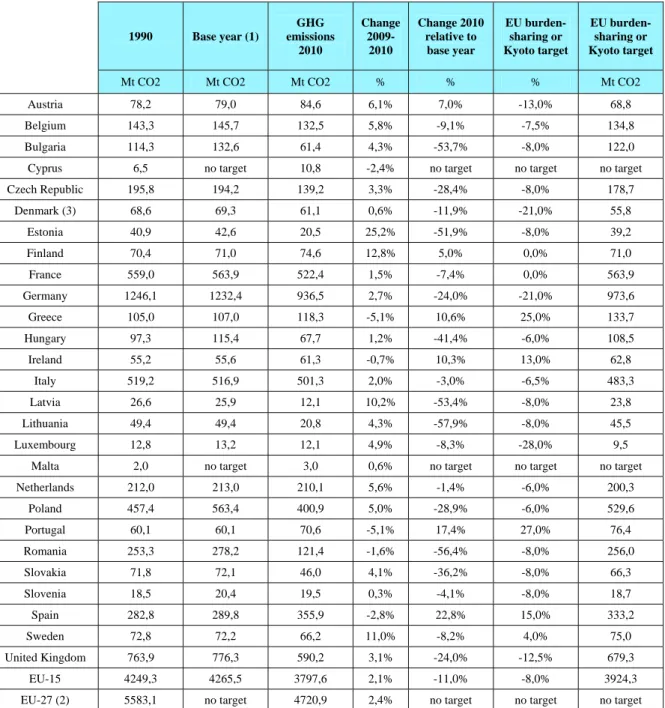
Energy, responsible for around 60%, is the largest sector in terms of greenhouse gas emissions in the EU. CO2 emissions from electricity and heat production are the largest key source in the EU-15, accounting for 26% of total greenhouse gas emissions in 2009 and for 86% of greenhouse gas emissions from the energy industry. Between 1990 and 2010 in the EU-15, greenhouse gas emissions from the energy industry increased in seven Member States and decreased in eight.
The separation of fuel combustion and greenhouse gas emissions is also observed in the EU-27. CO2 emissions from road transport are the second largest key source among all categories in the EU-15. In the EU-15, Germany, France, Italy, Spain and the United Kingdom contributed the most to CO2 emissions from road transport (77%).
Between 2009 and 2010, total emissions from road transport decreased in the EU-15 as well as in the EU-27 due to lower emissions from petrol. Gut fermentation in cattle is the largest single source of CH4 emissions in the EU-15, accounting for 3.2% of total GHG emissions in 2010. Waste is the fourth largest sector in the EU-15, contributing around 3% to total GHG emissions.
Policies and measures
Cross-cutting’
Emission reduction potential in 2010 in
Emission reduction potential in 2020 in
Stage of implementation /timetable /comments
Energy Supply
Energy supply’
Energy demand
Energy demand’
Stage of implementation / timetable /comments
Transport
Transport’
Stage of implementation / timetable / comments
Industry & non CO 2 gases
Industry’
Waste
Waste’
Integration Research & Development
Integration Cohesion Policy
Agriculture
Agriculture’
Forests’
Sequestration potential in 2010 in
Sequestration potential in 2020 in
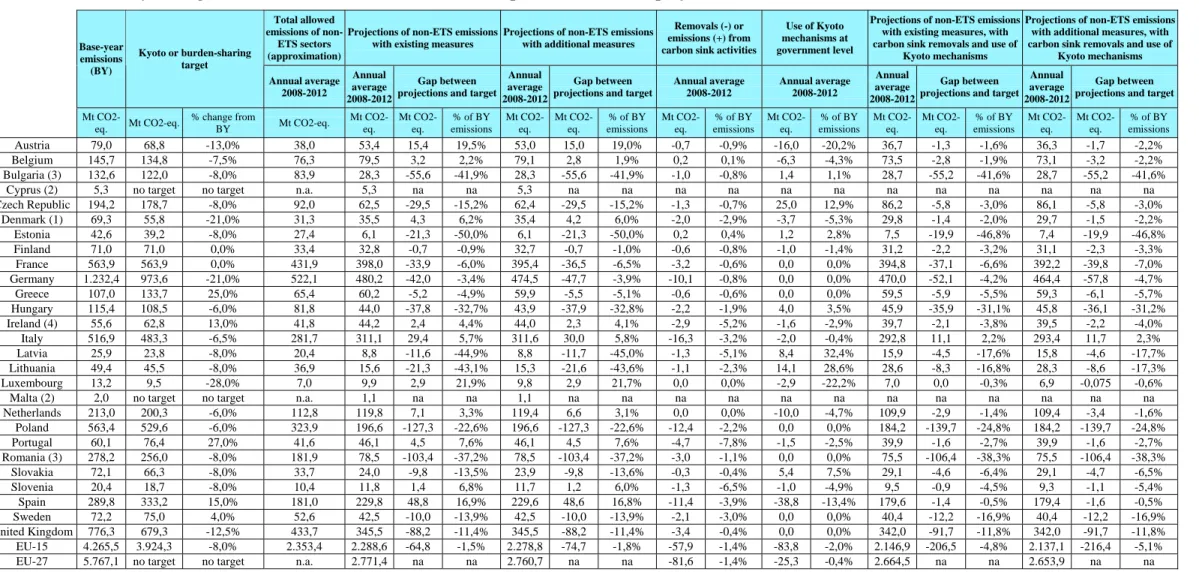
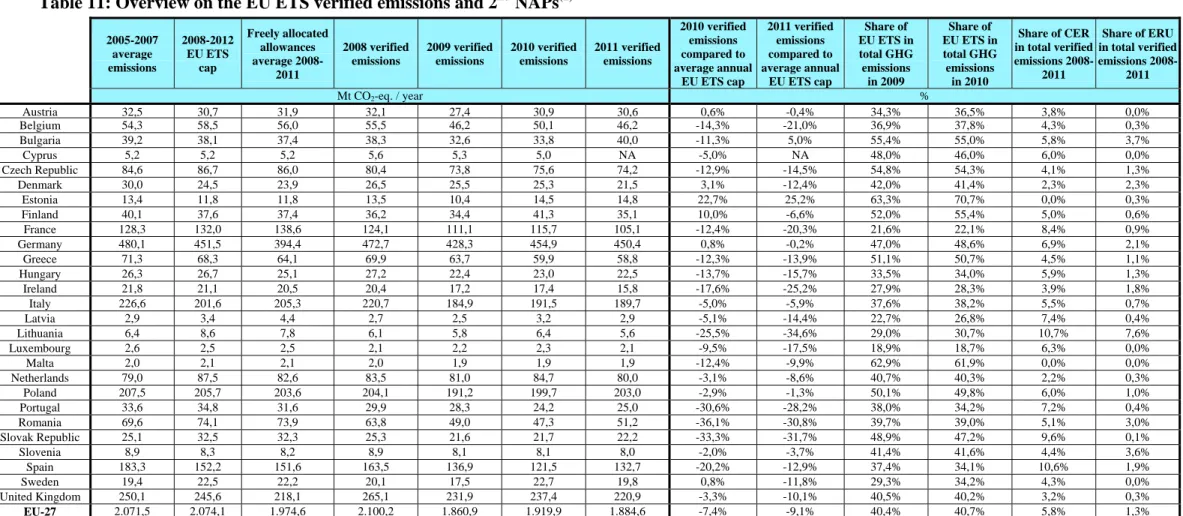
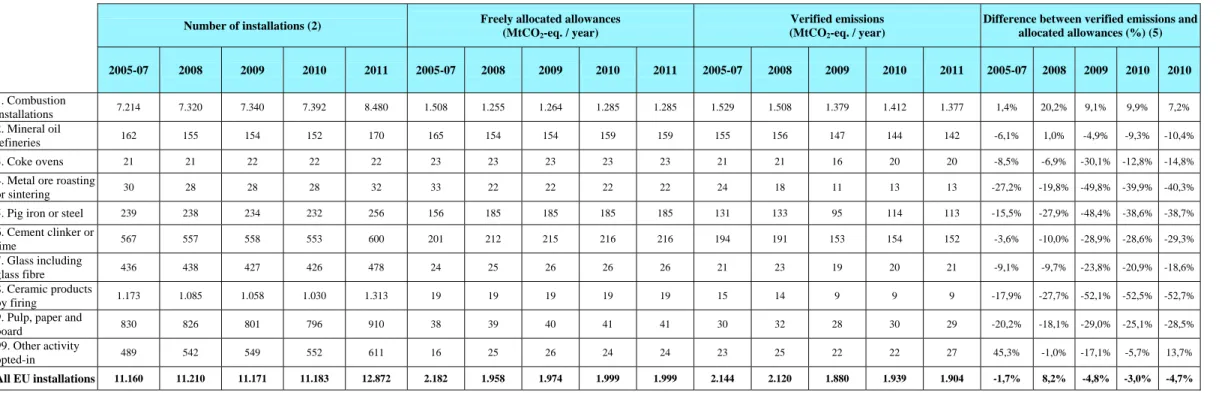
Notes: (1) Please note that due to changes in the application of scope (i.e. the coverage of installations or emissions by the EU ETS) in some Member States between the period 2005-2007 and the trading period, the results may not be can be compared perfectly. verified emissions data relating on the one hand to the trading period 2005-2007, and on the other hand to the trading period 2008-2012. In 2009 and 2010, Germany received 4 Mt from operators due to backup requirements not included in the CITL. France distributed an additional 9.4 million tonnes to operators not included in the CITL in 2008 and 2009.
In 2011, the CITL data showed an additional 9.6 Mt, which is not yet included in the EEA EU ETS viewer.
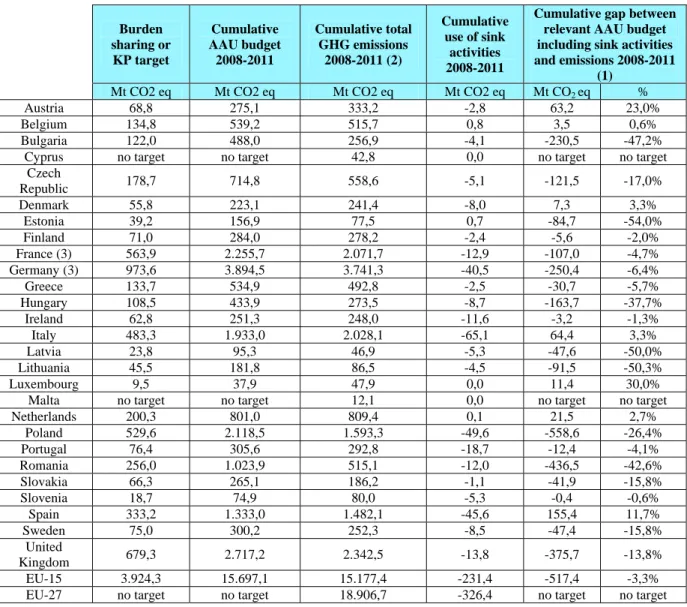
Consistent with reporting emissions inventories, a negative '-' sign is used for removals and a positive '+' sign for emissions. In addition to accounting for forest management up to the maximum allowance, Parties may account for removals from forest management to offset net emissions under Art. In Finland and Sweden, removals from forest management are predicted to exceed the amount of emissions according to Art. and the maximum compensation for forest management.
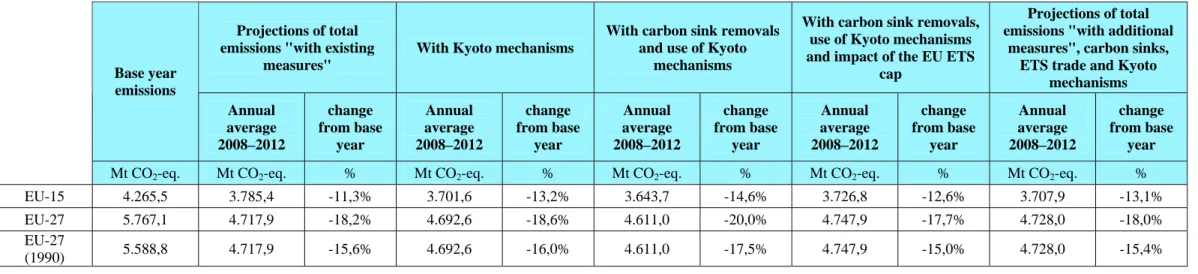
Source: Questionnaires and projection reports submitted under the EC Greenhouse Gas Monitoring Mechanism; Initial Report of the European Community under the Kyoto Protocol (EEA Technical Report No. 10/2006); Initial reports of Greece and Romania under the Kyoto Protocol; Decisions 16/CMP.1 and 8/CMP.2 of the Conference of the Parties serving as the meeting of the Parties to the Kyoto Protocol. The EU's joint commitment to a 20% reduction by 2020 also includes CO2 emissions from international flights from the EU. The reductions achieved so far by the EU-27, when emissions from international aviation are also taken into account, amount to -14% compared to 1990 levels39.

Emissions (MtCO 2 -eq.) covered by the Kyoto Protocol
Emissions (MtCO 2 -eq.) covered by the Climate and Energy Package
Developing the knowledge base
CLIMATE-ADAPT is currently hosted and managed by the EEA and is publicly accessible here: http://climate-adapt.eea.europa.eu/. Under the EU's 7th Framework Program for Research / FP, climate change remains a key priority, including research on climate change adaptation. A number of projects funded under FP 7 will contribute to improving the assessment framework by improving the understanding of the climate system and its processes, quantifying the impact of climate change on human and natural systems (including extreme events), and to the identification and assessment of mitigation and adaptation options, including their costs.
Most relevant FP7 projects: ClimateCost: Full cost of climate change inaction and adaptation; CLIMSAVE: Climate Change Integrated Assessment Methodology for Cross-Sectoral Adaptation and Vulnerability;. RESPONSE: European responses to climate change: deep reduction of emissions and mainstreaming of mitigation and adaptation; MEDIATION: Methodology for effective decision-making about impacts and adaptation; CCTAME: Climate Change, Terrestrial Adaptation and Mitigation; ClimateWater: Bridging the gap between adaptation strategies of climate change impacts and European water policies; ACQWA: Assessment of climate change and impact on the quality and quantity of water; PRINTS: Improving preparedness and risk management for flash floods and debris flow events; CLIWASEC: Cluster - Climate-Water- Security; IMPACT2C: Quantifying projected impacts under 2°C warming; ArcRisk: Impacts on Health in the Arctic and Europe from Climate-Induced Changes in Contaminant Cycling; CLEAR: Climate change, environmental pollution and reproductive health Viroclime: Impact of climate change on the transport, fate and risk management of viral pathogens in water; EDENext: Biology and Control of Vector-Borne Diseases in Europe; DROUGHT-R&SPI: Advancing European Drought Research and Science-Policy Interface; CULTURAL RISK: Knowledge-based approach to developing a culture of risk prevention. Develop indicators to better monitor climate change impacts, including vulnerability impacts, and progress on adaptation by 2011.
A set of studies and contributions from research projects will be used to transform the general concept of vulnerability promoted by Impact Assessment A (along the lines of IPCC AR4) into an operational instrument to be used to raise awareness, guiding the design of adaptation policies (eg funding requirements), assessing the effectiveness of adaptation measures. 1) 2012 Indicator-Based Report on Climate Change Impacts and Vulnerability in Europe 2) 2012 Climate Change Adaptation Report in Europe. Cost and benefit assessment of adaptation options by 2011 A database on adaptation measures will be the backbone of this action.
It will be integrated into CLIMATE ADAPT and will collect information available from existing FP7 projects and other ongoing projects. A methodological study has been launched that will provide a comprehensive overview of the available information on the costs of adapting to adaptation measures within the EU, and an overview of existing methods to identify these costs. It will also assess and compare such methodologies, and identify the methodological and data challenges associated with calculating expenditure for adaptation.
Currently in the process of being built, GEOSS will aim to encompass all areas of the globe, covering in situ, air and space-based observations. The data and information include climate change with the strategic target of achieving effective and sustained operation of the global climate observing system and reliable delivery of climate information of a required quality.
Action EU Action – status and planned
- Integrating adaptation into EU policies a) Health and social policies
- Instruments – Financing
- Partnership with the Member States
- External dimension and UNFCCC
- Improve climate predictability, 2) Developing climate services, 3) Understanding societal
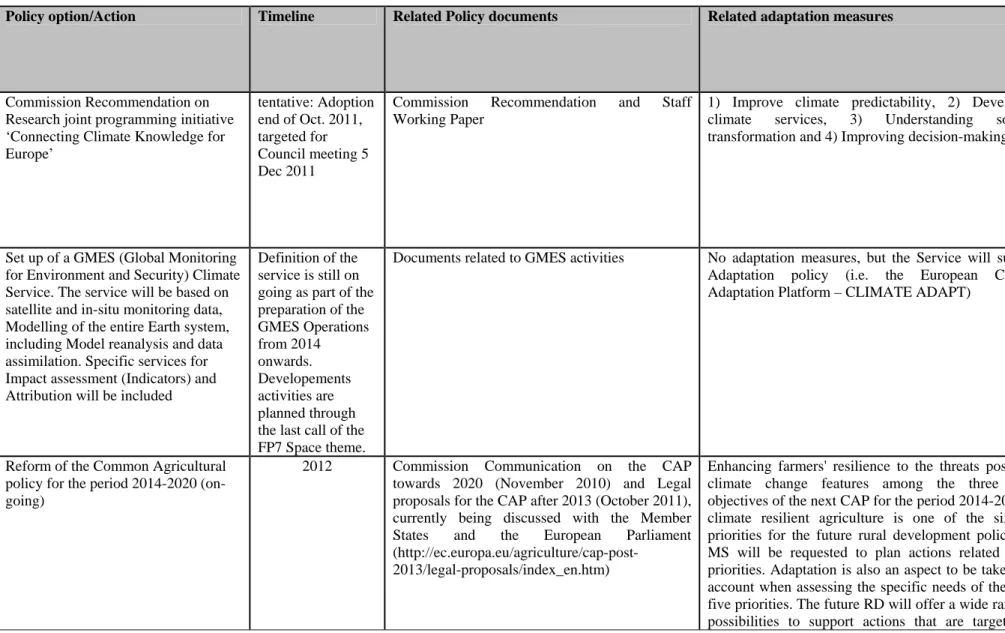
A portion of 15% of the new funds made available has been allocated for mitigation and adaptation measures. The Commission's proposal for the post-2013 CAP envisages expanding its scope to climate-related aspects, such as information on the potential impacts of climate change on relevant regions, the impact on GHG emissions of relevant agricultural practices and the contribution of agriculture. mitigation sector. Within the framework of the revision of the Rural Development Policy after 2013, the further development of forestry measures will be examined.
Providing scientific and economic analyzes for the review of the EU thematic strategy on air and the European Climate Change Program (ECCP). Climate change was one of the four key policy areas identified in the communication on "Halting the loss of biodiversity by 2010 – and beyond" and the Biodiversity Action Plan includes the objective "to support biodiversity adaptation to climate change". Ensure that climate change is taken into account when implementing the Flood Directive.
Work is progressing on the catalog of good adaptation measures and on improving information on past floods. Ensure that adaptation in coastal and marine areas is taken into account in the framework of the Integrated Maritime Policy, in the implementation of the Marine Strategy Framework Directive and in the reform of the Common Fisheries Policy. The Marine Strategy Framework Directive will facilitate adaptation to climate change by ensuring that climate change aspects are integrated into Member States' marine strategies, while providing a mechanism to regularly update marine strategies to take account of new information.
This could be considered as part of the EU Communication on Climate Change Adaptation Strategy to be adopted in 2013. A study on the use of economic instruments for climate change adaptation was completed in 2011, which examined the use of the following instruments: risk management Instruments, market instruments, public - private partnerships. The use of instruments is analyzed from two aspects: Promotion of adaptation to climate change and sharing (transfer) of climate change risks.
Explore the feasibility of collecting data on climate change expenditure (mitigation and adaptation) as part of the environmental accounting system. The group is also expected to assist the COM in drafting the 2013 adaptation strategy. Increasing farmers' resilience to the threats of climate change is among the three main objectives of the next CAP for the period 2014-2020.
Adaptation is also an aspect to consider when assessing the specific needs of the other five priorities.
Technical notes
Directive 2009/28/EC on the promotion of the use of renewable energy sources sets legally binding targets for each member state to achieve the EU target of a 20% share of renewable energy sources.
Directive 2009/28/EC on the promotion of the use of renewable energy sets legally binding targets for each Member State in order to reach the EU target of 20% share of renewable
Directive 2009/31/EC on geological storage of CO2 provides a legal framework to manage possible environmental risks and liability issues and includes a long-term incentive for
Regulation (EC) No 443/2009 sets standards for CO2 emissions from new passenger cars, which will ensure that emissions from the new car fleet are reduced to an average of 130g
Council on or after 1 January 2006 specifying the administering Member State for each aircraft operator with regard to the extension of the Union emissions trading scheme to EEA EFTA countries (OJ 27.4.2011 L 107/1). No 510/2011 of the European Parliament and of the Council of 11 May 2011 establishing emission performance standards for new light commercial vehicles as part of an integrated approach to reduce CO2 emissions from light vehicles. This amounts to an overall JI/CDM limit of around 6.5% of the EU-wide limit over the period 2008-2020. The exact limits for each installation will still have to be determined, but the directive already grants existing operators access to credits of at least 11% of their allocation during the period 2008-2012.
In addition, new entrants and new sectors, including aviation, have minimum levels of access to JI and CDM credits.