Maggie Hargrave, Program Coordinator, Family Resource Center of Truckee Amy Kelley, Executive Director, North Tahoe Family Resource Center Matt Kowta, Director, BAE Urban Economics. John McLaughlin, Community Development Director, City of Truckee Aaron Nousaine, Senior Associate, BAE Urban Economics.
DEFINITION OF TERMS
Low Income: Households categorized as low income include those with an annual income equal to more than 50 percent, but not more than 80 percent, of the area median income for the county in which it is located, adapted to the size of the family. Median Income: Households categorized as moderate income include those with an annual income that is equal to more than 80 percent, but not more than 120 percent, of the area median income for the county in which it is located. which is located, adapted to the size of the family.
EXECUTIVE SUMMARY
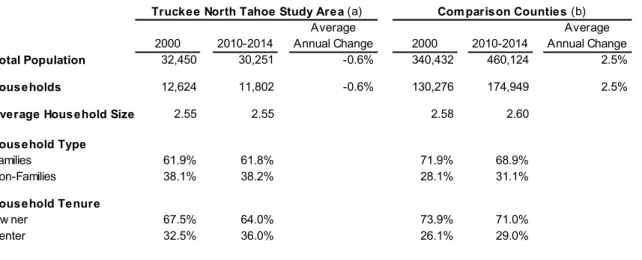
Most communities within the study area also experienced notable population losses, with the exception of Truckee and Sunnyside-Tahoe City, which both increased in population. Compared to households in comparison countries, households in the study area are more likely to live in overcrowded conditions.
INTRODUCTION
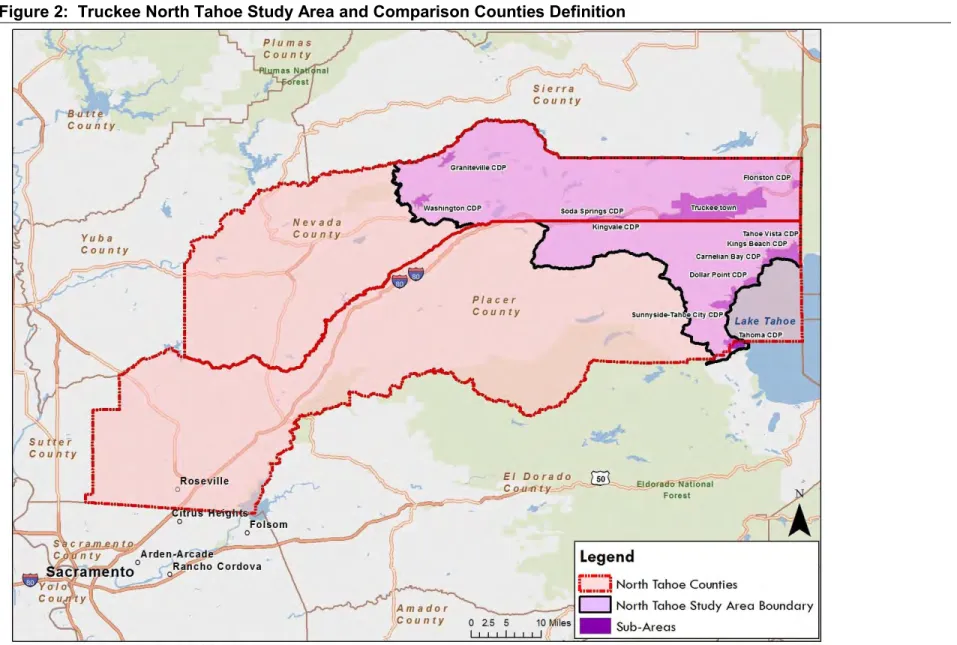
The Truckee North Tahoe Study Area (study area) is next defined using both 2000 and 2010 census block group definitions. Using 2000 definitions, the Study Area is composed of 44 separate Block Groups covering a total land area of 844 square miles.
DEMOGRAPHIC AND ECONOMIC TRENDS
The median age in the Truckee North Tahoe study area was somewhat lower than in the comparison countries. The distribution of households by income is similar in both the Truckee North Tahoe Study Area and the Comparison Counties.
HOUSING STOCK CHARACTERISTICS
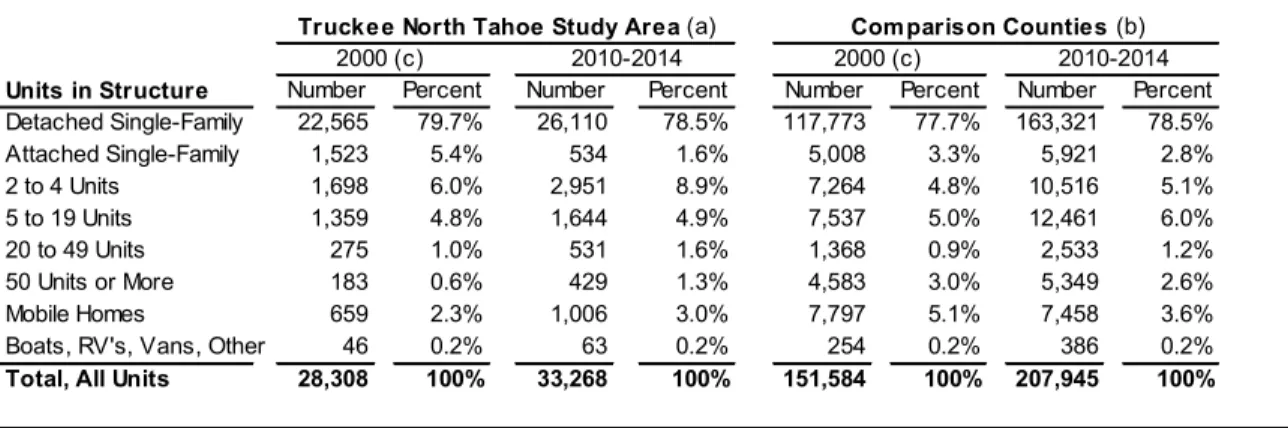
This represents a moderate increase since 2000, when approximately 3.0 percent of the housing stock was vacant, excluding seasonally occupied units. However, as shown in Table 17, approximately 25.9 percent of the residents in the study area consist of only one person, while another 38.0 percent consist of two people. All income levels: Of households at all income levels in the Truckee North Tahoe study area, 49.1 percent had a housing cost burden of more than 30 percent of income, while 26.1 percent had a housing cost burden of more than 50 percent of income.
In the Truckee North Tahoe study area, 81.0 percent had a housing cost burden greater than 30 percent, while 78.0 percent had a cost burden greater than 50 percent of income. Owner households in this income bracket were somewhat less affected, with 67.4 percent paying more than 30 percent of their income. Among low-income households that own their own home, 70.2 percent had more than 30 percent of their expenses paid.
Moderate Income: Among moderate-income households in the Truckee North Tahoe study area, 50.6 percent had a housing cost burden of more than 30 percent of income, while 22.6 percent had a housing cost burden of more than 50 percent of income. Above average income: Of the above-mentioned moderate households in the Truckee North Tahoe study area, 27.6 percent had a housing cost burden of more than 30 percent of income, while only 4.5 percent had a housing cost burden of more than 50 percent of income.
HOUSING MARKET CONDITIONS
All current rental multifamily housing units in the study area, with the exception of those available in Sawmill Heights, are concentrated in the City of Truckee. Based on the data, however, housing units located in the Placer County portion of the study area are registered for. All but one of the existing below market rate housing projects are located in Truckee.
All of the subsidized affordable rental complexes contacted for this survey identified a high demand for subsidized units in the Truckee North Tahoe region. There are no residential projects planned or in the pipeline in the Nevada County portion of the study area. Although not definitively known, it is likely that most of the housing units identified in
Only two of the identified sites in the Truckee North Tahoe Study Area portion of the County are zoned for high-density residential development. The inventory of vacant sites in the Placer County portion of the Study Area 1,850 acres of developable land on 38 sites. Currently, there are funds available for residents who make up to 120 percent of the area median.
The program provides down payment assistance in the form of deferred loans of up to $38,000 to families making up to 80 percent of the area median.

EMPLOYEE AND EMPLOYER SURVEY RESULTS
Conversely, 48 percent of respondents work in Truckee, while 18 percent work in Tahoe City and 16.5 percent work in Olympic Valley. As shown in Figure 12, 60 percent of all employee survey respondents live in single-family homes, while 16 percent live in apartments and eight percent live in apartments. As noted above, 60 percent of employee survey respondents live in single-family homes, which is roughly 20 percentage points lower than the share of all study area residents living in single-family homes.
Recognizing the high cost of housing, a total of 1,040 employee respondents (77 percent) living within the Study Area reported paying more than 30 percent of their income for housing, with 425 respondents (32 percent) reporting paying more than 50 percent of their income toward housing costs. The second largest concentration of respondents was in Tahoe City, which accounted for 17 percent of all respondents to the employer survey. Overall, about 60 percent of employer survey respondents work in industries that primarily serve residents, such as Natural Resources and Construction, Business or.
As shown in Figure 17, 82 percent of all businesses reported that the availability of adequate housing for workers in the Truckee North Tahoe region impacted the recruitment and retention of their workforce, with approximately 48 percent reporting a "significant" impact on their business. About six percent of all respondents provide housing for their employees, either on-site or off-site.

OUTREACH AND PUBLIC PARTICIPATION
This community outreach portion of the Project added significant support and depth to BAE's data analysis. The Community Collaborative of Tahoe Truckee (CCTT) is a program of the Tahoe Truckee Community Foundation. CATT promoted the surveys and forums through the regular activities of the Association and worked with CATT members to introduce storytellers and focus group participants.
Elevate Tahoe was engaged as an outreach partner to collect a series of solution-based videos that will educate and engage the community throughout the final stages of the study. From the beginning of the study, TTCF committed to a multi-part print media series using a regular TTCF column in the Sierra Sun. To engage the community, two forums were held in the early stages of the study, with three additional informational forums held in the later stages.
For a summary of the workforce housing policy results and program prioritization, see Appendix G. For more in-depth summaries of the information discussed in each of the three special issue focus groups, see Appendix J.
WORKFORCE HOUSING DEMAND ESTIMATES
An analysis of ACS data for CDPs in the Study Area indicated that there were an average of 1.6 workers per household for worker households in the Study Area. The difference between these two estimates is equal to the total number of seasonal workers who live in the Study Area only part of the year. 24 Due to the requirement for a minimum population of 100,000, the PUMAs extend beyond the Study Area;.
25 Resident labor force households are defined to include those resident households that contain at least one worker who is physically employed within the survey area. Unmet non-resident workforce housing demand estimates are based on the proportion of commuter survey respondents who indicated they would move to the study area if suitable housing options were available. Moderate income households account for approximately 20.6 percent of unmet need, which translates into unmet demand for nearly 2,500 units.
Upper-middle-income households account for 37.1 percent of unmet need, which translates to approximately 4,507 units. Households with a permanent year-round workforce account for 33.7 percent of total unmet need (4,100 units), while households that are seasonal residents account for 9.8 percent (1,196 units).

WORKFORCE HOUSING CASE STUDIES
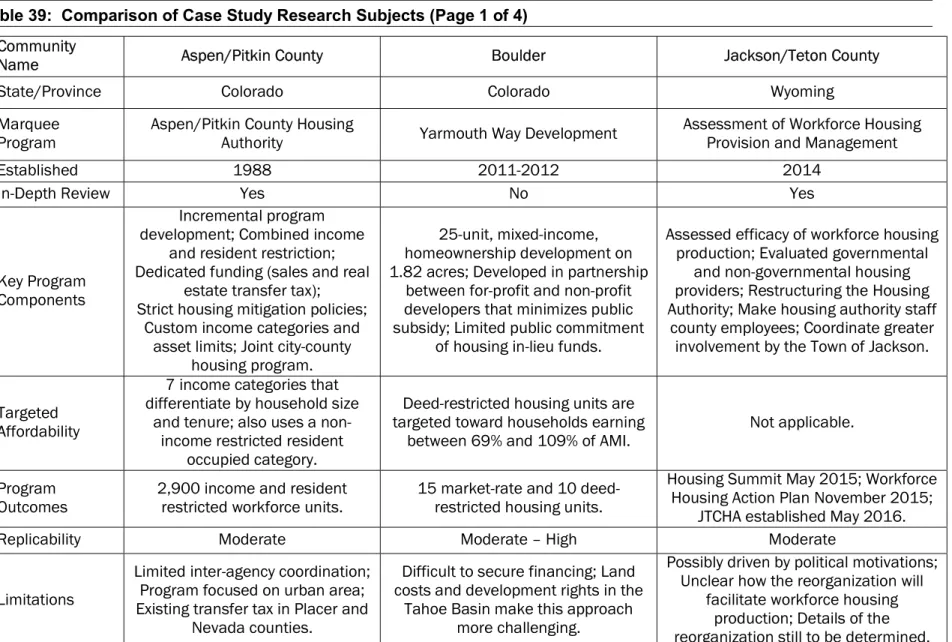
The cornerstone of the Aspen/Pitkin County Housing Program is a set of affordable housing mitigation requirements associated with private sector land development. Units can be built outside of the City of Aspen, but only with the approval of the City Council. These represent nearly twenty-two percent of the total housing stock in Pitkin County.
The implementation of the Affordable Housing Credits program is intended to encourage faster development of workforce housing by allowing units to be deed-restricted. Defining income categories based on local conditions and needs has facilitated the management of workforce housing, but has also significantly increased the complexity of Aspen/Pitkin County's housing program. Between 2007 and 2014, only 21 percent of workforce housing produced was the result of workforce housing.
According to Rhoda Stauffer, housing specialist with the Park City Municipal Corporation, workforce wages typically equal approximately 60 percent of the area median income (AMI). According to municipal staff, around 260 deed-restricted homes have been established since the establishment of the municipality's inclusive housing requirement in the 1990s.
REGIONAL WORKFORCE HOUSING POLICY AND PROGRAM OPTIONS
Regional stakeholders should establish an "Entity" that will take the lead in implementing the Regional Workforce Housing Action Plan. Advocate at all levels of government for actions necessary to fully implement the Regional Workforce Housing Action Plan. Provides a means for the participating jurisdictions to hold themselves accountable for implementing the portions of the Regional Workforce Housing Action Plan for which they are individually responsible.
Board support – coordinating and facilitating periodic board meetings; including monitoring and reporting progress in implementing the Regional Workforce Housing Action Plan. One of the roles of the Housing Council should be to advocate and educate within the region about workforce housing needs. This conversation will be an important part of the work to be undertaken by the Truckee North Tahoe Regional Housing Council as it pursues the development of a regional workforce housing action plan.
Land owned by government agencies in the region is an important asset that can be used to support the production of workforce housing. An alternative could be to work with lawmakers to earmark a portion of the region's existing TOT for workforce housing development.
APPENDIX A: STUDY AREA DEFINITIONS
APPENDIX B: DEMOGRAPHIC AND ECONOMIC TRENDS BY SUBAREA