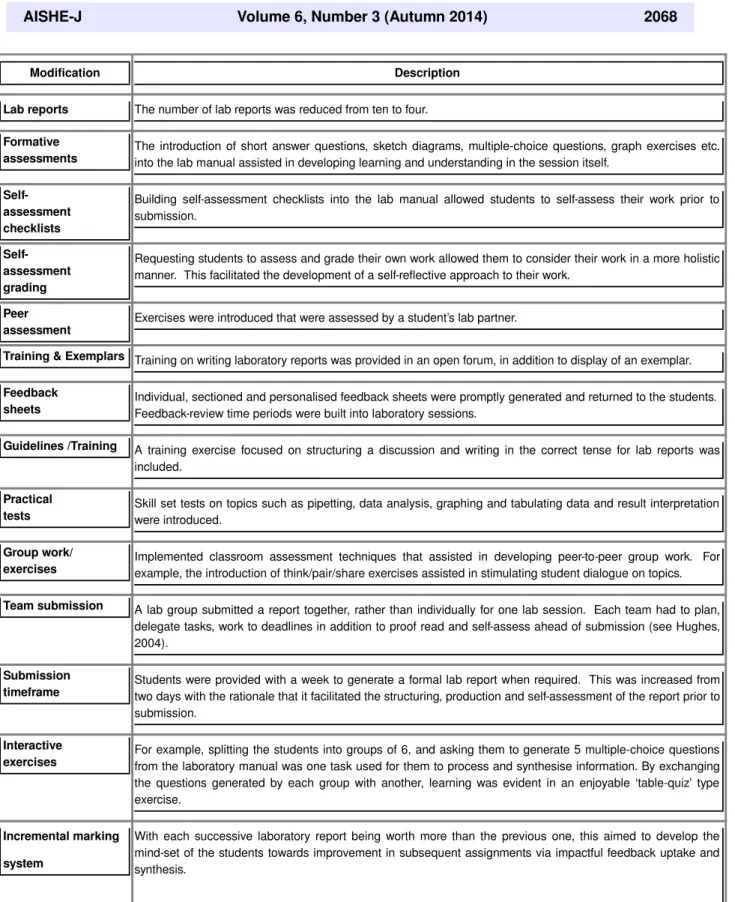
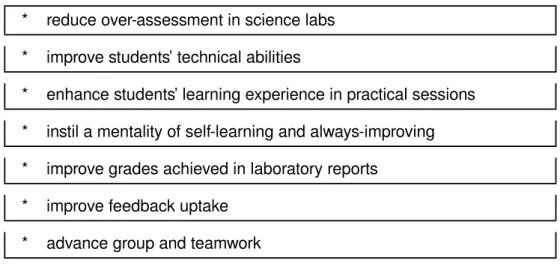
The goal of the scholarship of teaching and learning (SOTL) requires that, in a teaching capacity, they research and focus on the quality of their students' learning and understanding while encouraging learning-focused conceptions of teaching (Boyer Light & Cox, 2009) . The aim of this study was to implement and evaluate changes in the delivery and assessment of the standard laboratory system. This article describes a short-term mixed methods study conducted over a semester of the biochemistry module (the study was piloted 12 months earlier to facilitate its design with the evaluation of the main study presented here).
A smaller subgroup was selected to allow close observation of skill set tests and implementation of feedback. Assessment is at the heart of the student experience,” wrote Sally Brown and Peter Knight (1994). Assessment is one of the most controversial aspects of teaching, but it is also an emotionally sensitive aspect (Fry et al, 2009; Light & Cox, 2009).
In the context of constructivist learning theory, feedback is part of the platform that the teacher provides to enable students to learn (Orsmond et al., 2005). This statement supports the rationale for implementing a complete overhaul of the system as described in this article. This was increased from two days on the rationale that it facilitated the structuring, production and self-assessment of the report prior to submission.
Each student was provided with study information leaflets, an overview of the assessment methods (i.e. online questionnaire, focus groups) and study participation forms.
Results & Discussion
Reduction in the number of lab reports
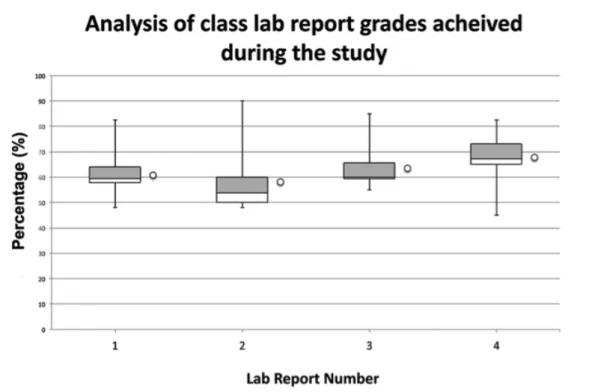
Incremental Marking System
Eleven respondents (91.7%) felt that they improved their performance in writing laboratory reports and learned how to implement feedback. There is a slight decrease in the mean/median for the second lab report, which may be explained by the group report that was done just before and during reading week—students later stated that they would have preferred it to have occurred completely during the regular semester. time. Interestingly, the pilot intervention indicated a similar trend, even with a slight decrease for the second report.
Therefore, one must take into account that students may need time to adapt to the system, and especially to realize the role of the feedback/its recording (Price et al., 2010; Boud & Falchikov, 2006; Nicol & MacFarlane Dick, 2006; Brown, 2007). This requirement may stem from prior educational experiences and potential unfamiliarity with the feedback survey concept (Fee et al., 2009). While this is a good concept, the incremental marking system will be ineffective without constructive feedback on how to improve.
Price and colleagues (2010) stated that students who did not recognize the feed-forward function of feedback had only a short-term view in its application. Therefore, it was essential that the role/function of feedback was understood by both the teacher and the students (Gibbs and Simpson, 2004). Sadler (1998) found that students may need to be taught how to use feedback to develop metacognitive control. Therefore, a session on the role of feedback was held at an early stage.
As recommended by Orsmond et al., (2002), feedback review time periods were built into laboratory sessions allowing students to ensure they understood the feedback, check it against their report and ask for clarification during the session, i.e. th. Educators' use of feedback from students can increase motivation and learning, encourage reflection and clarify understanding (Orsmond et al., 2005). From the educator's perspective, generating feedback took time (echoing Hughes, 2004; Pickford and Brown, 2006).
The researcher was very aware, feedback often only highlighted mistakes, with no praise given for aspects of work done correctly or beyond expectations (an opinion presented in Brown, 2004). The feedback sheets gave me the information I needed to improve my grade with each submission. Overall, the researcher noted that students were applying feedback suggestions and not making the same mistakes a second time.
Interactive Lab Manual Exercises
I felt that the difference in quality between my first submission and my last submission was therefore enormous (feedback).” Peer learning/assessment has been shown to contribute to the development of self-assessment skills, so this has been used regularly (Nicol and Milligan, 2006; Segers and Dochy, 2001). Overall, the Self-Assessment Checklist received an 8.1/10 in questionnaire responses because “it ensures that you have completed all parts of the laboratory report and is not missing any items” and “provides me with a clear, concise layout gave for the laboratory reports. ”.
However, the self-assessment aspect proved to be “difficult” for the students (as reiterated in Stefani, 1994). One student said they “didn't like grading themselves but saw the benefit of it,” while another student noted that it was “difficult to grade my own work” and that they “wanted to be told where I'm going wrong." I think it forced students to actually think about the quality of the work being done.
The development of self-reflection through the process of self-assessment was one of the key aims of the study (Stefani, 1994; Dochy et al., 1999; Boud, 2001). Students reported that the self-assessment process with lab reports "forced you to go back," "look again," "feel like you can do more," or ask yourself, "could it be better?" , proving self-. One of the students stated in the focus group that the self-assessment “made me feel guilty” about their level of work, which led him to state that they “wrote excuses” into the self-assessment form.
Other responses included that students felt they had to "be modest" with their self-assessment and that they were "very reticent about the 'well achieved'" option, with one saying that self-assessment had a big impact: "I had to think". A very different emotion identified in one student in relation to self-assessment was that of fear - the student "felt that the self-assessment mark might blow the mind of the proofreader and that they would agree that my work is bad This aspect of the intervention emphasizes the requirement for an open dialogue between lecturer and students about self-assessment (as recommended by Carnell (2007) in relation to feedback).
Finally, one student used the self-assessment form as an “opportunity to explain what you were having difficulty with, to ask for help.” The fact that the self-evaluation resulted in an emotional response shows that the students actively reflected on their work and evaluated their efforts – an invaluable ability (Stefani, 1994). Performing exercises/activities in the laboratory is preferable to doing them at home.
Concluding Remarks & Recommendations
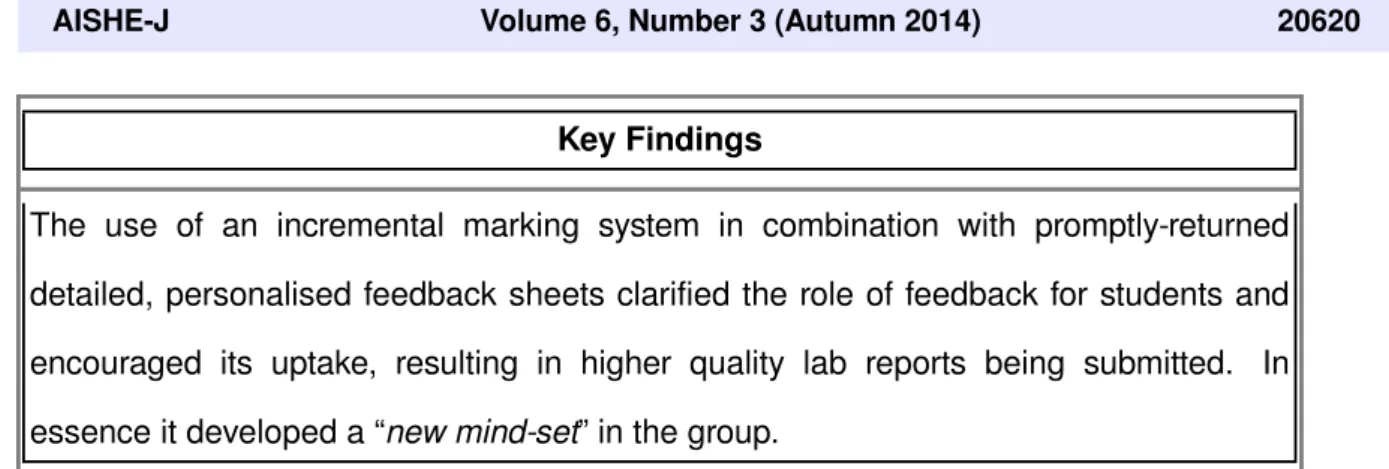
For any educators considering aspects of this particular intervention for their own practice, the authors would recommend adopting the incremental marking system in combination with personalized, distributed feedback sheets and self-evaluation forms after observing their success in this study. Equally important is that a dialogue about the role of feedback and self-assessment is established early in the process between the educator and the students - engaging in feedback should be presented as an opportunity for learning, showing students how they can be further developed in future work (Knight and Yorke, 2003; Poulos and Mahony, 2008). Despite the limitation of a small sample size, the authors would not anticipate any concerns in conducting the intervention with larger group numbers.
These approaches will build on Hunt and colleagues' (2012) recommendation to enhance “all dimensions of learning” in the laboratory. In summary, reducing the number of laboratory reports, combined with the introduction of formative assessments and peer-evaluation oriented approaches, facilitated students' understanding of a subject and the development of practical skills. An incremental marking system stimulated an ever-improving, self-learning trait in students, while the self-assessment/feedback process was enhanced so that all parties involved actively engaged in a feedback-feed-forward dialogue that led to improvement in the quality of laboratory reports.
Given that the laboratory represents an important place for learning and understanding, an effective learning framework is crucial.
Acknowledgements
V Rethinking assessment in higher education; learning in the long run (David Boud and Nancy Falchikov);. V Rethinking assessment in higher education; long-term learning (David Boud and Nancy Falchikov); Routledge Publications. Using tutor feedback and student self-assessment in summative assessment tasks: Towards transparency for students and tutor.
29 Supplemental Material 1 – Lab grading Rubric
30 Supplemental material 2 – Online Questionnaire
32 Supplemental Material 3 – Focus Group Questions
Over the term (using this new system in the labs), the class’ average mark for Biochemistry lab write-ups increased, why do you think this occurred?
How do you feel about the incremental marking scheme used over the term?
Can you comment on the feedback system used in this project?
How do you feel about the structure of the biochemistry lab manual?
How did you feel about the self-assessment checklist/form that accompanied your lab submissions?
33 Supplemental Material 4 – Feedback Sheet Template
34 Comments
35 Supplemental Material 5 – Self-Assessment Form