Therefore, this study first examined how students self-reported their beliefs about feedback, SRL, and self-efficacy, and second, the relationships between these constructs and their English language performance in the College English course. A questionnaire was used to collect data on students' beliefs about feedback, SRL, self-efficacy, and self-perceived English proficiency. From a theoretical perspective, this study addressed the research gap in the literature by jointly examining four constructs, namely students' beliefs about feedback, SRL, self-efficacy, and English language performance within a university context in China.
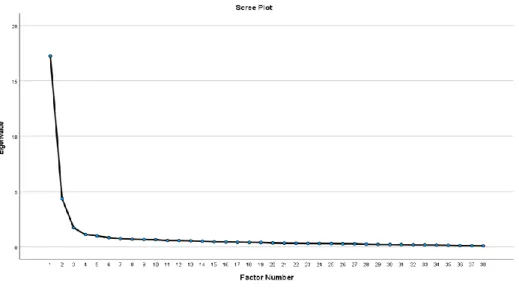
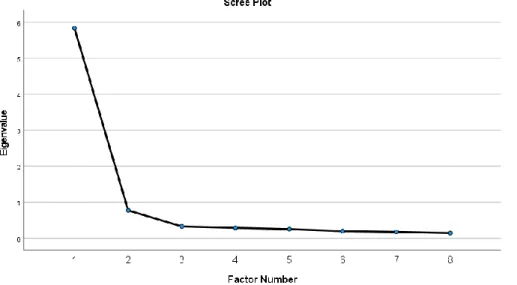
From the pedagogical angle, the results can also support teachers with their feedback practices to facilitate students' SRL, self-efficacy and learning. 24 Figure 2 Screen plot for exploratory factor analysis of students' perceptions of feedback with 38 items extracting a 3-factor solution. 36 Figure 4 Screen plot for exploratory factor analysis of self-efficacy scale with 8 items extracting a 1-factor solution.
Introduction
Formative assessment is supported in higher education in China and is an important format of College English assessment that provides feedback on both teaching and learning. Feedback, as an integrated part of formative assessment, occupies a large proportion of the College's English classroom assessment. In the College English course in China, student-centered learning is highly encouraged when the traditional teacher-centered learning was found to be increasingly problematic (Cheng &Wang, 2012).
However, empirical studies on the relationship between feedback as an integrated part of formative assessment and SRL, especially in the College English course in China, are found to be scarce. This study first examined students' conceptions of feedback, SRL, and levels of self-efficacy in a College English course from a university in Northern China, and then investigated the relationships between students' conceptions of feedback, their use of self- arranged learning, itself. - efficiency and achievement of the English language in this context. How Chinese Students Self-Report Their Concepts of Feedback, SRL Strategy Use, and Self-Efficacy in the College English Course in China.
Literature Review
Students' self-efficacy together with the ways to regulate their learning determine their academic performance. Some research suggests that certain types of feedback can promote self-efficacy and improve academic performance. Chan and Lam (2010) investigated the effects of feedback on students' self-efficacy by conducting two experiments in Hong Kong.
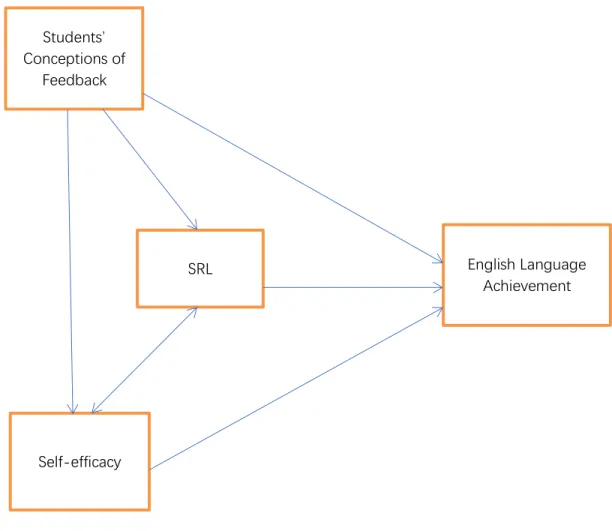
The aim of the first study is to compare the effects of summative and formative feedback on students' self-efficacy. A study (Gan et al., 2020) in China examined the relationships between students' feedback behavior, feedback preference, and self-efficacy in English language. The schematic relationships between students' beliefs about feedback, SRL, self-efficacy, and English language performance provide a visual representation (see Figure 1) for this study.
Methods
The English language performance used the students' latest English test scores and students self-assessed English language proficiency as the indicators. Section two: Students' conceptions of feedback were measured by the adapted version of Student Conceptions of Feedback Questionnaire-Ⅲ (Irving & Peterson, 2007). Section three: Self-regulated learning strategies use was measured by the Metacognitive Self-regulation subscale of the Motivated Strategies for Learning Questionnaire (MSLQ) by.
Prior to the study, ethics approval (see Appendix B) was received from Queen's University's General Research Ethics Board (GREB) in December 2021 to ensure participants were aware of the risks and benefits of the study. As part of participation, participants' recent English test scores were obtained with participants' consent. At the beginning of the online survey, participants were asked if they agreed to consent to access their recent English test scores.
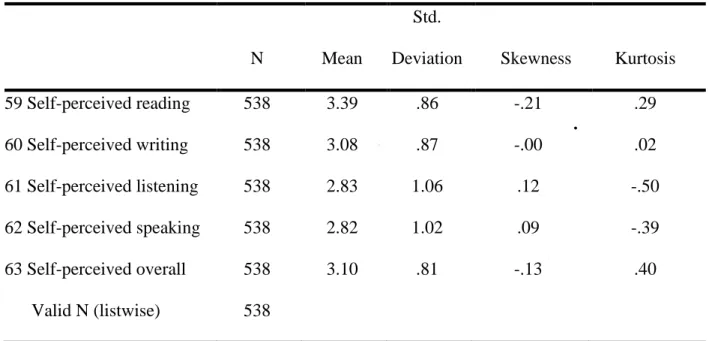
The most recent English test scores were used as an indicator of English language achievement in the College English course for this study. Participants' questionnaire responses and their English test scores were entered into Statistical Package for the Social Sciences 27 (SPSS Version 27) for further analysis. First, to address the first research question, descriptive statistics (eg, means, standard deviations, confidence intervals, skewness, and kurtosis) of students' concepts of feedback, SRL, self-efficacy, and self-perceived ability were calculated. of the English language.
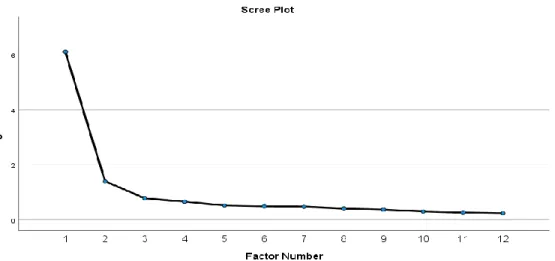
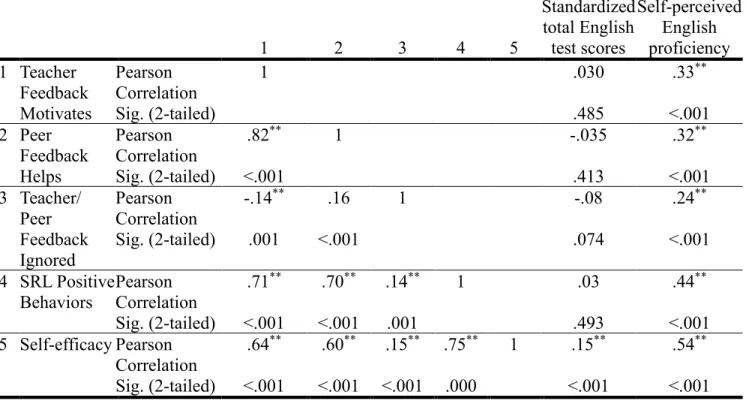
Second, exploratory factor analyzes were used to identify the latent variables in the student conceptions of feedback scale, SRL scale, self-efficacy scale, and self-perceived English proficiency scale. Third, Pearson product-moment correlation coefficients were first calculated to examine the bivariate relationships between students' English test scores and their self-perceived English proficiency. Furthermore, to answer the second research question, correlations between all variables, that is, students' beliefs about feedback, SRL, self-efficacy, self-perceived English proficiency, and their English test scores, were examined.
For research question 2a, standard multiple regression analyzes were conducted with students' beliefs about feedback variables as the independent variable, SRL and self-efficacy as.
Results
Four separate analyzes were conducted, first on the Student Concepts of Feedback Scale, then on the SRL Scale, Self-Efficacy and the Self-Perception of English Proficiency Scale. Next, it was conducted across all possible variables to explore the relationships between students' concepts of feedback, SRL, self-efficacy, and English language achievement. To explore the relationship between students' concepts of feedback, SRL, self-efficacy and English language achievement, Pearson correlation analysis was conducted between all possible variables.
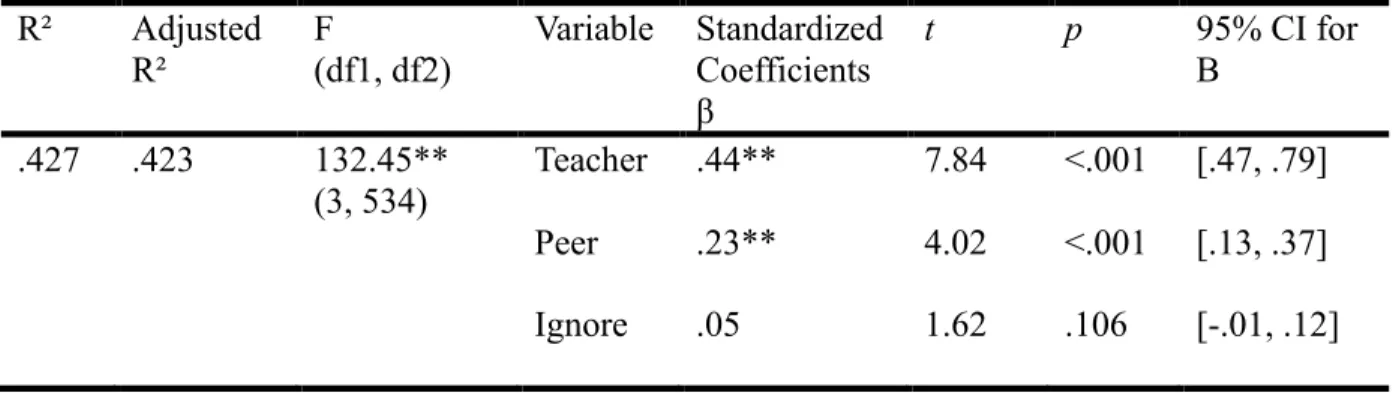
The results also indicated that the factors Teacher-feedback motivates and Peer-feedback helps from the students' perception of the feedback scale were positively and significantly correlated with SRL Positive Behaviors, Self-efficacy and Self-perceived English proficiency. To answer research question 2a, multiple regression analyzes were conducted to explore the contributing power of students' perceptions of feedback on SRL strategy use and on self-efficacy. In addition, to answer research question 2b, stepwise regression analyzes were conducted to explore the extent of students' perceptions of feedback, SRL strategy use, self-.
In the regression, the three variables identified in students' concepts of feedback were entered as independent variables, and SRL Positive Behaviors were entered as a. As shown in Table 5, students' concepts of feedback explained 54.6% of the variance of Positive SRL Behaviors. To explore the predictive power of students' conceptions of feedback on self-efficacy, students' conceptions of the feedback variables were treated as independent variables and the self-efficacy variable as the dependent variable.
Predictive Power of Self-efficacy, SRL, and Students' Perceptions of Feedback on English Language Performance. To explore the predictive power of self-efficacy, SRL, and students' perceptions of feedback on their English language performance, stepwise regression analyzes were conducted with the self-efficacy variable, the SRL variable, and students' perceptions of feedback variables as the independent variables, and with self-perceived English proficiency and the standardized total English test scores as dependent variables, respectively. In the regression model, students' self-perceived English skills were entered as the dependent variable first.
Stepwise regression analyzes (see Table 7) showed that Teacher Feedback Motivations, Peer Feedback Helpfulness, and SRL Positive Behaviors were not in any model, indicating that they did not contribute to students' self-perceived English.
Discussion and Conclusion
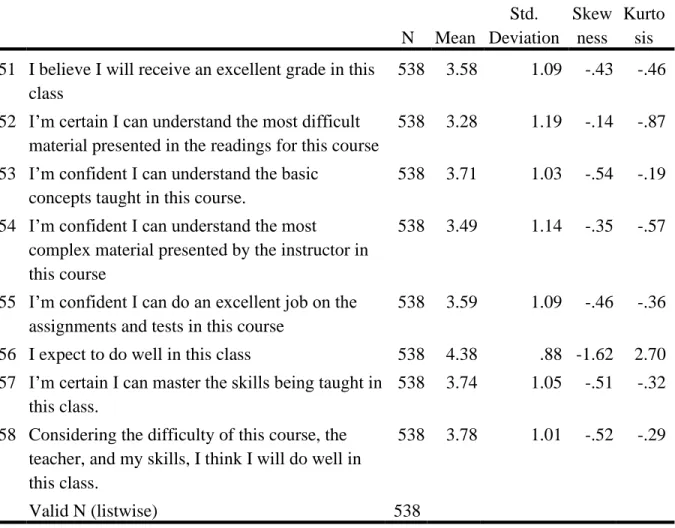
The second unique finding of this study is that students' perceptions of feedback contributed to the self-reported high level of SRL strategy use and self-efficacy on their. The means of positive behavior in SRL (M= 3.68) and Self-efficacy (M=3.70) suggested that students generally identified themselves as self-regulated learners with high self-efficacy in the College English course. Teacher/Peer Feedback Ignored was not found to be a significant predictor of both positive behavior in SRL and self-efficacy.
Students who used more SRL strategies presented a higher level of self-efficacy in English writing (Bai & Guo, 2018). In summary, there was a strong alignment between SRL and students' self-efficacy. conceptions of feedback and SRL, as well as students' conceptions of feedback and self-efficacy. The third unique finding of this study is that self-efficacy was found to be the largest contributor to English language performance.
Students who rejected feedback may have higher self-efficacy, which was the largest predictor of self-perceived English proficiency. From a theoretical perspective, this study adds to the literature by investigating students' concepts of feedback, SRL, and self-efficacy levels and their relationship with English language achievement in a different context of students in China. From a pedagogical perspective, self-efficacy was found to be the strongest predictor of self-perceived English language proficiency and standardized English test scores, both indicators of.
Therefore, students' independence should be given an important place to be cultivated in the College English course. It is very important for teachers to adapt their assessment practices in the classroom to develop students' self-efficacy. In conclusion, this study could enable educators and researchers to understand how Chinese college students' perceptions of feedback affected their SRL, self-efficacy, and English language performance in the College English course.
Influences of self-regulated learning strategy use on self-efficacy in primary school students' English writing in Hong Kong. Validation of the instruments to measure ESL/EFL learners' self-efficacy beliefs and self-regulated learning strategies. This questionnaire consists of five sections, including demographic information, perceptions of feedback, self-regulated learning strategies, self-efficacy, and self-assessment for English language proficiency.
Total Variance Explained of the Self-efficacy Scale
I am confident that I can understand the basic concepts taught in this course .87 53 I am confident that I can understand the most complex material presented by. I am sure I can master the skills taught in this class .87 57 Considering the difficulty of this course, the teacher and my skills, I have.