February 11, 2022
Added
METRO VANCOUVER REGIONAL DISTRICT CLIMATE ACTION COMMITTEE
REGULAR MEETING Friday, February 11, 2022
1:00 p.m.
Meeting conducted electronically pursuant to the Procedure Bylaw 28th Floor Boardroom, 4515 Central Boulevard, Burnaby, British Columbia
Webstream available at http://www.metrovancouver.org
R E V I S E D A G E N D A1
1. ADOPTION OF THE AGENDA
1.1 February 11, 2022 Regular Meeting Agenda
That the Climate Action Committee adopt the agenda for its regular meeting scheduled for February 11, 2022 as circulated.
2. ADOPTION OF THE MINUTES
2.1 January 14, 2022 Regular Meeting Minutes
That the Climate Action Committee adopt the minutes of its regular meeting held January 14, 2022 as circulated.
3. DELEGATIONS
3.1 Alex Boston, Executive Director, Renewable Cities & Fellow, SFU Morris J Wosk Centre for Dialogue
Subject: Climate 2050 Land Use Policy Implications Preliminary Analysis & Land Use Big Moves to Meet Targets
4. INVITED PRESENTATIONS
4.1 Ralf Nielsen, Director, Enterprise Sustainability and Caitlin Cooper, Project Manager, Regional Transportation Strategy, TransLink
Subject: TransLink's Climate Action Strategy
1Note: Recommendation is shown under each item, where applicable.
Climate Action Committee Regular Agenda February 11, 2022 Agenda Page 2 of 3
5. REPORTS FROM COMMITTEE OR STAFF
5.1 2022 Liquid Waste Sustainability Innovation Fund Application
That the GVS&DD Board approve the allocation from the Liquid Waste Sustainability Innovation Fund of $270,000 over two years starting in 2022 for Phase 1 of the Biorock: Innovative Building Material for Shoreline Protection, Carbon Sequestration, and Habitat Creation project.
5.2 2022 Regional District Sustainability Innovation Fund Applications
That the MVRD Board approve the allocation from the Regional District Sustainability Innovation Fund for the following projects:
a) Showcasing Innovation in Alternative Powered Park Operations and Maintenance Equipment to Reduce Emissions: $35,000 in 2022;
b) Social and Community Data Model – Phase 2: $180,000 over two years starting in 2022;
c) Net Zero Water Technology Accelerator: $175,000 over two years starting in 2022;
d) Integrating greenhouse gases requirements into air emission permits and regulations: $150,000 over two years starting in 2022;
e) Taking out the Trash: Transitioning to Zero-Carbon Heavy Duty Vehicles through Waste Collection Trucks: $400,000 over three years starting in 2022;
f) Metro Vancouver Large Building Retrofit Accelerator: $850,000 over three years starting in 2022;
g) Driving Down Emissions: Working with Key Partners to Develop a Regional Pathway to Accelerate Transportation Emission Reductions: $455,000 over two years starting in 2022; and,
h) Smart Cities: Hyperlocal Air Quality Monitoring: $250,000 over two years starting in 2022.
5.3 2022 Water Sustainability Innovation Fund Applications
That the GVWD Board approve the allocation from the Water Sustainability Innovation Fund for the following projects:
a) 10-year Salmon Enhancement Action Plan: $180,000 over two years starting in 2022;
b) Hydrological Models for the Capilano and Seymour Watersheds: $750,000 over three years starting in 2022;
c) Digital Transformation of Water Transmission System Planning & Analysis:
$950,000 over three years starting in 2022;
d) Feasibility Study to Optimize Transmission System Energy Use: $350,000 over two years starting in 2022;
e) Regional Equity and Affordability of Drinking Water: $550,000 over three years starting in 2022; and,
f) New Technology for the Determination of E.Coli in Recreational Water to Enhance Public Safety: $200,000 over two years starting in 2022.
Climate Action Committee Regular Agenda February 11, 2022 Agenda Page 3 of 3
5.4 Alignment between MoveUP Proposal and Metro Vancouver Climate 2050 Buildings Roadmap
That the MVRD Board direct staff to engage with the Canadian Office and Professional Employees Union (MoveUP) as part of the implementation of the Climate 2050 Buildings Roadmap, to seek opportunities for collaboration related to their proposal titled “Capitalizing on Retrofitting Opportunities for Greenhouse Gas Emissions Reductions and Job Creation”.
5.5 Manager’s Report
That the Climate Action Committee receive for information the report dated January 28, 2022 titled “Manager’s Report”.
6. INFORMATION ITEMS 7. OTHER BUSINESS
8. BUSINESS ARISING FROM DELEGATIONS 9. RESOLUTION TO CLOSE MEETING
Note: The Committee must state by resolution the basis under section 90 of the Community Charter on which the meeting is being closed. If a member wishes to add an item, the basis must be included below.
10. ADJOURNMENT/CONCLUSION
That the Climate Action Committee adjourn/conclude its regular meeting of February 11, 2022.
Membership:
Carr, Adriane (C) – Vancouver Dhaliwal, Sav (VC) – Burnaby Arnason, Petrina – Langley Township Baird, Ken – Tsawwassen First Nation Dupont, Laura – Port Coquitlam
Hocking, David – Bowen Island Kruger, Dylan – Delta
McCutcheon, Jen – Electoral Area A McIlroy, Jessica – North Vancouver City McLaughlin, Ron – Lions Bay
Patton, Allison – Surrey Royer, Zoë – Port Moody Steves, Harold – Richmond Wilson, Chris – Coquitlam Yousef, Ahmed – Maple Ridge
METRO VANCOUVER REGIONAL DISTRICT CLIMATE ACTION COMMITTEE
Minutes of the Regular Meeting of the Metro Vancouver Regional District (MVRD) Climate Action Committee held at 1:02 p.m. on Friday, January 14, 2022 in the 28th Floor Boardroom Room, 4515 Central Boulevard, Burnaby, British Columbia.
MEMBERS PRESENT:
Chair, Councillor Adriane Carr, Vancouver
Vice Chair, Councillor Sav Dhaliwal*, Burnaby (departed at 4:31 p.m.) Councillor Petrina Arnason*, Langley Township
Councillor Laura Dupont*, Port Coquitlam Councillor David Hocking*, Bowen Island Councillor Dylan Kruger*, Delta
Director Jen McCutcheon*, Electoral Area A Councillor Jessica McIlroy*, North Vancouver City Mayor Ron McLaughlin*, Lions Bay
Councillor Allison Patton*, Surrey
Councillor Zoë Royer*, Port Moody (departed at 4:01 p.m.) Councillor Harold Steves*, Richmond
Councillor Chris Wilson*, Coquitlam Councillor Ahmed Yousef*, Maple Ridge MEMBERS ABSENT:
Chief Ken Baird, Tsawwassen STAFF PRESENT:
Roger Quan, Director, Air Quality and Climate Change, Parks and Environment Jerry W. Dobrovolny, Chief Administrative Officer
Natalia Melnikov, Legislative Services Coordinator, Board and Information Services
OPENING REMARKS
Director Sav Dhaliwal, Board Chair and Vice Chair of the Climate Action Committee, acknowledged the contributions of the Metro Vancouver Standing Committee members in what has been a challenging time for the region due to the COVID-19 pandemic and recognized the vital role this Committee will play in moving forward.
*denotes electronic meeting participation as authorized by Section 3.6.2 of the Procedure Bylaw
2.1
Minutes of the Regular Meeting of the MVRD Climate Action Committee held on Friday, January 14, 2022 Page 2 of 7 1. ADOPTION OF THE AGENDA
1.1 January 14, 2022 Regular Meeting Agenda It was MOVED and SECONDED
That the Climate Action Committee:
a) amend the agenda for its regular meeting scheduled for January 14, 2022 by adding:
i. Item 3.1 Late Delegation – Alex Boston, Renewable Cities, Simon Fraser University;
ii. Item 3.2 Late Delegation – Christy Juteau, A Rocha Canada;
iii. Item 7.1 Other Business – Trans Mountain Pipeline Relocation Under Fraser River;
b) vary the order of the agenda by moving Item 6.1, “Report from Gregory Freeman, Senior Economist and Megan Gerryts, Senior Policy Advisory, Invest Vancouver re Clean Transportation: Findings and Actions to Strengthen the Sector in the Metro Vancouver Region, dated November 1, 2021”, after Item 5.2, “Update on Metro Vancouver Zero Emissions Innovation Centre”; and c) adopt agenda as amended.
CARRIED 2. ADOPTION OF THE MINUTES
2.1 November 5, 2021 Regular Meeting Minutes It was MOVED and SECONDED
That the Climate Action Committee adopt the minutes of its regular meeting held November 5, 2021 as circulated.
CARRIED 3. DELEGATIONS
3.1 Alex Boston, Renewable Cities, Simon Fraser University
Alex Boston, Renewable Cities, spoke to the Climate Action Committee members on the need to focus efforts on reducing carbon emissions, increasing affordable housing and transportation options in relation to Item 5.1, “2022 Climate Action Committee Meeting Schedule and Work Plan”.
Discussion occurred regarding the urgent need to reduce greenhouse gas emissions, increase the use of renewable fuels, and integrate land use and transportation planning.
Presentation material titled “Good to Great” is retained with the January 14, 2022 Climate Action Committee agenda.
3.2 Christy Juteau, A Rocha Canada
Christy Juteau, A Rocha Canada, spoke to the Climate Action Committee members on the proposed Regional Growth Strategy Amendment for South Campbell Heights, in relation to Item 5.1, “2022 Climate Action Committee Meeting Schedule and Work Plan”.
Discussion occurred regarding the need for aquifer and forest protection, and urban land use and transportation planning in ecologically sensitive areas.
Presentation material titled “2022 Work Plan – Climate 2050 – Roadmaps for Nature and Ecosystems and Land Use and Growth Management” is retained with the January 14, 2022 Climate Action Committee agenda.
4 INVITED PRESENTATIONS
4.1 David Black, President and Norman Gludovatz, Director of Communications, MoveUP: the Movement of United Professionals
David Black, MoveUp: the Movement of United Professionals, spoke to Climate Action Committee members on opportunities for financing retrofit programs for existing buildings and grants targeting greenhouse gas emissions reductions.
Discussion occurred regarding the opportunity to liaise with the Provincial Government to explore the retrofit funding programs further.
Presentation material titled “Capitalizing on Retrofitting Opportunities for GHG Emission Reductions and Job Creation” is retained with the January 14, 2022 Climate Action Committee agenda.
It was MOVED and SECONDED
That the Climate Action Committee direct staff to review the alignment between the MoveUP proposal, as presented at the January 14, 2022 meeting in the delegation from David Black, MoveUP, and the Climate 2050 Buildings Roadmap.
CARRIED 5 REPORTS FROM COMMITTEE OR STAFF
5.1 2022 Climate Action Committee Meeting Schedule and Work Plan
Report dated January 4, 2022, from Roger Quan, Director, Air Quality and Climate Change, Parks and Environment, providing the Climate Action Committee with its Terms of Reference, the 2022 Work Plan, and the annual meeting schedule.
Members were provided with a presentation on the Climate Action Committee Work Plan priorities highlighting the extreme weather events in 2021 and the need to address the climate change effects on the region.
Minutes of the Regular Meeting of the MVRD Climate Action Committee held on Friday, January 14, 2022 Page 4 of 7 Members commented on the urgent need to reduce greenhouse gas emissions and the role that land use and transportation planning will have in achieving the climate targets. Discussion ensued on the plans and policies that are within the purview of other standing committees and opportunities for coordination.
Request of Staff:
Staff were requested to explore opportunities to coordinate with other Metro Vancouver standing committees to assist in prioritizing sustainable land use and transportation planning.
Presentation material titled “2022 Climate Action Committee Meeting Schedule and Work Plan” is retained with January 14, 2022 Climate Action Committee agenda.
It was MOVED and SECONDED That the Climate Action Committee:
a) receive for information the Climate Action Committee Terms of Reference and the 2022 Annual Meeting Schedule, as presented in the report dated January 4, 2022, titled “2022 Climate Action Committee Meeting Schedule and Work Plan”; and
b) endorse the 2022 work plan, as presented in the report dated January 4, 2022, titled “2022 Climate Action Committee Meeting Schedule and Work Plan”, incorporating the requested changes from the Climate Action Committee:
i) analysis of how land use will contribute to achieving the greenhouse gas reduction targets, especially for transportation.
CARRIED 5.2 Update on Metro Vancouver Zero Emissions Innovation Centre
Report dated January 4, 2022, from Jen McCutcheon, Director, Electoral Area A, providing the Climate Action Committee with an update on the formation of the Metro Vancouver Zero Emissions Innovation Centre as a new entity that will contribute to the reduction of greenhouse gas emissions in the region.
Members were provided with a presentation on the Metro Vancouver Zero Emissions Innovation Centre highlighting the key milestones and collaboration opportunities.
Presentation material titled “Metro Vancouver Zero Emissions Innovation Centre (ZEIC)” is retained with the January 14, 2022 Climate Action Committee agenda.
It was MOVED and SECONDED
That the MVRD Board receive for information the report dated January 4, 2022, titled “Update on Metro Vancouver Zero Emissions Innovation Centre”.
CARRIED
Agenda Order Varied
Pursuant to Item 1.1 of the agenda, the order of the agenda was varied to consider Item 6.1 at this point.
6 INFORMATION ITEMS
6.1 Report from Gregory Freeman, Senior Economist and Megan Gerryts, Senior Policy Advisory, Invest Vancouver re Clean Transportation: Findings and Actions to Strengthen the Sector in the Metro Vancouver Region dated November 1, 2021
Members were provided with a presentation on Clean Transportation highlighting Metro Vancouver’s role as a regional service leader and outlining the priorities for economic development and the value propositions for key industries.
Presentation material titled “Clean Transportation: Findings and Actions to Strengthen the Sector in the Metro Vancouver Region” is retained with the January 14, 2022 Climate Action Committee agenda.
Agenda Order Resumed
The order of the agenda resumed with Item 5.3 being before the Committee.
5.3 MVRD Non-Road Diesel Engine Emission Regulation Amending Bylaw No. 1337, 2021
Report dated December 13, 2021, from Cindy Onyejekwe, Senior Policy Analyst, and Esther Berube, Division Manager, Air Quality Bylaw and Regulation Development, Parks and Environment, seeking the MVRD Board’s approval of minor amendments to Metro Vancouver Regional District Non-Road Diesel Engine Emission Regulation Bylaw No. 1329, 2021 (Bylaw 1329) that address operational issues and enhance clarity and alignment with the intent of the bylaw.
It was MOVED and SECONDED That the MVRD Board:
a) give first, second and third reading to Metro Vancouver Regional District Non- Road Diesel Engine Emission Regulation Amending Bylaw No. 1337, 2021; and b) pass and finally adopt Metro Vancouver Regional District Non-Road Diesel
Engine Emission Regulation Amending Bylaw No. 1337, 2021.
CARRIED 5.4 Metro Vancouver Regional Consumption-Based Emissions Inventory
Report dated December 16, 2021, from Sheryl Cumming, Project Engineer, Parks and Environment, providing the Climate Action Committee with information about a consumption-based emissions inventory developed for Metro Vancouver, including key findings, trends, and potential implications for future greenhouse gas emissions policies, programs, and inventories.
Minutes of the Regular Meeting of the MVRD Climate Action Committee held on Friday, January 14, 2022 Page 6 of 7 Members were provided with a presentation on the regional consumption-based emissions inventory broken down by the sectors contributing to the emissions, highlighting opportunities for developing a regional approach for managing greenhouse gas emissions.
Presentation material titled “A Regional Consumption-Based Emissions Inventory” is retained with the January 14, 2022 Climate Action Committee agenda.
It was MOVED and SECONDED
That the Climate Action Committee receive for information the report dated December 16, 2021, titled “Metro Vancouver Regional Consumption-Based Emissions Inventory”.
CARRIED 4:01 p.m. Councillor Royer departed the meeting.
5.5 Manager’s Report
Report dated January 4, 2022, from Roger Quan, Director, Air Quality and Climate Change, Parks and Environment, providing the Climate Action Committee with an update on upcoming 2022 events, a provincial funding opportunity and various other on-going initiatives.
It was MOVED and SECONDED
That the Climate Action Committee receive for information the report dated January 4, 2022, titled “Manager’s Report”.
CARRIED 7. OTHER BUSINESS
7.1 Trans Mountain Pipeline Relocation Under Fraser River
Members discussed correspondence from the Protect the Planet group encouraging the Metro Vancouver Board members to file a statement of opposition with the Canada Energy Regulator over the proposal to relocate Trans Mountain pipeline tunnel under the Fraser River.
It was MOVED and SECONDED
That the Climate Action Committee refer to staff the matter of Trans Mountain’s proposal to relocate and re-drill its tunnel under the Fraser River and report back to the Committee with an assessment of the potential impacts and a recommended course of action for consideration.
CARRIED 4:31 p.m. Vice Chair Dhaliwal departed the meeting.
8. BUSINESS ARISING FROM DELEGATIONS
The Committee discussed referring the information from the delegate, Christy Juteau, to the Regional Planning Committee.
It was MOVED and SECONDED
That the Climate Action Committee refer the information from the delegation, Christy Juteau, at the January 14, 2022 meeting to the Regional Planning staff for information and report back to the Climate Action Committee as part of the Manager’s Report.
CARRIED Councillor Yousef and Mayor McLaughlin voted in the negative 9. RESOLUTION TO CLOSE MEETING
No items presented.
10. ADJOURNMENT/CONCLUSION It was MOVED and SECONDED
That the Climate Action Committee conclude its regular meeting of January 14, 2022.
CARRIED (Time: 4:38 p.m.)
____________________________ ____________________________
Natalia Melnikov, Adriane Carr, Chair
Legislative Services Coordinator
50104880 FINAL
1 CLIMATE 2050 LAND USE POLICY IMPLICATIONS
PRELIMINARY ANALYSIS & LAND USE BIG MOVES TO MEET TARGETS Clean Air Plan Commitments & Current Land Use Policy
Metro Vancouver’s Clean Air Plan states
“Strong regional land-use policies are foundational to achieving the targets in the Clean Air Plan.
Building compact, mixed-used communities that connect homes, jobs and recreation with walking, cycling and public transit will reduce driving emissions and will support the protection of important lands such as agricultural and industrial lands, and natural areas” (Metro Vancouver, 2021)
Metro 2050’s vision and goals are consistent with this statement and a broader agenda to advance a prosperous, sustainable, low carbon, resilient future. As the IPCC has underscored, what fundamentally matters for local is smart land use policy integrated with good transportation infrastructure. This is essential for driving GHG reductions and increasing resilience.
Auto oriented land use patterns have been a major driver of the region’s largest and fastest growing sector:
passenger transportation. Metro Vancouver’s current and proposed land use designations unfortunately keep the region on course for a high carbon, high congestion, high cost, high risk and high inequity destination. Metro Vancouver explicitly articulates:
“…no changes have been made to the location of any of the land use designations, the Urban Containment Boundary, the Urban Centres and Frequent Transit Development Areas, or the Special Study Areas.”(Metro Vancouver, 2021)
Excellent Metro Vancouver analysis of urban tree canopy and impervious surface historical trends and projections, based on current (and proposed) land use designations have significant implications for meeting Climate 2050, Clean Air Plan and CleanBC Roadmap targets and objectives:
“There are currently about 6,500 hectares of lands with the regional land use designation ‘General Urban’ within the UCB, that are undeveloped or rural and planned for future urban growth... the remaining urban lands within the UCB will be largely developed over the next 15-20 years... These areas are expected to be developed as mainly low-density housing with some higher density…” (Metro Vancouver, 2019)
The “undeveloped” 6,500 ha within the UCB is roughly the size of a medium sized municipality, e.g., half a City of Vancouver by area, one West Van, two Port Moodys, four New Westminsters or five City of North Vancouvers.
Current and Proposed Land Use Policy Climate 2050 Implications
Coarse projections using defensible and well-documented assumptions and analysis––notably relying on Metro Vancouver sources–– show these land use policies and trends have immense consequences to meeting Metro Vancouver and CleanBC targets and should inform Climate Action Committee work plan priorities.
2030 Driving 2040 Driving 2030 GHGs 2040 GHGs 2030 Urban Tree Canopy 2040 Urban Tree Canopy 650 million km
additional driving in Metro annually
one billion km additional driving in
Metro annually
4.66% passenger vehicle GHG increase
annually
5.25% passenger vehicle GHG increase
annually
5% loss, shrinking UCB
coverage from 32% to 30% 10% loss, shrinking UCB coverage from 32% to 28%
CleanBC Roadmap Target:
25% reduction in driving km by 2030
Climate 2050 Target:
60% reduction by 2030
Metro 2050 Target:
Increase from 32% to 40%
Metro Vancouver’s growth projections for undeveloped land have three implications:
3.1 ON TABLE
1. Increased Carbon & Congestion: Increase passenger vehicle GHGs an estimated 4.66 per cent by 2030 from 2010 levels versus contributing to a targeted 60 per cent reduction and add an estimated 650 million km of driving per year on Metro Vancouver roads versus a 25 per cent reduction as targeted by the BC Government.
2. Loss of Urban Tree Canopy & Climate Resilience: “Result in a loss of over 3,000 ha of tree canopy,” according to Metro Vancouver, virtually wiping out the prospect of meeting a target of increasing urban tree canopy from 32 to 40 per cent. Implications include increased stormwater management costs, vulnerability to flooding and heat wave events, and a sustained decline in ecosystem health, biodiversity and terrestrial carbon.
3. Increased Civic Infrastructure Deficits & Intergenerational Inequity: Because low density development doesn't generate enough revenue to operate, maintain and replace its civic infrastructure, this will increase civic infrastructure deficits. This is a significant additional burden on future taxpayers, further exacerbating one of the greatest inequities of our time: intergenerational inequity. Young people today will not only confront greater climate change impacts, under current policy, affordability, congestion and taxpayer burden will grow and public services will decline. Young, disadvantaged populations will be more adversely impacted.
Yes, the Urban Centres and FTDAs have potential to drive trends in the opposite direction. However, it will be extremely challenging to meet Metro’s GHG reduction targets for 2030 and 2050 as well as broader sustainability and prosperity imperatives with current policies and trends in the undeveloped UCB let alone Special Study Areas.
Climate 2050 Course Correction Framework & Six Big Moves
Climate 2050 is built on big moves. Despite land use planning being the paramount authority of local government and the IPCC recommended arena for climate action, Climate 2050 has no land use big moves. Here are six.
Each and every municipality, its residents, businesses and taxpayers and the region would benefit environmentally, socially and economically, and it would b
1. Housing & Commercial Transit Hubs, generating 1000s of affordable housing units and revenue for TransLink 2. SkyTrain Connected Freight Consolidation Centres & Zero Emission Courier Vehicles, stemming the fastest
growing source of carbon and congestion
3. Industrial Land Protection & Intensification, implementing municipal and Metro policy, catching up to competing ports and embracing the region’s lost practice of multi-storey industrial and employment buildings 4. General Urban Resiliency & Gentle Intensification, meaningfully addressing the region’s single largest land use
designation which is rapidly depopulating
5. Connecting Big Urban Centres - Frequent Transit Corridor Focused Growth, using existing policy tools to meet policy objectives and reverse Metro’s slowest growing land use designation: FTDAs
6. Greenspace Protection, phasing out development on farm, forest and environmentally sensitive land that is driving civic infrastructure deficits, congestion, carbon, intergenerational inequity and increased vulnerability Reinforcing Clean Air Plan Principles
Renewable Cities respectfully provides these insights in the interests of advancing renewable, resilient and restorative urban region, and optimistically, informing the Climate Action Committee Work Plan, notably including the recently added priority to be imminently initiated in Q2:
“analysis of how land use will contribute to achieving the greenhouse gas reduction targets”
Renewable Cities is hopeful these insights can support analysis as well as insight, engagement and policy development that helps Metro Vancouver deliver on its targets and the principles laid out in the Clean Air Plan.
1. Ambitious 2. Evidence-based
3. Equitable
6. Continuous Improvement 7. Prioritize Co-benefits
8. Dynamic
4.1
50587688
TransLink Corporate Climate Action Strategy
Invited Presentation to Climate Action Committee, February 11, 2022 SPEAKERS
Ralf Nielsen, Director, Enterprise Sustainability, TransLink
Caitlin Cooper, Project Manager, Regional Transportation Strategy, TransLink CONTEXT
This presentation is to inform the Committee on the key elements of TransLink’s Corporate Climate Action Strategy, work planned for 2022 and how it supports the Regional Transportation Strategy, Transport 2050.
To respond to the climate emergency, TransLink has developed a Corporate Climate Action Strategy focusing on its operations and infrastructure. It has also committed to new climate and GHG reduction targets:
• Achieve net zero GHG emissions by 2050, with an interim reduction of 45% by 2030, from 2010 levels; and,
• Ensure our infrastructure and operations are resilient to the impacts of climate change.
TransLink has outlined a roadmap to net-zero that outlines the investments and projects required to meet its targets. Together with the roadmap, seven key strategies, and 31 actions have been developed:
1. Reduce GHG Emissions
a. Implement Low Carbon Fleet Strategy b. Develop Net Zero Facilities Strategy 2. Adapt to Climate Impacts
a. Develop Climate Change Adaptation and Resiliency Roadmap b. Support a More Climate-Resilient Region and Low Carbon Economy 3. Advance Governance and Funding
a. Develop and Implement Supporting Climate Policies, Plans, and Processes b. Enhance Climate Education and Communication
c. Secure Funding for Net Zero and Climate Resilience
The Corporate Climate Action Strategy and its implementation support the objectives of Transport 2050, Climate 2050, and a future Regional Resilience Strategy.
Reference:
TransLink’s Corporate Climate Action Strategy is available at www.translink.ca/climate
To: Climate Action Committee
From: Lillian Zaremba, Program Manager, Collaborative Innovations, Liquid Waste Services
Date: January 19, 2022 Meeting Date: February 11, 2022
Subject: 2022 Liquid Waste Sustainability Innovation Fund Application RECOMMENDATION
That the GVS&DD Board approve the allocation from the Liquid Waste Sustainability Innovation Fund of $270,000 over two years starting in 2022 for Phase 1 of the Biorock: Innovative Building Material for Shoreline Protection, Carbon Sequestration, and Habitat Creation project.
EXECUTIVE SUMMARY
The Climate Action Committee is responsible for overseeing the Sustainability Innovation Funds, and for making all funding recommendations to the respective Boards. Staff assist the Climate Action Committee in reviewing and evaluating all proposals that are submitted for consideration. This report presents Phase 1 of the Biorock: Innovative Building Material for Shoreline Protection, Carbon Sequestration, and Habitat Creation project recommended for funding, totaling $270,000 over two years, which will be funded through the Liquid Waste Sustainability Innovation Fund.
PURPOSE
To present one project recommended for Sustainability Innovation Funding for the Climate Action Committee and the GVS&DD Board’s consideration.
BACKGROUND
The Liquid Waste Sustainability Innovation Fund was created by the Board in 2004 to provide financial support to Liquid Waste Services projects that contribute to the region’s sustainability. The GVS&DD Board adopted the Liquid Waste Sustainability Innovation Fund Policy in 2014, with further amendments in 2016 and 2021, to guide the use and management of the Fund. The Policy describes the process of generating, submitting, evaluating and recommending proposals for funding each year.
The Climate Action Committee is responsible for overseeing the Fund, and for making all funding recommendations to the Board. Staff assist the Climate Action Committee in reviewing and evaluating all proposals that are submitted for consideration.
LIQUID WASTE SUSTAINABILITY INNOVATION FUND POLICY
On an annual basis, Liquid Waste projects are submitted to an internal staff Steering Committee, representing a cross-section of the organization, to evaluate projects and initiatives based on the Fund’s evaluation criteria. As defined in the policy, projects need to fulfill the following criteria:
• be overseen by the GVSⅅ
• be consistent with the authority and responsibility of the GVSⅅ
• be consistent with the objectives of the Board Strategic Plan or other Liquid Waste plans as
5.1
2022 Liquid Waste Sustainability Innovation Fund Application Climate Action Committee Regular Meeting Date: February 11, 2022 Page 2 of 3
• consider partnerships including, but not limited to, member jurisdictions, academic institutions, non-governmental organizations, and community groups;
• result in a positive contribution, in the form of tangible results and/or measurable benefits, to the sustainability of the region;
• demonstrate innovation or a continuous improvement approach.
Annually the Climate Action Committee receives an update report on the projects supported by the Fund including the deliverables, outcomes, and the measurable benefits of these projects to the region’s sustainability. A summary of past projects can be found on the Sustainability Innovation Program website (Reference 1).
2022 APPLICATION PROCESS
An internal call for proposals closed on November 5, 2021 and two Liquid Waste proposals were considered by the cross-departmental Sustainability Innovation Fund Steering Committee, composed of representatives from several departments within Metro Vancouver.
The Steering Committee evaluated the submissions and determined that one proposal has strong alignment with promoting regional sustainability and innovation. The proposal recommended for funding by the Steering Committee is listed in the table below with additional detail provided in the executive summary (see Attachment).
Recommended Allocation from the Liquid Waste Sustainability Innovation Fund
Project Title Year Amount Requested
Biorock: Innovative Building Material for Shoreline Protection, Carbon Sequestration, and Habitat Creation
(Phase 1) 2022-2023 $270,000
A biomimicry-inspired mechanism, Biorock uses naturally occurring ingredients in sea water to effectively construct marine structures under water. The process accumulates concrete-like material on a suitably designed frame and continues to grow and strengthen the structure over time. Biorock has been used to produce artificial reefs in other parts of the world.
ALTERNATIVES
1. That the GVS&DD Board approve the allocation from the Liquid Waste Sustainability Innovation Fund of $270,000 over two years starting in 2022 for Phase 1 of the Biorock: Innovative Building Material for Shoreline Protection, Carbon Sequestration, and Habitat Creation project.
2. That the Climate Action Committee receive for information the report dated January 19, 2022, titled “2022 Liquid Waste Sustainability Innovation Fund Application” and provide alternate direction to staff.
FINANCIAL IMPLICATIONS
If the Board approves Alternative 1, $270,000 for the project will be disbursed from the Liquid Waste Sustainability Innovation Fund over two years. The Fund has sufficient capacity to support Alternative 1.
2022 Liquid Waste Sustainability Innovation Fund Application Climate Action Committee Regular Meeting Date: February 11, 2022 Page 3 of 3
Approved projects will be incorporated into applicable work plans and budgets.
CONCLUSION
The Liquid Waste Sustainability Innovation Fund was created by the Board in 2004 to provide financial support for Liquid Waste projects that contribute to the region’s sustainability. The Liquid Waste Sustainability Innovation Fund Policy guides the use and management of the Fund and describes the process of generating, submitting, evaluating and recommending proposals for funding each year.
The Climate Action Committee is responsible for overseeing the Fund, and for making all funding recommendations to the GVS&DD Board. Staff assist the Climate Action Committee in reviewing and evaluating all proposals that are submitted for consideration.
This report presents the Steering Committee’s recommendation to fund Phase 1 of the Biorock:
Innovative Building Material for Shoreline Protection, Carbon Sequestration, and Habitat Creation project over two years.
Additional details of this project are provided in the executive summary (see Attachment). Staff recommend that the Climate Action Committee approve the Steering Committee’s recommendation for funding this proposal and forward the recommendation to the GVS&DD Board for consideration.
Staff recommendation is presented as Alternative 1.
Attachment
Liquid Waste Sustainability Innovation Fund – Executive Summary (49482895)
Reference
http://www.metrovancouver.org/services/air-quality/sustainability-innovation- program/Pages/default.aspx
49331373
49482895
Sustainability Innovation Fund: Liquid Waste Services Executive Summary
Project Name: Biorock: Innovative building material for shoreline protection, carbon sequestration & habitat creation – Phase 1
Amount Requested from Sustainability Innovation Fund: $270,000 for Phase 1 (2022-2023) Purpose:
The purpose of this project is to explore the feasibility of Biorock, an artificial reef material that is grown in situ to provide resilient protection of coastal infrastructure, with the potential to capture carbon from local sea water. Shoreline infrastructure protection and resilience is a concern for critical components of the Metro Vancouver wastewater treatment system that are vulnerable to the effects of climate change, including rising sea level and storm surge.
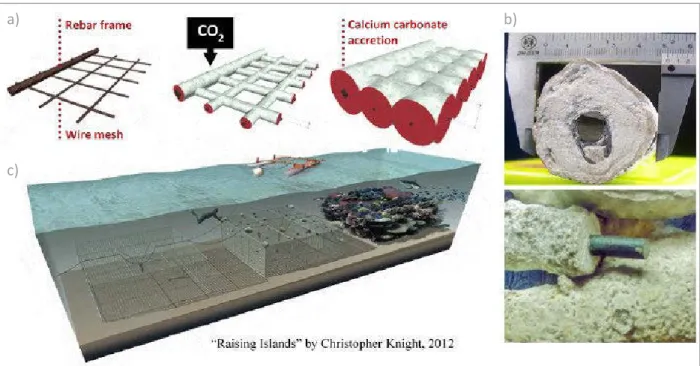
Biorock is formed by applying low-voltage electric current to a submerged metal skeleton, which induces the deposition of solid calcium carbonate from dissolved carbon dioxide and calcium in sea water (Figure 1), similar to how seashells are formed. A Biorock artificial reef acts as a wave break to reduce forces on ocean-facing hard and soft infrastructure and can create marine habitat. Biorock sequesters carbon in the hard material that is formed, and may further sequester carbon by supporting marine vegetation growth.
Expected advantages of Biorock over conventional rock or concrete shore protection include reduced carbon footprint, modularity, self-repairing capability, habitat creation, and reduced environmental impact during installation.
Project Objectives:
Phase 1 will take place over a two-year timeframe, with the following objectives:
• Support research to quantify the local carbon sequestration potential and ecological benefits of Biorock.
• Determine feasibility and develop a design for a Biorock demonstration structure adjacent to Iona Island, including consultation, risk assessment, permitting requirements and cost estimates.
If Phase 1 is successful, Phase 2 will involve fabrication, installation and commissioning of the Biorock demonstration off Iona Island. This SIF application is only for Phase 1. A separate SIF application will be submitted for Phase 2.
Contributions to Regional Sustainability:
Environmental benefits include increased resilience of existing infrastructure to the impacts of climate change, reduced environmental impact of new shore protection installations, and reduced carbon emissions. Biorock installations elsewhere have reduced erosion, created protected ecosystems for marine life, and increased biodiversity. Social/community benefits include development of expertise within the region on alternative coastal infrastructure and educational opportunities for graduate students supported by this project. The project will include opportunities for engagement with Indigenous
ATTACHMENT
communities, neighbours, local environmental groups, and schools. Economic benefits of full-scale installation could include significant savings by extending the lifespan of coastal infrastructure or by providing a lower-cost alternative to traditional shore protection measures. Lifecycle cost comparisons will include the value of carbon set by the Carbon Price Policy.
Innovation Element:
This project aims to demonstrate Biorock as a viable alternative shore protection material in coastal BC waters and determine the range of applications within Metro Vancouver. Although Biorock is well established in other areas of the world, the project seeks to identify the regional scalability and economic considerations of this innovative approach to coastal infrastructure. The ecological benefits of Biorock could lead to innovations in local habitat restoration and applied research partnerships.
Tangible Benefits and Outcomes:
Tangible benefits and outcomes of the project are:
• Quantify carbon footprint of Biorock compared to conventional shore protection structures.
• Prepare design, installation, and operational requirements for a demonstration unit through review of ocean conditions including wave energy, tidal impacts and water quality.
• Produce a feasibility study and cost estimate for a demonstration Biorock installation adjacent to Iona Island, and enable an informed Phase 2 application.
• Develop project plan and identify gaps in expertise or partnerships necessary for permitting, construction, installation, and monitoring of a Biorock demonstration in Phase 2.
Members and Other Partners:
Liquid Waste Services staff will lead the project. The project will be advised by Dr. Thomas Goreau of Blue Regeneration. Dr. Goreau is a preeminent Biorock expert with over 30 years’ experience directly with the technology inventor and has commissioned numerous installations. Dr. Goreau will provide site assessment, conceptual and preliminary design options, and insight into using this unique material. The project will be completed through a research partnership with Principal Investigator Dr. Kim Juniper of University of Victoria and professor Dr. Alfonso Mucci of McGill University. Dr. Juniper’s team will review the formation of Biorock in coastal BC water conditions and quantification of carbon lifecycle. University of Victoria will leverage its allocated SIF funds to seek grants from agencies such as Natural Sciences and Engineering Research Council (NSERC), Mitacs, and others. The scope of work in Phase 1 includes opportunities for engagement with Musqueam, interested municipalities, community groups, and neighbours of Iona Island. Through this, cultural and ecological considerations can be integrated into the design process.
49482895
Figure 1. Biorock formation process: a) progression of accretion on the metal scaffold, b) thickness of Biorock on 10 mm rebar after 18 months, c) illustration of Biorock lifecycle in tropical regions for coral reef formation.
a) b)
c)
To: Climate Action Committee
From: Roger Quan, Director, Air Quality and Climate Change Parks and Environment Department
Date: January 10, 2022 Meeting Date: February 11, 2022
Subject: 2022 Regional District Sustainability Innovation Fund Applications RECOMMENDATION
That the MVRD Board approve the allocation from the Regional District Sustainability Innovation Fund for the following projects:
a) Showcasing Innovation in Alternative Powered Park Operations and Maintenance Equipment to Reduce Emissions: $35,000 in 2022;
b) Social and Community Data Model – Phase 2: $180,000 over two years starting in 2022;
c) Net Zero Water Technology Accelerator: $175,000 over two years starting in 2022;
d) Integrating greenhouse gases requirements into air emission permits and regulations: $150,000 over two years starting in 2022;
e) Taking out the Trash: Transitioning to Zero-Carbon Heavy Duty Vehicles through Waste Collection Trucks: $400,000 over three years starting in 2022;
f) Metro Vancouver Large Building Retrofit Accelerator: $850,000 over three years starting in 2022;
g) Driving Down Emissions: Working with Key Partners to Develop a Regional Pathway to Accelerate Transportation Emission Reductions: $455,000 over two years starting in 2022; and,
h) Smart Cities: Hyperlocal Air Quality Monitoring: $250,000 over two years starting in 2022.
EXECUTIVE SUMMARY
The Climate Action Committee is responsible for overseeing the Sustainability Innovation Funds, and for making all funding recommendations to the respective Boards. Staff assist the Climate Action Committee in reviewing and evaluating all proposals that are submitted for consideration. This report presents eight projects recommended for funding, totaling $2,495,000 over three years, which will be funded through the Regional District Sustainability Innovation Fund. The projects cover a wide range of climate action areas including reducing transportation and building emissions, improving the air quality monitoring network, growing the region’s net zero water technology sector and encouraging alternative powered park operations and maintenance equipment.
PURPOSE
To present eight projects recommended for Sustainability Innovation Funding for the Climate Action Committee and the MVRD Board’s consideration.
BACKGROUND
The Regional District Sustainability Innovation Fund was created by the Board in 2004 to provide financial support to Regional District projects that contribute to the region’s sustainability. The MVRD Board adopted the Regional District Sustainability Innovation Fund Policy in 2014, with further
5.2
2022 Regional District Sustainability Innovation Fund Applications Climate Action Committee Regular Meeting Date: February 11, 2022 Page 2 of 4
amendments in 2016 and 2021, to guide the use and management of the Fund. The Policy describes the process of generating, submitting, evaluating and recommending proposals for funding each year.
The Climate Action Committee is responsible for overseeing the Fund, and for making all funding recommendations to the Board. Staff assist the Climate Action Committee in reviewing and evaluating all proposals that are submitted for consideration.
REGIONAL DISTRICT SUSTAINABILITY INNOVATION FUND POLICY
On an annual basis, Regional District projects are submitted to an internal staff Steering Committee, representing a cross-section of the organization, to evaluate projects and initiatives based on the Fund’s evaluation criteria. As defined in the policy, projects need to fulfill the following criteria:
• be overseen by the MVRD;
• be consistent with the authority and responsibility of the MVRD;
• be consistent with the objectives of the Board Strategic Plan or other regional district plans as applicable;
• consider partnerships including, but not limited to, member jurisdictions, academic institutions, non-governmental organizations, and community groups;
• result in a positive contribution, in the form of tangible results and/or measurable benefits, to the sustainability of the region;
• demonstrate innovation or a continuous improvement approach.
Annually the Climate Action Committee receives an update report on the projects supported by the Fund including the deliverables, outcomes, and the measurable benefits of these projects to the region’s sustainability. A summary of past projects can be found on the Sustainability Innovation Program website.
2022 APPLICATION PROCESS
An internal call for proposals closed on November 5, 2021 and eight Regional District proposals were considered by the cross-departmental Sustainability Innovation Fund Steering Committee, comprised of representatives from a wide variety of departments within Metro Vancouver.
The Steering Committee evaluated the submissions and determined the proposals have strong alignment with promoting regional sustainability and innovation. The proposals recommended for funding by the Steering Committee are listed in the table below with additional detail provided in the executive summaries (Attachment 1).
Recommended Allocation from the Regional District Sustainability Innovation Fund
Project Title Year Amount Requested
Showcasing Innovation in Alternative Powered Park Operations and Maintenance Equipment to Reduce
Emissions 2022 $35,000
Social and Community Data Model 2022-2023 $180,000
Net Zero Water Technology Accelerator 2022-2023 $175,000
2022 Regional District Sustainability Innovation Fund Applications Climate Action Committee Regular Meeting Date: February 11, 2022 Page 3 of 4
Recommended Allocation from the Regional District Sustainability Innovation Fund
Project Title Year Amount Requested
Integrating greenhouse gases requirements into air
emission permits and regulations 2022-2023 $150,000
Taking out the Trash: Transitioning to Zero-Carbon Heavy
Duty Vehicles through Waste Collection Trucks 2022-2024 $400,000
Large Building Retrofit Accelerator 2022-2024 $850,000
Driving Down Emissions: Developing a Regional Policy to
Reduce Transportation Emissions 2022-2023 $455,000
Smart Cities: Hyperlocal Air Quality Monitoring 2022-2024 $250,000
Total $2,495,000
ALTERNATIVES
1. That the MVRD Board approve the allocation from the Regional District Sustainability Innovation Fund for the following projects:
a) Showcasing Innovation in Alternative Powered Park Operations and Maintenance Equipment to Reduce Emissions: $35,000 in 2022;
b) Social and Community Data Model – Phase 2: $180,000 over two years starting in 2022;
c) Net Zero Water Technology Accelerator: $175,000 over two years starting in 2022;
d) Integrating greenhouse gases requirements into air emission permits and regulations:
$150,000 over two years starting in 2022;
e) Taking out the Trash: Transitioning to Zero-Carbon Heavy Duty Vehicles through Waste Collection Trucks: $400,000 over three years starting in 2022;
f) Metro Vancouver Large Building Retrofit Accelerator: $850,000 over three years starting in 2022;
g) Driving Down Emissions: Working with Key Partners to Develop a Regional Pathway to Accelerate Transportation Emission Reductions: $455,000 over two years starting in 2022;
and,
h) Smart Cities: Hyperlocal Air Quality Monitoring: $250,000 over two years starting in 2022.
2. That the Climate Action Committee receive for information the report dated January 10, 2022, titled “2022 Regional District Sustainability Innovation Fund Applications” and provide alternate direction to staff.
FINANCIAL IMPLICATIONS
If the Board approves Alternative 1, $2,495,000 for the projects will be disbursed from the Regional District Sustainability Innovation Fund over three years. The Fund has sufficient capacity to support Alternative 1.
Approved projects will be incorporated into the applicable work plans and budgets.
2022 Regional District Sustainability Innovation Fund Applications Climate Action Committee Regular Meeting Date: February 11, 2022 Page 4 of 4
CONCLUSION
The Regional District Sustainability Innovation Fund was created by the Board in 2004 to provide financial support for Regional District projects that contribute to the region’s sustainability. The Regional District Sustainability Innovation Fund Policy guides the use and management of the Fund and describes the process of generating, submitting, evaluating and recommending proposals for funding each year. The Climate Action Committee is responsible for overseeing the Fund, and for making all funding recommendations to the MVRD Board. Staff assist the Climate Action Committee in reviewing and evaluating all proposals that are submitted for consideration.
This report presents the Steering Committee’s recommendation to fund the following project proposals:
• Showcasing Innovation in Alternative Powered Park Operations and Maintenance Equipment to Reduce Emissions
• Social and Community Data Model – Phase 2
• Net Zero Water Technology Accelerator
• Integrating greenhouse gases requirements into air emission permits and regulations
• Taking out the Trash: Transitioning to Zero-Carbon Heavy Duty Vehicles through Waste Collection Trucks
• Metro Vancouver Large Building Retrofit Accelerator
• Driving Down Emissions: Working with Key Partners to Develop a Regional Pathway to Accelerate Transportation Emission Reductions
• Smart Cities: Hyperlocal Air Quality Monitoring
Additional details of each project are provided in the executive summaries (Attachment 1). Staff recommend that the Climate Action Committee approve the Steering Committee’s recommendations for funding the proposals and forward the recommendations to the MVRD Board for consideration.
Staff recommendations are presented as Alternative 1.
Attachment
1. Regional District Sustainability Innovation Fund Projects – Executive Summaries (50358975) Reference
1. http://www.metrovancouver.org/services/air-quality/sustainability-innovation- program/Pages/default.aspx
49393828
Sustainability Innovation Fund: Regional District Executive Summary
Project Name: Regional Parks: Showcasing Innovation in Alternative Powered Park Operations and Maintenance Equipment to Reduce Emissions
Amount Requested from Sustainability Innovation Fund (SIF):
Project Phases: Event planning early 2022 / Event delivery later 2022 - Total = $35,000 Purpose:
The purpose of this project is to encourage a transition to alternative powered (mainly electric) operations and maintenance equipment. The District will lead and support the initiative by offering commercial equipment vendors an opportunity to spot-light their innovations at a showcase event. Manufactures and suppliers will collaborate at the event with regional and municipal parks operations staff, fleet, procurement and other interested professionals. The ultimate goal is to foster a change in behaviour amongst regional and municipal park operators to increase acceptance and use of emission reducing alternative powered equipment options.
Regional Parks will measure the success of this initiative a couple different ways. First, we will record the number and types of commercial vendors, manufactures and suppliers attending the event. Post-hoc analysis of interest, turnout and the mixture of staff present from member municipalities can inform whether objectives are met. Additionally, Visitor and Operations Services might commission two short surveys following the event. The first survey can solicit feedback from attendees on the relative value of the day. A second survey, intended for operations and maintenance staff, might seek to understand the momentum of transition resulting from the showcase event by analyzing new technology performance and measuring against current Park operation standards, priority tasks and objectives. This survey could attempt to quantify and report on increases in adoption of electric equipment and inform future purchasing by agencies over the next 12 to 24 months.
Project Objectives:
To allow for the demonstration and adoption of innovative electric powered equipment which can be used for operations and maintenance tasks. Legacy objectives of the large one-day showcase event in 2022 include:
• working with member jurisdictions, industry and business groups to develop an awareness about the benefits of zero-emission equipment while showcasing Parks O&M electrical equipment;
• demonstrating the ability of electric powered equipment to “do the job”;
• reducing greenhouse gas and other harmful emissions to support air quality, public health and wellness of Metro Vancouver employees and residents; and
• providing regional leadership to member jurisdictions by encouraging the transition to new and innovative electric technology/equipment options
Contributions to Regional Sustainability:
ATTACHMENT
activities/communities and reduces staff exposure to harmful pollution across the region. This project supports Metro Vancouver’s Climate 2050 goals for the region by helping to achieve the target of a 45%
reduction in emissions from 2010 levels by 2030 and the goal of becoming a carbon neutral region by 2050. Also, concurrent with the development of the regional climate action strategy, this event will continue efforts to encourage small and medium size businesses to make progress on increasing energy efficiency and reducing their carbon footprints.Allowing for the sharing of results / lessons learned from this event and collaborative analysis amongst partners and a broader audience facing similar challenges will provide an opportunity to enhance sustainable operational and maintenance practices and could have a significant cumulative impact on reducing greenhouse gas emissions across the region.
Innovation Element:
This event will provide a venue where equipment manufacturers and vendors can demonstrate the latest technology in electric equipment that can be used in Parks operations and maintenance settings, and bring together internal work groups / municipal peers that do not customarily collaborate on Parks maintenance practices and the procurement of equipment. It is innovative in the sense that this opportunity will offer public agencies the ability to network with industry for the purpose of gaining familiarity with electric powered equipment or vehicles. Unique aspects of the collaboration will focus on electric equipment which: currently exists, is in the research and development stage, or will soon be offered in the market.
Tangible Benefits and Outcomes:
The tangible benefits and outcomes of this project include providing an opportunity to learn about advanced technology and capabilities of the latest electric equipment. An interactive hands-on showcase experience, for regional and municipal parks staff and vendors, will afford the ability to share findings from the event with a broader audience.
The event will promote options to achieve a healthier/safer work environment for employees at worksites across the region. Worksites with less noise pollution, cleaner air and increased health and wellness when using electric equipment to maintain parks and greenways throughout the region. This project also aligns with Corporate & Departmental plans and principles to provide safe, clean and well maintained facilities to park visitors, and promote positive visitor experiences.
Members and other Partners:
Representatives from Metro Vancouver’s 21 member jurisdictions, Electoral Area and Treaty First Nation will be invited to participate in the event, along with agents representing private industry, and potentially academia.
The event may include a partnership with British Columbia Recreation and Parks Association who represent parks agencies from across the Province of BC, and could offer MV Air Quality & Climate Change staff an opportunity to display its clean air exhibit and educate both industry and public sector staff on its Clean Air Plan.
Sustainability Innovation Fund: Regional District Executive Summary
Project Name:
Social and Community Data Model– Phase 2Amount Requested from Sustainability Innovation Fund: $180,000 (2022) Purpose:
Develop and collect data for the Behaviour Model that will provide an enhanced set of assumptions to be used in the Growth Management and Infrastructure Model. This model will assist with decision making related to future planning and infrastructure investment activities.
Project Objectives:
This project has two main objectives: understanding residential housing and neighborhood choices by conducting a new survey and using survey outcomes to develop the Behavioural Model. This model will then be used to base assumptions for the Growth Management and Infrastructure Model. The model will be a critical regional planning tool in spatial forecasting and identifying future infrastructure investments.
Contributions to Regional Sustainability:
This project will have long term impacts from the environmental/social/economic perspective as the outcomes of this project will provide qualitative assumptions, ultimately creating a more robust scenario modelling tool.
From the modeling perspective, Regional Planning has a very robust database of quantitative data that is used to inform policies; these databases are comprehensive and well maintained. The challenge is with the qualitative - "soft" data. For example, we have "numbers" about inter-municipal migrations (quantitative data), but we would like to know which factors triggered inter-municipal migrations within the region (qualitative data)? We are aware that housing affordability is one of the most important factors for deciding where to live, but we also want to know how other factors influence the decision to live in a certain areas of the region or move to another municipality?
With this type of data, Regional Planning will have an additional data source, which will be qualitative in nature, to frame future regional growth and planning policies. It will help set up assumptions for future population and dwelling unit projections; along with helping to define the urban centre and FTDA's growth targets, currently in the Regional Growth Strategy. This data will enhance the inputs for projections and growth targets, ultimately producing better outputs and information for the region's and Metro Vancouver’s utilities and investments in liquid waste, solid waste, and water.
Understanding how people are making choices about housing will impact intra-municipal migration data and this information will assist municipalities in their local growth management and land-use policies.
Innovation Element:
There is a strong innovation element in this project. Metro Vancouver has not invested in similar projects in the past. The Behavioural Model will help regional planning through many aspects: we will better
groups or only work-age population, which age groups prefers to live in urban centres and which ones prefer less dense and peripheral zones, what is the preferred housing type for highly skilled professionals, what is the urban design vision of the student population, where do seniors prefer to live, and what is their preferred housing type, etc. We will also test what walkability means to our residents. Is walkability a critical factor in deciding where to live?
In addition, we would like to obtain the data by socio-economic groups (i.e. urban inners, sub-urban outers, high skilled professionals, students, seniors, etc.) to understand their preferences about location/socio-economics/visual factors (i.e. urban form, walkability, proximity to transit, proximity to facilities, etc.).
Using these data/assumptions, Regional Planning staff will run many different spatial scenarios. One of the important innovations and benefits is the ability to run each scenario in an integrated manner. This means criteria can be aggregated to a specific purpose and be assessed against the "business as usual"
scenario (BAU - baseline scenario) that excludes the Behavioral model inputs. Regional Planning will then be able to test the difference between regional growth according to historical trends (BAU scenario) and regional growth based on people's preferences (their vision), creating a very rich data source/trend line.
Overall, this data, and the project as a whole, is important to understanding people patterns across the region. Generally, because it requires significant resources and is costlier to collect, qualitative data is not as widely used in land use modelling scenarios. However, having these assumptions will have a profound impact on how land use designations and region building are undertaken across the Region in the future.
Tangible Benefits and Outcomes:
This project is phased for one year with the following deliverables:
1. Finalize survey questions
2. Select the sampling method that will be used for the survey 3. Conduct the survey
4. Analyze survey results
5. Develop the Behavioural Model
Project results will benefit the Regional Planning and Housing and other Metro Vancouver departments, mainly Parks and Environment, Water Services, and Liquid Waste Services. They will be able to use the behavioural model data independently or as a scenario that is integrated with the land-use model.
Moreover, aggregated survey results by municipalities will be an excellent source for municipal partners in framing their local land-use policies.
Members and other Partners:
Metro Vancouver will finance this project, but project outputs will be aggregated geographically to MV sub-regions and municipalities. Therefore, municipalities can be considered partners since they will have strong benefits from this project.
Sustainability Innovation Fund: Regional District Executive Summary
Project Name:
Net Zero Water Technology AcceleratorAmount Requested from Sustainability Innovation Fund: $175,000 (2022-2023) Purpose:
Climate change, drought, population growth, and urbanization pose significant threats to water systems across our planet. The Net Zero Water Technology Accelerator project is aimed at accelerating the Metro Vancouver region’s water technology innovation ecosystem to solve global challenges in water systems.
In collaboration with Foresight Cleantech Accelerator this project will help firms in the region commercialize, grow, and export their net zero water technologies.
Project Objectives:
The Metro Vancouver region has an opportunity to lead innovation in the water technology space.
Working with Foresight’s WaterNEXT team, the Net Zero Water Technology Accelerator project will:
• Define the regional specializations in this industry
• Build capacity for net zero applications
• Provide strategic support for Metro Vancouver-based startups, small and medium sized enterprises (SMEs), and service providers
• Host a global showcase of Metro Vancouver net zero water technologies to investors in key markets
Contributions to Regional Sustainability:
This project will advance the capabilities of the region as a hub for water innovation, advancing the sustainability of many of the largest sectors in Canada including utilities, energy, mining, agriculture, and manufacturing. The project is specifically targeting net zero water applications.
Innovation Element:
Innovation and technology has a vital role to play globally in improving water scarcity and safety, water efficiency, utility operations, monitoring and treatment, and data and analytics. Increasingly, there is a greater willingness by investor-owned and public utilities to test, pilot, adopt, and scale promising technologies, such as the remote sensing of water and the internet of things, which enables smart irrigation, water quality control, and water management. (Source: Chloe Oliver Viola, “The future of water:
How innovations will advance water sustainability and resilience worldwide”, World Bank (dated: June 15, 2020.) The Metro Vancouver region has built-in productive advantages (R&D expertise, public sector procurement and commitment, labour market specializations, capital access, etc.) to develop world- leading specialization in water technology.
This project is specifically aimed at advancing innovation around net zero water technology. The targeted companies are advancing innovation in water tech across many specializations, including filtration and treatment, data and software, as well as monitoring and testing.