
Many rural and remote Indigenous and non-Indigenous communities in Canada lack access to clean, safe drinking water due to inadequate drinking water infrastructure, among other challenges. We examine the effects of the global COVID-19 pandemic on various communities in NL that rely on drinking water dispensing units (PWDUs) as key elements of their drinking water systems. Furthermore, this article provides insight into the relationships across stakeholder groups that are relevant to drinking water management and governance in NL.
The article concludes with recommendations for future research that will continue to add new insights into collaborative multi-level governance for drinking water safety in NL. That was the case for Potable Water Dispensing Units (PWDUs), also called Advanced Drinking Water Systems or water kiosks, in the province of Newfoundland and Labrador. PWDUs have emerged in the Netherlands in recent decades as a small-scale infrastructure option to provide clean and safe drinking water (Lacey, 2016; Minnes & Vodden, 2014).
We find that fragmented and overlapping drinking water jurisdictions across Newfoundland and Labrador require collaborative multi-level governance structures to effectively adapt and respond to water security solutions in rural, remote and Indigenous communities. Many communities in the Netherlands, especially those with a population of 1000 or less, struggle to ensure reliable access to clean drinking water (Minnes & Vodden, 2017). In addition, access to a reliable supply of clean and safe drinking water is essential for maintaining optimal health, managing existing diseases, and maintaining hygiene (Hanrahan et al., 2014).
Various actor groups within the CMLG drinking water network, including such organizations, can play a key role in improving the capacity for the operation of water systems and contributing knowledge in different jurisdictions (Van Tol Smit et al., 2013).
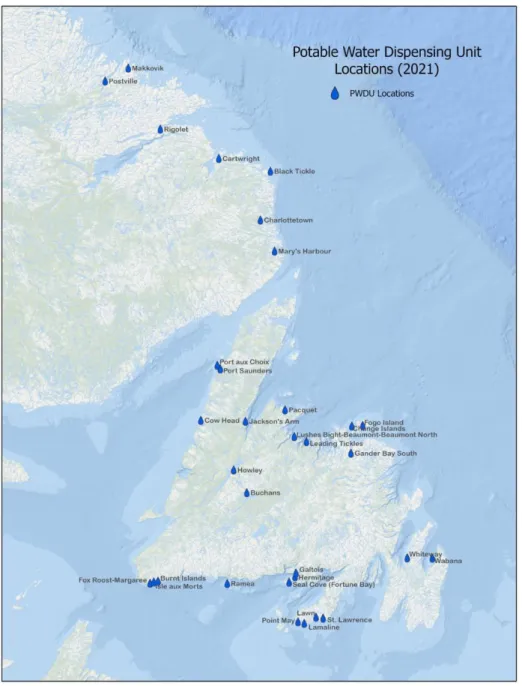
Results
This section presents and discusses the findings from the semi-structured interviews conducted in 2020 and the webinar in 2021 with communities using PWDUs throughout the COVID-19 pandemic. Although our findings suggest that PWDUs provided a stable source of drinking water in many communities throughout the pandemic, almost all (n=14/15) communities that participated in interviews faced challenges related to the COVID-19 pandemic reported. In other cases, COVID-19 has led to reduced access to training and delays in the installation of new units.
In addition to the new challenges brought by COVID-19, many rural, remote and Indigenous communities have acknowledged that COVID-19 has placed an additional burden on municipalities already juggling the responsibility of providing multiple services. I am sure that we will be dealing with COVID-19 for at least the first six months of next year. Various groups of actors have stepped up to support rural and remote communities during the COVID-19 pandemic, providing personal protective equipment, water and information to help communities adapt.
During early COVID-19 consultations with their municipal members, MNL received questions regarding recommended operating procedures for the sanitization and safety of their PWDU facilities during the pandemic (MNL, 2020a). The COVID-19 pandemic has highlighted inequities and inequities in a number of areas that are negatively impacting the health and well-being of NCC members in NunatuKavut and across the Netherlands. As a result of the impacts of COVID-19 in NunatuKavut, the NCC developed an initial response proposal for the COVID-19 program and sought funding from the ICSF to support an immediate response based on needs across NunatuKavut.
In addition to the aforementioned parallel efforts, a rapid research response from the research partnership described above was undertaken to further understand the impact of COVID-19 communities raised together with MNL and NCC. The resulting partnership, which builds on several previous drinking water collaborations and other research activities, continues to explore community experiences with people with intellectual disabilities in NL, even after COVID-19. To date, the partnership has identified jurisdictional elements, challenges, and opportunities for disability operations and maintenance during the COVID-19 pandemic.
The value of such a diverse partnership within a complex jurisdictional context during an emergency is evident in the speed and agility with which the research team brought together information and gaps from multiple jurisdictional perspectives and mobilized a research program during the COVID-19 pandemic. The coming together of diverse actor groups in this study provides evidence of the value of different governance entities during the COVID-19 pandemic. While the research itself has not acted to help the COVID-19 situation, it has enabled partners to work together to better understand the experiences of rural, remote and Indigenous communities operating their PWDU during a pandemic.
Discussion and Conclusions
Thus, the experience of the COVID-19 pandemic further underscores the need for multi-stakeholder collaboration at different levels in rural, remote and Indigenous communities in Newfoundland and Labrador and elsewhere to ensure water security. In this case, COVID-19 has helped bring these groups of actors together, with each other and with the communities they serve and represent. However, future responses would benefit from further coordination among all stakeholder groups, including Indigenous governments, to ensure that an effective and successful response plan/strategy is appropriate and/or tailored to the specific circumstances of rural and remote communities.
It is essential to recognize that although the types of actors involved are similar in many Newfoundland and Labrador communities (recognizing and respecting the presence of unique Indigenous governance structures and organizations within their Indigenous territories), the role these different actors play in drinking water can and does vary given individual community situations and different types of drinking water challenges. Thus, we suggest that further collaboration across multiple levels and actors involved in the provision of drinking water in NL is necessary and to be achieved through formal and informal multi-jurisdictional governance structures involving multiple jurisdictions in the context of water security drinkable. Such mechanisms include collaborative structures that enable dialogue and decisions between governments and levels of jurisdiction specifically related to addressing water insecurity and more specific issues such as those related to BWA or PWDU operations and maintenance opportunities in rural communities. , remote and indigenous.
In particular, timely, coordinated and appropriate communication mechanisms are important for a successful actor response (Le et al., 2021; Gibson, 2011). For example, numerous parallel communications during pandemics or other emergencies from the various Indigenous and non-Indigenous jurisdictions can be further tailored to increase relevance to rural, remote and Indigenous communities and reduce the overload of irrelevant information received. This will require an understanding of the breadth and scope of actors relevant to drinking water issues in each jurisdiction, particularly organizations that are site-specific and can be linked across different jurisdictions and actor groups (e.g. by Dressel et al., 2009; Marvin & Medd, 2007).
Knowledge of local contexts can help ensure that these plans/strategies are relevant and tailored to rural, remote and indigenous communities. Additionally, given that this research focused primarily on perspectives provided at the local level, future research exploring responses and perspectives from provincial and federal level agencies with responsibility for drinking water may provide further useful insights. from scale beyond rural, remote and indigenous focus communities. in this study, with specific links to PWDU infrastructure or CMLG's aspiration for enhanced drinking water security in general. For example, interviews with key individuals with responsibility for drinking water services at these levels would complement this study and provide further insights into possible next steps for the role of PWDUs in helping to provide water to drinking in Newfoundland and Labrador.
Concerns related to the COVID-19 pandemic are exposing gaps in water systems and access to clean drinking water in rural and remote communities, but may also further contribute to concentrated efforts to address inequitable access to potable water in NL and in Canada . The recent experience of the COVID-19 pandemic highlights the need for continuous and proactive attention to navigate responses across jurisdictions so that actors can mobilize quickly and avoid challenges related to CMLG (Criado & . Guevara-Gómez, 2021; Gibson, 2011). This research can help inform more effective, timely and coordinated responses to emergencies and crises in the future to keep PWDUs operational and provide greater water security to rural, remote and indigenous communities.
Interview Protocol 2020
Is the PWDU your only source of clean and safe drinking water for your community. Has your community ever had problems with water shortages (i.e., lack of access to an adequate supply of clean, safe drinking water). What measures have you taken to ensure public safety at your PWDU during the pandemic?
Have you had to reduce certain other services or part of your operations to pay for these increased costs of your PWDU due to COVID-19 related protocols. Do you need any further support from either MAE or anyone else who will help with the operation of your PWDU during the pandemic. Do you have any concerns about the operation of your PWDU, whether related to the pandemic or otherwise.
Common challenges related to PWDU operation in NL during the 2020 COVID-19 pandemic
Costs - direct: costs of PPE, staff hours; indirect - increase demand/ PWDU usage from people who are at home, increase cost of parts. It's not like my budget is blown for the year because I had to buy some tissues, it's just going into the city's costs, I guess.” (Community #13).
