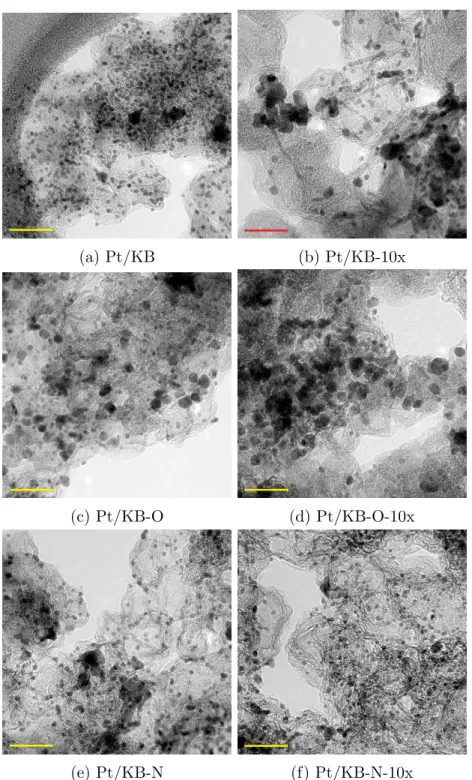
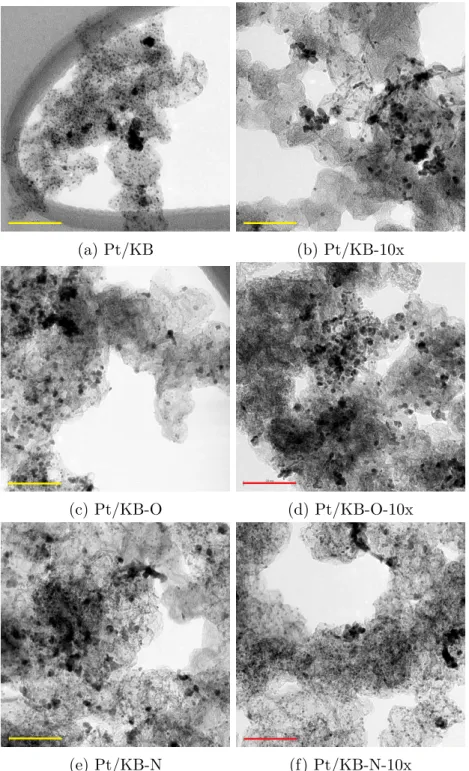
For both Pt/KB-O and Pt/KB-N, the functional groups on the carbon serve as binding sites, preventing the NPs from agglomerating. However, the carbon affects the NP size distribution, with Pt/KB-O containing larger NPs compared to Pt/KB and Pt/KB-N.
Motivation
While some types of fuel cells are designed to use carbon-containing fuels, most can run on hydrogen (H2) and oxygen (O2), classifying them as zero-emission conversion devices. Envisioned as a key component of the hydrogen-based energy economy, PEM fuel cells are recognized as new clean energy and propulsion systems for markets in sustainable aviation [5], passenger vehicles, and heavy transportation [6, 7 , 8].
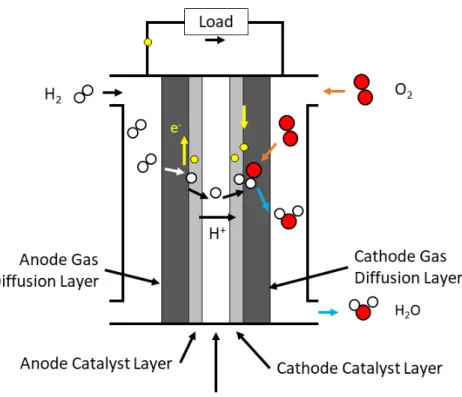
Fuel Cell Working Principle and Components
The GDLs distribute reactant gases in the CL and facilitate the removal of product water from the fuel cell. Therefore, fuel cell catalysts and CLs need to be optimized because they affect all overpotentials in equation 1.4.
PEM Fuel Cell Catalysts and Catalyst Supports
Catalyst support is a key component of CL and can affect the overall performance of a PEM fuel cell. Similar to the catalyst itself, specific design strategies can be used to improve the properties of the carbon support.
Challenges of Adopting Shape-Controlled Platinum Catalysts
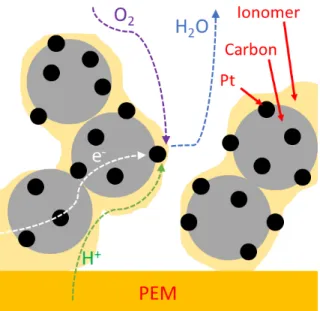
Experimental studies show that the choice of carbon support affects both the activity and stability of the catalyst [22, 23]. The ionomer coats the Pt/C catalyst as a thin layer and its main functions are to bind the catalyst and conduct H+ between the PEM and the active sites of the catalyst.
Objectives and Outline of Thesis
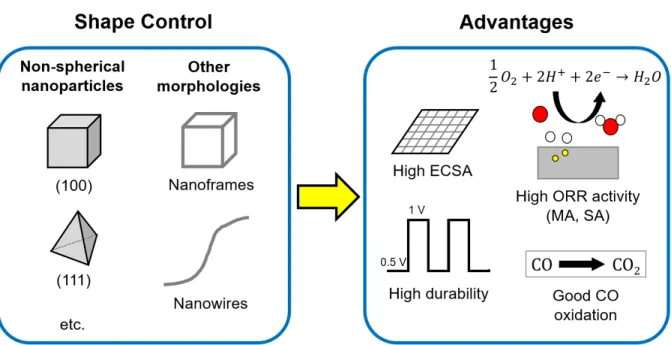
NPs based on cubic Pt have received attention as an advanced electrocatalyst design due to the properties of the Pt(100) surface. Another example of a Pt alloy catalyst dominated by the (111) surface is the Pt-Pd tetrahedron, which has been proposed as an electrocatalyst for direct alcohol fuel cells.
Carbon-Based Catalyst Supports
Importance of the Carbon Support
For typical fuel cell catalysts, this is achieved by dispersing Pt NPs on a high surface area carbon support. One way to maximize the fuel cell performance of graphene-supported catalysts is to combine graphene with carbon black.
Functionalization by Oxidation Treatment
Functionalization by Heteroatom Doping
Synthesis of Shape-Controlled Platinum Catalysts
Catalyst Shape Control Strategies
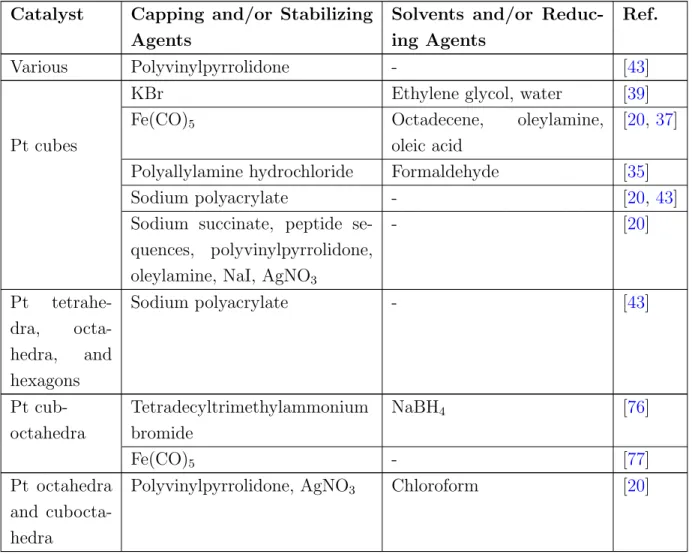
Some strategies to synthesize shape-controlled Pt nanostructures without capping agents include controlling the reaction system's temperature and reducing power [81], using certain additives such as KOH [82], and choosing solvents that have easily removable stabilizing species. can generate during the reaction [40]. With further efforts to scale up the reaction system and simplify the synthesis procedure, this class of solvothermal synthesis methods is a promising path towards low-cost production of shape-controlled Pt nanostructures.
Scalable Catalyst Synthesis Methods
Furthermore, the synthesis of shape-controlled catalysts in large quantities requires careful control of the conditions for the synthesis process, so shape-controlled Pt/C catalysts are typically synthesized in two steps. The first step is to synthesize the shape-controlled PtNPs, and the second is to deposit these NPs on the functionalized carbon support [28]. In contrast, one-pot synthesis (also called one-step synthesis) is a single reaction between Pt precursor and carbon support that directly forms a carbon-supported Pt catalyst.
Continued exploration of one-pot synthesis is needed to determine how to combine shape-controlled Pt NPs with functionalized carbon materials to create highly active and stable catalysts.
Performance of Shape-Controlled Platinum-Based Catalysts in PEM Fuel
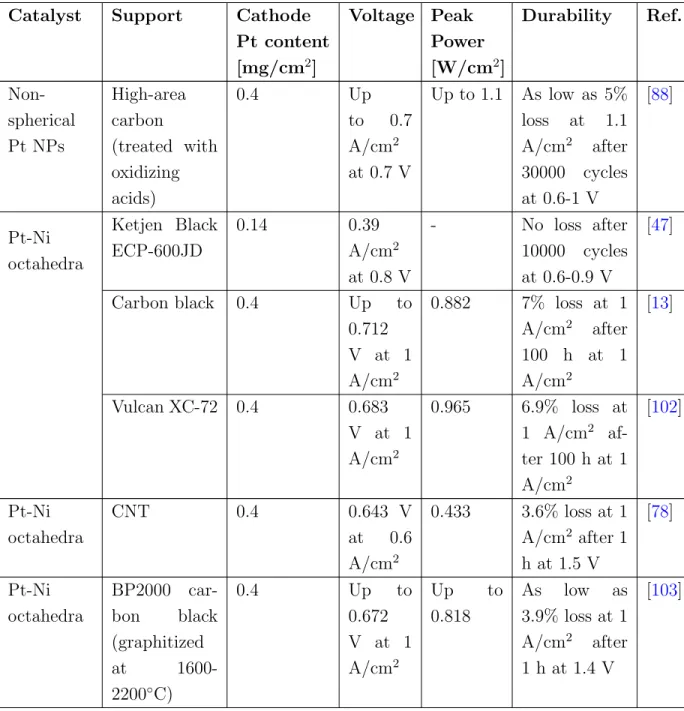
Some shape-controlled Pt and Pt alloy catalysts with carbon supports appear to perform well on the MEA scale. Changing the carbon support properties can help optimize the fuel cell performance of such shape-controlled PtNP catalysts. CL optimization is recognized as an important research area for shape-controlled Pt-based catalysts [19].
Finally, the research group that published multiple studies on Pt-Ni octahedra found that using CNTs as support causes the CNTs to become intertwined and reduce the contact between ionomer and active components, leading to poor fuel cell performance [ 78].
Experimental Characterization of Fuel Cell Catalysts
Physical Characterization
Electrochemical Characterization
Fuel Cell Testing
These limitations help explain why the exceptional RDE performance of advanced fuel cell catalysts, such as Pt alloys and shape-controlled nanostructures, does not necessarily correlate with good MEA performance. Like RDE testing, MEA testing can provide information about the catalyst's activity and durability, but it also involves unique challenges such as water flooding, mechanical degradation of the PEM and CL, and so on. During a single cell assay, operating conditions such as temperature, RH, reactant stoichiometry, and pressure have a dual effect on MEA performance.
Second, operating conditions affect activation, ohmic, and mass transport overvoltages through a number of mechanisms.
Contributions of Thesis
First, these conditions affect the reversible cell potential as described by the Nernst equation, which predicts the reversible potential as a function of temperature and partial pressures of the reactants. This addresses a gap in the current literature, which lacks detailed findings on how scaling up a batch-based one-pot synthesis method can affect catalyst size/morphology and its electrochemical performance.
Summary
The effects of functionalization of the carbon support on the non-spherical Pt catalyst are inferred using conventional physical and electrochemical tests. In addition, the synthesis process is repeated using small and large batches to investigate its suitability as a scale-up synthesis process. In this study, a non-spherical Pt catalyst is synthesized with both oxidized and nitrogen-doped carbon to study the effects of carbon functionalization, and then the one-pot synthesis method is repeated in small and large batches to evaluate the scalable performance of the catalyst.
Ketjen Black EC-600JD carbon powder (AkzoNobel), hydrochloric acid (37%, Sigma-Aldrich), sulfuric acid (95-98%, Sigma-Aldrich), nitric acid (70%, Caledon Laboratories), chloroplatinic acid hexahydrate (≥ 37.50% Pt base, Sigma-Aldrich), ethylene glycol (Fisher Scientific), N,N-dimethylformamide (≥99.8%, Sigma-Aldrich), sodium hydroxide (≥97.0%, Sigma-Aldrich), ethanol (HPLC, Sigma - Aldrich), Nafion (5% solution, Ion Power) and perchloric acid (70%, GFS Chemicals) are used as received.
Carbon Treatment and Functionalization
Hydrochloric Acid Treatment
Functionalization
To prepare carbon functionalized by nitrogen doping, 1.6 g of the HCl-treated carbon is dispersed in 100 mL of DIW and 5 g of dicyanamide is dissolved in 40 mL of hot DIW. The two mixtures are stirred for 30 minutes and then heated at 180◦C in an autoclave for 20 hours, before the carbon is collected and washed repeatedly with DIW. The carbon is then mixed in 75 ml of ammonium hydroxide, heated again for 20 hours at 180◦C and washed again.
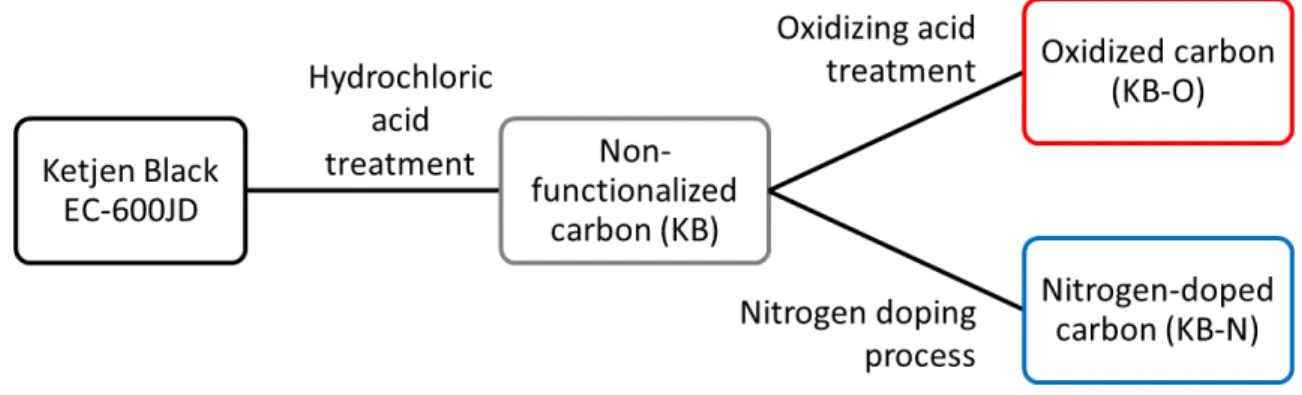
The carbon supports that are unfunctionalized (i.e. treated with HCl alone), oxidation treated and nitrogen doped are referred to as KB, KB-O and KB-N, respectively (Figure 3.1).
Catalyst Synthesis
This washing process is repeated 3-4 times to remove any residual surfactants and chemicals from the synthesis process. Once the wash is complete, the product is transferred to an evaporation disk using DIW and air dried for at least 48 hours. Finally, the product is transferred to a crucible and placed in a temperature-controlled chamber at 70 °C for 24 hours before being collected in a glass vial.
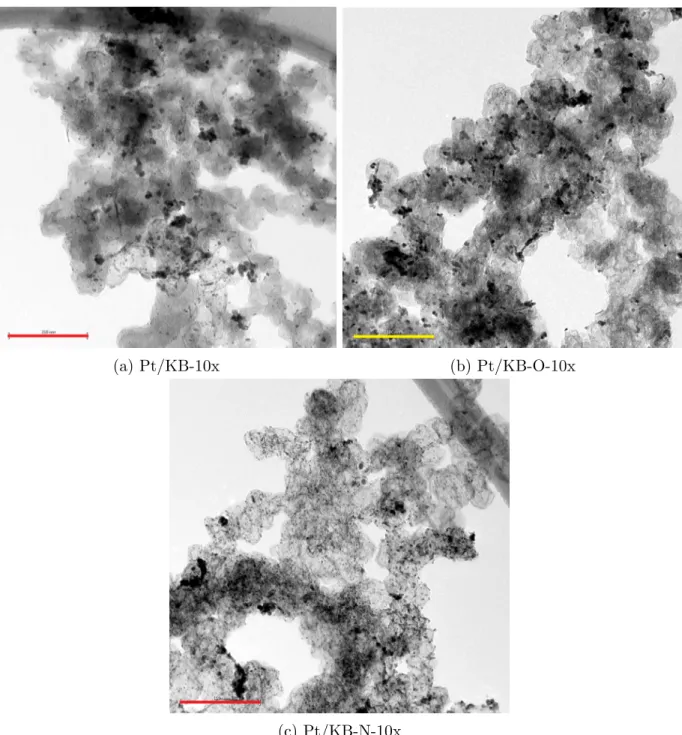
Small samples of catalysts on KB, KB-O and KB-N are called Pt/KB, Pt/KB-O and Pt/KB-N; the corresponding bulk samples are named Pt/KB-10x, Pt/KB-O-10x, and Pt/KB-N-10x.
Physical Characterization
Carbon Support Characterization
To scale up the synthesis procedure, everything described above is repeated, but with all amounts of reactants scaled tenfold (ie, using 1 g of H2PtCl6·6H2O). For surface measurement, the sample tube is immersed in a liquid nitrogen bath and nitrogen gas is used as the adsorbate. XPS measurements were taken using a VGS ESCALab 250 Imaging ESCA system to study the surface chemistry of the three carbon supports.
Thus, it is possible to study the elemental composition of the material and information about the bonding of these elements (C, O and N are the most important in this work).
Pt/C Catalyst Characterization
For each test, 5 mg (± 0.2 mg) of the catalyst sample is weighed into a 20 ml vial with a microbalance. 50 potential cycles are run between 0.05–1.2 V (vs. RHE) using a scan rate of 0.5 V/s to activate the catalyst and observe preliminary data. LSV is performed to measure the ORR activity of the catalyst, which is quantified by MA and SA.
Catalyst degradation is accelerated by repeatedly oxidizing and reducing the catalyst surface area while avoiding corrosion of the carbon support [18].
Carbon Support Properties
BET Surface Area
X-ray Photoelectron Spectroscopy
These signals indicate residues of nitric acid treatment, and the results corroborate a previous study with carbon black oxidized using nitric acid [67].

Pt/C Catalyst Properties
- Transmission Electron Microscopy
- X-ray Diffraction
- Thermogravimetric Analysis
- Summary
As before, Pt/KB-O-10x contains more medium-sized NPs and Pt/KB-N-10x contains more small NPs. Medium-sized and large NPs are more uniformly dispersed with less agglomeration in Pt/KB-O-10x and Pt/KB-N-10x compared to Pt/KB-10x. The general increase in size for Pt/KB-10x and Pt/KB-O-10x is due to the loss of very small NPs.
However, the Pt content in Pt/KB-N-10x is significantly lower, which is unexpected considering that Pt/KB-N has close to nominal Pt content.
Electrochemical Performance
- Catalyst Activity
- Catalyst Durability
- Implications for Single-Cell Performance
- Summary
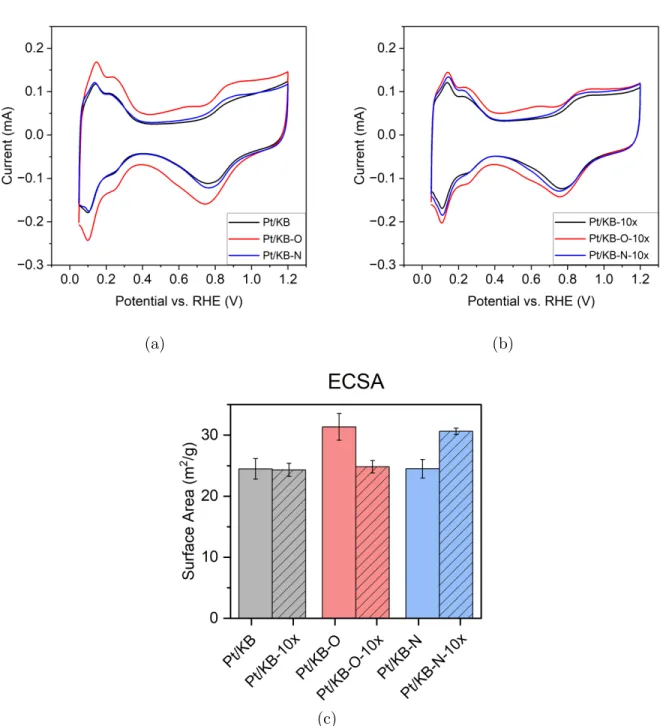
Pt/KB-O achieves similar or slightly lower OR activity than Pt/KB, while Pt/KB-N achieves similar or slightly higher activity. Since Pt/KB-O and Pt/KB-O-10 have less small NPs (which are more thermodynamically unstable) than other catalysts, they may be more resistant to Pt separation. Pt/KB-O achieves similar or slightly worse ORR activity than Pt/KB, but shows the best ECSA retention in corrosion AST.
Meanwhile, Pt/KB-N achieves similar or slightly better ORR activity than Pt/KB along with similar durability.
Recommendations for Future Work
Proton Exchange Membrane Fuel Cells with Ultra-Low Platinum Loading: Performance Losses and Solutions," Journal of Power Sources, vol. Zhang, "Highly Active and Durable Carbon Supported Pt Rare Earth Catalyst for Proton Exchange Membrane Fuel Cell," International Journal of Hydrogen Energy, vol. Solvothermal Synthesis of Platinum Alloy Nanoparticles for Electrocatalysis of oxygen reduction,” Journal of the American Chemical Society , vol.
Friedrich, “Minimization of Mass Transport Loss in Proton Exchange Membrane Fuel Cell by Freeze Drying of Cathode Catalyst Layers,” Journal of Power Sources, vol. Kim, “Effects of Ionomer Content on Pt Catalyst/Ordered Mesoporous Carbon Support in Polymer Electrolyte Membrane Fuel Cells,” Journal of Power Sources, vol. Arenz, "Comparative Degradation Study of Carbon Supported Proton Exchange Membrane Fuel Cell Electrocatalysts Influence of Platinum to Carbon Ratio on Degradation Rate," Journal of Power Sources, vol.