DoD 5015.2-STD
DESIGN CRITERIA STANDARD FOR
ELECTRONIC RECORDS MANAGEMENT
SOFTWARE APPLICATIONS
ASSISTANT SECRETARY OF DEFENSE FOR COMMAND, CONTROL, COMMNICATIONS AND INTELLIGENCE
DOD CHIEF INFORMATION OFFICER 6000 DEFENSE PENTAGON WASHINGTON, D.C. 20301-6000
June 19, 2002 FOREWORD
This Standard is reissued under the authority of DoD Directive 5015.2, "Department of Defense Records Management Program," March 6, 2000 which provides implementing and procedural guidance on the management of records in the Department of Defense. It sets forth mandatory baseline functional requirements for Records Management Application (RMA) software used by the DoD Components in the implementation of their records management programs; defines required system interfaces and search criteria to be supported by the RMAs; and describes the minimum records management requirements that must be met, based on current National Archives and Records Administration (NARA) regulations.
DoD 5015.2-STD, “Design Criteria Standards for Electronic Records Management Software Applications,” November 24, 1997, is hereby canceled.
This Standard applies to the Office of the Secretary of Defense, the Military Departments, the Chairman of the Joint Chiefs of Staff, the Combatant Commands, the Inspector General of the Department of Defense, the Defense Agencies, the DoD Field Activities, and all other
organizational entities within the Department of Defense (hereafter referred to collectively as
"the DoD Components").
This Standard is effective immediately and is mandatory for use by all DoD Components.
Electronic record management information systems already in use must comply with this Standard within 2 years of the effective date of this document. The Heads of the DoD
Components may issue supplementary instructions only when necessary to provide for unique requirements within their organizations provided that those instructions do not adversely affect interoperability and compatibility with DoD Automated Information Systems (AISs).
Send recommended changes to:
Department of Defense Voice: 703-607-0510
Office of DASD (Deputy CIO) FAX: 703-607-0248 Architecture & Interoperability Directorate
1931 Jefferson Davis Highway DSN: 224-0510
Crystal Mall-3, 7th Floor E-mail: [email protected]
This Standard is approved for public release; distribution is unlimited. The DoD Components, other Federal Agencies, and the public may obtain copies of this Standard via Internet at http://www.dtic.mil/whs/directives.
JOHN P. STENBIT
Assistant Secretary of Defense for Command, Control, Communications and Intelligence
TABLE OF CONTENTS
Page
FOREWORD 1
TABLE OF CONTENTS 2
REFERENCES 3
DEFINITIONS 5
ABBREVIATIONS AND ACRONYMS 16
CHAPTER 1 – GENERAL INFORMATION 18
C1.1. PURPOSE 18
C1.2. LIMITATIONS 18
CHAPTER 2 – MANDATORY REQUIREMENTS 19
C2.1. GENERAL REQUIREMENTS 19
C2.2. DETAILED REQUIREMENTS 19
CHAPTER 3 – NON-MANDATORY FEATURES 38
C3.1. REQUIREMENTS DEFINED BY THE ACQUIRING OR USING ACTIVITY 38
C3.2. OTHER USEFUL RMA FEATURES 39
CHAPTER 4 – MANAGEMENT OF CLASSIFIED RECORDS 42
C4.1. REQUIREMENTS FOR RMAs SUPPORTING MANAGEMENT OF
CLASSIFIED RECORDS 42
C4.2. OPTIONAL SECURITY FEATURES 47
TABLES 48
C2.T1. File Plan Components 25
C2.T2. Record Folder Components 26
C2.T3. Record Metadata Components 29
C2.T4. Transmission and Receipt Data 33
C2.T5. Authorized Individual Requirements 39
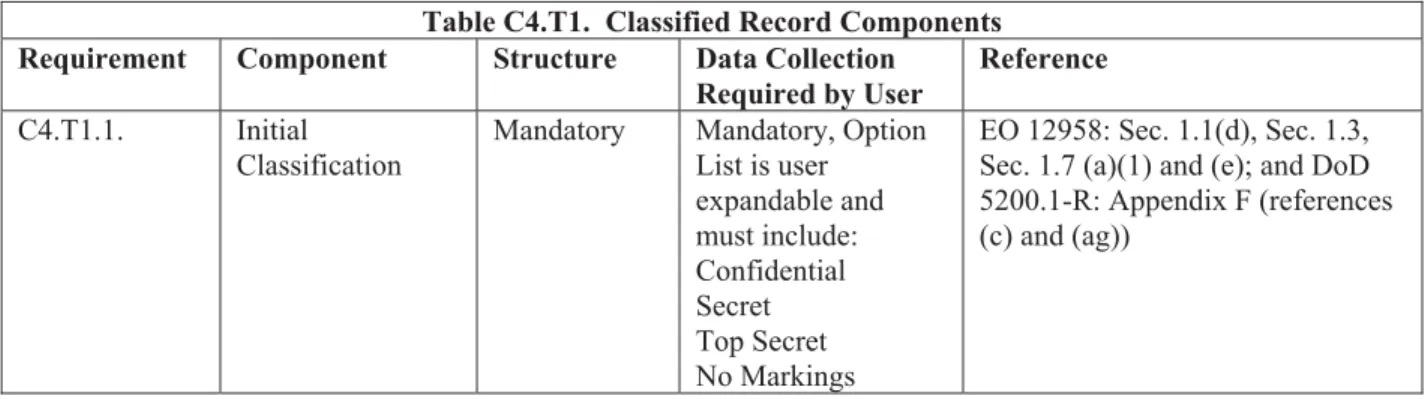
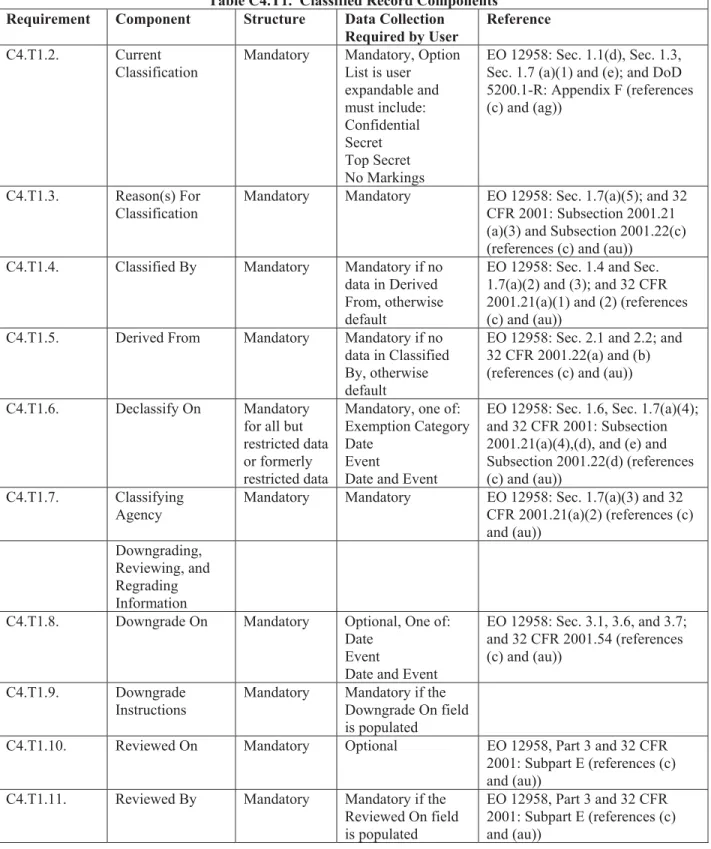
C4.T1. Classified Record Components 52
C4.T2. Authorized Individual Requirements 57
REFERENCES
(a) DoD Directive 5015.2, "Department of Defense Records Management Program," March 6, 2000
(b) DoD 5015.2-STD, “Design Criteria Standards for Electronic Records Management Software Applications,” November 24, 1997 (hereby canceled)
(c) Executive Order 12958, "Classified National Security Information," April 17, 1995 (d) National Archives and Records Administration, "Records Management Handbook —
Disposition of Federal Records," 1996
(e) Title 36, Code of Federal Regulations, Part 1236.14, "Definitions," current edition (f) Title 36, Code of Federal Regulations, Part 1234.2, "Definitions," current edition
(g) National Archives and Records Administration, "Managing Electronic Records Instructional Guide," "Appendix F, Glossary," 1990
(h) Title 36, Code of Federal Regulations, Part 1228.58, "Destruction of Temporary Records,"
current edition
(i) Title 36, Code of Federal Regulations, Part 1228.60, "Donation of Temporary Records,"
current edition
(j) Section 3301 of title 44, United States Code, "Definition of Records"
(k) Title 36, Code of Federal Regulations, Part 1220.14, "General Definitions," current edition (l) Section 3511 of title 44, United States Code, "Establishment and Operation of Government
Information Locator Service"
(m) Federal Information Processing Standard Publication 192, "Application Profile for the Government Information Locator Service," December 7, 1994
(n) Section 2901 of title 44, United States Code, "Definitions"
(o) Section 2902 of title 44, United States Code, "Objectives of Records Management"
(p) Section 3103 of title 44, United States Code, "Transfer of Records to Records Centers”
(q) Title 36, Code of Federal Regulations, Part 1222.10, "Creation and Maintenance of Federal Records," current edition
(r) Federal Information Processing Standard Publication 4-2, "Representation of Calendar Date for Information Interchange," November 15, 1998
(s) DoD 8320.1-M, "Data Administration Procedures," March 1, 1994
(t) Title 36, Code of Federal Regulations, Part 1194.21, "Software Applications and Operating Systems," current edition
(u) Title 36, Code of Federal Regulations, Part 1194.31, "Functional Performance Criteria,"
current edition
(v) Title 36, Code of Federal Regulations, Part 1194.22, "Web-based Intranet and Internet Information and Applications," current edition
(w) Section 794d of title 29, United States Code, "Electronic and Information Technology"
(x) Section 3303 of title 44, United States Code, "Lists and Schedules of Records"
(y) Title 36, Code of Federal Regulations, Part 1222.50, "Records Maintenance and Storage,"
current edition
(z) Records Management Task Force, "Functional Baseline Requirements and Data Elements for Records Management Application Software," August 28, 1995
(aa) Title 36, Code of Federal Regulations, Part 1228.24, "Formulation of Agency Records Schedules," current edition
(ab) Title 36, Code of Federal Regulations, Part 1236.20, "Vital Records Program Objectives,"
current edition
(ac) Director of Central Intelligence Directive (DCID) 6/6, "Security Control on the Dissemination of Intelligence Information," July 11, 2001
(ad) DoD Directive 5210.83, "Department of Defense Unclassified Controlled Nuclear Information (DoD UNCI)," November 15, 1991
(ae) DoD 5400.7-R, "DoD Freedom of Information Act Program," September 1998
(af) DoD Directive 5230.24, "Distribution Statements on Technical Documents," March 18, 1987
(ag) DoD 5200.1-R, "Information Security Program Regulation," January 14, 1997 (ah) Title 36, Code of Federal Regulations, Part 1234.22, "Creation and Use of Text
Documents," current edition
(ai) Title 36, Code of Federal Regulations, Part 1234.32, "Retention and Disposition of Electronic Records," current edition
(aj) Title 36, Code of Federal Regulations, Part 1222.32, "General Requirements," current edition
(ak) Title 36, Code of Federal Regulations, Part 1234.24, "Standards for Managing Electronic Mail Records," current edition
(al) Section 3105 of title 44, United States Code, "Safeguards"
(am) Title 36, Code of Federal Regulations, Part 1234.28, "Security of Electronic Records,"
current edition
(an) Section 2909 of title 44, United States Code, "Retention of Records"
(ao) Title 36, Code of Federal Regulations, Part 1228.54, "Temporary Extension of Retention Periods," current edition
(ap) Title 36, Code of Federal Regulations, Part 1228.270, "Disposition of Federal Records,"
current edition
(aq) Title 36, Code of Federal Regulations, Part 1234.34, "Destruction of Electronic Records,"
current edition
(ar) DoD Directive 5200.28, “Security Requirements for Automated Information Systems (AISs)," March 21, 1988
(as) Executive Order 12968, "Access to Classified Information," August 4, 1995
(at) Title 36, Code of Federal Regulations, Part 1234.30, "Selection and Maintenance of Electronic Records Storage Media," current edition
(au) Title 32, Code of Federal Regulations, Part 2001, "Classified National Security Information," current edition
(av) Title 32, Code of Federal Regulations, Part 2004, "Directive on Safeguarding Classified National Security Information"
DL1.1. DEFINITIONS
DL1.1.1. Access. The ability or opportunity to gain knowledge of stored information.
DL1.1.2. Accession. To transfer physical and legal custody of documentary materials to an archival institution.
DL1.1.3. Addressee. The name of the organization to which or individual to whom a record is addressed.
DL1.1.4. Application Administrators. Individuals who are responsible for setting up the RMA infrastructure.
DL1.1.5. Attachment. A record, object, or document associated with another document or record and filed in the RMA or transmitted as part of the other document or record.
DL1.1.6. Audit Trail. An electronic means of tracking interactions with records within an electronic system so that any access to the record within the electronic system can be
documented as it occurs or afterward. May be used to identify unauthorized actions in relation to the records, e.g., modification, deletion, or addition.
DL1.1.7. Authenticity. A condition that proves that a record is genuine based on its mode (i.e., method by which a record is communicated over space or time), form (i.e., format or media that a record has upon receipt), state of transmission (i.e., the primitiveness, completeness, and effectiveness of a record when it is initially set aside after being made or received), and manner of preservation and custody.
DL1.1.8. Authorized Individual. A Records Manager or other person specifically designated by the Records Manager as responsible for managing various aspects of an organization's records.
DL1.1.9. Author or Originator. The author of a document is the person, office or designated position responsible for its creation or issuance. The author or originator is usually indicated on the letterhead or by signature. For RMA purposes, the author or originator may be designated as a person, official title, office symbol, or code.
DL1.1.10. Biometrics. Biometrics are automated methods of authenticating or verifying an individual based upon a physical or behavioral characteristic of that individual.
DL1.1.11. Bulk Load. Automatically importing data.
DL1.1.12. Classified Information. Information that has been determined pursuant to E.O. 12958 (reference (c)) or any predecessor order to require protection against unauthorized disclosure and is marked to indicate its classified status when in documentary form.
DL1.1.13. Classification Markings. Identifications or markings that leave no doubt about the classified status of the information, the level of protection required and the duration of the classification. Such markings include: Overall Markings, Portion Markings, Classified by line, Reason line, Derived from line, and Declassify on line.
DL1.1.14. Copy. In electronic records, the action or result of reading data from a source
(RMA’s repository), leaving the source data unchanged, and writing the same data elsewhere on a medium that may differ from the source (user workspace or other device) (see RM Handbook, reference (d)).
DL1.1.15. Create. In electronic records, the action or result of filing a new record and its associated metadata.
DL1.1.16. Cutoff. To cut off records in a file means to break, or end, them at regular intervals to permit their disposal or transfer in complete blocks and, for correspondence files, to permit the establishment of new files. Cutoffs are needed before disposition instructions can be applied because retention periods usually begin with the cutoff, not with the creation or receipt, of the records. In other words, the retention period normally does not start until the records have been cut off. Cutoffs involve ending input to old files and starting input to new ones at regular intervals (see reference (d)).
DL1.1.16.1. For records with retention periods of less than 1 year. Cut off at an interval equal to the retention period. For example, if a record series has a 1-month retention period, cut the file off at the end of each month and then apply the retention period (that is, hold the file 1 more month before destroying it).
DL1.1.16.2. For records with retention periods of 1 year or more. Cut off at the end of each fiscal (or calendar) year. For example, if the disposition instruction for a correspondence file is
"Destroy after 3 years," then destroy it 3 years after the annual cutoff date has been reached.
DL1.1.16.3. For records with retention periods based on an event or action. Cut off on the date the event occurs or the action is completed, and then apply the retention period. For
example, if the disposition for case working papers is "Destroy when related case file is closed,"
then cut off and destroy the working papers when closing the related file.
DL1.1.16.4. For records with retention periods based on a specified time period after an event or action:
DL1.1.16.4.1. Place in an inactive file on the date the event occurs or the action is completed and cut off the inactive file at the end of each fiscal (or calendar) year; then apply the retention period. For example, if the disposition for a case file is "Destroy 6 years after case is closed," then destroy 6 years after the annual cutoff along with all other case files closed during that year.
DL1.1.16.4.2. Cutoff is sometimes abbreviated as COFF and is also called file cutoff or file break
DL1.1.17. Cycle. The periodic replacement of obsolete copies of vital records with copies of current vital records. This may occur daily, weekly, quarterly, annually, or at other designated intervals as specified by regulation or by the records manager (see 36 CFR 1236.14, reference (e)).
DL1.1.18. Database. In electronic records, a set of data elements, consisting of at least one file or of a group of integrated files, usually stored in one location and made available to several users (see 36 CFR 1234.2, reference (f)).
DL1.1.19. Database Management System (DBMS). A software system used to access and retrieve data stored in a database (see reference (f)).
DL1.1.20. Data Element. A combination of characters or bytes refers to one separate piece of information, such as name, address, or age (see Instructional Guide, reference (g)).
DL1.1.21. Date Filed. The date and time that an electronic document was filed in the RMA and thus became a record. This date and time will normally be assigned by the computer at the time the record is filed in the RMA.
DL1.1.22. Declassification. The authorized change in the status of information from classified information to unclassified information (see reference (c)).
DL1.1.23. Declassification Guide. Written instructions issued by a declassification authority that describes the elements of information regarding a specific subject that may be declassified and the elements that must remain classified (see reference (c)).
DL1.1.24. Defense Message System (DMS). A secure and accountable writer–to-reader messaging service accessible from world-wide DoD locations to tactically deployed users and other designated Federal users, with interfaces to Allied users and Defense contractors.
DL1.1.25. Delete. The process of permanently removing, erasing, or obliterating recorded information from a medium, especially a reusable magnetic disk or tape (see reference (g)).
DL1.1.26. Department of Defense (DoD) Components. The Office of the Secretary of Defense, the Military Departments, the Chairman of the Joint Chiefs of Staff, the Combatant Commands, the Office of the Inspector General of the Department of Defense, the Defense Agencies, the DoD Field Activities, and all other organizational entities in the Department of Defense.
DL1.1.27. Derivative Classification. The incorporating, paraphrasing, restating or generating in new form information that is already classified, and marking the newly developed material consistent with the classification markings that apply to the source information. Derivative classification includes the classification of information based on classification guidance. The duplication or reproduction of existing classified information is not derivative classification (see reference (c)).
DL1.1.28. Destruction. In records management, the primary type of disposal action. Methods of destroying records include selling or salvaging the record medium and burning, pulping, shredding, macerating, or discarding it with other waste materials (see 36 CFR 1228.58, reference (h)).
DL1.1.29. Disposition. Those actions taken regarding Federal records after they are no longer required to conduct current Agency business (see reference (d)). These actions include:
DL1.1.29.1. Transfer of records to Agency storage facilities or Federal Record Centers (FRCs).
DL1.1.29.2. Transfer of records from one Federal Agency to another.
DL1.1.29.3. Transfer of permanent records to the National Archives.
DL1.1.29.4. Disposal of temporary records no longer needed to conduct agency business, usually by destruction or, occasionally, by donation of temporary records to an eligible person or organization after the authorized retention period has expired and after NARA has approved the donation (see 36 CFR 1228.60, reference (i)).
DL1.1.30. Disposition Action. Action to be taken when a disposition date occurs (e.g., freeze, interim transfer, accession, or destroy).
DL1.1.31. Disposition Action Date. The fixed date on which the records in a file become due for final disposition.
DL1.1.32. Disposition Authority. Legal authority that empowers an Agency to transfer permanent records to the National Archives or to carry out the disposal of temporary records.
Must be obtained from NARA and also, for certain records proposed as temporary, from the GAO (see reference (d)).
DL1.1.33. Disposition Instruction. Directions for cutting off records and carrying out their disposition (transfer, retirement, or destruction) in compliance with NARA's regulations and the General Records Schedule (GRS). Disposition instructions in an RMA include retention-related fields such as authority, transfer location, active or dormant chronological retention periods, and conditional retention periods (see reference (d)).
DL1.1.34. Disposition Instruction Type. One of three ways of scheduling a disposition instruction: time, event, or a combination of both time and event. See DL1.43, DL1.86, and DL1.87. (see also reference (d)).
DL1.1.35. Document. Information set down in any physical form or characteristic. A document may or may not meet the definition of a record.
DL1.1.36. Document Management Application (DMA). A system used for managing
documents that allows users to store, retrieve, and share them with security and version control.
A word processor can integrate DMA support so that you can create, edit, and manage your documents through the word processor. DMAs are sometimes called Electronic Document Management Systems (EDMSs).
DL1.1.37. Downgrade. A determination by a declassification authority that information
classified and safeguarded at a specified level shall be classified and safeguarded at a lower level (see reference (c)).
DL1.1.38. Edit. Function that allows the user to change an existing record's metadata.
DL1.1.39. Electronic Document Management (EDM). The management of different kinds of documents in an enterprise that uses computer programs and storage. An EDM system allows an enterprise and its users to create a document or capture a hard copy in electronic form, store, edit, print, process, and otherwise manage documents in image, video, and audio, as well as in text form. An EDM system usually provides a single view of multiple databases and may include scanners for document capture, printers for creating hard copies, storage devices such as redundant array of independent disks systems, and computer server and server programs for managing the databases that contain the documents.
DL1.1.40. Electronic Mail Message. A document created or received via an electronic mail system, including brief notes, formal or substantive narrative documents, and any attachments, such as word processing and other electronic documents, which may be transmitted with the message (see reference (f)).
DL1.1.41. Electronic Mail System. A computer application used to create, receive, and transmit messages and other documents electronically. This definition does not include file transfer utilities (software that transmits files between users but that does not retain any transmission data); computer systems used to collect and process data organized into data files or databases;
and word-processing documents not transmitted via an e-mail system (see reference (f)).
DL1.1.42. Electronic Record. Information recorded in a form that requires a computer or other machine to process it and that satisfies the legal definition of a record according to 44 U.S.C.
3301 (reference (j)).
DL1.1.43. Event Disposition. A disposition instruction in which a record is eligible for the specified disposition (transfer or destroy) upon or immediately after the specified event occurs.
No retention period is applied and there is no fixed waiting period as with "timed" or
combination "timed-event" dispositions. Example: "Destroy when no longer needed for current operations" (see reference (d)).
DL1.1.44. File. An arrangement of records.
DL1.1.44.1. When used as a noun, this term is used to denote papers, photographs,
photocopies, maps, machine-readable information, or other recorded information, regardless of physical form or characteristic. Files are accumulated or maintained on shelves, in filing equipment, boxes, or machine-readable media, and they occupy office or storage space (see 36 CFR 1220.14, reference (k)).
DL1.1.44.2. When used as a verb, this term is used to define the act of assigning and storing records in accordance with the file plan (see reference (d)).
DL1.1.45. File Plan. A document containing the identifying number, title, description, and disposition authority of files held or used in an office (see reference (d)).
DL1.1.46. Format. For electronic records, format refers to the computer file format described by a formal or vendor standard or specification, such as ISO/IEC 8632-1 [Information
Technology - Computer Graphics - Metafile for the Storage and Transfer of Picture Description Information (CGM)]; ISO/IEC 10918 [Joint Photographic Experts Group (JPEG)]; WordPerfect 6.1 for Windows; or Microsoft Word 7.0 for Windows. For non-electronic records, the format refers to its physical form: e.g., paper, microfilm, and video.
DL1.1.47. Freeze. The suspension or extension of the disposition of temporary records that cannot be destroyed on schedule because of special circumstances, such as a court order or an investigation. A freeze requires a temporary extension of the approved retention period (see reference (d)).
DL1.1.48. Government Information Locator Service (GILS). A Federal Government service to help the general public locate and access information throughout the Federal Government (see 44 U.S.C. 3511, reference (l)). GILS describes the information available in those resources and provides assistance in obtaining that information. GILS uses network technology and
international standards for information search and retrieval. These standards are described in the Federal Information Processing Standard (FIPS) Publication 192, "Application Profile for the Government Information Locator Service" (reference (m)).
DL1.1.49. Imaging Tools. Software and hardware that works together to capture, store, and recreate images.
DL1.1.50. Life Cycle. The records life cycle is the life span of a record from its creation or receipt to its final disposition. It is usually described in three stages: creation, maintenance and use, and final disposition.
DL1.1.51. Location of Record. A pointer to a record’s location. Examples: an operating system path and filename, the location of a file cabinet, or the location of a magnetic tape rack.
DL1.1.52. Media Type. The material or environment on which information is inscribed (e.g., microform, electronic, paper).
DL1.1.53. Metadata. Data describing stored data: that is, data describing the structure, data elements, interrelationships, and other characteristics of electronic records.
DL1.1.54. Move. Function that allows the user to relocate records and metadata.
DL1.1.55. Multiple Sources. Information classified based on two or more source documents, classification guides or combination of both (see reference (c)).
DL1.1.56. Office Applications. Software packages that perform a variety of office support functions, such as word processing, desktop publishing, spreadsheet calculations, electronic mail, facsimile transmission and receipt, document imaging, optical character recognition (OCR), workflow, and data management. These applications are generally used to generate, convert, transmit, or receive business documents.
DL1.1.57. Optical Character Recognition (OCR). The recognition of printed or written text character by a computer. This involves photoscanning of the text character-by-character, analysis of the scanned-in image, and then translation of the character image into character codes, such as ASCII, commonly used in data processing.
DL1.1.58. Original Classification. An initial determination that information requires, in the interest of national security, protection against unauthorized disclosure (see reference (c)).
DL1.1.59. Originating Organization. Official name or code identifying the office responsible for the creation of a document.
DL1.1.60. Permanent Record. Records appraised by NARA as having sufficient historical or other value to warrant continued preservation by the Federal Government beyond the time they are normally needed for a particular Agency's administrative, legal, or fiscal purposes (see reference (d)).
DL1.1.61. Privileged Users. Individuals who are given special permission to perform functions beyond those of typical users.
DL1.1.62. Publication Date. The date and time that the author or originator completed the development of or signed the document. For electronic documents, this date and time should be established either by the author or from the time attribute assigned to the document by the application used to create the document. This is not necessarily the date or time that the document was filed in the RMA and thus became a record.
DL1.1.63. Rebuild. Reconstructing the RM environment after a disaster.
DL1.1.64. Receipt Data. Information in electronic mail systems regarding dates and times of receipt of a message, or acknowledging receipt or access by specific addressee(s). It is not the date and time of delivery to the Agency. If receipt data are provided by the computer system, they are a required part of documents or records received through electronic mail (see reference (f)).
DL1.1.65. Record. Information, regardless of medium, detailing business transactions. Records include all books, papers, maps, photographs, machine-readable materials, and other
documentary materials, regardless of physical form or characteristics. Records are made or received by an Agency of the United States Government under Federal law or in connection with the transaction of public business. Records are preserved or appropriate for preservation by that Agency or its legitimate successor as evidence of the organization, functions, policies, decisions, procedures, operations, or other activities of the Government or because of the value of data in the record (see reference (j)).
DL1.1.66. Record Category. A description of a particular set of records within a file plan. Each category has retention and disposition data associated with it, applied to all record folders and records within the category.
DL1.1.67. Record Category Identifier. An Agency's alphanumeric or numeric identifier indicating a unique record category.
DL1.1.68. Record Folder. A record folder is an extension to the file plan either as a static structure or an aggregate gathering of records. It is used to manage case records and to break other records into periods supporting retention and disposition.
DL1.1.69. Record Identifier. An element of metadata, a record identifier is a data element whose value is system-generated and that uniquely identifies a particular record.
DL1.1.70. Records Management. The planning, controlling, directing, organizing, training, promoting, and other managerial activities involving the life cycle of information, including creation, maintenance (use, storage, retrieval), and disposal, regardless of media. Record management procedures are used to achieve adequate and proper documentation of Federal policies and transactions and effective and economical management of Agency and
organizational operations (see 44 U.S.C. 2901, reference (n)).
DL1.1.71. Records Management Application (RMA). Software used by an organization to manage its records. An RMA’s primary management functions are categorizing and locating records and identifying records that are due for disposition. RMA software also stores, retrieves, and disposes of the electronic records that are stored in its repository.
DL1.1.72. Records Managers. Individuals who are responsible for records management administration.
DL1.1.73. Referential Integrity. Ensuring that all references are updated or deleted as necessary when a key reference is changed in a database environment.
DL1.1.74. Regrade. A determination by a classification or declassification authority that information classified and safeguarded at a specified level requires a different level of classification and safeguarding.
DL1.1.75. Relational Integrity. Ensuring that "children" in a database or hierarchical structure are updated or deleted appropriately as actions are taken on the "parent." Maintaining relational integrity prevents "orphans."
DL1.1.76. Rendition. Replication that provides the same content but differs from the reference because of storage format, or storage medium.
DL1.1.77 Repository for Electronic Records. A direct access device on which the electronic records and associated metadata are stored.
DL1.1.78. Retention Period. The length of time that a record must be kept before it can be destroyed. Records not authorized for destruction are designated for permanent retention.
Retention periods for temporary records may be expressed in two ways (see reference (d)).
DL1.1.78.1. A fixed period from the time records in the series or system is created.
Normally, a fixed period that follows their regular cutoff dates. For example, the phrase "destroy after 2 years" provides continuing authority to destroy records in a given series 2 years after their creation (normally 2 years after their regular cutoff date).
DL1.1.78.2. A fixed period after a predictable event. Normally, a fixed period following the systematic cutoff applied after completion of an event. The wording in this case depends on the kind of action involved. Note the following examples:
DL1.1.78.2.1. "After completion" (as of a study, project, audit).
DL1.1.78.2.2. "After sale or transfer" (as of personal or real property).
DL1.1.78.2.3. "After publication" (as of monthly reports).
DL1.1.78.2.4. "After superseded" (as of an administrative directive).
DL1.1.78.2.5. "After revision or cancellation" (as of a form).
DL1.1.78.2.6. "After acceptance or rejection" (as of an application).
DL1.1.79. Scheduled Records. Records whose final disposition has been approved by NARA.
DL1.1.80. Screening. Aggregating and reviewing records for management and disposition purposes.
DL1.1.81. Source Document. An existing document that contains classified information that is incorporated, paraphrased, restated, or generated in new form into a new document (see
reference (c)).
DL1.1.82. Standard Data Element. A data element that is clearly defined by data type and size.
Data element groupings are submitted to Defense Information Systems Agency for approval and inclusion into the Standard Data Elements Dictionary.
DL1.1.83. Storage. Space for non-active records. Can be digital, optical, or cubic feet.
DL1.1.84. Subject. The principal topic addressed in a record.
DL1.1.85. Supplemental Markings. Document markings not necessarily related to classification markings, but which elaborate on or clarify document handling, e.g., "ORCON (Originator Controlled);" Special Access Programs; "RD (Restricted Data)."
DL1.1.86. Time Disposition. A disposition instruction specifying when a record shall be cut off and when a fixed retention period is applied. The retention period does not begin until after the records have been cut off. Example: "Destroy after 2 years — cut off at the end of the calendar (or fiscal) year; hold for 2 years; then destroy" (see reference (d)).
DL1.1.87. Time-Event Disposition. A disposition instruction specifying that a record shall be disposed of a fixed period of time after a predictable or specified event. Once the specified event has occurred, then the retention period is applied. Example: "Destroy 3 years after close of case." The record does not start its retention period until after the case is closed — at that time its folder is cutoff and the retention period (destroy after 3 years) is applied (see reference (d)).
DL1.1.88. Transfer. The act or process of moving records from one location to another,
especially from the office space in which the record is used to Agency storage facilities or FRCs, from one Federal Agency to another, or from office or storage space to the National Archives for permanent preservation. Transfer does not relieve the owning organization of legal and
management responsibilities for non-permanent records. Accessioning permanent records to NARA does transfer legal ownership and responsibility for the records to NARA (see reference (d)).
DL1.1.89. Transmission Data. Information in electronic mail systems regarding the date and time messages were sent or forwarded by the author or originator. If this data is provided by the electronic mail system, it is required as part of the record for documents that are transmitted and received via electronic mail (see reference (f)).
DL1.1.90. Unscheduled Records. Records that do not have a NARA-approved final disposition.
DL1.1.91. Upgrade. A determination that certain classified information requires, in the interest of national security, a higher degree of protection against unauthorized disclosure than currently provided, together with a changing of the classification designation to reflect such higher degree.
DL1.1.92. User-Definable Fields. Fields defined during application configuration by authorized individuals to support organization-specific information management and access requirements.
DL1.1.93. Version. One of a sequence of documents having the same general form and specific subject and purpose. The sequence often reflects successive changes to a document.
DL1.1.94. View. Function that allows the user to look at the metadata and content of a record in a viewer or other application.
DL1.1.95. Vital Records. Essential Agency records needed to meet operational responsibilities under national security emergencies or other emergency or disaster conditions (emergency operating records) or to protect the legal and financial rights of the Government and those affected by Government activities (legal and financial rights records). They are subject to periodic review and update. Emergency operating records are the type of vital records essential to the continued functioning or reconstitution of an organization during and after an emergency.
Included are emergency plans and directive(s), orders of succession, delegations of authority, staffing assignments, selected program records needed to continue the most critical Agency operations, and related policy or procedural records assisting Agency staff in conducting
operations under emergency conditions and for resuming normal operations after an emergency.
Legal and financial rights records are those essential to protecting the legal and financial rights of the Government and of the individuals directly affected by its activities. Examples include accounts receivable records, social security records, payroll records, retirement records, and insurance records. These records were formerly defined as "rights-and-interests" records (see reference (e)).
DL1.1.96. Workflow. The tasks, procedural steps, organizations or people, required input and output information, and tools needed for each step in a business process. A workflow approach to analyzing and managing a business process can be combined with an object-oriented
programming approach, which tends to focus on documents, data, and databases.
AL1.1. ABBREVIATIONS AND ACRONYMS AL1.1.1. AISs Automated Information Systems
AL1.1.2. ASD Assistant Secretary of Defense
AL1.1.3. C3I Command, Control, Communications, and Intelligence
AL1.1.4. CAC Common Access Card
AL1.1.5. CFR Code of Federal Regulations AL1.1.6. CGM Computer Graphics Metafile AL1.1.7. COFF Cutoff
AL1.1.8. COTS Commercial-off-the-Shelf AL1.1.9. DBMS Database Management System
AL1.1.10. DCID Director of Central Intelligence Directive AL1.1.11. DISA Defense Information Systems Agency AL1.1.12. DMA Document Management Application AL1.1.13. DMS Defense Message System
AL1.1.14. DoD Department of Defense
AL1.1.15. DoDD Department of Defense Directive AL1.1.16. EDM Electronic Document Management
AL1.1.17. EDMS Electronic Document Management System
AL1.1.18. E-mail Electronic mail
AL1.1.19. FIPS Federal Information Processing Standard AL1.1.20. FOIA Freedom of Information Act
AL1.1.21. FRC Federal Records Center AL1.1.22. GAO General Accounting Office
AL1.1.23. GILS Government Information Locator Service AL1.1.24. GRS General Records Schedule
AL1.1.25. ISO International Standards Organization
AL1.1.26. IT Information Technology
AL1.1.27. JITC Joint Interoperability Test Command AL1.1.28. JPEG Joint Photographic Experts Group
AL1.1.29. LAN Local Area Network
AL1.1.30. NARA National Archives and Records Administration AL1.1.31. NATO North Atlantic Treaty Organization
AL1.1.32. NOS Network Operating System
AL1.1.33. OASD Office of the Assistant Secretary of Defense AL1.1.34. OCR Optical Character Recognition
AL1.1.35. OIG Office of the Inspector General AL1.1.36. OMB Office of Management and Budget AL1.1.37. OSD Office of the Secretary of Defense
AL1.1.38. PKI Public Key Infrastructure
AL1.1.39. RM Records Management
AL1.1.40. RMA Records Management Application AL1.1.41. RMTF Records Management Task Force AL1.1.42. SDE Standardized Data Element AL1.1.43. SMTP Simple Mail Transfer Protocol AL1.1.44. SQL Structured Query Language AL1.1.45. STD Standard
AL1.1.46. TCP/IP Transmission Control Protocol/Internet Protocol AL1.1.47. UCNI Unclassified Controlled Nuclear Information AL1.1.48. U.S.C. United States Code
AL1.1.49. WAN Wide Area Network
C1. CHAPTER 1 GENERAL INFORMATION
C1.1. PURPOSE
This Standard sets forth mandatory baseline functional requirements, and identifies non- mandatory features deemed desirable for Records Management Application (RMA) software.
This revised version of the standard incorporates requirements for classified marking, access control, declassification and downgrading, and other issues. The Department of Defense (DoD) Components will use this Standard in the implementation of their records management programs.
This standard describes the minimum records management requirements that must be met in accordance with 44 U.S.C. 2902 (reference (o)) and guidance and implementing regulations promulgated by the National Archives and Records Administration (NARA). Also, the word
"shall" identifies mandatory system standards and the word "should" identifies design objectives that are desirable but not mandatory.
C1.2. LIMITATIONS
This Standard addresses a minimum set of baseline functional requirements applicable to all RMAs used within the Department of Defense. For the Defense Information Systems Agency's (DISA) Joint Interoperability Test Command (JITC) to certify that an RMA is compliant with this Standard, these minimum requirements must be met, regardless of organizational and site- specific needs. Using organizations may identify additional requirements to satisfy their site- specific needs, but these functions will not be certified as compliant by JITC. Some examples of site-specific needs are the capability to label Privacy Act data and data exempt from release under the Freedom of Information Act (FOIA), and the capability of adopting features described as optional in Chapter 3 of this Standard. These requirements will be addressed in a later version of this Standard. Additionally, future versions of this Standard will address interface with the Defense Message System (DMS), the incorporation of standard data elements, and
interoperability within the organization's enterprise information environment, and among disparate RMAs.
C2. CHAPTER 2
MANDATORY REQUIREMENTS
C2.1. GENERAL REQUIREMENTS
C2.1.1. Managing Records. RMAs shall manage records in accordance with this Standard, regardless of storage media or other characteristics (see 44 U.S.C. 3103 and 36 CFR 1222.10, references (p) and (q)).
C2.1.2. Accommodating Dates and Date Logic. RMAs shall correctly accommodate and process information that contains dates in current, previous, and future centuries (see FIPS 4-2, reference (r)). The capability shall include, but not be limited to, century recognition,
calculation, and logic that accommodates same century and multi-century formulas and date values, and date interface values that reflect the century. RMAs shall store years in a 4-digit format. Leap year calculations shall be accommodated (e.g., 1900 is not a leap year; 2000 is a leap year).
C2.1.3. Implementing Standard Data. RMAs shall allow for the implementation of standardized data in accordance with DoD 8320.1-M (reference (s)). When selecting commercial-off-the-shelf (COTS) products to support RMA requirements, selection criteria should include the feasibility and capability of the COTS products to implement and maintain DoD data standards. This requirement implies the capability for adding user-defined metadata fields and modifying existing field labels.
C2.1.4. Backward Compatibility. RMAs shall provide the capability to access information from their superseded repositories and databases. This capability shall support at least one previously verified version of backward compatibility.
C2.1.5. Accessibility. The available documentation for RMAs shall include product information that describes features that address 36 CFR parts 1194.21 and 1194.31 (references (t) and (u)). For web-based applications, 36 CFR part 1194.22 (reference (v)) shall also apply (see 29 U.S.C. 794d, reference (w)).
C2.2. DETAILED REQUIREMENTS C2.2.1. Implementing File Plans.
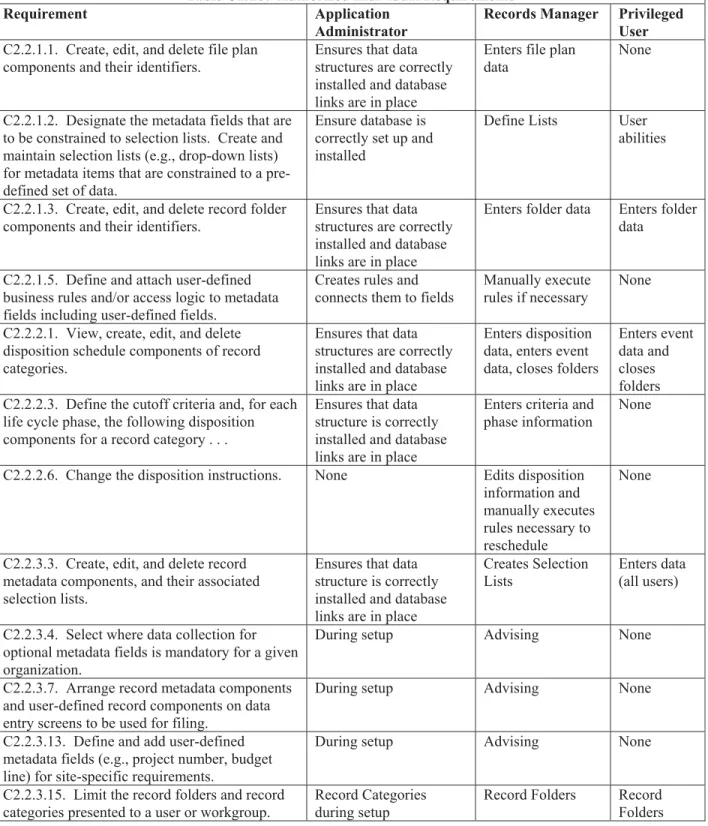
C2.2.1.1. RMAs shall provide the capability for only authorized individuals to create, edit, and delete file plan components and their identifiers. Each component identifier shall be linked to its associated component and to its higher-level component identifier(s) (see 44 U.S.C.
3303 and 36 CFR 1222.50, references (x) and (y)). Mandatory file plan components are shown in Table C2.T.1. Mandatory in the Structure column indicates that the field must be present and available to the user either as read/write or as read only depending upon the kind of data being stored. Mandatory in the Data Collection Required by User column indicates that RMAs shall ensure population of the associated data structure with non-null values. For fields that are not mandatory in the Data Collection column, RMAs shall behave in a predictable manner as a result of queries or other operations when the fields are not populated. The file plan components should be organized into logical sets that, when populated, will provide all the file plan references necessary to properly annotate (file) a record.
Table C2.T1. File Plan Components Requirement File Plan
Component Structure Data Collection
Required by User Reference/ Comment C2.T1.1. Record Category
Name
Mandatory Mandatory RMTF (reference (z)) C2.T1.2. Record Category
Identifier
Mandatory Mandatory, RMAs shall ensure unique
RMTF (reference (z)) C2.T1.3. Record Category
Description
Mandatory Mandatory RMTF (reference (z)) C2.T1.4. Disposition
Instructions Mandatory Mandatory 36 CFR 1228.24 (reference (aa))
C2.T1.5. Disposition
Authority Mandatory Mandatory RMTF (reference (z)) C2.T1.6 Permanent
Record Indicator Mandatory Mandatory C2.T1.7. Vital Record
Indicator
Mandatory Mandatory 36 CFR 1236.20 (reference (ab))
C2.T1.8. Vital Record Review and
Update Cycle Period
Mandatory, conditional on Vital Record Indicator
Mandatory, conditional on Vital Record Indicator
36 CFR 1236.20 reference (ab))
C2.T1.9. User Definable Fields
Mandatory/
Undefined
Optional Multiple user defined fields shall be supported
C2.2.1.2. RMAs shall provide the capability for authorized individuals to designate the metadata fields that are to be constrained to selection lists. RMAs shall provide the capability for authorized individuals to create and maintain selection lists (e.g., drop-down lists) for metadata items that are constrained to a pre-defined set of data.
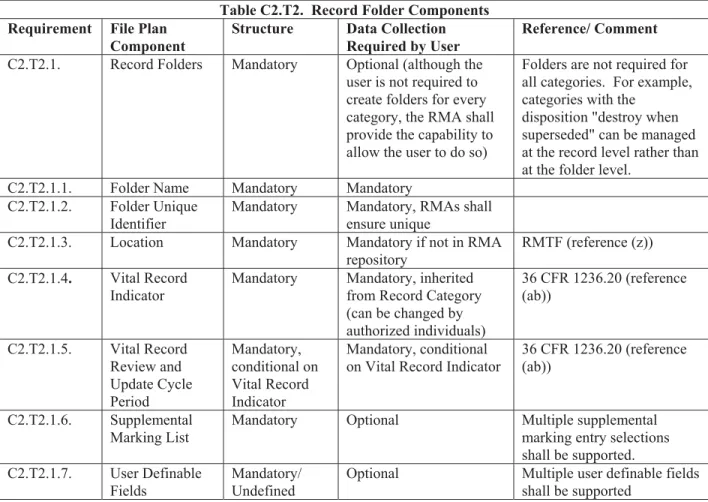
C2.2.1.3. RMAs shall provide the capability for only authorized individuals to create, edit, and delete record folder components and their identifiers. Each component identifier shall
be linked to its associated component and to its higher-level file plan component identifier(s) (see references (t) and (y)). Mandatory record folder components are shown in Table C2.T2.
Mandatory in the Structure column indicates that the field shall be present and available to the user either as read/write or as read only depending upon the kind of data being stored.
Mandatory in the Data Collection Required by User column indicates that RMAs shall ensure population of the associated data structure with non-null values. For fields that are not
mandatory in the Data Collection column, RMAs shall behave in a predictable manner as a result of queries or other operations when the fields are not populated.
Table C2.T2. Record Folder Components Requirement File Plan
Component
Structure Data Collection Required by User
Reference/ Comment C2.T2.1. Record Folders Mandatory Optional (although the
user is not required to create folders for every category, the RMA shall provide the capability to allow the user to do so)
Folders are not required for all categories. For example, categories with the
disposition "destroy when superseded" can be managed at the record level rather than at the folder level.
C2.T2.1.1. Folder Name Mandatory Mandatory C2.T2.1.2. Folder Unique
Identifier Mandatory Mandatory, RMAs shall ensure unique
C2.T2.1.3. Location Mandatory Mandatory if not in RMA repository
RMTF (reference (z)) C2.T2.1.4. Vital Record
Indicator
Mandatory Mandatory, inherited from Record Category (can be changed by authorized individuals)
36 CFR 1236.20 (reference (ab))
C2.T2.1.5. Vital Record Review and Update Cycle Period
Mandatory, conditional on Vital Record Indicator
Mandatory, conditional on Vital Record Indicator
36 CFR 1236.20 (reference (ab))
C2.T2.1.6. Supplemental Marking List
Mandatory Optional Multiple supplemental marking entry selections shall be supported.
C2.T2.1.7. User Definable Fields
Mandatory/
Undefined
Optional Multiple user definable fields shall be supported
C2.2.1.4. RMAs shall ensure that identifiers (e.g., folder identifiers, record category identifiers) are unique so that ambiguous assignments, links, or associations cannot occur.
C2.2.1.5. RMAs shall provide the capability to allow only an authorized individual to define and attach user-defined business rules and/or access logic to any metadata field including user-defined fields.
C2.2.1.6. RMAs shall provide the capability to sort, view, save, and print user-selected portions of the file plan, including record folders (see reference (z)).
C2.2.2. Scheduling Records.
C2.2.2.1. RMAs shall provide the capability for only authorized individuals to view, create, edit, and delete disposition schedule components of record categories.
C2.2.2.2. RMAs shall provide the capability for defining multiple phases (e.g., transfer to inactive on-site storage, transfer to off-site storage) within a disposition schedule.
C2.2.2.3. RMAs shall provide the capability for only authorized individuals to define the cutoff criteria and, for each life cycle phase, the following disposition components for a record category:
C2.2.2.3.1. Retention Period (e.g., fiscal year).
C2.2.2.3.2. Disposition Action (interim transfer, accession, permanent, or destroy).
C2.2.2.3.3. Interim Transfer or Accession Location (if applicable).
C2.2.2.4. RMAs shall, as a minimum, be capable of scheduling and rescheduling each of the following three types of cutoff and disposition instructions (see reference (d)).
C2.2.2.4.1. Time Dispositions, where records are eligible for disposition immediately after the conclusion of a fixed period of time following user-defined cutoff (e.g., days, months, years).
C2.2.2.4.2. Event Dispositions, where records are eligible for disposition
immediately after a specified event takes place (i.e., event acts as cutoff and there is no retention period).
C2.2.2.4.3. Time-Event Dispositions, where the timed retention periods are triggered after a specified event takes place (i.e., event makes the record folder eligible for closing and/or cutoff and there is a retention period).
C2.2.2.5. RMAs shall provide the capability to automatically calculate the complete life cycle, including intermediate phases, of record folders and records not in folders (see reference (d)).
C2.2.2.6. RMAs shall provide the capability for rescheduling dispositions of record folders and/or records (those not in folders) during any phase of their life cycle if an authorized individual changes the disposition instructions. This requirement includes the capability to change the cutoff criteria of disposition instructions and to change the retention period associated with a disposition.
C2.2.2.7. The RMA shall provide recalculation of the record life cycle based on changes to any life-cycle date and set the filing status (i.e., open, closed) of the folder according to the business rules associated with date change(s).
C2.2.3. Declaring and Filing Records.
C2.2.3.1. RMAs shall provide the capability to associate the attributes of one or more record folder(s) to a record, or for categories to be managed at the record level, provide the capability to associate a record category to a record (see reference (y)).
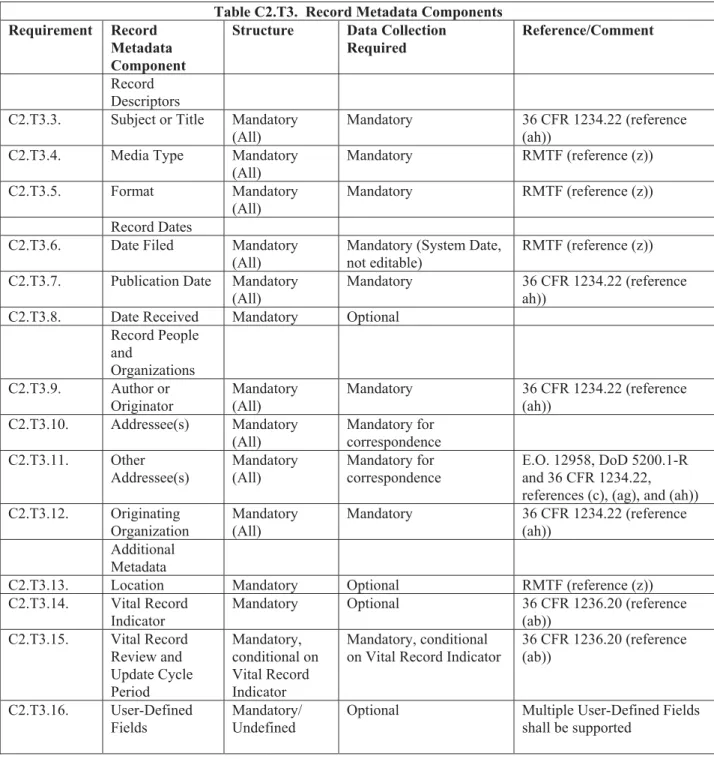
C2.2.3.2. Mandatory record metadata components are shown in Table C2.T3.
Mandatory in the Structure column indicates that the field shall be present and available to the user either as read/write or as read only depending upon the kind of data being stored.
Mandatory in the Data Collection Required column indicates that RMAs shall ensure population of the associated data structure with non-null values. For fields that are not mandatory in the Data Collection column, RMAs shall behave in a predictable manner as a result of queries or other operations when the fields are not populated.
Table C2.T3. Record Metadata Components Requirement Record
Metadata Component
Structure Data Collection
Required Reference/Comment
Record Identifiers,
Markings, and Indicators
C2.T3.1. Unique Record
Identifier Mandatory, system
generated (All)
Mandatory (System Generated, not editable) C2.T3.2. Supplemental
Marking List
Mandatory (All)
Optional Multiple Supplemental
Markings entry selections shall be supported (see DCID 6/6, DoD Directive 5210.83, DoD
5400.7-R, DoD Directive 5230.24, and DoD 5200.1-R, references (ac), (ad), (ae), (af), and (ag))
Table C2.T3. Record Metadata Components Requirement Record
Metadata Component
Structure Data Collection Required
Reference/Comment
Record Descriptors
C2.T3.3. Subject or Title Mandatory (All)
Mandatory 36 CFR 1234.22 (reference (ah))
C2.T3.4. Media Type Mandatory
(All)
Mandatory RMTF (reference (z))
C2.T3.5. Format Mandatory
(All) Mandatory RMTF (reference (z))
Record Dates
C2.T3.6. Date Filed Mandatory
(All)
Mandatory (System Date, not editable)
RMTF (reference (z)) C2.T3.7. Publication Date Mandatory
(All) Mandatory 36 CFR 1234.22 (reference
ah)) C2.T3.8. Date Received Mandatory Optional
Record People
and
Organizations
C2.T3.9. Author or
Originator
Mandatory (All)
Mandatory 36 CFR 1234.22 (reference (ah))
C2.T3.10. Addressee(s) Mandatory (All)
Mandatory for correspondence C2.T3.11. Other
Addressee(s) Mandatory
(All) Mandatory for
correspondence E.O. 12958, DoD 5200.1-R and 36 CFR 1234.22, references (c), (ag), and (ah)) C2.T3.12. Originating
Organization
Mandatory (All)
Mandatory 36 CFR 1234.22 (reference (ah))
Additional Metadata
C2.T3.13. Location Mandatory Optional RMTF (reference (z)) C2.T3.14. Vital Record
Indicator
Mandatory Optional 36 CFR 1236.20 (reference (ab))
C2.T3.15. Vital Record Review and Update Cycle Period
Mandatory, conditional on Vital Record Indicator
Mandatory, conditional on Vital Record Indicator
36 CFR 1236.20 (reference (ab))
C2.T3.16. User-Defined Fields
Mandatory/
Undefined
Optional Multiple User-Defined Fields shall be supported
C2.2.3.3. RMAs shall provide the capability for only authorized individuals to create, edit, and delete record metadata components, and their associated selection lists.
C2.2.3.4. RMAs shall provide the capability for authorized individuals to select where data collection for optional metadata fields is mandatory for a given organization.
C2.2.3.5. RMAs shall assign a unique computer-generated record identifier for each record they manage regardless of where that record is stored (see reference (z)).
C2.2.3.6. RMAs shall provide the capability to create, view, save, and print the complete record metadata, or user-specified portions thereof, in user-selectable order (see reference (z)).
C2.2.3.7. RMAs shall provide the capability for authorized individuals to arrange record metadata components and user-defined record components on data entry screens to be used for filing.
C2.2.3.8. RMAs shall prevent subsequent changes to electronic records stored in its supported repositories. The content of the record, once filed, shall be preserved (see references (y) and (z)).
C2.2.3.9. RMAs shall not permit modification of the metadata fields indicated by this Standard as not editable.
C2.2.3.10. RMAs shall (for all records) capture, populate, and/or provide the user with the capability to populate the metadata elements before filing the record. RMAs shall ensure that fields designated mandatory for data collections are non-null before filing the record (see
references (y) and (ah)).
C2.2.3.11. For records that are being filed via the user interface, RMAs shall provide the user with the capability to edit the record metadata prior to filing the record, except for data specifically identified in this Standard as not editable. For autofiling, RMAs shall provide the user the option of editing the record metadata prior to filing.
C2.2.3.12. Dates captured electronically shall be valid dates as defined in paragraph C2.1.2. Where data entry/capture errors are detected, RMAs shall prompt the user to correct the error. These prompts shall provide guidance to the user in making corrective actions; for
example, "Date format incorrect - use MM/DD/YYYY."
C2.2.3.13. RMAs shall restrict the capability to only authorized individuals to define and add user-defined metadata fields (e.g., project number, budget line) for site-specific requirements (see reference (ah)).
C2.2.3.14. RMAs shall provide the capability to view, save, or print the metadata associated with a specified record or set of records, or user-specified portions thereof, in user- selectable order.
C2.2.3.15. RMAs shall provide the capability for only authorized individuals to limit the record folders and record categories presented to a user or workgroup. Based on these limits, RMAs shall present to users only those record categories or folders available to the user or workgroup for filing.
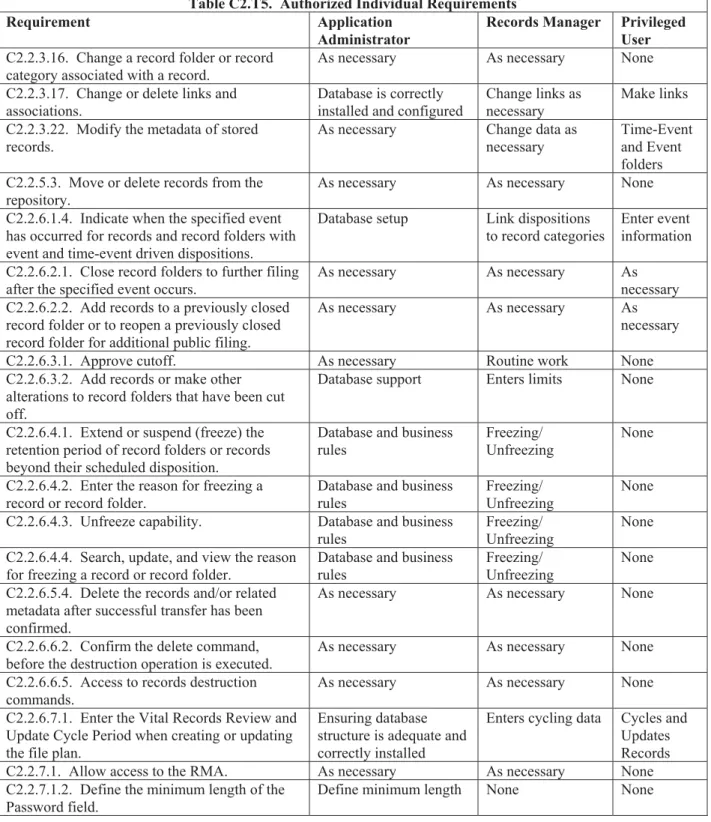
C2.2.3.16. RMAs shall provide the capability for only authorized individuals to change a record folder or record category associated with a record.
C2.2.3.17. RMAs shall provide a capability for referencing or linking and associating supporting and related records and related information, such as notes, marginalia, attachments, and electronic mail-return receipts, etc., to a specified record. RMAs shall allow only authorized individuals to change or delete links and associations (see reference (z)).
C2.2.3.18. RMAs shall provide the capability to link original superseded records to their successor records.
C2.2.3.19. RMAs shall provide the capability to support multiple renditions of a record.
These shall be associated and linked.
C2.2.3.20. RMAs shall provide the capability to increment versions of records when filing. RMAs shall associate and link the versions.
C2.2.3.21. RMAs shall link the record metadata to the record so that it can be accessed for display, export, etc. (see 36 CFR 1234.32, reference (ai)).
C2.2.3.22. RMAs shall provide the capability for only authorized individuals to modify the metadata of stored records. However, RMAs shall not allow the editing of metadata fields that have been specifically identified in this Standard as not editable.
C2.2.3.23. RMAs shall enforce data integrity, referential integrity, and relational integrity.
C2.2.3.24. RMAs shall provide the capability to automatically synchronize multiple databases and repositories.
C2.2.3.25. RMAs shall provide the capability for users to create and maintain shortened
"quick–pick" lists from the authorized lists.
C2.2.3.26. RMAs shall provide the capability for users to create and maintain templates that automatically populate commonly used data into record metadata fields.
C2.2.4. Filing Electronic Mail Messages (E-mail).
C2.2.4.1. RMAs shall treat e-mail messages the same as any other record, and these shall be subject to all requirements of this Standard (see 32 CFR 1222.32 and 36 CFR 1234.24,
references (aj) and (ak)).
C2.2.4.2. RMAs shall capture and automatically store the transmission and receipt data identified in Table C2.T4 if available from the e-mail system, as part of the record metadata when an e-mail message is filed as a record (see reference (ak)). RMAs shall provide the capability for editing Subject or Title, Author or Originator, Addressee(s), and the Other Addressee(s) metadata fields prior to filing. All other fields shall not be editable.
TABLE C2.T4. Transmission and Receipt Data
Transmission and Receipt Data Record Metadata Mapping
The intelligent name1 of the sender. RMAs shall automatically enter this data into the Author or Originator data field (subparagraph C2.T3.9.).
The intelligent name of all primary addressees (or
distribution lists). RMAs shall automatically enter this data into the Addressee(s) data field of the record metadata (subparagraph C2.T3.10.).
The intelligent name of all other addressees (or distribution lists).
RMAs shall automatically enter this data into the Other Addressee(s) data field (subparagraph C2.T3.11.).
The date and time the message was sent. RMAs shall automatically enter this data into the Publication Date data field (subparagraph C2.T3.7.).
For messages received, the date and time the message was received (if available).
RMAs shall automatically enter this data (if available) into the Date Received data field (subparagraph C2.T3.8.).
The subject of the message. RMAs shall automatically enter this data into the Subject or Title data field of the record metadata (subparagraph C2.T3.3.).
C2.2.4.3. RMAs shall provide the user the option of filing e-mail and all its
attachment(s) as a single record, or filing selected e-mail item(s) as individual record(s), or to do both. When the attachment(s) is (are) filed as individual record(s), the user shall be provided the capability to enter the metadata required in table C2.T3. (see reference (ak)).
C2.2.5. Storing Records.
1Intelligent names are clear, uncoded, identifications of the individual.
C2.2.5.1. RMAs shall provide at least one portal that provides access to all associated repositories and databases storing electronic records and their metadata.
C2.2.5.2. The RMAs shall prevent unauthorized access to the repository(ies) (see 36 CFR 1222.50 and 44 U.S.C. 3105, references (y) and (al)).
C2.2.5.3. RMAs shall manage and preserve any record in any supported repository, regardless of its format or structure, so that, when retrieved, it can be reproduced, viewed, and manipulated in the same manner as the original (see references (y), (z), and (ah)).
C2.2.5.4. RMAs shall allow only authorized individuals to move or delete records from the repository (see 36 CFR 1222.50 and 36 CFR 1234.28, references (y) and (am)).
C2.2.6. Retention and Vital Records Management.
C2.2.6.1. Screening Records.
C2.2.6.1.1. RMAs shall provide for sorting, viewing, saving, and printing list(s) of record folders and/or records (regardless of media) based on any combination of the following:
C2.2.6.1.1.1. Disposition Action Date.
C2.2.6.1.1.2. Disposition Action.
C2.2.6.1.1.3. Location.
C2.2.6.1.1.4. Transfer or Accession Location.
C2.2.6.1.1.5. Vital Records Review and Update Cycle Period or Date.
C2.2.6.1.1.6. Record Category Identifier.
C2.2.6.1.1.7. Folder Unique Identifier.
C2.2.6.1.1.8. User Definable Fields.
C2.2.6.1.2. RMAs shall provide for sorting, viewing, saving, and printing life cycle information, eligibility dates, and events of user-selected record folders and records.
C2.2.6.1.3. RMAs shall allow the user to select and order the columns presented in the screening result list(s).