This is a true copy of the thesis, including any necessary final revisions as accepted by my examiners. A number of trust-based secure routing protocols have recently been introduced consisting of the traditional route discovery phase and a data transmission phase. Results show that the E-TBM scheme outperforms the Trust Based Multi-path (TBM) secured routing scheme [1], chosen as a benchmark, in terms of energy consumption of the selected routing paths, number of dead nodes, trust compromise. and route selection time, selected as performance metrics.
The latter involves examining the peculiarities of the wireless transmission medium used, as well as determining the required battery level of the source nodes involved in the data transmission process.
Motivation
When a node is drained of all its available power, it no longer plays a role in the route selection process. This thesis adds energy considerations to a recently proposed message security scheme in MANETs (so-called Trust Based Multi-path message security (TBM)) [1], to strengthen its design. Typically, the route discovery and selection algorithm in [1] is substantially modified to consider the energy level of the selected route routes while maintaining their security and trust levels, leading to our so-called Energy-Aware Trust Based Multi-path (E-TBM) message security scheme.
The change consists in assigning a power-aware metric [2] to each node involved in the chosen routing paths to quantify the amount of energy consumed by the node, thereby determining the necessary energy consumption to maintain an acceptable level of message security in the network.
Research Problem
Approach
Thesis Contributions
Thesis Organization
Mobile Ad Hoc Networks
MANETs are a type of network where nodes cooperate with each other to ensure proper communication between them. Due to its dynamic topology, the connections in a MANET can be established and broken continuously depending on the speed, direction and transmission range of the nodes. Typically, intermediate nodes are forced to forward the packets in cases where the destination node is not within the transmission range of the source node.
In such a network, nodes communicate with each other and are not managed by a single node or entity.
DSR Protocol
If the destination node exists in an intermediate node's routing table, the source node will forward the packet to that node. Once this is done, the destination node knows all the intermediate nodes it must traverse along the route to send the acknowledgment of receipt (ACK) back to the source node. When this happens, it means that a break in the route has occurred and the source node will then use an alternate route to send its information to the destination node (this refers to the multipath property of DSR used in this thesis).
The routing information is stored in the route cache, and if such information exists, the source node initiates the route discovery process again [5, 6].
Energy-Efficiency as a Key Concern when Designing Multipath Routing for
The reason Path Maintenance exists is because in MANETs, the topology of the network is constantly changing, meaning that nodes can enter or leave the network at any given time. Due to this nature, the source node is informed of this change by means of a route error packet (RERR). In our implementation of multipath DSR routing, we modify the route discovery process introduced in [1] to include node energy limiting (see Chapter 3).
It should also be noted that during routing in multipath MANET, for each active link, the source node, as well as the intermediate nodes and the destination node may change their position due to their mobility, which means that the paths chosen for routing messages are potentially subject to frequent disconnections.
Approaches To Achieve Secure Energy-Efficient Routing in Wireless Ad Hoc
- Energy-Aware Routing Schemes for MANETs
- Energy-Aware Secured Routing Schemes for MANETs
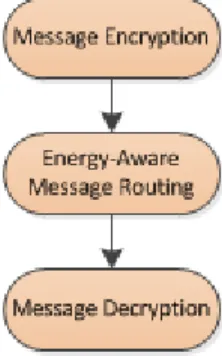
- Message Encryption
- Energy Aware Message Routing Using DSR
- Trust Assignment Strategy
- Energy-Aware Routing Mechanism
- Message Decryption
They found that their algorithm is good at conserving energy and performs better on the average end-to-end delay without affecting the overall network throughput. Node stability used two metrics for calculation: connection timeout and node residual energy. In their proposed scheme, all RREP packets are not forwarded through all available nodes as is done in standard DSDV.
Secure routing protocols for MANETs [17] have been the subject of interest for the research community in recent years. These reputations are then used to assess their behavior regarding their involvement in the data routing process. In [40], Vadivel and Narasimhan also proposed an energy-aware and secure routing scheme for MANETs, where energy efficiency is achieved through a technique to reduce the broadcast messages in the network.
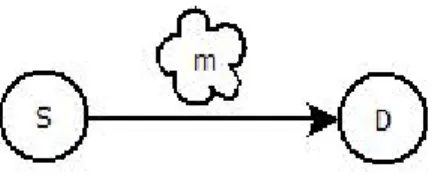
Fuzzy logic is used as a technique to evaluate the trust of a node and to detect nodes that misbehave in the network. In the proposed encryption scheme, the message m (at the source node) is segmented into four parts a, b, c and d, after which these paths are encrypted using soft encryption - i.e. okay, a path p with trust Tp can only be given Tp parts of the packet to forward.
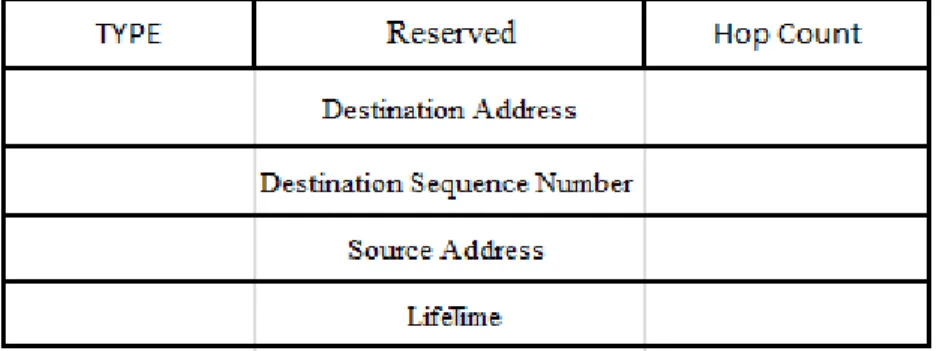
This rule helps to recognize more trusted nodes to which more encrypted message parts of the message should be assigned. In the packet header, the RREP message and the trust levels of the previous nodes involved in the packet forwarding are recognized and sent backwards along the route chosen by the DSR. The selection of the secured routes with least energy will be determined that way, and the message will.
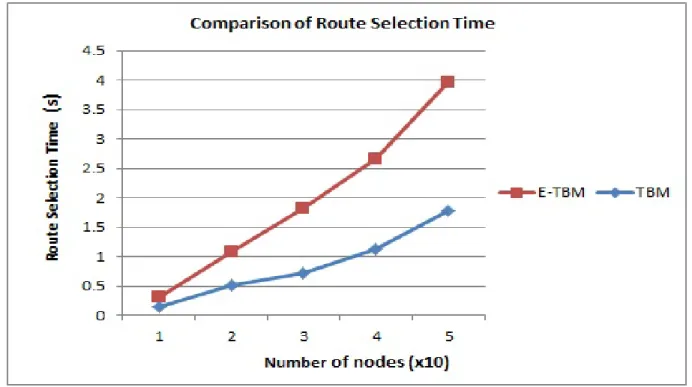
In this chapter, the performance evaluation of the proposed E-TBM scheme is compared with that of the TBM scheme [1] using some performance metrics.
Performance Metrics
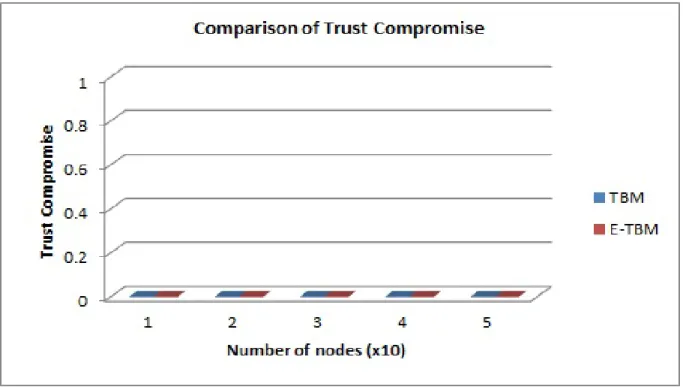
We also assume that the trust levels of nodes are available to the source nodes. It was demonstrated from Equation 4.1 and the lemma presented in [1] that the trust compromise of the selected paths in the E-TBM scheme is always equal to zero because a node cannot have more parts nparts than its trust levelTn . The number of dead nodes: a dead node is defined as a node that has completely exhausted its power level.
Total Energy Consumed by Selected Routing Paths: This represents the sum of energy consumed by the nodes that are selected to be part of the selected routing paths. Total energy consumed in the network: This represents the sum of the energy consumed by all nodes in the network, regardless of their involvement in the routing process.
Assumptions
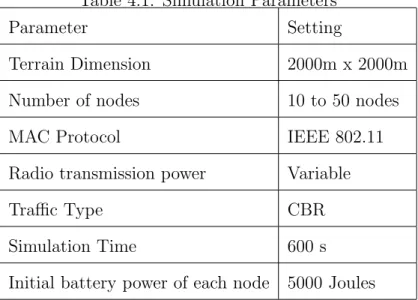
Simulation Parameters
We have also included an example GloMoSim configuration file in Appendix A that shows all the configurable parameters and the ones we have defined.
Simulation Scenario
Simulation Results
We also compare the total energy consumed (in Joules) by the nodes embedded in the selected secure paths for routing in both schemes. This provides a rationale for taking the energy required to transmit a packet into account when designing our secure routing protocol for MANETs. Next, we compare the total energy (in Joules) consumed by all the nodes in the network, regardless of their involvement in the route selection process.
4.4, it can be noted that for the E-TBM scheme, the total energy consumption required to safely select multiple paths and to send messages over those multiple paths is much lower than the energy consumption experienced with the TBM scheme. 4.5, it can be noted that at the end of the simulation, there were fewer nodes whose power was exhausted in the E-TBM scheme compared to the TBM scheme. This result is a direct correlation with the reduced total energy observed in the case of the E-TBM scheme.
Since the total energy consumption is lower, the nodes will survive longer and consequently the lifetime of the network will be extended. The main goal of this task was to help improve the energy efficiency of the path selection process in a secure trust-based multipathing scheme. This appendix describes the GloMoSim software specification for implementing our proposed E-TBM scheme and TBM scheme.
The simulation aims to evaluate both schemes in terms of the performance metrics described in Chapter 4. The user can change various parameters such as the number of nodes, terrain dimension and then study the performance of the above algorithms.
Assumptions
Interface Requirements
Command Line Interface
Software Resource Requirements
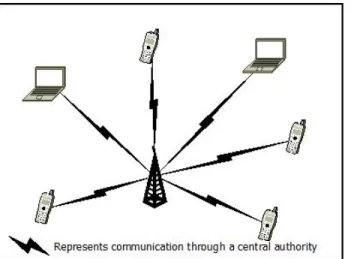
- An example of a wireless network
- An example of a MANET
- Original RREP packet format
- Basic Message sending between a source and destination node
- Proposed Message Security Scheme
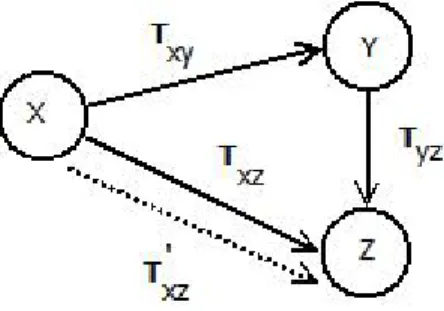
- Assignment of Trust Values to Nodes
- Illustrating the DSR protocol
- RREP packet format
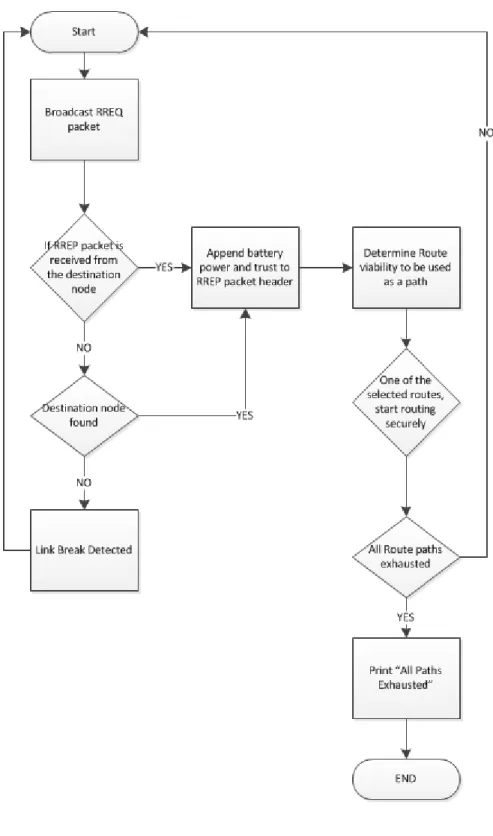
- E-TBM routing scheme operations
- Comparison of Trust Compromise
- Route Selection time for E-TBM vs. TBM schemes
- Total energy consumed in the selected routing paths for E-TBM vs. TBM
- Total energy consumed based on E-TBM vs. TBM schemes
- Number of dead nodes in the E-TBM vs. TBM schemes
Dobhal, “A survey of routing protocols in mobile ad hoc networks,” International Journal of Information Technology and Knowledge Management, vol. 5] network working group, “The Dynamic Source Routing Protocol (DSR) for Mobile Ad Hoc Networks for IPv4”, 2007. Demeester, “A review of mobile ad hoc networks: applications and challenges”, Journal of the Communications Network, vol.
Nayak, “An optimized energy aware routing (OEAR) scheme for mobile ad hoc networks using variable transmission range,” International Journal of Computer Applications vol. Prakash, “Design and energy efficient DSDV routing protocol for mobile ad hoc networks,” International Journal of Advances in Engineering and Technology (IJAET), vol. Belding-Royer, “A secure routing protocol for ad hoc networks,” in Proceedings of the 10th IEEE International Conference on Network Protocols, ICNP ’02, (Washington, DC, USA), pp.
Mehra, “Multipath and message-based secure routing in ad hoc networks,” in Proc. Chun-Kai, “An energy-aware adaptive dynamic routing scheme for wireless ad hoc networks,” in Proc. Mate, “Secure flow-aware routing to support real-time traffic in mobile ad hoc networks,” Intl.
Lai, “Mitigating routeing misbehavior in mobile ad hoc networks”, inProceedings of MobiCom 2000, (Boston, USA), fq. fq.
Kumar, “Improving Minimum Energy Consumption in Ad Hoc Networks under Different Scenarios,” International Journal of Advanced And Innovative Research (IJAIR), pp.