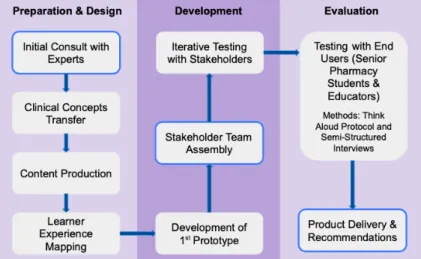
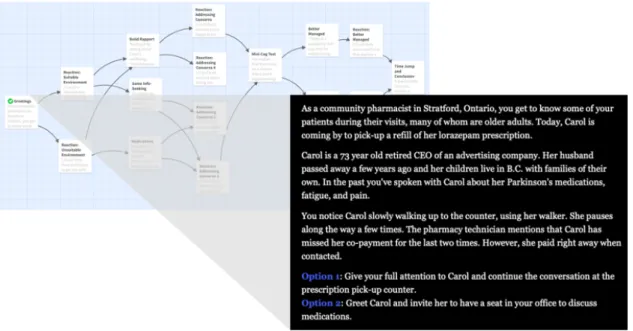
During the development phase, the prototype was reviewed by stakeholders including clinicians, people with dementia or care partners, and serious game researchers through semi-structured interviews, resulting in iterative improvements. Stakeholder feedback culminated in the development of a serious game with the goal of helping pharmacy students better understand the lived experience of dementia in a digital, non-linear story format.
Dementia
- Overview
- Prevalence of Dementia in Canada
- Impact of Dementia
- Pharmacist Roles in Dementia Care
- Evolution of Pharmacy Practice
- Pharmacy Education on Dementia
Pharmacists are among the most qualified and accessible healthcare professionals who can provide care to people living with dementia and their care partners. A combination of classroom and experiential learning opportunities help prepare students to provide care to patients with dementia.
Serious Games
Attributes of Serious Games
One way to facilitate situated learning through games is by integrating authentic stories, which adds relevance and meaning to the experience. Meaningfulness refers to the intention behind the learning and its personal relevance, which contributes to long-lasting acquired knowledge and skills.
Rationale
- Serious Games as Vehicles for Learning
- Application of Serious Games in Pharmacy Education
- Serious Game Development
- Game Format
- Learning Objectives
As there is unfulfilled potential in the use of serious games in pharmacy education, it is necessary to examine game development approaches. One of the challenges of designing effective serious games for healthcare education is that there is no consensus or consistency in the game development process.
Primary Objective
Secondary Objective
Summary of Common Approaches in Qualitative Studies
Codes or tags are assigned to important, recurring ideas and themes that are used to develop a theory. This approach relies heavily on the researcher to produce and interpret data and is subject to observer bias. In case studies, a person or a group is studied in depth and typically over a longer period of time, therefore they are not generalizable.
Qualitative Description
We desperately need new knowledge about the subjective, experiential, tacit, and modeled aspects of human health experience—not so that we can advance theorizing, but so that we can have enough contextual understanding to guide future decisions that will apply evidence in the lives of real people.". In educational research, qualitative description can be used to explore teaching and learning processes, student experiences, and educational practices [84,85]. Understanding end-users' game experiences and learning through qualitative description facilitates a user-centered approach to serious game design.
The results would provide a means to transform ideas, themes or concepts from the participants for use in future development of educational interventions.
Overview of Serious Game Design Framework
Preparation and Design
- Initial Consultation with Experts
- Medical and clinical concepts transfer
- Content production
- Learner experience mapping
Based on a sample case, provided by a geriatrician, of a patient with dementia, containing information on relevant medical conditions, medication and social history, a map of the story will be drawn with possible decision points and outcomes.
Development
- Development of the first prototype
- Assembling groups of stakeholders
- Stakeholder involvement
- Knowledge management framework for collecting stakeholder feedback 25
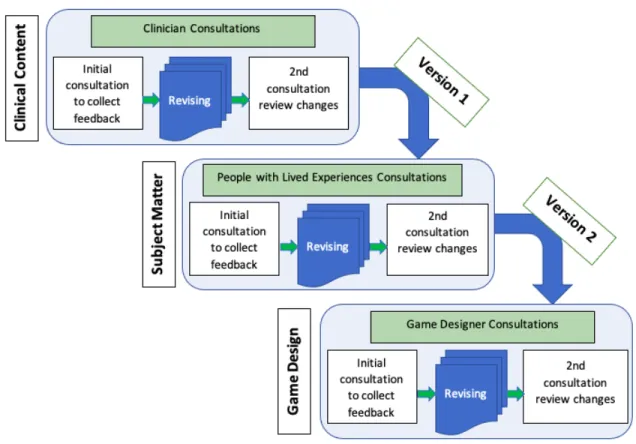
We will share project and game information with stakeholders to review on their own time. Meetings with the same stakeholders will be held again to review the revised version of the game and determine which aspects of their feedback were or were not incorporated into the changes. Physician stakeholders will first review the game for clinical content, and then
The knowledge management protocol [87], shown in the figure below, will be used to collect feedback from all stakeholders. To ensure that feedback is collected and implemented in a way that meets stakeholder expectations, improvements to the game will be reviewed again by the same stakeholder.
Formative Evaluation
Recruitment and data collection
To recruit teacher participants, they are contacted individually by email through connections within the research network. Participants will also be notified that the entire session will be audio recorded for accurate transcription and analysis. To understand user experiences, both the think-aloud protocol and the semi-structured interview will be used.
During the playtesting session, student participants will be asked to think aloud while playing the game to describe their experiences, feelings, strategy and any feedback that comes to mind. Student and teacher participants will be interviewed to understand the gameplay experience and gather further feedback on the game.
The framework method of analysis
For this project, otter.ai will be used to transcribe the interviews, edit the transcripts, and subsequently code the data. This stage is especially important when researchers who are new to the project are involved in the data analysis. Later, as the researchers become familiar with the interviews and start coding, an inductive approach is used where codes can be revised and new codes added to better represent the data.
If any changes or additions to the codebook are necessary, the second researcher will be consulted. Next, the development stages describe the process of creating the final version of the game.
Preparation and Design
Initial Consultation and Game Design
This chapter presents the results of serious game development and end-user testing experiences.
Stakeholders
Development
Stakeholder feedback
Checkmarks show the feedback points that were implemented and the crosses show the feedback points that could not be implemented with a brief explanation of why. For example, options at each decision point had to be predetermined rather than allowing students to create their own options that are more challenging and realistic. As people with personal experience of dementia were not involved in writing the content, there was a risk that the story or character would be inauthentic to players.
Feedback that could be implemented included adding a mini cogwheel assessment to increase relevance to pharmacy, more open and closed dialogue options that could prompt students to consider their language when interacting with patients, and story loops for players to recover from mistakes.

Formative Evaluation
Analytical Framework
End-User Learning and Play Experience
Although the patient's perspective and some of the feelings of living with dementia were presented in the story, students felt a lack of authenticity that prevented them from connecting with the patient's character. However, the game did not prompt students to reflect on perspectives other than that of the patient and the pharmacist. The novelty of the game format created an initial excitement that died down upon familiarity.
Therefore, it relied heavily on story intrigue and decision paths to be considered an engaging learning experience. The final page of the game contained open-ended questions for students to consider, which allowed students to be more creative in their responses.
Design Recommendations
Experiential Learning
Experiential opportunities enable learners to participate and apply their learning and gain exposure to the variability and uncertainty of the real world. Participants in this study were most interested in serious games for the promise of immersive, experiential learning. In healthcare education, authenticity is often associated with the realism of a simulation, in other words, the realism of the environment for learners.
The findings of this project showed that, in addition to the realism of the environment, students also appreciate an authentic story and characters. To improve the current game, stakeholders with dementia in their lives should be involved in the development of game content for more authentic characters and stories.
Problem-Oriented Approach
A study comparing the design of virtual simulations and serious games in nursing education elaborates on the place of authenticity and realism in the design of educational interventions [107]. Therefore, although not required or commonplace in serious games literature, the use of personal stories can enhance the authenticity of the content presented in games, which will help facilitate experiential learning and prevent harmful misrepresentation of patient experiences. In the literature, computer-based simulation training has been shown to be effective in improving clinical reasoning skills in nursing education [ 108 ].
In the literature, one of the disadvantages of simulations is that students feel frustrated by the limitations of the decisions they can make and by the inability to make their own decisions [109]. In a study of learning in healthcare simulations, it was determined that simulations cannot be completely predetermined, but rather emerge through interactions between the participant and the context.
Medium Considerations
Conclusion
Limitations
Another way to keep it fresh would be to explore new game formats that allow for a different gaming experience each time. The games can also be adapted to the learner's preferences and knowledge to create an optimally challenging experience. The next steps would be to involve people living with dementia in the development of the game as stakeholders and to test the game with groups of participants with different levels of dementia experience.
Furthermore, in this project no conclusions can be drawn about the impact of the game on students' learning, attitudes, empathy and clinical reasoning. More testing, of longer duration and larger sample sizes, would be needed to assess the impact.
Future Directions
Understanding public stigma and self-stigma in the context of dementia: a systematic review of the global literature. In Entertainment Computing and Serious Games: International GI-Dagstuhl Seminar 15283, Dagstuhl Castle, Germany, July revised selected papers, pages 17–41. Revealing the theoretical basis of gamification: a systematic review and analysis of theory in gamification research, serious games and game-based learning.
Developing theory-driven, evidence-based serious games for health: framework based on research community insights. Distinguish the design principles of virtual simulations and serious games to improve nurses' clinical reasoning. Impact of serious games on science learning achievement compared to more conventional instruction: a review and a meta-analysis.
You begin by asking about Carol's medications: "What questions do you have about your medications today?".
Pharmacy and Dementia Educators
- Page 1
- Page 2
- Page 3
- Page 4
- Page 5
- Page 6
- Page 7
- Page 8
- Page 9
- Page 10
- Page 11
- Page 12
- Page 13
- Page 14
- Page 15
- Page 16
In the past you have talked to Carol about the medications, fatigue and pain from her Parkinson's. You start by asking about Carol's medications: "I see you're picking up your sleeping pill medications today." The assessment consists of only two questions and completing them can help to involve the GP earlier in the conversation.
If you would like, I can help with this by contacting your family doctor about your concerns.”. The symptoms you have described and your assessment indicate that you may be suffering from dementia or cognitive impairment and it would be best if you talk to your family doctor about this.