This was my first encounter with rural health care – my first encounter with health care, for that matter. We must ensure opportunities and support for innovative ideas and future research that promise to change how we view the totality of rural health. If we have made progress on rural health issues, credit must go to the many individuals, organizations and governments who have made rural health issues clearly visible on the radar screen.
For many years, even prior to the creation of its now defunct Office of Rural Health, Health Canada sponsored research competitions to encourage rural health research. The short-lived Office of Rural Health, the report of the Conference on Rural Health (which the office sponsored), and the subsequent Ministerial Advisory Council on Rural Health articulated the need to focus on rural health as its own entity. The Canadian Society of Rural Physicians has always been a strong advocate for the special needs of rural health care.
The Rural Health Research Group at Laurentian University sponsored a conference in 1993 on "Redressing the Imbalance." The. The Canadian Institutes of Health Research produced a report on rural health research, making rural health a cross-cutting theme across its thirteen institutes. Committed academic researchers across Canada continue to explore rural health issues, many of whom contribute to this volume.
We need to build a library of reports, research data, stories and experiences that capture life in rural Canada, to create and build a discipline called rural health and life.
Acknowledgments
Health and Place in Rural Canada
Still persistent in the country's collective imagination is a sense of Canada's rural and remote places as defining spaces of Canadian national identity, of the diverse rural landscapes of the Group of Seven artists, whose work is an icon of Canadian nationality, to Canadian musicians such as as Gordon Lightfoot and Anne Murray, singing about life and existence in rural Canada. Canada's First Nations mastered survival in rural and remote corners of the country and taught Europeans how to live in the wilderness. The vulnerability of this group suggests that their needs must be prioritized if any change in rural health status is to take place.
To understand how health services are delivered in rural Canada, one must first review how Canadian health care is managed, funded and delivered. 3 Predominantly rural regions refer to the fact that more than 50 percent of the population lives in a rural community with a population density of less than 150 persons per square kilometer (OECD 1994). As Chapter 15 demonstrates, the implications extend to the ethics of health research in rural communities.
The second is that there is great diversity in rural areas, with each locality or Living and working in rural areas affects health status, partly as a result of deficiencies in health services. The findings presented here illustrate and confirm that the health status and provision of care services are different in rural areas compared to urban areas.
Compared to urban areas, for example, life expectancy is lower in rural and remote areas, and mortality is higher in more rural and remote areas. The persistent disparities in health status suggest that care is unavailable or unavailable in rural areas. In contrast, mental health status is actually better in rural and non-metropolitan areas compared to other disorders, partly due to the availability of social support in rural areas.
All these variations and specific examples regarding rural health status and the supply of health providers point to the need for a paradigm shift in how we operationalize health care services in rural areas. To advance our understanding of dynamics in rural communities, the research findings link place (rural and community) with condition (health and well-being). For example, in rural and remote Canada, individuals with mental health disorders and specific illnesses such as HIV/AIDS experience stigma.
Given the extreme shortage of health professionals (eg registered nurses, doctors, physiotherapists) in rural areas, creativity in the provision of care and support of those who provide it is needed to ensure that health care remains accessible and available to rural areas. residents. Our hope is that this volume will provide evidence that health care services in rural areas must remain in place and address the uniqueness of the rural context across the full spectrum, from health promotion to treatment, chronic care and end-of-life support.
Rural Health Status
Rural Health Status and Determinants in Canada
It is the first pan-Canadian study to present a broad picture of the health of rural populations in relation to aspects such as life expectancy, health behaviour, quality of life indicators, chronic conditions and injuries. A more detailed version of the report can be found at http://www.phac-aspc.gc.ca. Population aging, economic hardship and geographic isolation are among the factors that may contribute to health vulnerability in rural areas and small towns in developed countries.
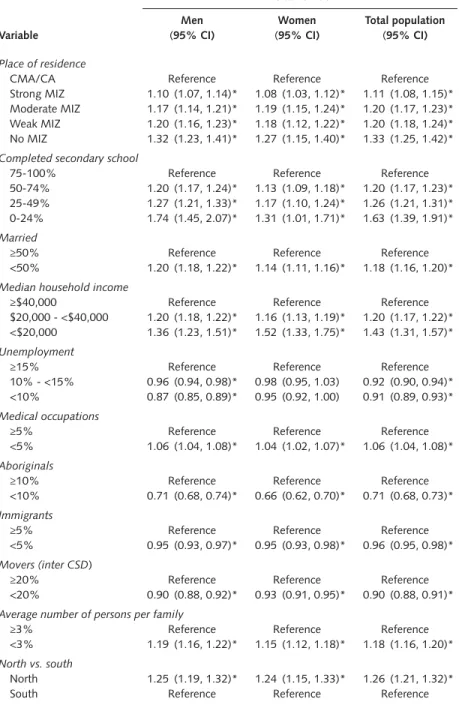
Aboriginal people made up 2.2 percent of the population of Australia and 1.5 percent of the population of the United States (Statistics Canada 2003). In 2001, just over half (51 percent) of the population identifying as Aboriginal—First Nations, Inuit, and Métis—lived in rural Canada (Statistics Canada 2003); of this 51 percent comprised 31 percent living on Indian reservations and settlements, and 19.5 percent living in rural off-reservation areas (Curtis and Jones. Metropolitan Influenced Rural Areas (MIZ) classification also developed by Statistics Canada, is a refinement or extension of the RST concept “to better capture the effects of metropolitan accessibility on non-metropolitan areas” (du Plessis et al. 2002; McNiven, Puderer, and Janes 2000).
Strong MIZ: 30 percent or more of the employed workforce living in the CSD work in each CMA/CA. Moderate MIZ: at least 5 percent but less than 30 percent of the employed workforce living in the CSD work in any CMA/CA. Weak MIZ: more than 0 percent but less than 5 percent of the employed workforce living in the CSD work in any CMA/CA.
For the methods used to determine the statistical significance of the SMRs and ASMRs, please see the full report at http://www.phac-aspc. gc.ca.). Causes of death according to the ninth revision of the International Classification of Diseases (ICD-9) were examined in ICD-9 chapters based on their frequency in each age group. Area suppression (i.e. the suppression of data for CSDs with small populations) explains the unavailability of some census data at the CSD level.
See the full report for methods to test the significance of the SIRs and ASIRs. As well, persons living on Indian reserves or crown lands, the clients of institutions, full-time members of the Canadian Armed Forces and residents of certain remote regions are excluded; therefore, the associations or the proportions reported for some of the most rural/remote areas may be underestimated. For a more detailed discussion of the methods for calculating HALE, see the full report at http://www.phac-aspc.gc.ca.
Although some health measures did not show pronounced rural/urban differences, and some outcomes were actually found to be worse in urban areas, rural areas generally showed a health disadvantage for many of the measures examined in this study. Ethnic composition also had a strong effect on mortality risk: a proportion of less than 10 per cent (versus more than 10 per cent) of Aboriginal people within the census subdivision was associated with a 53 per cent to 61 per cent reduction in mortality risk, and a proportion of immigrants of less than 5 percent was associated with a 5 percent reduction in mortality risk.