Doug Hitch
Independent Scholar
Proto-Inuit and the daughter dialects have two non-nasal, non- lateral consonant series, /p t c k q/ and /v ʐ j ɣ ʁ/. The distinctive feature separating these sets has been generally regarded as continuance but voicing is a better candidate. PI
*c has been seen as affricate [ts] or [tʃ] but a voiceless palatal stop value [c] better explains the diachronic and synchronic data. PI *ʐ and modern /ʐ/ have received a wide range of phonetic characterizations but a voiced retroflex sibilant value [ʐ] best accounts for the historical and descriptive evidence.
Some historical documents and modern descriptions are reassessed. Some suggestions are made for the reconstruction of PI.
1 Introduction
The Inuit language family stretches from Big Diomede Island in the Bering Strait to the east coast of Greenland. Probably all of the many intervening dialects have been studied, and while the studies have varying degrees of depth, there is no doubt about the basic identity of the phonemic units for any dialect and there is much known about phonological and morphophonological patterning. With the numerous distinct dialects, and the existence of much historical documentation, the language area offers a rich field for historical linguistics and linguistic typology.
In these pages much effort is made towards refining our phonetic understanding of the segments /c/
and /ʐ/ in both Proto-Inuit and the daughter dialects. This information has both diachronic and synchronic implications. It can simplify both descriptions and make them more natural. Also presented here is a fresh look at the distinctive feature specification of the consonants. By regarding voicing rather than continuance as the primary distinguishing feature among the consonants, other improvements may be made in the descriptions.
After the introductory sections (1.1–1.3) there are sections devoted to individual voiceless (2–2.6) and voiced (3–3.6) consonants. These sections cover historical and synchronic information relating to the phonetics and phonology of each of these consonants. The phonemic nasals /m n ŋ/ are phonologically straightforward and are not discussed. There is a final short section (4) on vowel epenthesis in consonant clusters. Appendices A to H contain lists of examples illustrating the phonetics of some segments.
Appendix I provides a list of comparative symbology, and Appendix J is a list of abbreviations and dialect names with geographic indications.
1.1 Method
At least three levels of transcription are needed when working with non-phonological sources: the original transcription in the original orthography or non-standard transcription; a phonetic transcription;
and a phonemic transcription. Sometimes there is overlap among them, but often all three require
* In early June 2017 Sean Guistini from Arctic College made a special effort to find and send a copy of Dorais 2003 which is out of print (3rd rev ed. in press). In late July 2017 I had a useful discussion with Elan Dresher and Daniel Hall about continuance being non-phonemic. The first draft of this paper received useful comments in October 2017 from Michael Fortescue, Louis-Jacques Dorais, Michael Cook and two anonymous reviewers. In the same month André Bourcier assisted with some Siglitun and French issues.
different symbols. Most scholarship to date makes compromises with these levels. They are combined or modified for the sake of expediency. This is not a criticism. Much very good work has been achieved with compromise transcriptions1 and some compromises are made here in two cases (see below). But at times a rigorous division of levels is necessary for accurate descriptions. Here, source transcriptions are in italics, phonetic in square brackets [ ], and phonemic in slanted brackets / /. These rules do not apply in quotations from other writers where the original apparatus is retained..
In the Inuit language field, the array of symbols in use now and in the past can be daunting. There is no consensus on symbology. The practice here has been to reproduce exactly what the original authors wrote. This is fairly easy now with Unicode and done almost without exception.2 For the phonetic and phonemic transcriptions, IPA is employed. It is not perfect but with so many symbols in use by Inuit language researchers, a symbolic system which is commonly understood is useful if not almost essential.
Appendix X+1 has a chart comparing symbols from the major systems relied on here. Where there is any doubt about a representation, there should always be an accompanying phonetic or phonemic rendering in IPA. In phonetic transcriptions here the vowel uvularization is not marked. It predictably occurs before uvular segments. This is a kind of compromise phonetic transcription as it does not write some phonetic information. In phonemic transcriptions of Utkuhiksalingmiutut the glottal stop symbol ʔ is used to show where the glottal stop allophone of /t/ occurs. This is also a compromise transcription as it shows non- phonemic information.
Many abbreviations for dialect names are necessary in work like this. Where there is material reproduced from the Comparative Eskimo Dictionary (CED; Fortescue et al., 2010), the CED dialect abbreviations are used. Also, when the CED more narrowly defines a source by putting it in square brackets, this too is reproduced. Almost all Proto-Eskimo (PE) or Proto-Inuit (PI) reconstructions are from the CED and not especially noted as such. In the few cases where a new, non-CED reconstruction is suggested, this should be clear from the text.
Page numbers are not given to sources which are properly indexed. There is little point in giving page numbers to the CED which has two editions with differing pagination. PE and PI forms from there are found in alphabetical order.
In contrast to Alaska, Greenland, and the western Canadian Arctic, the word “Eskimo” has been deprecated in the eastern Canadian Arctic for more than a generation. Unfortunately, it is long established in the scientific community as the name of a family with three branches, Inuit, Yupik and Sirenikski. It is also used in the name of the parent family, Eskimo-Aleut or Eskaleut. The scholars involved in this field have the highest respect and admiration for the people whose language, culture, and history they study.
They mean no disrespect through the limited scientific use of the “E-word”. Perhaps even more unfortunate is that no-one has been able to suggest a manageable alternative. Proto-Inuit-Yupik-Sirenikski is perhaps too unwieldy. It is easy to use the word Inuit when referring to the Inuit. It is difficult to find a new word to describe the parent family. “Proto-Eskimo” is used here with reservation.
1.2 The previous phonemic charts
I have noticed in the literature just one chart specifically of reconstructed Proto-Inuit consonants, but there are also examples of Proto-Eskimo charts which the authors appear to intend as serving also for Proto-Inuit.
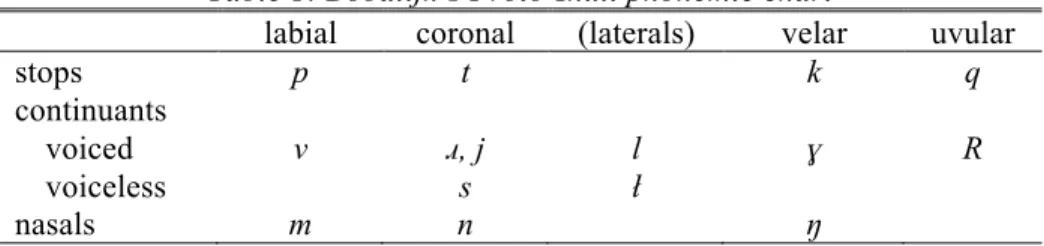
Bobalijk (1996: 325) provides a PI chart reproduced here as Table 1.
1For instance, the CED, which is fundamental to this study, has a section stretching over four pages detailing the well-thought-out compromises needed to provide representations of a wide range of dialects and languages in the dictionary entries (xiii–xvi).
2The only quasi-exception is with the subscript circle used to show the voiceless counterparts of [y] and [ŋ] in Yupik and Sirenikski transcriptions. Here the circle is put above the symbols: ẙ, ŋ̊. Technically this is not an issue with Unicode but with the text processing software.
Table 1: Bobalijk’s Proto-Inuit phonemic chart
labial coronal (laterals) velar uvular
stops p t k q
continuants
voiced v ɹ, j l ɣ R
voiceless s ł
nasals m n ŋ
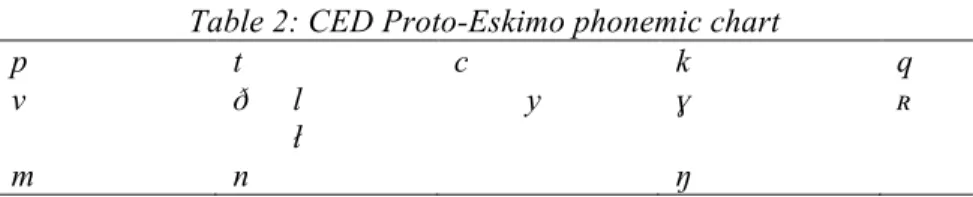
The CED chart has no phonetic or phonological labels, but much can be inferred by relative placement of the phonemic symbols. It also includes various symbols in parentheses which do not reflect phonemic units in PE. Those extra symbols are omitted in the version of the CED chart given here as Table 2:
Table 2: CED Proto-Eskimo phonemic chart
p t c k q
v ð l y ɣ ʀ
ł
m n ŋ
Dorais (1993) offers another presentation of the Proto-Eskimo consonant phonemes, based on that of the CED. His chart, Table 3, has phonological labels. He has substituted symbols more recognizable to people familiar with Canadian Inuit orthographies. He uses Ummaqmiutun r̂ in place of CED ð, the ICI &
in place of ł, and ICI j in place of y. Beside three of these symbols he includes Canadian Roman spellings in square brackets, that is, ɣ [g], R [r] and ŋ [ng]. He has also grouped seven symbols under an “apical”
label:
Table 3: Dorais’s (1993) Proto-Inuit-Yupik phonemic chart
bilabial apical velar uvular
stop p t c k q
fricative v j r̂ ɣ [g] R [r]
lateral & l
nasal m n ŋ [ng]
Dorais (2003) presents a somewhat different chart. It has no labels. Under t there are d̶, ł, l, and under c there is j. Under k is added x and under q is added x̂. In all of these charts the content of the (bi)labial, velar and uvular columns is essentially identical (Dorais 2003 has extra x and x̂). The chief difference in the layouts occurs with the remaining seven symbols. The view here is that the hesitation is due to an unclear understanding of the phonological status of the segments concerned. Refinement is needed in both manner and place specifications.
The top rows in all charts contains segments, p t k q, that in the daughter dialects are usually described as voiceless stops. The second rows in the charts have segments (v, ð~r̂, y~j, ɣ, ʀ~R) that are usually defined as either voiced continuants or voiced fricatives. The two rows are traditionally described as differing in two features, voicing and continuance. In terms of distinctive features, just one of these can be primary, or phonemic, while the other is secondary, or phonetic. That is, in a phonemic description of the segments, just one feature needs to be used to define the fundamental contrast between the two rows.
Descriptions either do not specify which is the underlying contrastive feature or they choose continuance as that feature.3
1.3 Proposed phonemics
There is evidence that the contrastive feature is voicing. First, while the segments in the first rows may appear in all positions, the segments in the second rows regularly only occur in the interior of words, rarely initially, and never finally. For example, in Iñupiaq, “Occurring initially are [p], [t], [k], [q], [s], [m] and [n] with [y], [l], and [v] found only occasionally and not in all dialects” (Kaplan, 1981: 32). In the bases section of the North Alaskan Inuit Index in the CED (638–665) there is one entry with initial /l/, livilivilaaluk ‘semipalmated sandpiper’, one with initial /j,/ yuvguq ‘fish slime’ and none with initial /v/.
Similarly, in Iñupiaq, “Possible word-final consonants are [t], [č], [k], [q], [m], [n], [ñ], and [ŋ]” (Kaplan, 1981: 33). Farther to the east, there is also final /p/ on the surface in the relative or genitive case ending, e.g., North Baffin igluup ‘of the house’, tupiup ‘of the tent’, inuup ‘of the person’ (Spalding, 1979: 59–
60).
Second, in some dialects, in some consonant clusters, the “continuant” segments from the second rows may be phonetically stops, for instance, /v/ may be [b], /ɣ/ [g], and ʁ [ɢ] (see sections 3.1, 3.5, 3.6 below). This encourages the argument that the segments are not defined underlyingly for continuance.
They become continuant intervocalically and are realized as stops in some clusters.
Third, in some dialects, in some positions, the “stop” segments from the top rows may be phonetically continuants, for instance, /p/ may be [f] or [ɸ], /k/ [x] and /q/ [χ] (see sections 2.1, 2.5, 2.6 below). In those cases, the continuance is also environmentally conditioned and so not phonemic.
A fourth bit of evidence involves the laterals. In many dialects there is a contrast between /l/ and /ɬ/.
Compare Siglitun taliq ‘arm’, iłuaqtuq ‘is correct’, akłaq ‘grizzly bear’, aglu ‘seal’s breathing hole’. This contrast requires that voicing must be a distinctive feature in those dialects. There is no similar requirement for continuance.
If continuance is non-phonemic, it would be technically correct to use stop symbols for the voiced consonants from the second row. That is, /v/ could be rendered as /b/, /ɣ/ as /g/, and /ʁ/ as /ɢ/. Underlying /b g ɢ/ are realized phonetically as [v ɣ ʁ] in most environments. In these pages, for the sake of clarity, I continue the tradition of using continuant symbols for phonemic representations of the voiced segments.
Table 3 below is a feature-minimalist chart of the proto-Inuit phonemic units. Known allophony in modern and older recorded dialects is given beside each segment in square brackets. This allophony is discussed farther below in separate sections for each segment. Long sections are devoted to the voiceless palatal /c/, and to the highly interesting voiced apical /ʐ/ (CED PE ð, PI ž; Dorais r̂, d̶). There is also new commentary on the [ʔ] allophone of /t/ and the stop [ɟ] allophone of /j/.
Table 4: Feature-minimalist Proto-Inuit phonemic chart
Labial Apical Lateral Palatal Velar Uvular voiceless p [p f ɸ] t [t ʔ] ɬ [ɬ] c [s h c ç] k [k x] q [q χ]
voiced v [v b β w] ʐ [ʐ ʂ ɖ] l [l d] j [j ɟ] ɣ [ɣ ɡ] ʁ [ʁ ɢ ɴ]
nasal m [m] n [n] ŋ [ŋ]
With regard to point of articulation, there are two arguments for placing the laterals on a separate plane. Firstly /ɬ/ cannot begin or end a word, unlike all other voiceless segments (cf. the statements above on Iñupiaq from Kaplan, 1981). It is in a different phonotactic category. Secondly, there are phonological interactions, both diachronic and synchronic, which the laterals exhibit with both the apicals and the palatals in various dialects, and which the apicals and palatals exhibit with each other. The lines in Figure
3 Of the works consulted here only Bobalijk 1996 specifies a contrastive feature. An example of a fairly recent work specifying continuance as the contrastive feature, in descriptions of a wide range of Yupik and Inuit languages, is Compton 2008.
1 connect segments involved in interactions. Each segment interacts with three others. All interactions are described in the sections on segments below.
Figure 1: Symmetrical phonological interactions
t c
ɬ
ʐ j
l
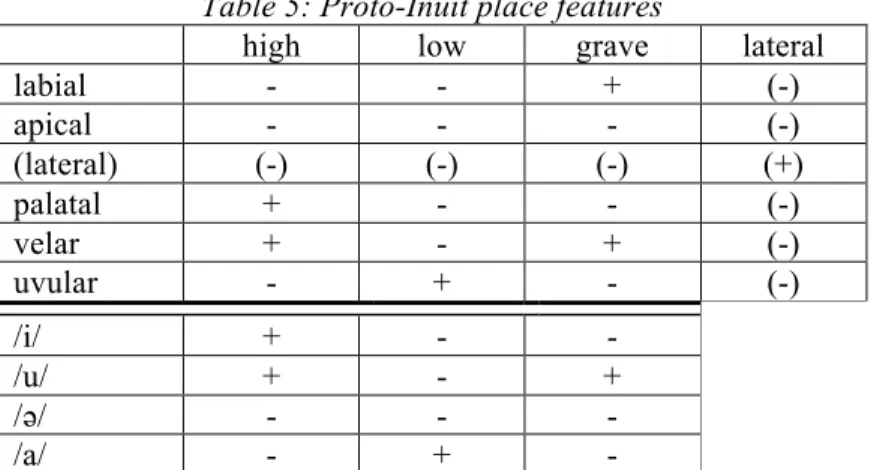
Placing the laterals on a secondary point of articulation plane allows the remaining points on the primary plane to be distinguished from each other by the same three features needed to distinguish the four proto-Inuit vowels from each other.
Table 5: Proto-Inuit place features
high low grave lateral
labial - - + (-)
apical - - - (-)
(lateral) (-) (-) (-) (+)
palatal + - - (-)
velar + - + (-)
uvular - + - (-)
/i/ + - -
/u/ + - +
/əә/ - - -
/a/ - + -
2 Voiceless consonants
2.1 Labial /p/ [p f ɸ]
The consonant cluster /pc/ is often realized as [fs] or [ff]. In Alaskan Iñupiaq the first segment becomes a continuant. In Barrow the cluster is [fs] but is non-phonemically written vs as in tavsi ‘belt’. In Kobuk in this environment “speakers tend to pronounce a bilabial, rather than a labio-dental fricative,”
i.e., [ɸ] and prefer to write tapsi (Kaplan, 1981: 25). The closely related Uummaqmiutun has [ff] for /pc/:
piffi ‘dry fish’, qaffit ‘how many?’, aqiffaaraa ‘he kicked it again’ (Lowe, 1984: xxii). Similarly, Kangiryuarmiutun from Holman on Victoria Island (Inuinnaqtun) also has [ff] and it is written ff in the orthography: iffuktaa ‘shook it’, tamaffi ‘all of you’, piffi ‘dry fish’ (Lowe, 1983: xix). In relation to Utkuhiksalik pipsi ‘dried fish’ Dyck and Briggs (2005: 24) note, “In /ps/ clusters, the /p/ is pronounced either as [p], [ɸ] or [f], and the /s/, as [s] or [sʲ]”.
Here follow some forms from the CED illustrating some of the proto-bases to words mentioned above. While the PE forms have *vc or mc, the PI must have had *pc.
(1) PE *əәvcuɣ- ‘shake’, but looks like PI *əәpcuk-, SPI ipsuk- ‘shake out’, NAI ifsuk- ‘vibrate’, WCI ipsuk-, ifsuk- ‘shake’.
(2) PE *pimci ‘dried fish’, but looks like PI *pipci, SPI pipsiʀaq, NAI, WCI pipsi, Lab [Peck] pipsi.
(3) PE *tavci ‘belt’, but looks like PI *tapci, SPI tapsi, NAI tafsi, Nu tapsi, Sig tapsi, Cop taffi.
(4) PE *qavcit ‘how many’, but looks like PI *qapcit, SPI qapsit, NAI qafsit, Mal qapsit, WCI qapsit, Cop qaffit.
Where the phonetic fricativization /p/ > [f] occurs, it is often parallel to /k/ > [x] and /q/ > [χ] (see sections 2.5, 2.6 below).
2.2 Apical /t/ [t ʔ]
The glottal stop occurs as an allophone of /t/ in the Central Arctic dialects Utkuhiksalik and Natsilik. I tentatively proposed this for Natsilik in 1994 after a short project with speaker Attima Hadlari and technical assistant Norman Keenainak (Hitch, 1994a, 1994b). Now more complete documentation is available for Utkuhiksalik.
2.2.1 Utkuhiksalik /t/ > [ʔ]
Cook (2010) has prepared a useful monograph on glottal stop in Utkuhiksalingmiutitut. It occurs before the three nasals, [ʔm], [ʔn], [ʔŋ], and before the labial, apical and lateral voiced consonants [ʔv], [ʔʐ], [ʔl] (2010:3). Cook follows Dyck and Briggs (2005) in calling the three voiced consonants /v ʐ l/
sonorants, thus putting them in the same natural class as nasals. The segments /v ʐ/ are not sonorant any more than /ɣ ʁ/ are. There is no need to have a feature of sonorance in this language. Some other principle is creating this pattern.
The strongest evidence for including [ʔ] as an allophone of /t/ may lie with the synchronic [utiC~uʔC] alternations listed by Cook (2010: 6): piqutiminik~piquʔminik 'his own possessions', qavřutiřaa~qavřuʔřaa (ř=/ʐ/) 'she put out the lights on him'. This involves the applicative verbal or instrumental nominalizer postbase -uti. When the affix final weak i is optionally deleted before a following “continuant”, the -ut- becomes -uʔ-. The clusters listed are -ʔm-, -ʔř-, and -ʔv- From the earlier statement about sonorants we can infer that -ʔg- and -ʔr- do not occur. It would be useful to have a positive statement about how the language behaves with postbases beginning with -g- /ɣ/ or -r- /ʁ/ that follow -uti. Presumably in these cases the i may not be deleted.
There is also synchronic /t/ > [ʔ] where a morpheme final /t/ meets a morpheme initial /n ʐ l/.
Presumably the environment is before any nasal or /v ʐ l/ but I find just three examples, two from Cook (5-6) and one from Dyck & Briggs (7):
(5) igluʔnut ‘to your house’ PE iglu- + 2S abs. -n + All. P -nun; Utku iglu + -t + -nut.
(6) niritiʔlunga ‘while I was eating...’ niri- ‘eat’ + -tit-4 (PE *təәt- ‘cause or let’ “used with the subord./contemp. mood” CED 472) + -lunga ‘while I’.
(7) apuʔřaqtuq ‘it’s buried in deep snow’ (Dyck and Briggs 2004:26), cf. ECI aput ‘snow on ground’.
There is substantial historical and comparative evidence showing that [ʔ] in Utkuhiksalik clusters is an allophone of /t/. There appear to be two sources of glottal stop in these clusters. One is historical *t before nasal or *v, *ð/*ʐ, *l, *y such as PE *tutmaʀ- > Utku tuʔmaq- ‘tread on’ (examples in Appendix A). The other is historical voiceless consonant before an apical voiced consonant (*n, *y, *l, *ð/*ʐ) such as PE *əәpnaʀ > Utku iʔnaq ‘cliff’ (examples in Appendix B).
Cook hesitates to conclude that [ʔ] is an allophone of /t/ in Utkuhiksalik because of the peculiar affix -ʔa- (expressing conjecture). He describes it “as the only regular occurence of a glottal stop in intervocalic position” and gives two examples, qaiřuuʔařuq ‘I think she has come’ and iniqtaɬugiʔařaa ‘I think she finished it’ (Cook, 2010: 7). Michael Fortescue (p.c.) suggests this postbase may be an alternative reflex for PE *tya- ‘intend or be about to’ which also appears in Natsilik and Utkuhiksalik as -ʔya- ‘vague future’ (CED: 474; and below, Appendix A, PE *ty > ʔj). At any rate, this instance is highly marked, and a description such as “[ʔ] is an allophone of /t/ except in -ʔa-” is reasonable.
4 Analysis suggested by Michael Fortescue p.c.
2.2.2 Natsilik /t/ > [ʔ]
The historical origins of Natsilik [ʔ] parallel those for Utkuhiksalik. There is *t > [ʔ] before certain nasal and voiced segments as in PE *natmaɣ- > Natsilik naʔmaktuq ‘he carries (something) on his back’.
There is much less phonetic information on this dialect. From Hitch 1994a and 1994b there are examples of historical *t > Natsilik [ʔ] before *m, *ŋ, *l, *y in Appendix C. As with the Utkuhiksalik spellings above, the orthographic renderings contain ʔ rather than the phonemic t.
The same sources have two instances of historical *k > [ʔ], one before *n and the other before *l:
(8) iʔniq 'bullet primer' and iʔnialuk ’bullet shell casing’. See the entry for Utku iʔniq ‘fire, flame’ in Appendix B. PE *əәk(əә)nəәʀ ‘fire’.
(9) kiʔliani ‘at/on the edge’. The -nl- in PE *kəәnləә ‘border or edge’ is supported by Yupik NSY, CSY kəәnla and Sirenikski kəәnləә(ŋ)a, but not by Yupik AAY, Nun kəәŋla. The Inuit forms support PI
*kəәkli: NAI kɨlli(q), [Jen.] kiɣlik, WCI kiɣli(k), kiɣliniq, killiniq ‘limit’, ECI killi, [Schn] kiɣli, GRI kiłłik, old ortho. kigdlik. Also Kang. kiglingani ‘at the edge of’. Compare also PE *kəәtliʀ ‘one far out in front or at sea’ and Net ki’liq ‘one farthest from land’.
They also offer one case of synchronic /k/ > [ʔ], before n:
(10) qamutiʔniittuq ‘he is on your sled’. PI *qamutəәk ‘sled’ [dual], NAI qamutik ‘low sled’, Sig qamutik ‘sled’, B. Lake [Dor.] qamutiik, ECI qamutiik du., NG qamutik ‘the two sled runners’. (+ - ni ‘on’ + -t ‘your’ + -tuq ‘he is’)
2.2.3 Other instances of glottal stop
In several Inuit dialects there is a glottal stop which is not an allophone of /t/. Some dialects feature a phonetic glottal stop between the two segments in a cluster, i.e. /CC/ > [CʔC]. Many Alaskan Inupiaq speakers insert [ʔ] when the first consonant is a voiceless stop as in [ikʔnɨq] ikniq ‘fire’ (Dorais, 2003:
43).
Dorais (2003: 62) reports Natsilingmiutut inserts glottal stops where the first consonant reflects a PE voiceless stop and gives the example qim’miq or qip’miq ‘dog’. The Paallirmiut and Ahiarmiut subdialects of Kivalliq similarly have qim’miq ‘dog’ or kuug’juaq ‘big river’ (Dorais, 2003: 79) The last example shows this to also be a synchronic development, kuuk ‘river’ + -juaq ‘big’. In Qairnirmiut a very small number of words features glottal stop, e.g., man’na ‘thank-you’, -n’naaq ‘small’ (as in anin’naaq
‘small, preferred brother’), or -t’tuaq ‘prominent’ (as in Qamanit’tuaq ‘prominent widening in a river;
Baker Lake’) (Dorais, 2003: 79).
In Itivimiut (Arctic Quebec, Hudson Bay coast) most speakers have a glottal stop in clusters where the second segment is voiced /v, ʐ, ɣ, ʁ/. The first segment is then sometimes dropped. These examples are in Dorais’s transcription (j̵ = [ʐ]): iv’it~i’vit ‘you’, qur’vik~qu’vik ‘chamber pot’, aj̵’j̵i~a’j̵i ‘picture’, qar’j̵uk~ qa’j̵uk ‘arrow’, ag’gait ~a’gait ‘hand’, tar’raq~ta’raq ‘shadow’ (Dorais, 2003: 115). Somewhat similarly, in Thule “a glottal stop occurs within vv, gg, rr, ll, rv and rl clusters” (Dorais, 2003: 141).
In the Kobuk dialect of Malimiutun an intervocalic [k] /k/ is sometimes phonetically replaced by glottal stop as in nirikami~niri’ami ‘when he/she eats’ (Dorais, 2003: 43).
2.3 Lateral /ɬ/ [ɬ]
Dorais (2003: 34–35) juxtaposes the reflexes of PE *ɬ in seventeen dialects. For intervocalic position he uses ‘suitable’ which has the shape iłuaqtuq in ten dialects. In four dialects PE *ɬ has merged with the reflexes of PE *c, giving phonetic [s] or [h]: Cape Dorset, Nunavik, SE Baffin (some speakers) isuaqtuq; Inuinnaqtun ihuaqtuq. In four dialects PE *ɬ has merged with /l/: SE Baffin (some speakers) iluaqtuq, Thule, W Greenlandic iluartuq, E Greenlandic ilivartiq. For clusters the pattern is
fundamentally the same, although obscured by other phonological developments. Dorais uses the word for ‘rope, strap’ which is akłunaaq in nine dialects. In Labrador ałłunaak and W Greenlandic ałłunaaq the PE *ɬ phonetically remains and the first segment has assimilated to it. In Thule aglunaaq the entire cluster has voiced and PE *ɬ has merged with /l/. In four of the five remaining dialects the reflex of PE *ɬ has merged with the reflex of PE *c: Inuinnaqtun akhunaaq; Cape Dorset, Nunavik atsunaaq; E Greenlandic atsinaaq. In SE Baffin attunaaq we see PE *ɬ reflected in modern t because the cluster has apparently evolved *kɬ > *ɬɬ > tt. (Dorais, 2003: 96).
Later in the same work Dorais treats the reflexes of *ɬ on Baffin Island. In North Baffin /ɬ/ still exists, while in Southeast and Southwest Baffin the segment is realized as [l], [t], or [s]. For example: N iłuaqtuq~SE iluaqtuq/isuaqtuq~SW isuaqtuq ‘is alright’; N tikiłłuni~SE tikittuni~SW tikitsuni ‘while arriving, [s]he…’; N kangiqłuk~SE kangiqtuk~SW kangiqsuk ‘bay, inlet’ (Dorais, 2003:96).
In Nunavik, /ɬ/ has merged with [s]; cf. Lab iłuittuk~Nunavik isuittuq ‘bad, uncomfortable’, Lab ałłunaak~Nunavik atsunaaq ‘thong, rope’ (Dorais, 2003: 114).
2.4 Palatal /c/ [s h c ç]
The CED uses the symbol c to represent a segment found in PE and some daughter languages. The authors describe the phonological nature of this segment as:
A palatal affricate, [č], with the following exceptions: an alveo-palatal affricate, [ts], in Central Alaskan Yupik when followed by əә, a dental affricate, [t̪s], in Sirenikski, and a palatalized dental stop [tʸ], when followed by another consonant in North Alaskan Inuit. (CED: xx, fn. 1)
This description is not clear to me.5 There appears to be a mismatch between the symbols č and ts and their definitions. Where č is used elsewhere in language work, as in Americanist tradition, it denotes an alveopalatal (also called palato-alveolar or postalveolar) affricate, IPA [tʃ], as in English chance or itch, not a palatal affricate. As far I know, ts is used elsewhere for an alveolar affricate IPA [ts], possibly for a dental affricate [t̪s̪] and never for an alveopalatal affricate [tʃ]. With Inuit phonology it is essential to rigorously distinguish between alveopalatal and palatal points of articulation.
Scholars (including myself) have sometimes loosely described č as palatal.6 In addition, there is sometimes the use of ‘palatal’ loosely for ‘alveopalatal’. For instance, for Iñupiaq Kaplan (1981: 30) notes, “What we refer to below as ‘palatals’ are phonetically alveo-palatals”, and Lowe (1985a: 298), for whom Siglitun (1984: xx) “ch sounds as in English chance” includes ch as a “palatal” in a phonemic chart. But there are languages which contrast alveopalatal [tʃ] with palatal [c], like Hungarian; cf. csupa [tʃupɒ] ‘full’ with tyúk [cuːk] ‘hen’, and kincs [kintʃ] ‘treasure’ with ponty [ponc] ‘carp (fish)’. This can be a challenging distinction to master for English speakers. I suspect that some descriptions of Inuit dialects list [tʃ] as a phonetic segment where technically the segment is palatal [c]. The common spelling Netchilik for Natsilik reflects the interpretation of [c] as [tʃ] by English ears.
I suspect that the CED may have selected c as the PE symbol because c is Americanist for IPA [ts], and the segment is alveolar [ts] sometimes in CAY, and is dental [t̪s̪] always in Sirenikski. With regard to the segment and its reflexes in Inuit, and Proto-Inuit, the choice of c is serendipitous (and possibly confusing) as the segment, in my view, is underlyingly in many dialects a palatal stop, IPA [c]. Today in Inuit dialects, in intervocalic and initial positions, the phonetic reflexes of PE *c seem to almost always be either [s] or [h] (or at least described as such). The reflexes of PE *kicaʀ ‘anchor’ (cf. CAY kicaq) in Inuit are NAI, WCI, ECI, GRI kisaq and Uum, Kang kihaq (SPI kizaq shows *s>z). The reflexes of PE
5“As regards /c/ in the CED, that is indeed a little confusing and was meant purely as an orthographic convention to cover both the palatal stop in Yupik and various reflexes in Inuit” (M. Fortescue, p.c.).
6The practice of describing č as a palatal affricate is widespread, and just a few randomly selected examples are listed here: for Californian languages, Golla (2011: xiii, 205); for Solomon Islands Pijin, Jourdan and Selbach (2008:
170); for Old Church Slavonic, Huntley (1993: 133).
*caviɣ ‘knife’ (cf. CAY cavik ‘knife, metal, iron’) in Inuit are: WCI savik ‘knife, iron’, NAI, ECI, GRI savik ‘knife’, Uum, Kang, Utku havik ‘knife’. The position here is that historical or synchronically underlying /c/ in initial and intervocalic positions becomes continuant [ç] and then either [s] or [h].
Fish River Qawiaraq in Alaska has a segment written ch where Proto-Inuit had */c/: chawik ‘knife’, uchuk ‘penis’, ichiq ‘smoke’ (other dialects have savik/havik, usuk/uhuk, isiq/ihiq; cf. Dorais, 2003: 44).
This palatal (or alveo-palatal) nature is generally thought to reflect an evolution from an older *[s]. For instance, according to Fortescue (1983: 14b), “A peculiarity of the Qawiažaq dialect around Fish River is the replacement of /s/ everywhere by /č/”. And, according to Dorais (2003: 44), “In Fish River Qawiaraq (for most speakers), s is pronounced ch”. Instead of an evolution [c > s > tʃ] it would be simpler to envision [c > tʃ] (if not [c > c]). This is added credence by the evidence from Petitot and Stefansson that the phonetic change [c > s] in Siglitun is recent (see below).
2.4.1 Sixteenth and eighteenth century /c/
In 1576 Martin Frobisher’s assistant collected a list of 17 words while anchored in what is now Frobisher Bay. As Dorais (1993: 39) noted, the entry chewat ‘ear’ (cf. PE *ciɣun, NAI siun, ECI siuti, GRI siut) seems to preserve the older plosive value of the word-initial segment. For us it means that /c/ in initial position retained the value [c] and had not yet become [s] (or [ç]).
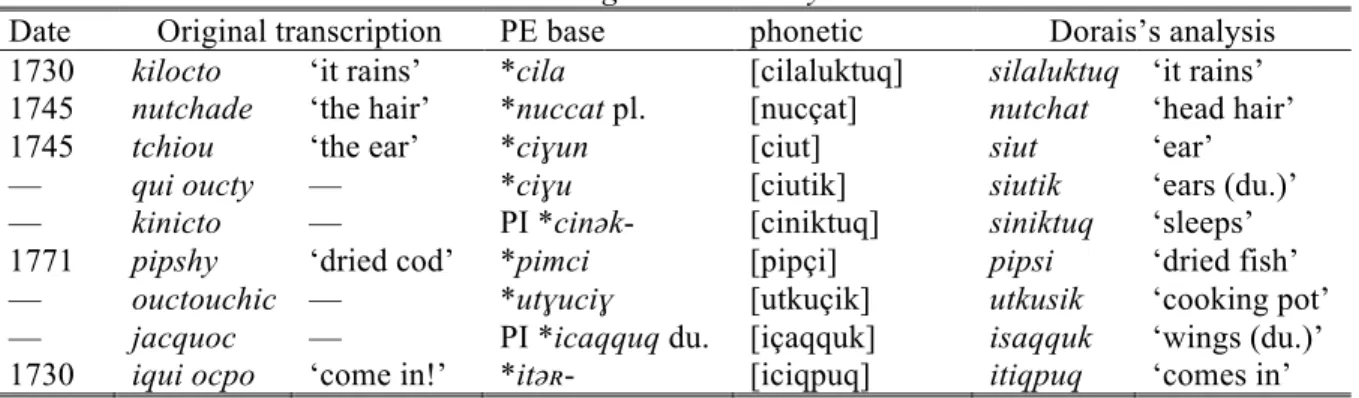
From around two centuries later there is some sparse vocabulary recorded by a number of mostly French explorers, traders and missionaries from their contact with Inuit in Labrador. Dorais (1993: 42, 44) presents some examples of these from which nine may show [c] or [ç].7 These are given in Table 6. The top eight reflect PE *c.8 The ninth and last item has [c] arising from the palatalization of /t/ by strong i as, for instance, in Iñupiaq isiqtuq ‘enters’.
Table 6: /c/ in eighteenth century Labrador
Date Original transcription PE base phonetic Dorais’s analysis 1730 kilocto ‘it rains’ *cila [cilaluktuq] silaluktuq ‘it rains’
1745 nutchade ‘the hair’ *nuccat pl. [nucçat] nutchat ‘head hair’
1745 tchiou ‘the ear’ *ciɣun [ciut] siut ‘ear’
— qui oucty — *ciɣu [ciutik] siutik ‘ears (du.)’
— kinicto — PI *cinəәk- [ciniktuq] siniktuq ‘sleeps’
1771 pipshy ‘dried cod’ *pimci [pipçi] pipsi ‘dried fish’
— ouctouchic — *utɣuciɣ [utkuçik] utkusik ‘cooking pot’
— jacquoc — PI *icaqquq du. [içaqquk] isaqquk ‘wings (du.)’
1730 iqui ocpo ‘come in!’ *itəәʀ- [iciqpuq] itiqpuq ‘comes in’
While /c/ was a stop [c] in initial position, between vowels it was a continuant [ç] as the spellings ch in ‘cooking pot’ and j in ‘wings (du.)’ show. The exception is the last item where presumably the strong i palatalization rule follows the rule making /c/ between vowels continuant. The one spelling by an English speaker, pipshy, suggests a continuant pronunciation [ç] for /c/ as the second segment in a cluster.
In all of these items except ‘hair’ the modern correspondent has [s]. In none of the thirty-six or so words cited by Dorais (1993: 42, 44) is there an s corresponding to modern [s].
7Dorais describes the phonetics of the segment as “word initial c (ch/ts)” (1993:44) probably intending IPA alveopalatal affricate [tʃ] or alveolar affricate [ts].
8*nuccat is my reconstructed plural; CED singular *nuyaʀ ‘hair’. *icaqquq du. reflects my reconstructed PI base
*icaʁuq, cf. NAI, WCI, ECI, GRI isaʀuq (CED PE *iyaquʀ ‘wing’).
2.4.2 Petitot’s Tchiglit (Siglit) Vocabulary
Émile Petitot was a brilliant linguist who, from 1862 to 1882 with some interruptions, resided in northwestern Canada and extensively documented several Athabaskan languages. In 1869–1870 he lived with a people he called Tchiglit, and in 1876 he published a French-Siglit vocabulary with grammatical notes and an ethnography.
Petitot did not provide a transparent spelling for /c/. In his chart “Alphabet et classification des lettres” there are three relevant entries. He offered a spelling for the palato-alveolar sibilant [ʃ]: “CH, se prononce comme dans charmant, chant” (Petitot 1876: xxxix). He gave a spelling for [s], noting that this sound was rare: “S, se prononce comme dans savoir, souci. Son emploi est très-rare” (Petitot 1876:
xxxix). He also noted that “S” is not found at the beginning of words (Petitot 1876: xl). The third alphabet entry suggests an affricate which is neither alveolar [ts] nor palato-alveolar [tʃ]: “TS, a une prononciation mixte entre ts et tch” (Petitot 1876: xxxix). This phonological information tells us that /c/ was still pronounced [c] or perhaps [ç] in most cases, and possibly that the transition towards [s] intervocalically was just beginning.
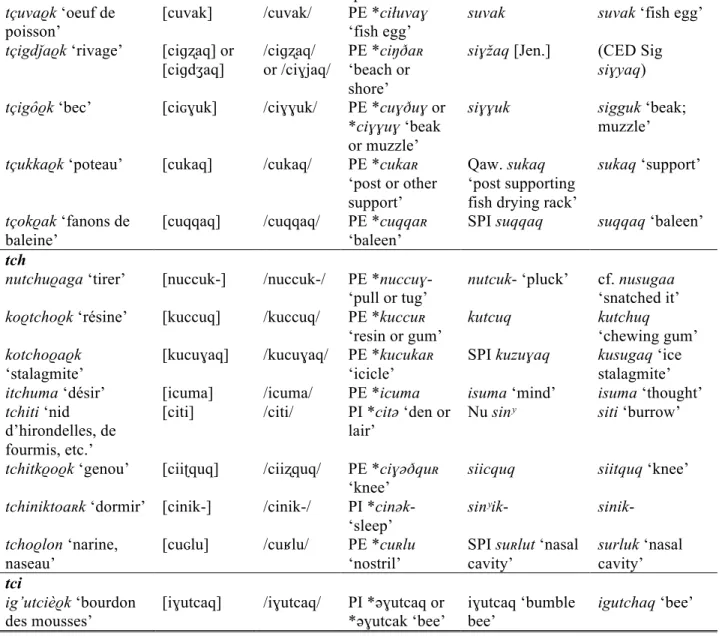
Although not discussed in his classification of letters, Petitot also made use of a symbol ç in the combination tç to write /c/. He transcribed /c/ in a few ways, mostly tç or tch but at least once ts, and at least once he wrote /tc/ (/cc/?) as tci. Appendix D provides examples of all of these spellings together with presumed phonetic and phonemic forms, proto-forms, NAI cognates and modern Siglitun forms.
2.4.3 Stefansson’s trade jargon
Vilhjalmur Stefansson reported on “The Eskimo Trade Jargon of Herschel Island” in 1909. Most of the words derive from Inuit dialects from Point Barrow to the Mackenzie but there are also some from English and Kanaka (Hawai’ian). In most entries he included forms from “Mackenzie Eskimo” or Siglitun for comparison, and some entries have Iñupiaq from Point Barrow. He spent the winter of 1906–
1907 among the Siglitun of the Mackenzie Delta and learned or recorded something of their language. His stay was 36 years after that of Petitot and it is possible that the language had evolved since then. For instance, his notes may show the beginning of the change of initial [ç] to [s]. Eight of his renderings show s where modern dialects have [s]; compare Mac. Esk. sĭr-kĭn-nĭrk ‘sun’ with Sig siqiniq, and Mac. Esk.
sī′-la ‘the outdoors’ with Sig sila9 ‘weather’. Sixteen, or twice as many, of his renderings show Mackenzie or Point Barrow c where modern Sigilitun or North Slope have s. He appears to use different spellings in the same word. He wrote ‘knife’ sa′-vik with s, and then in the next entry he wrote ca-vī-kō′- yak ‘rice’, which he suggested is “perhaps from ca′-vĭ-ĭt, the scrapings (like sawdust) from wood or ivory when scraped with a knife”.10 This inconsistency may reflect [ç~s] hesitation among speakers, or Stefansson’s inability to distinguish the phonetics. About his transcription system he stated, “c is used as the equivalent of (English) sh” (Stefansson, 1909: 222). Technically, English has alveo-palatal [ʃ] but he was presumably hearing palatal [ç] in Siglitun of that date. Some of the entries below could conceivably reflect [ʂ] for etymological *ʐ after a voiceless consonant. But there is no compelling evidence for the survival of retroflexion. His Mac. Esk. kē′rūk ‘wood’ (Stefansson, 1909: 226) seems to suggest that
9In Writing on Ice, The Ethnographic Notebooks of Vilhalmur Stefansson, the editor, Gísli Pálsson, includes a short glossary showing “most of the Inuit and non-English terms used in the diaries” (Pálsson, 2001: 325–329). Caution must be exercised with this list. It gives no indication of context, so dialect is unclear. As well, the transcription system(s?) does not match any other I know of. The entry, “tjuna pishunktu—what do you want?” must be the same as Jargon cuna picuktu? ‘what do you want?’ from Stefansson (1909) with extraneous n. It is not clear to me if the initial tj- and medial -sh- represent Stefansson’s early tentative spellings. If they are, they suggest he was hearing an initial stop or affricate, [c] or [tʃ], and a medial sibilant [ç] or [ʃ]. Tjiglik ‘Sigliq’ also has tj- (cf. Petitot Tchigleϱk;
1876: x). The entry “tsila—outside” (Sig sila, Pet tçilla ‘temps’) with unique initial ts- also implies an affricate, in contrast to the Mac. Esk. sī′-la of the jargon list.
10Under copeau de varlope ‘plane shavings’ Petitot gave tçavit which may be the same word. He also gave copeau très-menus servant de bourre ‘very fine shavings serving as stuffing’ as tçavilit, also a derivative of /cavik/ ‘knife’.
Siglitun may have still distinguished /ʐ/ from /j/, cf. Sig qiyuk, Uum qir̂uk ‘wood’. But note that Petitot earlier had y in kϱéyuk ‘bois’.11 Examples of Stefansson’s /c/ spellings are given in Appendix E together with proposed phonetic and phonemic renderings, proto-forms, modern Siglitun spellings and the corresponding entry form Petitot where available.
2.4.4 Utkuhiksalik /c/
Dyck and Briggs (2005: 313) report that PE *c developed into “[hʲ] between vowels”. Their phonetic rendering, [hʲ], is likely the same phonetic segment as IPA voiceless palatal fricative [ç], which is the continuant correspondant to IPA voiceless palatal stop [c]. The examples given could be regarded as having phonemic /c/ which becomes phonetically continuant [ç] between vowels. For instance, ahi
‘other of a different kind (including ‘another person’)’, PI *aci ‘somewhere or something vague or remote’ may be /aci/ and [açi]. The root in Utku qahungařuq (with [hʲ]) ‘flabby, floppy, slack, not taut’
(ibid.), from PE *qacu- ‘become loose or slack’, may be /qacu-/ and [qaçu-]. And ihuq (with [hʲ]) ‘be murky’ (ibid.) from PE *əәcuʀ- ‘be murky’ may similarly be /icuq/ and [içuq]. They report that, “Some words are pronounced exclusively with [hʲ] …, while other words have [h] or [hʲ] in free variation (ibid.).
Presumably, for some speakers, intervocalic [ç] is simplifying to [h].
Phonetically revealing is the relationship between single /c/ and double /cc/ in Utku. Dyck and Briggs (2005) provide a number of words which may have underlying /cc/. Utku atsaga ‘my father’s sister’ reflects PE *accaɣ ‘paternal aunt’, SPI assak, NAI atcak, Net atsak, Cop attak, ECI, GRI atsa(k).
Utku qitsuktauguma ‘if I am scratched’ reflects PE *qəәc(c)uɣ- ‘scratch or dig claws into’, Qaw qissuk-
‘scratch’, NAI qitsuk-, Cop qitsuk-, ECI qitsu(k)- ‘scratch, claw (several times)’, GRI kitsuɣ- ‘scratch, dig nails into (several places)’.
For ‘lake’, Dyck and Briggs (2005: 314) list singular tahiq with single /c/ and dual tatsik, plural tatsit, relative tatsip with geminate /cc/. The spellings reflect phonetic [taçik, tacçik, tacçit, tacçip].
Similarly, singular pihiq, plural pitsit ‘song, hymn’ (ibid.) reflect [piçiq, picçit]. The cluster [cç] is probably what I heard Natsilik speaker Attima Hadlari say in 1994 in words he was writing in syllabics with <ts>, such as [nacçiq] natsiq ‘ringed seal’. At the time, with my eastern arctic orientation, the phonetics puzzled me. But after working with Hungarian, which distingushes /c/ from /tʃ/ (Americanist /č/), I now wish to correct that initial description. I portrayed the cluster as [tç] (Hitch, 1994a: 10) but [cç]
may be more accurate. Two other Natsilik words with /cc/ noticed then are katsungařuq ‘slow, hesitant, without enthusiasm or zeal’ (Hitch 1994a:10), PI *katcuq- ‘be settled’, SPI kassuq- ‘be finished’, finish’, NAI katcuq- ‘be pacified, settle’, Sig katsuq-, ‘be satisfied, full’, ECI katsuŋa- ‘be slow, without zeal’, GRI katsuʀ- ‘be calm, at peace’, and katsuaq ‘biceps’ (ibid.), PE kay(y)u(C)aʀ, WCI, ECI, GRI katsuaq
‘biceps’.
In their earlier monograph, Dyck and Briggs (2004: 15) describe Utkuhiksalik “/ts/” as “heavily assibilated” and phonetically “[ts ~ tš]”. Presumably they were trying to write [cç]. One example is qala[ts]araittuq, qala[tš]araittuq ‘it cooks quickly’ (ibid.) with PE *yyaɣ-12 ‘reach state of’ (CED: 483;
not PE *ya, tya be liable or apt to’ as Dyck and Briggs). Another example is Utkuhiksalik itsaq ‘tent skin’
11In Pálsson (2001) there is an effort to write [ʂ], but it is possible that the [ʂ] forms are from Iñupiaq dialects, not Siglitun. The [ʂ] spellings are: “innukcuit—deer stockade” for [inukʂuit] ‘cairns’ PI *inukšuk ‘cairn’; “kaksrauk—
black throated and red-throated loon” for [qaqʂauq] ‘red-throated loon’ PE *qaqða(C)uʀ ‘loon’; “nerkiksran parkittutin—you have found something meant for you to eat” containing [niqikʂan] ‘your thing to eat’; “oktjuk—
whale meat” and “oxsrogon—with animal fat” both seem to contain [uqʂuk] ‘blubber’. The use of sr for [ʂ] is found in Iñupiaq orthography as is the use of r for [ʐ] in “pubraktuak—to swim” for [puubʐaqtuaq], cf. NAI puuvžaq-, WCI puuvyaq- [Pryde], and in “ugrug—bearded, square flipper seal” for [ugʐuk], PE *uɣðuɣ, NAI uɣžuk ‘bearded seal’. The form pubraktuak ‘he swims’ has the third singular -tuaq particular in a present sense to Siglitun. Petitot has ugiuk ‘phoque veau marin’ which looks necessarily to show [j] in [ugjuk]. He does not appear to have a stem like *puubyaq- or *puubdǰaq-. Uum is puuvr̂aqtuq.
12PE *yyaɣ- might be Proto-Inuit *ccak-, cf. NAI, WCI, ECI (#)tsak- ‘become’ [with emot. roots], GRI (#)tsaɣ-. PE
*yy may consistently be PI *cc (see below).
(Dyck & Briggs 2004: 16) to PI *itcaq ‘tent skin’, NAI itca ‘skin for tent, ECI itsaq ‘roof of tent or house’, etc.
An interesting example involves utjuk ‘vulva’. Dyck and Briggs (2005: 315) suggest this is an instance of PE intervocalic *c > Utku /tj/, but the word is actually an ancient dual, as noted in the CED.
Under PE *ucuɣ ‘sexual organ’ the CED notes “NAI usuk ‘penis’, (du.) utcuk ‘vagina’”. All of the CED Inuit entries have a single consonant for ‘penis’ and double for ‘vagina’. I suspect the NAI utcuk spelling may contain [cç]. As all of the forms for ‘vagina’ listed in the CED contain only voiceless consonants, the
<tj> in Utku utjuk looks suspicious. The statement that /tj/ “is pronounced somewhat like [tž]” (Dyck &
Briggs 2005: 315) may reflect transcriptional difficulty with a [cç] cluster. Conor Cook, working on the same materials a few years later, while discussing the unusual cluster [ʔj] in Utkuhiksalik states, “j does not normally occur in clusters at all in this dialect” (Cook 2010: 7). The underlying forms in Utku are likely /ucuk/ ‘penis’ and geminated dual /uccuk/ ‘vulva’, phonetically [uçuk] and [ucçuk].
Utku natsiq ‘seal’ and natsiaq ‘baby seal’ (Dyck & Briggs, 2005: 316) should both also contain [cç]
like the Natsilik. The CED gives PE nayyiʀ ‘ringed seal’ with -yy-, but as all Inuit forms have a voiceless cluster, PI looks like *nacciq, cf. SPI Qaw nassiq, NAI natciq [Nu natciʀžuaq ‘sealskin coat’], WCI, ECI natsiq, GRI natsiq, Petitot natçeϱk ‘phoque barbu’.
In a discussion of the Utku postbase psʸaaq- ‘more’ (from PE *mcaɣ- ‘finally or more?’), Dyck and Briggs (2004: 12, fn. 10) list the cognate Net phaaq- ‘again; more’. In a footnote to this cognate they write: “A Natsilik speaker, Janet McGrath (p.c.) reports that the < h > in this Nattilingmiutut postbase is a sound intermediate between [h] and [s], i.e. a palatal-like sound”. In the later version the authors give the post-base as psaaq- with the same Natsilik information (Dyck & Briggs, 2004:12).
In relation to pipsi ‘dried fish’ Dyck and Briggs (2005: 24) note, “In /ps/ clusters, the /p/ is pronounced either as [p], [ɸ] or [f], and the /s/, as [s] or [sʲ]. The [s] is not fully palatalized to [š] in /ps/
clusters”. /ps/ likely contains [pç].
There is evidence for the palatality of /c/ in the phonetics of the reflexes of PE or PI *kc in Utkuhiksalik. Dyck and Briggs (2005: 328) state that, “while /kh/ clusters are often pronounced [xx], they sometimes have an ‘s-like’ timbre, which we transcribe as a fronted velar fricative [x̯x̯ɕ]”. Their examples are PI *makcaq- > Utku makhaq- [max̯x̯ɕaq-] ‘sing a lullaby’, PI *akcut ‘hard or with effort’ > Utku akhut- [ax̯x̯ɕut-] ‘try harder, do with effort’, PE *aʀcar- ‘grab or otherwise act excessively’13 > Utku akhaaq- [ax̯x̯ɕaaq-] ‘grab’. The phonetic development of /kc/ is [kc > kç > çç]. The symbol x̯ is Americanist for IPA ç.
2.4.5 PI *cc
It is possible that all of the PE words containing *yy have *cc in PI. The CED gives PE *əәyyi(ʀ)
‘yolk’ with *-yy- but the Proto-Inuit here seems to contain *-cc-. All of the Inuit reflexes show two voiceless segments: SPI iksiq ‘yolk’, Nu itciaq ‘membrane inside eggshell or around internal organs’, Car ixxi ‘yolk’, Holman I iktiq, NBI iksi, ECI itsi, NG itsiq, GRI itsik ‘white of an egg’, Up itsiq. The CED states, “the westerly Inu forms with ks are unexplained” (132a). The Inuit forms may be understood if the proto cluster was *cc. As intervocalic [c] is becoming a sibilant in the daughter dialects, the cluster undergoes differing reinterpretations. The first segment, the palatal stop /c/ [c], is reinterpreted as either an apical /t/ or velar /k/. That is, the cluster */cc/ [cc], either evolves through [cç] > [tç] > [ts], or through [cç] > [kç] > [ks]. The eastern -ts- forms may also reflect usual velar assimilation (cf. Baffin iglu, Quebec illu).
Another example is PE *iyyuʀ- ‘poke head out for a look’ which may be PI *iccuq, cf. SPI issuq
‘go out to check weather’, NAI itcuq- ‘go out after waking’, ECI itsu(q)- ‘go out to take a look’, GRI itsuʀ- ‘look outside for something’. The CED gives the related PI *itcuaq ‘peek in or out’ which might
13Instead of listing PE *aʀcaʀ- as the proto-form for Utku akhaaq- ‘grab’, it would be better to use PI *aqcaaq-
‘remove by force from (s.o.)’, cf. NAI aqsaaq- ‘grab away from’, WCI aqsaq- ‘take away from’. This example suggests the reflexes of PI *qc and *kc have merged in Utkuhiksalik. More examples are desirable.
better be listed as *iccuaq, cf. SPI issuaq-, NAI itcuaq-, WCI itsuaq-, ECI itsua(q)-, GRI itsuaʀ-. For PE
*nayyiʀ ‘ringed seal’ a PI *nacciq was suggested above.
There are also PE words with *cc. E.g.:- PE *acciʀ- ‘name’, (AAY, CSY aciʀ-), SPI assiq-, NAI atciq-, WCI atsiq-, ECI atsi(q)-, GRI atsiʀ-; PE nuccuɣ- ‘pull or tug’, NAI nutcuk- ‘pull out’, WCI nutsuk- ‘pull on’, ECI nutsu(k)- ‘draw toward oneself’, GRI nutsuɣ- ‘pull toward self’ (CED).
Inuit dialects with more conservative morphology feature a type of plural and dual formation in which a single medial consonant is doubled, i.e., /VCV/ > /VCCV/. The consonant is also the onset of the last syllable in the word. With most consonants the relationship between the single and double consonant is transparently one of simply doubling. Some Iñupiaq singular~dual pairs: ‘tent’ tupiq~tuppak, ‘walrus’
aiviq~aivvak, ‘captain’ umialik~umiallak, ‘canoe’ qayaq~qayyak, ‘eye’ iri~irrak, ‘boot’ kamik~kammak,
‘person’ iñuk~iññuk (MacLean, 1986: 76–77). But where the consonant to be doubled is [s] the relationship is not transparent. In Siglitun orthography these words have s in singular and tch in dual and plural. Some singular~plural pairs: ‘shoulder blade’ kiasik~kiatchit, ‘sleeve’ asiq~atchit, ‘parka hood’
nasaq~natchat’, ‘fish scale’ kapisiq~kapitchit, ‘neck’ qunisiq~qungitchit, ‘lake’ tasiq~tatchit, ‘anchor’
kisaq~kitchat, ‘word’ uqausiq~uqautchit, ‘navel’ qalasiq~qalatchit. Diachronically the relationship is transparent, */c/ > */cc/. But if we posit an underlying /c/ in the synchronic language, the relationship may be simply described also as /c/ > /cc/, e.g., /kicaq/~/kiccat/ ‘anchor’. After doubling, rules apply giving the surface form, i.e., /VcV/ > [VsV], and /VccV/ > [VtʃːV] (the latter if tch truly writes an alveopalatal geminate and not [cc]).
2.4.6 Strong i palatalization
In North Slope and Malimiutun alveolar consonants /l ɬ n/ are palatalized after strong i in all positions. Dorais (2003: 46–47) writes the results as, for instance, ilʸu ‘the inside of something’, sikłʸaq
‘pickaxe’, iñuk ‘human being’. At the same time, /t/ is palatalized to ch when final as in iqaluich ‘fish (pl.)’, or to s intervocalically as in isiqtuq ‘enters’. It appears that /t/ palatalizes to /c/, which is then, in intervocalic position, fed into the rule /c/ > [ç] > [s]. In Uummaqmiutun this latter rule is /c/ > [ç] > [h] as in ihiqtuq ‘enters’ (ibid.). Also in these dialects the orthographic cluster tch created through the palatalization of geminate tt after strong i as in nirinngitchuq ‘does not eat’ (ibid.) represents geminate /cc/, in a way parallel to the palatalization of ll after strong i to lʸlʸ as in ilʸlʸatir̂uq ‘joins a group’ (ibid.).
2.4.7 Other information on /c/
Palatal pronunciations of the reflex of PI *c are found in Greenland. In Thule, “Particularly characteristic phonetically is the /h/ (varying from [h] to [ʃ] through palatal [ç] intervocalically and initially)” (Fortescue, 1983: 8b). And, “When geminate, the pronunciation [çç] or [ʃʃ] is most common”
(ibid. fn. 35). In East Greenlandic the segment corresponding to initial “/s/ of W Greenlandic becomes a palatalized [ᵗs] (almost [tʃ])” (Fortescue, 1983: 8b). This description appears to be of [c]. Fortescue 1983 uses the symbol ‘c’ to denote this sound though not intending the IPA usage. Also in E Greenlandic “/s/
following an /r/ is always /c/” (ibid.: fn. 30). Instead of [c] evolving from an older [s], the possibility should be considered that this dialect, on the extreme eastern edge of Inuit territory, has preserved [c]
from the proto-language.
Apparently, some elderly North Baffin speakers still have [cc] where younger speakers now have [tt]: “they pronounce tj (or, perhaps, tch, as in natjiq or natchiq ‘seal’)” (Dorais, 2003: 97 p.c. from Alexina Kublu).
In North Labrador [ts] is one of only two phonetic clusters with dissimilar first and second segments (utsuk ‘blubber’). The second is [kq], the usual pronunciation of /qq/ (akqutik ‘road’). All others are geminates (ibid.: 113). The preservation of [ts] may show that the cluster was or is viewed as a geminate already.
PI *c in some environments in some dialects merges with PI *t, and vice versa. Aivilik shows *c >
*t: “As a general rule, cluster ts does not exist. As in North Baffin, it is generally replaced by tt” (ibid.:
79). For example, Kiv natsiq~Aiv nattiq ‘seal’, Kiv uvatsiaru~Aiv uvattiaru ‘in a moment’ (ibid.). Some S Baffin dialects show *t > *c: “In Iqaluit and Kimmirut, initial t tends to become s when the next syllable starts with a s (cf. sasiq ‘lake’, suqsuuk ‘house porch’, rather than Southwest Baffin tasiq and tuqsuuk)” (Dorais, 2003: 97).
2.5 Velar /k/ [k x]
The voiceless velar consonant may be a fricative in some dialects when it occurs in a cluster before the reflexes of PI *ʐ, *ɬ or *c. In Uummaqmiutun /kʐ/ is pronounced [xʂ] as in ikpakr̂aq [ikpaxʂaq]
‘yesterday’ (cf. Lowe, 1984: xxii).
In Kangiryuarmiutun, “the combination kh results … in a double velar fricative” (Lowe, 1983: xx).
There is [xx] for kh in hinikhaq ‘fur trim on a parka’, anaakhiq ‘whitefish’, hakhagiaq ‘redpoll’ (ibid.).
To this may be added the Copper [Pryde] form maxxak- ‘sing a baby to sleep’ from the CED. Historically Kang or Cop [xx] in these words may come from *kɬ, cf. NAI aanaakłiq ‘Arctic cisco’. Or it may derive from *kc, cf.: PI *cakcakiq ‘redpoll’, ECI satsaɣiaq ‘little bird; and PI *makcaq- ‘sing a baby to sleep’, NAI maksaq-, Sig maksaaq-, Cop [Pryde] maxxak-, old GRI [Fab.] maksar-.
In Thule, corresponding to [ks] in many dialects, there is [xx] written gh, e.g., ikpaghaq [ikpaxxaq], cf. Aivilik ikpaksaq ‘yesterday’ (Dorais, 2003: 137). Another description is, “The combination of /g/ plus /h/ (orthographic ‘gh’) is a geminate velar fricative [xx]” (Fortescue, 1983: 8b).
2.6 Uvular /q/ [q χ]
Phonemic /q/ may be phonetically continuant [χ], either in all positions, or in clusters reflecting *qc or *qʐ. In Labrador and Arctic Quebec many speakers realize /q/ as [χ]. “This explains why the Nunavik schools teach children to write taarpat, ursuq and qurturaq, rather than standard taaqpat, uqsuq and quqturaq” (Dorais, 2003: 114).
In Uummaqmiutun /qʐ/ is pronounced [χʂ], as in qaqr̂auq [qaχʂauq] ‘red-throated loon’ (cf. Lowe, 1984: xxii). In Kangiryuarmiutun, “the combination … qh results in a double uvular fricative” (Lowe, 1983: xx). There is [χχ] for qh in miqhuqtuq ‘sewing’, uaqhiyuq ‘is washing something’, qaqhauq ‘red- throated loon’. In Thule these clusters are also [χχ] and written rh, e.g., urhuq [uχχuq], cf. Aivilik uqsuq
‘blubber’ (Dorais, 2003: 137). Another description of the Thule clusters is that, “/r/ plus /h/ (orthographic
‘rh’) [is] a geminate uvular fricative [χχ]” (Fortescue, 1983: 8b).
3 Voiced consonants
3.1 Labial /v/ [v b β w]
In the eighteenth century spellings from words heard in Labrador by French travellers the /v/ is sometimes written with b or p. In the items offered by Dorais (1993: 42–43), /v/ occurs just five times, written always either b or p, not v, which is notable since French /v/ is written v.
Table 7: /v/ in eighteenth century Labrador
Date Original transcription Phonetic Dorais’s analysis 1717 ibiéné ‘the breast’ [ibiaŋiq]] iviangiq ‘the breast’
1717 calquipia ‘the lips [kakkibiaq] kakkiviaq ‘the upper lip’
1730 oubignarou ‘a shirt’ [ubiɲiruq] uviniruq ‘shirt’
— tibougalo — [kibᵘɣaluk] kivgaluk ‘muskrat’
— tibailloc — [tibajuq] tivajuq ‘dances’
Although this list is short, it is clear that sometimes, if not always, /v/ was phonetically bilabial. In Table 6 the segment is phonetically transcribed as a stop [b] but it is possible that it was a continuant [β] (see below for voiced bilabial continuants elsewhere in Inuit).
As the first element in a cluster, /v/ is [b] in some dialects. Kangiryuarmiutun has [b] in the cluster [bl], e.g., orthographically ublumi ‘today’, abluqtuq ‘takes a step’, ubluriaq ‘star’ (Lowe, 1983: xix).
Siglitun has [b] in both [bl] and [bj]. There is [bl] in kublu ‘thumb’, ublumi ‘today’, publa ‘bubble’, tablu ‘chin’. There is [bj] in isibyuktuaq ‘whispers’, qibyauyaq ‘string’, kubyaq ‘fishnet’ (Lowe, 2001:
xvii). A possible third instance of Siglitun [b] may be in [bb] from PE *vv. Petitot’s tibukiyaϱneϱk ‘baver’
(‘slobber, drool’) has orthographic b seemingly for [bb] (/vv/). It reflects PE *təәvvuɣ- ‘spit’, cf. NAI tivvuk- ‘spit out’, GRI tiffuk ‘splash, squirt’. But Petitot has other words with etymological *vv which are written with v: Pet avaϱkϱ ‘moitié’ PI *avvaq ‘half’, WCI avvaq; Pet kiviktoaϱk ‘soulever’ PI *kəәvvak-
‘lift gradually’, Sig kivvak- ‘lift up’. Words with etymological *vv are uncommon. The other cases noticed of Petitot writing intervocalic b are purely orthographic. He seems to write VbiV for [VbjV], e.g., itçibiuktoaϱk ‘chuchoter’ with /icibjuk-/ for PE *əәcəәmðuɣ- ‘whisper’, NAI isivžuk-, WCI isivyuk- (more examples below).
3.1.1 Utkuhiksalik [bʐ], /pʂ/, and /pc/
Utkuhiksalingmiutut has the cluster [bʐ]. Dyck and Briggs (2004) have chosen to write this cluster př. They list three examples: Utku apřaq ‘mattress; caribou hide mattress’, PE *avðaʀ ‘hindrance or protection’, NAI avžat ‘bedding’, GRI aššaq ‘defense, shield, curtain’; Utku ipřit ‘you’, PE *əәlpəәt or əәłvəәt
‘you’, Net ilvit, ižvit, GRI old ortho. ivdlit ‘you’; Utku tapřa ‘here’ right now’, PE *taðva ‘there (you are), Net tavža ‘there (you are), NAI tavža, tažva ‘that’s it, enough’ (Dyck & Briggs 2004: 13, with extra dialect examples from the CED). About the cluster written př Dyck and Briggs (ibid.) state, “/př/ is pronounced [b̥ ᵒř]; the first segment is a partly- to fully-voiced labial stop that has a lenis release when before /ř/”.14 This is an extremely useful phonetic comment that is not found in the 2005 version of the paper. It is clear that the cluster phonetically is neither [vʐ] or [pʐ] but is [bʐ]. Phonemically the cluster is /vʐ/. Dyck and Briggs have in contrast chosen to associate phonetic [b] instead with the phoneme /p/, writing the cluster phonemically as /př/ and orthographically as př. Implied in this choice is the idea that continuance is the distinctive phonemic feature rather than voicing.
By using orthographic p and phonemic /p/ for the stop [b], there is in theory a risk of not distinguishing [bʐ] (/vʐ/) from [pʂ] (/pʐ/). Both would be written př. Instead, Dyck and Briggs have chosen to write [pʂ] as ps. While this avoids a conflict between [bʐ] and [pʂ], it creates a conflict between [pʂ] and [pç], confusing the retroflex and palatal sibilants. They do somewhat recognize the phonetic presence of both. They describe the retroflex sibilant as “rhotacized”, even putting the word in italics:
Isolated *labial-ð clusters, notably some *vð clusters, became a /ps/ cluster with a rhotacized /s/ cluster in Utkuhiksalingmiutut. In such clusters, the /s/ is consistently pronounced with a distinct rhotic quality as [psʴ] or [pʃʴ]. (Dyck & Briggs 2004: 29 fn. 21)
In the later version they repeat this but now use a subscript circle to show voicelessness: “The /ps/ cluster
… consistently has a distinctly rhotic quality, and is pronounced as [pšʴ̥] or [šʴ̥]” (Dyck & Briggs 2005:
318–319). Their one example is “Utku taapsuma [taaps⁽ʴ̥⁾uma] ‘of that one’s batch’”, cf. NAI taavžuma, taafšuma, taaptuma (CED s.v. demonstrative PE *uv-, fn. to prefixed adverb tavžani), WCI taaffuma, Sig taavyuma (ibid. fn. to prefixed abs. sing. pronoun), GRI taššuma (ibid. fn. to prefixed abs. sing. pronoun).
They describe the palatal sibilant [ç] in a number of ways, none of which is retroflex:
14Cook (2010: 2 fn.4) writes this cluster [bɹ] which may mean that Utkuhiksalik scholarship now regards [b] as fully voiced. Cf. “/ɹv/ (including from underlying /lv/) normally undergoes metathesis, becoming [bɹ]”.
PE clusters containing a labial (*m, *p, *v) plus *c (PI *s) typically became /ps/ in Utkuhiksalik (14). For example, PE *pimci dried fish became /pipsi/ (14.c). In /ps/ clusters, the /p/ is pronounced as [ɸ] or [f], and the /s/, as [s], [š], [sʸ], or [fʸ]. (2004: 11)
Their examples: Utku psʸaaq- ‘more’, PE *mcaɣ- ‘finally or more?’, Nu psaaq- ‘again’, NAI fsaaq-
‘again, more’; Utku apsʸak-tuq ‘a sound that’s not very audible’, PI *apcak- ‘make loud noise (by pounding)’; Utku pipsi-t ‘dried fish’, PE *pimci ‘dried fish’, WCI pipsi ‘dried fish’; Utku pui-psʸu-laaq- tuq ‘crackles (ice in warm water’, PE mcuɣ(-) ‘(a) little’, cf., NAI pifsukaq- ‘barely escape danger, barely miss hitting’, Cop [Pryde] kaffuk ‘a little while’ (2004: 12).
They carry this ambiguous phonemic analysis over into the 2005 version. In a chart the labial+*ð cluster is defined as “/ps/ (rhotacized)” while the labial + *c cluster is “/ps/”. Instead, by recognizing that [ʂ] and [ç] reflect a phonemic contrast, the description may be simplified and nonambiguous phonemic and orthographic representations may be used. Table 8 displays various symbologies related to these Utkuhiksalik clusters. Note the ambiguity of ps in the Dyck & Briggs orthography. The suggested phonemic orthography is likely too abstract. The suggested practical orthography writes allophones known from English. A drawback is that there is no b symbol in syllabics, so vř might be preferred to maintain correspondence between roman and syllabics.
Table 8: Utkuhiksalik cluster symbology
phonemic /pc/ /pʐ/ /vʐ/
phonetic [ɸç] [ɸʂ] [bʐ]
Dyck & Briggs orthography ps ps př
phonemic orthography pc př vř
practical orthography ps př bř
Dyck & Briggs (2005: 319) propose that PE *vð became Utku /vj/ in kuvjat ‘net’. However, the cognates suggest that the Utku form would be *kuvřat [*kubʐat]: PE kuvðaʀ ‘net’, SPI, NAI kuvžaq ‘net’, WCI kuvyaq ‘net’. Stefansson’s (1909: 226) jargon entry kūb′-ra, kūb'-dja ‘a net – for fish or seal’
suggests Inuit sources with [kubʐaq, kubdʒaq] but these phonetic clusters seem to no longer exist in the west, cf. Uum kuvr̂aq, Sig kubyaq ‘fishing net’. Petitot kϱubiaϱk ‘filet’ appears to have [bj]. Possibly an Utkuhiksalik alternate with [bʐ] still exists.
3.1.2 Other information on /v/
Petitot, who distinguishes b, v, w, has w sometimes for /v/: nuwiyoaϱk ‘enfiler’ reflecting PE *nuvəә-
‘thread’, NAI, WCI, ECI nuvi- ‘thread’; uwaña, uvaña ‘moi’ for /uvaŋa/ ‘I’. Possibly intervocalic /v/ was sometimes [β].
In Bering Strait and Qawiaraq dialects, when following an unstressed syllable, /v/ is pronounced [w] (Dorais, 2003: 46); for example, SPI kiɣžawik ‘peregrine falcon’.
In Kivalliq and Aivilik, the cluster /vl/ is pronounced [βl]. Dorais (2003: 78) describes the phone as
“β sounding like Spanish b, i.e. halfway between English b and v”. The cluster is usually written bl in roman transcription, e.g., tablu ‘chin’, qablu ‘eyebrow’.
Under certain conditions /v/ is bilabial in E Greenlandic and Thule (Fortescue, 1983: 8b and fn. 28).
I am not sure what is meant by, “the special ‘double’ labio-velar articulation of /vv/ in Lichtenau” (ibid.
fn. 28). Perhaps [ww] is intended.
In Labrador /vv/ is pronounced [ff] and written ff: saffik ‘chest’ (N Baffin sagvik), affik ‘whale’ (N Baffin arvik) (Dorais, 2003: 113). Some older speakers in North Labrador “say qablunaak, rather than qallunaak (‘white person’), or ibjuk, rather than ijjuk (‘soil’)” (Dorais, 2003: 115).