This research examines the location preferences of Millennials in Calgary by analyzing interviews with 37 young adults in three distinctive regions of Calgary that had high concentrations of the oldest Millennials in the 2011 Canadian census. Also, the effects of the current downturn in the Calgary economy are discussed with consideration of how it affects the participants' neighborhoods and housing decisions.
Introduction
The second research question is examined by asking participants in each of the areas what their future residential plans are. Chapter 6 examines the effects of the recession on Calgary's economy, and the thesis concludes with Chapter 7.
Background to the Thesis
- Demographic Cohorts
- Demographic Change
- Housing Choice
- Happiness and Quality of Life
- Summary
For example, Myers and Pitkin (2009) note that construction of dense housing tends to increase when there is an increase in the number of young adults in the housing market. Much of the research has focused on the United States or in Canada's three largest cities.
Research Objectives, Methods, and Context
- Introduction
- Research Question
- Study Area
- Demographic Characteristics of Study Regions in Calgary
- Methods
- Participant Selection
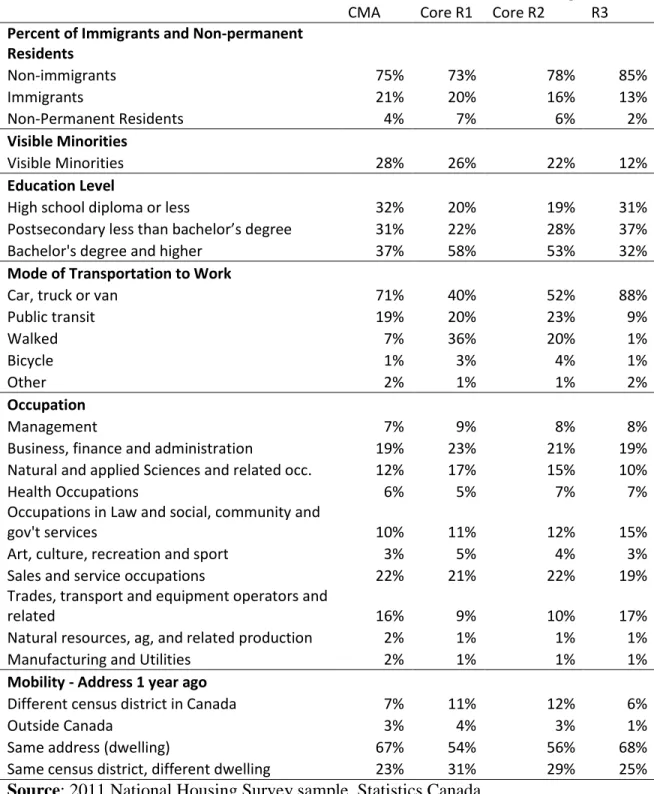
- Descriptive Statistics from the 2011 Census and National Housing Survey
- Theory of Factors Affecting Millennial Locational Choice
- Personal Situatedness
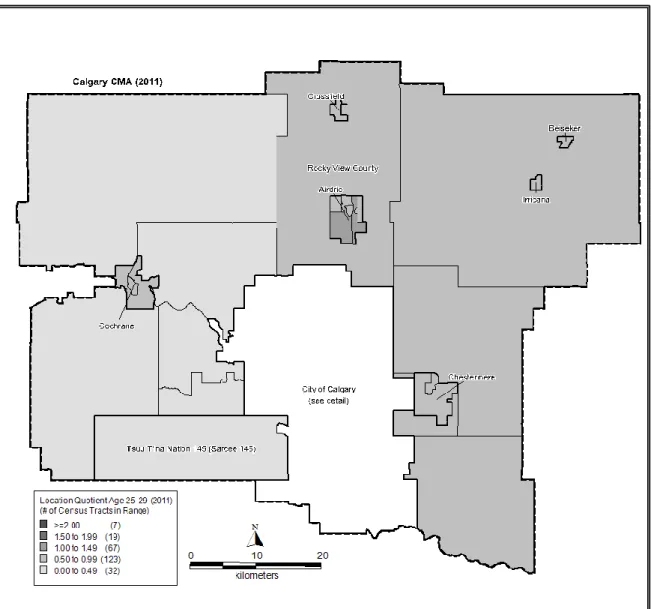
A third area consists of a group of contiguous census tracts in the southeastern suburbs (R3) where the location coefficient for 25–29 year olds in 2011 is 1.5 to 2. Complete data tables with comparisons of 25–29 year olds by age other groups in the city are included in appendix A.
Qualitative Interview Analysis
Constraints
What differs between respondents in the suburbs (R3) versus the core (R1) and surrounding area (R2) is what their biggest priority is and what tradeoffs they are willing to make. In the past, Calgary was a fast-growing metropolis and sometimes it was difficult for people to find the home they wanted.
Neighbourhood Attributes
- Amenities
- Location
- Trees
- Nightlife
- Quiet
- Safety
- Community Maintenance
- Housing Stock - Aesthetics and Appearance
- Summary of Neighbourhood Attributes
Lin is one of the few people in the core and surrounding area who mentioned schools at all. Some people who live in or near the city center have a strong aversion to living in the suburbs. He chose his location in the area around the core “because it's just outside the city center.
Neighborhood cleanliness is one of Rob (R3)'s top three reasons for living where he does in the suburbs. Being close to amenities is important to people who live in all three regions, but those who live in the core or.

Housing Attributes
- Apartment and Condominium Living
- Interior Housing Attributes
- External Housing Attributes
- Summary
Linda (R2) was evicted from the condominium after renting a condominium in the core area. Another feature of the floor plan that some mentioned was more than one bathroom so they didn't have to share with other people in the house or guests. When it comes to interior spaces, the kitchen was the most frequently discussed room in the house.
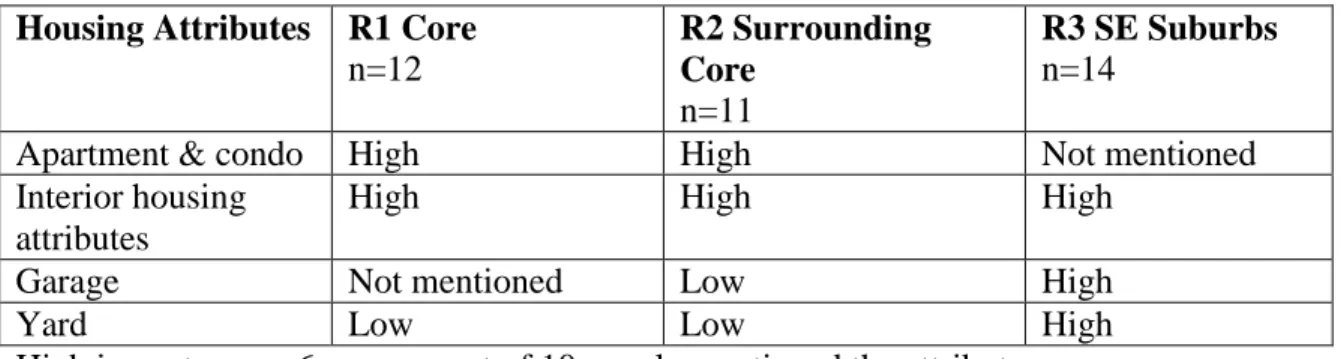
People in the suburbs tend to prioritize having single-family homes with yards and garages higher. Several people who live in or close to the core chose owner-occupied flats and the housing features associated with them.
Employment-based Considerations
Ellen (R2) also lives in the area around the core and she is a 15-minute walk from her work in the city centre. Janet (R3), who lives in the suburbs, describes the negative effects that a long commute has had on her life. Darcy (R3) is like many of the Millennials living in the core who chose to locate where they could walk to work.
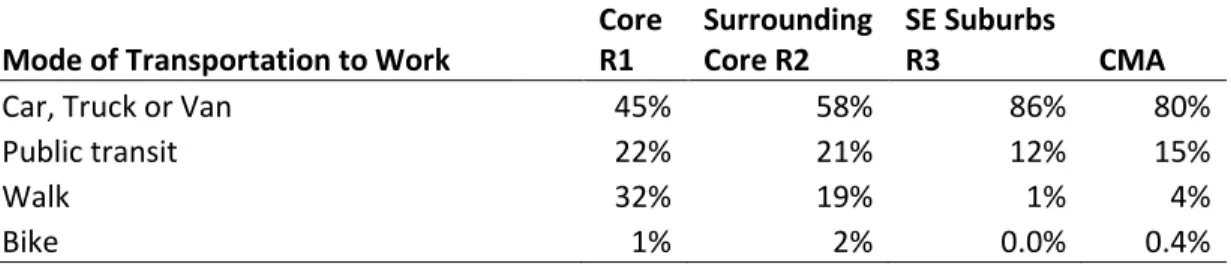
Darcy (R3) is part of only 1% of people in the South East suburbs who walk to work. This compares to 32% of people in the core who walk to work and 19% who walk to work from the area around the core.
Transportation Attributes
- Active Transportation
- Public Transit
- Car Sharing
- Summary
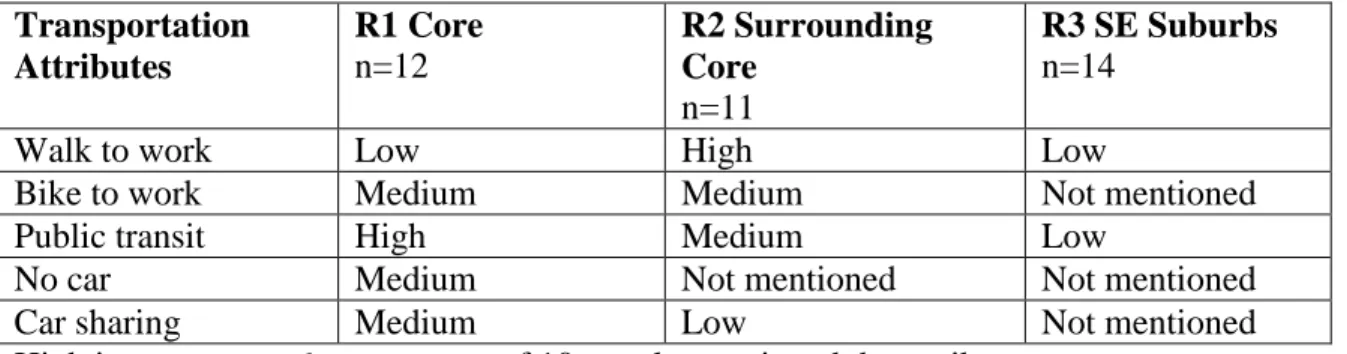
This survey sample is heavily biased towards people who choose active transportation in and around the core. The majority of people who said that public transport is important to them live in the core. Celina (R2) lives in the core area and says that she has mostly given up her car.
Active transport was more important for respondents who lived in the core (R1) or the surrounding area (R2) than it was for those who lived in the suburbs (R3). Car sharing was only available to those who lived in or near the core.
Social Attributes of the Neighbourhood
- Families and Children
- Proximity to Family and Friends
- Places to Meet People and Meet Up with People
- Friendly Neighbours
- Community Engagement
- High Density Living
- Social Diversity
- Summary
Shawn (R2) likes his neighborhood in the area around the core because: “It's easy to meet people. Brett (R2) appreciates the diversity of people in his neighborhood in the area around the core. Kim (R1) is a visible minority who lives in the same neighborhood as Matthew (R1), but she does not notice much diversity in the type of people in her neighborhood.
Community involvement was mentioned by a few people in each area, especially those in the core (R1). Social diversity was most important for respondents living in the core (R1), but was also mentioned by some of those who also live in the other two areas (R1 and R2).

Psychological Benefits
- Happiness or Quality of Life
- Pride of Ownership
- Stigma or Reputation
- Summary
Peter (R2) talks about experiencing an increase in his quality of life when he moved closer to the city center from what he describes as a miserable existence out in the suburbs. Steve (R1) feels that he belongs in the neighborhood, not just within the four walls of his house. Dean (R1) enjoys psychological benefits from spending time in green areas around his home in the core, “I think it's a happiness thing too.
Shawn's building is only four years old in the area around the core and it meets his needs to live somewhere modern that is acceptable to his peers. In contrast, Perry's satisfaction increased when he moved in the opposite direction from Peter, from.
Family and Household Considerations
- Partner Preferences
- Roommates
- Summary
They used to live in a condo in the central southeast, but Elsie (R3) says her husband didn't like the apartment because Rita (R3) says if her boyfriend didn't work in the southeast, she'd probably live closer to the center . Neither wanted to move to the suburbs after having children, so they continue to live in the core area as a family of 3.
Wendy (R1) moved in with her boyfriend who already had his own apartment in the core. The need for people to take roommates to live where they want to live presents a unique way to deal with the limitations that people face in housing.
Future Plans
- Suburbs
- Surrounding Core
- Core
- Summary
I may have told my husband a few times that I don't want to live in the suburbs forever. The vast majority of respondents who live in the suburbs plan to stay where they are or close to it. Of the 11 people in the survey who live in the area around the core, 10 plan to stay where they are for at least one more year.
Basically, 10 out of 12 people interviewed were planning to stay where they are for at least a few more years. Most respondents want to stay where they are in the short term although some are committed to the long term.
Conclusions
There are a number of people in Regions 1 and 2 who see themselves moving away from the center at some point, although it may be five or more years down the road. Respondents living in R1 and R2 are much more concerned about the walkability and bikeability of their neighborhood, as a greater percentage of them choose active transport to get to work and back than those living in R3. Public transport is also more accessible and used by people living in the core and surrounding areas than those in the suburbs, although there are still people in the suburbs who use public transport to get to work on a daily basis.
One noticeable difference between regions 1 and 2 is that more people in the area surrounding the core (R2) prefer a quiet neighborhood away from the noise of the city center, but still want to be close enough to get to work and nightlife easy. Respondents in the suburbs were more likely to express a desire for family-focused amenities in their neighborhoods.
Discussion
- Constraints
- Neighborhood Attributes
- Green Space
- Facility Use
- Schools
- Location
- Trees
- Quiet
- Safety
- Community Maintenance
- Summary
- Housing Attributes
- Employment Based Considerations
- Transportation Attributes
- Social Attributes of the Neighbourhood
- Psychological Benefits
- Family and Household Considerations
- Conclusions
Trees, safety and community maintenance receive a lot of attention in the literature and are mentioned by a few respondents in Calgary. Some of the respondents in this Calgary case study considered the cost of their time and the cost of their vehicle when deciding to live in the core and peri-core area. Similarly, many respondents in Calgary talked about the importance of walkability in their neighbourhoods, including some who lived in the suburbs.
Respondents in the Calgary case study report an improved mood when they live close to their work, a finding supported by the literature (Olsson et al., 2013). Some respondents prefer to live in socially diverse communities, and this topic was absent from the literature.
Effects of the Downturn in the Calgary Economy
Blake (R2) recently moved and said that because of the downturn it was quite easy to find an apartment in the area around the core. With lower prices in the current housing market, some of the homes she is looking at have become more affordable. The downturn in the economy may open up the possibility that we can actually afford a place down here.
And that's one thing that we've benefited from the downturn in the economy is that the price of childcare has probably dropped by 20%. The downturn in Calgary's economy has changed the decision-making process for millennials looking for housing.
Conclusion
Limitations
The sample of respondents largely left out the voices of those who were immigrants and those who did not have postsecondary education. It is conceivable that they face different limitations and challenges than those who participated in the study. Due to the in-depth nature of the interviews conducted in this study, only a small number of people were able to participate.
There are many millennials who choose to live in parts of the city not explored in this study. They may have interesting insights to offer about why they choose to live where they do.
Future Research Directions
Walker (Eds.), Canadian Cities in Transition: New Directions in the Twenty-First Century (4th ed.). Generating relationships in challenging times: Midlife Americans and Canadians in the Great Recession. Walker (Eds.), Canadian Cities in Transition: New Directions in the Twenty-First Century (4th ed., pp. 87-109).
Economic restructuring and trajectories of socio-spatial polarization in the 21st century Canadian city. To protect your anonymity and identity, your name will not be included on the transcript, which will use a Study ID number instead.