Funding for the project was provided by the Provincial Center of Excellence for Child and Youth Mental Health at the Children's Hospital of Eastern Ontario (CHEO), a center funded by the Ontario Ministry of Child and Youth Services. Carol Stuart of Ryerson University, School of Child and Youth Care and Bill Carty, President of Bartimaues Inc. Ali Cheaib and Pat Anderchek at the Learning Technology Center, Mohawk College for using the Curriculum Translation Tool.
We appreciate all their support and suggestions, and the researchers take full responsibility for the content in this report.
EXECUTIVE SUMMARY
Caring for children and young people has developed into a lively and energetic profession which obviously requires special skills, knowledge, education and training. The accreditation process for child and youth care education programs would ensure that the needs and changing practices of the various sectors in the field (including child mental health) are reflected in the curriculum in a timely manner. CMHOs should consider including a minimum standard in their agency accreditation standards that requires child and youth care providers to have formal training in child and youth care.
Additional research should be conducted that examines the career training, practice, and supervision of child and youth caregivers who provide children's mental health services. Research is being conducted that examines and compares training and practice issues for child and youth carers in other service sectors where there are children with mental health needs (e.g.
INTRODUCTION
Examine how educational programs that train CYC practitioners in Ontario position graduates to implement evidence-based practice in child and youth mental health. Emphasize the competencies of CYC practitioners in their roles as change agents in mental health settings. An analysis of current evidence-based practice as described by Knowledge transfer and implementation of evidence-based practice in children's mental health.
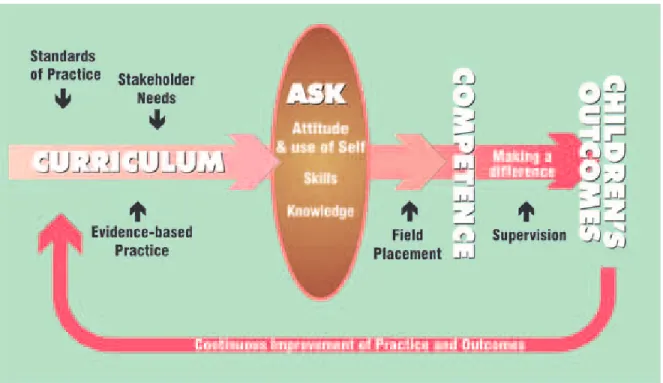
CMHO stakeholder needs assessment and evidence-based practice models in relation to entry-level skills and knowledge for child and youth practitioners. The intended outcomes of the project were: .. i) Analysis of child and youth mental health competencies/curriculum in child and youth worker programs in Ontario to confirm what exists and recommend additions needed. ii).
FINDINGS
Use of self in interventions – CYC practitioner examines the impact of self on others, cultivates and. Ethics - A CYC practitioner follows a code of personal and professional conduct on a daily basis. Diversity - The CYC practitioner respects the differences associated with cultural and human diversity by considering differences and similarities in the process of creating change for children, youth and families.
Professionals and the Community – The CYC practitioner uses effective communication skills with related professionals and the community by exploring and developing an understanding of the language and concepts used in those contexts. Patterns of Growth and Development – The CYC practitioner applies recent research on patterns and trajectories of child and adolescent development to observation and assessment of children and youth in his/her care. Linking Developmental Theory to the Pathology – The CYC practitioner can apply theory to what they observe to aid in understanding.
Teamwork – The CYC Practitioner demonstrates the ability to work with interdisciplinary and programmatic teams, take responsibility for collective duties and decisions, and represent the child and youth care perspective on the team.
SUMMARY AND RECOMMENDATIONS
The results of the project will be presented (by invitation) three times in Montreal at Beyond Borders, the international conference on child and youth care. Using this framework, the child and youth worker (college) and university (B.A. Child and Youth Care; B.A. Child and Youth Studies; or B.Sc. Best results, in turn, will inform which standards of practice and what EBP should teach in Child and Youth Care program curricula.
No accepted and approved standards of practice exist in child and youth care, as it is an unregulated profession. Professional Standards” to which the child and youth worker (college programs) must adhere. Currently, the OACYC certifies child and youth worker graduates from college programs and from the B.A. CYC) program at Ryerson University.
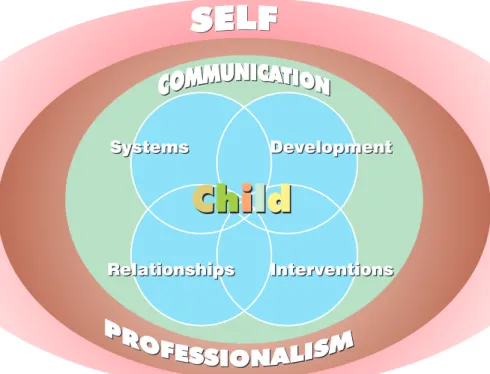
These standards were used in the creation of the Domains of Practice for this project along with four other national and international documents related to child and youth care standards. This project received initiative support from the Center of Excellence for Child and Youth Mental Health at CHEO. The Standing Subcommittee of the Coordinators of Child and Youth Worker Programs in Ontario Colleges meets annually.
They have stated that Ryerson University's Child and Youth Care program will continue to meet with them annually. Standards of practice should be developed for the child and youth care profession in Ontario that link the professional association's certification program, the. Additional research should be undertaken that examines the training, practice, and supervision of the child and youth care careers of CYC practitioners who provide child mental health services.
APPENDIX 1 – Methodology
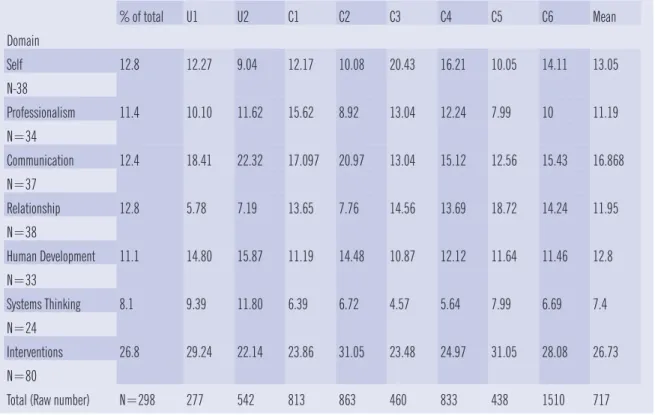
The items listed as competencies or learning outcomes within each of the above documents were reviewed and combined into a list of learning outcomes and skills required for child and youth mental health practice. To attach a level of learning to a competency in our work, the language of the competency was classified according to Bloom's Taxonomy. The writing was done through a systematic review of five papers on child and youth care work competencies and a systematic comparison of the competencies with focus group results.
Classification of competencies according to Bloom's Taxonomy was then completed by two research assistants (Becky Mercer and Mackenzie Dean). Each of the learning objectives for that subject was matched with competencies that reflected the same material. After matching the learning objective and competency within a given domain, each of the learning objectives from the curriculum was assigned a Bloom's Taxonomy rating.
The rating "CO" attached to the learning objective is a reflection of the level at which. The language used in the wording of the learning objective of the high school/university programs did not always reflect the Bloom's level achieved in the course. The language of the learning outcome suggests that the student is "evaluating," the highest level of learning according to Bloom's taxonomy, but a review of the course material indicated that it actually only delivers and tests information at the knowledge and understanding level.
This process was repeated for each learning objective in each course and for all programs reviewed. At this point the power of the curriculum translation tool was adopted and a chart and table were created for each of the 8 curricula. Focus groups were again convened in each region and an invitation was extended to instructors of child and youth work programs at community colleges and.
APPENDIX 2 – Competencies of Child and Youth Care Practice
The child and youth care worker (recently graduated) examines the impact of self on others, cultivates and develops checks and balances (FG) to ensure that interactions are. The child and youth care worker (recently graduated) values self-care as an essential part of a healthy practice. The child and youth worker (recently graduated) demonstrates skills in the use of information technology for communication, access to information and decision-making.
Conveys the expertise of the child and youth care profession to the interdisciplinary team members. The child and youth worker (newly qualified) uses developmental theory to observe and understand abnormal and/or pathological behavior in children and young people. Furthermore, the child and youth carer is aware of the symptoms and problems of substance abuse and misuse.
The child and youth worker (newly qualified) understands systems theory as a central organizing and conceptual framework for practice. The child and youth carer (newly qualified) understands this optimally. development takes place within the family and the surrounding social environment. The child and youth worker (newly qualified) values caring for others as an essential component of emotional growth, development of social competence and promotion of healthy development (NACP attitude 7) (outcome).
Modifies decision-making authority and responsibility for children and young people in a way that is appropriate for the developmental status of the child/young person. A child and youth care professional (recent graduate) understands that a group is a powerful socialization factor that provides opportunities for its members to experience social development and build on their existing strengths and competencies (outcome). The child and adolescent welfare practitioner (recent graduate) demonstrates observational and reporting skills that demonstrate the assessment and evaluation of processes and events related to the intervention plan(s) to create developmentally appropriate opportunities in which children can experience success.
Examines the totality of the child's social-ecological environment (AB Therapeutic Environments/attitudes, Client Service Planning/attitudes) and assists in the evaluation of the developmental appropriateness of the environments to meet the individual needs of clients (NACP IIIB1b) (FG). The Child and Adolescent Caregiver (newly qualified) understands the critical importance of evaluations to ensure successful outcomes for children and young people.
APPENDIX 3 – Focus Group Participants
Laurent Gilbert Timmins and District Children and Families Services Linda Glazier Niagara Children and Youth Services. Peter Neumayer Cornerstone Youth Services Rebecca Ward Bernst Children's Centre- Thunder Bay Robert Hutchinson Kinark (Residential). Sharon Thompson Blue Hills Children and Family Services Steven Doherty Halton Children and Youth Services Tahmo Gharabaghi George Hull Center.
The following Postsecondary programs submitted their curriculum for analysis in this project and agreed to be identified as participating in the project. We thank them and other programs not identified here for their participation and for the time they took to collect and submit electronic materials on their curriculum. Algonquin College Child and Youth Worker Program Cambrian College Child and Youth Worker Program Fanshawe College Child and Youth Worker Program George Brown College Child and Youth Worker Program Humber College Child and Youth Worker Program Ryerson University School of Child and Youth Care.
APPENDIX 4 – References and Additional Resources