No part of this publication may be reproduced, stored in a retrieval system or transmitted, in any form or by any means, without the prior written permission of the publisher. UBC Press gratefully acknowledges financial support for our publishing program from the Government of Canada (through the Canada Book Fund), the Canada Council for the Arts and the British Columbia Arts Council. This book was published with the help of a grant from the Canadian Federation for the Humanities and Social Sciences, through the Awards to Scholarly Publications Program, using funds from the Social Sciences and Humanities Research Council of Canada.
5 “Would Never Get Hired Today”: The Precarious Employment of Racialized and Indigenous Faculty Members | 84 6 The Everyday World of Racial and Indigenous Faculties. For example, Enakshi Dua's interest in equity policies and practices led her to study university equity firms; Howard Ramos and Peter Li chose to study income differences and performance measures; Frances Henry, Carl James, Audrey Kobayashi (and, at an earlier stage, Carol Tator) conducted dozens of personal interviews with racialized and indigenous teachers; and Malinda Smith explored social science disciplines and the role of unconscious or implicit biases. For example, neither Statistics Canada nor the Canadian Census publishes data on the percentages of racial minorities in Canadian universities, whether as faculty, staff or students.
Further, there is no data on the effectiveness of mechanisms such as employment equity, affirmative action and anti-discrimination policies. Reflecting the interdisciplinary field of critical race and indigenous studies, our research team consists of senior scholars from the disciplines of anthropology, educational studies, geography, political science, and more. Graduate students at each of the universities brought exemplary research talent to the project and collaborated as co-authors on research previously published by this project as well as found in this book.
Audrey Kobayashi assumed the role of editor-in-chief of the final manuscript with Frances Henry, who as principal investigator managed the project through each stage.
THE EQUITY MYTH
To unpack the complexity of race and racism in Canadian universities, we assembled a group of some of the leading scholars in the field, who tell those stories using many types of evidence and comparative analysis. The concept of race is used discursively to mark, separate and marginalize others and to impede and deny their full and equal participation in the academy. Therefore, as this book progresses, we delve deeper into the processes of racialization at work in the university with the clear understanding that the terms we work with—racialized and Indigenous scholars—are the result of powerful discourses of categorization.
Both racialized and indigenous people are largely underrepresented in the country's major institutions, and little is known about their experiences. The underrepresentation of racialized women scholars continues to be acute, and their numbers in the academy have increased only marginally over the past several decades (Kobayashi 2002b). There is no comprehensive source of data or demographic profiles of the professoriate, and no institutional efforts to create knowledge about the everyday experiences of racialized and indigenous researchers in the academy.
Another way in which systemic exclusions occur is through the availability of courses or the search for professors who are available to teach with authority about issues and concerns of vital importance to racialized and indigenous peoples. Despite the growing body of scholarship on equity and higher education, analyzes of race, racism, and indigeneity in the academy are most conspicuous by their absence. Their reluctance is reflected in the general silence about underrepresentation in professorial and university leadership; silence on the lack of equity research and institutional policies; limited institutional efforts to collect relevant data and monitor the status of racialized and Indigenous faculty members; and the absence of specific institutional initiatives to recruit, welcome, retain, or advance racialized and Indigenous scholars.
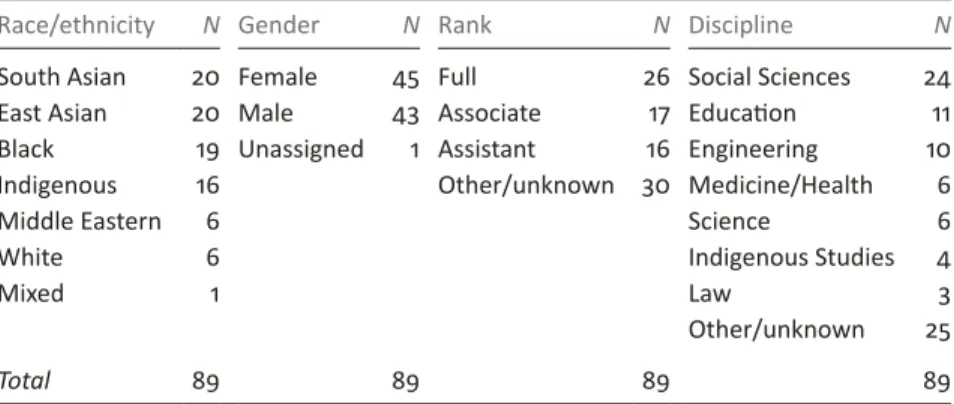
The use of the term "equity" was intended to distinguish the Canadian approach from the controversies surrounding affirmative action policies in the United States. Our study was largely shaped by the voices and lived experiences of race and Indigenous scholars who shared their stories of life in the Canadian academy through interviews and survey data. It also builds on our earlier collaborative work and an extensive review of scholarship on equity, and more specifically on racialization and indigeneity in the academy.
This examination of racism and indigeneity in the academy takes place at a time when neoliberalism and austerity politics inextricably shape the horizon of the possible. It resides in the bodies of individuals rather than in the institution, and masks the structural dimensions of racism and sexism (Johnson and Enomoto 2007; Ahmed 2012). Equity research in higher education shows that over the past four decades, the shift in the diversity of university faculty members has corresponded with a shift toward the neoliberal university and the prevalence of neoliberal rationality in society as a whole.
We also studied the process of racialization itself, examining how everyday events at the university created racial disparities and oppression. We did not necessarily use the same universities for each of the methods, but because the sample size was small we avoided identifying specific institutions in the analysis that follows. We encountered important challenges and identified new methodological issues in research on racialization in the academy.
The inability of race and Indigenous scholars to articulate their concerns in the normal academic setting raises both policy and methodological issues.