Dan Malleck
Try to Control Yourself
The Regulation of Public Drinking in
Post-Prohibition Ontario, 1927-44
Contents
List of Tables and Figures / ix Acknowledgments / xi
Preface: The Word on the Street / xv
Introduction: The Emergence of Liquor Control Bureaucracy in Ontario / 3
1 Liquor Control Bureaucracy and the Mechanisms of Governance / 17 2 The Public Life of Liquor, 1927-34 / 36
3 Idealistic Form and Realistic Function: Restructuring Public Drinking Space / 63
4 Hearing the Voices: Community Input and the Reshaping of Public Drinking Behaviour / 87
5 “As a Result of Representations Made”: The (Dys)function of Patronage in the LCBO’s Regulatory Activities / 110
6 Restructuring Recreation in the Drinking Space / 136
7 Women, Children, and the Family in the Public Drinking Space / 162 8 “Their Medley of Tongues and Eternal Jangle”: Regulating the Racial
and Ethnic Outsider / 186
Contents viii
Conclusion / 240
Appendix: The Communities / 245 Notes / 250
Bibliography / 278 Index / 285
Tables and Figures
Tables
1 Organizations that wrote to oppose the Rosdol Inn application / 90 2 Gender of applicants for hotel licences, 1920s-44 / 180
3 Summary of wartime increases in beverage-alcohol taxes and duties / 218 4 Revenue from alcohol sales, 1937-45 / 219
5 Sales of spirits, wine, and beer in gallons, 1937-45 / 220 6 Ethnicity in communities, 1931 / 249
Figures
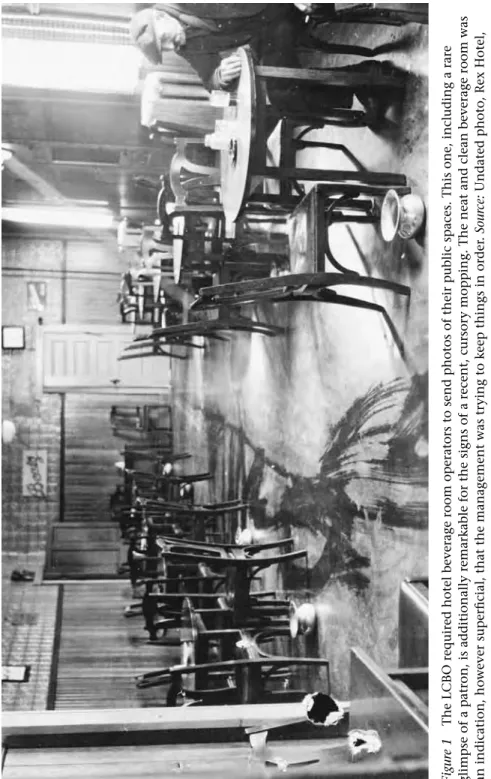
1 A neat and clean hotel beverage room / 2
2 Provincial comparison, from the New Business, 1 September 1932 / 56 3 “He Likes the Depression,” from the New Business, 1 July 1932 / 57 4 The intersection of Queen, King, and Roncesvalles in Toronto / 105 5 The change in employment and wage figures in nonagricultural
industries, 1941-51 / 216
6 Changes in liquor sales, in dollars, 1937-45 / 221 7 Changes in liquor sales, in gallons, 1937-45 / 222
Acknowledgments
I am sure that historians of alcohol and drugs quickly grow tired of people suggesting with a nudge and a wink that “the field research must be fantas- tic.” Yes, it was fantastic, but not for the dissolute reasons suggested in the nudges and winks. Research for this project gave me the opportunity to work and consult with a variety of fantastic people, and although I will never remember all of their names, I will never forget their assistance.
The hard-working staff members of the Archives of Ontario have been especially helpful. Having to deal with a researcher whose requests for literally hundreds of boxes of files at each visit overwhelmed their storage capacity must have been one of the more onerous frustrations of their work. Ana Cassanova was most notably patient and competent in her assistance. The Access to Information staff helped me to negotiate the intricacies of the regulations, and I remain indebted especially to Ron Ward, who fielded too many questions from someone who, although critical of the process of government regulation, had internalized enough of the state-control dis- course to want to do the right thing.
Beyond archival staff, a number of colleagues have provided valuable insight and support. Craig Heron’s work and collegiality have been especially important. Having dug through the same sorts of materials for a project that far exceeds this one in quality, he has provided insight and ideas, discussions over pints, and a place to stay, all of which will remain some of the high- lights of this field research. He read the entire manuscript at a late stage, and his thoughts, insights, and encouragement were invaluable. Members of the Al cohol and Drugs History Society (ADHS), that brilliant, sodden rabble whose field research is equally fantastic, have provided forums for discussion and insightful analyses that have opened up a variety of areas of new research and additional neuroses. James Nicholls, especially, suggested links between the Liquor Control Board of Ontario and the British Central Control Board (Liquor Traffic) that I have not yet fully explored. These links forced me to
Acknowledgments xii
in the early part of the twentieth century. The ADHS has been an ongoing source of support and insight, and I have appreciated the collegial discus- sions over many, many pints at our various conferences. Bill Rorabaugh, Scott Haine, and Richard Hamm participated with me in an especially in- formative panel that helped to shape the later stages of this project. David Courtwright has been extremely encouraging of my mash-up of methods and theories. Colleagues at the Canadian Society for the History of Medicine have heard me thrash out a number of my ideas, helping me to legitimize my work as “medical history” even though medical use of alcohol was in- creasingly the deviation from the norm. Steve Hewett allowed me to invite myself to speak to his students and colleagues at the University of Birmingham, where I was able to work out some of the main ideas in the last chapter; Alex Mold and Virginia Berridge hosted a talk at the London School of Hygiene and Tropical Medicine that made me feel like a big kid who had been allowed to play with ideas in an intellectual sandbox. Other good hosts and colleagues have included Jonathan Reinarz, Catherine Carstairs, Tricia Barton, Jim Mills, and Val Curtis, whose different perspec- tives, collegiality, humour, and hospitality have been invaluable.
I am especially grateful to the staff at UBC Press. I have had the privilege of working with a tremendously talented editor, Melissa Pitts, who has be- come a good friend, sharing pints and conversations as well as good editorial advice. The anonymous reviewers gave valuable insights and encouragement.
As the manuscript wound its way through the production process, I was continually impressed with the good nature and professionalism of the staff with whom I had the privilege of working.
Many of these connections, and all of this research, have been made pos- sible by the support of an Associated Medical Services – Canadian Institutes of Health Research Development Grant and also by funds from various pots of gold hidden at Brock University. This funding permitted me to hire several research assistants in the first few years of the project. Alanna Jenkins, Julia Ladner, and Trevor Campbell did much of the hard slogging through news- paper microfilm and digital files. Alanna deserves special acknowledgment for her diligent and detailed work over several years of this project, and the binders she put together have helped me out of many a difficult referencing problem.
Parts of Chapters 6 and 8 appeared in different versions in earlier publica- tions. I thank the editors of the Annals of Leisure Research as well as the University of Toronto Press, publisher of The Real Dope (2011), respectively, for permission to reproduce that material here.
Although most of the time we slog it out in solitude, we cannot survive without a support network of friends, family, and co-workers. My colleagues in the Department of Community Health Sciences at Brock University –
Acknowledgments xiii
often, I am sure, baffled about why they have a historian in their midst – have, by their very diverse approaches to scholarship, opened my eyes to a variety methodologies and perspectives. The staff at my own local public drinking space, the Merchant Ale House, unknowingly attended the birth of most of the chapters in this book. Thanks to them for the company and the many pints. My family continues to be supportive, resigning themselves to my absences and occasional silences. More than anyone else, Kim Landon had to put up with my semi-presence, need for isolation, various research and conference trips, ridiculously extensive collection of microbrews, and poor sleeping habits. She accepted it all with heroic fortitude. Although she has now moved on to other adventures, she still deserves credit for her pres- ence and support throughout the life of this project. It is for this reason that this book remains dedicated to her.
These people inspired, supported, and sustained me while I tried to figure out what all of this material meant, how to frame it, and how to make the results of this labour seem useful. Of course, any failure in this work remains mine alone, although I wish I could blame Zeeba.
Preface:
The Word on the Street
Of the dozen streets in the south-western Ontario village of Thorndale (pop.
400), where I spent the second decade of my life, one of the shortest is Temperance Street. It is literally a road to nowhere: roughly 150 metres long, it boasts a whopping three houses, and terminates in a farmer’s field. When, in 1984, the township of West Nissouri – of which Thorndale was the mu- nicipal capital – voted to end local option, making it legal to have a licensed premises, or even, God help us, a liquor store in the town, I, a cynical, slouching teenager, was baffled at the idea that there had been any kind of prohibition up to this point. I was raised in a family of moderate social drinkers, and still pride myself on what I call my healthy relationship with alcohol. Although one grandfather might be considered to have had a drink- ing problem (stories abound of my parents fetching him from the Hespeler Hotel’s beer parlour), my parents were social drinkers who enjoyed cracking a cold one when friends and family dropped by. Needless to say, we had many friends and family dropping by.
Soon after local option was overturned in West Nissouri, a licensed res- taurant opened up. It was located on the corner of Temperance Street. When, decades later, the Liquor Control Board of Ontario began to open “Agency Stores,” contracting private convenience-store owners in remote parts of the province to sell booze under licence, the store in Thorndale that got the licence was, you guessed it, on the other corner of Temperance Street. Fearing that the street would soon be renamed, since this positioning seemed to me too brilliant an irony to last, I asked my mother to keep an eye out for a name change. If they changed the name, I told her, I wanted that sign. My mother is clever, and our town is small; she went to the municipal office (a short stumble from Temperance Street) and paid to have a new “Temperance St.” sign hung. I have the original in my kitchen. The street’s name remains the same.
I tell you this not because I find my experience particularly fascinating
Preface xvi
offers a useful metaphor for the story in this book. The end of prohibition did not see the end of temperance in Ontario. That movement was strong, vocal, and persistent. Just as Temperance Street’s name became increasingly irrelevant as liquor gradually moved in at the end of West Nissouri’s own prohibition era, the creation of the Liquor Control Board of Ontario neces- sitated a gradualist approach to changing the system, requiring regulations that struck a balance between temperance sentiments and “wetter” inclina- tions. It was a bureaucratic solution to what was considered a widespread social problem. More important, it was a bureaucratic solution to a deeply divisive political problem. As a result, we still have many seemingly archaic and remarkably frustrating liquor regulations and laws in the province. We are not alone. Most Canadian provinces, and I would suspect American states, are riddled with bizarre and seemingly regressive regulations that limit the free flow of booze or impose certain expectations on the proprietors of public drinking spaces and on the people who want to consume alcohol.
Visitors from abroad may be baffled by our laws. A friend from Edinburgh, Scotland, once told me of the odd looks he got when he and his wife, fresh off a long bike ride in Banff, Alberta, strolled the path around Lake Louise while sipping from cans of beer. They were unwittingly breaking the law, and some people were aghast.
It is this sort of reaction that inspired the research that has led to this book. The end of prohibition was a tense and difficult time for government regulators. On the one hand, they had the evidence of what appeared to be the utter failure of prohibition, at least when viewed from the perspective of social order. On the other hand, they had many constituents who still believed that liquor was the devil’s drink and that the legalization of booze would lead to the downfall of society. I am not belittling these people. Many of them were progressive, socially minded individuals who believed that their ideas would elevate society, help to end poverty and social decline, and pave the way to a better world. Politicians also took them seriously.
They were not mindless reactionaries, antiquated old biddies, or crazed radicals. They were voting citizens who were organized, passionate, and respectable.
As a result of this tension, the liquor control regime that emerged was full of contradictions. From a contemporary perspective, it can appear to have been a frightening, hypercontrolling surveillance regime. But such an inter- pretation would be based both on a limited understanding of the goals of the regulatory system and on the tensions between the ideal and the actual.
The functioning of the law and regulations, the system that emerged, was shaped by people – politicians, bureaucrats, and everyday citizens – who had to negotiate the implementation of the regulations. This book is a story of the social, political, economic, and cultural forces that moulded the system with which they all interacted.
Try to Control Yourself
Figure 1The LCBO required hotel beverage room operators to send photos of their public spaces. This one, including a rare glimpse of a patron, is additionally remarkable for the signs of a recent, cursory mopping. The neat and clean beverage room was an indication, however superficial, that the management was trying to keep things in order. Source: Undated photo, Rex Hotel, Port Arthur, AO, RG 36-1-0-1149.
Introduction:
The Emergence of Liquor Control Bureaucracy in Ontario
With its own attempt at the “noble experiment” of prohibition a dismal failure, the Province of Ontario took the moderate route. In 1927 the Liquor Control Act (LCA 1927) overturned provincial prohibition, legislated by the Ontario Temperance Act, in favour of government-run liquor distribution, replacing the prohibition-era Board of License Commissioners with the Liquor Control Board of Ontario (LCBO) and ushering in the provincially managed distribution of alcoholic beverages.
Liquor control was supposed to solve the problems of prohibition, the
“noble experiment” gone awry. In spite of much fear mongering from the temperance forces, rhetorical hyperbole from the media, celebration from the drinkers, and – undoubtedly – hand rubbing from the brewers and dis- tillers, the end of provincial prohibition did not usher in utter social chaos.1 Although the “Drys” (often pluralized like that) feared that the Liquor Control Act would renew society’s slide toward iniquity, the advocates of liquor control chose a temperate modification to the status quo. The Liquor Control Act legalized alcoholic beverages in a manner that aimed to encour- age a moderate approach to drinking. The LCBO began to reconstruct resi- dents’ relationship with drink, how and where they could consume it, and in effect their perception of a mind-, body-, and (for some) soul-altering substance.
Since the LCBO’s early work involved both controlling the sale of liquor to the public and the regulation of the places in which people could drink their booze, a study of the entire scope of the board’s work would be far too complex for one book, at least if there is any hope of giving it a fair analysis.
This book, therefore, considers public drinking, leaving to others the issue of government sale for private consumption. What I am interested in here is the way that the public consumption of alcoholic beverages was regulated in post-prohibition Ontario, how government control placed constraints and expectations on the population, and how the regulatory process created
Try to Control Yourself 4
a dynamic inter action between the government agency and the general public. Residents who wanted to drink and those who wanted to sell it to them blatantly or surreptitiously challenged and in some cases modified the system that was envisioned by the regulators.
It is tempting to create a sharp dichotomy between the two sides of the equation – the government and the people – but it would be a distortion.
Neither side was homogeneous. “The government” was, and is, a complex system comprising politicians, self-interested career civil servants, idealistic administrators, and partisan appointees. They had diverse agendas and were often working at cross-purposes. The same can be said of “the people.” Owing to the distinct communities in which people lived, to the background, gender, ethnicity, or social class of the individuals, and to the values that drove them, the members of the general public were equally diverse. So studying the regulation of public drinking involves dissecting a complex relationship between the regulator and the regulated. To understand state regulation of the individual, we need to look at a variety of interests from a variety of perspectives, all under the disarmingly simple term of “liquor control.”
Among Canadian provinces, Ontario was no leader; by the time the LCBO opened its offices, ordered its stock, hired its staff, renovated its first liquor stores, and deputized its inspectors, provincial liquor boards were becoming somewhat commonplace in Canada.2 For most provinces, prohibition had been a wartime innovation (ostensibly to address wartime resource scarcity), which the Dominion government enacted through a series of prohibitionist orders-in-council. Consequently, immediately after the war, several provinces dismantled their prohibitory regimes. Quebec rescinded prohibition as soon as possible, allowing sales in stores in 1919 and reintroducing public drink- ing in 1921. British Columbia and Yukon Territory followed soon after, introducing their own liquor control regime in 1921; by 1925 both had opted to permit the public consumption of beer (passing “beer by the glass”
legislation).3 Other provinces soon followed suit, with Manitoba (1923), Alberta (1924), and Saskatchewan (1925) beating Ontario onto the liquor control bandwagon, although not necessarily permitting beer by the glass so quickly. Whereas Albertans could drink in bars the same year that they could buy alcohol at stores, Manitobans had to wait until 1928, and Sas- katchewan’s residents had to wait until 1935, fully a year after Ontarians had reopened the beverage rooms.4
From a twenty-first-century perspective, the metaphor of “jumping on the bandwagon” seems apt; given the limited nature of its early liquor control system, the province might appear to have remained almost completely “on the wagon.” Indeed, regulation was deliberate and slow, and in its operations the LCBO presented a sober face in a process that encouraged moderation.
Introduction 5
The LCA (1927) erected a complex system of oversight, what some have hyperbolically described as Nazi-like surveillance.5 People could buy liquor at government-run stores, but public drinking remained illegal. The con- sumption of beverage alcohol had to take place in an individual’s private residence. Notwithstanding that the act defined “private dwelling place”
remarkably loosely as “any building or part of a building or tent where a person resides,” which included private guest rooms in hotels, it would be another seven years before people could drink regular-strength beer in public with their friends and neighbours.6
Yet a closer look calls into question the often-stated opinion that Canada’s seemingly restrictive, abstemious provincial liquor control regimes were an extension of temperance ideology. Liquor control was, in my view, almost a revolutionary innovation for two reasons. First, looking forward from 1916, the creation of the LCBO was a reversal of the direction in which the prov- ince had been heading. Temperance rhetoric and the temperance movement had been strong in Ontario. In the 1898 plebiscite, Ontarians had voted overwhelmingly in favour of prohibition. Similarly, a 1902 provincial pleb- iscite geared to eliminating public drinking in favour of centralized liquor licensing – the License Act (1902) – was supported by a majority of electors, although it failed to receive adequate support to become law.7 Nonetheless, many Ontario municipalities had passed “local option” plebiscites, which banned the sale of liquor, beer, and wine within their boundaries. Wartime prohibition was continued after a resounding majority of voters agreed in a 1919 plebiscite on the issue. In 1921 another prohibition plebiscite reiter- ated this decision. Thus, far from embracing temperance ideology, liquor control was pushing against a process of drying out the province that had peaked in 1916 with prohibition.
The second reason that the LCA (1927) might be considered revolutionary is the nature of the regime that it enacted. A centrally organized Liquor Control Board, based on modern principles of governance, was what Gerald Halliwell called a “socialist system” of government oversight.8 The social problem of alcohol consumption was to be managed by tight control over the distribution of the troubling beverage. The board would be Janus-faced, charged with discouraging indulgence while profiting from sales.9
It was, however, a moderate revolution. There were many consistencies with the past. The LCBO replaced the provincial Board of License Com- missioners (BLC), which had been in existence for the decade of prohibi- tion. The BLC was itself a centralized board, but its mandate was to oversee the distribution of liquor for medical and industrial purposes and to make sure that the Ontario Temperance Act was enforced.10 It was also responsible for inspecting and licensing “Standard Hotels,” a component of its work that was a holdover from the decade before prohibition when the public
Try to Control Yourself 6
consumption of liquor in Ontario was normally confined to hotels. Finally, the administrative apparatus was already in place: the LCBO hired back most of the staff of the BLC.
For the first seven years of its existence, the LCBO was occupied mainly with controlling the distribution of alcohol for personal consumption. It closely monitored activities within the liquor stores, posted inspectors at each distribution point for alcohol (i.e., breweries, distilleries, and wineries), and simultaneously investigated the conduct of premises licensed to sell light beer. This beer, approximately 2.2 percent alcohol by volume, was known colloquially as “4.4 beer” in reference to its proof level.11 The board also collected data on the drinking habits of Ontarians, collaborated with social service agencies to keep an eye on the trouble drinkers, worked in close contact with various police authorities to root out illegal sellers (i.e., bootleggers) or illegal drinking places (often called “blind pigs”), and made sure that all beverage alcohol was distributed under its watchful administra- tive eyes.
In 1934 the board’s work expanded considerably. As a result of pressure from consumers, combined with the end of prohibition in the United States, the Conservatives under Howard Ferguson’s successor as provincial premier, George Henry, introduced to the Ontario Legislature “An Act to Amend the Liquor Control Act, 1927,” more commonly known as the Liquor Control Act (1934). Its major, and most controversial, change was to permit the sale and consumption of regular-strength beer and wine in public places, com- monly called “beer by the glass” legislation. The law was passed by the Con- servatives in an attempt to curry voter favour in the 1934 election. This political strategy did not work. The Conservatives’ main opponents, the Liberals, were led by the young and charismatic Mitchell Hepburn, who vowed to uphold the LCA in his stated attempt to depoliticize prohibition as an election issue. The Liberals won, and Hepburn was left to figure out how his party, which drew considerable support from the quite vocal and active temperance movement, would make this new legislation work.12 Hepburn’s task was made easier by the ambiguity of the 1934 legislation.
The LCA (1934) did not clearly state where public drinking could take place.
The Conservatives had apparently planned to extend the permission to several types of public establishments, including restaurants and hotels.
Doubtless, many who voted for the Liberals thought that they would be able to buy a beer at their local restaurant or “snack bars,” both of which had been permitted to sell light beer, and certainly many restaurant owners presumed this would be the case. They were mistaken. Hepburn and his newly selected chief commissioner, former federal Liberal member of Parliament Edmond Odette, decided that the best way to operate the LCA (1934) was to limit the sites of public drinking. The LCBO, therefore, focused
Introduction 7
its efforts on hotel beverage rooms and dining rooms, private clubs, steam- ships, and trains.
By far, the most prominent drinking space quickly became the hotel bev- erage room, a place rooted in several decades of public-drinking tradition.
Within the span of a few weeks in the summer of 1934, the LCBO received well over one thousand applications from hotel proprietors seeking the privilege of selling beer in their beverage rooms or beer and wine with meals in their dining rooms. Hotels that received such permission were issued a beer authority or a beer and wine authority (and although it was the pro- prietors who applied, the authority was attached to the premises). In late July, Ontarians returned to the revivified hotel beverage rooms.
What they found would have surprised and disappointed many of them.
The beverage room of 1934 was considerably different from the archetypes of the past. The LCA (1934) was heavily restrictive, and the LCBO expanded on the legislated rules with its own set of regulations. According to the LCA (1934), no gambling, drunkenness, or “riotous, quarrelsome, violent or dis- orderly conduct” could take place in the beverage rooms. No slot machines or gambling devices were allowed. The stand-up bar, a mainstay of the pre- prohibition saloon, was prohibited, replaced by a screened-in “taproom.”
Beer could not be served for off-premises consumption. Hotels were not allowed to have any financial association with breweries, and breweries could neither own nor provide free services or products to hotels. The LCBO’s regulations were more specific. Only beer could be sold in beverage rooms.
Beer and wine were allowed in hotel dining rooms as long as a reasonably sized meal was also purchased. In the beverage room, customers had to sit at a table and be served their beer by waiters – whose tidy appearance was also mandated by the regulations. To the clause on disorderly conduct in the LCA (1934), the board added “music, singing, dancing, disorder, quar- relling, profane or obscene language or misbehaviour.” Radios and music boxes being played in other parts of the hotel should not be loud enough to be heard in the beverage room. Food was not allowed in beverage rooms, although in the early rules “the Board will make no objection to the placing of a small bowl of either pretzels or potato chips on each table ... providing no charge is made for the same.”13 As we will see, the board created many more regulations, governing all aspects of a hotel’s operations.
Disinterested Management
In placing the control over drinking in the hands of a central board, the Ontario government was following the lead of governments around the world. The centralization of both distribution and control over liquor con- sumption was based on the principle of “disinterested management” pion- eered in Scandinavia in the last part of the nineteenth century. Under this
Try to Control Yourself 8
arrangement, also called the Gothenburg system, government controlled both the manufacture and the sale of alcoholic beverages. Such management was “disinterested” because managers did not have a financial stake in sell- ing more alcohol; their focus was supposed to be control. Ontario’s approach was a modified Gothenburg system: the manufacture of alcohol remained the purview of private industry, but the LCBO ran the stores. Breweries and wineries were allowed to sell their own products from their own stores, but an LCBO inspector was on site. The 1934 act continued this mix of private and public management: the drinking establishments were privately owned but were authorized by the board and closely watched by the local inspector.
Management of all aspects of liquor consumption remained, ultimately, the purview of the state.
The centralization of liquor control in Ontario created a system in which individual behaviour intersected with state regulation. This of course is nothing new, but the process of liquor control was a major expansion of the state oversight into individual lives. It is an example of “governmentality,”
an idea Michel Foucault introduced to characterize governance in the modern era, or as he explained it, “the conduct of conduct” (“conduire des conduits”).14 As Mitchell Dean notes, “government entails any attempt to shape with some degree of deliberation aspects of our behaviour according to particular sets of norms and for a variety of ends.”15 As an agent of governmentality that attempted to “conduct the conduct” of citizens, the LCBO attempted to construct a social vision based on a specific set of values and ideas about social order. It created a system of control that defined moral and immoral activities, compelling individuals to conform to idealized behaviours in order to get direct benefits – a drink in public with their friends.
To further Foucaultize the discussion, I would argue that the LCBO’s activ- ity was the expression of biopower. Biopower is the active principle of bio- politics, the process by which government’s role expands from the simple management of trade and other external facets of life to the subtle but per- vasive management of the internal life of the individual, the way we conduct our physical selves.16 Biopolitics is not just social control with a newer name.
Whereas social control is the imposition or implementation of a specific value system on others, the “power” in biopower is a neutral force that both oppresses and empowers: certain activities and beliefs are permitted and even encouraged, whereas others are suppressed and discouraged. Biopolitics is therefore a process of negotiation and modification. The LCBO’s biopower was subtle but extensive. It sought to reshape the individual’s relationship with his or her body by internalizing self-control over the consumption of liquor and to restructure an individual’s ideas about the physical and neurochemical effects of that substance. Whereas prohibition simply pro- hibited the consumption of alcohol, liquor control permitted consumption,
Introduction 9
although under certain conditions that were controlled by the state but negotiated with the citizen.
The mechanisms of the LCBO’s biopower were complex and pervasive.
The very consumption of something that brought pleasure and psychic transformation was framed by various notions of propriety and validity, dis courses like those found in temperance, medical, and social-reform rhet- oric, each of which contained specific ideas of what was dangerous to the physical body and the body politic. These mechanisms forced people who wanted a drink to run a series of bureaucratic gauntlets before they could indulge and relax. In the liquor stores, the customer had to buy a permit book, fill in a form listing a substance he or she wanted to buy, and be evalu- ated by the liquor store employee.17 (The employee’s actions, of course, were also controlled.) As I noted above, after 1934 the customer who wanted to have a legal drink with friends was also subjected to a series of state-prescribed constraints on behaviour. There was slightly more leeway in the licensed hotel dining rooms, but here again the individual’s desire for the physical pleasure of drinking was severely constrained. Moreover, the system con- tained several layers of control: the hotel management was overseen by the state; staff was overseen by management; the customer was both served and regulated by the staff; and members of the public could report back to the state about activities in the hotels. (As we will see, the apparatus of the state was also scrutinized by the public.) The authority of the central administra- tion was diffused throughout the system by various paid and unpaid agents.
Those familiar with the work of Max Weber will recognize this structure since the LCBO’s biopolitical project was facilitated by the bureaucratization of government. Weber’s dissection of bureaucratization helps us to see the structural implementation of central values. He and his intellectual descend- ants provide an appreciation of how government works in a structural way and of how bureaucrats who are invested in the system place considerable value in the bureaucracy as a way of injecting rationale into chaos.18 Weber’s
“ideal-typical” bureaucracy, which strives toward an objectivity that is devoid of subjective value judgments and personal interest, is a valuable tool for understanding the LCBO’s regulatory project. A bureaucracy derives its power from “well-defined spheres of competence, continuous performance of of- ficial duties, an orderly hierarchy of control ... decision-making based on written records ... and a style of decision-making which consists of applying general rules to particular cases.”19 These structures permit a form of govern- ance that would otherwise be impossible. Hence the structure was functional:
“The whole point about bureaucratic administration as a means of dom- ination is that it carries out tasks which cannot technically be performed by the employing agent itself.”20 A well-structured bureaucracy allows man- agement of people from a distance.
Try to Control Yourself 10
What makes Weber’s ideas of bureaucratization useful to a study of the LCBO is that this idealization of an objective, rule-based bureaucracy stands in stark contrast to emotionally charged temperance discourse of moral regulation and social disaster. By the 1930s the manufacture, sale, and con- sumption of beverage alcohol had been the focus of reform organizations in North America for at least a century. Even though many considered pro- hibition – the outcome of the anti-alcohol movement – to be a failure by the 1930s,21 the temperance movement remained a strong and very active force in local and provincial politics. So the activity of the LCBO was viewed from both sides, the Drys and the Wets, in emotional and passionate ways.
The Wets saw the board as restrictive; the Drys saw it as facilitating a social danger. Indeed, that the LCBO’s first few years brought enough money into the coffers of the provincial government to virtually erase its debt further added to the Drys’ concerns about the dubious connection between liquor and the management of the state. To them, these connections created the danger of the pre-prohibition regime, in which alcohol licensing was an intensely political activity. In contrast, the Wets were not really a cohesive movement. Yet, although not as organized or vocal as the Drys, they certainly expressed their interests through their actions. The many arrests, licence suspensions, and investigations into illegal activities in both hotel bever- age rooms and the pervasive unlicensed “blind pigs” made it very clear that the people wanted to drink in public and could not easily shake off the forms of sociability that had been normative in the past. Such behaviour is fun- damental to understanding the operation of and the limits to the bureau- cracy of the LCBO. No matter how well-organized this bureaucracy was (and the LCBO was by no means a perfect system), it was run by, and organized to control, the actions of humans, all of whom had their own values, ideals, expectations, and demands.
The Governmentality of the Bureaucracy
Although it may seem odd, the ideas of bureaucratization and governmen- tality intertwine quite nicely. Bureaucratization is the development of a complex organization in which rules and ultimate power are centralized but decision-making authority is diffused throughout the system. Governmen- tality is the discursive construction of this regulatory system. Mitchell Dean has described a variety of components of governmentality that are useful for this current analysis. Most notable are the means by which government functions and the point at which it ceases to function: the “regimes of con- trol” of government. These regimes sit within the bureaucracy’s “field of visibility” and are shaped by a variety of technologies, what Dean calls the
“techne” of the system. “Fields of visibility” are the areas in which a govern- ment functions and on which a governing activity focuses. I like to think
Introduction 11
of a spotlight in the dark: it brightly illuminates certain things while obscur- ing everything outside of the spot. So the government’s vision is limited to that which it chooses to see; governmental discourses ignore certain behaviours, ideas, and values. Similarly, the techne restricts the form of gov- ernance: the technologies, documentation, mechanisms, and apparatuses of the governing body enable a certain delimited form of observation and data collection, but they also limit the mode of governance to the parameters of the physical functionality of these technologies.22
The complex bureaucracy of the LCBO relied on diverse technologies of communication and surveillance – including paperwork, statistics, observa- tions, and photographs – that facilitated a certain degree of standardized data collection presented in a form that was understandable to the central administration. Moreover, communications tools, such as the telephone, the telegraph, letters, and personal meetings, further shaped the nature of the LCBO’s governance, that is, the way conduct was conducted. Here, we see the limits of the techne. Certain aspects of public behaviour were hidden from the eyes of the bureaucracy, whereas others faced increased scrutiny.
Still others may have been ignored, to extend the analogy, through a sort of selective blindness. Moreover, the bureaucracy’s view was additionally obscured because it relied on a degree of subjective evaluation by inspectors who were from the regions under scrutiny and who thus had their own biases about the communities. For example, local hotel inspectors could (and some did) exploit their official positions to advance their own interests, but this activity was often invisible to the central administration (and sadly, to historians), owing to the nature of the techniques of regulation. We learn of this behaviour only when a proprietor or community member chose to complain, and even then the veracity of the complaint is questionable. As well, the structure of the bureaucracy, which required a degree of trust in the system’s distant agent, made it difficult both for the central administra- tion to accept such criticisms and for the complainants to make their case.
Here, we get back to my assertion that liquor control was revolutionary:
its expansion drove the centralized control of behaviour deeper into the lives of individuals, as a solution to a “problem” that had plagued the state for decades, and in the process constructed a new discourse of govern- ance. Government became an agent of moderation; the late-nineteenth- and early-twentieth-century temperance movement’s insistence on absolute prohibition was replaced by an earlier form of moderation (or “true temper- ance”), regulated by the state but made real by the self-governing individual – you had to control yourself if you wanted to drink. This revolution was possible because the alternative was social chaos. On the one hand was prohibition, which had been reframed as a state of lawlessness under an extremely restrictive legal regime, not to mention an egregious violation of
Try to Control Yourself 12
individual liberties. On the other hand was the unregulated drink traffic, which had been framed by the prohibition and temperance movements as a steep and slippery slope to social disaster. Liquor control was the com- promise between the two extremes. Just as, with public health inspection of factories, schools, and other public or semi-public institutions, the gov- ernment infiltrated the bodies of individual citizens, so with liquor control the government entered another aspect of the lives of citizens: their bodies at rest. It deployed the ideal of what I call the “citizen-drinker”: one who indulges, but responsibly, within the constraints imposed by the state and in a way that does not upset the existing social order.
Possibly the key to understanding the specific biopolitical perspective of the LCBO’s bureaucracy is the notion of a politics of moderation. Just as excessive drinking wreaked havoc on an individual’s body, excess was the enemy of the body politic. Overly permissive liquor distribution in the pre-prohibition period resulted in prohibition, which was excessive restric- tion. Neither worked. In his 1929 report to the provincial Legislature, the board’s second chief commissioner asserted that the board was interested in moderation in all aspect of its work: “After the test of prohibitory laws, it may be affirmed that moral advance and their personal acceptance of vol- untary limitation, if not voluntary abstinence, is the real solution to evils arising from the abuse of intoxicating liquors.”23 In other words, prohibition failed because it was legislative excess rather than moderation. To be too restrictive would be to drive erstwhile legal drinkers into the arms of the still-prevalent bootleggers or operators of “blind pigs.” As a result, the board had to be responsive to the demands at the local level. It recognized that the only way to create a successful regime of control was to create a system that was both sufficiently lenient to discourage people from seeking illegal means of satisfying their craving and sufficiently restrictive to prevent social disorder.
To understand this process of regulation, the interplay of often contra- dictory interests, and the negotiation of respectability, this book examines the LCBO’s operations at the community level, excavating its relationship to the individual drinker and vendor while considering how its system of control was a mechanism enforcing a biopolitical agenda. It looks at the operation of the Liquor Control Board in six Ontario communities: (1) Essex County; (2) Waterloo County; (3) the “Niagara region” of Lincoln, Niagara, and Welland Counties; (4) the Thunder Bay district; (5) the city of Ottawa;
and (6) the city of Toronto. These communities were chosen in an attempt to embrace geographic and demographic diversity, and the specific social and demographic characteristics of these communities are provided in the Appendix. The study ends in 1944 because in that year new legislation was passed that bifurcated the work of the LCBO, creating the Liquor Authority
Introduction 13
Control Board to oversee the regulation of booze consumption in public places.24 Most of the current study concentrates on the period 1934-44, the first decade of “beer by the glass” legislation.
By reading all of the available LCBO Establishment Files for these com- munities, I was able to construct an impression of the type of forces at work in each area: the local politics, the community opposition to or support of public drinking, and the various social and cultural factors that affected the board’s ability to enforce its rules. This multicentred approach is far preferable to any other form of sampling, such as a random sample of all of the establishments across the province, because it permits us to see the communities as places with their own character and cultures. The context of these activities was established by an examination of at least one news- paper from each region. Municipal and other government records, such as letters to the premier of Ontario, round out main sources for the work. Since much of the material and many of the investigations into the drinking spaces were filtered through official eyes, it is important to remember that what we have here is a biased view of public drinking. Some things are missing.
For example, there is no indication, even in reports on the beverage rooms of a city as diverse as Toronto, that some of these spaces were used for homosexual socialization, even though it is likely that they were.25 This is not a cultural history of drinking in post-prohibition Ontario; it is a social, cultural, and administrative history of the development of the control of public drinking in the province.
Drinking and Regulation in History
As a study of liquor regulation, and of government bureaucracy, this work fits into several historical traditions. Since the LCBO was mandated to restrict access to alcohol, its creation and most especially its early history inform aspects of the broad history of the prohibition and temperance movements.
Conversely, in attempting to shape the way people viewed alcoholic bever- ages, the LCBO is part of an emerging history of drinking culture. Moreover, as a government agency that emerged in the interwar period, the LCBO also adds to the literature on the functioning of government bureaucracy. It is valuable to look at these historical traditions in turn.
For several decades, the social history of alcohol was for the most part a social history of anti-alcohol movements. Research on “temperance” is broad and deep.The temperance movement was a remarkably important and influential social force in North America, and by the end of the nine- teenth century, it was international in scope.26 The Woman’s Christian Temperance Union (WCTU), which began in the United States and quickly spread to Canada and around the world, established what Ian Tyrrell has called a “Woman’s Empire.”27 The WCTU was not alone in its efforts, and
Try to Control Yourself 14
male-dominated organizations like the Anti-Saloon League in the United States and the Dominion Alliance for the Total Suppression of the Liquor Traffic in Canada joined the WCTU to push the prohibition agenda in the political realm.28 By the beginning of the First World War, many states and several provinces had already passed some form of prohibitory legislation.
These histories are important because they help us to understand that, far from some group of sour, boring old crackpots who wanted to stop decent people from having a nice drink with friends, members of the temperance and prohibition movements viewed themselves as progressives, hoping to elevate society from the potential downward spiral of an industrial age. They just wanted to do it without what they saw to be the fundamentally demoral- izing and socially disruptive influence of beverage alcohol. This is why, in Canada, they allied themselves politically with the Liberals.
Although the history of the temperance and prohibition movements is extensive, an increasing number of historians are looking at those on the other side of the barroom door: the drinkers. Several historians of early mod- ern drinking have demonstrated that the tavern was an important social space in a variety of urban and rural settings.29 For Upper Canada, historian Julia Roberts has shown that the rural tavern was an essential community centre.30 As industrialization expanded, the urban tavern in North America appears to have become more firmly a place of working-class socialization.
Historians of working-class culture have found the tavern to be an import- ant, if not the most important, cultural institution for the industrial work- ing class.31 Craig Heron’s recent research into the place of the working-class tavern in Canada and his tremendously important larger study of booze in Canada have gone a long way toward rectifying this gap, but more ex- amples from more places across Canada will expand our understanding of this important social space.32
Since most of the studies of historical North American drinking cultures and their opposition reasonably set the onset of prohibition as their end point, the history of alcohol (both temperance and consumption) exhibits an uneven appreciation of the prohibition and post-prohibition drinking environments. Prohibition itself has not been understudied, but there has been a decided lack of rigour in much of the popular prohibition-era histor- ies. With gangsters, rumrunners, and speakeasies, the prohibition era has seen tremendous attention in popular history and popular culture. Much of this attention has been highly sensationalized, placing “myth above real- ity.”33 In contrast, academic historians have attempted to understand prohibition as government policy and social formation.34 Some studies of prohibition-era policy creation have taken the examination of government regulation forward into the post-prohibition era. In the Unites States, where liquor policy is developed at the state level, several historians have begun to dissect the field of post-prohibition liquor policy.35 Some valuable studies
Introduction 15
have considered the relationship between Canada and the United States during American prohibition, including Greg Marquis’s examination of how Can adian post-prohibition policies affected US attitudes toward liquor control and other studies of the situation along the Canada-US border.36 In Canada, given the provincial jurisdiction of liquor policies, the situation has also been studied mostly at the provincial level.37
This book engages with these various historical traditions. For historians of the temperance and prohibition movements, the LCBO’s work to limit access to and curtail the consumption of alcohol offers important insights into how the messages of these large social movements impacted public policy after their big success – complete prohibition – was seen to have failed.
For historians of drinking cultures, the LCBO’s mandate to facilitate but control drinking provides important insight into how uses of alcohol within a social setting were viewed by the predominantly white, middle-class bureaucrats who were interested in normalizing a specific type of drinking within a narrowly focused notion of respectability. Finally, for historians of government policy and government bureaucracy, the LCBO’s work provides key insights into the functioning of an administration that, although con- structed to deal with the significant political challenges presented by public drinking, did not seem to be able to please anyone, except maybe the pol- iticians who hid behind its apparatus.
The book is divided into two sections. After a brief examination of the unique political and social situation regarding public drinking from 1927 to 1934, the book turns to the various aspects of regulation of space and behaviour. The first section examines the ways the LCBO attempted to re- structure, physically and discursively, the public drinking space. Here, we are concerned with the bureaucratic methods of the LCBO, Dean’s techne of governmentality (Chapter 2), the geospatial arrangement of the drinking space (Chapter 3), the social and political forces that influenced the LCBO’s work (Chapters 4 and 5), and the ways that the hotel proprietors resisted or attempted to modify the board’s approach to entertainment and recreation (Chapter 6). The second section is concerned with the way the LCBO sought to regulate specific types of people within the drinking space. The board sought to address the sticky problems of women in bars (Chapter 7) and of ethnic groups whose relationship with beverage alcohol was different and therefore a challenge to the LCBO (Chapter 8). The last chapter is an exam- ination of how the board’s work, forged in the Depression of the 1930s, changed during the Second World War. The brief Conclusion considers the board’s legacy in 1944, when new legislation divided its operations, transfer- ring the oversight of public drinking to a new government agency.
Post-prohibition liquor control is a story of how the temperance move- ment, various drinking cultures, politicians, and the emerging bureaucracy
Try to Control Yourself 16
construction of a new subject, the citizen-drinker. He or she consumed legally purchased alcohol in legal spaces and tried to behave but acted in a way that accepted the need for social order. By looking at the activities in the com- munities, the book attempts to go beyond the “high-policy” approach to studying governance. It considers the implementation and modification of policy at the community level and how these local contexts affected the achievement of some homogenized version of the citizen-drinker. The at- tempted objective implementation of centralized rules intersected with the subjective interest of a diverse population. Temperance Street would never be the same.
1
Liquor Control Bureaucracy and the Mechanisms of Governance
As a complex regulatory bureaucracy, the Liquor Control Board of Ontario (LCBO) developed or adapted a series of systems and technologies to do its work. Some of the board’s approaches have been addressed by other writers, notably Scott Thompson and Gary Genosko in Punched Drunk and Mariana Valverde in Diseases of the Will.1 Both of these studies conceptualize the board as an essentially oppressive agency that kept Ontarians under tight surveillance. Although it is true that, like most developing government bureaucracies, the board was increasingly technological and complex in its functioning, such extreme characterizations miss the limits of the bureau- cratic apparatus. As discussed in the Introduction, both the presuppositions and the technology of control affect the view of the observer. What one looks for, and where and how one looks for it, restricts the range of possi- bilities of what one finds. It is useful, then, to examine both the context in which the LCBO was created and the procedures the board developed to undertake its work.
When it was formed in 1927, the LCBO adopted some of the apparatus of its predecessor, the Board of License Commissioners, but with a much larger and growing bureaucratic organization. Initially, the LCBO’s central administration consisted of three men: chief commissioner D.B. Hanna and commissioners R.J. Manion and Stewart McClenaghan.2 By 1934, before the new Liquor Control Act (LCA) of that year came into place, this body had been reduced to now chief commissioner McClenaghan, supported by deputy chief commissioner J.M. McNamara.3 Premier Mitchell Hepburn reduced the number of commissioners to one: chief commissioner Edmond Odette.4 Through its first seven years, the LCBO reported to the attorney general.
Under Hepburn’s Liberals, the board began to report to Hepburn himself, likely because he was not only the premier but also provincial treasurer.
Although the precise internal organizational structure of the LCBO remains unclear, extant records offer us a basic quantitative impression of the board’s
Try to Control Yourself 18
a general manager’s staff of two, a comptroller’s office of eight, and a general office of several hundred. Including the inspectors and store and warehouse staff, the LCBO in 1927 had 785 employees.5 By 1934, prior to the new LCA, although the total number of commissioners had declined, the office staff had increased to seven in the chief commissioner’s office, four in the general manager’s office, and eleven in the comptroller’s office. Although the total number of office staff appears to have been reduced, likely as a result of Depression-era reductions, increased inspection, store, and warehouse em- ployees meant that, before the new law came into place, the LCBO’s staff numbered 1,066, a 36 percent increase in employees.6 After the beginning of the operation of the LCA (1934), and despite significantly adding to the hotel-inspectorate branch, the LCBO’s staff declined to 904.7
The LCBO rapidly became an extensive, complex regulatory bureaucracy.
Its activities reached to the edges of the province, into the homes of any resident who chose to purchase and consume alcohol, and into the public spaces in which they were permitted to do so. Through its operations, it sought to reshape not only the behaviour and very self-perception of drinkers but also the attitudes of the managers and owners of drinking establishments.
The board employed inspectors and staff across the province and deployed various forms of regulatory technology and bureaucratic language to fulfill its mandate. To reconstruct the citizen-drinker, a concept based on intermin- gling discourses of social order and respectability, it deployed an authoritative language of control that radiated from the central administration to its operatives at the periphery, where it was modified to suit local conditions.
Hotels throughout the province were the main focus of the LCBO’s public- drinking regulatory activities. In the early part of the twentieth century, most hotels remained small, independent businesses that were often run by a married couple or less frequently by a widowed woman or (less ideal to the board) a male bachelor. Far from the large, multistorey hotels owned by multinational corporations, with which readers may be more familiar, a typical Ontario hotel at this time was relatively small, with no more than a handful of rooms, several of which could be occupied by the proprietor and his or her family. The building might be either owned by the proprietor or leased, leading to a variety of individuals who were interested in the suc- cessful operation of the business. Building owners might repeatedly dismiss problematic proprietors until one who could properly do the job was found.
Or owner-proprietors would struggle along, hoping to make enough money to improve their business, and either prosper or sell out and move on. So when an inspector reported back to the central administration about the activities within a hotel, he often framed his assessment in a personalized manner, making subjective assessments of the situation that added nuance to what could, at a distance, seem a clear case of rule violation or poor management.
Liquor Control Bureaucracy and the Mechanisms of Governance 19
Hotels were an important part of life in Ontario. Julia Roberts has shown how the colonial tavern functioned as a way station in the pre-mechanized travelling life of the province.8 This aspect persisted, transformed by the development of railways and automobiles.9 Business travellers needed hotels, and most older hotels had some kind of “sample room” where travelling salesmen could store or display their wares. Peter Delottinville’s description of Joe Beef’s Tavern in Montreal as a place that included facilities for workers to sleep further illustrates how hotels could cater to a variety of classes.10 Many hotels, especially in times of affluence or in areas of increased indus- trial or economic activity, housed workers either temporarily or on a semi- permanent basis. In north-western Ontario during various economic booms, the hotels could be full of “bushmen” or temporary labourers. Across the province during the Second World War, hotels were pressed into service to house transient or newly arrived labourers in wartime industries. Also, most hotels, especially those in smaller towns, usually had large rooms that could be made available to the public for banquets or other functions. Whereas large, corporate, and respectable hotels like Ottawa’s Chateau Laurier, Toronto’s Royal York, and Windsor’s Norton-Palmer were frequented by elite travellers, many more modest establishments, family-owned and -operated, squeaked by in a competitive market. These businesses received the most intense scrutiny from the LCBO.
With so many small hotels, the board could be selective in its licensing decisions. The “Standard Hotel” licence was considered by many to be a mark of quality, and not all hotels received it. In 1927 the LCBO licensed 1,258 standard hotels, and by the time the legislation changed in 1934 the number had risen to 1,463 (most, but not all, of these were licensed to sell light beer).11 It also denied many applications, deeming the premises to be unsuitable for any number of reasons, ranging from physical layout to po- tential problems in the surrounding community.12 The accommodation business was competitive. As Karen Dubinsky has shown in her work on Niagara Falls, there was considerable tension between owners of standard hotels and those individuals who operated “tourist homes,” which were licensed, if at all, by municipal authorities.13 To further complicate things, the board distinguished between rural and urban hotels. Initially, a rural hotel could have only four bedrooms, and an urban hotel needed a mere six. Likely as a result of applications from people who hoped to create a country drinking space by sparsely furnishing four “bedrooms” and calling their place a hotel, the LCBO quickly modified its regulations. Within the first year of the operations of the LCA (1934), a rural hotel needed six rooms, and an urban one needed twelve.
When an individual applied for a standard hotel licence and, after 1934, usually accompanied this application with one for a beer authority or a beer
Try to Control Yourself 20
premises, as well as the area in which their property was located and its residents, to the regulatory gaze of the LCBO. This gaze was authoritative and appeared ubiquitous, but it was also limited and biased, shaped not only by the values of the members of the central administration but also by the very apparatus of the LCBO’s bureaucratic structure. The technology used to enforce regulations both shapes and limits the activities of the governing agency.14 Having examined the surveillance techniques of the LCBO over a broad span of time, Gary Genosko and Scott Thompson argue that the vari- ous means of recording and tracking liquor purchases of individuals “could transform the most private interests into public matters, in the process re- categorizing individuals and redefining their material possessions and property.”15 In this view, the private individual fell under the oppressive gaze of the public agency.
Although this interpretation is useful, it tends to understate the functional limits of the surveillance techniques and the restrictions that extant com- munication methods placed on the ability of the central administration to enforce its authority. To use Dean’s terminology, the techne restricted the field of visibility available to the board’s scrutiny. What follows is a dissec- tion of the various forms of communication between hotel proprietors and the board. It demonstrates the limits of the technology of control, suggesting that silences were created by documentation that asked for specific informa- tion, and it exposes the expanding impersonalization of the process. This all began with the application for a standard hotel licence and for a beer and wine authority.
The Application
The initial contact between the hotel proprietor and the LCBO was often through the application for a standard hotel licence. Prior to 1934 the licence application form was a single standard-sized page, which included a few lines indicating the proprietor’s desire for a light-beer authority. On the rare occasion when a hotel did not wish to apply for a light-beer authority along with the standard hotel licence, the light-beer section might be crossed out or not completed. After 1934 the hotel proprietor had to complete an ap- plication for a standard hotel licence and a separate application for a beer authority or a beer and wine authority. These applications were much more comprehensive than the pre-1934 form, being four pages long and asking for a range of information from physical layout of the building to the man- agement structure of the business. The applicant also had to forward three letters of reference from respectable community members – a politician, a police official, and another respectable community member, usually a busi- ness owner. All had to attest to the proprietor’s good character and suitability for running a hotel. Finally, possibly further attesting to the proprietor’s
Liquor Control Bureaucracy and the Mechanisms of Governance 21
financial stability and credibility, the application had to be accompanied by the appropriate fees: $1 for a standard hotel licence and $300 for an author- ity. The latter fee was not as high as it might appear since the board then credited back to the hotel $300 off the “gallonage fees” the management paid on beer purchases.
Although ideally an application would be followed by a visit from a local inspector or less frequently a police officer, in the first few months of the operation of the LCA (1934), this process was often impractical. In the sum- mer of 1934, the board received well over one thousand applications but had yet to add the staff required to enforce the new rules. Not surprisingly, the local inspectors could not undertake inspections of the premises prior to granting an authority, and many were granted “site unseen.” This situa- tion caused some concern when, in November 1934, after the initial phase of the LCA (1934)’s operation, and at the end of the fiscal year, many of these authorities were revoked.16
Less frequently, prior to an application being filed, the board would receive a letter asking whether an application would have any chance of success.
Many of these letters came after the initial flurry of applications and the granting of authorities in the summer of 1934 and permitted the board to undertake a much more comprehensive evaluation of the establishment than it had in the first few months. Having an inspection prior to submitting an application provided the proprietor the opportunity to make changes that the board required in order for the hotel to conform to a more idealized vision of a standard hotel. It also provided the inspector with an opportunity to comment on the character of the proprietor (and owner if they were not the same person) and to provide other subjective information, such as the suitability of the location for a hotel and the “desirability” of the hotel in the location. In the first few months of the 1934 act’s operation, the board promised to grant authorities to a few proprietors based on assessments of pending renovations.17 By the end of 1934, the board had changed its policy:
no more promises would be made before renovations were completed.
Once the licence and authorities were granted, the normal procedure was for the inspectors to file an annual report and monthly “Authority Holder’s Conduct Reports” (AHCRs). The annual reports were standardized four- page forms, with roughly three pages of checkboxes and fields that the inspectors needed to complete and with space at the end for additional comments. The AHCR was a shorter document, one single-sided page, that had a series of fields with yes or no questions or brief items that needed to be filled in, such as listing the temperature of the glass-cleaning water or the state of the beer kegs. An open field at the bottom of this report, about ten centimetres of space, was left for comments, and the opposite side of the page had lines for additional information. Some inspectors routinely used
Try to Control Yourself 22
all of this space. Inspector D.W. Downey from Toronto’s east side had large, scrawling handwriting and filled a page and a half with comments; other inspectors might have five lines of tightly typed information or nothing more than a word or two.
Depending on the location and the time of year, these monthly AHCRs were often filed irregularly. Probably owing to the number of hotels he had to inspect, and the problems he found in a number of them, inspector John Kidd from Toronto’s west side (whose district included the city’s rambunc- tious Jarvis Street) often filed AHCRs with several dates in the “date inspected”
field, suggesting that, whereas he inspected frequently, he filed reports only occasionally. In contrast, inspector George Skuce of the Thunder Bay district found that some of the more remote locations were difficult to reach, espe- cially in the winter, and therefore would apologize to the central adminis- tration when he could not visit every hotel on a regular basis. These forms, both the annual report and the AHCR, permitted a degree of subjective information to accompany the specific fields to be included. So the inspector’s perspective was essential to the technology of control; he could choose which aspects of the establishment’s operation to include or ignore.
By the 1940s the board had modified the format of both the long report and the AHCR to assert more specific control over the type and format of information being requested and over the activities of inspectors. Indeed, the AHCR was changed to the “Authority Holder’s Monthly Conduct Report”
(AHMCR), suggesting a standardization of the use of time. In both report forms, the requisite objective data expanded, and the space for additional subjective information declined. The long report now had a note at the bottom of the fourth page indicating that additional information should be submitted on a separate page, something that most inspectors rarely did.
The AHMCR had about three centimetres of space; often inspectors entered brief, generic information, such as “A well run hotel,” or more often simply left it blank. The subjective input from inspectors was reduced by these forms, although the priorities of each local inspector (e.g., whether he always checked the temperature of the dishwater or was preoccupied with the cleanliness of basements) could reappear in letters sent to the board or in additional pages. As a result, the inspector became more of a calculator for the central administration. Although it is impossible to determine the impact of such expanded objective formatting on the inspectors, it is telling that, after the AHMCR replaced the AHCR, the reports became increasingly bereft of additional comments. One can imagine an inspector becoming a form- filler; from Max Weber’s perspective, this outcome is the fundamental de- humanizing aspect of bureaucratization, but it is also what makes the ideal-typical bureaucracy so valuable to the central authority since it affords increased control of the type and format of information gathered. At the same time, by removing the opportunity for the inspector to make quick