
Effects of Intervention on Level of STS Independence 37 Effects of Intervention on Length of Time to Perform STS 37 Effects of Intervention on Functional Independence 39. Effects of Intervention on Level of STS Independence 42 Effects of Intervention on Length of Time to Perform STS perform 42 Effects of Intervention on Functional Independence 45.
Literature Review Stroke Recovery Conceptual Framework
Motor coordination was associated with functional performance in both men and women (Singh et al., 2006). The ability to perform daily activities contributes to the quality of life of older people (Singh et al., 2006).
Method Participants
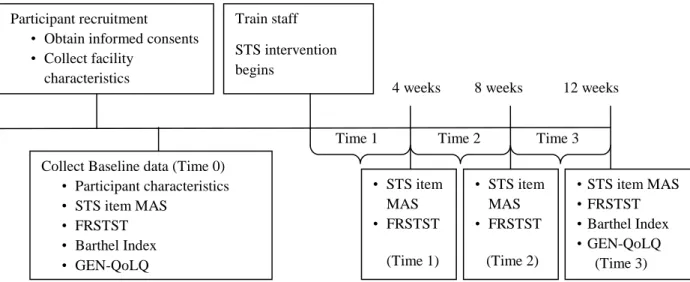
The average number of eligible individuals who ultimately agreed to participate was 62% (Forster et al., 2011). The training method was similar to that described by Barreca et al. 2004) using written materials; actual practice and support video. In addition, a standardized checklist was used to evaluate each staff member's observed ability to perform STS movements according to the STS protocol (Barreca et al., 2004).
It is a single item scored from 0 to 6 with higher numbers representing higher level of STS independence (Langhammer et al., 2007). The Five Repeat STS Test (FRSTST) is a widely used measure (Bohannon, 2012) to quantify STS performance and has been tested for the chronic stroke population (Mong et al., 2010). The Barthel Index consists of 10 primary activities of daily living (feeding, bathing, grooming, dressing, bowel, bladder, toileting, transfers, mobility and stairs) measured on a Likert scale (Langhammer et al., 2007 ).
It has been estimated that a score of 60 or below is indicative of the need for institutional care (Langhammer et al., 2007). In addition, the dependent variable data are ordinal or the assumptions of the paired-samples t-test are violated (Morgan et al., 2006).
Results Participants
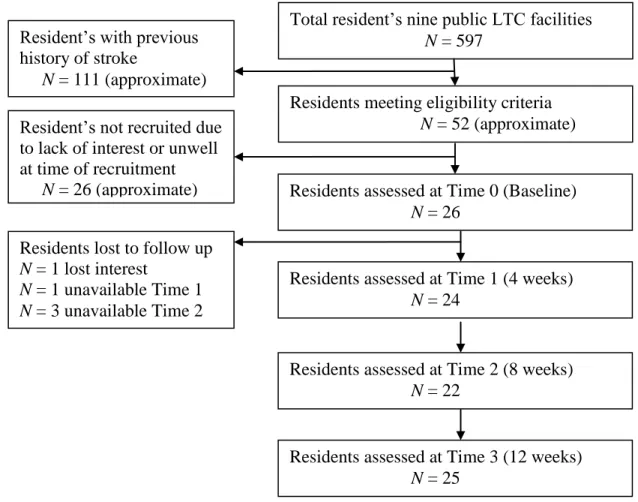
N = 111 (approx.) The resident is not recruited due to lack of interest or discomfort at the time of recruitment N = 26 (approx.). Only two participants (8%) met the minimum target of 11 average daily STS practiced at Time 1 and only one. However, not all participants were able to perform this test as they were unable to stand up from a chair without using their upper limbs.
At Time 0 (Baseline residents were unable to complete the Five-Repeat STS Test (FRSTST). Lower times to complete the FRSTST equated to better scores, thus better reflecting change over time for those participants with a time of zero at baseline; two different.To examine the effects of the intervention on duration of STS completion over time, a Repeated Measures ANOVA was conducted.
The Wilcoxon matched-pairs test was used to examine the effects of the STS protocol on functional independence, as indicated by the Barthel Index of Activities of Daily Living. The Wilcoxon signed-ranks matched-pairs test was used to examine the effects of the intervention on quality of life assessed at Time 0 (baseline) and Time 3 (12 weeks).
Discussion
This was measured by the STS score on the Motor Activity Assessment Scale (MAS) ranging from 0 (inability to perform) to 6 (sitting to standing, unaided, three times in 10 seconds) (Carr et al., 1985). . A lower distance between the ground and the seat puts taller people and people with more disabilities at a disadvantage (Whitney et al., 2005). Previous studies (Buatois et al., 2008; Whitney et al., 2005) have shown that duration longer than 15 seconds to complete the five-repetition STS test (FRSTST) is associated with greater deficits in instrumental activities of daily living.
The positive effects of exercise on perceived quality of life have been described by other studies (Barreca et al., 2004) where perceived quality of life refers to the subjective experience of the individual (Gerritsen et al., 2007). The ability to perform activities of daily living contributes to the quality of life of older persons (Singh et al., 2006) and has a significant improvement in functionality. independence was not found, may be one of the reasons that a statistically significant difference was not found. A recent study by Slaughter et al. 2015) evaluated the effect of STS activity on mobility, functional and health quality of life of nursing home residents with dementia.
Although the task-specific STS intervention has been shown to be a promising strategy, both the current study and the study conducted by Slaughter et al. 2015) experienced challenges in implementing the STS activity by healthcare assistants and maintaining compliance over time. Previous research has shown that twice daily STS activity can maintain and in some cases modestly improve residents' mobility (Slaughter et al., 2011).
Conclusion
Despite the challenges of implementing the sit-to-stand protocol, the results of this study support the need to integrate consistent practice of sit-to-stand as a standard of care for stroke survivors who living in long-term care. Effects of extra training on the ability of stroke survivors to perform an independent sit-to-stand: A. An exploratory randomized controlled trial of assisted practice for improving sit-to-stand in stroke patients in the hospital environment.
Five-time sit-to-stand test is a predictor of recurrent falls in healthy community-dwelling subjects aged 65 and older. Foot placement and arm position affect the five-time sit-to-stand test time of individuals with chronic stroke. Evaluation of a home-based exercise and training program to improve sit-to-stand in patients with chronic stroke.
Mobility of vulnerable elderly study: Effect of sit-to-stand activity on mobility, function and quality of life. Clinical measurement of sit-to-stand performance in individuals with balance disorders: The validity of data for the Five Times Sit to Stand test.
INFORMATION LETTER AND CONSENT FORM Title of Study
Why is this study being done?
Why am I being asked to join this study?
What happens in this study?
If you can sit and stand without using your hands, you will be asked to sit and stand five times and the principal investigator will record the time it takes you. The first assessment will take place before the long-term care staff start practicing sitting and standing with you. You will also be asked some questions to gauge how your stroke has affected your life during the first assessment and again at the final assessment (12 weeks).
Long-term care staff will ask you to practice sitting up 4 times a day. If possible, you'll be encouraged to try practicing the squat without using your hands to help put weight through the legs. Each time you practice, the staff will ask you to do between 3 and 5 sit-ups.
Who can participate in the study?
Who will be conducting the research?
What are the possible risks, side effects, and/or inconveniences?
If you are not used to this type of movement, you may experience some muscle and/or joint pain. But if this happens, you can tell your nurse, doctor and/or the principal investigator, Carolyn. If your pain is severe and/or persistent, you will be referred to a qualified professional for appropriate medical care.
If you currently require assistance with transfers (eg, getting from bed to a wheelchair), there may be an increased risk of falling if you attempt to transfer on your own before you have sufficient balance control . Make sure your nurse or physiotherapist tells you it is safe for you to move without help.
What are the possible benefits?
What are my rights as a participant?
What about my right to privacy?
Additionally, your name will not appear in any report or article published as a result of this study. Any information about you will have a unique code and will not show any information that directly identifies you. Information collected for the study will be kept in a locked filing cabinet in a locked office by the principal investigator for five years.
The existence of the research will be listed in an abstract published online at the Athabasca University Library's Digital Thesis and Project Room; and the final research paper will be publicly available. Information about the results of this study will be shared with your long-term care staff and with you.
Will it cost me anything?
Who do I contact if I have questions or problems?
Sit to Stand Protocol in Long-Term Care to Optimize Recovery After Stroke Principal Investigator: Carolyn MacPhail Phone. Title of Study: Sit-to-Stand Protocol in Long-Term Care to Optimize Recovery After Stroke Principal Investigator. The purpose of the study is to determine whether practicing sit-to-stand (STS) in stroke survivors residing in long-term care will improve STS.
However, few studies have examined the effectiveness of STS implementation by regular caregivers in long-term care. The principal investigator will train and monitor long-term care staff to consistently administer the standardized STS protocol. The goal will be to practice three to five STS actions per session four times a day with a minimum goal of 11 to 14 STS actions per day.
Physiotherapists and occupational therapists who provide services at the facility will be invited to assist in the ongoing monitoring and support of long-term care staff as usual care. Study title: Sit to Stand protocol in long-term care to optimize stroke recovery.
Physician's Recommendations
Scoring: Award one point if the subject successfully draws the following pattern: 1 −A- 2- B- 3- C- 4- D- 5- E, without drawing lines that cross each other. Administration: The examiner, pointing to the cube, gives the following instructions: “Record this drawing as accurately as possible in the space below.” Scoring: One point is given for the following answers: (1) lion (2) rhino or rhino (3) camel or dromedary.
Administration: The examiner reads a list of five words at a rate of one per second and gives the following instructions: “This is a memory test. Forward Digit Span: Administration: Give the following instruction: “I'm going to say some numbers, and when I'm done, repeat them back to me exactly as I said them”. Vigilance: Administration: Examiner reads the list of letters at a rate of one per second after giving the following instruction: “I am going to read a series of letters.
Administration: The examiner gives the following instruction: “Tell me as many words as you can think of that begin with a certain letter of the alphabet that I will tell you in a moment. Administration: The examiner gives the following instruction: “Earlier I read you some words that I asked you to remember.
