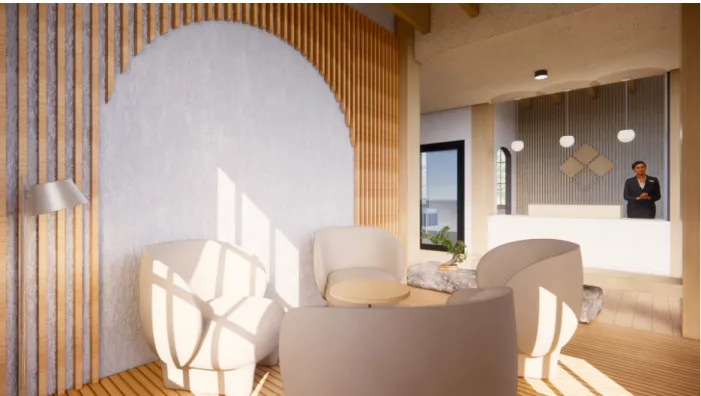
Kitchen space on the first floor of the Pardis center with flexible furniture. An enclosed garden with a void in the center that connects all three levels of the garden complex.
INTRODUCTIONCHAPTER I
- p roject d escrIptIon
- p roject r atIonale & c ontext
- p & K roject ey r esearch o bjectIves Q uestIons
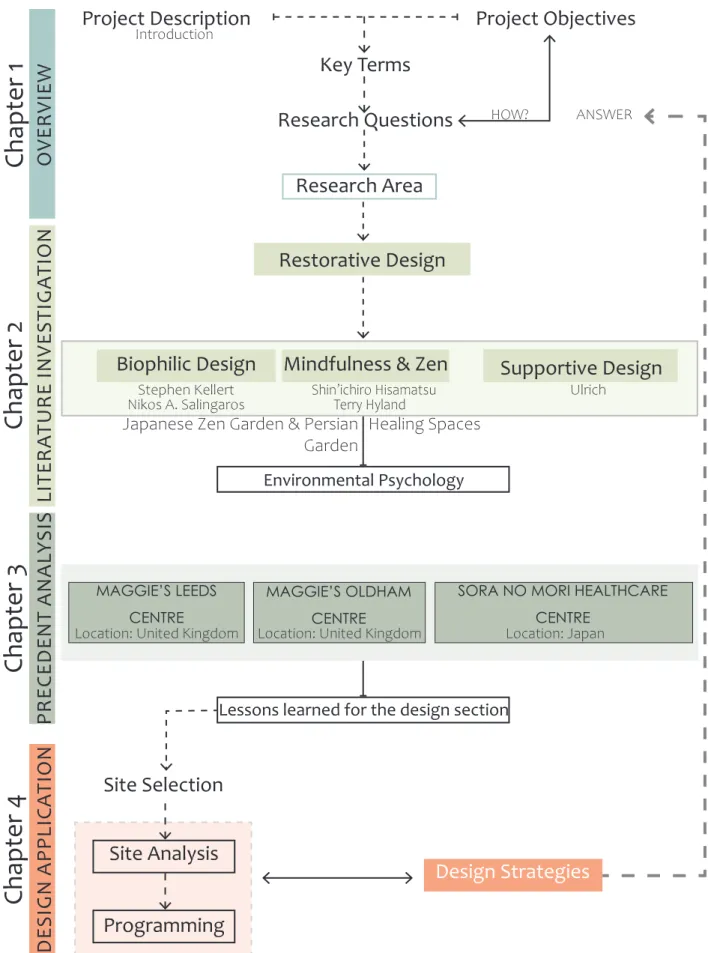
- Chapter 2 Chapter 3 Chapter 4 OVERVIEWLITERATURE INVESTIGATIONPRECEDENT ANALYSIS DESIGN APPLICATION
As shown in Figure 2, the main users of this practicum are people diagnosed with MS. Therefore, defining key research questions helps narrow the project to the scope of this practice.
LITERARY INVESTIGATION AND ANALYSISCHAPTER II
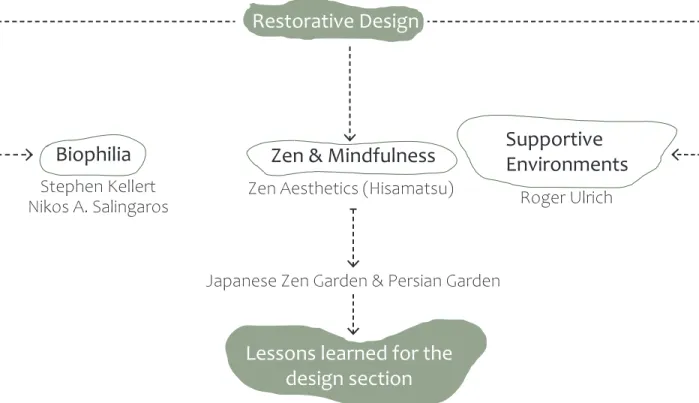
That said, restorative design is a major focus of this project and includes research into the theories of Biophilic Design, Mindfulness and Zen Philosophy, and the Theory of Supportive Environments. Zen garden design and traditional Persian garden design are explored as two examples of restorative spaces that combine Eastern philosophies with environmental psychology to create an environment designed for the well-being of users and that can be implemented in the design process of this project.
LITERARY INVESTIGATION
However, the biophilic design is not just the use of green areas in the project's internal environment. So in this project it is crucial to provide a supportive environment for the primary users of the project.

DESIGN PRECEDENT ANALYSISCHAPTER III
The Maggie's Centers are a series of non-residential buildings designed by prestigious architects such as Zaha Hadid, Norman Foster, Rem Koolhaas, to name but a few, in a small, domestic scale. Patients at Maggie's Center receive treatment in an informal setting that differs from hospitals and healthcare facilities by providing a supportive environment filled with nature. Maggie battled cancer in a conventional hospital setting, and the idea for Maggie's Centers was born.
They discussed the need to take people with cancer to a 'better' place, outside but close to the hospital (Maggie's Center). His prestigious position among architects made it possible for him to recruit some of the best architects to design Maggie's Centers. As a result, more than twenty Maggie's Centers worldwide currently serve the well-being of people going through difficult times in life.
To provide such spaces in this project, Maggie's Leeds center consists of a series of large-scale planters of various sizes (Figure 13). Maggie's Leed Center is built on a wooden structure that offers the building's users closer contact with nature (Figure 18).
Inside, for example, there is no reception at the entrance to welcome visitors. However, in this project, the tree in the center of the building acts as the heart of the project and the spaces are arranged around this core. Three layers of earth, trees and sky enter the building through the organic glass in the center.
The designers in this project translated this idea into the interior environment by thinking about the sensory experience of the user in the project. In this way, the natural materials in the building are less likely to transfer cold to the user's skin as they touch them. A small pond is placed under the building to collect water on rainy days (figure 26) as another sustainable solution in this project.
In the Pardis Centre, flowing water provides a sense of tranquility to the users, also the collection of rainwater on site can be used to irrigate the gardens to create a symbiosis between the building and nature. The kitchen island is made of a living wood as a direct use of nature in the building.

S ora no M ori h eaLth c are
As shown in Figure 32, there are several layers between the exterior and interior of the building in the Sora no Mori project. Each layer serves as a channel for circulation, as well as a bridge between the exterior and interior of the building. Furthermore, it facilitates a comfortable indoor climate by allowing sea breezes to penetrate the building and refresh it.
There is a movable partition on the farthest corridor between the inside and the outside, which allows users to have a sense of control over the space. Interior simplicity or Kanso as the first Zen aesthetic principle is evident in the absence of finishing materials on the exposed structure and in the white color of the space. This project tries to focus less on the built environment and instead frames nature by using the spaces between the wooden posts of the structure.
This absence of material and voids between the posts is in accordance with another Japanese design principle of Ma, which was explained in the previous chapter. For the design of the small addition to the existing building on the grounds of the Pardis Centre, openings on the structural envelope have been chosen to frame the intended view of nature for the users.
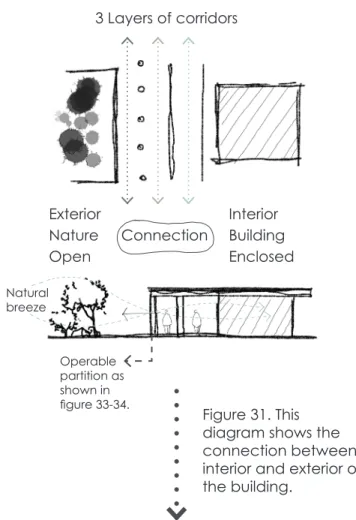
This project features a movable partition wall and a greenhouse that give users a sense of agency over the environment, which is one of the three pillars of supportive environment theory. Half of the built-up area of the project consists of open courtyards and semi-open corridors where patients can wander and enjoy the scenery inside and outside the building. The project follows Japanese vernacular architectural principles, such as creating a connection between indoors and outdoors by removing solid walls and replacing them with operable partitions.
The interior design of the project is based on a combination of exposed local wooden structures and white paint on the walls. The empty spaces between the structural columns make a moment of pause for users to stop and look at the courtyard garden or the outdoor landscape of nature around the project. In addition, Center Pardis offers users framed views of the landscape and local points inside the project.
The location and context of the project are also crucial factors to consider when designing the project. Pardis Center is located on a heritage site with a lot of natural potential such as the river, trees and animals that influence the interior and exterior design of the project.
DESIGN APPLICATIONCHAPTER IV
S Ite and B uIldIng a nalySIS
The information gathered in the literary analysis and design precedent analysis provided insight into the design of the Pardis Center and helped to find a suitable location for the project. So, adding evergreen trees to the landscape on the north side of the building works as a natural shield against the severe cold wind during winter. The exterior of the building must therefore not be changed in a way that overshadows the existing building.
Making a connection between the indoor environment and nature on the outside of the building is a biophilic design opportunity. Originally designed as a guest house intended for farming and meditation, the building fulfills the functionality of the Pardis Center. Due to its location outside the city, the site is not easily accessible by bus.
This section discusses the key considerations that contributed to the design of the Pardis Centre. Secondary users can choose to stay with the MS patients during their treatment or spend their time in other spaces of the Pardis Center.

RESTORATION
SUPPORTIVE
ACCOMMODATIONSOCIAL
D esign C onCePts anD P roCess
The draft presented in this section is an extension and summary of the literary research and analysis and precedent analysis presented in chapters two and three. As a result of the site analysis in this chapter, the design program was prepared and the biophilic zone as the garden complex was identified as the complementary structure for the Pardis Center. With the help of the garden zone, the Pardis Center emphasizes the connection between nature and the built environment.
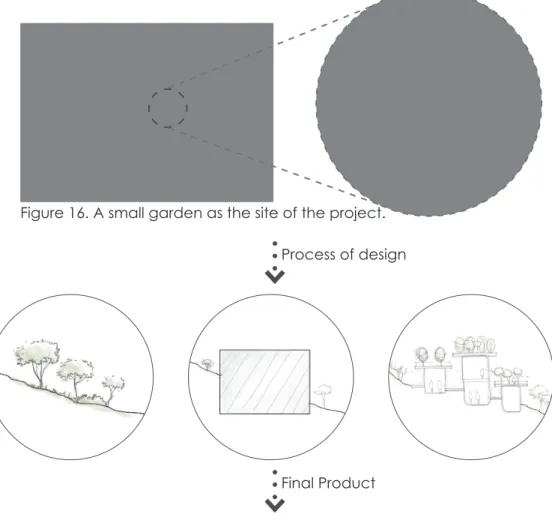
The garden complex is a transitional space between the existing building on the site and the surrounding nature (Figure 71). The Garden Complex bridges nature to the built environment by creating a microclimate in a building.
سیدرپ
سیـدپر
D esign o verview
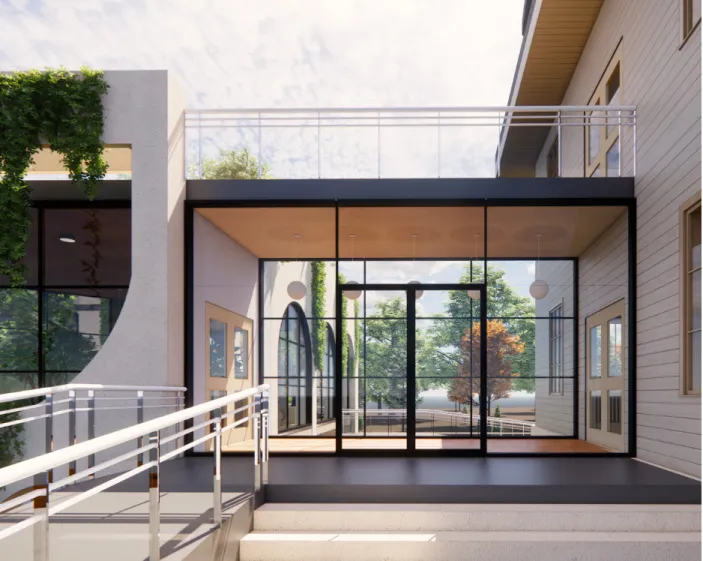
Like the entrance, the ramp also conveys the concept of transition between the different environments in the Pardis Centre. To the left of the entrance is the enclosed garden, open to all as the largest social zone in the project. On the first floor, the kitchen is dedicated to visitors who do not plan to spend the night in the Pardis Centre.
As part of a sensory experience in the Pardis Centre, the void located at the entrance to the existing building provides a visual connection between the first floor and the cafe in the basement level. As part of the sensory experience in the suites, each suite has openings in the room and washrooms to the surrounding nature. The ramp in the open garden gives access to the first floor of the garden facility.
The fenced garden on the first floor of the extension is the only place in the Pardis Center that is green even throughout the year. It is similar to the role of water in traditional Persian gardens explored in Chapter 2.
It is in line with Nikos Salingaros' arguments about the positive influence of biophilic design on architects and designers while working on the design of the project (Salingaros 2015). The design process of the Pardis Center gave me a satisfying experience as I visualized the spaces with biophilic qualities. Gaining a deeper understanding of the biophilic design principles was a personal achievement that I did not expect before starting the design chapter of this internship project.
Research related to this question took place in all three phases of the research methodology of this practicum. For example, as established in the literary analysis chapter, the vernacular design approach leads to a sustainable product, if the designer creates a symbiotic relationship between the built environment and nature as the context of the project. In this case, one side of the relationship is the built environment created by humans.
Consequently, the mutualistic symbiosis takes place when the designer creates the built environment as part of nature, as well as in the context of the project. Vernacular design is the result of close attention to the location and context of the project to create an environment that mimics its context. Paying attention to the location of the project was a common feature of the three precedents in Chapter 3.
The main focus of the research and design of this project was on the study of the quality of an environment that helps people deal with stress.