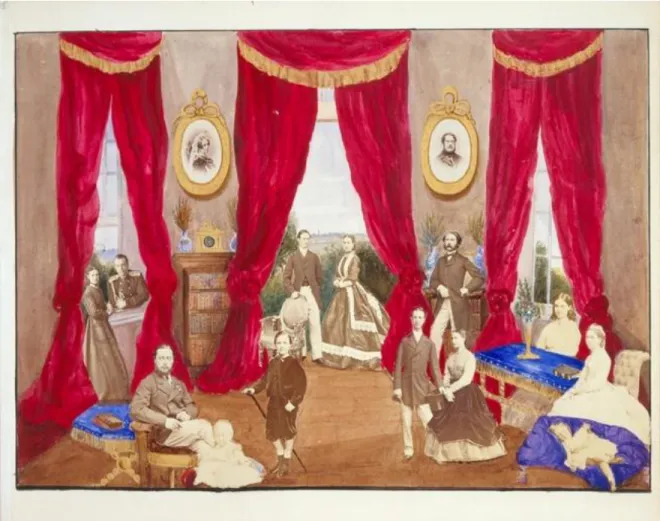
This project explores a fusion and organization of the regulations governing women's court dress in England and Russia. Researching both court dresses reveals the importance of women's clothing in communicating wealth and power. 8 Thorstein Veblen, The Theory of the Free Class; an Economic Study of Institutions (New York, NY: Modern Library, 1934).
This major research paper advances academic literature on the subject of English and Russian court dress at the turn of the twentieth century by conducting research into court dress regulations in the British and Russian empires in the late nineteenth and early twentieth centuries. Alexander, "Courts of the Russian Empresses in the Eighteenth Century," Court Historian 4, No. Tarasova, "Ceremonial Costumes of the Russian Court in the Eighteenth to Early Twentieth Centuries in the Collection of the State Hermitage Museum," in M.B.
An analysis of other Russian court gowns and related accessories was needed to provide context for the unknown wearer of The Met's dress. Court dress from 1901, worn by Queen Alexandra.41 A purpose of the ROM appointment was to consider the overall effect that the encounter with the dress had, which was then compared to the encounter with the Russian court dress (C.I.53.46a-g) at The Met. The visual and physical proximity of both court robes had a major impact on the researcher.
Plotnikova, "Fashion and Style at the Russian Court," in Russian Splendor: Sumptuous Fashions of the Russian Court, eds. Tarasova, "Ceremonies and Feasts at the Imperial Court," in Russian Splendor: Sumptuous Fashions of the Russian Court, eds. When trying to identify to what rank a woman of the Russian court belonged, there are many obstacles.
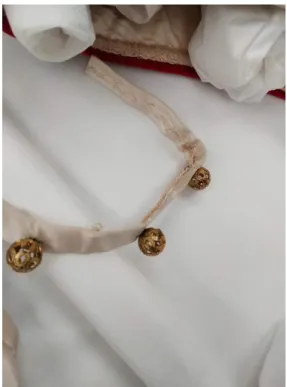
Before presenting this hypothesis of the wearer, the quantitative elements of the gown will be qualified. In the middle there is a long loop that pages or the bearer can use to help carry the train. Included in the object grouping of The Met's Crimson Gown are the accessories: two unadorned kokoshniks, and a red velvet cape.
In conclusion, The Met's analysis of the purple Russian court dress object revealed much about the wearer, in addition to how the garment played a role in the hierarchy of the Russian court. The research experience of the British monarchs stands in stark contrast to that of the Russian royal family. During the time of the Russian Revolution, Marie Feodorovna was not in the Russian capital and eventually escaped with the help of Queen Alexandra by boat.
Comparing the dress of a lower-ranking member of the Russian court provides a new perspective on the regality of Queen Alexandra's dress: that a queen who asserts herself sartorially is visibly influential.
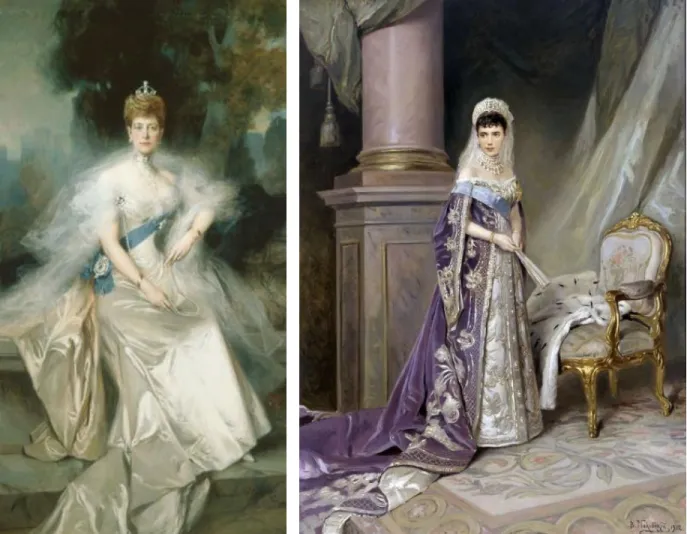
Chart of Russian Court Gown Colour Combinations and Ranks Figure 7.1
Ėrmitazh Gosudarstvennyĭ and Tamara Timofeevna Korshunova, The Art of Costume in Russia, 18th to Early 20th Century, The Hermitage (Leningrad: Aurora Art Publishers, 1983), 21. Aleshina, Russian Elegance: Country and City Fashion from the 15th to the Early 20th century (London: Vivays Publishing. Tamara Timofeevna Korshunova, Russian Style Court and Country Dress from the Hermitage (London, Great Britain: Barbican Art Gallery, 1987), 34.
Tally of Russian Court Gown Colour Combination and Associated Rank Figure 7.2
Russian Female Courtier Positions and German Equivalents
Russian Female Courtier Accessories Figure 7.4
Similar Russian Court Gowns
The modesty of The Met's crimson dress is emphasized in comparison with the girl's dress (ЭРТ-13137), which is kept in the State Hermitage Museum in St. dress. The dress is a crimson velvet, maybe a shade or two deeper than The Met dress, has a ruffle of tulle along the neckline, has larger gold embroidery and metallic threads, with a similar wheat or fauna pattern, has the same gold spherical buttons and bodice button panel .
The SHM also has a court dress by Marie Feodorovna from the 1880s (ЭРТ-8657), which is thirty years older than the gowns of The Met. The dress also features bulbous gold buttons and a button panel, as well as a lace ruffle around the neckline, similar, but larger, than the SHM maid of honor. Marie Feodorovna's dress features significantly larger embroidery on all garments, with a four- or five-leaf flora, present throughout, as well as a repeated scalloped embroidery design.
What is striking when analyzing this dress is that its general date can be narrowed down by examining the timeline of Romanov events. For example, events such as the death of her mother-in-law, which allowed Marie Feodorovna to wear a longer train. Because the court season took place in the winter months, it is possible that Marie wore this dress as a sign of loyalty to her mother-in-law in the winter of 1880.
What is interesting, is that if this dress was worn in the winter of 1880, the train is 10 feet long, which is a foot above the Imperial family's designation, but four feet short of the Empress's train. It is unlikely that little Marie Fedorovna would choose to carry more weight than she should. Thus, if this dress was worn as a tribute to Marie Feodorovna's superior, she was also asserting herself as a superior member of the Imperial family.
It would require detailed research to specify what the length of the train and the color of Marie Fedorovna's dress meant for a maid of honor. Using Google Translate, it was discovered that the dress belonged to Zoya de Stekl and was donated to the Russian museum in 2014 by the de Stekl's. This dress has more embroidery than the Met's, which would make sense considering it was eventually worn in St. Louis.

Emily Roebling: A Woman of Two Courts
The yellow color does not correspond to the common practice of debutantes wearing white to be presented at the English court, but since Roebling was a married woman in her early fifties, the muted pastel shade would have been appropriate. The train, which attaches to the back of the dress at the waist, is deep purple in color, but the decoration is not repeated on the overskirt, and thus not in Russian style despite the velvet fabric. The dress exhibits a striking richness in its embellishment choices. Furthermore, the multi-embellished designs suggest that Roebling's personal preference was an important consideration in the design of the dress.
Presentations at Court: Rules of Dress Issued by Britain's Lord Chamberlain." New York Times, April 6, 1902. Two of the world's most prominent women eschew the petticoat and all the arts of modern fashion." Evening News, June 26, 1913. The Majesty of the Czars: Ceremonial Men's Dress of the Russian Imperial Court from the Collection of the Moscow Kremlin Museums.
34;In The 'Most Uncompromising Russian Style': The Russian Repertoire at The Metropolitan Opera Revolutionary Russia 28, no. The court of the last tsar: pomp, power and pageantry in the reign of Nicholas II. 34; Challenging Boundaries in the Field of Traditional Russian Costume." The Journal of Dress History 2, no.
The Race to Save the Romanovs: The Truth Behind the Secret Plans to Save the Russian Imperial Family. High Style: Masterpieces from the Brooklyn Museum Costume Collection at the Metropolitan Museum of Art. Britain, Russia and the Road to the First World War: The Fatal Embassy of Count Aleksandr von Benckendorff.
34; Empire Dressing – The Design and Execution of Queen Alexandra's Crown Dress." Journal of Design History 25, No. 34; Imitation in Fashion: Further Reflections on the Work of Thorstein Veblen and Georg Simmel." Fashion, style and popular culture 3, no. Scenarios of Power: Myth and Ritual in the Russian Monarchy from Peter the Great to the Abdication of Nicholas II.