THE FIGHT TO RETAIN TALENT: SENIOR OFFICER RETENTION AND THE NEXT CANADIAN FORCES PERSONNEL CRISIS
Major S.R. Murphy
JCSP 38
Master of Defence Studies
Disclaimer
Opinions expressed remain those of the author and do not represent Department of National Defence or Canadian Forces policy. This paper may not be used without written permission.
© Her Majesty the Queen in Right of Canada, as represented by the Minister of National Defence, 2012
PCEMI 38
Maîtrise en études de la défense
Avertissement
Les opinons exprimées n’engagent que leurs auteurs et ne reflètent aucunement des politiques du Ministère de la Défense nationale ou des Forces canadiennes. Ce papier ne peut être reproduit sans autorisation écrite.
© Sa Majesté la Reine du Chef du Canada, représentée par le ministre de la Défense nationale, 2012.
JCSP 38 - PCEMI 38
THE FIGHT TO RETAIN TALENT: SENIOR OFFICER RETENTION AND THE NEXT CANADIAN FORCES PERSONNEL CRISIS
By Major S.R. Murphy This paper was written by a student
attending the Canadian Forces College in fulfilment of one of the requirements of the Course of Studies. The paper is a scholastic document, and thus contains facts and opinions, which the author alone considered appropriate and correct for the subject. It does not necessarily reflect the policy or the opinion of any agency, including the Government of Canada and the Canadian Department of National Defence. This paper may not be released, quoted or copied, except with the express permission of the Canadian Department of National Defence.
Word Count: 17 783
La présente étude a été rédigée par un stagiaire du Collège des Forces
canadiennes pour satisfaire à l'une des exigences du cours. L'étude est un document qui se rapporte au cours et contient donc des faits et des opinions que seul l'auteur considère appropriés et convenables au sujet. Elle ne reflète pas nécessairement la politique ou l'opinion d'un organisme quelconque, y compris le gouvernement du Canada et le ministère de la Défense nationale du Canada. Il est défendu de diffuser, de citer ou de reproduire cette étude sans la
permission expresse du ministère de la Défense nationale.
Compte de mots:
TABLE OF CONTENTS
TABLE OF CONTENTS……….i
LIST OF FIGURES……….ii
ACKNOWLEDGEMENTS………iii
ABSTRACT………...iv
INTRODUCTION………...1
CHAPTER 1 – UNDERSTANDING THE ENVIRONMENT………...9
External Demographics Affecting Retention………...9
Canadian Forces Senior Officer Demographics………13
Societal Pulls and Factors Affecting Retention……….21
CHAPTER 2 – AN EXAMINATION OF THE CANADIAN FORCES MILITARY PERSONNEL RETENTION STRATEGY………...28
The CF Retention Strategy and Retention Culture………29
Organizational Commitment and the CF………...34
Measuring Effectiveness through CF Members’ Feedback………...37
CHAPTER 3 – LESSONS IN RETENTION………43
Officer Retention and the US Army………..44
The Australian Defence Forces Experience………...49
Retention Incentives and Civilian Corporations………54
Career Management in Civilian Corporations………...56
CHAPTER 4 – CHALLENGES IN STRATEGY IMPLEMENTATION………61
Fiscal Realities………...61
CF Culture and the Profession of Arms……….65
The Career Management Challenge………...67
CHAPTER 5 – RECOMMENDATIONS FOR STRATEGY REFINEMENT………….71
CONCLUSION………..78
BIBLIOGRAPHY………..83
LIST OF FIGURES
Figure 1.1 - Steady-State Population Profile and Current Population
Profile 2007/2008………...14
Figure 1.2 – Distribution of the Population of the Regular Force……….15
Figure 1.3 – Officer Population Profile by YOS and Rank as of 31 March 2009……….16
Figure 1.4 – Officer Attrition Rates by YOS……….17
Figure 1.5 – CF Officer Stress Levels in Comparison to Civilian Managers………26
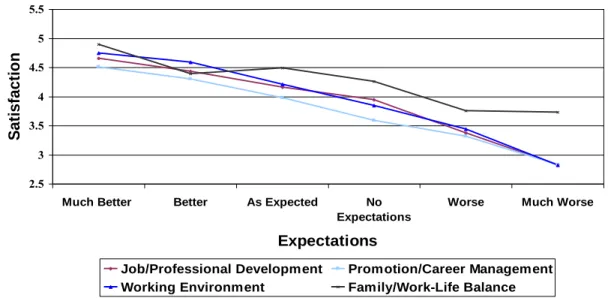
Figure 2.1 – CF Exit Survey Results – Expectations……….39
Figure 3.1 – Rankings over Time 2008 Top Reasons for Leaving the ADF……….50
ACKNOWLEDGEMENTS
I would like to thank Dr. Alan Okros of the Canadian Forces College for his provision of guidance, advice and assistance in drafting this paper. Most importantly, I would like to thank my wife, Bronwyn, for her unwavering support.
ABSTRACT
The future labour market will be a competitive one wherein demand for educated, experienced and talented leaders will exceed supply. A confluence of external factors will create this demand for talent while at the same time, a host of internal issues
afflicting the CF risks causing its educated, experienced and talented leaders, specifically the senior officer cohort, to consider other employment options, potentially leaving the CF with an institutional leadership deficiency. There is the likelihood that there will be a fight to retain talent for which the CF is arguably, unprepared.
Civilian organizations across the world and foreign militaries alike are recognizing and in some cases already experiencing retention challenges, more
specifically, challenges in retaining talent. Accordingly, they are working diligently to better comprehend both the nature of the challenge and the expectations of their members with a view to modifying and adapting their current retention strategies. Efforts to retain talent are becoming a core aspect of modern business operations strategy.
The CF however is seemingly somewhat of a laggard in this respect. Its Military Personnel Retention Strategy is broad-based, sourced with shallow data, and is
consequentially rendered ineffective in targeting the senior officer cohort in the fight to retain talent. For this critical reason, it is essential for the CF to refine its current retention strategy, such that it becomes better able to deliver targeted effects and such that it becomes better equipped to meet the employment expectations of its members.
This paper examines these issues in greater detail, revealing retention related areas of dissatisfaction of CF members, strategies being pursued by other organizations as well as challenges in implementing a more targeted strategy to address senior officer retention.
INTRODUCTION
As talent becomes more elusive it will be increasingly tough to keep great people.
Employers must get single minded about putting in place a strategic and integrated plan 1
Dr. Paul Davis
The Canadian Forces (CF) competes with a diverse range of civilian sector organizations and other governmental departments to attract new waves of the nation’s best and brightest. These people are described in multiple defence departmental
statements and publications as being, the CF’s most precious resource and in the words of former Chief of Military Personnel, Major-General Semianiw, “the most valuable
component of national defence.”2 Accordingly, it is logical to assume that a key cohort of military personnel of great value to the CF is the nation’s best, brightest and
experienced leaders, those who sit on the cusp of assuming senior leadership roles, those who will lead the forces, its people, policies and actions into and beyond the Defence 2020 and Canada First Defence strategies.
As the future domestic and global security environment may be best, yet understatedly described as complex, the importance of solid institutional and senior leadership within the CF and the implied requirement to retain our top leaders cannot be understated. Surging growth rates in the third world, economic imbalance and global
1 Dr John Davis, "How to Retain Talented Employees?" International Quality & Productivity Center, http://www.iqpc.com/redcontent.aspx?id=66038 (accessed 20/02/2012).
2 Standing Committee on National Defence, Recruitment and Retetion in the Canadian Forces (Public Works and Government Services, Ottawa: Speaker of the House of Commons,[March 2010, 40th Parliament, 3rd Session]),
http://www.parl.gc.ca/content/hoc/Committee/403/NDDN/Reports/RP4393616/403_NDDN_Rpt02/403_N DDN_Rpt02-e.pdf (accessed 11/01/2012), 1.
resource disparity will continue to produce intra-state and intra-regional conflict. Failed and failing states will also continue to breed insurgencies and transnational criminal activities, all of which pose a legitimate threat to Canadian ideals. Consequently, the CF will require not only leaders but rather, the best leaders that exist within the senior officer cadre, those who possess the highly sought after balance of knowledge, common sense and applied leadership, to ensure the CF and its soldiers are able to meet the demanding challenges that lie ahead. Moreover, talented senior officers employed in leadership positions at all levels and those employed as staff officers at the strategic and operational levels will continue to remain an indispensable asset well into the future.3
In a competitive labour market, the CF recognizes the demands posed by the future security environment and consequently expends great effort in developing, analyzing and monitoring recruitment strategies to ensure that it has the number of soldiers necessary to meet anticipated political and military strategic goals. It can be assessed that the CF works diligently, within the confines of an already over-stretched personnel budget, to ensure that the CF is an attractive career option for aspiring
members. The Canada First Defence Strategy (CFDS) highlights recruitment as being a priority for the CF, stressing the requirement to recruit, “the best and the brightest that
3“The strategic level is the level of conflict at which a nation, or group of nations, determines national or alliance security aims and objectives and develops and uses national resources to attain them. This is the level that establishes corresponding military strategic objectives, defines limits and assesses risk pertaining to the concerted use of all instruments of national power.” “The operational level is the level at which campaigns are planned, conducted, and sustained to achieve military strategic objectives within an area of responsibility (AOR). Plans and direction at this level link tactics with military strategy by establishing joint operational-level objectives that are necessary to achieve strategic-level objectives.” Directly cited from: Department of National Defence, Canadian Forces Joint Publication 3-0, Operations (Ottawa, Department of National Defence, 2010), 1-2.
Canadian communities have to offer.” 4 In fact, until intake targets were recently met, the past several years have seen a focus on, “aggressively recruit[ing] people from across the country.” 5 One must question however if the CF has placed an equal degree of emphasis on retention or whether there is simply a naïve assumption, or almost an arrogant notion, that the CF will always be able to retain the best leaders and senior staff officers possible.
Unfortunately for the CF, it does not and will not exist within a skilled-labour employment vacuum. Skill-sets possessed by senior officers such as applied leadership, project management, analytical thinking, bilingualism and post-graduate education, are critical in leading the CF through its future challenges. It is assessed that these same skill-sets are also of great value to the CF’s employment competitors, competitors who recognize, implement and remain adaptive to strategies and concepts focused on increasingly important employment issues such as work-life balance and stability and who are equally prepared to negotiate terms of reference with prospective leaders.
Consequently, an undeniable requirement can be derived for the CF to ensure it acts both pragmatically and proactively to ensure strategies and tools are implemented to retain this specific cohort. For an institution whose retention strategy broadly states that it will foster a culture of retention and commitment, placing an emphasis on,
“recognition, fairness, consideration and respect for members and their families”, one must ask if the CF’s retention strategy is adequately targeted towards the senior officer
4 Department of National Defence, Canada First Defence Strategy (Minister of National Defence, [June 2008]), 16.
5 Patricia Bell, "Top General Promotes Recruitment Drive" The Ottawa Citizen, sec. National News, 24 August 2009 , http://www.cbc.ca/news/canada/story/2009/08/24/natynczyk-arctic-recruit.html (accessed 27/03/2012).
cohort to actually be effective.6 Are the CF’s personnel policies and initiatives sufficiently focused to address what could be a critical retention issue? Moreover, is there even a requirement to do so?
Understanding national and labour market demographics and their impact on the CF is of great importance in retention strategy development. For instance, within the next 10 years, approximately 25-30% of labourers will be over the age of 55, potentially looking to retire.7 This stands to produce that which the Canadian Conference Board refers to as a, “mass exodus of baby boomers” from the Canadian labour market, which stands to create leadership voids within other governmental organizations and private sector corporations across the country. 8 Accordingly, one could argue that these same organizations will be actively recruiting executives with applied leadership experience and a strong work-ethic. It is rational to deduce that some senior officers could be susceptible to this societal pull, which begs the question as to whether or not the CF’s retention strategy can guard against it.
In order to frame the issue, it is also important for one to understand the overall profile of the CF officer demographic. Research presented in this paper will show that military officers are experiencing high levels of job stress and unmatched levels of operational tempo, all the while conceivably struggling to achieve the elusive yet desirable concept of work-life balance. Does the CF retention strategy adequately
6 Military Personnel Retention Strategy, 5000-1 (CMP), (19 July 2009), A-1/1.
7 "Study: Projected Trends to 2031 for the Canadian Labour Force," Statistics Canada, the Daily, http://www.statcan.gc.ca/daily-quotidien/110817/dq110817b-eng.htm (accessed 11/01/2012).
8 Conference Board of Canada, Canadian Outlook Long-Term Economic Forecast: 2010, [March 2010], http://www.conferenceboard.ca/e-Library/abstract.aspx?did=3503 (accessed 11/01/2012).
address these issues? Furthermore, there is already a precious ‘middle ground’ of experienced officers, those who currently have between 15 and 19 years of service and are the talent pool from which the next CF senior leaders will emerge. This group of officers, arguably the same group that are experiencing high operational tempo, is fewer in numbers than the cohort it follows, and may potentially be attracted to outside
employment opportunities, jobs offering wage parity or greater and jobs that provide better levels of stability and work-life balance. Is this a catalyst for the CF to develop a targeted retention strategy aimed at senior officers?
Undeniably, the issues raised are some of the pressures that result from choosing to serve in the CF and undeniably, the profession of arms is distinct from other
professions. For all members of the CF, the concepts of ‘service before self’ and ‘service to country’ imply a level of self-sacrifice that impose upon certain niceties and benefits enjoyed by other professions, to include family stability, pay bonuses and flexible work hours. However, it is commitment and devotion to service espoused by our senior
officers that drives them forward and enables them to look past these tangible benefits; or is it? Is the CF mistakenly relying on the concept of loyalty as a strategy to retain senior officers, those who are set to assume senior leadership responsibilities within the next ten years? Current CF personnel management reports seem to indicate that there will be a sufficient number of officers to fill attritional voids and to assume leadership roles well into the future; however, it can be suggested that this analysis falls short.9 It is not
9 Department of National Defence, Canadian Forces Personnel Management Report FY 2010/2011 Four Quarter Report (Chief of Military Personnel, [31 March 2011]), Accessed via Defence Wide Area Network: http://cmp-cpm.forces.mil.ca/dgmp/dmpsc/engraph/cf_pers_mgt_report_e.asp (accessed 28/01/2012).
merely the question of whether or not there will be a sufficient number of senior officers retained that is at issue but rather it is the retention of talent that needs to be examined.
After all, the CF has stated that it wants the best. Does the CF’s retention strategy account for retaining talent?
This paper submits that the CF is not aggressive enough in its retention strategy.
This is especially concerning at the senior officer rank levels of Major (Maj) and
Lieutenant-Colonel (LCol), wherein internal promotion criteria are creating a product that meets an external demand. Moreover, the compounding strength of societal pull factors and the lack of attention to addressing CF members’ expectations risk losing the talent, that is to say the commanders and staff officers, that will be required for the CF to succeed in the future, in what will be a competitive talent-oriented, managerial level labour market. Consequently, the CF must refine its retention strategy such that it allows for targeted initiatives to positively influence senior officer retention.
In examining this position, the first section of this paper will aim to understand national demographics and the environment the CF will have to contend with in the next decade. The Canadian demographic profile will be sketched out, illustrating an exodus of baby-boomers from the workforce and the creation of a competitive, talent-oriented labour market. The CF officer demographic profile will also be explored to determine if there is a justified cause for concern over senior officer retention. The final portion of this section will examine the people behind the numbers, discussing factors affecting career choices and how the emergence of new values, representative of Canadian society at large, drive the requirement for adaptation and whether or not the CF’s retention strategy is effectively responsive.
The second chapter of this paper will provide an overview of the current CF retention strategy. Its principles will be explored along with the retention culture that exists within the CF, relating them to foundational concepts of organizational
commitment and behaviour. Important to note is that the CF retention strategy outlines four specific types of attrition, and this paper will focus solely on attrition that is deemed to be voluntary and avoidable.10 This chapter will also examine the effectiveness of the CF retention strategy through feedback obtained from CF members and correlate key themes of dissatisfaction with factors proposed in Chapter One as being influential to career choices and societal pulls.
The third chapter of this paper will explore lessons in retention from other organizations, chiefly foreign militaries and businesses from the civilian sector, in order to determine their applicability to the CF. Chapter Four will explore assessed challenges that the CF faces in developing and implementing its retention strategy. Fiscal
constraints, military culture, the distinctiveness of the military profession and challenges in career management will be discussed as factors potentially limiting flexibility in strategy development. Finally, the last chapter of this paper will propose concepts for the way-ahead, suggesting areas of potential refinement to ensure the CF retains its best senior officers.
The importance of retaining talent should be of critical concern to the CF. The complexities of the future security environment demand nothing short of the best leaders
10 Department of National Defence, The Canadian Forces Retention Intervention Process (Chief of Military Personnel, [14 July 2004]), http://www.cmp-cpm.forces.gc.ca/pd/pi-ip/08-03-eng.asp (accessed 13/01/2012).
the CF has to offer. The military cannot afford to lose senior officers in what will be competitive talent-oriented labour market.
CHAPTER ONE – UNDERSTANDING THE ENVIRONMENT
Building a new social contract that fits today's economy also requires that we recognize the seismic shifts in both families and the workforce that have taken place since our basic
employment policies and institutions were put in place. Most policies and institutions were designed to serve the 20th century's industrial economy and a workforce dominated
by a male breadwinner with a wife at home taking care of family and community responsibilities. 11
Thomas Kochan
In order to understand the nature of the retention challenge the CF could face in the upcoming decade and the importance of developing a retention strategy targeting senior officers, it is necessary for one to comprehend the climate that exists, both internal and external to the CF. Accordingly, this chapter will discuss national demographics, illustrating a void that will be left within the managerial and executive level strata of private sector organizations and other governmental departments by baby-boomer retirement. Further, CF demographics will be examined, illustrating an already
precarious manning situation as a result of previous personnel management decisions that has resulted in a diminished pool of senior officers. Lastly, this chapter will present factors for consideration in career and life decisions of CF members, factors that must not be ignored in the fight to retain talent within the CF upper echelons.
External Demographics Affecting Retention
The baby-boomer cohort is arguably the largest driving factor that will affect the national labour market within the upcoming decade. This influential group, born between 1946 and 1965, will be retiring from the workforce in large numbers during the upcoming
11 Thomas Kochan and Debbie Shulman, A New Social Contract: Restoring Dignity and Balance to the Workplace (Washington, DC: Economic Policy Institute, [22 February 2007]), 7.
decade.12 With CIBC economists noting the national average age of retirement as 62, the oldest of the baby-boomers will be turning 66 this year, indicating that Canada is on the front end of a massive retirement wave.13
Conservative estimates presently indicate that 25% of the Canadian labour market consists of people aged 55 and over. Statistics Canada however notes that in 2011, a staggering 31% of national labourers were in fact over the age of 55.14 It is also essential for one to understand that within the next decade, the number of seniors in terms of a percentage of the overall population will increase steadily towards 20%.15 There are two important deductions that can be drawn from these statistics. Firstly, the overall growth rate of the labour force will decrease sharply within the span of the next decade, seeing the current annual labour force growth rate of 1.5% drop to a forecasted low of 0.2% for a five-year period.16 This indicates that there will be fewer people entering the job market as new labourers, yet no change to the number of employment positions that will potentially need to be filled. If this holds true, demand could exceed supply creating plenty of job opportunities for those who are dissatisfied in their current line of work.
12 Statistics Canada, "Census Snapshot of Canada - Population (Age and Sex)," Canadian Social Trends catalogue no. 11-008, http://www.statcan.gc.ca/pub/11-008-x/2007006/article/10379-eng.pdf (accessed 13/01/2012).
13 Emanuella Enenajor, "Solving Canada's Participation Rate Puzzle," Economic Insights CIBC World Markets Inc (22 December 2011), 1.
14 Diana Wyman, "Recent Trends in Canada's Labour Force Participation Rate," Canadian Economic Observer December 2011, http://www.statcan.gc.ca/pub/11-010-x/2011012/part-partie3-eng.htm (accessed 11/01/2012), Chart 3.7.
15 Christopher Ragan, "Two Policy Challenges Driven by Population Aging," Policy Options October 2010, http://www.irpp.org/po/archive/oct10/ragan.pdf (accessed 12/01/2012), 73.
16 Martel Laurent, Eric Caron-Melenfant, et al, "Projected Trends to 2031 for the Canadian Labour Force," Canadian Economic Observer August 2011, http://www.statcan.gc.ca/pub/11-010-x/2011008/part- partie3-eng.htm (accessed 13/01/2012).
Secondly and perhaps more importantly for the purposes of this paper, the departure of baby-boomers will create vacancies to be filled within the senior ranks of organizations across the country by a significantly smaller, “baby-bust cohort”, indicating that demand for educated, experienced leaders could also potentially exceed supply.17 These points are well recognized within the private sector. In 2010, the Canadian national publication, Human Resources Management Guide, conducted a survey of over 160 top human resource leaders across the country and the results were telling. Listed as being among the greatest perceived challenges facing organizations today are the
requirement for coherent retention strategies and the need for, “building leadership capacity.”18 In a separate survey of senior executives from multiple Fortune 1000 companies, including Canadian firms, studies indicate that increasing an organization’s competiveness by way of implementing a talent management process as part of a viable business strategy is a top priority.19 As such, it is assessed that the CF will also need a retention strategy that guards against a competitive pull from outside organizations that looks to potentially draw away senior officers to fill leadership vacancies.
The fact that labourers and the population in general are aging cannot be refuted;
what can be argued however is the level of impact it will have on the labour market.
Firstly, it can be argued that a mass retirement of baby-boomers is unlikely as many within this cohort are choosing to work longer, either out of economic necessity or personal desire. Research from Statistics Canada illustrates that there is a growing trend
17 Statistics Canada, Census Snapshot of Canada - Population (Age and Sex).
18 Alan Price, "Ongoing Competion for Talent," Human Resources Management Guide, http://www.hrmguide.net/canada/jobmarket/employment-weaknesses.htm (accessed 13/01/2012).
19 Ibid.
of Canadian seniors working past the age of 65.20 Secondly, the future labour market shortage fails to account for the intake of talent from a growing immigration population.
As the province of Ontario’s economic strategy notes, immigration is a key factor in ensuring positive growth in the labour force and baby-boomer retirement can be off-set by establishing policies that recognize foreign credentials.21 Based on these arguments, the competitive pull perceived on the senior officer cohort is certainly diminished.
Although these arguments certainly offer mitigation strategies to deal with a massive drain in the labour force, to view them as a comprehensive strategy to
completely clot the future bleeding of people from the labour force is irrational. A 2007 International Public Management Association sponsored study of over 350 public management professionals found that even with such mitigation strategies, over 50% of respondents felt that there was insufficient talent within their organizations to fill gaps left by retiring baby-boomers.22 Further studies conducted by the Canadian Labour and Business Centre found that 57% of public sector managers and approximately 50% of and private sector managers consider critical skill shortages in the future to be a, “serious problem.”23 Additionally, 2007 research conducted by Human Resources and Skills Development Canada (HRSDC) concluded that the senior management domain within
20 Statistics Canada, “Still Working After Retirement” Canadian Year Book 2008, http://www41.statcan.gc.ca/2008/70000/ceb70000_001-eng.htm (accessed 31/03/2012).
21 Ministry of Finance, “Ontario’s Long-Term Report on the Economy” (Province of Ontario:
2010), 13.
22 Glenn Davidson, Stan Lepeak, Elizabeth Newman, “The Impact of the Aging Workforce on Public Sector Organizations and Mission”, (International Public Management Association for Human Resources: February 2007), 11.
23 Canadian Labour and Business Centre, Viewpoints 2002 The Perspectives of Business, Labour and Public Sector Leaders, Skills and Skill Shortages (Canadian Labour and Business Centre, [August 2002]), 10.
the business, finance and administration fields would, “face shortage pressures over the next ten years.”24 This provides ample evidence to suggest that there will be significant talent-oriented, executive level employment competition within the next decade.
From a CF perspective, these statistics ought to be of significant concern as they indicate the future existence of an environment wherein senior officers, highly educated and possessing an abundance of applied leadership experience, will be in demand to fill vacant private and public sector management positions. Interestingly, it is the CF’s own professional military education system for senior officers that assists in building a product that meets external demands, a concept that will be discussed in following portions of this paper. This challenge, looming on the CF human resource management horizon, is compounded by several additional factors that also warrant investigation.
Canadian Forces Senior Officer Demographics
The leadership and senior officer talent deficiency that the CF may experience will not solely be the result of a private sector pull on CF personnel. As this section of the paper will illustrate, there are compounding issues within the military human resources management realm that will exacerbate the situation.
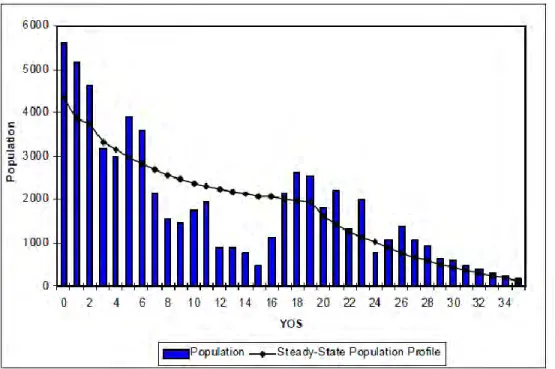
The CF personnel profile with regard to force strength and years of service is depicted in Figure 1.1. Although data is representative of 2007 and is inclusive of all ranks, it serves to identify trends in the overall CF demographic. Firstly, the greatest
24 Human Resource and Skills Development Canada, “Looking Ahead: A 10-Year Outlook on the Canadian Labour Market: Current and Future Labour Market Shortages in Canada”,
http://www.hrsdc.gc.ca/eng/publications_resources/research/categories/labour_market_e/sp_615_10_06/sh ortages.shtml (accessed 28/03/2012).
percentages of CF personnel exist within two brackets: those with less than six years of service and those who now have greater than 22 years of service (YOS).
Figure 1.1 - Steady-State Population Profile and Current Population Profile, 2007/2008 Source: Review of Attrition and Retention Research for the Canadian Forces25
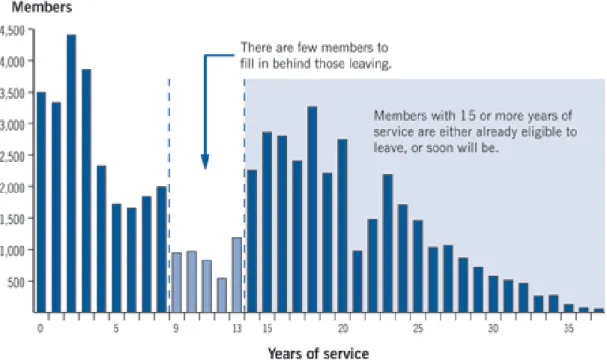
One of the key drivers of this outcome was the Force Reduction Plan (FRP) that was introduced in the 1990s to intentionally reduce force strength.26 It sent attrition rates surging from 6% to 12% in the senior officer and non-commissioned officer corps and
25 Nancy Otis and Michelle Straver, Review of Attrition and Retention Research for the Canadian Forces (Department of National Defence, [October 2008]), 40.
26 The CF FRP was designed to intentionally reduce force strength in occupations that were deemed to be over-strength based on estimated needs for force strength after directed downsizing from 85 000 to 60 000 service personnel. Members of specific trades and rank levels were offered enticing packages to release from the CF. Approximately 14000 members released under the FRP. (Department of National Defence, Recruiting and Retention in the Canadian Forces, http://news.gc.ca/web/article- eng.do?m=/index&nid=448289 , [accessed 29/03/2012]).
drastically reduced recruiting inflow.27 The long term outcome of the FRP was the creation of an unequal distribution of personnel, as depicted in Figure 1.2. As these numbers are based off of 2006 data, one must note that this unequal distribution of
personnel has now shifted to the right and comprises those personnel who now have 15 to 19 YOS.
Figure 1.2 – Distribution of the Population of the Regular Force Source: May 2006 Status Report of the Auditor General of Canada28
More current officer specific data outlined within the CF’s Annual Report on Regular Force Personnel highlights these same points and specifically identifies a
27 Christopher Ankersen, "The Personnel Crisis," in Canada without Armed Forces?, ed. Douglas Bland (Kingston, Ontario: Queens University School of Political Studies, 2003), 55-82, 68.
28 Office of the Auditor General of Canada, Status Report of the Auditor General of Canada:
Chapter 2 - National Defence - Military Recruiting and Retention (Office of the Auditor General of Canada, [May 2006]), 54.
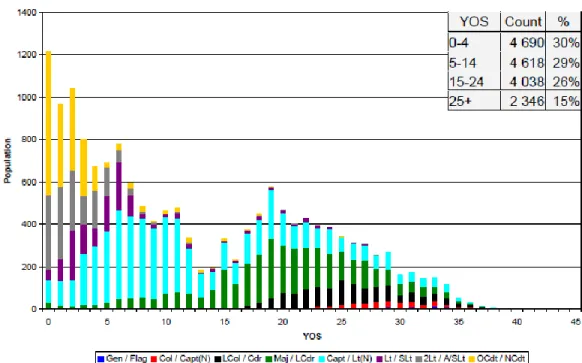
deficiency of officers that are following the current CF senior leaders. While comparing preferred manning levels of officers to actual trained effective strength, the CF has 13%
less officers than required to fill positions.29 Supporting previously mentioned CF demographic trends, Figure 1.3 depicts an unequal distribution of officers serving between what would now once again be the 15 to 19 YOS mark.
Figure 1.3 – Officer Population Profile by YOS and Rank as of 31 March 2009 Source: Canadian Forces Annual Report on Regular Force Personnel 2008/200930
It is critical to understand two important tie-ins to the deficiency that exists within the officer population profile. Firstly, the segment of the officer population profile that is under-strength is the same cohort on which the CF relies to complete the largest portion of its staff work; from this perspective, it is assessed as the true horsepower that enables
29 Department of National Defence, Annual Report on Regular Force Personnel 2008-2009, ed.
Director General Military Personnel Research and Analysis, (February 2010), 42.
30 Ibid., 6.
the institution to function. Secondly, and perhaps more importantly, the CF cannot recruit or easily replace the experience held by this group; building a senior officer with the proper balance of knowledge and experience is a process that requires a great deal of investment and time. From a retention perspective, this gives cause for the CF to ensure it builds an effective retention strategy for its future senior leaders, especially due to the increased societal pull factors which will become a more prevalent factor in the future.
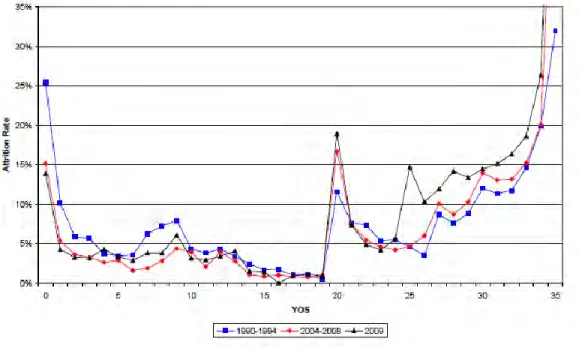
On top of this, CF officer attrition, albeit slowly, is growing. During the period 2009-2010, the officer attrition rate grew to 7%, a rate that is only expected to decrease slightly over the next several years.31 What is concerning, yet not unsurprising, are the spikes in officer attrition rates at the 20 and 25 YOS points. As depicted in Figure 1.4, attrition rates at the 20 YOS mark are approximately 20%. Superimposed on the baby-
Figure 1.4 – Officer Attrition Rates by YOS
Source: Canadian Forces Annual Report on Regular Force Personnel 2008/200932
31 Ibid., 42.
32 Ibid., 30.
boomer retirement timeline, these high attrition rates at the 20 and 25 YOS points, what effectively amounts to career continuation decision points for CF senior officers, will be occurring at relatively the same time.
Additional studies conducted by Defence Research and Development Canada (DRDC) support these findings, noting that the historical attrition rate at the 20 years of service mark is approximately 15%.33 Although lacking any substantive evidence, DRDC researchers also suggest that attrition rates could be expected to be greater among those with higher levels of education.34 As will be discussed later, this presents an interesting paradox in demanding that our senior officer corps obtain greater and greater levels of education, deemed as being necessary for career progression.
Thus, to summarize what should be a situation of concern: firstly, a large percentage of the CF, including the bulk of its current senior officers, will be retiring in the upcoming decade; secondly, the follow-on group, those to whom present day institutional leaders will pass the torch, is under-strength as a result of previous human resource management policy decisions; and lastly, external demand and competition for this same cohort will be high. These statistics and trends paint a picture of too high a rate of attrition in an already under-strength cohort, a key strategic challenge noted by the CF Chief of Military Personnel (CMP) to which the CF must respond.35 If the CF does not have effective retention tools in place, the organization risks losing its senior officers to the competition.
33 Otis and Straver, Review of Attrition and Retention Research for the Canadian Forces, 30.
34 Ibid., 23.
35 Department of National Defence, The Fight of Today: Military Personnel Planning and Management Document FY 2009/2010 (Chief of Military Personnel, March 2009), 1.
Another interesting perspective from which senior officer retention can be assessed lies in an examination of the nature of work being done by senior officers.
Statistics reveal that within the Army, almost 70% of LCols are employed in some sort of staff capacity versus approximately 15% employed in a command capacity.36 As
previously noted, the horsepower that is provided by officers working within a staff officer capacity is vital to the CF’s functioning and therefore needs to be assessed as talent. Supporting this point, the Senate Standing Committee on National Defence noted the importance of the senior staff officer, citing the need for, “experienced . . . mid-level officers . . . who can take on complex staff issues from planning to project
management.”37 The deduction to be made is that a CF senior officer retention strategy cannot be command specific, but rather it must target both commanders and senior staff officers.
An argument can be made that supports the bleed of a certain percentage of the senior officer cohort from the CF, be it natural or otherwise, in that the organization is not short officers but rather improperly structured. As a result, preferred manning levels are representative of a force structure that is not optimally designed to function effectively.
As noted in Lieutenant-General (LGen) Leslie’s Transformation Report 2011, the ‘tail’ of the CF, that is to say personnel working in headquarters and staff positions (a large percentage of which are senior officers), grew 40% from 2004 to 2010.38 One of the
36 Department of National Defence, Army LCols Career Manager Briefing, 31 January 2012.
Percentages are representative of Combat Arms, Engineer and EME officers.
37 Senate Standing Committee on National Security and Defence, Four Generals and an Admiral:
A View from the Top, Government of Canada, 12.
38 Department of National Defence, Report on Transformation 2011 (Department of National Defence, [6 July 2011]), xi.
report’s key recommendations is the reduction in numbers of such personnel and the elimination of redundant staff positions at operational and strategic levels.39 A reduction in the senior officer cohort is therefore required out of fiscal necessity and organizational structure, ultimately indicating that there is no senior officer shortage, but rather PML levels are inflated. Additionally, when senior officer manning levels are examined in greater detail, with the exception of some stressed trades, it can be rationalized that there are no immediate forecasted personnel problems. For example, total effective strength of infantry, armour and artillery officers are all within 3% of PMLs, with an expectation that all army officer trades will be in a, “healthy state by 2014”.40
The fallout of this argument however is that promotion rates are decreasing and in some cases stagnant. The promotion forecast to the rank of Colonel in 2012 for Army LCols is 0-3%, meaning that nine of 240 eligible LCols will be promoted, and for some trades, notably the Artillery, there are no promotions forecasted to the rank of Colonel.41 The net result is a highly competitive internal environment with a low probability for advancement. Consequently, the talent that is relied upon to provide the horsepower for the organization to function effectively is left with a disincentive for performance and for remaining with the CF. It is in such circumstances that the influence of societal pull factors and the increased marketable skills of the senior officer cohort, such as increased education levels and bilingualism, will have the greatest impact on talented senior
39 Leslie, xii, 23.
40 Department of National Defence, Army LCols Career Manager Briefing.
41 Department of National Defence, Army LCols Career Manager Briefing. Eligible for promotion includes only those LCols who have entered the promotion zone and is not the total number of LCols in the applicable Army trades.
officers voluntarily leaving the CF. Simply stated, the CF risks losing talented members of this cohort unless there are innovative retention initiatives put in place.42 From a pure numbers perspective, there may not be cause for alarm as a steady rate of attrition is a good thing; however from a talent perspective, a possible outcome is that top performers will be the ones pulled to outside organizations while the CF is left with the middle of the pack, those who don’t have the skill-sets and applied leadership experienced that will be in demand. This is certainly contradictory to the CF’s stated desire to retain, “highly trained and experienced” personnel.43
The implications of the internal demographic trends and statistics provided thus far are not necessarily lost on current CF leadership. As noted in the CF’s retention strategy, the “distortion in CF YOS demographics makes the retention of skilled and experienced personnel particularly important to overall capability.”44 The compounding nature of the external environment however creates all the more necessity to act. Before examining what the CF’s is doing, or failing to do, to retain talent, it is first necessary to examine factors affecting career decision-making and societal pulls.
Societal Pulls and Factors Affecting Retention
In order to understand how to retain CF senior officers, it is important for one to understand present-day societal values and factors influencing career decisions. It could be suggested that the changing nature of Canadian societal values has spawned changes
42 Cornerstone On Demand, Two Sides of the Same Coin: Using Succession Management and Career Development to Improve Talent Mobility (Cornerstone On Demand, [2010]), 6-7.
43 Department of National Defence, Military Personnel Retention Strategy, 1.
44 Ibid., 2.
in the younger and middle portions of the CF demographic, changes to which our human resources policies have not yet fully adapted. In his research spanning CF personnel issues presented in Canada Without an Armed Forces, Chris Ankersen notes that much like Canadian society in general, the newly enrolled soldier is now concerned with,
“maximizing individual welfare” and is not ready to put aside individual well-being nor personal freedoms for the greater good of an organization.45 These societal
characterizations stand in stark contrast to the very nature of military service and the notion of ‘duty before self’, a concept which the CF publication, Duty with Honour, deems to be a fundamental requirement for CF members.46
It would be naïve however to believe that only new soldiers recruited into the CF espouse these characteristics; changing societal values affect all elements of the CF demographic, including its senior officers, those of whom the CF perhaps expects to continue to serve solely out of a sense of loyalty. Changing societal values and related CF member employment expectations are compounding factors to the statistics
previously presented that demonstrate the potential outflow of talent from the CF senior leadership echelons. For this reason, it is important to understand both members’
expectations and societal norms, as they should form the foundation on which to build a retention strategy.
Firstly, the cost of living in Canada has increased steadily within the past decades, in many cases breaking the dynamic of the traditional military family, one wherein the
45 Ankersen, The Personnel Crisis, 55-82, 68.
46 Department of National Defence, A-PA-005-000/AP-001, Duty with Honour: The Profession of Arms in Canada (Kingston, ON: Canadian Forces Leadership Institute, 2009), 27.
service spouse remains at home or possesses an employment skill-set that is extremely portable. The dual-income family is the new norm within the nation, with 65% of Canadian families having both partners working outside of the home.47 The introduction of a military spouse not only working, but having a profession, necessitates geographic stability, a factor CF policy makers did not have to contend with in previous decades and one that creates great friction with the portability requirement expected of CF senior officers. Just recently, the Standing Committee on National Defence deemed this recognized juxtaposition to be, “especially problematic for CF personnel in their mid- career” and noted the absolute necessity of addressing the issue, less the CF risk losing its mid-level leadership.48 The requirement to act on this issue was deemed by the
committee to be, “imperative.”49 Interestingly, according to CMP’s retention strategy campaign plan, there has been no action yet taken to deal with this issue.50
To fully comprehend the effect of the dual-income family dynamic on CF senior officer retention, one needs to also examine education levels. Statistics from 2007 indicate that over 15% of the officer corps possessed some form of post-graduate education.51 Although current data is unavailable, post-graduate education is now considered in most unofficial internal circles to be a pre-requisite for promotion to LCol and as such, the percentage of senior officers with some form of post-graduate education
47 Statistics Canada, "Women in Canada: Economic Well being," The Daily (16 December 2010, http://www.statcan.gc.ca/daily-quotidien/101216/dq101216c-eng.htm (accessed 28/01/2012).
48 Standing Committee on National Defence, Recruitment and Retetion in the Canadian Forces, 2.
49 Ibid., 2.
50 Department of National Defence, Military Personnel Retention Strategy, A-1/1.
51 Department of National Defence, Annual Report on Regular Force Personnel 2006-2007, ed.
Director General Military Personnel Research and Analysis, (January 2008), 17-18.
is believed to be significant. Derived from this point, one can make an assumption that educated military officers will choose or have partners with a similar level of education;
the impact of which is interesting. Taking the perspective that the majority of service spouses are women (based on the large percentage of men in the CF), Statistics Canada has noted that with increasing levels of education in women, there is a growing
percentage of cases wherein the wife earns more than the husband in dual-income
families, currently measured at 30%; this statistic has climbed steadily in the past several years.52 It is not difficult to deduce that CF senior officers, approaching or having already obtained pensionable service and looking to balance two professional careers, risk being lost to external employment that provides family stability, enabling support to their respective partner’s career requirements. This poses a major retention challenge for the CF and the only recognizable tool within the CF’s retention strategy to dissuade a member from choosing to do so is the power of persuasion of one’s immediate superior.
Secondly, another important societal consideration which has changed over the years is the concept of work-life balance. No longer is the average Canadian able to fully commit his or her energy solely on achieving the expectations of an employment
organization. Additional factors such as having both parents working, caring for aging relatives and a faster paced society in general have resulted in greater work-life stress.
As can be expected, studies conducted by the Canadian National Research Network indicate that two of the most important factors influencing career decisions for Canadians
52 Statistics Canada, Women in Canada: Economic Well being. This male-centric perspective is based on the fact that females represent 16% of the overall officer corps, with even less representation in the senior officer ranks. For example, females only account for 1% of General Officers (Department of National Defence, Annual Report on Regular Force Personnel 2008-2009, edited by Director General Military Personnel Research and Analysis February 2010, A-9).
are work-life balance and job stress.53 Employers prescribing to what human resource management expert Linda Duxbury describes as being, “the dated myth of two separate worlds [work and family]” will only lead to high turnover and poor production; this is especially true in a knowledge-based economy, wherein demand exceeds supply.54 This change in thinking has essentially, “transformed the Canadian workplace” in that
employers must consider the familial impacts of their employment expectations.55 This concept is not lost on the CF as its retention strategy highlights the requirement to respect CF members’ families. Yet despite this stated position, CF Retention Survey results would lead one to believe that the CF is failing to achieve its objectives, an issue explored in detail in the following chapter. At this time, it is more relevant to understand the private sector pull that is magnified if the CF fails to address the work-life balance issue, along with the associated issue of stress. Research conducted by Statistics Canada presented in Figure 1.5 illustrates significantly higher levels of job stress and job dissatisfaction among military officers than that experienced by their civilian counterparts. Assuming that these statistics continue to hold true and that stress levels are linked to an inability to achieve a work-life balance, there is a definite risk of losing senior officers to organizations that are able to meet this important driver in career decision-making. Equally as concerning is the possibility that talented future leaders may
53 Graham Lowe, 21st Century Job Quality: Achieving what Canadians Want (Ottawa, Ontario:
Canadian Policy Research Networks, [September 2007]), 44.
54 Linda Duxbury and Chris Higgins, Work-Life Balance in the New Millenium: Where are we?
Where do we Need to Go? (Ottawa, Ontario: Canadian Policy Research Network, [October 2001]), 4.
55 Human Resources and Skills Development Canada, "The Changing Face of Canadian Workplaces," Government of Canada,
http://www.hrsdc.gc.ca/eng/labour/employment_standards/fls/resources/resource01.shtml (accessed 19/01/2012).
Figure 1.5 – CF Officer Stress Levels in Comparison to Civilian Managers
Source: Statistics Canada, Canadian Community Health Survey Cycle 1.2, 200256
make career decisions that will effectively take themselves out of the career advancement stream in hopes of achieving a better work-life balance.
In summary, already having to contend with a diminished officer cohort to follow current CF senior officers, there are multiple compounding factors that stand to drain talented leaders and staff officers from the ranks of the CF. The demand for experienced managerial level leaders outside of the military created by the retirement of the baby- boomer cohort risks pulling away senior officers who are facing increasing internal competition for promotion. Moreover, this same cohort, argued as more likely to have educated and working spouses, is also looking to establish greater stability and greater work-life balance while the institution is demanding more and more of them. In this
56 Jungwee Park, "A Profile of the Canadian Forces," Perspectives on Labour and Income 9, no. 7 (July 2008), 25.
regard, the CF must be provide provide flexibility to its members, as retention strategies that fail to account for the family dynamic will falter; as such, the retention mantra of the US military, “recruit the soldier, retain the family”, should be used a guide for CF
retention initiatives. 57
These and other issues will be examined in the following chapter as this paper moves on to explore the CF military personnel retention strategy.
57 Cindy Williams, “Paying Tomorrow’s Military” Regulation, (Massachusetts Institute of Technology [Summer 2006]), 29.
CHAPTER TWO – THE CANADIAN FORCES MILITARY PERSONNEL RETENTION STRATEGY
Rather than the traditional “one-size-fits-all” retention strategy, a targeted personalized approach will be required if you expect to have a reasonable chance to retain your top
talent.58
Dr John Sullivan
The CF refined its military personnel retention strategy in 2009, highlighting the requirement to retain experienced members in order to maintain its, “operational
capability.”59 This retention strategy guides the work being done by the CF Attrition and Retention team, a group initially formed in 2003 with a more focused purpose of
developing policy to support branches of the military experiencing attrition problems within specific trades.60 Important to note is the fact that neither the CF retention strategy nor the Attrition and Retention team have directly addressed senior officer retention.61
This chapter will provide an overview of the CF retention strategy and examine whether or not the CF is meeting its own outlined objectives. This will be done through analyzing the strategy using various organizational behaviour and psychology concepts as well as through assessing retention related feedback obtained via sanctioned departmental surveys.
58 Dr John Sullivan, "10 Predictions for 2012: The Top Trends in Talent Management and Recruiting," Talent Management, http://www.ere.net/2011/12/05/10-predictions-for-2012-the-top-trends- in-talent-management-and-recruiting/ (accessed 20/02/2012),1.
59 Department of National Defence, Military Personnel Retention Strategy, 1.
60 Department of National Defence, The Canadian Forces Retention Intervention Process, B-1.
61 Irina Goldenberg, Team Leader Attrition and Retention Team, Chief of Military Personnel.
Email correspondence with author, 18/01/2012, with permission.
The CF Retention Strategy and Retention Culture
The CF retention strategy is a strategic level document outlining several lines of operation to reduce attrition levels at both the initial career stage of CF members as well as the 20 YOS point. The chief strategic objective is to, “reduce attrition by building a retention culture and fostering greater commitment through such values as recognition, fairness, consideration and respect for members and their families.”62 Possessing six lines of operation, those deemed as being most applicable to senior officer retention include: Personnel Tempo, highlighting the need to reduce tempo and to mitigate adverse effects; Career-Family Balance, listing high tempo and the importance of stability as being chief influences in career decisions; Career Management, noting the importance of the members’ voices in the process; and finally Leadership, the line of operation
responsible for establishing cohesion and for monitoring influences affecting retention.63 To understand the CF retention strategy, it is necessary to understand the concept of retention-culture, as it is the underpinning of the strategy itself. Building a retention culture describes a process by which respect and loyalty are nurtured, creating long-term commitment to an organization. Business and organizational behaviour strategists differ on how best to attain this commitment, however most agree that it is based on
understanding the motivators of personnel, meeting their needs and being able to, “see the world through their eyes”, as described by the President of Coyne PR, a highly ranked
62 Department of National Defence, Military Personnel Retention Strategy, A-1/1.
63 Ibid., 6-8.
employer within the United States.64 In essence, a retention culture, as is the case with the CF retention strategy, aims to create a social contract between an organization and an employee, wherein the member feels a strong desire to remain with an organization based on his or her personal needs being fulfilled.65 In other research, this same concept has been referred to as a, “psychological contract”, which includes a common and shared understanding, between employer and employee, of employment expectations from each other’s perspective, which is used to positively affect commitment levels and retention.66
That which must be emphasized is that the present day social contract extends beyond the organization and a singular employee. No longer can an organization expect employee commitment based on the provision of simple needs, for example salary and basic benefits. As Thomas Kochan, professor of business management at MIT explains, organizations must be prepared to meet the more complex needs of not only employees but also the expectations of society at large; perhaps most importantly and as previously alluded to in the first chapter, organizations must also meet the needs of a member’s family. With both parents now working outside the home and other factors making life more challenging, the new social contract must, “build strong and durable families” and it must provide employees with, “the flexibility and resources to meet their dual
64 Paul Holmes, "Retention: Compensation; Job Satisfaction; Balance and Cultural Fit," The Holmes Report,http://www.holmesreport.com/opinion-info/6427/Retention-Compensation-Job- Satisfaction--Balance-and-Cultural-Fit.aspx.
65 Major Deborah Howe, Retention: 'if we Build it, they Will Stay' Building and Sustaining a Retention Culture in the Canadian Forces, [10/09/2007]), (accessed via Defence Wide Area Network 28/01/2012).
66 Abdul Mutalib Mohamad Azim and Aminah Achmad, "Work-Family Psychological Contract as a Mediator in the Relationships between Work-Family Factors and Organizational Commitment,"
International Journal of Business and Social Science, 2, no. 22 (December 2011), http://www.ijbssnet.com/journals/Vol_2_No_22_December_2011/26.pdf., 232.
obligations to be productive workers and good parents and citizens.”67 Demanding workloads, frequent postings and high levels of operational tempo imposed upon senior officers create a friction with the concept of a new social contract. The implication is that if the CF does not readily adapt to meet the changing expectations of its members, it will certainly risk losing talented senior leaders to those organizations wherein the expanded social contract is recognized as the foundation of a committed working relationship.
One could argue that the CF has recognized the importance of the social contract and is working towards striking a balance between meeting members’ expectations and the demands of the service. In fact, one of the assessed core strengths of the CF retention strategy is that it is theoretically sound, outlining multiple initiatives to be developed in support of building of a retention culture through the establishment of a social contract.
It is aiming to achieve its obligations that extend beyond the workplace in terms of controlling operational tempo and providing additional services for families.
Furthermore, what cannot be dismissed in the social contract are the obligations of the employees. As argued in A New Social Contract for the New Millennium, employees are expected to commit themselves to the mission of the organization to which they belong.68 In the case of the CF, this necessitates that, at times, members be away for extended periods of time and that they also maintain a certain degree of portability. As such, this
67 Kochan and Shulman, A New Social Contract: Restoring Dignity and Balance to the Workplace, 2.
68 Anne Osborne Kilpatrick, “A New Social Contract for the New Millennium” Public Administration and Management, 4, no 3, (Charleston, SC: 1999), 177.
creates an inevitable friction between the demands of the profession and perhaps unrealistic work-life balance expectations of members.
To refute these points, one must understand that the establishment of a social contract is truly derived from actions, not from the mere formulation of a strategy. This is where the CF’s social contract as a means of building retention encounters challenges.
The CF retention strategy deals with the issue of retention by addressing grouped measures of dissatisfaction, in response to which strategic policy is adapted. It is an approach referred to as “broad-based” retention initiative development and can be categorized as being focused on influencing a wider grouping of personnel vice a
particular sub-set.69 Such an approach can be a slow, measured and rightfully deliberate process that may or may not meet the expectations of smaller sub-sets of the overall organization and are certainly not geared towards anyone individual.
At the coalface, the CF retention strategy relies on the power of persuasion whereby immediate superiors engage their subordinates in an attempt to dissuade any request for release from the CF. Outside of personal influence, which is variable and inconsistent, there are no tangible tools provided to truly retain talent. Therefore, if a strategic policy does not meet the social contractual needs of a talented CF member, there is little that can be done to immediately affect that member’s decision to release. The CF’s broad-based approach does not readily enable the social contract to be,
“renegotiated regularly and frequently”, assessed as an element of vital of importance if a
69 David G. Allen, Retaining Talent: A Guide to Analyzing and Managing Employee Turnover (Alexandria, VA: SHRM Foundation, 2008), 14.
strategy is to be effective.70 In the case of an experienced, educated senior officer who may have a job offer from an outside organization, the current retention strategy
demonstrates a key weakness in that it lacks adaptability and responsiveness. As such, it presents itself as a strategy that is focused on retention as an issue of numbers and not one of talent, assessed as being a major shortfall. In order to retain talent, a retention strategy should be responsive to the needs of an individual or smaller sub-group of personnel. In this way, incentives and other tools utilized in retention are able to be tailored to an individual’s needs and expectations.71 The pros and cons of such a strategy will be discussed in the following chapters of this paper. Suffice it to say at this point that a targeted retention strategy focused on the senior officer cohort, particularly at the 20 and 25 YOS point is lacking.
Supporting these points, research conducted by the Directorate of Military Personnel Research Analysis (DGMPRA) indicates that, “one-size-fits-all strategies”, that have been applied in the past for personnel management issues may indeed not be successful in the future and that there is a requirement for strategic “rethinking” of approaches that should include an, “increased focus on individuals.”72 This fundamental concept is one that is continuously observed within the best practices of successful organizations across the globe. As the impact of societal factors on retention become ever more apparent, there is a growing realization that, “if an institution fails to
70 Osborne Kilpatrick, A New Social Contract for the New Millennium, 177.
71 Ibid., 24.
72 Department of National Defence, Putting People First (Chief of Military Personnel; Director General Military Personnel Research and Analysis, [27 July 2009]), Accessed via Defence Wide Area Network: http://cmp-cpm.forces.mil.ca/dgmpra-dgrapm/pub/rp-pr/index-eng.asp.