RELATIONAL ORIENTATION IN CONSUMER PURCHASE INTENTIONS:
BRICK-AND-MORTAR VS. E-COMMERCE SHOPPING ENVIRONMENTS
BERNHARD RISSE Dipl. Kaufmann (FH)
Fachhochschule der Wirtschaft, Paderborn, Germany 2002
A Research Project
submitted to the School of Graduate Studies of the University of Lethbridge
in partial Fulfillment of the Requirements for the Degree
MASTER OF SCIENCE IN MANAGEMENT
Faculty of Management The University of Lethbridge LETHBRIDGE, ALBERTA, CANADA
© Bernhard Risse, 2003
RELATIONAL ORIENTATION IN CONSUMER PURCHASE INTENTIONS:
BRICK-AND-MORTAR VS. E-COMMERCE SHOPPING ENVIRONMENTS
BERNHARD RISSE
Approved:
__________________________________________ ______________________
Supervisor: Michael Basil, Ph.D. Date
__________________________________________ ______________________
Co-supervisor: Jay Handelman, Ph.D. Date
__________________________________________ ______________________
External Examiner: Krystyna Aune, Ph.D. Date
University of Hawaii at Manoa, Honolulu
__________________________________________ ______________________
Chairperson: Robert Loo, Ph.D. Date
Without dreams
where would our goals come from?
And just where would we be now
if we didn't have a dream that got us here?
With this in mind, this is dedicated to my parents for giving me the opportunity to realize
my dreams, and to all my family for their love and support
iii
Abstract
Building lasting customer relationships is a central goal for companies in today’s business world. While numerous studies deal with the construct of relationship as objective it has also been suggested that relationships are very subjective and based on individual perceptions. This study puts the emphasis on the concept of relational orientation as an individual difference that influences the customers’ view of relationships. The study compares individual preferences and influences across the two shopping environments, Brick & Mortar and E-Commerce. Relational Orientation was found to be a moderating factor in the relationship development process, mainly influencing the effects of trust.
Acknowledgments
Completing this project was a new, exiting and rewarding experience. My horizon was expanded, new knowledge was gained and above all, new friendships were won. For the completion of this project and for making this year an unforgettable experience, I want to thank a number of people without whom this would not have been such a fun, rewarding and successful experience.
First of all I want to thank Dr. Michael Basil, my supervisor in this research project.
Your dedication to this project and inspirational ideas all along the way made this thesis what it is now. Your calming advice, direction and feedback kept me on track, helped me manage every unexpected and disturbing situation one faces when conducting research, and inspired me to constantly try my best. Thank you Mike.
Secondly I want to thank Jay Handelman, my co-supervisor, who helped shaping this project from the beginning. Taking your class and discussing my project outside of class always triggered new ideas and helped in some crucial steps along the way. Your expertise and time was invaluable for this project, and is appreciated more than you know.
Thirdly, I want to thank my cohort who helped in so many ways that I can only highlight some. A thank you goes to the whole group for keeping up the good spirit and bringing fun into our days and weekends, and of course for their participation in my pilot test. I want to extend a special thank you to Grant Massie, who sat next to me in our office, always supported me and who became a good and close friend. Thank you for your great friendship and support.
Finally I would like to extend my appreciation to Dr. Krystyna Aune, who graciously took on the role of external examiner for this project. Your commitment and involvement was an honor and greatly appreciated.
v
Table of Contents
Abstract iv Acknowledgments v
Table of Contents vi
List of Tables viii
List of Figures ix
List of Abbreviations x
CHAPTER ONE: Introduction 1
Research Question and Objectives 3
Importance of Study 4
CHAPTER TWO: Literature Review and Research Model 6
The Term Relationship 6
Relationship Marketing – The Consumer Perspective 9
Personality and Personal Traits 13
Dependant Variables 14
Purchase Intention 14
Price Sensitivity 15
Independent Variables and Hypotheses 16
Relational Orientation 16
Trust 18 Price 22
The Research Model 24
CHAPTER THREE: Research Methodology 25
Overview of the Research Procedure 25
Pilot Test 25
Pre-Test #1 28
Pre-Test #2 31
CHAPTER FOUR: Main Study 35
The Research Design 35
Subjects and Procedure 36
Data Analysis 37
Manipulation check 38
Experimental Results 41
RO Scale and General Data 41
Hypothesis #1a 42
Hypothesis #1b 42
Hypothesis #2a 42
Hypothesis #2b 43
Hypothesis #2c 45
Hypothesis #2d 46
Hypothesis #3a 46
Hypothesis #3b 48
Post-hoc Analysis ‘E-commerce Experience’ 49
Hypothesis #1a 51
Hypothesis #2c 52
Hypothesis #3a 54
Summary of Findings 55
CHAPTER FIVE: Discussion and Conclusion 57
Discussion 57
Discussion of Relational Orientation 58
Discussion of Trust 58
Discussion of Price 61
Discussion of Post-hoc Findings 63
Conclusion 66
Limitations of Research 67
Directions for Future Research 70
References 72
Appendix A: Factor Analysis for Pilot Test 77
Appendix B: Research Questionnaire 78
Appendix C: Experiment Scenarios 81
Appendix D: Scree Plot for SRO and PRO Items in Main Experiment 85
Appendix E: Trust Ratings across Scenarios and RO 86
vii
List of Tables
Table Page
Table 1: Factor Analysis on Trust Items...29
Table 3: Rotated Component Matrix for SRO and PRO Items ...33
Table 4: Cell Sizes in Research Design...37
Table 5: Trust Manipulation Items ...38
Table 6: Rotated Component Matrix for SRO and PRO Items ...41
Table 7: Percentage of E-commerce Shoppers over RO and Trust...45
Table 8: Percentage of E-commerce Shoppers over Trust and Price ...47
Table 9: RO by E-comm. Experience Data ...51
Table 10: Summary of Research Findings ...56
List of Figures
Figure Page
Figure 1. Customer and Product Influences on Relationship Potential...8
Figure 2. The Hourglass of Relationship Development...12
Figure 3. Hypothesis #2c...21
Figure 4. Hypothesis #2d ...21
Figure 5. Hypothesis # 3b ...23
Figure 6. Research Model...24
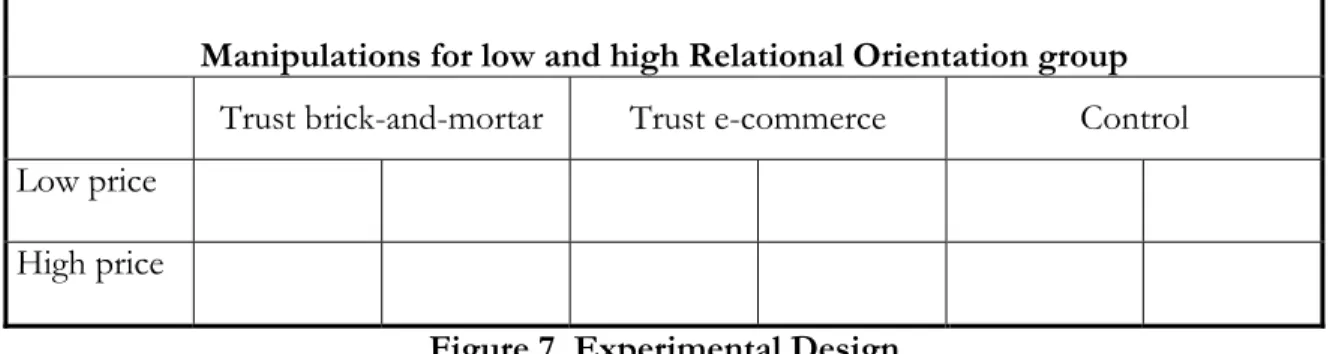
Figure 7. Experimental Design...35
Figure 8. Trust Development for Scenario #1 ...39
Figure 9. Trust Development for Scenario #2 ...40
Figure 10. Interaction effect of Trust and Price on PI ...47
Figure 11. Interaction Effect of RO and Price ...49
Figure 12. Interaction Effect of RO and E-commerce Experience ...52
Figure 13. Interaction of RO, Trust, and E-comm. Experience on Purchase Intention...53
Figure 14. Interaction of Price, Trust, and E-comm. Experience on PI ...54
ix
List of Abbreviations B&M brick-and-mortar E-Comm. E-Commerce
H Hypothesis
PI Purchase Intention
PS Price Sensitivity
PRO Personal Relational Orientation
RO Relational Orientation
SRO Shopping Relational Orientation
CHAPTER ONE:
Introduction
Charles R. Schwab brings it to the point when he says that we live in an era of rapid change (Siebel & House, 1999). The growing competition and transparency of the markets through globalization, along with the high comparability of products lead to an ever growing power of the customer and ultimately higher demands on companies. The rapid
development of the internet over the last years played a big part in this growing competition and transparency. The companies’ reactions to this new market were to give more attention to the customer and the development of relationships with the customer and to structure the organization in a way that puts the customer at the centre of it.
Statistics show that U.S. companies lose half of their customers within five years and that this disloyalty can account for stunting corporate performance by 25% to 50%
(Reichheld & Teal, 1996). Because of these findings, building lasting customer relationships has become the central goal of many companies. As Hennig-Thurau and Hansen (2000b) note, managing relationships is at the core of marketing today. Since the focus on the customer developed, significant research has been done on developing consumer trust, loyalty and eventually consumer relationships. ‘Customer Relationship Management’ or
‘Relationship Marketing’ are two of the new concepts companies are applying to develop lasting relationships with their customers. Building trust, loyalty and a relationship with consumers is considered one of the most important activities in marketing today because long term, loyal customers potentially create long term profits.
For companies, this approach means to target their activities towards customers who frequently shop at their store, require their service and generally create a high turnover of inventory for the company. An underlying assumption of this is that all the customers who
frequently shop at one store already have or potentially want to have a relationship with the store. It is the company which can initiate and maintain a relationship with a consumer.
Conversely, it is assumed that it is not necessary to establish relationships with customers who do not shop regularly at one store and only create modest turnover. This approach does not reflect individual differences in shopping patterns though. It can be assumed that
different customers value a relationship with the same store differently (Bendapudi & Berry, 1997). Therefore trying to engage frequent customers into a relationship while disregarding non-frequent customers, might or might not be the most efficient way to loyalty and high turnover creation. In this context, it is of great value to determine differences which lead some customers to value a relationship and others not to.
Ganesh, Arnold, and Reynolds (2000) state that although there is an increasing awareness that not all customers are alike, little is known about how or why they differ. This is also the case in relationship building. As an explanation for differences in relationship value prior research suggests factors like perceptions of quality, dissatisfaction or service encounter failures (Ganesh et al., 2000). These factors however can be manipulated by the company and are not intrinsic to the customer. Nonetheless, support exists that personal traits play a role in the differences in relationship building. As Ganesh et al. (2000) suggest, even the most satisfied and loyal customers might switch companies they do business with for reasons beyond the control of the firm. In this context, little attention has been given to factors intrinsic to the consumer. For example personal traits have only been given as an explanation by very few studies. One example is Garbarino and Johnson’s (1999) study on the different roles of satisfaction, trust and commitment in customer relationships. In addition to the factors mentioned by Ganesh et al. (2000), Garbarino and Johnson (1999) identified a customer’s orientation to relationships as an important factor, treating this
orientation as an intrinsic variable. This orientation of customers is of great importance since it potentially influences a customer’s purchase decision. McAdams (2001) suggests that personality traits are one important factor that has to be studied to understand what kind of consumer a person is. In general, personality traits have to be considered more closely in the literature on marketing relationships.
This research will follow McAdams suggestion and further study the influence of personality traits on the development of marketing relationships. It will examine the influences of customer differences in relationship building, by refining the concept of
‘relational orientation’ introduced by Garbarino and Johnson (1999). By expanding on the concept of relational orientation in the marketing context, this study will further the understanding of the effects of customer differences in relationship building.
Research Question and Objectives
The main objective of this study is to further the research on individual differences of customers for a better understanding of the needs and goals of today’s consumer. As McAdams (2001) suggests personality traits (or personal traits) are an important anchor to understanding these differences in consumer behaviour. Specifically, this research examines the impact of one personal trait – Relational Orientation – on the consumer purchase decisions. Since relationship marketing is employed by a growing number of companies, it is of value to study relational orientation of consumers. Looking at marketing as a courting relationship, it is important to establish whether or not both parties desire a relationship.
Relational orientation is the concept representing the customer’s desire to build
relationships. It is expected, that relational orientation will impact where consumers make their purchases (purchase intention) and how price sensitive consumers are in a purchase
situation. To study the impact on purchase intention this project will compare the choice between brick-and-mortar and e-commerce environments. Determining factors that drive the decision between these two environments is of special interest, considering the rapid growth and increasing competition between brick-and-mortar and e-commerce. Therefore, the main research question that will be addressed is: Does relational orientation have an effect on purchase intention and price sensitivity in a purchase decision between brick-and- mortar and e-commerce?
With the influence of relational orientation, trust and price are also expected to be of importance. Relational Orientation is somewhat related to trust, by reflecting the importance of trust. Also, price is expected to have an influence due to risk perceptions associated with product price. Therefore, this project will also address a second research question, which is:
Do trust and price have direct and/or indirect effects on purchase intention and price sensitivity?
Importance of Study
Bendapudi and Berry’s (1997) statement on the perceived value of relationships was one of the motivations for this study. Bendapudi and Berry (1997) stated that different customers value a relationship to a store differently. Research so far dealt with the effects of relationships in the marketing area, and the factors that determine relationships, like trust, commitment and loyalty. The focus has not been on what drives customers to build relationships and value them. As Hennig-Thurau and Hansen (2000a) notice, relationship marketing theory so far has focused primarily on the suppliers’ perspective, and generally neglects the customers’ perspective and the willingness of customers to engage in
relationships. These two perspectives of the supplier and the customer can be viewed as two
sides of the same coin. It is the difference of asking “How can we retain our frequent customers?” and “What makes this customer a frequent customer and what does the customer want?”. Focusing on the customer’s perspective to find out what factors make a customer a frequent customer and why some customers prefer having relationships while others do not is at the heart of this research project.
Hennig-Thurau and Hansen (2000a) also state that the motives of customers with regard to relationships and the willingness to engage in relationships have only been analyzed implicitly, creating a need for future research on a variety of topics. These include factors that block relationship development (relational barriers) and the customer’s individual interest in relational benefits.
This research suggests the concept of relational orientation as an explanation for the willingness to engage in relationships and for the individual differences in the value of relationships and their benefits. Crosby, Evans and Cowles (1990) conclude that the literature has identified the need to expand the focus on buyer-seller interaction to include relational properties. Relational orientation is one approach to follow this suggestion. It is also following McAdams’ (2001) suggestion, that studying personal traits is of great importance to understand consumers. To tie the relational orientation concept into the existing literature on relationships, trust which is one of the most mentioned and studied concepts, is included in the research design. ‘Price’ is also included in the research design, and the effects of relational orientation, trust and price on purchase intention and price sensitivity are studied.
CHAPTER TWO:
Literature Review and Research Model The Term Relationship
For the purpose of this research, it is essential to first define the term ‘relationship’.
Generally, Bagozzi (1995) found that the word relationship is poorly defined both operationally and theoretically. Hunt (Hunt, 1983) uses the term relationship in his
conceptualization of the domain of marketing when he states that ‘exchange relationships’
are the primary focus of marketing. The term ‘relationship’ in a marketing context is indeed based on the exchange concept. Unfortunately, ‘exchange’ among the social sciences is lacking a central definition (Bagozzi, as cited in Toyne, 1989). For the purpose of this project it is useful to draw from the economists’ view of exchange where it is described as a transfer of money for a product or service (Toyne, 1989). Exchange itself describes single
transactions. In spite of the importance of the exchange concept, marketing has mostly neglected the relationship aspect of buyer-seller interaction (Dwyer, Schurr, & Oh, 1987).
A relationship develops over a series of exchanges. Storbacka et al. (1994) state that a relationship is created through a series of episodes, so that in the shopping situation at least two encounters are required before a relationship exists. In fact, the concept of relationships has been conceptualized as a continuum based on the number of interactions (Barnes, 2000).
The literature suggests three key constructs that are of importance in relationship building, namely satisfaction, trust and commitment (Hennig-Thurau & Hansen, 2000a).
Storbacka’s definition of the term relationship was further developed by Barnes (1997), who suggests that before a relationship truly exists, both parties must mutually perceive that the relationship exists and the relationship must be characterized by a special status. Supporting
interaction may be perceived by some people as a relationship, while others perceive the same situation as merely an interaction. Also, Christy, Oliver and Penn (1996) state that some customers may have a general belief that relationships normally offer better value, while others believe that better value can be obtained by seeking single transactions. These two facts on the interpretation of interactions and the value of relationships show, that the concept of a relationship is highly subjective and based on perceptions of both parties (Wong & Sohal, 2002). Barnes (2000) suggests that this subjectivity is due to different individual relationship thresholds. He also states that because of these individual thresholds, a relationship will only exist in the mind of the customer regardless of whether a marketer feels that a relationship has been created. What passes as a relationship under many
relationship marketing programs is not likely a relationship at all in the customer’s eye for it is mostly one-sided (Barnes, 2000). Another view that reflects this notion of subjectivity is the concept of interdependence. Fournier (1998) states that before a relationship truly exists interdependence between the partners must be evident, meaning that partners must
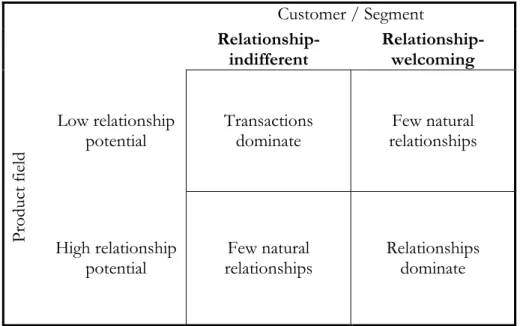
collectively affect, define and redefine the relationship. Berscheid (Berscheid, 1996) states that one aspect that reflects interdependence is the frequency with which partners influence each other.Christy et al. (1996) developed a relationship matrix based on two factors:
customer relationship orientation and product field.
Customer / Segment Relationship-
indifferent Relationship- welcoming
Low relationship
potential Transactions
dominate Few natural
relationships
Product field High relationship
potential
Few natural relationships
Relationships dominate
Figure 1. Customer and Product Influences on Relationship Potential
This matrix shows that the number of relationships in a market depends on the customer’s relational orientation. The outcome of relationships is an increased probability of future transactions between the two parties in a relationship (Christy et al., 1996).
Although researchers seem to agree on this perception based subjective view of relationships, the reasons why those differences exist remain an under-explored area. In general, research found that the attributes of interpersonal relationships can be usefully employed to describe exchange relationships in a business context (Morgan & Hunt, 1994).
The attributes of interpersonal relationships might therefore be useful to explain why individual differences exist in the perception of relationships.
The purpose of this research project is to explore and establish a concept of
individual difference that impacts the perceptions of relationships and describes a customer’s
‘need for relationship’.
Relationship Marketing – The Consumer Perspective
Twenty years have gone by since the concept of relationship marketing was first mentioned in the literature by Berry (as cited in Hennig-Thurau & Hansen, 2000a). Today, the concept is not only up-to-date, but probably more popular than ever and its popularity is still growing. Christy, Oliver and Penn (1996) state, that the relationship marketing
discussion in the academic and professional press has been a prominent part of a re- evaluation of the role and direction of development of marketing. Relationship marketing has even been called a paradigm change for marketing theory itself by some authors (Hennig-Thurau & Hansen, 2000a), while others refute this saying that relationship
marketing does not meet the conditions necessary to be called a paradigm shift (Backhaus, as cited in Hennig-Thurau & Hansen, 2000a). Mostly academic scholars refute that relationship marketing is a new concept, suggesting that buyer-seller relationships are an old-fashioned way of doing business (Sheth & Parvatayar, 1995). Although it seems to be clear that
relationship marketing is not a paradigm shift or a totally new approach, it certainly gave the marketing field both for academics and for practitioners a new boost and lead somewhat to a refreshing discussion of the field itself.
The development of the relationship-oriented approach in marketing was a response to the constraints of the transaction-oriented approach (Rapp, 2000). In the transaction- oriented approach, an interaction ends with the sale. The relationship-oriented approach takes the sale as a beginning of a long-term relationship. The traditional or transaction- oriented marketing approach has long been the core of the marketing function combining the four P’s of the marketing mix. The perfect combination of the four p’s product, price, place, and promotion, was what drove the marketing function (Bowen, 1998). The focus was on the transaction and the processes for efficiency, and on the acquisition of new customers.
Today, the four p’s although still valid and functional, have somewhat outlived their usefulness (English, 2000). The shift towards a relational approach has added a whole new dimension. Now the focus of relationship-oriented marketing is to retain already existing customers by building and maintaining relationships with them. Hansen (2000) concludes that the theoretical development of relationship marketing began in the late sixties and early seventies with a market-oriented and customer-focused marketing approach. During this time period, more emphasis was given to satisfy the customer with factors outside the actual product or service. Marketers began to develop relationships with customers on both a collective and an individual level.
Throughout the nineties relationship marketing was at its peek. Drawing from the lifecycle theory, Hennig-Thurau and Hansen (2000a) state that relationship marketing as a concept reached its maturity stage during that time. As mentioned by Veloutsou, Saren, and Tzokas (2002) many academics tried to conceptualize relationship marketing and define its scope in the early nineties. Diller (as cited in Diller, 2000) for example developed a
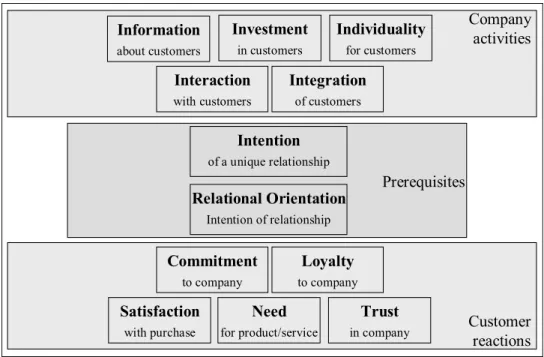
framework of six general principals in relationship marketing, which he called the six i’s. His six i’s information, investments, individuality, interaction, integration and intention refer to the necessary company activities needed to establish relationships with customers. The 6 i’s mean that a company needs information about its customers, it needs to invest in the relationship to the customer, it has to respect the customers individuality and offer
individualized service, it needs to foster continuous interaction with the customer, it needs to integrate the customer and it needs the intention to build and maintain a relationship to the customer. Incorporating all these different aspects according to Diller is the key to a successful relationship marketing initiative.
Research in the area of relationship marketing has mainly focused on industrial and services marketing (Christy et al., 1996), potential benefits of the companies (Hansen, 2000), activities of companies (Diller, 2000), and not on consumer markets, benefits for consumers or generally relationship marketing from a consumer perspective. This was due to the fact that it was almost unthinkable in the early nineties, to incorporate the relational approach into mass consumer markets, mainly because of missing technology. Highly relevant to the development and the popularity of relationship marketing especially in the consumer market were the technological advancements made during the mid and late nineties. Software that allowed businesses to maintain customer databases that stored a customer’s personal information, interactions and purchases, enabled large organizations to develop the kind of one-to-one relationships which small organizations had with their customers in the past.
These relationships meant more profit from the frequent customers, and they held a large hidden potential for today’s large organizations. This technological development made relationship marketing a feasible strategy in consumer markets (Christy et al., 1996; Sheth &
Parvatayar, 1995).
Although researchers put more emphasis on relationship marketing in consumer markets, researching relationship marketing from a consumer perspective still remains an under-explored area. One point that is brought up again and again in the literature is, that ultimately, a relationship does not depend solely on the companies activities but on the consumers willingness to engage in such a relationship, asking the question what it is that motivates customers to engage in relationships (Hansen, 2000; Hennig-Thurau, Gwinner, &
Gremler, 2002; Sheth & Parvatayar, 1995). This aspect of what motivates consumers to engage in retail (marketing) relationships is the primary motive of this study. Outcomes of relationships like trust, commitment or loyalty have been studied extensively in the literature,
but what is the main drive for consumers and how does it fit into the existing models and the conceptualization if relationship marketing and customer retention? O’Malley and Tynan (2000) broadly categorize the existing literature in the area into conceptual developments, operational issues, implementation, relevance and nature of relationships. Some work has been done to integrate some of these areas into one model, like Diller’s 6 i’s of relationship marketing (Diller, 2000) which I believe is a good combination of conceptual development, operational issues, and implementation. Nonetheless, the model is also lacking the customer perspective which I think is necessary to complete his conceptualization. I have used Diller’s model to envision a new framework incorporating the nature of relationships and the missing customer perspective. This framework is depicted in Figure 2.
Company activities
Customer reactions Information
about customers
Investment
in customers
Individuality
for customers
Interaction
with customers
Integration
of customers
Intention
of a unique relationship
Satisfaction
with purchase
Need
for product/service
Trust
in company
Commitment
to company
Loyalty
to company
Relational Orientation
Intention of relationship
Prerequisites
Figure 2. The Hourglass of Relationship Development1
This framework is referred to as “The hourglass of relationship development” as it describes the company-customer relationship development as a frame of actions and
reactions. The framework is initiated top-down with the reactions following bottom-up, meeting at the middle point. This narrow part of the hourglass that allows actions to ‘flow’
and create reactions, resembles the natural barriers which are on both sides, of company and customer, the intentions to engage in a relationship. In this instance, it is not only the
companies’ but also the customers’ intention to engage in a relationship that is of importance. The concept of the customer’s intention to engage in relationships, called relational orientation is understood as a personal trait. This concept is developed in a later chapter in this thesis.
Personality and Personal Traits
Unfortunately, researchers do not agree on a general definition of the term
‘personality’ (Kassarjian, 1973). Kleinmuntz (1967) defines Personality as “the unique organization of factors which characterize an individual and determine his pattern of interaction with the environment” (p. 9).
By the very nature of retail shopping, any shopping situation potentially includes a personal contact with both the store in general and its salespeople in specific. In this personal contact, the interaction of salesperson and customer is influenced by each of their personalities. Studies on service providers show this influence of personality (Hurley, 1998) from a salesperson perspective. In general though, personality research in the consumer context has been neglected for a long time (Baumgartner, 2002). This could partly be due to the existence of competing schools of thought (Hurley, 1998). Personality research in the psychology discipline is done for the interest in personality traits with a desire to understand characteristics of humans. While personality research in a management and specifically marketing context is done to somewhat predict behaviour. The value of studying personality
to predict behaviour is what the competing schools argue about. Although some researchers favour personality as a predictor of behaviour, the dominant view has been that personality is less relevant than a person’s capacity to adapt and the influence of situational variables (Hurley, 1998).
This lack of personality research in the consumer context and the negligence of personality as a predictor of behaviour is somewhat surprising considering that over the last two decades personality research has been a popular topic in psychology (Baumgartner, 2002).
Today personality research is dominated by trait theories (Cervone, 2000). Trait theories explain a person’s tendency towards one type of behaviour by conceptualizing personality in terms of ‘individual-difference’ constructs (Cervone, 2000). This means that the ‘individual-difference’ constructs manifest themselves in behavioural tendencies that are not domain specific. Dabholkar and Bagozzi (2002) state that “variation in consumer differences arising from personality traits is of greater interest than demographic or
psychographic factors because such variation is at the heart of consumer attitude formation and behavioural intentions” (p. 187).
Dependant Variables Purchase Intention
This research project includes two dependant variables. The first one is purchase intention (PI). Consumer purchase intention in this project is conceptualized as the participant’s choice of purchase environment. In particular, research participants have to choose between the two environments of a local retail store (brick-and-mortar) and an online retailer (e-commerce) in a purchase situation. The focus is to determine factors that
influence consumer purchase decisions between the brick-and-mortar and e-commerce environments because the competition between these two environments is growing continually. There are no attributes of the stores mentioned other than the ‘trust manipulation’. Therefore when participants make a choice between two stores they are indirectly choosing between two environments. Purchase Intention will be directly measured by asking participants which store they would buy from (choice of purchase environment) in the given situation. In this research, the ‘choice of purchase environment’ and purchase intention are synonymously used terms.
Price Sensitivity
The second dependant variable is price sensitivity. For the purpose of this research project, price sensitivity is defined as the importance of price in a purchase situation. Low price sensitivity reflects that price is not of great importance in a given situation, while high price sensitivity means that price is important and savings could lead a consumer to switch the store they buy from. The concept of price sensitivity is also conceptualized as price tolerance (Delgado-Ballester & Munuera-Alemán, 2001). Price tolerance also reflects the importance of price but follows the opposite direction. High price tolerance means that consumers are more willing to tolerate a high price (Delgado-Ballester & Munuera-Alemán, 2001).
To measure price sensitivity, I chose to go with a simple one item measure by asking participants to state a needed price difference (savings) to switch purchase environments. In other words what the price at the e-commerce store would have to be to make a participant switch from the brick-and-mortar store to e-commerce. Measuring price sensitivity with one question of needed savings is consistent with Sirvanci’s (1993) approach to the concept.
Sirvanci (1993) also measure price sensitivity by one question, asking participants for needed savings.
Independent Variables and Hypotheses Relational Orientation
Relational Orientation (RO) as used in this research is defined as a person’s
preference to relationship building. In accordance to the social psychology literature (Snell &
Finney, 1993; Swap & Rubin, 1983) RO in a purchase situation (consumer-company relationship) is viewed as a personal trait. A concept in the existing literature that is closely related to RO is commitment. Commitment is described as a customer’s orientation towards long-term relationships with specific stores (Hennig-Thurau & Hansen, 2000a). Geyskens, Steenkamp, Scheer and Kumar (1996) split the concept of commitment into affective commitment, based on emotional bonds, and calculative commitment based on the rational reasoning that higher benefits are gained by remaining in a relationship. Affective
commitment as described by Geyskens et al. (1996) is very closely related to the concept of RO. There is one important difference though. Commitment is situation specific, meaning that one person can have different levels of commitment to different stores or in different shopping situations. RO on the other hand is understood as an overall, predominant attitude that leads a customer to show consistent behaviour in any shopping situation.
In their research on a non-profit professional theatre company, Garbarino and Johnson (1999) segmented the customer base according to responsiveness to transactional and relational marketing. They established three categories of RO; high, medium and low.
They did not measure RO, but based it on the behavioural indicator of ticket purchase.
According to this behavioural indicator, frequent subscribers were considered high, non-
frequent subscribers medium, and individual ticket buyers low in RO. Addis and Holbrook (2001) interpret Garbarino and Johnson’s approach, as having demonstrated that the customers’ orientation determines the kind of relationship they want to build with a firm.
The customer’s relational orientation not only determines the kind of relationship, it also determines if the customer wants to build a relationship to begin with.
RO originally stems from the social psychology literature and the area of interpersonal-relationships. Concepts related to RO are relational-preoccupation and interpersonal orientation (Snell & Finney, 1993; Swap & Rubin, 1983) from the social psychology literature. As stated earlier, research found that the attributes of interpersonal relationships can be usefully employed to describe exchange relationships in a business context (Morgan and Hunt, 1994). Since the concept as described has not been measured in the marketing literature, the first objective was to determine its existence and influence in the purchase decisions of consumers. In this project, only two categories of RO (low and high) were used versus the three categories used by Garbarino and Johnson. A median split into two categories seemed to be more reasonable for this project and was possible because no theory exists that defines the three categories of RO. From previous research (Garbarino &
Johnson, 1999) it can be predicted, that RO will have a direct effect on purchase intention.
More personal contact and therefore higher relational approach will lead consumers with high RO to prefer to shop at a local store, therefore I hypothesize the following:
H1a: RO will have a relationship with purchase intention such that people with high RO are more likely to choose a local retailer over an online store than people with low RO.
It is also expected that RO will have a direct effect on price sensitivity. Previous research found, that relationships (commitment and loyalty) may decrease price sensitivity.
(Delgado-Ballester & Munuera-Alemán, 2001; Diller, 2000). Since RO is the importance of relationships it is likely to have a similar effect. This can be explained by Bendapudi and Berry’s (1997) and Barnes’ (1997) findings that a relationship is highly subjective and Christy’s et al. (1996) finding, that relationships are viewed as beneficial by some people while other perceive relationships in a business-to-consumer context as detrimental. Based on these findings, I am concluding that RO will impact price sensitivity. Since relationships in general are found to impact price sensitivity, RO – the need for and value of a relationship – should also impact price sensitivity. It can be expected, that people with high RO, who value a relationship, will register lower price sensitivity, because price is not as important to the consumer as the relationship is. Formally stated:
H1b: People with high RO will have a lower price sensitivity than people with low RO.
Trust
Trust develops over time from exchanges by keeping promises, hence trust arises from an exchange experience as a long-term asset (Addis & Holbrook, 2001). Trust has been explored and defined in many ways. As Doney and Cannon (1997) state, trust has been studied in the fields of social psychology, sociology, economics and marketing. For this study, the focus of trust will be in the marketing field using its definitions and findings.
Morgan and Hunt’s (1994) article is one example of the study of trust in the marketing literature and probably one of the most cited ones. Morgan and Hunt (1994) define trust as existing when one party has confidence in an exchange partner’s reliability and integrity. Reliability and integrity in this definition are associated with qualities such as
consistency, competency, honesty, fairness, responsibility, and helpfulness. Walter, Mueller and Helfert (2000) define trust as a customer’s belief in the supplier’s benevolence, honesty,
and competence to act in the best interest of the relationship to the customer. Although different, both definitions reflect the same core factors for trust. It is the belief of a customer that a company will act in his/her best interest. It is beyond the scope of this study to
discuss the different conceptualizations of trust in greater depth. For a good overview of the existing studies on trust, its conceptualizations and measures or manipulations, see Gefen, Karahanna and Straub’s (2003) study.
A considerable amount of research has been done to examine the role of trust in relationship development particularly within distribution channels (Nicholson, Compeau, &
Sethi, 2001). Different studies showed the influence of trust on future purchase intention of customers. Ganesan (1994) states the importance of trust in purchase intentions by showing that trust is a necessary factor for a long-term orientation. Morgan and Hunt (1994)
demonstrate the importance of trust by showing that it is negatively related to propensity to leave. Gefen (2000) found that trust directly influences purchase intentions. Based on these findings, trust is expected to directly influence a customers purchase intentions. Therefore, I propose the following:
H2a: Trust will have a direct positive effect on purchase intention.
Literature shows that trust also reduced the perceived risk of a purchase (Morgan &
Hunt, 1994). Delgado-Ballester et al. (2001) found that trust indirectly creates lower price sensitivity by leading to higher commitment which in turn leads to lower price sensitivity (or higher price tolerance as they use it). Lemmink and Mattsson (2002) studied the effects of trust in service encounters, more specifically the benevolence and honesty aspects of trust.
They found that there is a significant relationship between the benevolence aspect of trust
and willingness to pay more. Based on their finding, it can be concluded that trust will directly affect price sensitivity. Formally stated:
H2b: Trust will be negatively associated with price sensitivity.
The definition of trust as the belief of a customer that a company acts in his/her best interest and the concepts mentioned in the definitions are of long term value for a
relationship between customer and company. As Henning-Thurau, Gwinner and Gremier (2002) found that trust positively influences commitment which is understood as an
enduring desire to maintain a valued relationship (Garbarino & Johnson, 1999). Supporting this direct relation of trust to relationship Ganesan (1994) found that trust enables parties to focus on the long-term benefits of a relationship. Because of this long term value of trust and its influence on commitment and the relationship, it can be expected, that trust will vary in importance to customers depending on their intention to engage in a relationship with a company or not. Also Gefen (2000) found that trust increases purchase intentions directly and indirectly. In other words, as an indirect influence trust will moderate how RO will affect purchase intention. Formally stated,
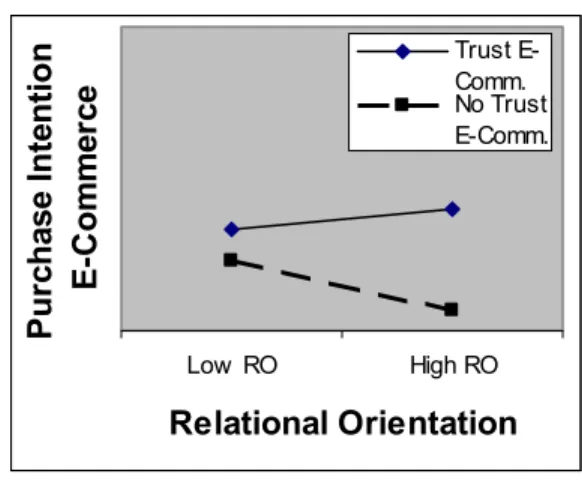
H2c: Trust will moderate the effect of RO on purchase intention such that people with high RO are more likely to choose a store they trust over one they do not trust than are people with low RO.
Low RO High RO
Relational Orientation Purchase Intention E-Commerce
Trust E- Comm.
No Trust E-Comm.
Figure 3. Hypothesis #2c
The previous trust hypotheses lead into another, which is the moderating effect of trust on price sensitivity. As stated, trust will be valued differently by people with high and low RO. It is the perceived trust that results from the two concepts of trust and RO, that is important. Because of this connection of ‘RO and trust’, and the hypothesized direct influence of trust on price sensitivity, it is expected that trust will moderate the effect of RO on price sensitivity. Potentially, consumers with low RO will put less emphasis on trust and more on price, therefore leading to higher price sensitivity. Formally stated:
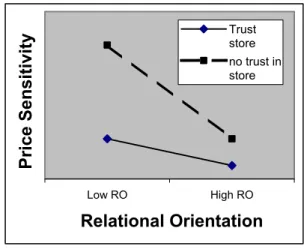
H2d: Trust will moderate the effect of RO on price sensitivity such that people with low RO will be less price sensitive when trust differs between purchase environments.
Low RO High RO
Relational Orientation
Price Sensitivity
Trust store no trust in store
Figure 4. Hypothesis #2d
Price
The third independent variable is price. Basil (2001) proposes price as one of three variables that are important in the purchase decision between e-commerce and local retailers.
I suggest that the price variable can be split up into two aspects of price. First is the actual product price which will determine if a product is judged as being high or low priced. The actual product price is likely to be important in the choice of purchase environment. The second price aspect is the relative product price which shows the difference in price between different shopping environments or stores. This relative product price can be expressed in percentage savings, and it can be viewed as price threshold to switch between shopping environments or stores. The relative product price is reflected in the research model in the dependent variable price sensitivity.
To reflect the actual product price the scenarios for the experiment differ between a low and a high price product. Price has been shown in the literature to influence a
consumers risk perception of a purchase (Olson, 1977). The consensus among the literature on the effects of price is that consumers perceive more risk with higher priced purchases (Bearden & Shimp, 1982). Because of the higher perceived risk on the product, it is expected, that consumers will try to minimize or even eliminate other risk factors of the purchase situation. As shown in previous studies buying over the internet involves numerous risks for consumers outside of the risks of the transaction process itself (Grabner-Kraeuter, 2002). Reichheld and Schefter (2000) found that risk in an e-commerce environment is generally high. Therefore, trying to minimize risk, customers will be less likely to purchase a high price product online than at a brick-and-mortar store. It is therefore expected, that price will have a main effect on purchase intention. Formally stated:
H3a: For high priced products people will prefer to purchase from a brick-and- mortar retailer.
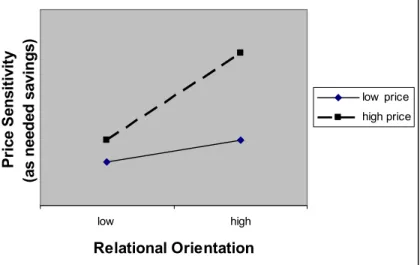
The same reasoning leads us to expect that price will moderate the effect of RO on price sensitivity. The fact that e-commerce is generally perceived as a purchase environment with higher risk than brick-and-mortar, together with the higher perceived risk with high price product purchases, it is likely, that people with high and low RO will react differently to different prices. Consumers with low RO are likely to register only slight differences in needed savings between high and low price products, because they are less risk sensitive and more driven by price. In contrast, high RO consumers are likely to register substantially higher needed savings for a high price product than for a low price product, because of the high associated risk. Formally stated:
H3b: Price will moderate the effect of relational orientation on price sensitivity such that people with high RO will have higher differences in price sensitivity than people with low RO.
low high
Relational Orientation Price Sensitivity (as needed savings)
low price high price
Figure 5. Hypothesis #3b
The Research Model
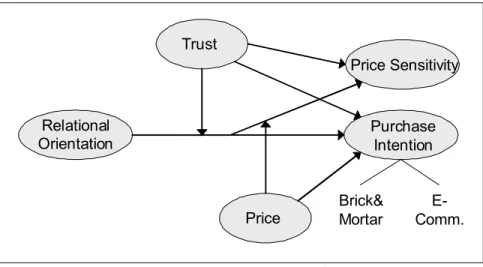
Figure 6 depicts the complete research model used in this project. All hypotheses are shown by the arrows between the independent variables of relational orientation, trust and price and the dependent variables of purchase intention and price sensitivity. Arrows directly connected to other arrows are to be understood as a moderating effect on the relationship depicted by the main arrow it connects to.
Relational Orientation
Trust
Purchase Intention
E- Comm.
Brick&
Mortar Price
Price Sensitivity
Figure 6. Research Model
In summary, the RO hypotheses predict the main effect of RO on purchase intention (H1a) and price sensitivity (H1b). The trust hypotheses predict the effect of trust on purchase intention (H2a), on price sensitivity (H2b), and the interaction effect of RO and trust on purchase intention (H2c) and price sensitivity (H2d). The price hypotheses predict the main effect of price on purchase intention (H3a) and the interaction effect of RO and price on price sensitivity (H3b).
CHAPTER THREE:
Research Methodology Overview of the Research Procedure
This study was conducted in four stages. First, a pilot study was conducted to test items for the RO scale. The second stage was a pre-test of the experimental scenarios that were to be used in the main experiment. The objective was to manipulate trust between the two shopping environments of brick-and-mortar and e-commerce. The initial pre-test of the scenarios was followed up by a second pre-test which was done to test the revised scenarios and the new RO scale. Finally the main study was conducted as an experiment on shopping situations including a manipulation of trust and price. Participants completed the 7-item RO scale, read a short shopping situation scenario and then were asked to state their purchase intention and rate their price sensitivity. The relationships hypothesized in the research model (see Figure 6) were then tested. All aspects of this study were approved by the Faculty of Management Research & Ethics Committee and were found to follow the ethical
guidelines and standards as described in the Tri-Council Policy Statement for ethical conduct of research involving humans.
Pilot Test
An initial pilot test was conducted to develop the measurement for RO. The purpose of this pilot test was to determine the existence, variability and reliability of the RO concept.
For the initial questionnaire 12 items were developed to measure RO. The items were written using a number of scales as a guide and inspiration (Garbarino & Johnson, 1999;
Swap & Rubin, 1983). In the relationship marketing literature, commitment has widely been acknowledged to be an integral part of any long-term business relationship (Walter et al.,
2000). Garbarino and Johnson (1999) capture commitment in their research as ‘belonging’
and ‘attachment’. Because of the importance of commitment in relationships Garbarino and Johnson’s (1999) approach was followed and questions relating to ‘attachment’ and
‘belonging’ were included in the RO questionnaire. Because of the unknown nature of the RO concept and its exact boundaries, other questions relating to the concepts of trust and relationships in general were also added.
Generally, a customer can have a relationship in purchase situations with a store and/or its salespeople. This is why the items also related to both a store and the salespeople.
A five point Likert scale was used with “strongly agree” and “strongly disagree” as anchors.
To make it easier for participants to state their overall preferences in the RO scale without bias from certain shopping situations, they were asked to think of all their shopping for Christmas gifts. This was done to ensure that responses were not based on some specific shopping situation like grocery shopping. The Christmas shopping was chosen because of the proximity of the test date to Christmas. A question was included that asked participants to state what kind of products they bought, to compare the shopping mix.
The questionnaire was administered to 26 University students and employees by way of hallway intercepts. The question on products bought for Christmas showed a good variance. It included products like books, CD’s, car parts, clothing, sports equipment, toys, perfume, and beauty products. A factor analysis on the items was performed by using principal components with a varimax rotation which is the recommended method in personality measurement (Comrey, 1988: as cited in Hurley, 1998). Criteria consistent with those recommended by Hair, Anderson, Tatham, and Black (Hair, Anderson, Tatham, &
Black, 1998) was used, specifically the scree plot and the eigenvalue-greater-than-one criterion. Evaluation based on both of these criteria showed that four factors were present
(Eigenvalues of 3.47, 2.32, 2.11, and 1.23, respectively). One of these factors contained the relational questions and was titled ‘relational orientation’. The analysis also showed that the relationship to salespeople and the relationship to a store were clearly separated factors with items on ‘trusting salespeople’, ‘liking salespeople’ and ‘preferring to get offered assistance’
in the Salesperson factor (factor loadings of .72, .85, and .86 respectively). Using the definition of the RO concept given in this project, the concept was narrowed to the relationship to stores and relationships to salespeople were not included. This is consistent with Iacobucci and Ostrom’s (1996) finding that differences exist between the levels of relationships to stores and salespeople.
The RO factor contained three items with factor loadings between .734 and .781.
The items related to ‘sense of belonging, ‘emotional attachment’ and ‘relationships’. None of the three RO items cross-loaded significantly (see Appendix A for complete factor analysis).
A reliability analysis of the RO items was conducted giving a reliability coefficient for the scale of .74. This reliability coefficient was calculated using Coefficient Alpha, which is recommended for reliability tests for any multiple-item scale (Carmines & Zeller, 1979).
It should be mentioned, that the main objective of this pre-test was to test the relationship of the items and their construct domain RO. The test was performed to
establish content validity, and to determine if the concept of RO, as defined in this research project, existed, and if it could be measured. The clear separation of relationships with a store and with the salespeople also provided some construct validity. This result clearly separated RO from the concept ‘need for interaction’ (Dabholkar, 1996) which is related to the factor ‘relationship to salespeople’.
Three additional items from the relational-preoccupation and the interpersonal orientation scale (Snell & Finney, 1993; Swap & Rubin, 1983) were included to further test if
the concepts are closely related. Additionally one more item for RO was developed and added for further testing.
Pre-Test #1
After the initial pilot test of items for the RO scale, two pre-test were conducted to further test the revised RO scale and the experimental scenarios. To manipulate trust, concepts that were shown in previous studies to be direct antecedents of trust were used:
‘Previous experience’ (Doney & Cannon, 1997), and ‘satisfaction’ (Delgado-Ballester &
Munuera-Alemán, 2001; Selnes, 1998). To manipulate trust according to these antecedents, the scenarios stated that the participants had experience with one store and were always satisfied and that they had no experience with the other store. The product chosen for the test was a camera because a camera can be both a high and a low priced product. Also, most of the population are familiar with the product and have some kind of experience using it.
To manipulate price, a high and a low price camera were used. The price of the low price camera was $50, the price of the high priced camera was $300. Mardian (2002) sees the hundred-dollar point as an appropriate middle dollar amount to distinguish low and high priced products. Certainly, price perceptions differ between different populations. In his study though, the same population as in Mardian’s study was used. The sample population was therefore likely to have the same characteristic in price perceptions. Following his findings, the prices of $50 and $300 were chosen to have a clear separation of the two categories low and high. Using the same product category for the high and low priced product assured minimal influence of other external factors. In a study of pricing and internet shopping, Ancarani (2002) has shown, that online prices were always lower than prices at brick-and-mortar stores. Following this study and the fact that online retailers do
not have the expenses a brick-and-mortar store has, it was reasonable to assume that consumers expect to get a lower price when shopping online. Because if this fact, it was decided to include a minor price difference in the scenario to make the situations more realistic. The price for the camera was always 5% lower for e-commerce. The prices for the low and high priced camera were $45 and $270 at the online retailer respectively. Since there are always shipping costs associated with an online purchase, it was stated in the scenario, that the price at the e-commerce store includes shipment to the customer’s door.
Trust can be related to a variety of concepts so the manipulation check included questions on ‘overall trust’, ‘trust in expertise’ (Doney & Cannon, 1997), ‘trust in price’, and
‘trust in delivery’. The manipulation check was measured using a 5 point Likert-type scale (1
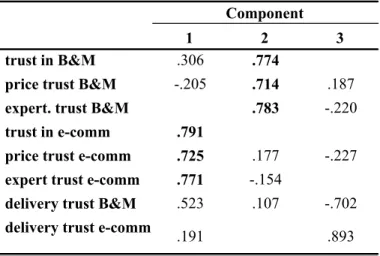
= Not at all, 5 = Very much). The first pre-test was administered to 24 university students during class. Participants were each given one written scenario and were asked to rate their trust on each of the trust dimensions based on the scenario. A factor analysis was conducted with the trust items. The results of this analysis are shown in Table 1.
Table 1: Factor Analysis on Trust Items
.306 .774
-.205 .714 .187
.783 -.220 .791
.725 .177 -.227
.771 -.154
.523 .107 -.702
.191 .893
trust in B&M price trust B&M expert. trust B&M trust in e-comm price trust e-comm expert trust e-comm delivery trust B&M delivery trust e-comm
1 2 3
Component
Extraction Method: Principal Component Analysis.
Rotation Method: Varimax with Kaiser Normalization.
Note: Only results greater than .1 are reported in table.
The analysis showed that the ‘trust in delivery’ dimension was not related to the other dimensions of expertise and price. The results clearly indicated that ‘trust in delivery’ is only of relevance in an e-commerce shopping situation. Consequently, the delivery
dimension was excluded and not used to determine the overall trust. To determine the overall store trust an aggregate mean of the three items on ‘overall trust’, ‘price trust’, and
‘expertise trust’ was used for both brick-and-mortar and e-commerce. The manipulation check of the scenarios showed that the trust manipulation overall was not significant, since the trust differences between brick-and-mortar and e-commerce were not high enough. The results of the manipulation check are shown in Table 2.
.547 1 .547 1.446 .242
347.455 1 347.455 918.393 .000
.547 1 .547 1.446 .242
8.323 22 .378
356.444 24
8.870 23
Source
Corrected Model Intercept
Trust Error Total
Corrected Total
Type III Sum
of Squares df Mean Square F Sig.
p Table 2: Manipulation Check Results
T-tests were conducted for manipulation checks on the individual scenarios. The t- tests showed that trust was effectively manipulated for the ‘trust brick-and-mortar scenario’
with a trust mean for brick-and-mortar of 3.97 and for e-commerce of 3.18 (t = 2.61, p <
.05). Trust was not effectively manipulated for the ‘trust e-commerce scenario’ with a trust mean for brick-and-mortar of 3.67 and a trust mean for e-commerce of 3.15 (t = 1.78, p = .10). These results also showed that the effect has the wrong direction. A conclusion from the results was that there is a clear tendency for higher levels of trust for the brick-and-
scenario, the trust ratings for brick-and-mortar were still higher than the trust ratings for e- commerce. These results were inadequate and the scenarios were changed and tested through a second pre-test.
Pre-Test #2
The problem with the trust manipulation was that levels of trust for e-commerce seemed to generally be lower than for brick-and-mortar. The goal was therefore to increase trust in e-commerce. To accomplish that, the scenario text was rearranged. In the previous scenario the brick-and-mortar environment was always mentioned first. This was changed to always have the trusted environment first. That way, the attention could be directed to the trusted environment. As Reichheld and Schefter (2000) found the limited web-interface does not allow consumers to judge trustworthiness the same way as they judge it in a brick-and- mortar environment; therefore making it more difficult for consumers to establish trust in an e-commerce environment. This finding might have been partially responsible for the
insignificant manipulation. Consequently it was decided to also include trust manipulations that are specific to the e-commerce environment. Factors of fraudulent charges on credit cards and spam emails were included in the trust manipulation for the e-commerce
environment, by stating that the participant never experienced any problems with fraudulent charges or unwanted e-mails.
These new scenarios were tested again with a sample of 29 university students collected by hallway intercepts. T-tests were conducted to test the manipulations. As in the first pretest, the brick-and-mortar manipulation was shown to be successful with a trust mean for brick-and-mortar of 4.31 and for e-commerce of 2.64 (t = 7.17, p < .001, respectively). The trust manipulation for the trust e-commerce scenario was still not
successful with a trust mean for brick-and-mortar of 3.48 and for e-commerce of 3.83 (t = - 1.63, p = .128, respectively). The added manipulation for the e-commerce trust proved to be valuable, because the direction of the manipulation was correct in this pre-test. Based on the previous efforts to manipulate trust, it was decided that the best way to increase the
difference of trust levels between e-commerce and brick-and-mortar in the trust e-commerce scenario, was to degrade the brick-and-mortar environment.
Next to the trust manipulation, the RO scale was also tested again. In both pre-tests the RO scale was included and not changed. It was decided after the pilot-test that it was to restricting to ask participants to think of their Christmas gift shopping experience when answering the RO questions. Although a large variety of products were named in the pilot test, the variety per individual was still relatively low. Therefore, for these pre-tests
respondents were asked to answer the scale thinking about all their shopping experiences during the Christmas holiday season.
The scale was made up of seven items, four in the RO scale and three that were added from the relational-preoccupation and the interpersonal orientation scale (Snell &
Finney, 1993; Swap & Rubin, 1983), to test for correlation between the constructs.
Following Hair et al.’s (1998) recommendation for ten cases per item for a factor analysis, a minimum of 70 cases was needed in order to have enough power. To reach this number the RO scale was administered to an additional 20 participants. The RO data of the pre-tests were then combined. This was possible because the RO scale was not changed in any way and it was always administered first, before the scenarios. The change of scenarios therefore had no influence on the results of the RO scale. The total number of cases for the analysis of the RO scale was 73 sufficing for Hair’s recommendation of ten cases per item included.
First a factor analysis with a varimax rotation was conducted. Evaluation based on the eigenvalue-greater-than-one criterion (Hair et al., 1995) confirmed that two factors were present as expected, showing clear separation of the RO-items (also called Shopping
Relational Orientation = SRO) and the interpersonal-orientation-items (Personal Relational Orientation = PRO). The rotated component matrix is shown in Table 3.
Table 3: Rotated Component Matrix for SRO and PRO Items
.753
.898 .146
.805
.660 .321
.852
.208 .738
.888 emotional
attachment sense of belonging relationships 1 store comes to mind
thinking of intimat rel.
closeness to people thinking of intim2
1 2
Component
Extraction Method: Principal Component Analysis.
Rotation Method: Varimax with Kaiser Normalization.
Note: Only results greater than .1 are reported in table.
Item four which was added after the pilot test was the only one that loaded on both factors, but with the RO factor as dominant and the interpersonal orientation as minor loading. Following the factor analysis the reliability of the RO scale was assessed using the recommended Coefficient Alpha (Carmines & Zeller, 1979). The reliability of the scale with all four items was .79. All alpha-if-item-deleted measures were lower than .79 suggesting that deleting any item, especially the fourth, would not improve the reliability of the scale. Based on these conflicting results, item four was kept for the main experiment. A decision on whether the item should or should not be included in the RO scale could then be made based on the large sample of the main experiment.
A correlation analysis between the SRO and PRO scale showed that the two constructs were significantly correlated (r = .22, p < .05) as was expected. Based on the factor and reliability analysis it was decided to keep the four SRO items and the three PRO items.