by Ethan Brandt
0692978
An Undergraduate Thesis Submitted in Partial Fulfillment of the Requirements for the Degree of Honours Bachelor of Science in Forestry
Faculty of Natural Resources Management Lakehead University
April 2023
by Ethan Brandt
0692978
An Undergraduate Thesis Submitted in Partial Fulfillment of the Requirements for the Degree of Honours Bachelor of Science in Forestry
Faculty of Natural Resources Management Lakehead University
April 2023
_______________________
Dzhamal Amishev, Ph.D.
Lakehead University, Thunder Bay Major Advisor
_______________________
Beau Johnson, R.P.F.
Resolute FP Canada Inc., Thunder Bay Second Reader
LIBRARY RIGHTS STATEMENT
In presenting this thesis in partial fulfillment of the requirements for the HBScF degree at Lakehead University in Thunder Bay, I agree that the University will make it freely available for inspection.
This thesis is made available by my authority solely for the purpose of private study and research and may not be copied or reproduced in whole or in part (except as permitted by the Copyright Laws) without my written authority.
Signature: _______________________
Date: _______________________
A CAUTION TO THE READER
This HBScF thesis has been through a semi-formal process of review and
comment by at least two faculty members. It is made available for loan by the Faculty of Natural Resources Management for the purpose of advancing the practice of
professional and scientific forestry.
The reader should be aware that opinions and conclusions expressed in this document are those of the student and do not necessarily reflect the opinions of the thesis supervisor, the faculty or of Lakehead University.
Signature: _______________________
Date: _______________________
MAJOR ADVISOR COMMENTS
ABSTRACT
Brandt, E.B. 2023. A Review of Silvics, Stand Dynamics, Density Management, and Vegetation Management in the Ontario Boreal Forest. 74 pp.
Keywords: adaptive management, brushing, commercial thinning, density management, herbicide, initial spacing, pre-commercial thinning, renewal, silviculture, vegetation management
Adaptive forest management requires constant re-evaluation of the efficacy and impact of current practices. Continuous development of information is key to any adaptive management regime, especially in the face of large-scale changes to the environment, economy, society, and the forest itself. This is why it is important to always look to the future for alternatives to what may be working now. Two common management objectives in the establishment and tending of boreal forest stands are stand density management and vegetation management. These management areas rely heavily on tree silvics and stand dynamics to be properly applied. This review outlines the species silvics and stands dynamics of merchantable boreal tree species in Ontario. It then explores the concepts of both density and vegetation management as they have been established through previous literature. The current methods of density and vegetation management in the Ontario boreal are outlined and to what degree they are used in what situations. Finally, several alternative vegetation management options which reduce the reliance on herbicides are explored.
TABLE OF CONTENTS
LIBRARY RIGHTS STATEMENT ii
A CAUTION TO THE READER iii
MAJOR ADVISOR COMMENTS iv
ABSTRACT v
TABLE OF CONTENTS vi
TABLES viii
FIGURES ix
ACKNOWLEDGEMENTS x
INTRODUCTION 1
OVERVIEW 5
SELECTION OF SOURCES 5
ECONOMIC DEMAND AND SILVICS OF BOREAL FORESTS IN ONTARIO 6
ECONOMIC USES OF COMMERCIAL TREE SPECIES 6
BLACK SPRUCE 7
JACK PINE 9
WHITE SPRUCE 11
BALSAM FIR 12
PAPER BIRCH 14
TREMBLING ASPEN (POPLAR) 15
COMPARISON OF COMMERCIAL TREE SPECIES 16
STAND DYNAMICS OF BOREAL FORESTS 18
STAND SUCCESSION 18
LANDSCAPE CONFIGURATION 20
DISTURBANCE REGIMES 21
DENSITY MANAGEMENT IN BOREAL FORESTS 23
THE BASICS OF STAND DENSITY MANAGEMENT 23
WHY LOWER STAND DENSITY? 24
SELF-THINNING 26 The EFFECTS OF STAND DENSITY ON TREE CHARACTERISTICS 28
STAND DENSITY MANAGEMENT DIAGRAMS 29
DENSITY MANAGEMENT METHODS 30
VEGETATION MANAGEMENT IN BOREAL FORESTS 37
VEGETATION MANAGEMENT METHODS 39
SITE PREPARATION 39
Mechanical Site Preparation 40
Chemical Site Preparation 41
CLEANING AND WEEDING 43
Chemical 43
Manual and Mechanical 44
VEGETATION MANAGEMENT STRATEGIES FOR REDUCING HERBICIDE 48
UTILIZATION OF BIOLOGICAL CONTROL METHODS 48
LIMITED APPLICATION OF HERBICIDE 50
INCREASED COMMERCIAL UTILIZATION OF COMPETITIVE SPECIES 52
CONCLUSION 56
LITERATURE CITED 63
TABLES
Table 1. A comparison of multiple species factors for commercial species in the
boreal forest 17
FIGURES
Figure 1. A stand density management diagram of jack pine in Eastern Canada, from
Sharma and Zhang (2007). 31
Figure 2. The timeline of thinning treatments in a forest stand, from stand establishment
to gap dynamics. From MNRF 2003. 32
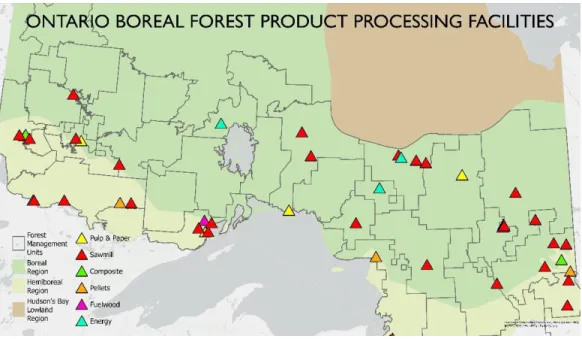
Figure 3. The locations of forest processing facilities in the Ontario boreal forest. Most of the facilities are sawmills with few scattered pulp and paper operations, which focus heavily on the continuous feedstock of SPF species. Adapted from (Brandt 2009; MNRF
2021, 2023; Natural Resources Canada 2022b 53
ACKNOWLEDGEMENTS
I would first and foremost like to extend my gratitude to Beau Johnson and Tom Ratz at Resolute FP Canada Inc. for their continued support of both my studies and career, and for graciously providing me with thesis topics to explore. Without their help, I would have likely become too indecisive about what I wanted to research.
Next, I would like to thank Dr. Dzhamal Amishev for his advisory support and wealth of knowledge as a university professor and professional in his field. It has been a pleasure to be a student of Dzhamal’s, and I think he is a wonderful asset to the Natural Resources Management faculty at Lakehead University.
I would like to thank my partner, Tanice Mackenzie, for always supporting me and helping me achieve my goals. I’d also like to thank my dog Summit for protecting me from black bears while in the field for school or work.
I would additionally like to extend my gratitude to my peers in the NRM program at Lakehead University. The lot of you make it that much more enjoyable to attend school and I have learned a great deal from everyone I have met over the past four years.
Finally, I would like to thank my father, Glenn Brandt, for always pushing me to be the best I can be in every aspect of my life, and for his constant reminder of how proud he is of me and the work I am doing. Most importantly, I want to thank you for reminding me to always have fun. I wouldn’t be here without your mental, financial, and loving support.
INTRODUCTION
A great deal of time and effort has been spent understanding the dynamics of forests so we can better manage the forest ecosystem and better utilize the benefits from the forest, both commercial and non-commercial. We, as forest managers, aim to
efficiently use these resources while ensuring the needs of the future are met, and this is often the explanation given when referring to the concept of sustainable forestry. A major component of sustainable forestry is the practice of silviculture. Silviculture is both the theory and the practice of controlling the establishment and growth at the tree and stand levels to meet desired management objectives set by forest managers and landowners (Achim et al. 2022). This includes considering all management factors of the stand, such as species associations, soil types, effective harvest treatment, regeneration treatments, and the establishment and intermediate treatments. Silviculture is often considered both an art and a science (Nyland 2016). It is considered an art because there is a certain degree of personal reflection and introspection based on some previous knowledge of what has worked before, what hasn’t worked, and what may work in the future. It is considered a science because, at its very core, silviculture will follow some basic renewal principles solidified through trials, results, and peer-reviewed literature conducted by those bold enough to test new management strategies.
The fickle nature of silviculture and what it means to be a silviculturist are summarized succinctly in the preface to the Forest Management Guide to Silviculture in the Great Lakes-St. Lawrence and Boreal Forests of Ontario (MNRF 2015), where it is stated:
“The job of the silviculturalist [sic] is a mixture of routine application of time tested treatments and experimentation with novel techniques or sites,
interspersed with the occasional head scratching when one or the other does not provide the expected outcome. Our knowledge has progressed to a point where successes far outnumber failures, but cause and effect is not always obvious, nature is messy, and things do not always go as planned. This does not mean we throw our hands up in frustration with the occasional failure, but that we
embrace the uncertainty with which we are working, and commit to learning through practice. As long as we never answer “why do you do it that way” with
“cause that’s how we’ve always done it” we can be assured that ineffective practices will be identified and effective practices will get even better.”
One main concept within the scope of silviculture is Renewal. Renewal is defined in the Ontario Ministry of Natural Resources and Forestry 2020 Forest Management Planning Manual:
“The silvicultural operations undertaken to stimulate and promote the establishment and growth of desired future forest stands, which may include the activities of site preparation and regeneration.”
Renewal is an important portion of silviculture because forest managers must renew forests to previous or near-previous conditions. This obligation remains regardless of the environmental or social conditions surrounding the forest, be it changes in
vegetation dynamics in forests, climate change, unforeseen disturbance of the forest, or through a change in public perception of practices. Thus, it is important to ensure that as foresters we are constantly taking appropriate steps to renew the forest.
The dynamic nature of the forest requires dynamic management approaches to be taken. Just as the forest changes, so must how we view management strategies. Forest management practices are essential to maintaining the ecological, social, and economic sustainability of our forests. However, the dynamic and complex nature of forest
ecosystems means that effective management practices must constantly evolve and adapt to changes in the environment, economy, and society. As our understanding of the impacts of climate change and other environmental factors on forest ecosystems grows, it is critical that we continually research and learn about new techniques and practices that can help to mitigate these impacts. Additionally, changes in economic and social conditions can impact the demand for forest products and services, as well as the values and priorities of forest stakeholders. By staying informed and adapting our forest management practices to these changes, we can ensure that our forests continue to provide the benefits and services that are valued by society while maintaining their long- term health and productivity.
Fundamentally sound renewal practices made today can have lasting effects in the future. Poor renewal practices can prove to be even more detrimental, and their effects can outlast the foresters who choose to use them. This underlines the importance of continuous learning. One of the more important areas of silviculture is the renewal activities that are implemented to ensure that the stand is established and tended to effectively. It is an area that can be constantly improved on as new research is
completed. The management of forest density and vegetation is critical to maintaining the health and productivity of the forest, as well as ensuring its long-term sustainability.
Managing stand density is important to ensure that we are getting the optimal efficiency off the landbase. Increasing our yield per tree means that we can get more off the land
per smaller unit area. This can allow us to manage some areas more intensively, and in other areas more effectively for other ecological goals across the landscape. Vegetation management is important for maintaining target species composition across the
landscape. Maintaining species composition is imperative for timber supply, economic security, and ecological harmony. Ensuring the proper establishment of a stand after harvest is also a requirement of the Crown Forest Sustainability Act, 1994 (CFSA).
Infiltration of invasive or undesirable species can limit the proper establishment of stands and cause changes to the ecological balance.
This paper aims to provide an overview of the current literature on density and vegetation management, and it will also look forward to the future on how we can improve upon some of the methods we use now. First, the economic importance and silvics of the common boreal tree species will be outlined briefly. Stand dynamics will then be reviewed, which provide the basis for the assemblage of species on sites, their succession, and their common disturbances. Then, the basics of stand density
management will be defined, justified, and how stand density management affects trees in the Ontario boreal forest will be demonstrated. The current density management methods in use will be briefly reviewed. Justification for vegetation management in the boreal forest and its effect on forest stands will be reviewed along with current
vegetation management methods. Because of its increasing importance with the change of societal views, the future of vegetation management without or with limited herbicide will also be explored. This includes the reduction of methods involving herbicides. In doing so, hopefully, the reader will acquire a better understanding of the importance of effective forest management practices in the Ontario boreal forest, and the implications for sustainable forestry practices more broadly.
OVERVIEW
To better streamline the breadth of literature revolving around silvics, stand dynamics, stand density, and vegetation management in boreal forests, this literature review will be divided into subsections, listed as follows:
1. Economic Demand and Silvics of Boreal Forests in Ontario 2. Stand Dynamics of Boreal Forests
3. Density Management in Boreal Forests 4. Density Management Methods
5. Vegetation Management in Boreal Forests 6. Vegetation Management Methods
7. Vegetation Management Strategies for Reducing Herbicide SELECTION OF SOURCES
To identify relevant sources for review two key databases were used. Sources for the literature review were queried using both the Lakehead University Knowledge Commons and Lakehead University OMNI Portal. Keywords relating to silviculture, renewal, density management, vegetation management, stand dynamics, silvics, and individual density and vegetation management methods were used to query articles.
Emphasis was placed on finding and using peer-reviewed journal articles from within the last 30 years. Articles which studied subjects within the Ontario boreal forest were prioritized. However, acceptance was given to governmental publications, older publications that provided solid foundational background on the subjects, and
publications with relevant findings which did not occur in the province of Ontario (but still within the boreal region). Articles from outside the boreal region were used sparingly and only when relevant connections could be made. Relevant literature was also sourced from within literature used in other peer-reviewed articles. It should be understood that this methodology may have limitations in allowing for all relevant
knowledge to be parsed. It also has the potential to create a bias on this topic. Because of this, this literature review is by no means an extensive dive into all the nuances of
silvics, density and vegetation management, and the future of forest management. It is, however, meant to continue the conversation about the importance of responsible, adaptive, sustainable forest management in the Ontario boreal forest.
ECONOMIC DEMAND AND SILVICS OF BOREAL FORESTS IN ONTARIO ECONOMIC USES OF COMMERCIAL TREE SPECIES
Ontario has many tree species that are considered merchantable and thus are harvested and processed for industrial and consumer products. The exact species that are considered merchantable vary by region depending on local regulation, market demand, proximity to a processing facility, and forest management objectives. For example, Resolute Forest Products is currently the largest operating forest products company in Northwestern Ontario, with five operations including the Thunder Bay pulp and paper mill, the Thunder Bay Sawmill, the Thunder Bay pellet plant, the Ignace sawmill, and the Atikokan sawmill (Resolute Forest Products 2021). The Thunder Bay pulp and paper mill is a Northern Bleach Softwood Kraft (NBSK) pulp mill, which requires a steady supply of long-fibred black spruce (Picea mariana (Mill.) B. S. P.) and jack pine (Pinus banksiana Lamb.). The Thunder Bay sawmill requires black spruce, jack pine, and white spruce (Picea glauca (Moench) Voss.) to manufacture dimensional lumber. The
Thunder Bay pellet plant utilizes the sawing waste from the Thunder Bay sawmill and manufactures wood pellets for the Atikokan biomass-fired generating station (Maria Church 2017). The Ignace and Atikokan sawmill process black spruce, white spruce, jack pine, and balsam fir (Abies balsamea (L.) Mill.). Thus, the main merchantable
boreal tree species, directed by the market demand in the Thunder Bay region are black spruce, white spruce, jack pine, and balsam fir.
Paper birch (Betula papyrifera Marsh.) and trembling aspen (Populus tremuloides Michx.) are also harvested in this region, though they are sent to other operations throughout northwestern Ontario. However, stands with large components of poplar that lack veneer-grade stems are usually underutilized (Prevost et al. 2022). This creates compliance problems as contractors struggle to meet residual tree requirements and transportation costs become uneconomical to send low-grade poplar farther from the stand. Birch suffers the same utilization issues, with the majority of the non-veneer- grade harvest being used for firewood. For these reasons, researching and innovating new efforts to increase the utilization of these species would be wise.
BLACK SPRUCE
Black spruce comprises the largest proportion of the total growing stock of Ontario’s forests at 30% of the provincial growing stock (MNRF 2016). It is harvested at the highest rate compared to any other tree species in the province, with 40% of the annual total volume harvested being comprised of black spruce. As a staple of the forest industry in Ontario, its prevalence in the landscape in a constant fibre supply is
important, as is the quality at the individual tree level. The current black spruce working group has much of the volume in the 0-30 and 71-120 year age classes (MNRF 2016).
There is a decrease in the volume from the 31-80 year age classes, possibly indicative of poor renewal practices or natural disturbances occurring in the past. This outlines the importance of a comprehensive and sustainable silvicultural program to ensure a constant fibre supply. Black spruce has a high prevalence in the mid-to-north region of
Ontario, from Sudbury in the south to the Hudson’s and James Bay coast in the northern region of the province (MNRF 2016).
Black spruce grows in a variety of climates, though in central Canada a cold, humid to subhumid climate is typical, and annual temperatures are in the range between 7° C in the southern areas too -11° C near the tree line (Viereck and Johnston 1990).
Much of the precipitation in the black spruce range comes from snow accumulation in the winter months, in which dormancy can range from 225 days to 305 days. Black spruce grows on a variety of different site types, but generally in lowlands with wet organic soils (Viereck and Johnston 1990). Other soil types include deep humus clays, loams, sands, course tills, and boulder fields or shallow soil over bedrock. Ontario black spruce sites and the sites around the lake states are typically peat bogs formed from ancient glacial lakebeds. The primary economic use of black spruce in North America is pulp (Nesom and Guala 2004). Other uses include use in part of the manufacturing of SPF lumber (Spruce, Pine, Fir), though its relatively small size leads it to be used in smaller lumber such as studs and small-scale building products. Black spruce wood can be used for biofuel (Nesom and Guala 2004), generally in the refined pellet form when mixed with pine and fir.
Black spruce is typically slow growing, but its growth rate is dependent primarily on the location within its range and the quality of the site. Black spruce in even-aged stands tend to grow at a faster rate than those growing in uneven-aged stands (OECD 2010). This is why organic soiled sites that were originally stocked with pure black spruce are generally regenerated again as pure stands after harvest. The slower growth rate of black spruce results in it taking twice as long to reach breast height when compared to other boreal tree species like trembling aspen, paper birch, and jack pine
(Vasiliauskas and Chen 2002; OECD 2010). Black spruce, however, are longer-lived species and can commonly reach 200 to 250 years old on lowland sites, and 70 to 100 years on upland sites.
The slow growth, long-living potential, and shade tolerance of black spruce place it as a late successional species in the boreal forest, compared with earlier successional species like jack pine and trembling aspen. On organic soils, black spruce grows in pure stands, and on mineral soil, it will typically grow in mixed stands (OECD 2010). In mixed stands it is commonly associated with paper birch, trembling aspen, white spruce, tamarack, or balsam poplar. On upland dry sands and gravel in Ontario black spruce will regenerate under jack pine. This association with jack pine has also allowed black spruce to have intermediate tolerance to fire, with semi-serotinous cones allowing for post-fire regeneration (OECD 2010). Balsam fir and white spruce will succeed black spruce in the absence of fire. There are six commonly occurring subtypes of black spruce: a) black- spruce feathermoss, b) black spruce lichen, c) black spruce-dwarf shrub, d) black spruce sphagnum, e) black spruce speckled alder, and f) black spruce sedge (Eyre 1980).
JACK PINE
jack pine is a small- to medium-sized conifer that is native to the northern forest region of the United States and Canada, and it is a staple species within the boreal forest region in North America. In Canada, jack pine is considered the most widely distributed tree (MNRF 2014), and in Ontario, it is the second most prevalent tree, second to black spruce, at 11% of total growing stock volume (MNRF 2016). It is also the second most important economic tree species in Ontario, making up 25% of the annual harvest. Its wide availability lends to its commercial success in the pulp and lumber industry. The
current jack pine working group has an abundance in the 11-40- and 71–100-year age classes (MNRF 2016). There is a shortage in the 41–70-year age class, possibly due to previous mismanagement and natural disturbance on the landscape. With its prevalence in the forest industry, researching to advance the management of jack pine is in the best interest of forest managers. Advanced silvicultural practices in density and vegetation management can ensure that jack pine prevalence continues to be high on the Ontario boreal landscape.
In Ontario, jack pine is distributed in the mid-region of Ontario, from near the Algonquin highlands in the south, to the southern extent of the Hudson’s Bay Lowlands in the North (MNRF 2016). The region experiences a similar climate to that of black spruce. In the mid-Ontario region, jack pine is considered an important commercial species for its diverse uses, including the manufacturing of pulpwood and dimensional lumber (OECD 2010), as well as its uses in biofuel pellet manufacturing. jack pine typically grows on sandy soils, though it can also be found on loamy soils, thin soils over granites, over limestones, on peats, and soil over permafrost (Rudolph and Laidly 1990). In the great lakes area, jack pine generally grows on the level to rolling sand plains characteristic of glacial, fluvial, or lacustrine geological activities. It can also occur on eskers, sand dunes, and rarely on rock outcrops or bald rock ridges (Rudolph and Laidly 1990). jack pine is an early successional and pioneer species that germinate on mineral soil exposed from major disturbances, most commonly fire. As a result, it is often naturally found in pure and even-aged stands, and in many cases, the only
dominant species for very large contiguous areas in the boreal (Rudolph and Laidly 1990).
Jack pine will commonly grow in mixed stands with other boreal species.
Canopy tree associations of jack pine in the Ontario boreal forest include trembling aspen, paper birch, balsam fir and black spruce (Rudolph and Laidly 1990). Balsam fir and black spruce act subordinate to and are suppressed by jack pine due to its relatively early onset of fast growth while trembling aspen and paper birch are coordinated as early successional species. jack pine exists within six distinct subtypes: a) jack pine-balsam fir-black spruce (SPF), b) jack pine-feather moss, c) jack pine-sheep laurel, d) jack pine- sphagnum, and e) jack pine-lichen (Eyre 1980).
WHITE SPRUCE
White spruce is a common species used in the production of dimensional lumber and is also used in the manufacturing of pulp and paper (MNRF 2016). It is not quite as economically dominant as black spruce and jack pine and only accounts for 4% of the growing stock volume in Ontario. However, the management of white spruce as a prevalent tree species in the boreal is important to diversify both the forests in which we derive forest products and the feedstocks in which we use to produce forest products.
The current white spruce working group has the most coverage in the 0–40-year age classes (MNRF 2016). In the recent past, white spruce has become a preferred species for reforestation due to the wide range of sites it can readily establish on (OECD 2010).
It is the most planted tree in Canada. The increased obligation for forest managers to restock harvest stands and the increased frequency of planting have likely played a role in the proliferation of younger age classes of white spruce.
White spruce is commonly found in southern to northwestern Ontario, and the only lack of prevalence is found in the Hudson’s Bay Lowlands (MNRF 2016). The
climate that white spruce experiences in Ontario are the same as black spruce and jack pine, characteristic of long, cold winters and short, humid summers. White spruce has extreme variability in the climate and conditions it can grow in, which has gained it the moniker of a “plastic” tree species (Nienstaedt and Zasada 1990). White spruce has historically readily established on postglacial landscapes, as well as those of lacustrine, marine, and alluvial origin (OECD 2010). Though it has a large range of conditions it can grow in, white spruce can have very specific moisture and fertility requirements to grow to its full potential, mainly found to grow well on well-drained, fertile soils.
Because white spruce covers such a broad ecological niche, it has species associations with most of the other boreal tree species (Nienstaedt and Zasada 1990).
Common associations include white spruce-jack pine, white spruce-balsam fir, white spruce-black spruce, white spruce-aspen, white spruce-paper birch, and white spruce- tamarack. White spruce is a mid-successional species and takes an important role in the successional structure of many forest stands. When establishing the following
disturbance, white spruce will establish in even-aged stands, either pure or mixed with other pioneering species (Nienstaedt and Zasada 1990). It will be succeeded by less tolerant species and remain in the understory for 50-70 years but will eventually emerge.
The most common agents of disturbance that affect white spruce in the boreal are fire and insect defoliation, namely the spruce budworm.
BALSAM FIR
Balsam fir is a common commercial tree species in Ontario used for pulp, paper, and lumber products, and is one of the three staple species in the manufacturing of SPF forest products (MNRF 2016). Balsam fir accounts for 5% of Ontario’s annual growing
stock volume and is 2.5% of Ontario’s annual forest volume. The balsam fir working group in Ontario has a normal distribution from 0-120+ years, with most of the growing stock in the 51-100 year age classes (MNRF 2016). Because balsam fir is a tolerant and late successional species, it will stay suppressed and clumped in the understory of earlier successional forest types like poplar/aspen and jack pine (Frank 1990). In the absence of disturbance in the boreal, balsam fir may become the climax community which persists until replaced by disturbance.
Balsam fir is commonly found across the majority of Ontario, from the southern Niagara region to the southern extent of the Hudson’s Bay Lowlands in the north (MNRF 2016). As a result, the climate within the range is similar to those of the other common boreal tree species, characterized by long, cool winters and short, hot, and humid summers (Frank 1990). Balsam fir grows on many organic and inorganic soils, common boreal tree species, characterized by long, cool winters and short, hot, and humid summers (Frank 1990). Balsam fir grows on many organic and inorganic soils, mostly of postglacial origin. Soils that are of neutral pH generally provide the optimum growth potential for balsam fir (Bakuzis and Hansen 1965; Frank 1990). Slow growth occurs on poor sites, such as shallow soil, gravelly sands, and lowland organic sites (Fowells 1965; Frank 1990).
Balsam fir is commonly associated with black spruce, white spruce, paper birch and trembling aspen in the boreal forest (Frank 1990). Balsam fir is strong at persisting in the understory and is considered a very tolerant species. However, the amount of tolerance is relative to the quality of the site. Balsam fir in pure stands often grows in clumps, so intraspecific competition is common, and the result is poor overall growth
rates of individual trees (Frank 1990). Other competition can occur from tolerant hardwoods that persist in the understory.
PAPER BIRCH
Paper birch, or white birch, is a species mostly used for firewood and home heating, though it is also used for veneer, pulp and paper, and some specialty products like panelling, tongue depressors, and ornamental items (Parish 1948; Safford et al.
1990). The sap can be used for syrup like sugar maple (Acer saccharum Marsh.), though the amount of sap required for a reasonable yield makes it a time-consuming and
expensive process (Parish 1948). Paper birch accounts for only 8 percent of Ontario’s growing stock, and 3% of the harvest volume as a low-merchantability species (MNRF 2016). The current working group has a normal distribution, with the bulk of the area in the 51–110-year age classes.
In Ontario, paper birch is widespread in distribution across the province, but where prevalence is the highest is between the Algonquin Highlands in the south and the southern extent of the Hudson’s Bay lowlands in the north (MNRF 2016). The climate in which paper birch grows is very variable, one of the most variable of all the
merchantable tree species. Paper birch can also grow on almost any site, from pure rock boulder fields to flat lowland swamps (Safford et al. 1990). The most optimal sites, however, are deeper, well-drained, ashy, acidic, mineral-heavy soils, also known as spodosols. This leads to paper birch being a very effective pioneer species that grows effectively after heavy site disturbance. Paper birch has even been found as the most likely species to colonize difficult-to-restore lands, such as mine spoils, poor and abandoned agricultural fields, and areas with very poor air quality (Perala and Alm
1990). The ability of paper birch to grow effectively on ashy soils could lend its
usefulness as a crop tree for biofuel use, as the ash by-product could be effectively used as a soil amendment in birch plantations. This will be discussed further in the upcoming section exploring novel methods and alternatives for vegetation management.
TREMBLING ASPEN (POPLAR)
Trembling aspen (or simply aspen or poplar) is the most widespread tree in North America and thus is a staple of the boreal tree species (Perala 1990). In Ontario, it
accounts for 22% of the province’s growing stock volume, second only to black spruce (MNRF 2016). However, although second to black spruce in prevalence, the annual harvest volume of aspen is less than half of that of black spruce, at just 18%. The working group of aspen in Ontario has significant numbers in younger years and even more in older years, with a decrease in the 41-60 year age range (MNRF 2016).
Trembling aspen utilization has been increasing in Ontario but the ability for adequate utilization is largely dependent on mill presence in the region and market demand.
Because of its ability to readily establish and dominate sites after disturbance (Perala 1990), aspen is seen as a serious source of competition for the establishment of more utilized and valuable species (SPF).
Aspen is widespread across Ontario and has moderate to high occurrence in most of the province (MNRF 2016). Like paper birch, the climatic conditions aspen grows in are varied. In Ontario, aspen will be present in every climatic extreme on either end of the temperature range, given that the site is free of permafrost (Perala 1990). Aspen will also grow on a variety of soil types ranging from shallow to deep, rocky to deep loam and sands, and even on heavy clays (Perala 1990). Coarse sands of glacial outwash and
shallow rocky outcrops will generally not promote good growth and development. The same issue occurs on sandy and pure sand soils because of low moisture and nutrients, and on heavy clays because of poor drainage (Perala 1990). The best aspen sites will have well-drained silty-clay soils. Because aspen is an early and competitive colonizer its main forest type is pure aspen (Perala 1990). However, aspen is also associated with all the previous boreal tree species as both a minor or major part of a mixedwood stand.
COMPARISON OF COMMERCIAL TREE SPECIES
Table 1 compares the different factors of each of the six commercial boreal tree species, as described above. They are compared on their percentage of the total growing stock and harvest volume in Ontario, their economic uses (from most common to least), their distribution in Ontario, their shade tolerance, site tolerance, optimal site type, and management considerations. This is not an exhaustive comparison but will provide a quick reference to better understand the importance of some of these species and emphasize proper management. One major observation to note is how prevalent in distribution and variable in site tolerance birch and aspen are in Ontario’s Area of the Undertaking. Despite this, birch and aspen have the lowest utilization of all the other forest species. This raises questions about why birch and aspen have not received heavier consideration from other non-timber uses that could increase their utilization.
This will be explored briefly in the vegetation management portion of this literature review.
STAND DYNAMICS OF BOREAL FORESTS
Stand structure is the interaction between both live and dead trees within a stand (Brassard and Chen 2006). These interactions are important for the overall dynamics within a forest ecosystem. The boreal forest has a limited number of tree species compared to many diverse forest types across the globe. Because of this, the dynamics that occur between these species and the communities they make up are predictable.
Brassard and Chen (2006) note that several main factors can affect the composition of species within the forest. This includes fire frequency intervals and fire intensity affecting stand succession, landscape configuration and surficial deposits affecting soil composition across the landscape, and small-scale disturbances which partially affect succession in stands and are important in the absence of stand-replacing fire. This section will focus on these three factors and how they relate to the species assemblages that may grow on certain sites. This will solidify the notion that instead of fighting against nature, forest managers should work with nature by using stand dynamics to their advantage.
STAND SUCCESSION
Stand succession is a process which occurs temporally as the age of a stand increases and changes occur to the stand species composition (Bergeron and Dubic 1988). Succession will occur until a disturbance event resets the temporal progression of the stand. Boreal forest colonization follows the format of autogenic succession where the soil is present and species colonize an area after a disturbance of varying intensity.
This secondary succession is accepted as following the Connell-Slayter model of ecological succession (Connell and Slatyer 1977). This model of succession considers
three models, each exhibiting how a particular process of succession affects the original pioneer species. The three models are the facilitation model, the inhibition model, and the tolerance model. These models are not mutually exclusive and can often have overlapping boundaries and nuances (Pickett et al. 1987; Kenkel et al. 1997).
In the facilitation model, the succession is controlled by the vegetation on the site (Pickett et al. 1987). It assumes that species which have qualities suitable for the
pioneering of a site will be able to colonize and facilitate the growth of later cohorts (Connell and Slatyer 1977). These qualities include effective dispersal methods, seed dormancy, and rapid growth rate. The colonizing species will grow together in an early successional cohort until crown closure. Because of this, the facilitation model evolves to have drawbacks for the species which benefit from it initially. Once a cohort has colonized the site, its fast growth rate and subsequent crown closure will limit the availability of resources for future cohorts. This changes the conditions of the site to be unconducive to early successional species, and they become more likely to facilitate later successional species which can tolerate the low light levels and limited resources (Connell and Slatyer 1977). An example of a facilitation species would be jack pine colonization of a site and facilitating black spruce growing beneath.
In the inhibition model, the competition is so strong that the growth of other species cannot be facilitated (Connell and Slatyer 1977; Pickett et al. 1987). Other colonizing species will also be unable to establish because the colonizing cohort will alter the site through rapid growth (Connell and Slatyer 1977). This will eventually close the canopy and also make the site unconducive for the growth of shade-intolerant
species. An example of this is fire-origin jack pine which can often establish so thick that the stand will stagnate and another cohort cannot grow beneath it (Weth 1999).
The tolerance model differs from the facilitation and inhibition models in that the colonizing cohort does not facilitate nor inhibit the growth of a later cohort, but instead tolerates the competition (Connell and Slatyer 1977). The species on the site will be the most efficient at exploiting the limited resources on the site (Pickett et al. 1987). In the tolerance model, species which come later are tolerant of the growth characteristics of the colonizing cohort. An example of this would be balsam fir, which will stay dormant in the understory, tolerating low light conditions. These species typically can persist into a climax community, in which the dominant species replace or reduces the pioneer species through persistent competition (Connell and Slatyer 1977).
LANDSCAPE CONFIGURATION
Which succession model occurs is dependent on the species which are present at the site during colonization. the landscape configuration of a stand determines the types of species which will colonize after disturbances and will influence successional
pathways in the stand (Brassard and Chen 2006). The landscape configuration is heavily dependent on the surficial deposits and soil structure. The soil structure of a site will also dictate soil richness, or poorness, and thus can alter species occupancy on a site. Mesic sites will tend to have mixedwoods established on them, with a heavy emphasis on trembling aspen (Gauthier et al. 2000; Brassard and Chen 2006). Hydric and xeric sites will tend to host conifers, like spruces and firs (Bergeron and Dansereau 1993; Timoney 2003; Brassard and Chen 2006). Jack pine and paper birch tend to establish readily on drier rocky or sandy sites (De Grandpré et al. 2000; Gauthier et al. 2000; Timoney 2003;
Brassard and Chen 2006). Black spruce will readily grow on acidic sites while other species won’t, such as lacustrine bog-type sites (Parisien and Sirois 2003; Brassard and
Chen 2006)). Because these sites dictate the species that occur, they also dictate the process of succession and will affect the disturbance regimes which occur.
DISTURBANCE REGIMES
Fire frequency, which is the number of occurrences of fire, within a defined forest unit, within a defined timeframe, is one of the most important factors in
determining the structure of forest stands (Bergeron and Dubic 1988). Stand-replacing fire is the dominant disturbance in North American boreal forests (Brassard and Chen 2006). The time since the last stand-replacing fire is reflected through the composition of a stand, as this will dictate the temporal stage of succession the stand is in. Fire can have a profound effect on the structure of the proceeding forest. Some instances of fire can affect areas of the forest so large that they will alter forest management due to the dynamics which occur in stands afterwards.
For example, in 1980 a major fire event occurred in Northwestern Ontario altered the stocking of the Black Spruce Forest and its future management strategy. This fire, known as Thunder Bay 46, resulted in 126,747.7 ha of forest being consumed by stand- replacing fire (Natural Resources Canada 2002). The main outcome has been a
significant age class imbalance, and at the time of publishing of the 2001 FMP, 7% of the Black Spruce Forest’s productive forest was in the 41–60-year (near merchantable) age class, and 16%, approximately 110,000 ha, was in the 21–40-year age-class due to the 1980 disturbance (Ratz 2004). Much of this forest was comprised of jack pine- dominated stands, which tend to self-replace as a fire-endemic species (Burns and Honkala 1990). In the 2001-2021 Black Spruce Forest FMP the jack pine working group accounted for 25% of the total forest area, 16% of which was overmature (80+ years)
and 63% was less than 40 years as a direct result of this fire and similar large fire events (Ratz 2004). Stands regenerating after this fire also exhibit very high stem densities of anywhere from 15,000 to 30,000 stems per hectare, which have a negative effect of stand stagnation and low productivity (Weth 1999).
Though fire is more pervasive and obvious because of its cataclysmic nature, non-fire disturbance also plays a very large role in gap dynamics and species
assemblages in boreal forests. In Canada, insects and other non-fire disturbances are responsible for a larger area of disturbed forests than fire every year (Kneeshaw 2001;
Bergeron and Fenton 2012; Natural Resources Canada 2022a). Insects can be as devastating as fires, like the spruce budworm (Choristoneura fumiferana) which
commonly destroys buds and defoliates large swaths of trees in the eastern boreal forest (Morin et al. 2009; Bergeron and Fenton 2012). However, the disturbance patterns to stands that have experienced insect outbreaks are very different from fire. Fire tends to destroy all of the standing trees immediately (Perera et al. 2009; Bergeron and Fenton 2012) while insect outbreaks will kill trees over a longer period and create a patchier structure, and some or most of the stand may persist after the disturbance due to the selective targets of the insects (Rossi and Morin 2011; Bergeron and Fenton 2012).
Because of the different dynamics of each disturbance, it can be expected that stand- replacing fires will reset succession back to the colonization of a site, while insect and other non-fire disturbances will alter a site in a way that gap dynamics will be the main successional pathway. This alters the vegetation dynamics on a site and determines the species composition. Small-scale disturbances may also play a role in succession through small gap openings, mineral soil exposure, and the killing of older age-class trees to allow younger cohorts to grow.
Fire and non-fire disturbances are not mutually exclusive in the boreal and have dynamics which affect each other. Fire disturbances play a significant role in the severity of insect outbreaks. In the case of spruce budworm, longer fire intervals create forest conditions of older aged stands that are more vulnerable to host budworm infestations (Bergeron and Fenton 2012). Insect outbreaks can also weaken stand structure and make trees more susceptible to wind events. Wind events can either be smaller intermediate disturbances that affect a single tree or groups of trees and create gap dynamics (Bergeron and Fenton 2012), or they can be large, stand-replacing events which decimate hundreds of hectares (Kuuluvainen 2004). Thus, all disturbances are a factor in the succession and dynamics of forest stands. This emphasizes the importance of having silvicultural strategies to affectively manage stands after a fire to ensure the success of future stocking. This includes density and vegetation management strategies, which will be discussed further.
DENSITY MANAGEMENT IN BOREAL FORESTS THE BASICS OF STAND DENSITY MANAGEMENT
Stand density management in forests is the process of controlling resource competition by regulating the density of growing crops based on various management goals (Sharma and Zhang 2007). Density management is arguably one of the most important components of silvicultural sustainable forest management as it allows managers to alter the growing stock based on their long-term management objectives (Long 1985). It can provide high economic crop yield while still maintaining
sustainability targets for regenerating forests. The management occurs at both the early and mid-silvicultural stages, either during stand establishment with initial spacing or
with intermediate cutting treatments called thinnings. A stand is thinned multiple times in the basic stand density treatment model, and each time it is thinned to its lower limit after being able to grow at its upper-density limit (Long 1985). The determination of the lower and upper-density limits is the subject of complex stand dynamics and biological factors. Generally, these limits are based on size-density relationships, such as those described in Reineke’s Stand Density Index (SDI) (Reineke 1933). Reineke’s SDI is an antiquated concept by today's standards because it is nearly 100 years old, though it is still considered a useful tool to generally estimate the required density for targeting stocking levels in stands despite its universality (Shaw 2006).
Stocking refers to the quantitative measure of merchantable occupancy within a stand based on specific management objectives (Vanderschaaf 2013). Stocking is a relative term, and when comparing stands of different densities (Reineke 1933). In a set of stands with the same characteristics (species, site type, age, average diameter), the stand with the highest density is considered 100% stocked. Reineke’s SDI is used to estimate the stocking of even-aged stands based on the logarithm of the quadratic mean diameter (DBH of the tree representing the average basal area) plotted against the logarithm of the stem density, measured as trees per hectare (Shaw 2006). This
relationship creates a linear outer limit that represents the maximum, or full density that a stand can reach before it is considered fully stocked. Beyond this line, tree size cannot increase unless the density of the stand is decreased (Forrester et al. 2021), either through self-thinning or management intervention.
WHY LOWER STAND DENSITY?
Stand density is an important factor in the merchantable growth of a forest stand.
Lowering the stand density through initial stem spacing or pre-commercial thinning increases the average diameter growth (MAI) after treatment by extending the period of free growth before crown closure and suppression occur (BC Ministry of Forests 1999, pp. 11-14). Increased diameter growth will increase tree size and log diameter at the point of harvest. Larger tree and log sizes lower transportation costs because they increase per-tree utilization and decrease waste (BC Ministry of Forests 1999, pp. 25)
Stand density is not just related to the economic value and merchantability of the stand and can have implications on ecological objectives too. A study by Hedwall et al.
(2019) found that an increase in density in forest stands can contribute to a decrease in forest diversity by lowering species richness in the understory of the stand. Findings surmised that even though biomass and species richness was increased by shade- intolerant broadleaf trees being mixed with conifers, the crowding due to the increased density of the forest can at a point revert these benefits due to resource filtering
(Hedwall et al. 2019). If biodiversity values are considered as part of forest management, as they should be with any sustainable management plan, this has
implications for the balance between economic fibre supply and ecological management objectives. For this reason, lowering stand density should be considered along with other management methods for mixedwood forests.
The exact target of stand density is dependent on several factors like species, SDI, site productivity, and management objectives. There are, however, some general findings for ranges of numbers to use as targets for certain species. For example, jack pine stands that are overstocked above 4,950 stems per hectare should be cleaned (pre- commercial thinned) to improve the growth and development of the stand (Rudolph and
Laidly 1990). These high densities should be lowered optimally to between 2,000 and 3,000 stems per hectare to take advantage of increased growth potential. If stands are not thinned and left to grow in high densities, they can eventually reach their maximum density and stagnate (Benzie 1977). Beyond this point, stem diameter growth becomes very slow, and treatment is required to increase productivity in the stand again. Self- thinning of jack pine can aid in decreasing these densities naturally, though if Reineke’s (1933) model is considered it would not be optimal to rely on self-thinning for diameter management objectives because it will occur at a slow rate, only to perpetually maintain the stand at its maximum stand density. This is why prescriptive treatments are useful for increasing the productivity and economic viability of stands.
SELF-THINNING
Trees growing in competitive environments demand a certain level of resources and growing space. As these plants grow, this demand becomes larger, and at a certain point, the availability of resources on a site will no longer be adequate to support growth further (Pretzsch and Biber 2005). When these resources cannot sustain the demand of the density of trees, the number of trees in each unit area will begin to decrease via mortality. Self-thinning and the increase in resource demand with tree growth occur from intraspecific (local) competition, that is, competition within a species of trees (Kenkel 1988).
For example, jack pine is a species that is known to self-thin (Kenkel 1988).
Mortality will occur within even-aged stands that are over-density, resulting in a decrease of density over the development of the stand, which follows the self-thinning rule proposed by Reineke (1933) and later re-evaluated by Yoda et al (1963). The 1988
study by Kenkel aimed to observe the pattern of self-thinning in jack pine and determine how much intraspecific competition affects self-thinning by testing the random mortality hypothesis. The random mortality hypothesis suggests that the distribution of live trees in a stand has little difference from what you would expect observing the same stand in a previous state due to the inherent nature of mortality being random, or stochastic. The findings of the study indicate that the random mortality hypothesis does not apply in this case and that there is a pattern within the self-thinning of jack pine due to intraspecific competition. In short, as density increases, mortality will be more common as the stand self-thins to regulate the competition load. This pattern results in a model represented by differential mortality rather than random mortality.
Kenkel identifies two important competitive phases within jack pine's
development through this study. The first phase is coined as “an early scramble phase”
where individuals experience two-sided (symmetrical) competition for soil, water, and light nutrients until depletion. In high-density stands, this results in aggregate groups of young trees being shaded out by individuals that have become larger. This then develops into the second phase of competition in later stages of stand development coined the
“contest phase”. In the contest phase, light becomes the limiting resource, and one-sided or asymmetrical competition occurs, where large individuals within the canopy
disproportionately gain access to light resources while understory trees are suppressed and eventually die (Kenkel 1988). The result of these interactions over the development of even-aged jack pine stands that have decreased in density as it ages.
THE EFFECTS OF STAND DENSITY ON TREE CHARACTERISTICS
Although lowering stand density increases the per-tree merchantable volume (Buckman 1964; McClain et al. 1994; Weiskittel et al. 2011; Moulinier et al. 2015), the alteration of growth rates of trees through silvicultural treatment can have differing effects on wood quality, tree characteristics, and overall stand volume (Cown 1972;
Zhang et al. 2006; Morris et al. 2011; Tong and Zhang 2011). A 2004 study conducted by Kang et al observed the effects of initial spacing on wood density, fibre, and pulp properties in jack pine. Within their study, Kang et al (2004) found that increasing the initial spacing and thus lowering stand density had significant positive and desirable effects on the stand. The main effect on yield was an increase in the proportion of trees in the stand from smaller to larger diameter classes.
Wood density, however, was affected differently. It was found that wood density decreased with a decrease in the density of the stand. This finding can be interpreted twofold. Lowering the density of the wood can be seen as reducing the quality of the wood, as denser woods are desirable for their increased strength (Blankenhorn 2001).
However, a decrease in the density of the wood can also signify an increase in the growth rate of the tree (Kennedy 1995), indicating a shorter time to merchantability and thus a shorter rotation. This can be a desirable outcome even when sacrificing some material strength. The decrease in stand density was also found to increase the number of extractives (Kang et al 2004). This was hypothesized to be due to the lower stand densities allowing for a higher concentration of foliage, which is key to metabolizing extractives. Total lignin content was also increased in stands with lower densities (Kang et al 2004). This can also be considered undesirable due to an increased lignin content
complicating the pulping process and creating weaker pulp (Davidsdottir 2013, pp. 723- 727). Kang et al (2004) also found this with further analysis showing that pulp yields were greater in stands at higher stem densities.
A study by Zhang et al. (2021) found similar results. Wood density decreased opposite of the increase of initial stand spacing in a black spruce trial. Radial and volumetric shrinkage also decreased with wider spacings, while volumetric shrinkage increased. The overall per-tree shrinkage may not be a large issue and could even be considered negligible, but it could affect usage properties in certain applications which require specific timber properties. However, the outcome of decreased rotation time may be of greater importance to forest managers depending on their management objectives.
The diversified use of individual boreal species as either pulp wood or sawlog, along with bolstering pulp yield and strength with multiple species (SPF), may motivate managers to choose lower densities as a management strategy to focus solely on
increased fibre yield coming off the landbase. Additionally, focusing on intensive forest management and conducting more intensive silviculture and harvesting in smaller areas, especially in the face of a declining landbase due to conservation and societal values (Lautenschlager 2000), will put pressure on forest managers to produce more with less.
STAND DENSITY MANAGEMENT DIAGRAMS
Managers can use Stand Density Management Diagrams (DMD) to guide the management of even-aged, single-species stands. These diagrams were first described by Drew and Flewelling (1979) and were created to quantify the effects of tree density on growth and allow the direction to be taken in managing future stands. DMDs are based on the SDI and the rule of self-thinning initially proposed by Reineke (1933) and later
adapted by Yoda et al. (1963). The relationship can be visually represented by a line of - 3/2 slope which is created when tree volume is plotted against stand density on a
logarithmic scale (Farnden 1996). Therefore, at any stand density, a management diagram can be used to hypothesize the theoretical maximum average size of a tree. As density increases, mortality increases, so there is an optimal density at which tree size will be maximized, and beyond this point, the stand will produce a lower yield (Farnden 1996). Density management diagrams can also be used to estimate dominant tree height, relative density, and average or quadratic mean DBH in forest stands at a given density.
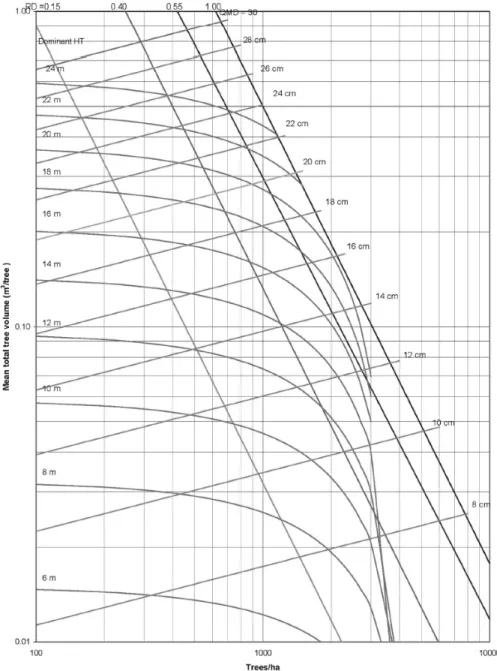
Figure 1 displays a density management diagram for jack pine in Eastern Canada (Sharma and Zhang 2007). The y-axis of the diagram represents the volume of the tree and additionally has logarithmic scales for the dominant tree height (HT) This is compared with the x-axis which is tree density. Both axes are on a logarithmic scale.
Diagonal lines also represent the relative density (RD) of the stand. The same is
represented for quadratic mean density (QMD). The values of each of these metrics are determined where lines intersect one another. For example, using Figure 1, at a
theoretical density of approximately 1350 stems per hectare, the average tree volume will be 0.10 m3, the dominant tree height will be 12m, QDBH will be 14cm, and RD will be 0.40.
DENSITY MANAGEMENT METHODS
Multiple theories and experimental studies have now been discussed regarding the ideology behind density management and its utility in boreal forests. Now it is important to outline the current methods that are used to manage density in boreal forest
stands. The main methods include pre-establishment treatments and thinning treatments.
These methods have been well established with years of literature proving their efficacy
Figure 1. A stand density management diagram of jack pine in Eastern Canada, from Sharma and Zhang (2007).
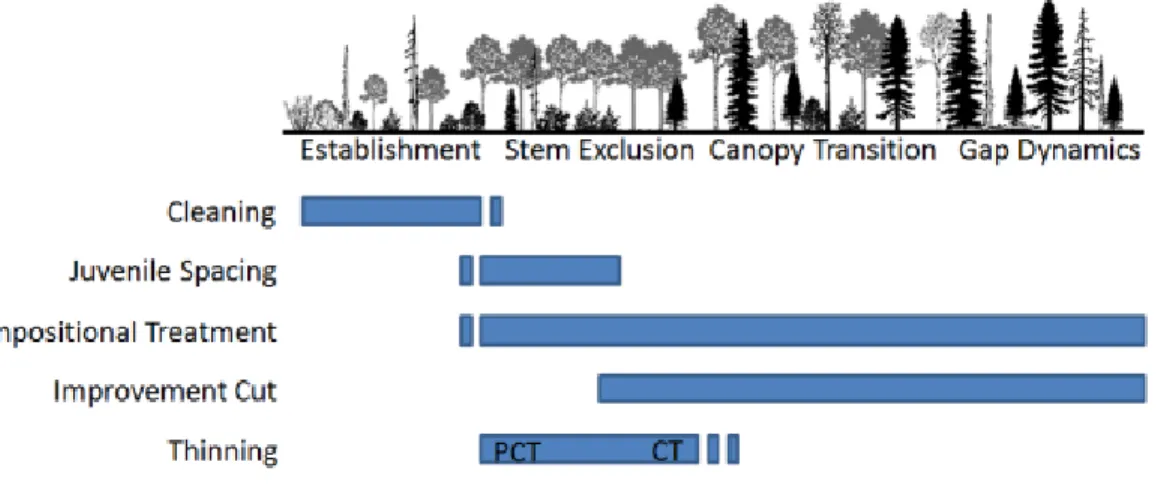
This represents the basis for density management practices which are currently used in many boreal forest stands in Ontario. Figure 2 displays the general silvicultural thinning management timeline of a forest stand (MNRF 2003, 2015). The initial cleaning stage occurs right after establishment and will typically involve herbicide
applications, so it will be considered vegetation management and will be outlined further.
Figure 2. The timeline of thinning treatments in a forest stand, from stand establishment to gap dynamics. From MNRF 2003.
Initial Spacing
When compartments are to be regenerated artificial planting is a commonly used treatment method because of the container stock’s competitive advantage and the ability to set the density of the establishment (Duryea 1992). Planting is useful because it can be suited for the most competitive sites, site prepared or not (MNRF 2015). Stand density and structure can also be controlled for management purposes with planting. In Ontario. Jack pine, white spruce, black spruce, white pine, and red pine are commonly planted in boreal regions (MNRF 2015). Planting is typically done in rows and each tree is evenly spaced to the specifications of the forest management plan.
If establishing a stand with planting, it should be initially spaced to a target that satisfies the management objectives. A study of black spruce, white spruce, and red pine initial spacings in a legacy 1950 Thunder Bay spacing trial by McClain et al. (1994) demonstrated the economic merits of increasing initial spacing and proactively lowering
the stand density when establishing a stand. After 37 years of growth, the study
reassessed trials planted at 1.8 m, 2.7 m, and 3.6 m initial spacing and found that DBH, live crown length and crown width all exhibited a significant increase with increasing initial spacing while there was a decrease in height. McClain et al. (1994) also found that the total and merchantable stem volume of each tree increased with increased initial spacing, although the stand volume per unit area decreased. Because of the higher value of timber which could be extracted to the increased merchantable stem volume, it is considered that a decrease in volume per unit area is an acceptable loss when considered economically.
Another study in northern Minnesota measured a jack pine pre-commercial thinning trial for changes in diameter across various treatments (Buckman 1964). The study compared the growth of no-thinning with thinning to square spacings of 1.2, 1.8 and 2.4 m. The site had been direct seeded by jack pine, like the site this thesis is
observing, and the stand was averaging 32,100 stems per hectare at 5 years. Results from a twenty-two-year remeasurement found the average diameter at breast height (DBH) of trees to be 9, 10, 13 and 15 cm for the control, 1.2, 1.8 and 2.5 m spacings respectively.
These results are indicative that pre-commercial thinning of overstocked stands is a good management practice to increase the merchantable volume of a stand. In just twenty-two years the increase of the DBH by 6 cm is a significant gain in merchantability. The preliminary increase in the value of the stand is already worth the investment.
Post-establishment Treatments
Treatments post-establishment, but before crown closure occurs will manipulate the density, composition, structure, and quality of the future stand (MNRF 2015). These
include juvenile spacing, compositional treatments, and improvement cuts. Juvenile spacing removes undesirable trees in a juvenile stand to free up space for desirable trees (BC Ministry of Forests 1992). Some target species will be removed during this and thus interspecific competition will be decreased. Cut trees have no commercial value so they are left on the site as downed woody debris (DWD). Trees will be cut to allow a specific spacing between crop trees, which will equate to a total stem per hectare density on the overall stand (BC Ministry of Forests 1992).
Compositional treatments are not used to directly manage stand density, but they will reduce the overall density within a stand. These treatments are applied to alter the proportion of species in a stand based on management objectives which dictate a target species composition (MNRF 2015). Common treatments are manual or chemical, and removed stems can be merchantable or non-merchantable depending on species and age.
Improvement cuts are like compositional treatments as they do not directly target density, but lowered density is an added value. Improvement cuts remove undesirable trees of any species in favour of stand development (MNRF 2015). This can be done as a single tree or a group and may be done to release suppressed artificial or natural trees.
Thinning
Thinning is a complex topic in forestry and an entire series of books could be written on the nuances and intricacies of it. Thinning is the compromise between
maximum growing space per land area and maximum growing space per individual tree (Ashton and Kelty 2018, p. 461). In the simplest terms, thinning is the partial removal of the canopy to meet economic objectives in the stand through lowered stand density, thus producing larger stems for timber production. There are several basic principles that
thinning should follow. First, thinning is only done once a stand is released and beyond the establishing stages of treatment (seedlings, saplings, poles) (Ashton and Kelty 2018, pp. 461-462). Second, to maximize the efficacy of thinning, managers should take care to ensure that openings created in the canopy are not too large (Ashton and Kelty 2018, p. 461). Canopy openings that do not close in sufficient time after growth will invite understory species to infiltrate. The structure of thinning operations is dependent on the stage of the stand and what managers expect to get out of a stand. Pre-commercial thinning is considered an investment treatment on a stand because there is no economic gain immediately seen from it (Ashton and Kelty 2018, p. 462). It is generally done earlier on in the rotation of the stand just after crown closure has occurred (MNRF 2015). Stems are left on the site as downed woody debris. Commercial thinning is done later in the development of the stand (Figure 2) (MNRF 2003, 2015). Because of this, the size of a tree that is cut during a commercial thinning enables it to be a profitable treatment, producing a net income for the trees cut.
Pre-commercial thinning can also be used to release desirable understory species from a stand while increasing the merchantability of the overstory cohort. A study of boreal mixedwood stands in Alberta, conducted by Bjelanovic et al. (2021) found that pre-commercial thinning was effective at decreasing the density and increasing the yield of both the overstory and understory. The study thinned aspen to 0, 1000, 2500, and 5000 stems per hectare, and had an unthinned control (Bjelanovic et al. 2021). The unthinned plots had greater mortality than the thinned plots. After eight years, the aspen diameter was increased by thinning, but height had no difference. Planted spruce
survival was not affected by aspen density, but the spruce diameter and height growth increased with aspen thinning intensity and time since treatment. The final yield
estimation results suggest that a heavy pre-commercial thinning to 1000 aspen per hectare will increase merchantable volume without lowering the aspen volume (Bjelanovic et al. 2021). Lighter to moderate thinning averaging approximately 2500 aspen stems per hectare did not have similar gains in merchantability for both aspen and spruce.
A study by Prévost and Gauthier (2012) had similar results for overstory. The study observed the effect of unthinned, 2.5, 3.0, and 3.5 m aspen spacing on both the retained overstory aspen and the understory balsam fir. It found that over ten years, the pre-commercial thinning increased aspen diameter increment by 66-85% and the basal area increment by 234-326%. Understory balsam fir greater than 1 m was favoured with the pre-commercial thinning, as height and crown growth were two to three times that of the control. Regenerating balsam fir was not favoured with the pre-commercial thinning, however. Prévost and Gauthier (2012) suggest that, in addition to increasing the
merchantable volume of the stand, pre-commercial thinning can be used to limit complete softwood conversion in the early stages of stand development.
A somewhat abstract and controversial method of pre-commercial thinning is aerially thinning with herbicide. This method is different from typical chemical
applications as it is done in the growing season before conifer buds have hardened off. A 1999 study by Weth applied Vision glyphosate and Release Tripoclyr at varying
concentrations on an overstocked jack pine stand. The stand was treated by helicopter with a thru valve boom that has three-meter swath spacing. One year after application each treatment was measured using a series of established sample plots, and there was an apparent decrease in live tree density on the site, as every other three-meter strip was killed. The site was later remeasured in 2004 (KBM Forestry Consultants 2005) and the