However, to date, no comprehensive studies have been conducted to compare and investigate the performance of different transformer-based language models in question answering (QA). By conducting extensive experiments on two query-answering datasets (namely SQuAD and NLQuAD), we demonstrate that the proposed framework can improve the performance of transformer-based models.
![graph extracted from an external knowledge base. . . . . . . . . . . . . . 46 3.7 AHE [99] architecture for multiple-choice question-answering](https://thumb-us.123doks.com/thumbv2/9docorg/12453263.0/15.918.120.820.90.1129/extracted-external-knowledge-architecture-multiple-choice-question-answering.webp)
Problem Definition
This study aims to compare the performance of different state-of-the-art transformer-based models in the extractive question-answering task. Finally, we investigate the performance of several transformer-based language models when processing long context passages in the extractive question-answer task.
Contribution
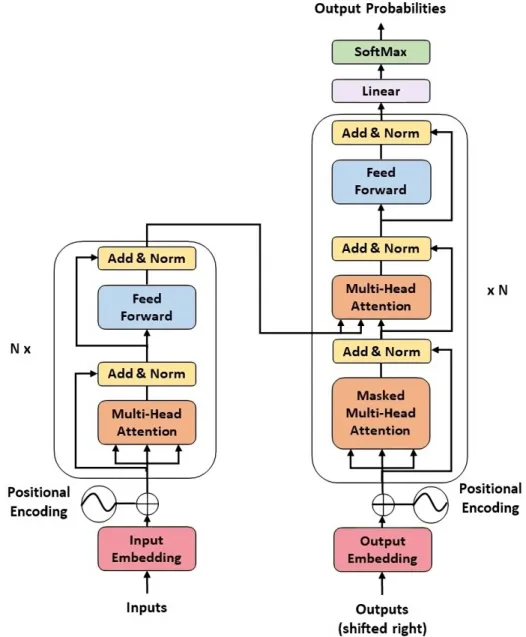
This thesis studies and compares different transformer-based [91] models, such as BERT [19], RoBERTa [52], BART [50] and Longformer [5] in the task of answering questions. We explore and compare the performance of different transformer-based models on different question types.
Thesis Outline
We aim to perform a comprehensive investigation of individual features and their impact on different transformer-based models through an ablation study. In this chapter, we further compare the performance of different transformer-based feature-augmented models for each specific query type in SQuAD [73].
Software & Source Code
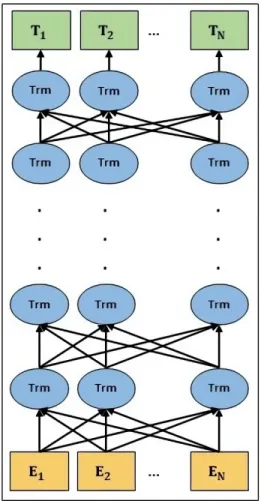
This method captures information about the order of the words within the data itself, rather than relying on the structure of the network. Self-attention enables the neural network to understand a word within the context of the words adjacent to it.

BERT
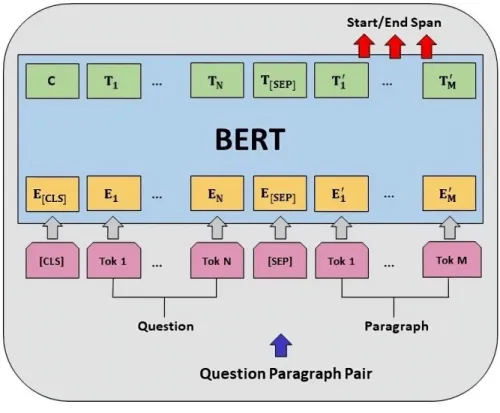
During the pretraining phase (as depicted in Figure 2.5), the input consists of a pair of sentences (sentence A followed by sentence B) with certain words masked. In the case of the question-answering task for example (as shown in Figure 2.7), the input consists of the question followed by a passage containing the answer.
RoBERTa
RoBERTA uses the same architecture as BERT, but removes the goal of pre-training to predict the next sentence. However, by conducting some experiments and defining different input formats, the authors of this paper found that the training without loss of next-sentence prediction outperforms the performance of the original BERT model on most subsequent tasks.
BART
Extractive Question-Answering [93]
This can be a single document or a collection of documents, such as a database, a website or a series of news articles. Optional additional information, such as background knowledge or context, that can help the system determine the correct answer. Based on this input, the extractive QA system will identify and extract the relevant sentences or phrases in the given text corpus that contain the answer to the question.
The output will be the most relevant and accurate answer to the question, extracted from the text corpus. Extractive QA is often used in information retrieval and text summarization applications, where the goal is to provide fast and accurate answers to questions using existing text sources [93].
Open Generative Question-Answering [39]
Closed Generative Question-Answering [39]
Categorization based on Question Type
Multiple-Choice Question-Answering or MCQA
The subject of the painting is said to be Lisa Gherardini, the wife of a wealthy Florentine merchant. The Mona Lisa is known for the mysterious smile on the subject's face, which has fired the imagination of art lovers for centuries. The painting is kept in the Louvre Museum in Paris and is one of the most famous works of art in the world.
Conversational Question-Answering or CQA
Visual Question-Answering or VQA
Categorizing based on Answer Type
Factoid Questions Answering
Definition-Based or Non-Factoid Question-Answering
Hybrid Question-Answering
Categorization based on Evidence or Answer Source
Raw Text-Based Question-Answering
Knowledge-Based Question-Answering
Categorization based on Modeling Approach
Rule-Based Models
Machine Learning Based Models
Deep Learning Based Models
A Few Examples of Previously Proposed Question-Answering Models
LSTM-based Deep Learning Models for Non-factoid Answer Selec-
Using CNN filters on top of the Bi-LSTM model [26] results in improved embeddings for both the question and the answer [86]. However, for the multiple choice task, the first text is the given question, and the second text is each of the given answer sentences [99]. The input to each of these transformer-based models is a single packet consisting of the question and passage, containing the answer to the given question, separated by a [SEP] token, and the outputs are the start and end positions of the answer. . extension [19].
Start Token Classifier Vector (S) and End Token Classifier Vector (E) to predict the beginning and end of the response span, respectively. Similarly, to predict the end of the response span, the model follows the same process using the E vector [19].
![Figure 3.3: The basic Bi-LSTM [26] architecture proposed by this work [86] for answer selection task.](https://thumb-us.123doks.com/thumbv2/9docorg/12453263.0/60.918.174.784.119.455/figure-basic-lstm-architecture-proposed-work-answer-selection.webp)
Linguistic Features
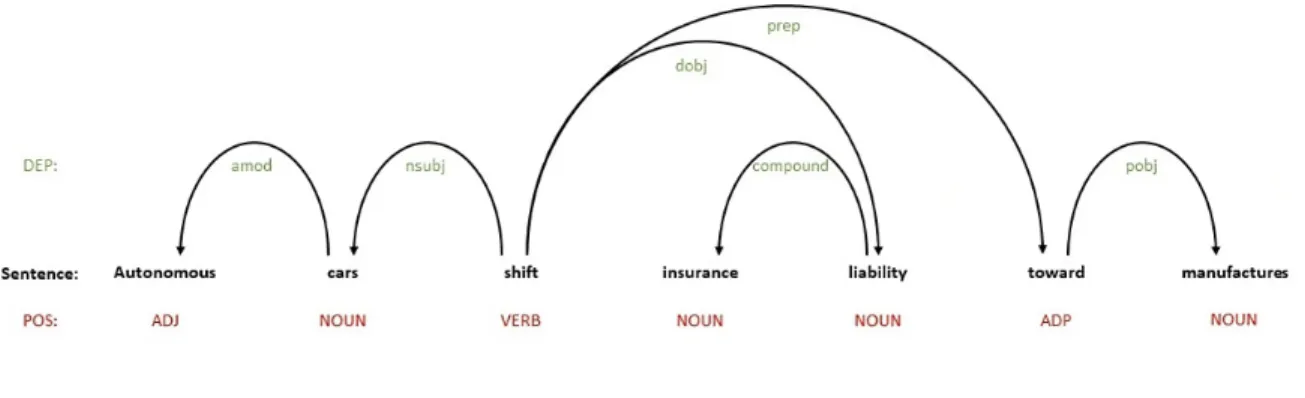
In syntactic dependency, words in a sentence are represented as nodes and the relationships between the words are represented as directed edges or arcs. In this example, the relationship between the words cars and autonomous is identified as an adjectival modifier, abbreviated as amod, indicating an adjectival phrase that serves to modify a noun (or pronoun). In addition, the relationship between the words move and cars is categorized as a nominal subject, or nsubj for short, which represents a nominal element that serves as the syntactic subject and the proto-agent of a clause.
Additionally, the relationship between the words move and liability is labeled as a direct object, also known as dobj, which refers to the noun phrase that functions as the accusative object of the verb. The choice of stop words may depend on the specific NLP task, the language being processed and the domain or topic of the text being analyzed.
Variants of Feature-Augmnted Architecture
In this variant of the architecture, the neural network component is removed from the General Feature Augmentation Architecture. In this variant of the architecture, the neural network component from the General Feature Augmentation Architecture is replaced with an LSTM [34] layer to transform the features. In this variant of the architecture, the neural network component of the General Feature Augmentation Architecture is replaced with a linear layer to transform the features.
In addition, an ablation study will be performed on one of the studied question-answer datasets to investigate the impact of certain features on the proposed extended-features transformer-based architecture. Current state-of-the-art models for SQuAD [73] use deep learning techniques such as transformers [91] and other transformer-based models (e.g., BERT [19]).

Non-Factoid Long Question Answering Dataset [82]
In most existing query-answering datasets, such as SQuAD [73], queries are generated by aggregation workers based on provided short passages, and answers are extracted from these passages. As previously mentioned, NLQuAD [82] requires a comprehensive understanding of language at the document level, which is challenging due to the average length of documents and responses being 877 and 175 words, respectively. For example, to answer the question "How are people coping in the lockdown?" (Figure 5.3), the question-answering model must read the document to first understand the idea of blocking and then to find information on people's behavior in blocking [82].
In this thesis, we performed most of our experiments on SQuAD [73], as this is a well-known benchmark dataset for question-answering task. Furthermore, we performed some experiments on NLQuAD [82] to investigate the effect of the proposed feature-augmented architecture on a non-actual, long question-answering dataset.
Performance Metrics for Question Answering
- Precision
- Recall
- F1 Score
- Exact Match
- Jaccard Index
Finally, we report the average of the precision scores calculated for all instances in our evaluation set as the model's precision score. However, it is still a measure of the model's ability to correctly answer a question given a context. Finally, we report the average of the recall scores, calculated for all instances in our test set, as the overall recall score of the model.
If the predicted normalized response exactly matches the normalized ground truth response (ie, they have the same text and sign order or in other words are identical), then the response predicted by the model is considered correct and the result the exact match for that example is 1. Finally, we determine the model's Jaccard Index by averaging the Jaccard Indices that were calculated for every single example in our evaluation set.
Experimental Results
- Experimental Settings
- Comparing Transformer-Based Models on SQuAD using Different
- Comparing Transformer-Based Models on SQuAD using the Direct
- Comparing Transformer-Based Models on SQuAD using the Direct
- Comparing Transformer-Based Models on SQuAD using the Direct
- Comparing Transformer-Based Models on SQuAD using the Direct
- Comparing Transformer-Based Models on SQuAD using the Direct
- Comparing Transformer-Based Models on SQuAD using the Direct
- Comparing Transformer-Based Models on SQuAD using the Direct
- Comparing Transformer-Based Models on SQuAD using the Direct
Thus, we can conclude that Direct Feature Augmentation Architecture 4.2.2 is more successful in improving the performance of the transformer-based models, compared to LSTM Feature Transformation Architecture 4.2.2. Our approach involves training each model on the entire training set, using the Direct Feature Augmentation Architecture or architecture without augmentation, and then testing their performance on Where questions from the test set. However, in most cases, the Direct Feature Augmentation Architecture was able to improve the performance of the studied models.
Although the Direct Feature Augmentation Architecture has shown the ability to improve performance in the majority of studied transformer-based models for Who questions. Our approach involves training each model on the full training dataset, using the Direct Feature Augmentation Architecture or architecture without augmentation, and then evaluating their performance solely on Which questions from the test dataset.
Feature Augmentation for Long Passages
Experimental Settings
Comparing Longformer Model on NLQuAD using Different Vari-
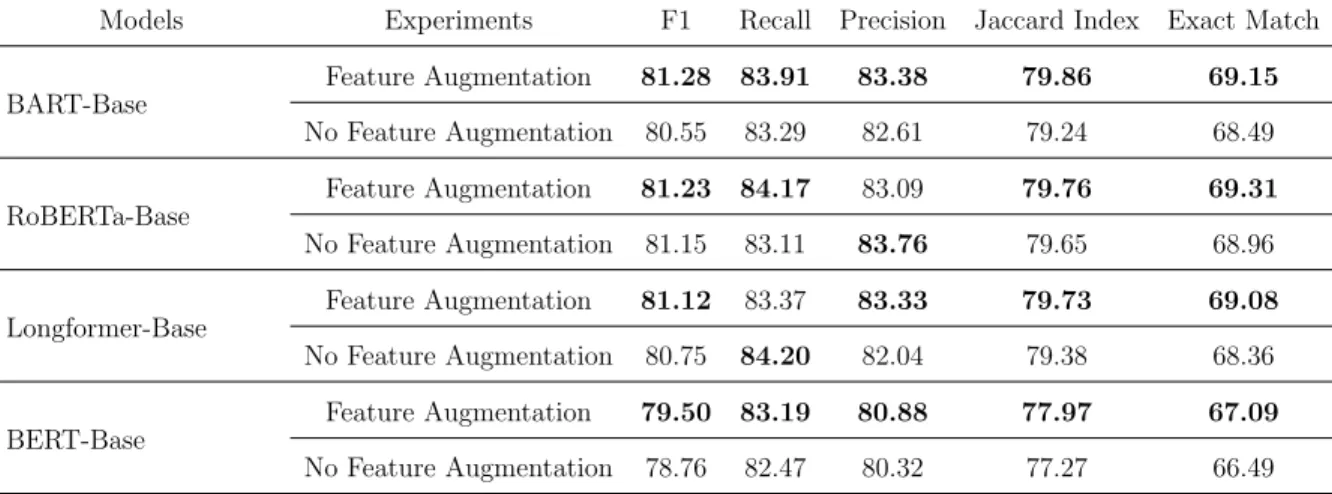
Contrary to the previous experiment, the present experiment explores the overall efficiency of the long model [5], as the backbone model for the Direct Feature Addition Architecture, which was designed without a neural network (previously described in 4.2.2 . ), in all types of questions. After performing a comparative analysis of the Direct Feature Augmentation Architecture in NLQuAD [82] and the Direct Feature Addition Architecture in SQuAD [73], it is evident from the results that the improvement in the performance of the backbone model is greater in NLQuAD [82] than in SQuAD [73]. In this experiment, we use one of the variants of the feature-augmented architecture that involves feeding the extracted features through an LSTM layer, followed by concatenating them with the output of the longformer model [5].
The evaluation metrics described in Table 5.13 reveal that this specific variant of the feature-augmented architecture fails to improve the performance of the backbone model in SQUAD [82].
Ablation Study
- Absence of Named Entity Recognition (NER)
- Absence of Part-of-Speech Tag (POS)
- Absence of Syntactic Dependency (DEP)
- Absence of Stop Words (STOP)
In this study, we remove each language feature one by one to investigate its effect on the performance of the Direct Feature Enhancement Architecture. Therefore, excluding NER has a noticeable, though not significant, effect on the performance of the feature-augmented architecture. The results shown in Table 5.15 show that not tagging the part of speech (POS) had a detrimental impact on the effectiveness of the direct Augmen- Feature.
In other words, the feature-augmented architecture could not improve the performance of the underlying model after eliminating POS. Hence, in the absence of the DEP feature, the Direct Feature Augmentation Architecture is unable to improve the performance of the backbone model.

Case Study on SQuAD
Effectiveness of Syntactic Dependency (DEP)
Furthermore, the ablation study performed on the SQuAD [73] dataset shows that the exclusion of part-of-speech (POS) tags or syntactic dependencies (DEP) from the feature set negatively impacts the performance of the Direct Feature Augmentation Architecture. We proposed an enhanced feature architecture, along with three variants, to improve the performance of the studied high-performance transformer-based language models in query answering. The results indicate that including additional linguistic features can improve the performance of the backbone transformer-based model in most cases.
In Proceedings of the 55th Annual Meeting of the Association for Computational Linguistics (Volume 1: Long Articles), pages 1870–. In Proceedings of the 2020 Conference on Empirical Methods in Natural Language Processing (EMNLP), Web pages, November 2020.
![Figure 2.5: BERT overall pre-training procedure. [CLS] is a special token, which is added to the start of every input sequence and [SEP] is another special token, which is used to separate first sentence from the second sentence.](https://thumb-us.123doks.com/thumbv2/9docorg/12453263.0/36.918.240.708.128.505/figure-overall-training-procedure-sequence-separate-sentence-sentence.webp)

![Figure 2.10: Different attention mechanisms introduced by Longformer compared to the original full attention introduced by transformers [91].](https://thumb-us.123doks.com/thumbv2/9docorg/12453263.0/45.918.156.798.113.278/different-attention-mechanisms-introduced-longformer-attention-introduced-transformers.webp)
![Figure 3.4: The Bi-LSTM/CNN architecture proposed by this work [86] for answer se- se-lection task.](https://thumb-us.123doks.com/thumbv2/9docorg/12453263.0/61.918.197.743.113.585/figure-lstm-cnn-architecture-proposed-work-answer-lection.webp)
![Figure 3.5: The Bi-LSTM [26] with attention architecture proposed by this work [86] for answer selection task.](https://thumb-us.123doks.com/thumbv2/9docorg/12453263.0/62.918.183.761.116.376/figure-lstm-attention-architecture-proposed-work-answer-selection.webp)