Non-Alcoholic Fatty
Liver Disease in Children and Adolescents:
Lifestyle Change - a Systematic Review and Meta-Analysis
Melina Utz-Melere,* Cristina Targa-Ferreira,*,† Bernardo Lessa-Horta,‡ Matias Epifanio,*,§ Marialena Mouzaki,|| Angelo A. Mattos¶ * Santo Antônio Hospital, Santa Casa de Misericordia Complex of Porto Alegre/RS, Brazil.
† Federal University of Health Sciences of Porto Alegre (UFCSPA), Brazil. ‡ Federal University of Pelotas. Senior Researcher. FAPEAM, Brazil. § Pontifical Catholic University of Rio Grande do Sul (PUCRS), Brazil. || Department of Pediatrics, Division of Gastroenterology, Hepatology and Nutrition,
Hospital for Sick Children, University of Toronto, Toronto, Ontario, Canada.
¶ Federal University of Health Sciences of Porto Alegre (UFCSPA), Brazil.
May-June, Vol. 17 No. 3, 2018: 345-354
INTRODUCTION
Nonalcoholic fatty liver disease (NAFLD) is an in-creasingly common cause of chronic liver disease in chil-dren and adolescentes,1 likely due to an increase in the
incidence of overweight and obesity in this population.2,3
In Europe, the prevalence of overweight and obesity in children surpasses 30% and has been steadily increasing over the past decades.3 In the United States, 16.9% of
chil-dren aged 2 to 19 are obese.4 In Brazil, more than 30% of
children between the ages of 5 and 9 are overweight, while the prevalence of obesity is about 15%.5
The Official Journal of the Mexican Association of Hepatology, the Latin-American Association for Study of the Liver and
the Canadian Association for the Study of the Liver
Manuscript received: Manuscript received:Manuscript received:
Manuscript received:Manuscript received: November 20, 2017. Manuscript accepted:Manuscript accepted:Manuscript accepted:Manuscript accepted:Manuscript accepted: January 12, 2018.
DOI:10.5604/01.3001.0011.7380
A B S T R A C T A B S T R A C T A B S T R A C T A B S T R A C T A B S T R A C T
Introduction and aim. Introduction and aim. Introduction and aim. Introduction and aim.
Introduction and aim. This manuscript seeks to analyze the impact of lifestyle changes on body mass index (BMI), aminotrans-ferases and steatosis in children and adolescents with nonalcoholic fatty liver disease (NAFLD). Material and methods. Material and methods. Material and methods. Material and methods. Material and methods. A re-view of PubMed, BIREME, Scopus, EMBASE, Medline and Web of Science databases 2015 was performed seeking studies addressing the impact of lifestyle interventions on children and/or adolescents with NAFLD. Inclusion were manuscripts written in Portuguese, English and Spanish, as well as age less than 18 years. Two reviewers performed the data extraction independently and differences were resolved by consensus. Outcome measures were BMI, serum aminotransferase levels and the presence of hepatic steatosis. Results. Results. Results. Results. Results. The literature search identified 71,012 articles. After excluding 46,397 duplicates and other clearly irrelevant studies, 89 publications were reviewed in detail. Another 55 studies were excluded at this stage. Subsequently, 18 were excluded due to lack of data and three new articles were found in the review of the references of previously identified manuscripts. Therefore, 19 studies that had evaluated 923 subjects (477 boys and 446 girls) aged 6-18 years were included in the review. In most studies, the intervention included aerobic exercise and diet. In nine studies, BMI improved significantly following the intervention. The vast majority of studies reported a benefit from the intervention on aminotransferase levels. Lifestyle changes also had a significant im-pact on steatosis, reducing the risk by 61%. ConclusionConclusionConclusionConclusionConclusion. In conclusion lifestyle changes lead to significant improvements in BMI, aminotransferase levels and hepatic steatosis in children and adolescents with NAFLD.
Key words. Key words.Key words. Key words.
Key words. Pediatric. Hepatic steatosis. Physical activity. Nutritional intervention. Obesity.
NAFLD is classified histologically as either simple he-patic steatosis or non - alcoholic steatohepatitis (NASH), the latter being defined by hepatocellular steatosis and in-flammation with or without fibrosis.6 The gold standard
for the diagnosis of NAFLD is histology obtained using liver biopsy, which can determine the presence of steato-sis, inflammation or fibrosis.2 The biopsy has some
limita-tions; therefore, indirect methods have been used for diagnosis.7-10
events.11-14 The long-term prognosis of children with
NAFLD remains nuclear;12 however, in adulthood these
patients have a 14-fold increased risk of dying or requiring liver transplantation compared to the general population of the same age and sex.15
Due to the correlation of NAFLD with excess weight, the first step in treatment has traditionally been targeting obesity by stimulating lifestyle changes through physical activity and consumption of a healthier diet, as this is the only available treatment for these patients.16-18 The
number of well-designed, randomized controlled trials that have investigated the impact of lifestyle changes as a first-step intervention to treat pediatric NAFLD is small. Most intervention studies that combine diet and increased physical activity shows a benefit in NAFLD. Exercise, even without weight loss, appears to reduce steatosis, but the intensity of the exercise for the treatment of NAFLD has not yet been established. Isolated exercise, without ca-loric restriction, is not yet a proven strategy for the man-agement of children with NAFLD.19-23
The aim of this study was to perform a systematic re-view and meta-analysis to assess the evidence on the im-pact of lifestyle interventions through aerobic exercise and a balanced diet on body mass index (BMI), serum ami-notransferase levels and hepatic steatosis in children and adolescents NAFLD.
MATERIAL AND METHODS
Type of studies assessed
The search included randomized controlled trials, co-hort, case-control studies, non-randomized controlled tri-als and non-controlled tritri-als. Case reports, reviews, editorials and thesis dissertations were excluded. We in-cluded manuscripts published in Portuguese, English or Spanish.
Types of exposure and participants
The trials included had investigated some form of life-style intervention, such as regular physical activity, diet or a combination of the two. Randomized trials that had in-vestigated medications for the treatment of NAFLD were included but only data from the control arm were includ-ed in the analyses. Studies were includinclud-ed if variables BMI, aminotransferases and hepatic steatosis were available be-fore and after the intervention.
Studies including participants under 18 years of age were included. In cases of combined adult and pediatric cohorts, data from individuals under the age of 18 years were included. All participants had to have a diagnosis of NAFLD for inclusion in the analysis. The diagnosis could
have been made clinically (overweight/obesity patient with abnormal aminotransferases or increased insulin re-sistance), radiologically (magnetic resonance imaging of the abdominal (MRI)), ultrasound or histologically fol-lowing a liver biopsy.24,25
We excluded studies that evaluated children and ado-lescents with other chronic liver diseases such as infec-tious hepatitis, endocrinological diseases that could predispose to liver disease, steatosis secondary to parenteral nutrition, drugs or alcohol and studies that had evaluated the patients after surgery.
Types of outcome measures
Studies were included if the outcome measures of in-terest were improvement in BMI, serum aminotransferase levels, as well as radiological or histological evidence of steatosis improvement. To compare BMI between ages and gender Z scores were used. A BMI between 85 and 96 percentiles for age was used to define overweight and per-centile ≥ 97 was used as cut off for obesity.1,26
Aminotrans-ferases (ALT, AST) were used as the only laboratory test; the values were defined according to the laboratory refer-ence of each study.16
Search methods and selection of studies
PubMed, BIREME, Scopus EMBASE, Medline and Web of Science were reviewed by a single researcher. The search in the database covered articles published through-out the indexing period up to April 2015.
The literature search used the following key words: disease (hepatic steatosis non-alcoholic, non-alcoholic st-eatohepatitis, NAFLD, NASH, obesity, aminotransferase, aspartate aminotransferase AST, ALT, alanine aminotrans-ferase, fatty liver and hepatic steatosis). These words were combined with the use of the following words: lifestyle intervention, physical activity, physical fitness, aerobic ex-ercise, weight loss, intervention, treatment, nutritional in-tervention and diet.
Two reviewers (MUM and CTF) performed the data extraction independently and differences were resolved by consensus. Outcome measures were: BMI, serum levels of ALT and AST and the presence of hepatic steatosis, be-fore and after the intervention. In each study data on par-ticipant’s characteristics, such as gender, age and the way in which the intervention was performed were extracted. In cases of missing data, the corresponding author was contacted via email twice.
cal-culated intervals of 95% confidence. Q test was used to as-sess for heterogeneity of the studies and in the case of het-erogeneity being greater than expected, we used the random effects model to obtain aggregated measurements. The significance level was 5% and the analysis were per-formed in STATA version 13.0.
RESULTS
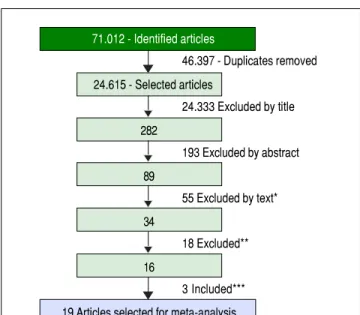
Following the initial search 71,012 articles were identi-fied (Figure 1). After excluding 46,397 duplicates, 24,615 articles were reviewed and 24,333 were excluded. The ab-stracts of the 282 remaining manuscripts were reviewed, which led to the removal of another 193 studies. Eighty-nine manuscripts were read in their entirety leading to the exclusion of another 55 studies. Of the remaining 34 man-uscripts 18 were not included, as they did not contain data necessary for the meta-analysis. Three more studies iden-tified by reviewing the references of already included studies were selected as well. In total, 19 manuscripts (923 individuals) were selected for review and meta-analysis.
Out of the selected studies eight were controlled trials, three were nonrandomized and eight were non-controlled clinical trials. In most studies, the intervention included aerobic exercise and diet. In two studies27,28 physical
activ-ity through aerobic exercise was the only intervention. The age of participants ranged from 6 to 18 years, and 477 were male and 446 females (Table 1).
The diet suggested was normocaloric ranging from 1.300-1900 Kcal/day with a caloric distribution as follows:
Figure 1. Figure 1.Figure 1.
Figure 1.Figure 1. Flow chart of meta-analysis inclusion.
46.397 - Duplicates removed
24.333 Excluded by title
193 Excluded by abstract
55 Excluded by text*
18 Excluded**
3 Included*** 71.012 - Identified articles
24.615 - Selected articles
282
89
34
16
19 Articles selected for meta-analysis
* Excluded: Observational studies (n = 5). Prevalence studies (N = 9). Did not presented values post intervention (N = 10). There were no groups with only lifestyle changes (N = 8). Adults popula-tion (N = 4). No intervenpopula-tion made, only a quespopula-tionnaire (N = 9). Text was not found in its entirety (N = 3). Same pupulation (N = 2). No reports on the intervention (N = 5). ** Excluded: Due to lack of date to carry out the meta-analysis (N = 18). *** Included: After references review (N = 3).
Table 1. Characteristics of the evaluated population.
References Location N* Age (SD)** Male (%) BMI (SD***
Van der Heijden GJ (2010)27 EUA 15 12.6 (±0.4) 47% 33.7 (±1.1)
Farris JW (2011)33 EUA 23 6-12 22% 30.3 (± 4.56)
Verduci E (2013)37 Italy 46 6-14 46% 2.3 (± 0.4)****
Gronbaek H (2012)16 Denmark 117 12.1 (±1.3) 44% 28.0 (± 3.6)
Antunes BDMM (2013)28 Brazil 34 13.7 (± 1.17) 65% 29.5 (± 5.1)
Togashi K (2010)45 Japan 33 10.1 (± 1.7) 70% 25.9
Wang CL (2008)20 China 19 13.4 (± 2.5) 68% 29.6 (±1.48)
Nobili V (2006)1 Italy 43 12.4 (± 3.02) 30% 25.5 (± 3.6)
Tazawa Y (1997)29 Japan 73 10 955 28.4
Vajro P (2000)36 Italy 11 8.5 (± 2.8) 55% n/d
Tock L (2010)30 Brazil 14 15-18 100% 37.0 (± 3.15)
Nobili V (2006)39 Italy 84 3-18.8 70% 25.9 (± 3.6)
Tock L (2006)31 Brazil 73 17 (± 1.6) 33% 36.5 (± 2.86)
Reinehr T (2009)34 London 109 6-16 53% 2.5 (± 0.04)****
Pozzato C (2010)38 Italy 26 6-14 42% 2.3 (± 0.46)****
Santomauro M (2012)19 Venezuela 24 7-18 50% 28.3 (± 4.23)
Akcam M (2011)35 Turkey 22 11.3 (± 2.6) 45% 26.8 (± 4.0)
Nadeau KJ (2009)32 USA 13 15.1 38% 40.2 (± 1.8)
Koot BG (2011)22 Holland 144 14.1 (± 2.3) 38% 3.4 (± 0.40)****
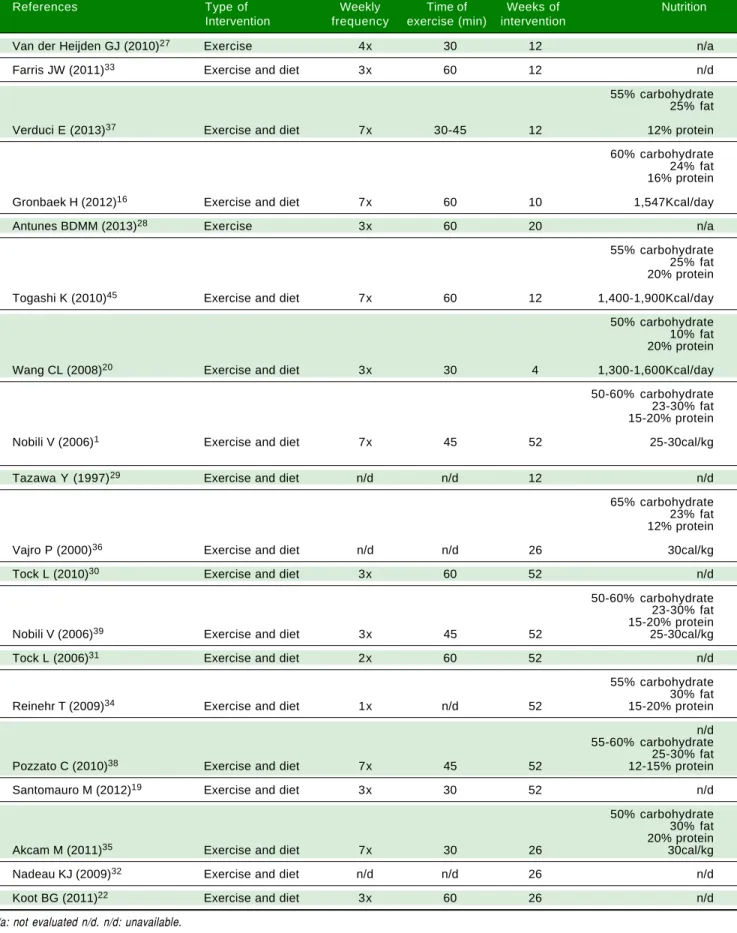
50-65% from carbohydrates, 10-30% from fat and 12-20% from protein. In some studies, depending on the patient’s age, 10 g of fiber were added to the diet. The details of the diet were not reported in seven studies.19,22,29-33
Regard-ing physical activity, all studies assessed aerobic exercise, ranging from once a week to daily workouts of 60 min-utes on average. The duration of intervention ranged be-tween 4 and 52 weeks. Details of interventions are shown in table 2.
In most studies, hepatic steatosis was assessed using ab-dominal ultrasound.16,19,20,22,28-32,34-36 Three studies assessed
steatosis through MRI/MR spectroscopy27,37,38 and only
two studies included histological data as a means of assess-ing steatosis severity.1,39
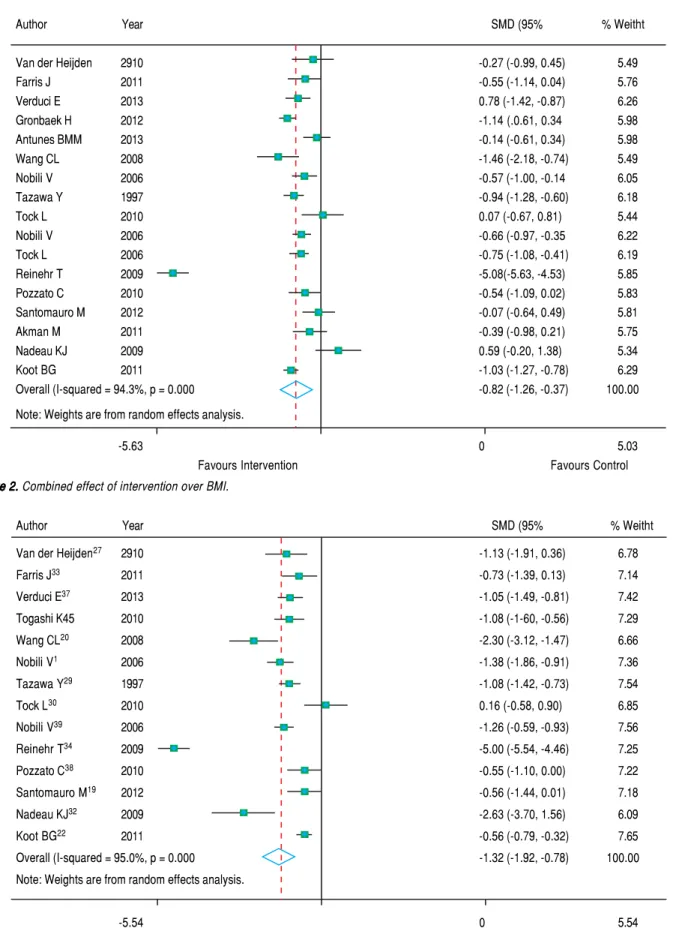
With regards to the effect of intervention on BMI, fig-ure 2 shows that in eight studies the result was not signifi-cant and in nine studies there was a decrease in BMI z-score. As the heterogeneity between studies was high (p < 0.001), we used a random effects model to combine the studies and the standardized aggregate was 0.82 (95% CI: -1.26 to -0.37).
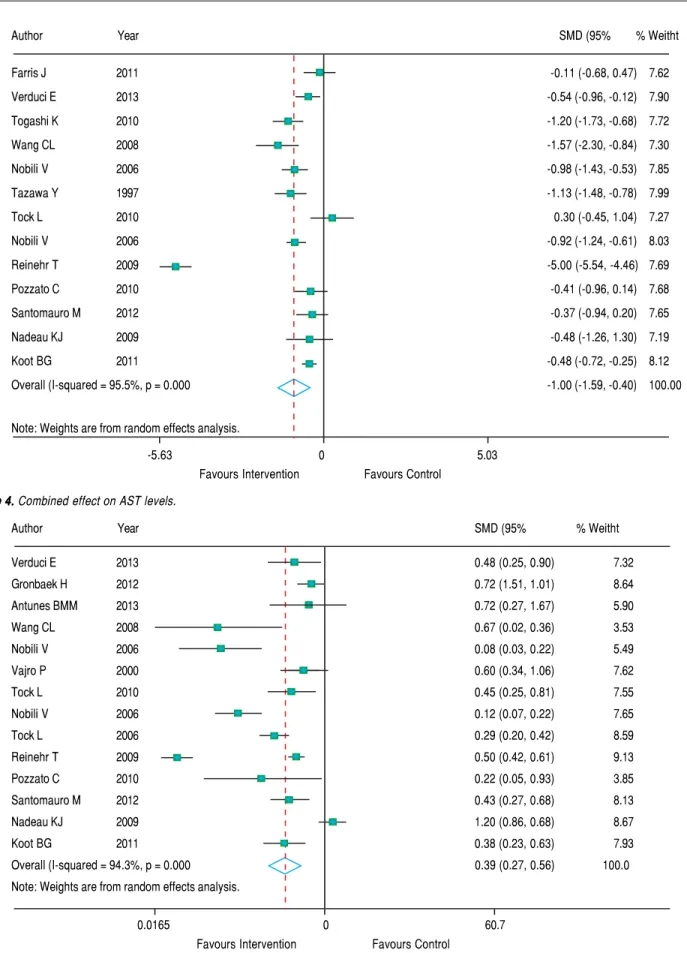
Figure 3 shows that in most studies there was a benefit from the intervention on ALT levels. The combined effect of using a random model was 1.35 (95% CI: 1.92 to -0.78), since the heterogeneity was increased (p < 0.001). In five studies, intervention showed no effect on AST lev-els. However, in eight studies there was a significant drop in AST. The combined effect was -1.00 standard deviation (95% CI: -1.59 to -0.40) (Figure 4).
In figure 5, we note that the intervention was beneficial for hepatic steatosis in ten studies; but four studies showed no significant effect. The heterogeneity was high (p < 0.001) and the pooled effect was estimated using ran-dom - effects model. The risk of steatosis reduced by 61% after the intervention (RR grouped = 0.39; 95% CI: 0.27 to 0.56).
DISCUSSION
NAFLD is the most prevalent pediatric liver disease in the world and has become a serious health problem, as well as a challenge for pediatricians who aim at treating but also preventing the evolution of this condition. Adult studies suggest that lifestyle changes can be beneficial for the treatment of NAFLD.10,25 The pediatric literature is
characterized by small numbers of patients and heteroge-neous interventions. This systematic review and meta-analysis shows that a balanced diet coupled with physical activity, improves BMI, aminotransferases and hepatic st-eatosis of children and adolescents with NAFLD, inde-pendent of puberty.19,35
Most patients with NAFLD are asymptomatic. NAFLD should be suspected in overweight / obese
chil-dren and adolescents if their waist circumference is >> 95th percentile for age and sex.30
The outcome measures of this systematic review in-cluded changes in BMI and aminotransferase levels, as this is how patients are typically monitored in the clinical set-ting and these are the markers most often measured in pediatric interventional studies in the field of NAFLD. While they have both been found to correlate with disease severity, their sensitivity and specificity in determining st-eatosis is poor. BMI does not reflect body composition, and performs worse than waist circumference in predict-ing metabolic dysregulation, the hepatic manifestation of which is NAFLD.40 It has also been shown to miss over a
quarter of children with excess adiposity.41
Aminotrans-ferases have been shown to be inaccurate markers of stea-tosis when used for screening of NAFLD; ALT elevation above twice the upper limit of normal has a sensitivity 57% and specificity of 71% in this context.42
Magnetic resonance spectroscopy seems to be an imag-ing method quite promisimag-ing, however, it still needs more studies.32
Given the invasive nature of liver biopsies, imaging is often used as an additional surrogate marker of steatosis. The available literature included in this systematic review reports predominantly on ultrasound-based estimates of hepatic steatosis. This is a significant limitation, as the positive predictive value of ultrasonography for the deter-mination of steatosis ranges between 47-62%.43 Only a
limited number of studies included the use of MRI, which albeit better than ultrasonography,43 its accuracy in
pediat-rics remains to be determined. An even fewer number of studies reported on the results of histology, which is con-sidered the gold standard for the determination and quan-tification of hepatic steatosis in the context of NAFLD. The paucity of histological data also prevented the assess-ment of the impact of lifestyle interventions on hepatic fi-brosis, which is the major determinant of long-term outcomes.44
The goal of treatment is the regression of steatosis/in-flammation and/or liver fibrosis. The decrease in ALT is commonly used as a marker of improvement for NAFLD.1
Most studies included in this systematic review and meta-analysis assessed the impact of both dietary and physical activity interventions. The study of Van der Hei-jden, et al.27 however, solely examined the impact of
physi-cal activity on the hepatic steatosis of adolescents. The results showed a significant reduction in hepatic steatosis mirrored by ALT changes, however, BMI z-scores did not change. The latter may be the result of the aforementioned limitations of BMI as a surrogate marker of obesity. Like-wise, Ali, et al.28 assessed the impact of physical activity,
Table 2. Details of the interventions used in each study for lifestyle change.
References Type of Weekly Time of Weeks of Nutrition
Intervention frequency exercise (min) intervention
Van der Heijden GJ (2010)27 Exercise 4x 30 12 n/a
Farris JW (2011)33 Exercise and diet 3x 60 12 n/d
55% carbohydrate 25% fat
Verduci E (2013)37 Exercise and diet 7x 30-45 12 12% protein
60% carbohydrate 24% fat 16% protein
Gronbaek H (2012)16 Exercise and diet 7x 60 10 1,547Kcal/day
Antunes BDMM (2013)28 Exercise 3x 60 20 n/a
55% carbohydrate 25% fat 20% protein
Togashi K (2010)45 Exercise and diet 7x 60 12 1,400-1,900Kcal/day
50% carbohydrate 10% fat 20% protein
Wang CL (2008)20 Exercise and diet 3x 30 4 1,300-1,600Kcal/day
50-60% carbohydrate 23-30% fat 15-20% protein
Nobili V (2006)1 Exercise and diet 7x 45 52 25-30cal/kg
Tazawa Y (1997)29 Exercise and diet n/d n/d 12 n/d
65% carbohydrate 23% fat 12% protein
Vajro P (2000)36 Exercise and diet n/d n/d 26 30cal/kg
Tock L (2010)30 Exercise and diet 3x 60 52 n/d
50-60% carbohydrate 23-30% fat 15-20% protein Nobili V (2006)39 Exercise and diet 3x 45 52 25-30cal/kg
Tock L (2006)31 Exercise and diet 2x 60 52 n/d
55% carbohydrate 30% fat Reinehr T (2009)34 Exercise and diet 1x n/d 52 15-20% protein
n/d 55-60% carbohydrate 25-30% fat Pozzato C (2010)38 Exercise and diet 7x 45 52 12-15% protein
Santomauro M (2012)19 Exercise and diet 3x 30 52 n/d
50% carbohydrate 30% fat 20% protein Akcam M (2011)35 Exercise and diet 7x 30 26 30cal/kg
Nadeau KJ (2009)32 Exercise and diet n/d n/d 26 n/d
Koot BG (2011)22 Exercise and diet 3x 60 26 n/d
Figure 2. Figure 2. Figure 2. Figure 2.
Figure 2. Combined effect of intervention over BMI.
Figure 3. Figure 3. Figure 3. Figure 3.
Figure 3. Combined effect of the intervention on ALT levels.
Author Year SMD (95% % Weitht
Van der Heijden27 2910 -1.13 (-1.91, 0.36) 6.78
Farris J33 2011 -0.73 (-1.39, 0.13) 7.14
Verduci E37 2013 -1.05 (-1.49, -0.81) 7.42
Togashi K45 2010 -1.08 (-1-60, -0.56) 7.29
Wang CL20 2008 -2.30 (-3.12, -1.47) 6.66
Nobili V1 2006 -1.38 (-1.86, -0.91) 7.36
Tazawa Y29 1997 -1.08 (-1.42, -0.73) 7.54
Tock L30 2010 0.16 (-0.58, 0.90) 6.85
Nobili V39 2006 -1.26 (-0.59, -0.93) 7.56
Reinehr T34 2009 -5.00 (-5.54, -4.46) 7.25
Pozzato C38 2010 -0.55 (-1.10, 0.00) 7.22
Santomauro M19 2012 -0.56 (-1.44, 0.01) 7.18
Nadeau KJ32 2009 -2.63 (-3.70, 1.56) 6.09
Koot BG22 2011 -0.56 (-0.79, -0.32) 7.65
Overall (I-squared = 95.0%, p = 0.000 -1.32 (-1.92, -0.78) 100.00
Note: Weights are from random effects analysis.
-5.54 0 5.54
Favours Intervention Favours Control
Author Year SMD (95% % Weitht
Van der Heijden 2910 -0.27 (-0.99, 0.45) 5.49
Farris J 2011 -0.55 (-1.14, 0.04) 5.76
Verduci E 2013 0.78 (-1.42, -0.87) 6.26
Gronbaek H 2012 -1.14 (.0.61, 0.34 5.98
Antunes BMM 2013 -0.14 (-0.61, 0.34) 5.98
Wang CL 2008 -1.46 (-2.18, -0.74) 5.49
Nobili V 2006 -0.57 (-1.00, -0.14 6.05
Tazawa Y 1997 -0.94 (-1.28, -0.60) 6.18
Tock L 2010 0.07 (-0.67, 0.81) 5.44
Nobili V 2006 -0.66 (-0.97, -0.35 6.22
Tock L 2006 -0.75 (-1.08, -0.41) 6.19
Reinehr T 2009 -5.08(-5.63, -4.53) 5.85
Pozzato C 2010 -0.54 (-1.09, 0.02) 5.83
Santomauro M 2012 -0.07 (-0.64, 0.49) 5.81
Akman M 2011 -0.39 (-0.98, 0.21) 5.75
Nadeau KJ 2009 0.59 (-0.20, 1.38) 5.34
Koot BG 2011 -1.03 (-1.27, -0.78) 6.29
Overall (I-squared = 94.3%, p = 0.000 -0.82 (-1.26, -0.37) 100.00
Note: Weights are from random effects analysis.
-5.63 0 5.03
Figure 4. Figure 4.Figure 4.
Figure 4.Figure 4. Combined effect on AST levels.
Figure 5. Figure 5.Figure 5.
Figure 5.Figure 5. Combined effect of intervention in the presence of hepatic steatosis.
Author Year SMD (95% % Weitht
Verduci E 2013 0.48 (0.25, 0.90) 7.32
Gronbaek H 2012 0.72 (1.51, 1.01) 8.64
Antunes BMM 2013 0.72 (0.27, 1.67) 5.90
Wang CL 2008 0.67 (0.02, 0.36) 3.53
Nobili V 2006 0.08 (0.03, 0.22) 5.49
Vajro P 2000 0.60 (0.34, 1.06) 7.62
Tock L 2010 0.45 (0.25, 0.81) 7.55
Nobili V 2006 0.12 (0.07, 0.22) 7.65
Tock L 2006 0.29 (0.20, 0.42) 8.59
Reinehr T 2009 0.50 (0.42, 0.61) 9.13
Pozzato C 2010 0.22 (0.05, 0.93) 3.85
Santomauro M 2012 0.43 (0.27, 0.68) 8.13
Nadeau KJ 2009 1.20 (0.86, 0.68) 8.67
Koot BG 2011 0.38 (0.23, 0.63) 7.93
Overall (I-squared = 94.3%, p = 0.000 0.39 (0.27, 0.56) 100.0
Note: Weights are from random effects analysis.
0.0165 0 60.7
Favours Intervention Favours Control
Author Year SMD (95% % Weitht
Farris J 2011 -0.11 (-0.68, 0.47) 7.62
Verduci E 2013 -0.54 (-0.96, -0.12) 7.90
Togashi K 2010 -1.20 (-1.73, -0.68) 7.72
Wang CL 2008 -1.57 (-2.30, -0.84) 7.30
Nobili V 2006 -0.98 (-1.43, -0.53) 7.85
Tazawa Y 1997 -1.13 (-1.48, -0.78) 7.99
Tock L 2010 0.30 (-0.45, 1.04) 7.27
Nobili V 2006 -0.92 (-1.24, -0.61) 8.03
Reinehr T 2009 -5.00 (-5.54, -4.46) 7.69
Pozzato C 2010 -0.41 (-0.96, 0.14) 7.68
Santomauro M 2012 -0.37 (-0.94, 0.20) 7.65
Nadeau KJ 2009 -0.48 (-1.26, 1.30) 7.19
Koot BG 2011 -0.48 (-0.72, -0.25) 8.12
Overall (I-squared = 95.5%, p = 0.000 -1.00 (-1.59, -0.40) 100.00
Note: Weights are from random effects analysis.
-5.63 0 5.03
In the study of Farris, et al.,33 the intervention was
per-formed in adolescents with physical activity associated to nutritional education. The results showed a statistically significant reduction in BMI and ALT levels. Similar re-sults were found by Verduci, et al.,37 which also showed a
significant reduction in steatosis.
Pozzato, et al.38 and Togashi, et al.45 observed a
signifi-cant decrease in BMI, but it was not signifisignifi-cant in reduc-ing aminotransferases. In some studies, the authors tried to estimate how much weight reduction was needed for a significant result in the improvement of NAFLD to oc-cur. These values ranged from 1 to 10% weight loss to ob-tain some benefit.29,31,34,39
Due to the association of this disease with overweight, the first step in the treatment has been to prevent obesity, stimulating lifestyle change through physical activity and a healthier diet.16-18 Physical exercise, even without weight
loss, appears to decrease steatosis. Isolated exercise, with-out a calorie restriction, has not yet proven effective.19,22,23
In general, the studies seem to show that the decrease in weight is an important factor in reducing NAFLD markers. Even showing weight reduction variable values, there is a positive interference in the disease. The change in lifestyle seems, thus, to represent the first step in treat-ing children and adolescents with NAFLD.
Lifestyle change with a healthier diet, gradual weight loss and increased physical activity seem to be the only ef-fective treatment for this disease at present.6-14
This study has some limitations, such as the age of sub-jects, ranging from 6 to 18 years, justifying different puber-tal stages of Tanner (pre-puberpuber-tal, puberpuber-tal and post-pubertal) and there may be some hormonal influ-ence, although in many studies, this difference did not in-fluence the results.19,37 The gold standard in the diagnosis
of NAFLD is a liver biopsy, but it is difficult to carry out obese children considered “healthy” and without a proven effective treatment plan to justify the procedure. Thus, the vast majority of studies conducted diagnosis by abdominal ultrasonography, this being a standard that is operator -dependent. Some of the studies were not randomized and some had no control group. None of the studies reported on long-term outcomes, specifically on what happens after lifestyle interventions are stopped. This is a key gap in the literature as NAFLD is a chronic condition with a con-stant impact on metabolic health. Finally, physical activity with respect to the time, intensity and duration differed between the included studies.
According to this systematic review and meta-analysis, lifestyle changes lead to improvement of NAFLD deter-mined primarily via surrogate markers, even in patients who do not exhibit a significant weight reduction. More randomized controlled trials are needed to assess the
im-pact of lifestyle changes on the histology of patients with NAFLD.
ABBREVIATIONS
• ALT: alanine aminotransferase. • AST: aspartate aminotransferase. • BMI: body mass index.
• MRI: magnetic resonance imaging.
• MRI: magnetic resonance imaging of the abdominal. • MRS: magnetic resonance spectroscopy.
• NAFLD: nonalcoholic fatty liver disease.
• NASH: steatosis or non - alcoholic steatohepatitis.
REFERENCES
1. Nobili V, Manco M, Devito R, Ciampalini P, Piemonte F, Mar-cellini M. Effect of vitamin E on aminotransferase levels and insulin resistance in children with non-alcoholic fatty liver disease. Aliment Pharmacol Ther 2006; 24: 1553-61. 2. Corte CD, Alisi A, Saccari A, De Vito R, Vania A, Nobili V.
Nonalcoholic fatty liver in children and adolescents: an over-view. J Adolesc Health 2012; 51: 305-12.
3. Rodríguez G, Gallego S, Breidenassel C, Moreno LA, Gottrand F. Is liver transaminases assessment an appropri-ate tool for the screening of non-alcoholic fatty liver disease in at risk obese children and adolescents? Nutr Hosp 2010; 25: 712-17.
4. Hsu E, Murray K. Is nonalcoholic fatty liver disease in chil-dren the same disease as in adults? Clin Liver Dis 2012; 16: 587-98.
5. Instituto Brasileiro de Geografia e Estatística (IBGE). Pesqui-sa de Orçamentos Familiares 2008-2009: antropometria e estado nutricional de crianças, adolescentes e adultos no Brasil. Rio de Janeiro: IBGE, 2011.
6. Chalasani N, Younossi Z, Lavine JE, Diehl AM, Brunt EM, Cusi K, Charlton M, et al. The diagnosis and management of non-alcoholic fatty liver disease: Practice Guideline by the American Gastroenterological Association, American Asso-ciation for the Study of Liver Diseases, and American Col-lege of Gastroenterology. Gastroenterology 2012; 142: 1592-609.
7. Ued FV, Weffort VRS. Vitaminas antioxidantes no contexto da doença hepática gordurosa não alcoólica em crianças e adolescentes obesos. Rev Paul Pediatr 2013; 31: 523-30. 8. Alp H, Karaarslan S, Eklioglu BS, Atabek ME, Altýn H, Baysal
T. Association between nonalcoholic fatty liver disease and cardiovascular risk in obese children and adolescents. Can
J Cardiol 2013; 29: 1118-25.
9 . Ciba I, Widhalm K. The association between non-alco-holic fatty liver disease and insulin resistance in 20 obese children and adolescents. Acta Paediatr 2007; 96: 109-12.
10. Miriam MB, Abrams SH, Barlow SE, Caprio S, Daniels SR, Kohli R, Mouzaki M, et al. NASPGHAN Clinical practice guide-line for the diagnosis and treatment of nonalcoholic fatty liv-er disease in children. J Pediatr Gastroenterol Nutr 2016; 64: 319-4.
11. Moran JR, Ghishan FK, Halter SA, Greene HL. Steatohepati-tis in obese children: a cause of chronic liver dysfunction.
12. Molleston JP, White F, Teckman J, Fitzgerald JF. Obese chil-dren with steatohepatitis can develop cirrhosis in childhood.
Am J Gastroenterol 2002; 97: 2460-2.
13. Welsh JA, Karpen S, Vos MB. Increasing prevalence of non-alcoholic fatty liver disease among United States adoles-cents, 1988-1994 to 2007-2010. J Pediatr 2013; 162: 496-500.
14. Nobili V, Manco M, Devito R, Di Ciommo V, Comparcola D, Sartorelli MR, Piemonte F, et al. Lifestyle intervention and antioxidant therapy in children with nonalcoholic fatty liver disease: a randomized, controlled trial. Hepatology 2008; 48: 119-28.
15. Feldstein AE, Charatcharoenwitthaya P, Treprasertsuk S, Benson JT, Enders FB, Angulo P. The natural history of non-alcoholic fatty liver disease in children: a follow-up study for up to 20 years. Gut 2009; 58: 1538-44.
16. Grønbæk H, Lange A, Birkebaek NH, Holland-Fischer P, Solvig J, Hørlyck A, Kristensen K, et al. Effect of a 10-week weight loss camp on fatty liver disease and insulin sensitivi-ty in obese Danish children. J Pediatr Gastroenterol Nutr
2012; 54: 223-8.
17. Musso G, Gambino R, Cassader M, Pagano G. A meta-anal-ysis of randomized trials for the treatment of nonalcoholic fatty liver disease. Hepatology 2010; 52: 79-104.
18. Bradford V, Dillon JF, Miller MH. Lifestyle interventions for the treatment of non-alcoholic fatty liver disease. Hepat Med
2013; 14: 1-10.
19- Santomauro M, Valeri MP, Fernández M, Camacho N, Molina Z, Cicchetti R, Valeri L, et al. Non-alcoholic fatty liver dis-ease and its association with clinical and biochemical vari-ables in obese children and adolescents: effect of a one-year intervention on lifestyle. Endocrinol Nutr 2012; 59: 346-53.
20. Wang CL, Liang L, Fu JF, Zou CC, Hong F, Xue JZ, Lu JR, et al. Effect of lifestyle intervention on non-alcoholic fatty liver disease in Chinese obese children. World J Gastroenterol
2008; 14: 1598-602.
21. Keating SE, Hackett DA, George J, Johnson NA. Exercise and non-alcoholic fatty liver disease: A systematic review and meta-analysis. J Hepatol 2012; 57: 157-66.
22. Koot BGP, Slootweg OHB, Smeulders CLJT, Rijcken THP, Ko-revaar JC, van Aalderen WM, Jansen PLM, et al. Lifestyle in-tervention for non-alcoholic fatty liver disease: prospective cohort study of its efficacy and factors related to improve-ment. Arch Dis Child 2011; 96: 669-74.
23. Lee S, Bacha F, Hannon T, Kuk JL, Boesch C, Arslanian S. Effects of Aerobic Versus Resistance Exercise Without Ca-loric Restriction on Abdominal Fat, Intrahepatic Lipid, and In-sulin Sensitivity in Obese Adolescent Boys A Randomized, Controlled Trial. Diabetes 2012; 61: 2787-2795.
24. Schwimmer JB. Clinical advances in pediatric nonalcoholic fatty liver disease. Hepatology 2016; 63: 1718-25.
25. Nobili V, Alisi A, Newton KP, Schwimmer JB. Comparison of the phenotype and approach to pediatric vs adult patients with nonalcoholic fatty liver disease. Gastroenterology
2016; 150: 1798-810.
26. Cole TJ, Bellizzi MC, Flegal KM, Dietz WH. Establishing a standard definition for child overweight and obesity world-wide: International survey. BMJ 2000; 320: 1-6.
27. Van der Heijden GJ, Wang ZJ, Chu ZD, Sauer PJ, Haymond MW, Rodriguez LM, Sunehag AL. A 12-Week Aerobic Exer-cise Program Reduces Hepatic Fat Accumulation and Insulin Resistance in Obese, Hispanic Adolescents. Obesity 2010; 18: 384-90.
28. Antunes BDMM, Monteiro PA, Silveira LS, Cayres SU, Silva CBD, Júnior F, Forte I. Effect of concurrent training on risk factors and hepatic steatosis in obese adolescents. Rev Paul Pediatr 2013; 31: 371-6.
29. Tazawa Y, Noguchi H, Nishinomiya F, Takada G. Effect of weight changes on serum transaminase activities in obese children. Acta Paediatr Jpn 1997; 39: 210-14.
30. Tock L, Dâmaso AR, De Piano A, Carnier J, Sanches PL, Lederman HM, Ernandes RMY, et al. Long-term effects of metformin and lifestyle modification on nonalcoholic fatty liv-er disease obese adolescents. J Obes 2010.
31. Tock L, Prado WL, Caranti DA, Cristofalo DM, Lederman H, Fisberg M, Siqueira KO, et al. Nonalcoholic fatty liver dis-ease decrdis-ease in obese adolescents after multidisciplinary therapy. Eur J Gastroen Hepat 2006; 18: 1241-1245. 32. Nadeau KJ, Ehlers LB, Zeitler PS, Love-Osborne K.
Treat-ment of non-alcoholic fatty liver disease with metformin ver-sus lifestyle intervention in insulin-resistant adolescents.
Pediatr Diabetes 2009; 10: 5-13.
33. Farris JW, Taylor L, Williamson M, Robinson C. A 12-week interdisciplinary intervention program for children who are obese. Cardiopulm Phys TherJ 2011; 22: 12.
34. Reinehr T, Schmidt C, Toschke AM, Andler W. Lifestyle inter-vention in obese children with non-alcoholic fatty liver dis-ease: 2-year follow-up study. Arch Dis Child 2009; 94: 437-42.
35. Akcam M, Boyaci A, Pirgon O, Kaya S, Uysal S, Dundar BN. Therapeutic effect of metformin and vitamin E versus pre-scriptive diet in obese adolescents with fatty liver. Int. J
Vi-tam Nutr Res 2011; 81: 398-406.
36. Vajro P, Franzese A, Valerio G, Iannucci MP, Aragione N. Lack of efficacy of ursodeoxycholic acid for the treatment of liver abnormalities in obese children. J Pediatr 2000; 136: 739-43.
37. Verduci E, Pozzato C, Banderali G, Radaelli G, Arrizza C, Ro-vere A, Riva E, et al. Changes of liver fat content and transaminases in obese children after 12-mo nutritional in-tervention. World J Hepatol 2013; 5: 505-12.
38. Pozzato C, Verduci E, Scaglioni S, Radaelli G, Salvioni M, Ro-vere A, Cornalba G, et al. Liver fat change in obese children after a 1-year nutrition-behavior intervention. J Pediatr Gas-troenterol Nutr 2010; 51: 331-5.
39. Nobili V, Marcellini M, Devito R, Ciampalini P, Piemonte F, Comparcola D, Sartorelli MR, et al. NAFLD in children: A pro-spective clinical-pathological study and effect of lifestyle ad-vice. Hepatology 2006; 44: 458-65.
40. Brambilla P, Bedogni G, Heo M, Pietrobelli A. Waist circumfer-ence-to-height ratio predicts adiposity better than body mass index in children and adolescents. Int J Obes 2013; 37: 943-6. 41. Javed A, Jumean M, Murad MH, Okorodudu D, Kumar S, Som-ers VK, Sochor O, et al. Diagnostic performance of body mass index to identify obesity as defined by body adiposity in children and adolescents: a systematic review and meta-analysis. Pediatr Obes 2015; 10: 234-44.
42. Schwimmer JB, Newton KP, Awai HI, Choi LJ, Garcia MA, El-lis LL, Vanderwall K, at al. Paediatric gastroenterology eval-uation of overweight and obese children referred from primary care for suspected nonalcoholic fatty liver disease.
Aliment Pharmacol Ther 2013; 38: 1267-77.
43. Awai HI, Newton KP, Sirlin CB, Behling C, Schwimmer JB. Evidence and recommendations for imaging liver fat in chil-dren, based on systematic review. Clin Gastroenterol Hepatol 2014; 12: 765-73.
but no other histologic features, is associated with long-term outcomes of patients with nonalcoholic fatty liver disease.
Gastroenterology 2015; 149: 389-97.
45. Togashi K, Masuda H, Iguchi K. Effect of diet and exercise treatment for obese Japanese children on abdominal fat dis-tribution. Res Sports Med 2010; 18: 62-70.
Correspondence and reprint request:
Melina Utz-Melere, M.D. 572 Taquara Avenue 403, Porto Alegre - Rio Grande do Sul, Brasil. Tel.: +55 (51) 999173213. Fax.: +55(51) 33111457