Probiotics and synbiotics may improve liver aminotransferases
levels in non-alcoholic fatty liver disease patients
Caroline Buss,*,** Cristiane Valle-Tovo,** Suellen Miozzo,** Angelo Alves de Mattos**
*Nutrition Department, Universidade Federal de Ciências da Saúde de Porto Alegre (UFCSPA), Porto Alegre-RS, Brazil.
**Postgraduate Study Program in Medicine: Hepatology, Universidade Federal de Ciências da Saúde de Porto Alegre (UFCSPA), Porto Alegre-RS, Brazil.
ABSTRACT
Non-alcoholic fatty liver disease (NAFLD) is defined as a spectrum of liver diseases ranging from simple stea-tosis to steatohepatitis (NASH). Alterations in intestinal microbiota and inflammatory response may play a key role in disease progression and development of complications in liver diseases, mainly in cirrhosis and NASH. The aim of this study was to perform a systematic review on randomized clinical trials (RCTs) testing probiotics, prebiotics or both (synbiotics) in the treatment of NAFLD in adult patients. After the screening process, 9 full-text articles were included in the review and 6 studies were excluded. Three randomized controlled trials were finally included in the qualitative synthesis. All patients in all the 3 studies were ran-domized to receive different formulations of probiotics, synbiotics or placebo. Reductions in aminotransfe-rases were observed in the treated group in 2 of the studies. However, in one study reductions were also detected in the control group. In conclusion, the available evidence precludes, for the moment, recom-mendations on the use of pre and probiotics in clinical practice.
Key words. NAFLD. Liver steatosis. Prebiotics.
Correspondence and reprint request: Prof. Caroline Buss, R.D., Ph.D.
Rua Sarmento Leite, 245 sala 611-Centro CEP: 90050-170 Porto Alegre-RS-Brasil. E-mail: [email protected]
Manuscript received: December 08, 2013. Manuscript accepted: May 22, 2014.
September-October, Vol. 13 No. 5, 2014: 482-488
CONCISE REVIEW
INTRODUCTION
Non-alcoholic fatty liver disease (NAFLD) is de-fined as a spectrum of liver diseases ranging from simple steatosis to steatohepatitis (NASH), which in some cases can progress to fibrosis/cirrhosis1 and
complications such as hepatocellular carcinoma.2
NAFLD has been shown to be the most common liv-er disease affecting children and adults worldwide with increasing incidence.3 Its true prevalence in
the general population is unknown due to the high number of asymptomatic patients. It has been esti-mated that NAFLD affects 20% of the world’s popu-lation. Hepatic disease is the most prevalent in the United States of America (USA).4-6 Its prevalence
can be much higher in several diseases and may reach 90% in morbid obese patients eligible for bari-atric surgery, 69% in type 2 diabetes mellitus and 50% in dyslipidemic patients.7
Hepatic steatosis is accepted to be a relatively be-nign non-progressive process. It is different from NASH in which an evolving process might take place. Approximately 26 to 37% of NASH patients may present progression in the disease, and 9 to 20% of these cases can progress to cirrhosis. Many cases of cryptogenic cirrhosis as well as hepatocellu-lar carcinoma result from NASH progression.8
NAFLD patients present higher mortality rates than the general population. The most common cause of death in NAFLD is the cardiovascular diseases. This is not true of patients presenting NASH in which mortality rates are due more often to hepatic causes.7
Considering that NAFLD progression may lead to cirrhosis or hepatocellular carcinoma, an effective treatment is necessary. However, there is no consen-sus in the treatment approach in the literature, and randomized clinical trials present several limitations. There is no proven effective therapy for NASH, although modification of risk factors, such as obesity, hyperlipidemia, and proper diabetic control is gener-ally recommended. Hepatitis A and B vaccinations should be given after serologic testing for immunity.9
studied, but most trials have been too short to deter-mine the real impact on clinical outcomes.14
Recently, it has been suggested that the gut microbiota is implicated in obesity, diabetes, meta-bolic syndrome (MS) and NAFLD through effects on caloric salvage, host energy metabolism, proinflam-matory signaling, and via direct hepatotoxicity of bacterial products, including ethanol and ammo-nia.15 Alterations in intestinal microbiota and
in-flammatory response may play a key role in disease progression and development of complications in liv-er diseases, mainly in cirrhosis and NASH.
Prebiotics are defined as a group of non-digestible carbohydrates that beneficially affects the host by altering the composition and activity of the gut microbiota.16 Probiotics are defined as live
microor-ganisms, which when consumed in adequate amounts, confer health effects on the host.17
Synbi-otics are the combination of both pre- and probiot-ics. They are potential treatments options for consideration based primarily on animal studies.18
Prebiotics and probiotics have been suggested to be likely useful in the delay of disease progression and prevention of complications development due to their ability to modulate intestinal flora, intestinal per-meability and inflammatory response.16,19
The aim of this study was to perform a systematic review on randomized clinical trials in which probi-otics, prebiotics or both (synbiotics) were used in the treatment of NAFLD in adult patients.
MATERIAL AND METHODS
Protocol and registration
This systematic review was registered at the PROSPERO International prospective register of sys-tematic reviews platform (http://www.crd.york.ac.uk/ NIHR_PROSPERO/), number CRD42013004592. This study followed the recommendation of the Preferred Reporting Items for Systematic Reviews and Meta-Analyses: The PRISMA Statement.20
Eligibility criteria
Randomized clinical trials (RCTs) testing the use of probiotics, prebiotics or both (synbiotics) in the treatment of NAFLD in adult patients (over 18 years) were included in the study. The intervention with probiotics, prebiotics or both (synbiotics) should not have been combined with any other medi-cation. Patients should present histology-proven NAFLD/NASH. Primary outcomes of interest to be
evaluated in the pre and post treatment were; ami-notransferases levels (AST, ALT); liver fibrosis and NASH activity index assessed by biopsy or non-inva-sive methods. Secondary outcome were the body mass index (BMI). Studies where one or more of these outcomes were assessed basally and at the end of treatment were included in this review.
Search and study selection
The search for eligible studies was performed in PubMed and Cochrane in April, 2013. The search strategy included the following set of keywords: pro-biotics or prepro-biotics or synpro-biotics or gut microbiota and [additional keyword]. The last gap was changed at each search using the keywords NAFLD, NASH, liver steatosis, liver, steatosis, fibrosis, liver biopsy, inflammation, liver inflammation. The searches were performed with and without limiting the types of articles (ECR, clinical trial, comparative study). The selection of eligible studies was performed by ti-tle and abstract reading. When abstracts regarding subjects or outcomes of interest were not clear, the full text of the article was read.
Data collection process
Data was collected by two independent investiga-tors for the following variables: age of participants, basal and final data regarding AST, ALT, liver activity/fibrosis grade, intervention, treatment dura-tion, and weight change. Authors of studies were contacted whenever raw data was needed.
The methodological quality assessment criteria considered were- randomized sequence generation, allocation concealment, blinding of outcome asses-sors, intention-to-treat analysis and description of losses and exclusions.
RESULTS
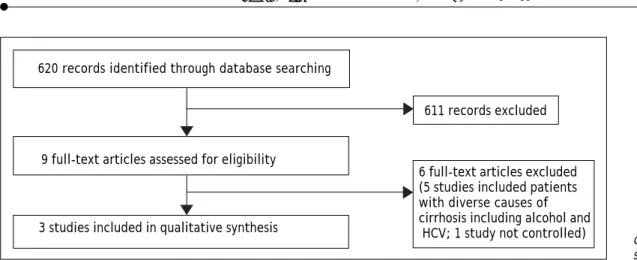
After the screening process (Figure 1), 9 full-text articles were included in the review and 6 stud-ies were excluded. Three randomized controlled trials were finally included. The authors attempted a sys-tematic review, but due to the variance amongst the three trials and small sample size, a qualitative synthesis was provided.
Results of individual studies
as-Buss C, et al. , 2014; 13 (5): 482-488
484
sessed that were common to all the 3 studies. The results of the studies with respective comparisons within groups and between the groups (when availa-ble) are shown in table 1. All patients in the three studies were randomized to receive different formu-lations of probiotics or synbiotics or placebo. Also, lifestyle modifications were suggested in the studies by Malaguarnera, et al.21 and Wong, et al.22 but not
in the study by Aller, et al.23 Reductions in ALT and
AST were observed in the treated group in two stud-ies.21,23 However in the study by Malaguarnera, et
al.,21 reductions were also detected in the control
group. Reduction in BMI was also observed in the same study21 in both treated and control groups, but
not in the other 2 studies.22,23
Aller, et al.23 included patients with NAFLD
diag-nosed by liver biopsy. The study methods declared using randomized sequence generation, blinding of outcome assessors and description of losses and ex-clusions. There was no information regarding allo-cation concealment. The analysis was not carried out based on intention to treat.
The study of Malaguarnera, et al.21 was the only
one that performed liver biopsies at entry and after 24 weeks of treatment. In 67% of patients, favorable histological response (reduction of steatosis and re-duction in the NASH activity index by at least 3 points) was observed. The study method mentioned using randomized sequence generation, blinding of outcome assessors, and description of losses and ex-clusions. There was no information regarding allo-cation concealment and intention-to-treat analysis.
Wong, et al.22 included patients with
histology-proven NASH by liver biopsy performed within 6 months before inclusion. In this particular study, in-trahepatic triglyceride content and liver stiffness (using the Fibroscan device) were evaluated pre and post treatment. No change was observed after treat-ment in either groups in the aminotransferases
lev-els and BMI, but there was a decrease in the intra-hepatic trygliceride content. The authors stated that randomized sequence generation, allocation conceal-ment were employed in the study protocol and losses and exclusions were reported. The study was open-label.
DISCUSSION
Most studies reported increased risk of progres-sion of NAFLD to cirrhosis, mainly in the presence of more severe histology at baseline.24,25 The
rela-tive risk–benefit of different interventions remains one of the most challenging aspects of treating NAFLD. Correcting dietary habits and increasing physical activity are considered the cornerstones and these lifestyle changes are typically part of the standard recommendations.26
In order to emphasize uncertainties regarding the management of NAFLD, the most recent practice Guideline by the American Association for the Study of Liver Diseases (AASLD), American College of Gastroenterology (ACG), and the American Gas-troenterological Association (AGA)7 recommends
weight loss that can be achieved either by hypoca-loric diet alone or in conjunction with increased physical activity. The guideline states that: ursodes-oxycholic acid is not recommended for the treatment of NAFLD or NASH; that metformin is not recom-mended as a specific treatment for liver disease in adults with NASH, because it has no significant ef-fect on liver histology; that pioglitazone can be used to treat steatohepatitis in patients with biopsy-prov-en NASH, but long term safety and efficacy is not established; that vitamin E (α-tocopherol) should be considered as a first-line pharmacotherapy for non-diabetic adults because it has been shown to im-proves liver histology with biopsy-proven NASH (although it is not recommended to treat NASH in Figure 1. Flow diagram of study selection.
620 records identified through database searching
9 full-text articles assessed for eligibility
3 studies included in qualitative synthesis
611 records excluded
485
Pre- and probiotics and NAFLD.
, 2014; 13 (5): 482-488
Intervention Control p Intervention Control p Intervention Control p
group group group group group group
N 14 14 34 32 10 10
Age (y) 49.4 ± 10.9 44.3 ± 15.1 44.3 ± 15.1 46.7 ± 5.7 42 ± 9 55 ± 9
Gender
(male, %) 71.4 71.4 53.0 46.9 80 50
Type of Lactobacilus Placebo Bifidobacterium Placebo + Lactobacillus Lifestyle
intervention bulgaricus longum Fructo- + lifestyle plantarum, modification
Streptococcus oligosaccharides + modification Lactobacillus thermophiles lifestyle modification deslbrueckii,
Lactobacillus acidophilus, Lactobacillus rhamnosus, Bifidobacterium bifidum +
fructo-oligosaccharides (prebiotics) + lifestyle modification
Dose 500 million 5 billion 200 million
(probiotic (probiotic cultures) + (probiotic cultures) +
cultures) 2.5g (prebiotics) 3g (prebiotics)
Treatment 3 6 6
duration (months) AST (IU/L)
Pre 41.3 ± 15.5 31.7 ± 13.1 109 ± 23.2 107.1 ± 21.4 50 ± 25 38 ± 15
Post 35.6 ± 10.4 36.4 ± 13.8 39.4 ± 28.2 61.2 ± 25.4 < 0.05 37 ± 20 46 ± 27 0.420
p < 0.05 ns < 0.001 < 0.001 0.226 0.189
ALT (IU/L)
Pre 67.7 ± 25.1 60.7 ± 32.1 101 ± 24.7 96.1 ± 24.2 96 ± 75 72 ± 30
Post 60.4 ± 30.4 64.8 ± 35.5 47.1 ± 19.8 58.1 ± 27.2 ns 71 ± 52 75 ± 44 0.858
p < 0.05 < 0.05 < 0.001 < 0.001 0.398 0.859
BMI (kg/m2)
Pre 30.2 ± 4.5 29.5 ± 5.5 27.3 ± 1.4 27.2 ± 1.3 30.2 ± 5.0 28.7 ± 5.7
Post 31.1 ± 4.8 30.1 ± 6.1 26.4 ± 1.8 25.9 ± 1.9 ns 29.3 ± 4.3 28.2 ± 5.6 0.638
p ns ns < 0.05 < 0.05 0.214 0.166
Buss C, et al. , 2014; 13 (5): 482-488
486
diabetic patients, NAFLD without liver biopsy, NASH cirrhosis or cryptogenic cirrhosis). However, it must be noted that vitamin E interventions present safety issues among which are increased mortality,27 vascular events28 and prostate cancer29
as observed in some studies.
Recently, it has been suggested that some bacteri-al bioproducts may be hepatotoxic, as ammonia, phenols and ethanol. Increased intestinal production of ethanol, due to alterations in the gut microbiota, has been described in NASH and obese patients.30
However, the main bacterial bioproduct involved in NAFLD/NASH pathogenesis is the lipopolysaccha-ride (LPS), the active component of endotoxin.31,32 It
has been suggested that increased LPS are related to increased inflammation and NASH progression.
Therefore, considering that hepatic steatosis and NASH are associated with bacterial proliferation and increased intestinal permeability, it could be ex-pected that interventions that modulate intestinal microbiota may be beneficial.34
Probiotics, prebiotics or both (synbiotics) have been suggested to be used in the treatment of NASH.35 Despite numerous articles published in
this area, it is difficult to assess the true effect of probiotics on NAFLD prevention or treatment, since the experiments used different animal models and different bacterial strains were employed in different experimental setups.34 A Cochrane Collaboration
Systematic Review published in 200736 did not
iden-tify any RCTs and suggested that although probiot-ics may be well accepted and ameliorate liver function tests, the lack of randomized clinical trials makes it impossible to support or refute probiotics in the case of NAFLD.
The three studies analyzed in this systematic re-view presented different results concerning prebiot-ics and/or probiotprebiot-ics supplementation for liver aminotransferases levels improvement in NAFLD patients. The studies with the highest doses and combined treatment21,23 showed amelioration of
ami-notransferases in the treated group. From a clinical standpoint, aminotransferases improvement cannot be directly correlated to NAFLD/NASH improve-ment.37 However, given the lack of post-intervention
liver biopsies and quantification of inflammatory markers in the included studies, this present analy-sis focused on aminotransferases since it was the only parameter evaluated in all the three studies that presented changes after the interventions.
Increased amelioration of aminotransferases was observable when treatment was combined with life-style intervention, with the resulting reduction in
body mass index (BMI). However the doses of pre-and probiotics pre-and combination of treatment differed in each study and thus hindered adequate compari-sons.
In the study of Aller, et al.23 there was no
com-bined treatment and the intervention used only pro-biotics. A reduction in AST and ALT was observed in the treatment group, without any change in BMI. The study of Malaguarnera, et al.21 employed an
in-tervention combining a 10-fold greater dose of probi-otics with prebiprobi-otics and lifestyle intervention. The reduction in the aminotransferases was much high-er and thhigh-ere was a BMI reduction in both groups. One could attribute the amelioration to the effect of lifestyle intervention and not to the synbiotic treat-ment. Nevertheless, a significant difference between groups after treatment in AST levels was demon-strated, which could support the effect of the synbi-otic treatment.
The study of Wong, et al.22 employed the lowest
probiotic dose associated with a higher dose (com-pared to the study of Malaguarnera, et al.21) of
prebiotic also in combination with lifestyle interven-tion. In spite of having similar treatment duration it did not demonstrate a significant change in any of the parameters.
It is important to highlight that treatment dura-tion was too short in all of the studies to be able to reflect histological improvement for clinical benefit and morbimortality reduction. However, the study of Aller, et al.,23 which had the shortest treatment
duration, presented significant results. This may im-ply a dose-response effect of probiotics treatment, which should be tested in future trials. An addition-al recommendation for upcoming studies would be the assessment of liver biopsy pre- and post-treat-ment, since only one of the trials included in this re-view presented such analysis. The studies also presented small sample sizes and different probiotic species combinations, which make comparisons diffi-cult to be made.
It would be interesting to also document altera-tions in gut microbiota subsequent to treatment, which was not reported in any of the studies analyzed in this review. The use of molecular tech-niques for analysis of microbiota constituents in health and disease are now available.38
clinical evidence precludes, for the moment, recom-mendations on the use of probiotics in clinical prac-tice. The safety of the interventions with probiotics and synbiotics in NAFLD should be tested in longer term studies. The beneficial effects of probiotics and synbiotics on NALFD have been demonstrated in limited human studies. However, since there is suffi-ciently strong rationale for the use of strategies that involve modulation of the gut microbiota in the management of liver diseases, the therapeutic poten-tial of probiotics in NAFLD should be tested in larg-er and high-quality studies.
REFERENCES
1. Vajro P, Lenta S, Pignata C, Salerno M, D’Aniello R, De Mic-co I, Paolella G, et al. Therapeutic options in pediatric non alcoholic fatty liver disease: current status and future di-rections. Ital J Pediatr 2012; 38: 55.
2. Matteoni CA, Younossi ZM, Gramlich T, Boparai N, Liu YC, McCullough AJ. Nonalcoholic fatty liver disease: a spec-trum of clinical and pathological severity.
Gastroentero-logy 1999; 116: 1413-9.
3. Mouzaki M, Allard JP. The role of nutrients in the develop-ment, progression, and treatment of nonalcoholic fatty li-ver disease. J Clin Gastroenterol 2012; 46: 457-67. 4. Angulo P. Nonalcoholic fatty liver disease. N Engl J Med
2002; 346: 1221-31.
5. Younossi ZM, Diehl AM, Ong JP. Nonalcoholic fatty liver disease: an agenda for clinical research. Hepatology 2002; 35: 746-52.
6. Clark JM, Brancati FL, Diehl AM. Nonalcoholic fatty liver disease. Gastroenterology 2002; 122: 1649-57.
7. Chalasani N, Younossi Z, Lavine JE, Diehl AM, Brunt EM, Cusi K, Charlton M, Sanyal AJ. The diagnosis and manage-ment of non-alcoholic fatty liver disease: practice Guideli-ne by the American Association for the Study of Liver Diseases, American College of Gastroenterology, and the American Gastroenterological Association. Hepatology 2012; 55: 2005-23.
8. Starley BQ, Calcagno CJ, Harrison SA. Nonalcoholic fatty li-ver disease and hepatocellular carcinoma: a weighty con-nection. Hepatology 2010; 51: 1820-32.
9. Athyros VG, Tziomalos K, Gossios TD, Griva T, Anagnostis P, Kargiotis K, Pagourelias ED, et al. Safety and efficacy of long-term statin treatment for cardiovascular events in patients with coronary heart disease and abnormal liver tests in the Greek Atorvastatin and Coronary Heart Di-sease Evaluation (GREACE) Study: a post-hoc analysis.
Lancet 2010; 376: 1916-22.
10. Hickman IJ, Jonsson JR, Prins JB, Ash S, Purdie DM, Clous-ton AD, Powell EE. Modest weight loss and physical activity in overweight patients with chronic liver disease results in sustained improvements in alanine aminotransferase, fasting insulin, and quality of life. Gut 2004; 53: 413-9. 11. Dixon JB, Bhathal PS, Hughes NR, O’Brien PE. Nonalcoholic
fatty liver disease: Improvement in liver histological analysis with weight loss. Hepatology 2004; 39: 1647-54. 12. Petersen KF, Dufour S, Befroy D, Lehrke M, Hendler RE,
Shulman GI. Reversal of nonalcoholic hepatic steatosis, he-patic insulin resistance, and hyperglycemia by moderate weight reduction in patients with type 2 diabetes.
Diabe-tes 2005; 54: 603-8.
M, Wands JR, Fava JL, Wing RR. Randomized controlled trial testing the effects of weight loss on nonalcoholic steatohepatitis. Hepatology 2010; 51: 121-9.
14. Musso G, Gambino R, Cassader M, Pagano G. A meta-analy-sis of randomized trials for the treatment of nonalcoholic fatty liver disease. Hepatology 2010; 52: 79-104.
15. Parnell JA, Raman M, Rioux KP, Reimer RA. The potential role of prebiotic fibre for treatment and management of non-alcoholic fatty liver disease and associated obesity and insulin resistance. Liver Int 2012; 32: 701-11.
16. Parnell JA, Raman M, Rioux KP, Reimer RA. The potential role of prebiotic fibre for treatment and management of non-alcoholic fatty liver disease and associated obesity and insulin resistance. Liver Int 2012; 32: 701-11.
17. Joint FAO/WHO Expert Consultation. Evaluation of Health and Nutritional Properties of Probiotics in Food Including Powder Milk with Live Lactic Acid Bacteria. 2001. 18. Endo H, Niioka M, Kobayashi N, Tanaka M, Watanabe T.
Bu-tyrate-producing probiotics reduce nonalcoholic fatty li-ver disease progression in rats: new insight into the probiotics for the gut-liver axis. PLoS One 2013; 8: e63388.
19. Soriano G, Sanchez E, Guarner C. Probiotics in liver disea-ses. Nutr Hosp 2013; 28: 558-63.
20. Liberati A, Altman DG, Tetzlaff J, Mulrow C, Gotzsche PC, Ioannidis JP, Clarke M, et al. The PRISMA statement for re-porting systematic reviews and meta-analyses of studies that evaluate health care interventions: explanation and elaboration. J Clin Epidemiol 2009; 62: e1-e34.
21. Malaguarnera M, Vacante M, Antic T, Giordano M, Chisari G, Acquaviva R, Mastrojeni S, et al. Bifidobacterium lon-gum with fructo-oligosaccharides in patients with non al-coholic steatohepatitis. Dig Dis Sci 2012; 57: 545-53. 22. Wong VW, Won GL, Chim AM, Chu WC, Yeung DK, Li KC,
Chan HL. Treatment of nonalcoholic steatohepatitis with probiotics. A proof-of-concept study. Ann Hepatol 2013; 12: 256-62.
23. Aller R, De Luis DA, Izaola O, Conde R, Gonzalez, Sagrado M, Primo D, de la Fuente B, et al. Effect of a probiotic on liver aminotransferases in nonalcoholic fatty liver disease patients: a double blind randomized clinical trial. Eur Rev
Med Pharmacol Sci 2011; 15: 1090-5.
24. Harrison SA, Torgerson S, Hayashi PH. The natural history of nonalcoholic fatty liver disease: a clinical histopatholo-gical study. Am J Gastroenterol 2003; 98: 2042-7. 25. McCullough AJ. Update on nonalcoholic fatty liver disease.
J Clin Gastroenterol 2002; 34: 255-62.
26. Caldwell SH, Kowdley KV. Treating NAFLD: future pros-pects. J Clin Gastroenterol 2006; 40(Suppl. 1): S67-S68. 27. Miller ER, III, Pastor-Barriuso R, Dalal D, Riemersma RA,
Ap-pel LJ, Guallar E. Meta-analysis: high-dosage vitamin E su-pplementation may increase all-cause mortality. Ann
Intern Med 2005; 142: 37-46.
28. Schurks M, Glynn RJ, Rist PM, Tzourio C, Kurth T. Effects of vitamin E on stroke subtypes: meta-analysis of rando-mised controlled trials. BMJ 2010; 341: c5702.
29. Klein EA, Thompson IM, Jr., Tangen CM, et al. Vitamin E and the risk of prostate cancer: the Selenium and Vitamin E Cancer Prevention Trial (SELECT). JAMA 2011; 306: 1549-56.
Buss C, et al. , 2014; 13 (5): 482-488
488
31. Abu-Shanab A, Quigley EM. The role of the gut microbiota in nonalcoholic fatty liver disease. Nat Rev Gastroenterol
Hepatol 2010; 7: 691-701.
32. Nair S, Cope K, Risby TH, Diehl AM. Obesity and female gender increase breath ethanol concentration: potential implications for the pathogenesis of nonalcoholic steato-hepatitis. Am J Gastroenterol 2001; 96: 1200-4.
33. Musso G, Gambino R, Cassader M. Gut microbiota as a re-gulator of energy homeostasis and ectopic fat deposition: mechanisms and implications for metabolic disorders. Curr
Opin Lipidol 2010; 21: 76-83.
34. Machado MV, Cortez-Pinto H. Gut microbiota and nonalco-holic fatty liver disease. Ann Hepatol 2012; 11: 440-9.
35. Imajo K, Yoneda M, Ogawa Y, Wada K, Nakajima A. Micro-biota and nonalcoholic steatohepatitis. Semin
Immunopa-thol 2014; 36: 115-32.
36. Lirussi F, Mastropasqua E, Orando S, Orlando R. Pro-biotics for non-alcoholic fatty liver disease and/or steatohepatitis. Cochrane Database Syst Rev 2007; CD005165.
37. Pearce SG, Thosani NC, Pan JJ. Noninvasive biomarkers for the diagnosis of steatohepatitis and advanced fibrosis in NAFLD. Biomark Res 2013; 1: 7.
38. Quigley EM, Stanton C, Murphy EF. The gut microbiota and the liver. Pathophysiological and clinical implications. J