Annals of Hepatology 8(1) 2009: S44-S50
S44
www.medigraphic.com
Annals of Hepatology 2009; 8(1): Supplement: S44-S50
Annals of
Hepatology
Association between type two diabetes and
non-alcoholic fatty liver disease in youth
Anna Alisi;1 Melania Manco;2 Nadia Panera;1 Valerio Nobili1
1Liver Unit.
2Scientific Directorate
Bambino Gesù Paediatric Hospital and Research Institute; Rome Italy.
Abbreviations:
Type two diabetes mellitus (T2DM), metabolic syndrome (MetS), non-alcoholic fatty liver disease (NAFLD), nonalcoholic steatohepatitis (NASH), impaired fasting glucose (IFG), impaired glucose tolerance (IGT), National Health and Nutrition
Examination Survey (NHANES), alanine aminotransferases (ALT), aspartate aminotransferase (AST), free fatty acid (FFA), Gamma-Glutamil-Transpeptidasi (GGT).
Address for correspondence: Anna Alisi, PHD
Unit of Hepatology
Bambino Gesù Hospital and Research Institute Piazza San Onofrio 4
00165 Rome; Italy
Phone: +39-06-68592650; Fax: +39-06-68592904; E-mail: [email protected]
Manuscript received and accepted: 23 December 2008
Abstract
In the last three decades prevalence of insulin related diseases has been growing worldwide with epidemic obesity, type 2 diabetes mellitus and non alcoholic fatty liver disease. In children such epidemics are particu-larly worrisome, since metabolic abnormalities track to the adulthood with significant implications for the health care system. Epidemiological studies support a close association between type 2 diabetes and fatty liver disease. We review the most recent epidemiological data on prevalence of both diseases in youth and their association.
Key words: Aminotransferases, glucose, insulin resis-tance, non alcoholic steatohepatitis, obesity.
Introduction
Estimates from population- and hospital-based studies indicate that the number of children and adolescents with type two diabetes mellitus (T2DM) has been increasing in the last decades.1 This is likely to occur since the
num-ber of adolescents and young adults affected by insulin resistance-associated morbidities is increasing.2 In fact,
T2DM is characterized by the simultaneous occurrence of both insulin-resistance and relative insulin-deficien-cy.3 During puberty, insulin resistance represents a
phys-iological condition aimed to favor growth. Obesity may exacerbate this condition. It has been shown that up to one in third obese adolescents with insulin resistance will keep this condition until the adulthood, whilst the remaining two will recover normal insulin sensitivity as it happens for all the normal weight adolescents.4
Sub-jects with severe insulin resistance which persists over the puberty are candidate to develop type 2 diabetes mel-litus, when their beta cell activity fails to compensate for increased and long term insulin resistance.5
T2DM in youth is usually not an isolated condition, but it is often accompanied by other metabolic abnor-malities which represent cardiovascular risk factors and cluster together in the metabolic syndrome (MetS),6 i.e.
obesity, dyslipidemia, hypertension and low-grade in-flammation.2,7 Recent evidence suggests a close
associa-tion also between T2DM and two other condiassocia-tion of in-sulin resistance, namely the polycystic ovary syndrome and the non-alcoholic fatty liver disease (NAFLD).8,9
NAFLD has a broad spectrum of manifestations, rang-ing from simple steatosis to its inflammatory representa-tion of nonalcoholic steatohepatitis (NASH). The bound-aries between NAFLD and NASH are defined only by liv-er biopsy and prediction is difficult using any single or combined clinical or laboratory test.10 A small proportion
of patients with NAFLD progresses to cirrhosis, hepato-cellular carcinoma and liver failure.11,12
Pediatric NAFLD is becoming the leading cause for re-ferral to liver clinics especially in overweigh/obese chil-dren from Western country.13 The occurrence of NAFLD in
these children who are already at cardiovascular risk, is particularly worrisome, since the disease appears to be a
per se independent cardiovascular risk.9 Patients with
NAFLD seem also prone to develop more frequently an impairment of the carbohydrate metabolism varying from a condition of pre-diabetes to overt T2DM. In our series of children and adolescents with biopsy proven NAFLD, we observed a prevalence of pre-diabetes and diabetes as high as 10-12%,14,15 and, in most of them the impaired glucose
metabolism will likely track to the adulthood.
The meaning of this association remains unclear. The question is whether NAFLD is per sè a determinant of
di-Artemisa
www.medigraphic.com
abetes or its effect is mediated by more severe obesity and insulin resistance.
In the present review, we will try to verify the occur-rence of this association in youth by resuming the most recent epidemiological data on prevalence/incidence of both diseases, thus highlighting their common trends; and considering pathogenetic mechanisms which may underlie both. The epidemic of T2DM and NAFLD will bear fruit in forthcoming decades, putting further stress on the healthcare system and, probably, leading to in-creased morbidity and a shorter lifespan for future gener-ations.
Epidemiology of T2DM
Prediabetes and T2DM are serious adverse conse-quences of obesity and pediatric metabolic syndrome, more likely to manifest in adolescence and early adult-hood than clinical atherosclerotic diseases.16
The American Diabetes Association defines diabetes as occurring if one of three criteria are present: 1) a casual plasma glucose of > 200 mg/dL in some one with symp-toms of diabetes; fasting plasma glucose of ≥ 126 mg/ dL; 3) 2 hr plasma glucose of ≥ 200 as part of an oral glucose tolerance test.17 The dose of glucose used as load is of 1.75 g/kg to a maximum of 75 g, although the pre-cise pediatric dose is not well validated.18 Impaired fast-ing glucose (IFG) or impaired glucose tolerance (IGT) characterize prediabetes.19
Most data on the epidemiology of diabetes comes from national surveys. However, they provide data on in-cidence and prevalence of the disease based on the num-ber of cases referred by physicians or self reported by pa-tients. For instance, the Search for diabetes in Youth is a 6-center observational study conducting population-based ascertainment of physician diagnosed diabetes in youth.20 The National Health and Nutrition Examination Survey (NHANES) is a stratified, multistage probability sample of the civilian non-institutionalized US popula-tion and diagnosis of diabetes was self reported. To esti-mate prevalence and incidence of diabetes, the adoles-cents of the NHANES study (N = 4,370, age 12-19 years) were simply asked about having or not the disease. Then, they underwent measurement of fasting glucose. Subjects without self reported diabetes but presenting with IFG (N = 1,496) were considered diabetic as well.21 In a longitu-dinal study, performed in the United Kingdom to evalu-ate the incidence of T2DM in subjects < 17 years of age, the estimate of cases was based on active monthly report-ing of cases by consultant pediatricians, as described above.22 Therefore, the major limit of this survey studies is related to the fact that they do not estimate the rate of prediabetes assessed by the impaired glucose tolerance, which is, on the contrary the most frequent form of im-pairment in the carbohydrate metabolism in the youth. Therefore, large surveys such as the SEARCH and the
NHANES are likely to see just the top of the iceberg, and to severely underestimate a more common phenomenon. On the other hand, surveys offer the opportunity to evalu-ate the effect of several factors, mainly age, sex and races.
Both prevalence and incidence of T2DM vary among races, with the highest prevalence and incidence in mi-norities.20-22 The SEARCH found that overall prevalence ranged from 6% in non Hispanic white youth to 76% in American Indians; incidence from 17 in Hispanic to 49.9 in American-Indian per x 100,000-1 x year-1 in 15-19 year olds. In the same range of age, incidence for non-Hispan-ic white was 5.6.20 Data from NHANES found an inci-dence of 8.1 x 100,000-1 in 10–14-year-olds and 11.8 x 100,000-1 in 15–19-year-olds in 2002–2003. The esti-mated incidence of T2DM in the Bostonian Youth varies from 0.79 x 1000-1 in children ≤ 9 years of age to 1.74 x 1000-1 in adolescents (age 10-19 years).23 In the UK study, a total of 168 confirmed cases of non-type 1 diabe-tes were reported, resulting in a national incidence of 1.3 x 100,000-1 x year-1. Of these, 40% were diagnosed with type 2 diabetes giving a minimum incidence of 0.53 x 100,000-1 x year-1.22 In New Zeeland, a 6 year study, which included 1,095.074 children of ≤ 14 years old es-timated incidence of impaired glucose tolerance (IGT) was 0.72 x100000-1 x year-1 in subjects of ≤ 14 years and 2.27 x100000-1 in those of 10-14 years. Type 2 DM had a rate of 0.84 x 100,000-1 x year-1.24 In Chinese youth, a nationally representative cross-sectional survey enrolling 44 880 children aged 7–17.9 years, showed an incidence of diseases, varying from 0.2 in subjects 7-12 year old to 0.4 in 12-18 year olds.25
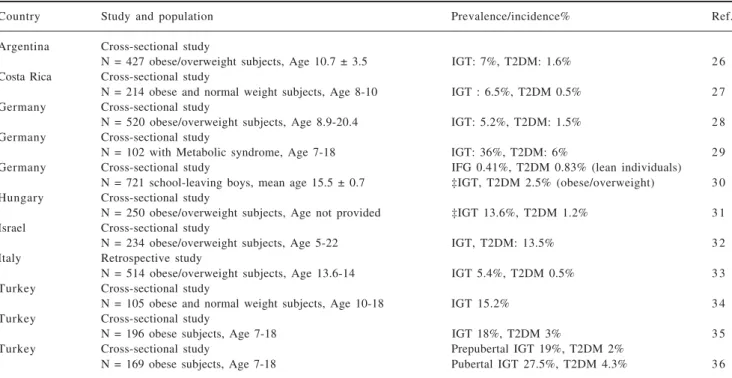
To obtain data on rates of IGT we have to look to small size studies, often performed in high risk populations, i.e. including obese individuals with co-morbidities and/or fa-miliar history of diabetes. We resume in Table 1 the most significant among those conducted and published in the last 5 years, and using the oral glucose tolerance test to di-agnose diabetes.26-36 Of note, even in samples of individu-als with severe obesity and familiarity for diabetes and car-diovascular disease, European rates were not as high as those in US studies. In Europe, T2DM remains a rarity, ac-counting only for 1% to 2% of all cases of diabetes melli-tus. Although, differences in obesity rates between US and European youth are likely contributors, the full explana-tion for this discrepancies remains uncertain.
Epidemiology of NAFLD
www.medigraphic.com
Population-based studies suggest that, as in the adults, its prevalence has been increasing over the past three decades also in children and adolescents, and that the disease represents a worldwide problem with case se-ries described in North and South America, Europe, Aus-tralia and Asia.13,37 These studies indicate that prevalence increases with age, ranging from 0.7% for ages 2 to 4 up to 17.3% for ages 15 to 19 years, but these rates are likely to be underestimated and all these reports do not dis-criminate between simple steatosis, necro-inflammation and fibrosis.13,37,38
The most prominent risk factor for fatty liver is obesi-ty and the disease is most common in males adoles-cents.39-41 In a recent study on 909 Korean obese children (boys 613, girls 296) the prevalence of NAFLD, mea-sured as surrogate of alanine aminotransferases (ALT), was 33.4% in boys, and 19.6% in girls respectively.42 Race, ethnicity and degree of obesity significantly pre-dicted the presence of fatty liver, with Hispanics having the highest and African Americans the lowest figure.43 One study with 181 consecutive asymptomatic obese children demonstrated that 8% had an elevated ALT sug-gestive of NAFLD, but the prevalence decreased in black individuals.44
As shown in table II, studies on prevalence of NAFLD in overweigh/obese children report values ranging from 8% to 80% (USA), depending upon the methods used for the diagnosis.45-50 Unfortunately, most studies have been
limited to the use of indirect measures such as elevated serum (ALT) and ultrasound to predict histological out-come,51 but up to a 20% of young patients have normal values of liver enzyme at the time of biopsy, despite hav-ing histological proven NASH and/or fibrosis.52 Data
Table II. Data of prevalence of NAFLD/NASH in obese children from different countries.
Number of NAFLD/NASH
Country children§ prevalence Ref.
USA 181 8% 4 4
USA 315 16% 5 3
USA 127 23% 4 3
USA 320 81% 4 9
México 8 0 42% 5 5
Japan 299 12% 4 5
Japan 228 24.1% 4 6
Japan 310 25% 4 7
Cina 113 55.7% 4 8 Cina 8 4 77% (24%)* 4 0 Cina 123 80.5% (43.9%)* 5 9 Korea 909 19.6%° and 33.4%^ 4 2
Italy 375 42% 5 7
Italy 268 44% 5 8
Italy 7 2 53% (25%)* 4 1 Italy 175 55(%) (15%)* 6 0 Turkey 101 52.4% 6 1
§Number of overweight/obese children included in the study.
*Percentage of presumed NASH. ° Girls ^ Boys
Table I. Prevalence/incidence of type 2 diabetes mellitus in youth.
Country Study and population Prevalence/incidence% Ref.
Argentina Cross-sectional study
N = 427 obese/overweight subjects, Age 10.7 ± 3.5 IGT: 7%, T2DM: 1.6% 2 6 Costa Rica Cross-sectional study
N = 214 obese and normal weight subjects, Age 8-10 IGT : 6.5%, T2DM 0.5% 2 7 Germany Cross-sectional study
N = 520 obese/overweight subjects, Age 8.9-20.4 IGT: 5.2%, T2DM: 1.5% 2 8 Germany Cross-sectional study
N = 102 with Metabolic syndrome, Age 7-18 IGT: 36%, T2DM: 6% 2 9 Germany Cross-sectional study IFG 0.41%, T2DM 0.83% (lean individuals)
N = 721 school-leaving boys, mean age 15.5 ± 0.7 ‡IGT, T2DM 2.5% (obese/overweight) 3 0 Hungary Cross-sectional study
N = 250 obese/overweight subjects, Age not provided ‡IGT 13.6%, T2DM 1.2% 3 1 Israel Cross-sectional study
N = 234 obese/overweight subjects, Age 5-22 IGT, T2DM: 13.5% 3 2 Italy Retrospective study
N = 514 obese/overweight subjects, Age 13.6-14 IGT 5.4%, T2DM 0.5% 3 3 Turkey Cross-sectional study
N = 105 obese and normal weight subjects, Age 10-18 IGT 15.2% 3 4 Turkey Cross-sectional study
N = 196 obese subjects, Age 7-18 IGT 18%, T2DM 3% 3 5 Turkey Cross-sectional study Prepubertal IGT 19%, T2DM 2%
N = 169 obese subjects, Age 7-18 Pubertal IGT 27.5%, T2DM 4.3% 3 6
www.medigraphic.com
from NHANES in 2450 adolescents found elevated ALT in 6% of overweight and 10% of obese subjects.53 Simi-larly, the 1998 Korean National Health and Nutrition Ex-amination Survey found a prevalence of elevated ALT as high as 3.2%.54 In a sample of Mexican obese/overweight children from an elementary school, elevated ALT were observed in 42% of subjects.55
Based on ultrasonography evidence of fatty liver, NAFLD was diagnosed in 2.6% of Japanese children and occurrence of disease correlated significantly with indices of obesity such as the body mass index;56 42% of 375, and 44% of 268 morbidly obese Italian children had hepatic steatosis;57,58 among 123 obese Chinese children, 99 sub-jects showed abnormal hepatic sonograms and 54 were di-agnosed as NASH.59 Some studies combine data from ul-trasonography and elevated ALT; for instance a study demonstrating that 52.4% of obese Turkish children had fatty liver by ultrasonography and 13.8% had high ALT levels.60 According to an Italian survey in 195 obese chil-dren, 55% had liver steatosis by ultrasonography, 20% had elevated ALT and AST levels, and 15% had both.61
Type 2 diabetes: pathogenetic mechanisms
T2DM is caused by a combination of increased insu-lin resistance and decreased insuinsu-lin secretion. Peripheral insulin-resistance is tightly coupled with obesity in chil-dren and seems to be the major driving force of deterio-rating glucose metabolism, and is also associated with lipid partitioning in specific compartments (i.e., viscera, muscle and liver). On the other hand, the reduction of in-sulin secretion is probably a secondary event evolving gradually.62
Insulin resistance is an impairment of the physiologic effects of insulin on glucose.63 Normal glycemic control requires the pancreatic β-cell sensing of glucose concen-tration, synthesis and release of insulin, binding of insu-lin to receptors with a consequent activation of several signaling proteins. The activation of multiple signaling cascade causes increased glucose uptake by muscles, fat, and liver and decreased glucose production by the liv-er.64 These molecular mechanisms are all altered in T2DM, causing insulin resistance in muscle tissue, de-creased pancreatic insulin secretion, and inde-creased hepat-ic glucose output.65
In children and adolescents with T2DM, defects of glucose metabolism are characterized by a decline in the first phase sensitivity of the β-cell coupled with the de-cline of both first and second phase sensitivity.66 The dy-namics of the impaired glucose metabolism in childhood seem to be faster than in adults, representing a limited window of opportunity for successful preventive inter-vention. Early identification of children with altered glu-cose metabolism is important in order to quantify public health needs and to allocate resources for appropriate prevention programs.
The risk factors for developing type 2 diabetes in youth include a genetic predisposition and certain envi-ronmental characteristics.67 The majority of diabetes in both adults and children is polygenic.68 Thus, the family history of diabetes represents the most important risk fac-tor of developing T2DM with respect to the general pop-ulation.69
Ethnicity is another important factor predisposing to T2DM development. The increased incidence of T2DM in youth of color was identified first in the Pima Indians of the southwest. Children of Pima Indian were found to have high rates of morbid obesity and from 1980 the re-search has focused on this group as well as other ethnic and racial groups with high rates of diabetes.70 Low birth-weight, maternal diabetes and the intrauterine environ-ment also are important areas to consider in risk for the development of T2DM in youth.71 Puberty coupled with insulin resistance provides a strong basis for the develop-ment of pre-diabetes and T2DM in youth with over-weight or frank obesity.72
The changing environment during the past several de-cades provided a further contribution of the dramatic in-crease in T2DM in youth. There has been a movement to-ward a positive energy balance due to diet intake, de-creased physical activity and inde-creased sedentary activity. Fast food consumption and portion sizes have increased from 30 years ago, leading to caloric intake in excess of metabolic need, and youth are the major consumers of fast food meals. Moreover, youth are increasingly inactive, re-ducing their physical activity and using sedentary screen activities, such as television viewing and playing video games, for an average of 5.5 hours daily.67
All these evidence demonstrate that development of T2DM in youth is complex and requires astute health care providers who understand the pathophysiology, pa-tient history, family history, and genetic predisposition, coupled with environmental factors, to manage each youth at the appropriate intervention level.
NAFLD: pathogenetic mechanisms
www.medigraphic.com
ESTE DOCUMENTO ES ELABORADO POR MEDI-GRAPHIC
host (genes) and environmental factors as well as those related to lifestyles and behaviors.76,77
All today theories consider insulin resistance as an important driving force, which promotes lipolysis of pe-ripheral adipose tissuewhich, in turn, increases free fatty acid (FFA) influx into the liver.78 Hyperinsulinemia and hyperglycemia promote de novo lipogenesis and inhibit simultaneously FFA oxidation.79 Fatty deposition at the liver side is also favored by defective incorporation of triglyceride into apolipoprotein carrier proteins and lipid export.80
Fatty loaded hepatocytes are susceptible of additional insults, which may lead to hepatocyte injury, inflamma-tion, and fibrosis. Also the role of oxidative stress is well documented in NASH., There is accumulating evidence that oxidative stress and mitochondrial dysfunction play a key role in the physiopathology of NAFLD/NASH whatever its initial cause.81 Moreover, there is a close in-teraction between development of mitochondrial dys-function, insulin resistance and cytokines in many liver diseases.82 Conversely, many forms of oxidative stress lead to antioxidant depletion, which then further en-hances oxidative stress and cytokine-mediated hepatox-icity.83 In addition, although the exact mechanisms pro-moting progressive liver injury are not well defined, also substrates derived from adipose tissue such as FFA, tumor necrosis factor alpha, leptin, and adiponectin have been implicated.84,85
Taken together, all discussed evidences highlight the complicated network of interactions existing among the several molecules and signaling pathways which contrib-ute do development of NAFLD/NASH. Thus, today it is impossible to distinguish between causes or effects dur-ing NAFLD/NASH development and progression.
More than a clinical association
The NHANES found NAFLD to be more prevalentin obese race minorities, with T2DM, hypertensionand hy-perlipidemia.86 These associations have led to the hy-pothesis that NAFLD may precede the onset of type 2 di-abetesin some individuals. But, why should NAFLD as-sociate with diabetes? The links between the two diseases reflect processes related to insulin action or re-sistance which may be mediated through the location and function of fat, excess total body fatness or hepatic fat. Otherwise, the risk for new onset diabetes may be me-diated by components of the MetS which occur very fre-quently in NAFLD.
NAFLD, as estimated by elevated ALT levels, and pre-diabetes or T2DM were found to be associated indepen-dently of confounders, including obesity in adults.87 The West of Scotland Coronary Prevention Study, consistent-ly with a number of other studies, found that compared with men with values for baseline ALT in the bottom quartile (< 17 U/L), those with levels in the top quartile
(> 29 U/L) had an adjusted odds ratio of 2.04 (95% CI 1.16–3.58) for incident diabetes.88 In the British Hearth Regional Study, the risk of type 2 diabetes increased sig-nificantly with increasing levels of ALT and g
amma-glutamil-transpeptidase (GGT), even after adjustment for a range of confounders, again including BMI (top vs bot-tom quartile, ALT: RR 2.72, 95% CI 1.47–5.02; GGT: RR 3.68, 95% CI 1.68–8.04) or with further additional adjustment for insulin resistance.89
Data on the association between T2DM and NAFLD in paediatric settings are poor, but nevertheless very strong. In the San Diego series of biopsy proven NAFLD, 6 out of 43 children had type 2 diabetes mellitus (14%).49,90 In our series of 120 babies,14 all subjects un-derwent oral glucose tolerance test and diagnosis of im-paired glucose tolerance or T2DM was done according to the criteria of the American diabetes Association. We ob-served a prevalence of IGT as high as 9% and T2DM of 2%. The degree of insulin resistance was not correlated with liver histology in terms of grade of steatosis, inflam-mation or fibrosis. Subjects with IGT/T2DM did differ from normo-tolerant individuals neither in anthropomet-rics or liver histology. Conversely the prevalence of overt MetS was higher in subjects presenting with fibro-sis and/or NASH.14 The limited number of subjects with impaired carbohydrate metabolism did not allow exclud-ing that visceral adiposity (i.e. through reduced levels of adiponectin or increased pro-inflammatory adipocytok-ines) mediates both derangements in liver histology and carbohydrate metabolism.
Conclusion
Also in youth, T2DM and NAFLD seem to be signifi-cantly associated. The meaning and the causative rela-tion of this finding is still unclear. It is likely that the in-sulin resistant phenotype, charactering non alcoholic fat-ty liver disease, contributes to anticipate significantly the onset of type 2 diabetes from mature adulthood to youth. This observation may translate into the worrisome anticipation of all cardiovascular abnormalities linked to T2DM. In addiction, NAFLD may represent an indepen-dent risk factor which augments further the total cardio-vascular risk. Therefore, both NAFLD and T2DM em-body a growing healthcare burden which will boost health related costs in the next future.
References
1. Shaw J. Epidemiology of childhood type 2 diabetes and obesity.
Pediatr Diabetes 2007; 8 (Suppl 9): 7-15.
2. De Ferranti SD, Osganian SK. Epidemiology of paediatric meta-bolic syndrome and type 2 diabetes mellitus. Diab Vasc Dis Res
2007; 4: 285-96.
www.medigraphic.com
4. Eckel RE. Insulin resistance; an adaptation for weight mainte-nance. Lancet 1992; 340: 1542-3.
5. Burcelin R, Knauf C, Cani PD. Pancreatic alpha-cell dysfunction in diabetes. Diabetes Metab 2008; 34 (Suppl 2): S49-55. 6. Morrison JA, Ford ES, Steinberger J. The pediatric metabolic
syndrome. Minerva Med 2008; 99: 269-87.
7. Newfield RS, Dewan AK, Jain S. Dyslipidemia in children with type 2 diabetes vs. obesity. Pediatr Diabetes 2008; 9: 115-21. 8. Franks S. Polycystic ovary syndrome in adolescents. Int J Obes
(Lond) 2008; 32: 1035-41.
9. Targher G, Bertolini L, Padovani R, Rodella S, Tessari R, Zenari L, Day C, et al. Prevalence of nonalcoholic fatty liver disease and its association with cardiovascular disease among type 2 diabetic patients. Diabetes Care 2007; 30: 1212-8.
10. Preiss D, Sattar N. Non-alcoholic fatty liver disease: an overview of prevalence, diagnosis, pathogenesis and treatment consider-ations. Clin Sci (Lond) 2008; 115: 141-50.
11. Yeh MM, Brunt EM. Pathology of nonalcoholic fatty liver dis-ease. Am J Clin Pathol 2007; 128: 837-47.
12. Farrell GC, Larter CZ. Nonalcoholic fatty liver disease: from ste-atosis to cirrhosis. Hepatology 2006; 43 (2 Suppl 1): S99-S112. 13. Barshop NJ, Sirlin CB, Schwimmer JB, Lavine JE. Review article:
epidemiology, pathogenesis and potential treatments of paediat-ric non-alcoholic fatty liver disease. Aliment Pharmacol Ther
2008; 28: 13-24.
14. Manco M, Marcellini M, Devito R, Comparcola D, Sartorelli MR, Nobili V. Metabolic syndrome and liver histology in paediatric non-alcoholic steatohepatitis. Int J Obes (Lond) 2008; 32: 381-7. 15. Manco M, Bedogni G, Marcellini M, Devito R, Ciampalini P, Sartorelli MR, Comparcola D, et al. Waist circumference corre-lates with liver fibrosis in children with non-alcoholic steatohepatitis. Gut 2008; 57: 1283-7.
16. Jones TF. Type 2 diabetes in children: a growing epidemic. Ky
Nurse 2007; 55: 7-8.
17. American Diabetes Association. Type 2 diabetes in children and adolescents (Consensus Statement). Diabetes Care 2000; 23: 381-389.
18. Alberti G, Zimmet P, Shaw J, Bloomgarden Z, Kaufman F, Silink M. Type 2 diabetes in the young: the evolving epidemic: the international diabetes federation consensus workshop. Diabetes Care 2004; 27: 1798-811.
19. Cali AM, Caprio S. Prediabetes and type 2 diabetes in youth: an emerging epidemic disease? Curr Opin Endocrinol Diabetes Obes
2008; 15: 123-7.
20. SEARCH for Diabetes in Youth Study Group, Liese AD, D’Agostino RB Jr, Hamman RF, Kilgo PD, Lawrence JM, Liu LL, Loots B et al. The burden of diabetes mellitus among US youth: prevalence estimates from the SEARCH for Diabetes in Youth Study. Pediatrics 2006;118:1510-8.
21. Duncan GE. Prevalence of diabetes and impaired fasting glucose levels among US adolescents: National Health and Nutrition Ex-amination Survey, 1999-2002. Arch Pediatr Adolesc Med 2006; 160: 523-8.
22. Haines L, Wan KC, Lynn R, Barrett TG, Shield JP. Rising inci-dence of type 2 diabetes in children in the U.K. Diabetes Care
2007; 30: 1097-101.
23. Writing Group for the SEARCH for Diabetes in Youth Study Group, Dabelea D, Bell RA, D’Agostino RB Jr, Imperatore G, Johansen JM, Linder B, Liu LL, et al. Incidence of diabetes in youth in the United States. JAMA 2007; 27:2716-24. Erratum in:
JAMA 2007 8; 298: 627.
24. Campbell-Stokes PL, Taylor BJ. New Zealand Children’s Diabe-tes Working Group. Prospective incidence study of diabeDiabe-tes mel-litus in New Zealand children aged 0 to 14 years. Diabetologia
2005; 48: 2442-3.
25. Li Y, Yang X, Zhai F, Piao J, Zhao W, Zhang J, Ma G. Childhood obesity and its health consequence in China. Obes Rev 2008; 9 (Suppl 1): 82-6.
26. Mazza CS, Ozuna B, Krochik AG, Araujo MB. Prevalence of type 2 diabetes mellitus and impaired glucose tolerance in obese
Argentinean children and adolescents. J Pediatr Endocrinol Metab
2005; 18: 491-8.
27. Holst-Schumacher I, Nuñez-Rivas H, Monge-Rojas R, Barrantes-Santamaría M. Insulin resistance and impaired glucose tolerance in overweight and obese Costa Rican schoolchildren. Food Nutr Bull 2008; 29: 123-31.
28. Wabitsch M, Hauner H, Hertrampf M, Muche R, Hay B, Mayer H, Kratzer W, et al. Type II diabetes mellitus and impaired glu-cose regulation in Caucasian children and adolescents with obe-sity living in Germany. Int J Obes Relat Metab Disord 2004; 28: 307-13.
29. Wiegand S, Dannemann A, Krude H, Grüters A. Impaired glu-cose tolerance and type 2 diabetes mellitus: a new field for pedi-atrics in Europe. Int J Obes (Lond) 2005; 29 (Suppl 2): S136-42. 30. Herder C, Beuting C, Rathmann W, Haastert B, Schmitz-Beuting J, Schäfer M, Scherbaum WA, et al. Prevalence of im-paired glucose regulation in German school-leaving students. Int
J Obes (Lond) 2007; 3: 1086-8.
31. Felszeghy E, Juhasz E, Kaposzta R, Ilyes I. Alterations of glucoregulation in childhood obesity—association with insulin resistance and hyperinsulinemia. J Pediatr Endocrinol Metab
2008; 2: 847-53.
32. Shalitin S, Abrahami M, Lilos P, Phillip M. Insulin resistance and impaired glucose tolerance in obese children and adolescents referred to a tertiary-care center in Israel. Int J Obes (Lond)
2005; 2: 571-8.
33. Invitti C, Gilardini L, Pontiggia B, Morabito F, Mazzilli G, Viberti G. Period prevalence of abnormal glucose tolerance and cardio-vascular risk factors among obese children attending an obesity centre in Italy. Nutr Metab Cardiovasc Dis 2006; 16: 256-62. 34. Babaoðlu K, Hatun S, Arslanoðlu I, Iþgüven P, Baþ F, Ercan O,
Darendeliler F, et al. Evaluation of glucose intolerance in adoles-cents relative to adults with type 2 diabetes mellitus. J Pediatr
Endocrinol Metab 2006; 19: 1319-26.
35. Atabek ME, Pirgon O, Kurtoglu S. Assessment of abnormal glu-cose homeostasis and insulin resistance in Turkish obese children and adolescents. Diabetes Obes Metab 2007; 9: 304-10. 36. Atabek ME, Pirgon O, Kurtoglu S. Prevalence of metabolic
syn-drome in obese Turkish children and adolescents. Diabetes Res
Clin Pract 2006; 72: 315-21.
37. Angulo P. GI epidemiology: nonalcoholic fatty liver disease.
Aliment Pharmacol Ther 2007; 25: 883-9.
38. Saadeh S, Younossi ZM, Remer EM, et al. The utility of radio-logical imaging in nonalcoholic fatty liver disease.
Gastroenter-ology 2002; 123: 745-50.
39. Dunn W, Schwimmer JB. The obesity epidemic and nonalco-holic fatty liver disease in children. Curr Gastroenterol Rep 2008; 10: 67-72.
40. Chan DF, Li AM, Chu WC, Chan MH, Wong EM, Liu EK, Chan IH, et al. Hepatic steatosis in obese Chinese children. Int J Obes
Relat Metab Disord 2004; 28: 1257-63.
41. Franzese A, Vajro P, Argenziano A, Puzziello A, Iannucci MP, Saviano MC, Brunetti F, et al. Liver involvement in obese chil-dren. Ultrasonography and liver enzyme levels at diagnosis and during follow-up in an Italian population. Dig Dis Sci 1997; 42: 1428-32.
42. Yoo J, Lee S, Kim K, Yoo S, Sung E, Yim J. Relationship be-tween insulin resistance and serum alanine aminotransferase as a surrogate of NAFLD (nonalcoholic fatty liver disease) in obese Korean children. Diabetes Res Clin Pract 2008; 81: 321-6. 43. Schwimmer JB, McGreal N, Deutsch R, Finegold MJ, Lavine JE.
Influence of gender, race, and ethnicity on suspected fatty liver in obese adolescents. Pediatrics 2005; 115: e561-5.
44. Louthan MV, Theriot JA, Zimmerman E, Stutts JT, McClain CJ. Decreased prevalence of nonalcoholic fatty liver disease in black obese children. J Pediatr Gastroenderol Nutr 2005; 41: 426-9. 45. Kinugasa A, Tsunamoto K, Furukawa N, Sawada T, Kusunoki T,
www.medigraphic.com
46. Kawasaki T, Hashimoto N, Kikuchi T, Takahashi H, Uchiyama M. The relationship between fatty liver and hyperinsulinemia in obese Japanese children. J Pediatr Gastroenterol Nutr 1997; 24: 317-21.
47. Tazawa Y, Noguchi H, Nishinomiya F, Takada G. Serum alanine aminotransferases activity in obese children. Acta Paediatr 1997; 86: 238-41.
48. Zou CC, Liang L, Hong F, Fu JF, Zhao ZY. Serum adiponectin, resistin levels and non-alcoholic fatty liver disease in obese chil-dren. Endocr J 2005; 52: 519-24.
49. Schwimmer BJ, Deutsch R, Kahen T, Lavine EJ, Stanley C, Behling C. Prevalence of fatty liver in children and adolescents. Pediat-rics 2006; 118: 1388-93.
50. Papandreou D, Rousso I, Mavromichalis I. Update on non-alco-holic fatty liver disease in children. Clin Nutr 2007; 26: 409. 51. Patton HM, Sirlin C, Behling C, Middleton M, Schwimmer JB,
Lavine JE. Pediatric nonalcoholic fatty liver disease: a critical appraisal of current data and implications for future research. J
Pediatr Gastroenterol Nutr 2006; 43: 413.
52. Manco M, Alisi A, Nobili V. Risk of severe liver disease in NAFLD with normal ALT levels. A pediatric report. Hepatology
2008; in press.
53. Strauss RS, Barlow SE, Dietz WH. Prevalence of abnormal serum aminotransferase values in overweight and obese adolescents. J
Pediatr 2000; 136: 727-33.
54. Park HS, Han JH, Choi KM, Kim SM. Relation between elevated serum alanine aminotransferase and metabolic syndrome in Ko-rean adolescents. Am J Clin Nutr 2005; 82: 1046-51.
55. Flores-Calderon J, Gomez-Diaz RA, Rodriguez-Gomez G, Moran-Villota S. Frequency of increased aminotransferases levels and associated metabolic abnormalities in obese and overweight chil-dren of an elementary school in Mexico City. Ann Hepatol 2005; 4: 279-83.
56. Tominaga K, Kurata JH, Chen YK, Fujimoto E, Miyagawa S, Abe I, Kusano Y. Prevalence of fatty liver in Japanese children and relationship to obesity. An epidemiological ultrasonographic survey. Dig Dis Sci 1995; 40: 2002-9.
57. Guzzaloni G, Grugni G, Minocci A, Moro D, Morabito F. Liver steatosis in juvenile obesity: correlations with lipid profile, he-patic biochemical parameters and glycemic and insulinemic re-sponses to an oral glucose tolerance test. Int J Obes Relat Metab
Disord 2000; 24: 772-6.
58. Sartorio A, Del Col A, Agosti F, Mazzilli G, Bellentani S, Tiribelli C, Bedogni G. Predictors of non-alcoholic fatty liver disease in obese children. Eur J Clin Nutr 2007; 61: 877-83.
59. Fu JF, Liang L, Wang CL, Hong F, Dong GP, Li Y. Nonalco-holic steatohepatitis in obese children: the prevalence and pos-sible mechanism. Zhejiang Da Xue Xue Bao Yi Xue Ban 2006; 35: 64-8.
60. Tuba F. Eminoðlu1, Orhun M. Çamurdan2, Suna Ö. Oktar3, Aysun
Bideci2, Buket DalgiÇ4 Factors related to non-alcoholic fatty liver
disease in obese children. The Turkish Journal of Gastroenterol-ogy 2008; 19: 85-91.
61. Bergomi A, Lughetti L, Corciulo N. Italian multicenter study on liver damage in pediatric obesity. Int J Obes Relat Metab Disord
1998; 22: S22.
62. Weiss R, Caprio S. Development of type 2 diabetes in children and adolescents. Minerva Med 2006; 97: 263-9.
63. Pattaranit R, van den Berg HA, Spanswick D. The development of insulin resistance in Type 2 diabetes: insights from knockout studies. Sci Prog 2008; 91: 285-316.
64. Schmitz-Peiffer C, Biden TJ. Protein kinase C function in muscle, liver, and beta-cells and its therapeutic implications for type 2 diabetes. Diabetes 2008; 57: 1774-83.
65. White MF. IRS proteins and the common path to diabetes. Am J
Physiol Endocrinol Metab 2002; 283: E413-22.
66. Weiss R, Gillis D. Patho-physiology and dynamics of altered glucose metabolism in obese children and adolescents. Int J
Pediatr Obes 2008; 3 (Suppl 1): 15-20.
67. Berry D, Urban A, Grey M. Understanding the development and prevention of type 2 diabetes in youth (part 1). J Pediatr Health Care 2006; 20: 3-10.
68. Silverstein JH, Rosenbloom AL. Type 2 diabetes in children. Urr
Diab Rep 2001; 1: 19-27.
69. Gill-Carey O, Hattersley AT. Genetics and type 2 diabetes in youth. Pediatr Diabetes 2007; 8 (Suppl 9): 42-7.
70. Pavkov ME, Hanson RL, Knowler WC, Bennett PH, Krakoff J, Nelson RG. Changing patterns of type 2 diabetes incidence among Pima Indians. Diabetes Care 2007; 30: 1758-63.
71. Sugihara S, Sasaki N, Amemiya S, Kohno H, Tanaka T, Matsuura N. Analysis of weight at birth and at diagnosis of childhood-onset type 2 diabetes mellitus in Japan. Pediatr Diabetes 2008; 8(9): 285-90.
72. Jasik CB, Lustig RH. Adolescent obesity and puberty: the «per-fect storm». Ann N Y Acad Sci 2008; 1135: 265-79.
73. Day CP, James OFW. Steatohepatitis: A tale of two «hits»?
Gas-troenterology 1998; 14: 842-5.
74. Day CP. NASH-related liver failure: one hit too many? Am J
Gastroenterol 2002; 7: 1872-4.
75. Charlton M. Noninvasive indices of fibrosis in NAFLD: starting to think about a three hit (at least) phenomenon. Am J Gastroenterol
2007; 102: 409-11.
76. Day CP. Genes or environment to determine alcoholic liver disease and non-alcoholic fatty liver disease. Liver Int 2006; 26: 1021-28. 77. Marra F, Gastaldelli A, Svegliati Baroni G, Tell G, Tiribelli C. Molecular basis and mechanisms of progression of non-alco-holic steatohepatitis. Trends Mol Med 2008; 14: 72-81. 78. Saito T, Misawa K, Kawata S. Fatty liver and non-alcoholic
steatohepatitis. Intern Med 2007; 46: 101-13.
79. Ahima RS. Insulin resistance: cause or consequence of nonalco-holic steatohepatitis? Gastroenterology 2007; 132: 444-6. 80. Charlton M, Sreekumar R, Rasmussen D, Lindor K, Nair KS.
Apolipoprotein synthesis in nonalcoholic steatohepatitis.
Hepatology 2002; 35: 898-904.
81. Begriche K, Igoudjil A, Pessayre D, Fromenty B. Mitochondrial dysfunction in NASH: causes, consequences and possible means to prevent it. Mitochondrion 2006; 6: 1-28
82. Sanyal AJ, Campbell-Sargent C, Mirshahi F, Rizzo WB, Contos MJ, Sterling RK, Luketic VA, et al. Nonalcoholic steatohepatitis: association of insulin resistance and mitochondrial abnormali-ties. Gastroenterology 2001; 120: 1183-92.
83. Begriche K, Igoudjil A, Pessayre D, Fromenty B. Mitochondrial dysfunction in NASH: causes, consequences and possible means to prevent it. Mitochondrion 2006; 6: 1-28.
84. Feldstein AE, Werneburg NW, Canbay A, Guicciardi ME, Bronk SF, Rydzewski R, Burgart LJ, et al. Free fatty acids promote hepatic lipotoxicity by stimulating TNF-alpha expression via a lysosomal pathway. Hepatology 2004; 40: 185-94.
85. Hui JM, Hodge A, Farrell GC, Kench JG, Kriketos A, George J. Beyond insulin resistance in NASH: TNF-alpha or adiponectin?
Hepatology 2004; 40: 46-5.
86. Ong JP, Pitts A, Younossi ZM. Increased overall mortality and liver-related mortality in non-alcoholic fatty liver disease. J
Hepatol 2008; 49: 608-12.
87. Schindhelm RK, Diamant M, Dekker JM, Tushuizen ME, Teerlink T, Heine RJ. Alanine aminotransferase as a marker of non-alco-holic fatty liver disease in relation to type 2 diabetes mellitus and cardiovascular disease. Diabetes Metab Res Rev 2006; 22: 437-43. 88. Sattar N, Scherbakova O, Ford I, O’Reilly DS, Stanley A, Forrest E, Macfarlane PW, et al. Elevated alanine aminotransferase pre-dicts new-onset type 2 diabetes independently of classical risk factors, metabolic syndrome, and C-reactive protein in the west of Scotland coronary prevention study. Diabetes 2004; 53: 2855-60. 89. Wannamethee SG, Shaper AG, Lennon L, Whincup PH. Hepatic enzymes, the metabolic syndrome, and the risk of type 2 diabetes in older men. Diabetes Care 2005; 28: 2913-8.
90. Schwimmer JR, Deutsch R, Rauch JB, Behling C, Newbury R, Lavine JE. Obesity, insulin resistance, and other clinicopatho-logical correlates of pediatric nonalcoholic fatty liver disease. J