Annals of Hepatology 8(1) 2009: S4-S8
S4
www.medigraphic.com
Annals of Hepatology 2009; 8(1): Supplement: S4-S8
Annals of
Hepatology
Epidemiology and natural history of non-alcoholic
fatty liver disease (NAFLD)
Stefano Bellentani;
1Mariano Marino
11Azienda USL di Modena – Liver and Nutrition Centre
-"Ramazzini" Hospital Carpi, Modena, Italy.
Address for correspondence: Stefano Bellentani, M.D., Ph.D. Centro Studi Nutrizione e Fegato Azienda USL di Modena
Poliambulatori Ospedale "B.Ramazzini" P.le Donatori di Sangue, 2
41012 Carpi (Modena) – Italy E-mail: [email protected] [email protected]
Manuscript received and accepted: 28 December 2008
Abstract
The authors summarize and update the most recent
knowledge in the field of prevalence, natural history
and incidence of Non Alcoholic Fatty Liver Disease
(NAFLD) and Non Alcoholic Steatohepatitis (NASH).
These novel diseases, firstly recognized at the
begin-ning of the second millennium, arose suddenly to the
at-tention of the clinicians, because they are the hepatic
expression of the "so-called" metabolic syndrome. Due
to the epidemic burden of obesity, diabetes, and
meta-bolic diseases, NAFLD and NASH will become soon
probably the most common hepatic disease worldwide,
and they surely will keep busy our future young
hepa-tologists.
Key words: NAFLD, NASH, prevalence, incidence,
nat-ural history, epidemiology.
Definition of NAFLD
The term NAFLD is used to describe a condition of fat
accumulation in the liver in the absence of excessive
al-cohol consumption (less than 20 g per day) and any other
specific causes of hepatic steatosis.
1-5In the majority of
the cases NAFLD is of primary origin and its aetiology is
not yet completely understood, even if it is strictly
relat-ed to the presence of insulin resistance, and thus
fre-quently occurs as the initial part of the metabolic
syn-drome (MS), and accompany obesity, type 2 diabetes and
dyslipidaemia.
6-11Among the secondary causes of
NAFLD there are relevant causes, such as nutritional (e.g.
malnutrition, rapid weight loss), metabolic (e.g.
abetali-poproteinemia, lipodystrophy) and drug-induced (e.g.
glucocorticoids, methotrexate, chemotherapics,
tamox-ifene, etc.), as well as other conditions (e.g. jejunal
diver-ticulitis with bacterial overgrowth, inflammatory bowel
disease, occupational exposure). In this review we are
fo-cusing our attention only to the epidemiology and
natu-ral history of primary NAFLD.
Prevalence of NAFLD
NAFLD is now the most common liver disease in the
United States and possibly worldwide. Furthermore, the
number of affected patients is growing rapidly, and the
disease has reached epidemic proportions. However, the
true prevalence of NAFLD and
Nonalcoholic-Steatohep-atitis (NASH), and their natural history remains
incom-pletely deûned. Furthermore, there are no data on the
change in prevalence of NAFLD within a population
over time, and there are no data on incidence of NAFLD.
The reported prevalence of NAFLD varies according to
the population studied, and the diagnostic criteria
used.
12-14Usually population-based studies provide better
estimates of the prevalence of NAFLD in the general
population compared with autopsy studies, hospital
se-ries or studies performed exclusively in obese
popula-tions, but few such studies have been reported to date.
15-47However, the diagnosis of NAFLD within the
popula-tion studies are usually made by ultrasonography (US),
that allows detecting moderate and severe steatosis with
a fair sensitivity and specificity only when fat on liver
biopsy exceeds 33%. More sensitive techniques,
includ-ing MR imaginclud-ing and spectroscopy, are hindered by
ex-pense and lack of feasibility in large populations. The
American Association for the Study of Liver Diseases
(AASLD) set the limit for the diagnosis of NAFLD at fat
accumulation in the liver of at least 5 to 10% by weight.
Therefore, liver biopsy is still considered as the gold
standard, but is limited by sampling and interpretation
error besides its cost and not applicability in
population-based studies for both ethical and practical reasons.
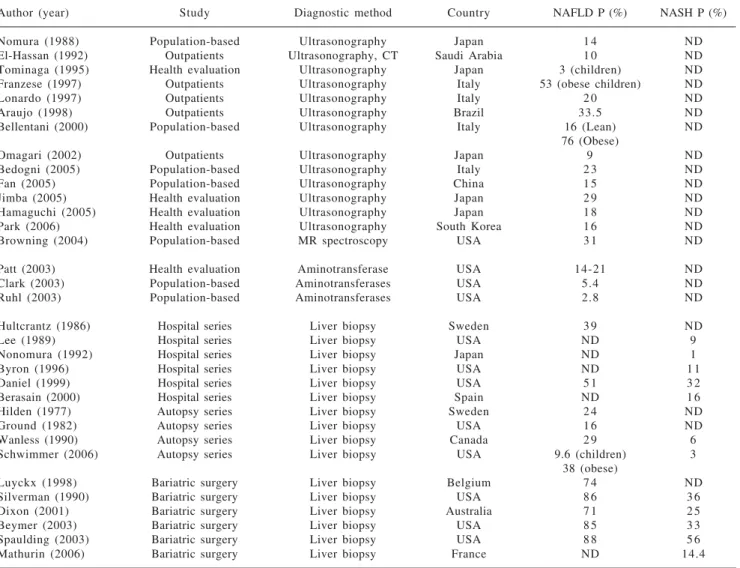
Table I
summarizes the results of several studies on
the prevalence of NAFLD/NASH.
12-44Proton MR
spectro-scopy and
1H-MRS are considered the most
accu-rate non-invasive methods for measuring liver fat, but
again unpractical and too expensive to be applied on a
Artemisa
www.medigraphic.com
large scale. Recently both the Dallas Heart Study (a
pop-ulation-based cohort study performed in an ethnically
di-verse community in the USA) and our Dionysos study (a
population-based cohort study performed in 2
communi-ty of Northern of Italy) reported that 30% of adult
Ameri-cans and 25% of adult Italians have NAFLD. This
indi-cates that over 70 million adult Americans and 15
mil-lion adult Italians suffer from NAFLD. In that studies 79
and 55% of patients with NAFLD had normal
ami-notransferase levels, suggesting that studies using liver
enzymes as a surrogate for NAFLD highly underestimate
the prevalence of NAFLD.
NAFLD has also reached epidemic proportions among
populations typically considered at ‘‘low risk’’ for this
liver condition, with a prevalence in China and Japan of
15 and 14%, respectively, among adults. The clinical
im-plications of this alarming prevalence of NAFLD are
de-rived from the fact that this liver condition may progress
to endstage liver disease and liver cancer. The
preva-lence of NAFLD among children is unknown, but some
data indicate that 2.6–9.6% of children have NAFLD,
in-creasing up to 38–53% among obese children
(Table I)
.
NAFLD is more frequent among obese subjects (75%)
compared to controls (16%), and among patients with
type 2 diabetes (34-74%), whereas it is an almost
univer-sal finding in obese patients with type 2 diabetes. The
prevalence of NAFLD is also more prevalent in Hispanics
and Asian-Indians than in white Americans or Black, and
it is normally increasing with age. Recent data indicate a
doubling of the prevalence in children: from 2.6% a
de-cade ago to 5% today in normal-weight, and 38% or 48%
in obese and diabetic children respectively. All these
prevalences makes NAFLD the most common chronic
liver disease in the Western societies.
Natural history, mortality and incidence of
NAFLD
Data on natural history and mortality of NAFLD/
NASH are contradictory and the study available in the
Table I. Prevalence (=P) of Nonalcoholic Liver Disease (NAFLD) and Nonalcoholic Steatohepatitis (NASH) according to different type of studies. ND= not determined. See reference from 12 to 44.
Author (year) Study Diagnostic method Country NAFLD P (%) NASH P (%)
Nomura (1988) Population-based Ultrasonography Japan 1 4 ND
El-Hassan (1992) Outpatients Ultrasonography, CT Saudi Arabia 1 0 ND
Tominaga (1995) Health evaluation Ultrasonography Japan 3 (children) ND Franzese (1997) Outpatients Ultrasonography Italy 53 (obese children) ND
Lonardo (1997) Outpatients Ultrasonography Italy 2 0 ND
Araujo (1998) Outpatients Ultrasonography Brazil 33.5 ND
Bellentani (2000) Population-based Ultrasonography Italy 16 (Lean) ND
76 (Obese)
Omagari (2002) Outpatients Ultrasonography Japan 9 ND
Bedogni (2005) Population-based Ultrasonography Italy 2 3 ND
Fan (2005) Population-based Ultrasonography China 1 5 ND
Jimba (2005) Health evaluation Ultrasonography Japan 2 9 ND
Hamaguchi (2005) Health evaluation Ultrasonography Japan 1 8 ND
Park (2006) Health evaluation Ultrasonography South Korea 1 6 ND
Browning (2004) Population-based MR spectroscopy USA 3 1 ND
Patt (2003) Health evaluation Aminotransferase USA 14-21 ND
Clark (2003) Population-based Aminotransferases USA 5.4 ND
Ruhl (2003) Population-based Aminotransferases USA 2.8 ND
Hultcrantz (1986) Hospital series Liver biopsy Sweden 3 9 ND
Lee (1989) Hospital series Liver biopsy USA ND 9
Nonomura (1992) Hospital series Liver biopsy Japan ND 1
Byron (1996) Hospital series Liver biopsy USA ND 1 1
Daniel (1999) Hospital series Liver biopsy USA 5 1 3 2
Berasain (2000) Hospital series Liver biopsy Spain ND 1 6
Hilden (1977) Autopsy series Liver biopsy Sweden 2 4 ND
Ground (1982) Autopsy series Liver biopsy USA 1 6 ND
Wanless (1990) Autopsy series Liver biopsy Canada 2 9 6
Schwimmer (2006) Autopsy series Liver biopsy USA 9.6 (children) 3
38 (obese)
Luyckx (1998) Bariatric surgery Liver biopsy Belgium 7 4 ND
Silverman (1990) Bariatric surgery Liver biopsy USA 8 6 3 6
Dixon (2001) Bariatric surgery Liver biopsy Australia 7 1 2 5
Beymer (2003) Bariatric surgery Liver biopsy USA 8 5 3 3
Spaulding (2003) Bariatric surgery Liver biopsy USA 8 8 5 6
www.medigraphic.com
ESTE DOCUMENTO ES ELABORADO POR
MEDI-GRAPHIC
literature are not conclusive.
48-64NAFLD progresses
slowly to NASH and cirrhosis or HCC over many years or
decades, therefore the natural history is difficult to
mea-sure in short-time interval. Patients with simple, bland
steatosis seem to have a more benign prognosis. For
in-stance, a Danish study by Dam-Larsen and co-workers
65of a cohort of 109 predominantly morbidly obese
sub-jects, followed for nearly 17 years, found the incidence
of cirrhosis to be less than 1%, and during the follow-up
the mortality of people with fatty liver did not differ
from the general population mortality. Conversely,
pa-tients with cryptogenic cirrhosis due to NASH have a
worse prognosis, as demonstrated in some recent studies
where 9-26% of patients died within 4-10 years of
fol-low-up, with most causes of death related to end-stage
liver disease.
66-70Using a community-based sample,
Ad-ams et al.
66-67demonstrated a lower survival among
per-sons with NAFLD compared to the general population. In
a different study, Ekstedt et al.
68showed that persons
with NAFLD, in particular those with the subtype of
NASH, had a reduced survival when compared with a
matched reference population. Both these studies
howev-er may not necessarily reflect the genhowev-eral population. In
the Dionysos cohort, after 8.5 years of follow up, we found
that people with alcohol use or abuse remains still the
main risk factor for progression of fatty liver to end-stage
liver disease.
23,69The last study available, published by
Ong et al.
70that used the NHANES III data-base, showed
that persons with NAFLD have a higher likelihood of
dy-ing of a liver-related complication compared to those
without NAFLD or liver disease. This risk was
indepen-dent of obesity or the presence of diabetes mellitus, the
latter being associated with higher rates of liver-related
deaths. However, a great limitation of this study is the
use of elevated serum aminotransferases as a marker of
NAFLD, which underestimates the true prevalence of
NAFLD of more than 50%, as already reported above.
Among the various causes of death in people with
NAFLD, cardiovascular disease and malignancy seems
to be the most important causes as found by Ong et al.,
70but also by others previously published cohort studies.
For this reason, NAFLD is now believed to be the
he-patic manifestation of the metabolic syndrome, and an
independent predictor of cardiovascular morbidity and
mortality.
Overall, a diagnosis of NAFLD is associated with a
shorter survival than expected for the general population
of the same age and gender, and the higher mortality is
mainly due to cardiovascular disease (CVD). A strong
as-sociation between elevated levels of serum liver enzymes
and increased CVD risk has also been reported by
numer-ous population-based studies, such as the Hoorn Study,
the Framingham Heart Study and the Valpolicella Heart
Diabetes Study,
71-73where mildly elevated levels of liver
enzymes were independently associated with an
in-creased CVD mortality rate in both sexes, independently
of traditional risk factors and components of the
meta-bolic syndrome.
Long-term data that clearly show that NAFLD
progress to end-stage liver disease are lacking, even if
some short-term data suggest that NAFLD underlies a
substantial proportion of cases of cryptogenic
cirrho-sis
74,75of patients with cryptogenic cirrhosis, 50–73% are
obese or suffer from diabetes. Further, the presence of
NAFLD increases disease severity and progression in
oth-er livoth-er diseases including chronic hepatitis C infection,
alcoholic liver disease and hemochromatosis.
The incidence of NAFLD remains unknown because
no prospective studies have been conducted. The only
data available are the one referring to the incidence of
fatty liver (FL) in the Dionysos cohort, where we found
that FL regressed in nearly 1 of every 2 cases and had a
substantially benign course, and ethanol intake was the
most important risk factor for FL remission and
inci-dence.
23,76,77The incidence and remission rates of FL after
8.5 years of follow up in the Dionysos cohort were 18.5
and 55.0 per 1,000 person-years; every increase of 20 g/
day of ethanol intake at baseline was associated with a
17% increase in the rate of incident FL.
76Conclusions
NAFLD has become a common diagnosis in clinical
practice of several medical specialties, and its
preva-lence in the general population is increasing together
with obesity, type 2 diabetes and the metabolic
syn-drome. Bland steatosis remains stable for a number of
years and will probably never progress in many cases.
On the contrary in those patients with NASH, whose
dis-ease progresses to advanced fibrosis and cirrhosis, most
liver and hearth-related morbidity and mortality are
ob-served. Prospective studies with long-term follow-up are
necessary to better define the natural history of NAFLD
and its incidence both in the general populations and in
speciûc groups. Genetic studies are also necessary to
de-termine to what extent the genetic background
predis-poses to NAFLD development and progression to
ad-vanced liver disease.
References
1. Ludwig J, Viggiano T, McGill D, Ott B. Nonalcoholic steatohepatitis. Mayo Clinic experiences with a hitherto unnamed disease. Mayo Clin Proc 1980; 55: 434-438.
2. Bacon BR, Farahvash MJ, Janney CG, Neuschwander-Tetri BA. Nonalcoholic steatohepatitis: an expanded clinical entity. Gas-troenterology 1994; 107: 1103-1109.
3. Bellentani S, Tiribelli C, Saccoccio G, Sodde M, Fratti N, De Martin C, et al. Prevalence of chronic liver disease in the general population of northern Italy: the Dionysos Study. Hepatology
1994; 20: 1442-1449.
www.medigraphic.com
clinical and pathological severity. Gastroenterology 1999; 116:1413-1419.
5. Neuschwander-Tetri BA, Caldwell SH. Nonalcoholic steatohepatitis: summary of an AASLD single topic conference. Hepatology
2003, 37: 1202-1219.
6. Angulo P. Nonalcoholic fatty liver disease. N Engl J Med 2002; 346: 1221-1231.
7. McCullough AJ. The clinical features, diagnosis and natural his-tory of nonalcoholic fatty liver disease. Clin Liver Dis 2004; 8(3): 521-33.
8. Hamaguchi M, Kojima T, Takeda N, Nakagawa T, Taniguchi H, Fujii K, et al. The metabolic syndrome as a predictor of nonalco-holic fatty liver disease. Ann Intern Med 2005; 143: 722-728. 9. Angulo P. Nonalcoholic fatty liver disease. Rev Gastroenterol
Mex 2005; 70 Suppl 3: 52-6.
10. Cave M, Deaciuc I, Mendez C, Song Z, Joshi-Barve S, Barve S, McClain C. Nonalcoholic fatty liver disease: predisposing factors and the role of nutrition. J Nutr Biochem 2007; 18(3): 184-95. 11. Dunn W, Schwimmer JB. The obesity epidemic and
nonalco-holic fatty liver disease in children. Curr Gastroenterol Rep 2008; 10(1): 67-72.
12. Adams LA, Lindor KD. Nonalcoholic fatty liver disease. Ann Epidemiol 2007; 17(11): 863-9.
13. Ong JP, Younossi ZM. Epidemiology and natural history of NAFLD and NASH. Clin Liver Dis 2007; 11(1): 1-16, vii. 14. Angulo P. GI epidemiology: nonalcoholic fatty liver disease.
Aliment Pharmacol Ther 2007; 25(8): 883-9.
15. Nomura H, Kashiwagi S, Hayashi J, Kajiyama W, Tani S, Goto M. Prevalence of fatty liver in a general population of Okinawa, Japan. Jpn J Med 1988; 27: 521-528.
16. El-Hassan AY, Ibrahim EM, al-Mulhim FA, Nabhan AA, Chammas MY. Fatty infiltration of the liver: analysis of preva-lence, radiological and clinical features and influence on patient management. Br J Radiol 1992; 65(777): 774-778.
17. Tominaga K, Kurata JH, Chen YK, Fujimoto E, Miyagawa S, Abe I, Kusano Y. Prevalence of fatty liver in Japanese children and relationship to obesity. An epidemiological ultrasonographic survey. Dig Dis Sci 1995; 40(9): 2002-9.
18. Franzese A, Vajro P, Argenziano A, Puzziello A, Iannucci MP, Saviano MC, Brunetti F, Rubino A. Liver involvement in obese children. Ultrasonography and liver enzyme levels at diagnosis and during follow-up in an Italian population. Dig Dis Sci 1997; 42(7): 1428-32.
19. Lonardo A, Bellini M, Tartoni P, Tondelli E. The bright liver syndrome. Prevalence and determinants of a "bright" liver echopattern. Ital J Gastroenterol Hepatol 1997; 29(4): 351-356. 20. Araujo LM, De Oliveira DA, Nunes DS. Liver and biliary ultra-sonography in diabetic and non-diabetic obese women. Diabetes Metab 1998; 24(5): 458-462.
21. Bellentani S, Saccoccio G, Masutti F, Croce LS, Brandi G, Sasso F, et al. Prevalence of and risk factors for hepatic steatosis in Northern Italy. Ann Intern Med 2000; 132: 112-117.
22. Omagari K, Kadokawa Y, Masuda JI, Egawa I, Sawa T, Hazama H, et al. Fatty liver in non-alcoholic non-overweight Japanase adults: incidence and clinical characteristics. J Gastroenterol Hepatol 2002; 17: 1098-1105.
23. Bedogni G, Miglioli L, Masutti F, Tiribelli C, Marchesini G, Bellentani S. Prevalence of and risk factors for nonalcoholic fatty liver disease: the Dionysos nutrition and liver study. Hepatology
2005; 42: 44-52.
24. Fan JG, Zhu J, Li XJ, Chen L, Li L, Dai F, et al. Prevalence of and risk factors for fatty liver in a general population of Shanghai, China. J Hepatol 2005; 43: 508-514.
25. Jimba S, Nakagami T, Takahashi M, Wakamatsu T, Hirota Y, Iwamoto Y, Wasada T. Prevalence of non-alcoholic fatty liver disease and its association with impaired glucose metabolism in Japanese adults. Diabet Med 2005; 22(9): 1141-5.
26. Hamaguchi M, Kojima T, Takeda N, Nakagawa T, Taniguchi H, Fujii K, Omatsu T, Nakajima T, Sarui H, Shimazaki M, Kato T, Okuda J, Ida K. The metabolic syndrome as a predictor of
non-alcoholic fatty liver disease. Ann Intern Med 2005; 143(10): 722-8.
27. Park SH, Jeon WK, Kim SH, Kim HJ, Park DI, Cho YK, Sung IK, Sohn CI, Keum DK, Kim BI. Prevalence and risk factors of non-alcoholic fatty liver disease among Korean adults. J Gastroenterol Hepatol 2006; 21(1 Pt 1): 138-43.
28. Browning JD, Szczepaniak LS, Dobbins R, Nuremberg P, Horton JD, Cohen JC, Grundy SM, et al. Prevalence of hepatic steatosis in an urban population in the United States: impact of ethnicity.
Hepatology 2004; 40: 1387-1395.
29. Patt CH, Yoo HY, Dibadj K, Flynn J, Thuluvath PJ. Prevalence of transaminase abnormalities in asymptomatic, healthy subjects participating in an executive health-screening program. Dig Dis Sci 2003; 48(4): 797-801.
30. Clark JM, Brancati FL, Diehl AM. The prevalence and etiology of elevated aminotransferase levels in the United States. Am J Gastroenterol 2003; 98(5): 960-967.
31. Ruhl CE, Everhart JE. Determinants of the association of over-weight with elevated serum alanine aminotransferase activity in the United States. Gastroenterology 2003; 124(1): 71-9. 32. Hultcrantz R, Glaumann H, Lindberg G, and Nilsson LH. Liver
investigation in 149 asymptomatic patients with moderately el-evated activities of serum aminotransferases. Scand J Gastroenterol
1986; 21(1): 109-113.
33. Lee RG. Nonalcoholic steatohepatitis: a study of 49 patients.
Hum Pathol 1989; 20: 594-598.
34. Nonomura A, Mizukami Y, Unoura M, Kobayashi K, Takeda Y, Takeda R. Clinicopathologic study of alcohol-like liver disease in non-alcoholic steatohepatitis and fibrosis. Gastroenterol Jpn
1992; 27: 521-528.
35. Byron D, Minuk GY. Clinical hepatology: profile of an urban, hospital-based practice. Hepatology 1996; 24(4): 813-5. 36. Daniel S, Ben-Menachem T, Vasudevan G, Ma CK, Blumenkehl
M. Prospective evaluation of unexplained chronic liver tran-saminase abnormalities in asymptomatic and symptomatic pa-tients. Am J Gastroenterol 1999; 94(10): 3010-3014.
37. Berasain C, Betes M, Panizo A, Ruiz J, Herrero JI, Civeira MP, Prieto J. Pathological and virological findings in patients with persistent hypertransaminasaemia of unknown aetiology. Gut
2000; 47(3): 429-435.
38. Hilden M, Christoffersen P, Juhl E, Dalgaard JB. Liver histology in a "normal" population—examinations of 503 consecutive fatal traffic casualties. Scand J Gastroenterol 1977; 12(5): 593-597. 39. Ground KE. Liver pathology in aircrew. Aviat Space Environ
Med 1982; 53(1): 14-18.
40. Wanless IR, Lentz JS. Fatty liver hepatitis (steatohepatitis) and obesity: an autopsy study with analysis of risk factors. Hepatology
1990; 12(5): 1106-10.
41. Schwimmer J, Deutsch R, Kahen T, Lavine JE, Stanley C, Behling C. Prevalence of fatty liver in children and adolescents. Pediat-rics 2006; 118: 1388.
42. Luyckx FH, Desaive C, Thiry A, Dewé W, Scheen AJ, Gielen JE, Lefèbvre PJ. Liver abnormalities in severely obese subjects: ef-fect of drastic weight loss after gastroplasty. Int J Obes Relat Metab Disord 1998; 22(3): 222-6.
43. Silverman JF, O’Brien KF, Long S, Leggett N, Khazanie PG, Pories WJ, Norris HT, Caro JF. Liver pathology in morbidly obese patients with and without diabetes. Am J Gastroenterol
1990; 85(10): 1349-55.
44. Dixon JB, Bhathal PS, O’Brien PE. Nonalcoholic fatty liver disease: predictors of nonalcoholic steatohepatitis and liver fi-brosis in the severely obese. Gastroenterology 2001; 121(1): 91-100.
45. Beymer C, Kowdley KV, Larson A, Edmonson P, Dellinger EP, Flum DR. Prevalence and predictors of asymptomatic liver dis-ease in patients undergoing gastric bypass surgery. Arch Surg
2003; 138(11): 1240-4.
www.medigraphic.com
47. Mathurin P, Gonzalez F, Kerdraon O, Leteurtre E, Arnalsteen L,Hollebecque A, Louvet A, Dharancy S, Cocq P, Jany T, Boitard J, Deltenre P, Romon M, Pattou F. The evolution of severe steato-sis after bariatric surgery is related to insulin resteato-sistance. Gastro-enterology 2006; 130(6): 1617-24.
48. Propst A, Propst T, Judmaier G, Vogel W. Prognosis in nonalco-holic steatohepatitis (Letter). Gastroenterology 1995; 108(5): 1607. 49. Teli MR, James OFW, Burt AD, Bennett MK, CP Day. The natu-ral history of nonalcoholic fatty liver: a follow-up study.
Hepatology 1995; 22: 1714-1719.
50. Sheth SG, Gordon FD, Chopra S. Non-alcoholic steatohepatitis.
Ann Intern Med 1997; 126: 137-145.
51. Falck-Ytter Y, Younossi ZM, Marchesini G, McCullough AJ. Clinical features and natural history of nonalcoholic steatosis syndromes. Semin Liver Dis 2001; 21: 17-26.
52. Bellentani S, Tiribelli C. The spectrum of liver disease in the general population: lesson from the Dionysos study. J Hepatol
2001; 35: 531-537.
53. Marchesini G, Brizi M, Bianchi G, Tomassetti S, Bugianesi E, Lenzi M, et al. Nonalcoholic fatty liver disease: a feature of the metabolic syndrome. Diabetes 2001; 50: 1844-1850.
54. Yu AS, Keeffe EB. Nonalcholic fatty liver disease. Rev Gastroenterol Disord 2002; 2(1): 11-19.
5 5 . Mulhall BP, Ong JP, Younossi ZM. Non-alcoholic fatty liver disease: an overview. J Gastroenterol Hepatol 2002; 17: 1 1 3 6 - 1 1 4 3 .
56. Bugianesi E, Leone N, Vanni E, Marchesini G, Brunello F, Carucci P, Musso A, et al. Expanding the natural history of nonalcoholic steatohepatitis: from cryptogenic cirrhosis to hepatocellular car-cinoma. Gastroenterology 2002; 123: 134-140.
57. Day CP. Non-alcoholic steatohepatitis (NASH): where are we now and where are we going? Gut 2002; 50: 585-588. 58. Clark JM, Diehl AM. Defining nonalcoholic fatty liver disease:
implications for epidemiologic studies. Gastroenterology 2003; 124(1): 248-250.
59. Harrison SA, Torgerson S, Hayashi PH. The natural history of nonalcoholic fatty liver disease: a clinical histopathological study.
Am J Gastroenterol 2003; 98: 2042.
60. Alba LM, Lindor K. Non-alcoholic fatty liver disease. Aliment Pharmacol Ther 2003; 17(8): 977-86.
61. Day CP. Natural history of NAFLD: remarkably benign in the absence of cirrhosis. Gastroenterology 2005; 129: 375-378. 62. Hashimoto E, Yatsuji S, Kaneda H, Yoshioka Y, Taniai M,
Tokushige K, Shiratori K. The characteristics and natural history of Japanese patients with nonalcoholic fatty liver disease. Hepatol Res 2005; 33: 72-76.
63. Clark JM, Dihel AM. Nonalcoholic fatty liver disease: an underrecognized cause of cryptogenic cirrhosis. JAMA 2003; 289: 3000.
64. Sanyal AJ, Banas C, Sargeant C, Luketic VA, Sterling RK, Stravitz RT, Shiffman ML, Heuman D, Coterrell A, Fisher RA, Contos MJ, Mills AS. Similarities and differences in outcomes of
cirrho-sis due to nonalcoholic steatohepatitis and hepatitis C. Hepatology
2006; 43: 682-689.
65. Dam-Larsen S, Franzmann M, Andersen IB, Christoffersen P, Jensen LB, Sørensen TI, Becker U, Bendtsen F. Long term prog-nosis of fatty liver: risk of chronic liver disease and death. Gut
2004; 53: 750-755.
66. Adams LA, Lymp JF, St Sauver J, Sanderson SO, Lindor KD, Feldstein A, et al. The natural history of nonalcoholic fatty liver disease: a population based cohort study. Gastroenterology 2005; 129: 113-121.
67. Adams LA, Sanderson S, Lindor KD, Angulo P. The histological course of nonalcoholic fatty liver disease: a longitudinal study of 103 patients with sequential liver biopsies. J Hepatol 2005; 42: 12-14. 68. Ekstedt M, Franze´n LE, Mathiesen UL, Thorelius L, Holmqvist
M, Bodemar G, et al. Long-term follow-up of patients with NAFLD and elevated liver enzymes. Hepatology 2006; 44: 865-873. 69. Bedogni G, Bellentani S, Miglioli L, Masutti F, Passalacqua M,
Castiglione A, et al. The Fatty Liver index: a simple and accurate predictor of hepatic steatosis in the general population. BMC Gastroenterol 2006; 6: 33-38.
70. Ong JP, Pitts A, Younossi ZM. Increased overall mortality and liver-related mortality in non-alcoholic fatty liver disease. J Hepatol 2008; 49(4): 608-12.
71. Schindhelm RK, Dekker JM, Nijpels G, Stehouwer CD, Bouter LM, Heine RJ, et al. Alanine aminotransferase predicts coronary heart disease events: a 10-year follow-up of the Hoorn study.
Atherosclerosis 2007; 191: 391–396.
72. Goessling W, Massaro JM, Vasan RS, D’Agostino RB Sr, Ellison RC, Fox CS. Aminotransferase levels and 20-year risk of meta-bolic syndrome, diabetes, and cardiovascular disease. Gastroen-terology 2008; 135(6): 1935-44.
73. Targher G, Bertolini L, Tessari R, Zenari L, Arcaro G. The Inter-national Diabetes Federation definition of the metabolic syn-drome independently predicts future cardiovascular events in Type 2 diabetic patients. The Valpolicella Heart Diabetes Study. Diabet Med 2006; 23(11): 1270-1.
74. Ratziu V, Poynard T. Assessing the outcome of nonalcoholic steatohepatitis? It’s time to get serious. Hepatology 2006; 44: 802-805.
75. Dunn W, Xu R, Wingard DL, Rogers C, Angulo P, Younossi ZM, Schwimmer JB. Suspected Nonalcoholic Fatty Liver Disease and Mortality Risk in a Population-Based Cohort Study. Am J Gastroenterol 2008 [Epub ahead of print].
76. Bedogni G, Miglioli L, Masutti F, Castiglione A, Crocè LS, Tiribelli C, Bellentani S. Incidence and natural course of fatty liver in the general population: the Dionysos study. Hepatology 2007; 46: 1387-1391.