Convergence Monitor
The Digital Home
PricewaterhouseCoopers
Contents
03
Executive summary
04
Global and regional trends
13
Conclusions
17
Recommendations
18
Methodology
19
Contacts
3 Convergence Monitor: The Digital Home
01
More and more
communications and
media companies are
pushing forward with their
triple- and quadruple-play
strategies. Enabled by
the growth in broadband
and Internet Protocol (IP)
technologies, new players
are intensifying competition
and the fight for revenues
as the market moves
toward lower prices.
For consumers, the possibilities are endless—an unprecedented explosion of choices and new services where they can call the shots. Often they can access content anywhere, anytime, on any device. They can entertain themselves and others and communicate with each other and with content and service providers in whole new ways. They can customize anything, from their music playlists to their television line-ups. They can use Weblogs, create their own content, and share that content on a growing number of social networks. All this points to a consumer who, increasingly, has the power to influence others, the organisation, and the marketplace. For the organisations that provide the content and distribution services, the growing complexity of their businesses is driven by new revenue opportunities, cost pressures, and a need to be much more transparent while developing offerings to meet consumer demand. Capturing the potential within the complexity requires a new marketing approach and a new mind-set, both reflecting the new expectations of consumers.
Customer focus may very well be the key differentiator in the months and
years to come. Such a focus means knowing your customers, offering them the best experience as customers, making sure your organisation truly listens to customers while having the agility to react quickly to their changing expectations. Those companies able to harness this approach almost certainly will be the winners in a competitive and increasingly complex marketplace. For this survey about the digital home, our first global Convergence Monitor
survey, PricewaterhouseCoopers surveyed 8,000 of our employees in 17 countries.
As we talk about consumers throughout the report, we stress that we are referring to our survey population as opposed to the general population of consumers at large.
Our survey reveals savvy, security-conscious consumers whose familiarity with and usage of converged services and technologies are well established and set to grow quickly.
They are users of voice over IP (VoIP) who turn to their mobile phone instead of their traditional fixed voice line at home. In the new converged world, these consumers are using the Internet as a place not only to surf or shop, but also to meet people, interact, and build their social networks. Consumers are willing to pay a premium for certain content, based on quality of experience and specific lifestyle interests as well as customer service enhancements. At the same time, they are looking for price-competitive, bundled offerings for increasingly commoditised services such as voice communications. The survey provides more details concerning such trends and
developments, informs readers about existing and emerging consumer preferences, and prompts us to ask ourselves the questions: What does the behaviour of this consumer tell me about my current strategy? Am I part of the conversation with the consumer?
Executive summary
Customer focus
may very well
be the key
PricewaterhouseCoopers 4
0
Global and regional trends
According to PwC’s Global Entertainment and Media Outlook: 2006–2010 (The Outlook), the number of broadband households, globally, in 006 stood at 33 million and is set to almost double by 010.
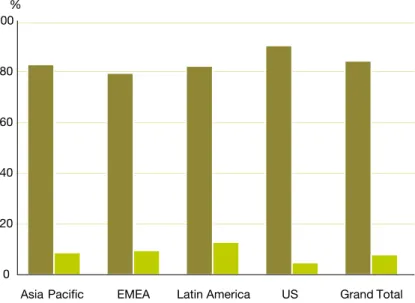
Our Convergence Monitor survey found a high global penetration of broadband, with some 84% of respondents having a high-speed connection at home (see Figure 1). Penetration varies to an extent across regions, with the United States, at 90%, showing the highest rate. Broadband adoption is still rising across the board and is most popular with the 16-to-34 age group. Bandwidth of the broadband connection is rapidly developing as operators upgrade and switch to next generation platforms, thus enabling the user access to high bandwidth content and applications.
The penetration of high bandwidth connections is specifically relevant in a ‘triple-play’ context (with TV distribution requiring speeds of at least 8Mbps and above). From an operator perspective this reflects the fundamental change in communications infrastructure, moving to all-IP scenarios. From a consumer perspective, the survey leads us to expect that the growing interest in downloading digitized music, movies, and other bandwidth-hungry applications, such as gaming, will further increase demand for higher bandwidth beyond entry market speeds.
Broadband penetration: Deep and growing
0 20 40 60 80 100 %
Asia Pacific EMEA Latin America US Grand Total
Current broadband usage Planning to use broadband
Figure 1: Broadband penetration rates
84%
Convergence Monitor: The Digital Home
0
Consumers are looking to alternative and convenient means of voice communication through combinations of fixed line, VoIP (either those that are free, such as Skype, or those being offered by the Internet service providers), and mobile.
Mobile phone usage is heavily
saturated, with all regions in the survey having penetration rates of more than 96%. Thirty-seven percent of respondents do not have a fixed line, and of these 97% have a mobile line but only 1% are using VoIP. We also found that younger age groups are less likely to have an additional fixed line for voice (half of all respondents in the 16-4 age category do not have a fixed line).
This indicates that these consumers are “cutting the cord” and relying completely upon their wireless devices at home.
In addition our survey reveals that one-third of all respondents globally have used VoIP at least once. Usage is more prevalent among the younger age groups, with -to-34-year-olds being the heaviest users (see Figure ).
Consumers’ preferences: Changing
Figure : Current usage of VoIP
16-24 25-34 35-44 45-64
0 5 10 15 20 25 30 35
%
Asia
Pacific AmericaLatin EMEA US 16-24 25-34 35-44 45-64 0
5 10 15 20 25 30 35
%
0 5 10 15 20 25 30 35
%
Consumers
are looking to
alternative and
convenient
means of voice
communication.
By age
PricewaterhouseCoopers 6
%
0 20 40 60 80
Asia Pacific EMEA Latin America US Grand Total
Strongly agree or agree
0
Global and regional trends
In recent months, the market has seen an abundance of multiplay bundles launched with ranging services. We found that 4% of respondents take their TV, Internet, mobile, and fixed voice services from only one or two suppliers.
Among the notable regional disparities, % of Latin Americans take their services from one or two suppliers as compared to 48% across EMEA. Also, it appears that the youngest demographic group in the survey responds more favourably than other groups, with 49% of 16- to 4-year-olds having one or two providers.
The one-bill approach
A trigger for migrating to an integrated (multiplay) offering is the convenience of receiving a single bill for all multiplay services.
In recent years, operators and media companies have introduced a multitude of billing and payment plans to their customers—pay-per-minute, bundles, subscriptions, pre-pay, per download, per megabyte.
While convergence offers the chance of simplicity through one bill to the end user, operators will have to be able to track the game played, the video viewed, the specific on-demand
service accessed, the type of delivery device (TV, personal digital assistant, or mobile phone), the charging mechanism, revenue-share partners and amounts, licenses/royalties due, and billing on behalf of advertising and other relationships. Operators also will have to address the tension that always exists between providing convenience, by combining billings, and the “sticker shock” that consumers experience upon seeing the total price they’re paying for their communication services.
Our survey supports the notion that customers are looking for the convenience of a single bill for multiple services when they buy from a multi-play supplier: globally, 67% support one bill for telephony, Internet, and TV (see Figure 3). The survey also indicates that customers are willing to pay US$.0 to $4 more for the convenience of a single bill, triple-play service package.
The convenience of multiplay
Figure 3: Preference for a single bill
Customers are
looking for the
convenience of
a single bill for
multiple services.
4%
7 Convergence Monitor: The Digital Home
0
Consumers are apprehensive about such issues as reliability, security, and complexity.
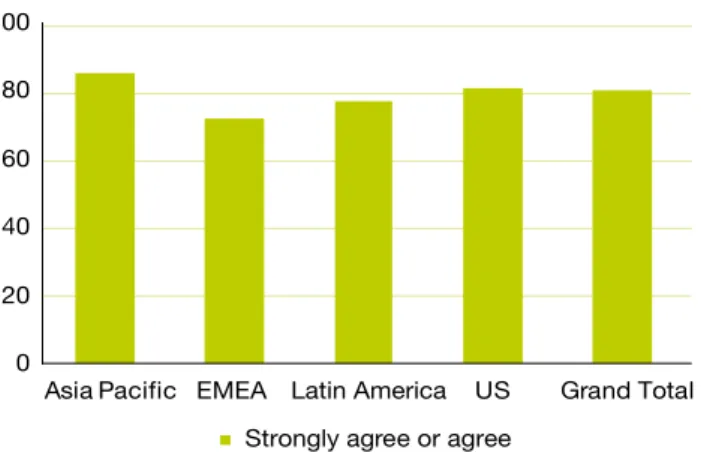
Topping the list of factors that influence choice of service providers is “trust in the service provider’s ability to provide a reliable service,” with 87% of respondents either in strong agreement or agreement. (See Figure 4.)
Security of personal data is clearly an issue for consumers. When asked whether they were “concerned about the security of personal information on the Internet” (e.g., being lost, stolen or hacked), 80% agreed with this statement (see Figure ).
Apprehension about this issue may limit the extent to which consumers use the full range of Internet capabilities— although, looking at broadband penetration, it does not stop them from going online. However, the security issue may be a differentiator for providers offering services such as e-commerce. At the same time, some 34% of consumers worry about the complexity of the Internet and some devices, hardware and software, i.e., PC set-up and modem hook up to the Internet (see Figure 6). An integrated service offering is bound to add to the perceived complexity of the service. So there is an opportunity for service providers to offer quick and easy installation.
Our Convergence Monitor found older groups, not surprisingly, more concerned about complexity than are those under 3. This theme was consistent with that of consumer focus groups PwC conducted recently in the US, which found older adults to be more overwhelmed by the choices and challenges of technology than are younger consumers (who are much more inclined to state available time and money as barriers to higher technology adoption).
Security and complexity: Remaining a concern
Figure : Concern about security of personal information on the Internet
0 20 40 60 80 100 %
Asia Pacific EMEA Latin America US Grand Total Strongly agree or agree
Figure 4: Importance of trust in service provider reliability
Asia Pacific EMEA Latin America US Grand Total
Strongly agree or agree 0
20 40 60 80 100 %
Figure 6: I find the Internet and some devices, hardware and software to be too complex
Asia Pacific EMEA Latin America US Grand Total
Strongly agree or agree 0
PricewaterhouseCoopers 8
The myriad of product offerings in the converging digital world are fighting for their share of the consumer’s mind and wallet. New technologies are providing new ways of accessing and buying content and opening up new markets; but in the fight for market share, many providers are forced to market their services before they are either technically or operationally mature. Many complexities exist in the converging world, and getting customer service right will become an even more critical success factor for the winning providers as consumers are presented with more options and less time.
The key for providers, therefore, is to make their products simple and seamless for customers to use and to offer a range of efficient and effective options for help when things go wrong. The Convergence Monitor survey reveals a substantial gap between the levels of customer service experienced and the importance that consumers place on service quality. Almost half the respondents indicated that they are unhappy with the level of customer service they currently receive. More interesting, nearly half the respondents indicated they were willing to pay an additional $6 to $9 per month for higher than standard levels of customer service, including service around the clock, quicker response times to fix infrastructure or hardware problems and help with software problems and extended warranty schemes (see Figure 7). This result is consistent with that of consumer focus groups PwC conducted recently in the US, in which the majority of respondents were willing to pay more for such things as a shorter time window for cable installation than the standard four-hour or all-day window.
‘Out-of-hours’ support
Having customer service available in the evenings and over the weekend is of great importance to respondents, with 8% in agreement or strong agreement, and reflects to an extent consumers’ higher expectations of their service providers in relation to customer service. This percentage was broadly consistent across all regions, with perhaps less importance placed on it by the EMEA countries.
Billing quality
Globally, our Convergence Monitor
indicates that consumers are generally happy with the clarity and accuracy of their billing (73%). However, 3% of respondents cited quality of billing as a key factor in their choice of a new service provider.
What it’s all about: Excellent customer service
Global and regional trends
0
3%
Respondents who
cited billing quality
as a key factor when
choosing a new
service provider
Figure 7: Approximate monthly amount that respondents would be willing to pay for enhanced customer service within a triple-play package
Country Local Currency USD
Australia 11.1 9.04
Brazil 16.64 7.87
India 94.00 6.66
Italy 6.49 8.8
Korea ,19.00 .16
Netherlands 6.0 8.60
Spain 6.69 8.8
Sweden .68 7.9
Switzerland 9.74 8.01
UK 4.68 9.18
US 6.1 6.1
9 Convergence Monitor: The Digital Home
0
Video on demand (VoD) and digital video recorders (DVR) are affecting the way people expect to access content. No longer dependent on location, device, or the times programs are set to air, consumers enjoy visual content when and where they want it (they are defining their own viewing experience). Demand for services such as VoD will increase as the mass market migrates to a digital platform due to availability and functionality of service. We predict that global consumer/end-user spending in the television distribution market (including VoD and Internet Protocol television, or IPTV) is expected to reach $193 billion within the next four years, according to The Outlook.
Our Convergence Monitor survey reveals DVR to be the most frequently used of the two technologies on a global basis, with 3% adoption, as compared to 14% for VoD. The differences between the age groups in adopting these technologies is not pronounced, with younger generations slightly to moderately more likely to adopt these television-centric devices than are their older counterparts. Even though new content such as mobisodes may generate incremental revenue, our survey shows IPTV and mobile TV, not surprisingly, to have very low current penetration. This can be attributed mainly to a combination of availability and consumer understanding (see Figure 8).
New ways of watching TV
0 5
%
4
3
2
1
Current use of IPTV Current use of Mobile TV Asia
Asia Pacific Latin America EMEA US Grand Total
Figure 8: Global adoption rates of IPTV and mobile TV
PricewaterhouseCoopers 10
The Internet has revolutionized the way consumers shop, manage their personal finances, and arrange leisure activities, among other things. The Internet has become a fully accepted retail channel. Consumers pay for services that have personal impact, such as online dating and personal Web site creation/publishing, although few pay for more widely available services such as instant messaging or shopping comparison engines.
The Outlook anticipates that, globally, Internet access will be the fastest growing consumer segment of the entertainment and media industry—at an 11.9% compound annual growth rate (CAGR)—and will be worth $14 billion within the next four years.
Asia Pacific and Latin America:
Capitals of social networking?
With such recent big-money deals as Google’s $1.6 billion acquisition of YouTube, user-generated content and social networking Web sites have leapt from teenagers’ bedrooms to the financial pages of the global press. Our Convergence Monitor survey found that China has the largest number of social networking users, with more than 8% of respondents having engaged in social networking at least once. China also has the largest number of “power” users (those using the service daily or weekly), with 1.8% of respondents going online daily to their social networks and another 7.3% going online weekly.
More than 80% of Brazilians have used social networks at least once. Brazilian men between 16 and 4 are the largest power-user demographic in the survey, with 1% using the service daily or weekly.
Hong Kong had the highest number of respondents, 1.9%, who use social networks on a daily basis.
In addition to social networking, users in Asia Pacific and Latin American countries are more likely to create their own blog than are their EMEA and US counterparts. Thirty-seven percent of Asia Pacific respondents have “blogged” at least once, as compared to the global average of 1% (see Figure 9).
What content are consumers accessing?
Global and regional trends
0
Figure 9: Blogging and social networking by frequency and region
%
0 20 40 60 100
80
0 20 40 60 100
80
%
Asia
Pacific AmericaLatin EMEA US GrandTotal PacificAsia AmericaLatin EMEA US GrandTotal
Blogging Social Networking Social Networking
11 Convergence Monitor: The Digital Home Our survey challenges, to some extent,
the belief that although people want music and other media downloads, they are unwilling to pay for them.
The results of the Convergence Monitor
survey indicate that if the offering and the pricing are right, customers are willing to pay for legal downloads. As the integration of digital technologies and video players in the home or car stereo/entertainment system develops so too will the need for higher-quality music.
Music demand on the rise
Seventy-four percent of all respondents have downloaded music, and 30% are “high volume” users who download tracks on a daily or weekly basis. The success of Apple iTunes—more than two billion downloads since the launch of the service—further confirms that legal downloads are very much in demand, as does the launch of a number of iTunes competitors such as Napster and Microsoft’s Zune.
The Outlook estimates that the global market will grow at a rapid 9.% CAGR to $6. billion by 010.
The likely growth in demand for music downloads is also indicated by the present and future penetration rates for mobile digital music players. According to our Convergence Monitor
respondents, MP3 players such as the iPod show very high penetration rates globally. Three-quarters are respondents are currently using portable digital music players. Device adoption is roughly the same across the three major regions.
Further stimulating such development will be the integration of music and video players and mobile phone devices (e.g., the Apple iPhone), as well as larger memory capacity in those devices.
0
Music and movies: Money to be had
MP3 Download Country Local Currency USD
Australia 1.76 1.38
Brazil 3.47 1.64
India 4.0 0.96
Italy 1.11 1.47
Korea 1,37.00 1.38
Netherlands 1.19 1.7
Spain 1.18 1.6
Sweden 11.7 1.61
Switzerland 1.77 1.46
UK 0.78 1.3
US 1.31 1.31
Figure 10: Approximate amount that respondents would be willing to pay for an MP3 music download
See page 18 for currency conversions
30%
PricewaterhouseCoopers 1 PricewaterhouseCoopers 1
The demand for downloaded movie content is also on the rise. More than 40% of all respondents have downloaded a movie at least once, with Asia Pacific, at %, showing the highest numbers. Youth, as well as region, is an important factor. More than half of all 16-to-4 year-olds have downloaded a movie at least once, as have 47% of those in the -to-34 age group. The survey revealed that people are willing to pay for permanent ownership of downloaded content—much like purchasing a DVD or a CD (many of the standard download offerings currently include a right to view for a limited time, for example, 4 hours). Respondents also indicate a willingness to pay a premium for recently released movies (see Figure 11).
The growth in portable video devices, in our view, will drive demand for downloading content. The trend in video extends to user-generated visual content as well. The integration of increasingly sophisticated cameras into mobile phones and the growth of memory capacity will have a large impact on sharing photos and personal videos via mobile networks, and thus on bandwidth requirements. However, speed and limited wireless transfer are still issues.
Figure 11: Approximate amount that respondents would be willing to pay for movie downloads
Movie* New Release** Ownership***
Country
Local
Currency USD
Local
Currency USD
Local
Currency USD
Australia 7.94 6.4 3.6 .80 .6 4.37
Brazil 19.31 9.13 6.39 3.0 10.68 .0
India 41.00 .46 117.00 .6 144.00 3.6
Italy 6.7 8.93 .3 .9 3.83 .07
Korea 8,40.00 8.4 ,86.00 .88 4,40.00 4.6
Netherlands 6.3 8.64 .36 3.1 3.68 4.87
Spain 6.44 8. .31 3.06 3.46 4.8
Sweden 4.3 7.78 .16 3.16 33.06 4.7
Switzerland 9.11 7.49 3.66 3.01 .3 4.38
UK 3.98 7.80 1.1 .96 .3 4.61
US 6.91 6.91 .4 .4 3.93 3.93
0
Global and regional trends
40%
Respondents who
have downloaded a
movie at least once
Saturday night at the movies becoming a thing of the past?
See page 18 for currency conversions
13 Convergence Monitor: The Digital Home
Conclusions
The battle for the customer
continues
The market is highly competitive, with formerly disparate businesses now finding themselves competing for the same converged business. Although convergence potentially will result in new revenue streams, and the opportunities associated with them, existing customers become vulnerable to competitive offerings. This fact will force providers into intense marketing and sales campaigns—even when the underlying technical and organisational infrastructure may not be ready. The short-term gains are clearly offset by longer-term risks. Time to market thus becomes a critical success factor. The intense competition is expected to lead to further consolidation in the market in order to acquire customers or to achieve the economies of scale necessary for remaining competitive. At the same time, providers face strategic make or buy decisions in order to be able to offer integrated multiplay propositions; such decisions will lead to developing more partnerships and alliances with content providers and device manufacturers, but also to merger and acquisition (M&A) activity in the form of horizontal integration. Examples include regional cable operators merging to be able to offer services on a nationwide level and telecom operators acquiring ISPs. This M&A activity does have additional impact on internal organisation and on streamlining processes and service offerings toward the newly acquired customer groups.
Customer focus is a key
differentiator
Broadly speaking consumers’ adoption of multiplay services has been quite slow up to now. Many customers are taken aback by the complexity of multiplay service offerings, which limits the adoption of these services. Customers who have purchased multiplay packages have been so disappointed by the associated customer service that they would be willing to pay extra for good customer service. Customers (with the exception of the innovators/early adopters) need to be certain that what they buy is simple, reliable and hassle free.
In fact, there are few other
differentiators—and fighting the battle on price alone will not contribute to generating operating margins and shareholder value.
Providers thus need to be sensitive and responsive to customers’ wishes and expectations, and have the agility to translate the expectations into their organisation, processes, and portfolio. Succeeding in these areas will both drive migration toward converged services and create competitive advantage over other providers.
Our
Convergence Monitor
on the digital home has
revealed some interesting
behaviours and reinforced
some current trends we
are seeing in the global
markets.
Multiplay scenarios are becoming
a reality
Communications operators continue to upgrade their communications infrastructure to better handle data and mobile applications. At the same time, increased use of the Internet is fuelling the demand for broadband access technologies such as digital subscriber line (DSL), cable modem, and fixed wireless. Technology companies are benefiting from this competitive environment as telecom and cable operators race to build a single, unified voice and data network.
Most media and communications companies are developing and organising for multiplay service offerings—and are marketing multiplay in some form. The survey shows us that multiplay strategies are becoming more and more relevant from a customer perspective as well. Customers seem to be warming up to combined offerings, with a lower price, new features, and the convenience of one package and one bill being the primary drivers. In itself, this development is good news for providers. The potential is for significant gains, yet also for dramatic losses.
03
Providers across the competitive arena face the great challenge of keeping it simple. In other words:
The service has to work. It has to be simple, easy, and convenient to use.
If something goes wrong, prompt and effective service should be available.
Providers must make good of what they promise.
• •
•
PricewaterhouseCoopers 14
The objective is to organise
for simplicity
So, the objective is to offer high-quality, integrated services and, at the same time, to keep it simple in the eyes of the customer. Meeting this objective means meeting the challenge of organising the company for simplicity. By no means easy, this change requires mastering the integration of technologies, organisation, and processes. Migrating from traditional telephony networks and infrastructures toward integrated IP offerings proves to be technically challenging and costly, as is the move from analog to truly interactive digital TV. Many providers are currently struggling with aspects of this
technology issue. Signs indicate that the technology is maturing; however, until it is stable, a full-blown marketing offensive comes with inherent risks, and precautions should be taken (and a risk-related budget prepared) to mitigate the risk of dissatisfied customers.
Integrating a service requires integrating organisations as well. The challenge is to create a truly integrated, customer-oriented organisation, which requires:
Integrating cultures and technologies.
Integrating marketing strategy (plus developing a market approach aligned with both the convergent strategy and the marketing opportunities that come with convergence).
Integrating billing.
Developing customer sensitivity and the organisational flexibility to quickly change service offerings in response to rapidly developing customer preferences (plus reducing time to market). •
•
• •
Also driving the integration issue are the consolidations that both take place and are expected to take place in this sector, which affect internal organisation, and the streamlining of processes and service offerings toward the newly acquired customer groups. When a service (e.g., a DSL service in the case of a mobile operator) is offered through partners, the main challenge is to integrate the service offering seamlessly and in such a way that the customer experience is that of one service provider, avoiding any suffering from the silo structure inherent in a partnership/wholesale arrangement.
03
Conclusions
1 Convergence Monitor: The Digital Home
Consumers know no boundaries
Consumers integrate Internet services into their everyday life and already spend a significant portion of their media time on the Internet.
Social networking and online gaming (including integration of gaming and social networking, e.g., Second Life, and gaming communities like “World of Warcraft”) have developed a significant following. Though some analysts predict that blogging is a fad that will gradually blow over, creating communities and sharing experiences is a social need that, in our view, will continue to grow in one form or the other.
Service providers will have to decide to what extent they will develop their own portfolio of value-added Internet services and content services or decide to remain a channel for other content providers. That being said, the benefits of Internet and digital TV in terms of marketing and advertising, and especially in measuring customer behaviour, are growing rapidly. Advertising models will change—and the market is currently experimenting with how they will change.
Whereas TiVo-type services are
gradually becoming commonplace in the US, digital TV penetration is relatively low on a global scale. However, the survey shows that the interest is there, especially in digital video recording/ delayed viewing. With the advent of EPG (Electronic Programming Guide) services, these developments will dramatically change viewing behaviour in the not too distant future, and thus will significantly affect advertising revenue models. TV broadcasters and advertisers alike need to create a strategy to take advantage of these developments.
The same goes for mobile TV. Although the numbers are low, the survey reveals interest in it. Our expectation is that the parallel development of the required devices and infrastructure will facilitate significant growth in consumer demand for TV distribution through mobile networks.
Content is important
Although file-swapping arrangements are a reality, the survey indicates a clear case for commercial downloading of content, and quality content at that. The increasing penetration of MP3 and video player devices will drive growth in the content market. Especially the developing integration of digital technologies and video players in the home or car stereo/entertainment system will create the need for higher-quality music.
Although the survey indicates a price point per downloaded file, the main message is the willingness to pay. Other commercial models, e.g., subscription services, are valid all the same, and we encourage providers to experiment with new propositions.
At the same time, customer—and community—created content is becoming a main impetus for Internet media consumption, and service providers will have to think about how to link into this stream, as interactivity is key in acquiring and retaining customers. The hype surrounding YouTube will develop even further once mobile phones have the video camera functionality and memory capacity to support higher-quality capturing of events.
03
insert heading here
sadsdsd
PricewaterhouseCoopers 16
Invest in
satisfying
17 Convergence Monitor: The Digital Home
Develop intimate customer
relationships:
Invest in measuring and understanding what is really motivating your customers when choosing, buying, and using your service; integrate this information into your day-to-day business operations. New channels to customers facilitate capturing customer data, which will lead to new forms of one-to-one customer marketing and addressability. Invest in satisfying customers; be sure to back up your promise of good service with processes and capabilities throughout the organisation. Offer premium customer service at an additional price, but don’t forget to make your basic customer service good, too. Engage your customers by maximizing opportunities for interacting with them through all available channels (interactivity enhances customer “stickiness”). Make sure that interaction with your customers is a key component of your service (make good use of interactive digital TV, facilitate the creating and publishing of consumer- or community-generated content, invest in creating
interaction on your website, etc.). Focus on your brand. With the high level of competition and the increasing complexity of converged service offerings, consumers are becoming uncertain. In this situation, strong brands have a better chance for survival. •
•
•
•
Build an integrated, agile,
customer-focused organisation:
Make sure your business is able to offer the simple, reliable services that customers value.
Organise in chains, not silos; create a front-to-back, customer-segment-specific operation.
Create the organisational sensitivity and flexibility to quickly change service offerings in response to rapidly developing customer preferences. Reduce time to market, invest in reducing product development cycles, and choose simple solutions for complex problems.
Invest in changing attitudes and mind-sets on all levels of the organisation; change the reward system throughout the organisation to include customer-related key performance indicators.
In-source critical customer
processes, such as customer care if this makes sense for the company. Expect integration problems and budget for them in the business cases on which convergence decisions are based.
• • • • • •
Develop an open collaboration
between value chain partners to
drive new products and services
to customers:
Adopt an open business model with partners and customers alike; remove internal and external barriers to create a maximally transparent company or partnership; be proactive in adopting new business models; and don’t focus too much on defending existing positions.
Include customers in R&D processes and content development.
When growing through M&A, make post-merger integration a key objective, but make sure that the requirements as stated above are part of the plan.
PricewaterhouseCoopers 18 36% 26% 6% 32% Asia Pacific EMEA Brazil & Chile
US 47% 53% Females Males 15% 56% 20% 7% 2% 16-24 25-34 35-44 45-54 55+
A
B
C
36% 26% 6% 32% Asia Pacific EMEA Brazil & ChileUS 47% 53% Females Males 15% 56% 20% 7% 2% 16-24 25-34 35-44 45-54 55+
A
B
C
0
Methodology
PricewaterhouseCoopers surveyed nearly 8,000 PwC partners and staff from 17
countries around the globe on their propensity to buy and use converged technologies and services in their personal lives. This is the first in a series of online surveys that we have dubbed Convergence Monitor.
We believe that the trends identified from the survey will provide insight into consumers’ preferences and attitudes that are of interest to communications, media, and entertainment companies.
The survey represents the following countries: Australia, Brazil, Chile, China, Germany, Hong Kong, India, Italy, Korea, The Netherlands, Singapore, Spain, Sweden, Switzerland, Thailand, the United Kingdom, and the United States of America.
We found the global consumer to be far from homogeneous: The take-up rates of various services and channels in various parts of the world reflect the diversity of consumers as well as the availability and penetration rates of technologies around the world.
Willingness to pay
The willingness to pay element of the survey was derived through conjoint analysis. Conjoint analysis is a multi-variant technique used to understand the dimensions of respondents preferences for different services or products. It is a statistical tool that allows for evaluation of trade off scenarios. The conjoint part of the survey was developed by PwC’s Economics Group in the Netherlands.
36% 26% 6% 32% Asia Pacific EMEA
Brazil & Chile US 47% 53% Females Males 15% 56% 20% 7% 2% 16-24 25-34 35-44 45-54 55+
A
B
C
Percentage of respondents by region
Percentage of respondents by gender
Percentage of respondents by age
One $USD to local currency equivalent as of nd March 007
Country Local Currency
Australia AUD 1.73
Brazil BRL .11
India INR 44.170
Italy EUR 0.76
Korea KRW 994.707 Netherlands EUR 0.76
Spain EUR 0.76
19 Convergence Monitor: The Digital Home Convergence Monitor: The Digital Home 19
Paul Rees
Global Communications Leader Tel: [44] (0) 713 4644
e-mail: [email protected]
Deborah Bothun
Global Convergence Leader Tel: [1] (13) 17 330
e-mail: [email protected]
Mitch Cohen
Global Technology, Communications, Entertainment & Media Leader Tel: [1] (973) 36 430
e-mail: [email protected]
Contacts
06
For more information or to download other convergence related material visit www.pwc.com/monitor
Global Contacts
Asia-Pac TICE Leader
Australia Paul McNab [email protected] [61] () 866 640 China (incl. Hong Kong) Marcel Fenez [email protected] [8] 89 68 India Deepak Kapoor [email protected] [91] (11) 413 001 Indonesia Irhoan Tanudiredja [email protected] [6] (1) 1 901 Japan Akihiko Nakamura [email protected] [81] (3) 3 179 Korea Jungsik Kim [email protected] [8] () 709 014 Malaysia Uthaya Kumar [email protected] [60] (3) 693 397 New Zealand Fred Hutchings [email protected] [64] (4) 46 704 Philippines Wilfredo Madarang [email protected] [63] () 84 78 Singapore (incl. Brunei) Chao Choon Ong [email protected] [6] (6) 36 3018 Taiwan Howard Kuo [email protected] [886] () 79 6 Thailand Prasan Chuaphanich [email protected] [66] () 344 111
Eurofirm
Austria Bernd Hofmann [email protected] [43] (1) 01 88 333 Belgium Koen Hens [email protected] [3] () 710 7 8 Denmark (incl. Greenland) Mikael Heibrock Sørensen [email protected] [4] (39) 4 91 0 Finland Marko Korkiakoski [email protected] [38] (9) 80 10 France Bernard Gainier [email protected] [33] (1) 6 7 81 31 Germany Werner Ballhaus [email protected] [49] (11) 981 848 Greece George Naoum [email protected] [30] (10) 6874 030 Israel Joseph Fellus [email protected] [97] (3) 79 4 683 Italy Andrea Martinelli [email protected] [390] () 778 19 Luxembourg Serge Saussoy [email protected] [3] (49) 48 48 30 6 Netherlands Ronald van Tongeren [email protected] [31] (0) 68 4346 Norway Bjørn Leiknes [email protected] [47] (9) 6 00 07 Portugal (incl. Cape Verde) Nasser Sattar [email protected] [31] (13) 99 48 Republic of Ireland Neil Murphy [email protected] [33] (1) 704 86 Spain Enrique Sanz [email protected] [34] (91) 684 07 Sweden Magnus Brandstrom [email protected] [46] (8) 333 36 Switzerland (incl. Liechtenstein) Peter Wittwer [email protected] [41] (8) 79 7680 United Kingdom (incl. N. Ireland) Murray Legg [email protected] [44] (0) 71 4667
Central & Eastern Europe
Czech Republic Petr Sobotnik [email protected] [40] (1) 11 111 Hungary Nick Kos [email protected] [36] (1) 461 933 Poland Chris Monteleone [email protected] [48] () 3 4411 Romania & Republic of Moldova Dinu Bumbacea [email protected] [40] (1) 0 880 Russia Nathan Birchall [email protected] [7] (49) 967 6469
Middle East
United Arab Emirates Ian Sanders [email protected] [971] () 694 680
North America
Canada Jean-Guy Martin [email protected] [1] (14) 0 68 Mexico Luis Roberto Martínez [email protected] [] () 63 861 US (incl. Puerto Rico) William Cobourn, Jr. [email protected] [1] (646) 471 70
SOACAT
Argentina Juan Carlos Grassi [email protected] [4] (11) 480 409 Brazil Estela Vieira [email protected] [] (11) 3674 380 Chile Rafael Ruano [email protected] [6] () 940 0160
Africa
Egypt Alaa ElSoueni [email protected] [0] () 16 801 South Africa Berno Niebuhr [email protected] [7] (1) 49 000
Marcel Fenez
Global Entertainment & Media Leader Tel: [8] 89 68
e-mail: [email protected]
William Cobourn
Global Technology Leader Tel: [1] (646) 471 70
PricewaterhouseCoopers’ Communications, Technology and Entertainment and Media industry groups deliver a complete range of professional services to telecom, cable, satellite, Internet service providers, technology, and entertainment and media companies. The groups provide industry-focused assurance, tax, and advisory services to build public trust and enhance value for its clients and their stakeholders.
Drawing on our accumulated experience, we anticipate and meet the challenges of global regulatory change, and help our clients deal with the impact of industry convergence. We continue to add measurable value to our client relationships through our leadership and innovation, which are evident in our evolving services and products.
This publication has been prepared for general guidance on matters of interest only, and does not constitute professional advice. You should not act upon the information contained in this publication without obtaining specific professional advice. No representation or warranty (express or implied) is given as to the accuracy or completeness of the information contained in this publication, and, to the extent permitted by law,
PricewaterhouseCoopers LLP, its members, employees and agents accept no liability, and disclaim all responsibility, for the consequences of you or anyone else acting, or refraining to act, in reliance on the information contained in this publication or for any decision based on it.
© 007 PricewaterhouseCoopers LLP. All rights reserved. “PricewaterhouseCoopers” refers to PricewaterhouseCoopers LLP (a limited liability partnership in the United Kingdom) or, as the context requires, the PricewaterhouseCoopers global network or other member firms of the network, each of which is a separate and independent legal entity.
www.pwc.com/monitor
The Rise of Lifestyle Media: Achieving Success in the Digital Convergence Era
Related PwC publications
Technology Executive Connections: Shaping Digital Convergence through Mergers and Acquisitions
Communications Review
Global Entertainment and Media Outlook: 2006–2010
Breaking Down Walls: How an Open
Business Model Is Now the Convergence Imperative