Fine-scale population genetic structuring of bottlenose
dolphins in Irish coastal waters
L. Mirimin1,2, R. Miller1, E. Dillane1, S. D. Berrow3, S. Ingram1,4, T. F. Cross1& E. Rogan1
1 Zoology Ecology and Plant Sciences, School of Biological, Earth & Environmental Sciences, Aquaculture & Fisheries Development Centre, University College Cork, Cork, Ireland
2 Institute for Environment, Marine and Energy, MRI Carna, National University of Ireland, Galway, Ireland 3 Shannon Dolphin and Wildlife Foundation, Merchants Quay, Kilrush, Co. Clare, Ireland
4 School of Marine Science and Engineering, University of Plymouth, Drake Circus, Plymouth, Devon, UK
Keywords
bottlenose dolphins; population structure; Special Area of Conservation; microsatellites; mitochondrial DNA; Shannon Estuary.
Correspondence
Luca Mirimin, Institute for Environment, Marine and Energy, MRI Carna, National University of Ireland, Galway, Ireland. Email: [email protected]
Editor: Karen Mock
Received 28 May 2010; accepted 5 December 2010
doi:10.1111/j.1469-1795.2010.00432.x
Abstract
The identification of localized discrete populations is particularly important to the management and conservation of animal species, especially in the marine environ-ment, where potential for dispersal is high but barriers to gene flow are often not clear. We investigated population genetic structuring of bottlenose dolphins Tursiops truncatusfound along the west coast of Ireland, with particular attention to the Shannon Estuary, which is the only candidate Special Area of Conservation designated for this species in Irish waters. A genetic structure analysis using 62 biopsy samples from free ranging dolphins and 23 necropsies from stranded dolphins revealed fine-scale population structure among three distinct populations. The Shannon Estuary population appears to be genetically isolated from adjacent coastal areas, with the exception of four animals sampled from a small group of six dolphins that are now resident in Cork Harbour (south coast) indicating ongoing gene flow or recent dispersal between these two areas. A second genetically distinct aggregation was identified in the Connemara–Mayo region, where recent photo-identification studies have suggested that dolphins found in this area show a degree of site fidelity. We found moderate nuclear (15 microsatellites) and low mitochon-drial (544 bp of the control region) gene diversity in dolphins using the Shannon Estuary and the Connemara–Mayo region, while dolphins that stranded along the coast showed markedly higher levels of gene diversity at both classes of markers. Specifically, these stranded dolphins formed a third genetically distinct cluster, which may be part of a larger pelagic population, as also suggested by the high levels of gene diversity. These results provide new insights into population structure of bottlenose dolphins in Irish waters and will aid future management and conserva-tion of the species in the eastern North Atlantic.
Introduction
Animal populations of conservation priority are often small and may be restricted to localized geographic areas (Smith et al., 2006). For cetacean species (whales, dolphins and porpoises), it is important to identify such populations because they are particularly vulnerable to habitat and climatic changes (Simmonds & Isaac, 2007) and tend to be directly exposed to anthropogenic impacts (e.g. Rojas-Bracho, Reeves & Jaramillo-Legorreta 2006; Currey, Dawson & Slooten, 2009). Bottlenose dolphins Tursiops truncates (Tursiops spp.) are among the most studied delphinid species throughout their worldwide distribution, where an increasing amount of information has revealed varying degrees of population structuring (e.g. Bairdet al., 2009; Rossbach & Herzing, 1999; M ¨oller & Beheregaray, 2004; Natoli, Peddemors & Hoelzel, 2008) and a need for
revision of the taxonomic status at the inter-specific level (Kingston & Rosel, 2004; Natoli, Peddemors & Hoelzel, 2004; Natoliet al., 2005; Charlton, Taylor & Mckechnie, 2006; M ¨olleret al., 2008). Habitat and resource specializa-tion have been suggested as key factors in determining local differentiation among populations (Hoelzel Potter & Best, 1998; Segura et al., 2006; Mendez et al., 2010), and such specialization appears to have occurred independently in different ocean basins (Tezanos-Pintoet al., 2009).
Pezeril, 2004) and Portugal (the Sado Estuary, Dos Santos & Lacerda, 1987). Patterns of distribution and habitat use have been studied to some extent in Irish and UK coastal areas (Wilson, Thompson & Hammond, 1997; Wood, 1998; Wilson,et al., 1999; Ingram & Rogan, 2002; Stockin, Weir & Pierce, 2006; Culloch & Robinson, 2008; O’Brienet al., 2009; Pierpoint et al., 2009), though population structure and levels of connectivity among different areas are still poorly understood. At the inter-regional scale, recent popu-lation genetic studies have shown significant segregation among the eastern North Atlantic, western North Atlantic and the Mediterranean Sea (Natoliet al., 2004) and at the intra-regional scale, between Scotland and other eastern North Atlantic areas, including Portugal, Spain and South of England (Parsons et al., 2002; Natoli et al., 2005). In contrast, the occurrence of a large pelagic population in the North Atlantic has been suggested by Querouilet al. (2007), who noted a lack of mitochondrial genetic differentiation between bottlenose dolphins from the Azores, Madeira and offshore areas in the north-west Atlantic.
Bottlenose dolphins in Irish waters are entitled to protec-tion under the Irish Wildlife Act (39/1976 and 38/2000) and are included on Annex II of the EU Habitats Directive (43/ 1992) as a species whose habitat requires special measures of protection with the designation of SACs (Ingram & Rogan, 2002). Along the west coast of Ireland, the Shannon Estuary is considered a critical habitat for bottlenose dolphins, which harbours about 120–140 individuals (Englund, In-gram & Rogan, 2007; Englund, InIn-gram & Rogan, 2008). Dolphins have been reported in the estuary since the mid-19th century (Knott, 1997) and have been directly studied since the early 19th nineties (Berrowet al., 1996). Dedicated boat surveys and photo-identification carried out in the Shannon Estuary have revealed long-term site fidelity and a seasonal trend in abundance with a possible decrease in numbers during winter (Ingram & Rogan, 2002; Englund et al., 2007). Results from photo-identification surveys conducted in the estuary since 1996 and other coastal areas since 2001 have not resulted in any matches of individuals between the Shannon Estuary and elsewhere in Ireland, suggesting a degree of isolation (Ingram, Englund & Rogan, 2001; Ingram & Rogan, 2003; O’Brienet al., 2009). Cur-rently, the Shannon Estuary is the only candidate Special Area of Conservation (cSAC) designated for this species in Irish waters. In contrast, bottlenose dolphins occurring around the Irish coast, outside the Shannon Estuary, are thought to be transient and highly mobile, with large-scale movements (up to 650 km) reported for dolphins occurring between the west, south and east coasts of Ireland (Ingram & Rogan, 2002; O’Brienet al., 2009). However, despite these large ranging movements, coastal animals also show inter-annual site fidelity. Specifically, a recent photo-identifica-tion survey in the Connemara–Mayo region has revealed some degree of site fidelity and the occurrence of a relatively large (17148SE) community of coastally transient bottle-nose dolphins (Ingramet al. 2009). Further studies among such aggregations could reveal significant adaptive differ-entiation to different habitats and/or genetic segregation,
which would aid the identification of distinct management units of conservation interest. Thus, understanding whether bottlenose dolphins using the Shannon Estuary and Irish coastal waters represent a single or several distinct popula-tions will play a major role in defining management require-ments and for the conservation of the species in this region.
Here we present a population genetic study of bottlenose dolphins using the waters of western Ireland, with particular attention to the Shannon Estuary cSAC. Using a suite of 15 microsatellite markers and a 544 base pairs (bp) fragment of the mitochondrial (mt) DNA control region, we assess levels of genetic diversity in the sampled areas, test the hypothesis of genetic structuring (vs. panmixia) in Irish waters and evaluate the degree of genetic distinctiveness between dol-phins from the Shannon Estuary and adjacent coastal areas.
Methods
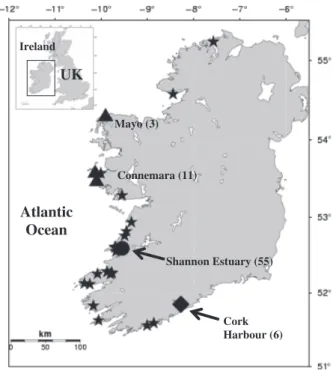
A total of 98 individual skin tissue samples were obtained from free-ranging dolphins from the Shannon Estuary (n= 55) between 2000 and 2007, the Connemara–Mayo area (n= 14) during summer 2009 and from Cork Harbour (n= 6) during summer 2008, using a biopsy darting system (Kr ¨utzenet al., 2002) (see approximate location in Fig. 1). Furthermore, dolphins of unknown origin that were found stranded dead along the west coast of Ireland (n= 23, including three dolphins found dead within the Shannon Estuary) between 1993 and 2009 were also sampled (Fig. 1). Sex of stranded individuals was recorded by inspection of the genital area and reproductive organs, while sex of
free-UK
Mayo (3)
Connemara (11) Ireland
Atlantic
Ocean
Cork Harbour (6) Shannon Estuary (55)
ranging biopsied individuals was determined by multiplex amplification of sex chromosome-specific DNA fragments, following the method described in Rosel (2003).
A total of 15 nuclear microsatellite loci were amplified following polymerase chain reaction (PCR) conditions as described in the original publications (Table 1). Amplified products were separated on 6% polyacrylamide gels on a LI-COR 4300 DNA analyser (Li-Cor Inc, Lincoln, NE, USA) and allele sizes were determined by eye, by comparison to a 50–530 size standard (LI-COR) and allele cocktails from reference samples. In order to infer genotyping error rate, 15% (15 out of 98) of the available tissue samples were randomly chosen and re-processed (i.e. from DNA extraction to PCR amplification). Amplification of a portion of the mtDNA control region was carried out using primers L15926 and H00034 (Rosel, Dizon & Heyning, 1994). Sequencing of each PCR product was carried out using both primers by means of the Sanger method (Sanger, Nicklen & Coulson, 1977), using the DNA cycle sequencing kit (Jena Biosciences GmbH, Jena, Germany) following manufacturer instruc-tions. Sequencing products were separated on 6% polyacry-lamide gels using a LI-COR 4300 s DNA analyser. Some sequencing was also carried out commercially (GATC Bio-tech AG, Konstanz, Germany), using the same set of primers. For each individual, the sequence trace from the forward primer was aligned to its relative reverse-complementary trace using Codoncode Aligner 2.0 (CodonCode Corpora-tion, Dedham, MA, USA) (http://www.codoncode.com/ index.htm) and checked by eye.
For mtDNA sequence data, the number of haplotypes, and nucleotide and haplotype diversity were calculated usingARLEQUIN(Excoffier, Laval & Schneider, 2005). Each microsatellite locus was checked for the presence of poten-tial genotyping errors caused by null alleles, large allele dropout and stuttering, using MICROCHECKER 2.2.3 (van Oosterhout et al., 2004) and selecting the Bonferroni ad-justed 95% confidence interval option (1000 simulations). Because sampling of free-ranging dolphins may lead to duplicate samples, multi-locus genotypes were compared between all pairs of dolphins. The probability of identity (PI) (Waits, Luikart & Taberlet, 2001) was used as an indicator of the power of the markers to resolve between two distinct individual samples and was calculated using the program GIMLET 1.3.3 (Valie`re, 2002). Number of alleles, allelic richness and the inbreeding coefficientFIS(to test for
non-random mating) and its significance [15000 randomiza-tions and indicative adjusted nominal level (5%) of 0.00333] were calculated usingFSTAT2.9.3.2 (Goudet, 2001). Possible linkage (disequilibrium) between all pairs of loci was tested, levels of diversity were evaluated as observed and expected heterozygosity, and Hardy–Weinberg equilibrium tests were carried out to detect possible departure from equilibrium, usingARLEQUIN3.1. Furthermore, populations that undergo a significant reduction in effective size (e.g. bottleneck) tend to show a sudden drop of the number of alleles per locus resulting in an excess of heterozygosity (Luikartet al., 1998). In order to test for possible recent reduction in effective size of the Shannon population, we used BOTTLENECK 1.2.02
(Piry, Luikart & Cornuet, 1999) to run a one-tailed Wilcox-on test (10000 simulatiWilcox-ons) assuming default parameters of mutation-drift equilibrium and that all loci fit a two-phase mutation model (95% single step, 5% multiple step with variance equal to 12), as suggested for microsatellite loci by Piryet al. (1999).
Because barriers to gene flow tend to be not evident in the marine environment and because origin of some individuals (i.e. stranded animals) was unknown, we first investigated population structure with no prior information on sampling location, using the model-based approach implemented in STRUCTURE 2.2 (Pritchard Stephens & Donnelly, 2000). This approach sorts multi-locus genotypes into Hardy– Weinberg/linkage equilibrium clusters, hence assigning in-dividuals to populations. Ten Markov Chains Monte Carlo (MCMC) runs were carried out for each of six K-values (1–6), using the admixture model and co-rrelated allele frequencies among putative populations. Convergence among independent runs was reached with medium-short runs of 100 000 (burn in) and 1 000 000 MCMC repetitions, and results from all runs were summarized and inspected usingSTRUCTURE HARVESTERv0.56.4 (Earl, 2009). Individual assignment to putative populations was then carried out by inspection of the proportion of membership (i.e. individual’s estimated membership fraction to each of the Kinferred clusters). Because population structure analyses can be affected by the presence of related individuals (i.e. family effect), we tested the hypothesis of no relatedness (Mathieu et al., 1990) using IDENTIX 1.1 (Belkhir, Castric & Bon-homme, 2002). The maximum likelihood approach imple-mented in the programCOLONY2.0 (Wang, 2004) was used to identify potential groups of closely related individuals (full sibs or parent offspring). In order to evaluate the level of genetic differentiation among putative populations account-ing for different mutation models, pairwiseF-statistics were calculated based on genotypic and haplotypic frequencies (FST and RST) (Weir & Cockerham, 1984; Michalakis &
Excoffier, 1996) and a corrected percentage of different nucleotides FST (Tamura & Nei, 1993) (10100
permuta-tions), usingARLEQUIN.
Results
re-sampled in close proximity to the original location of sampling, where time difference between sampling of the same individual ranged between 3 days to a maximum of 7 years. Thus, all replicate samples (n= 13) were excluded from subsequent analyses, which were carried out on a total of 85 distinct individuals (46 from the Shannon Estuary, four from Cork Harbour, 12 from the Connemara-Mayo area and 23 stranded dolphins), including 55 males, 29 females and one unknown gender.
No linkage between pairs of microsatellite loci and no evidence of null alleles or allelic dropout were detected. Overall, all loci were polymorphic with five to 16 alleles per locus, and observed and expected heterozygosity ranging between 0.217–0.917 and 0.242–0.874, respectively (Table 1). Levels of polymorphism varied among the sampling groups, with stranded dolphins showing highest allelic richness (6.7) and observed gene diversity (0.779), and a consistently higher proportion of private alleles across loci (47% of total number of alleles) (Table 1). No evidence of inbreeding (FIS)
and no departure from Hardy–Weinberg expected propor-tions were detected in any of the sampled groups. However, when pooling samples from all areas together, a significantly positiveFISvalue (0.059,P= 0.0002) was found over all loci
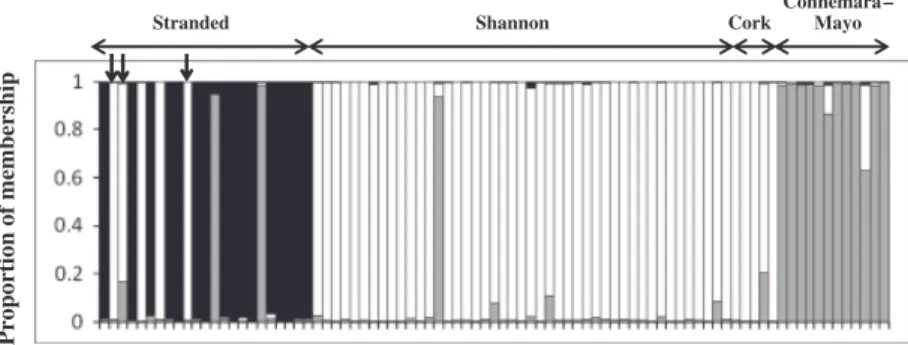
and a significant deviation from Hardy–Weinberg expected proportions was detected in 10 out of 15 loci (Table 1). No evidence of a recent reduction of effective population size (i.e. bottleneck) was detected (one-tailed Wicoxon test, P40.05). When analysing data with no prior information on sampling location, the STRUCTURE approach indicated that the data set was best explained by a three cluster (K) model, which was consistent in all repeated runs (i.e. highest likelihood values were always obtained forK= 3). Results from all STRUCTURE runs are summarized in supporting information. The proportion of membership of each indivi-dual genotype is shown as coloured vertical bars in Fig. 2, where most individuals were assigned to any of the three clusters that best explained the chosen model, given the observed data. Cluster one (white) comprised all but one (possible migrant) dolphin biopsied in the Shannon Estuary, the four Cork Harbour dolphins, the three dolphins that were found dead within the Shannon Estuary and two dolphins that were found dead within 100 km from the mouth of the estuary. Cluster two (grey) comprised all
dolphins biopsied in the Connemara–Mayo area, one dol-phin biopsied inside the Shannon Estuary, and two doldol-phins that stranded along the west coast. The third cluster (black) comprised most dolphins (16 out of 23) that stranded along the Irish coasts (see Fig. 2). When testing the hypothesis of no relatedness within the identified populations (IDENTIX), significant departure from mean and variance of unstruc-tured populations was detected in the Shannon (mean Po0.001, var. Po0.01) and Connemara–Mayo (mean P40.05, var. Po0.05) populations, while the group of stranded individuals conformed to proportions expected in unstructured populations. TheCOLONYapproach indicated that most individuals within populations were not closely related to each other, however, larger numbers of potentially closely related individuals were identified in the Shannon and Connemara–Mayo populations with varying degrees of con-fidence (data not shown). Nonetheless,STRUCTUREwas run with a reduced sample set and removal of potentially closely related individuals (up to 20) did not affect population structuring results (i.e. K= 3). Pairwise FST between the
three identified populations are shown in Table 3, where significant genetic differentiation was detected among all areas, although it was more marked when using the number of alleles-based estimator (FST-like), than the sum of squared
size difference-based estimator (RST-like).
A 544 bp fragment of the mtDNA control region was obtained from all but three individuals. Comparison of aligned consensus sequences allowed the identification of 36 polymorphic sites, including 33 transitions, two transver-sions and two indels, and a total of 14 different haplotypes (Ire1-Ire14, GenBank accession numbers: HQ634245-HQ634258) (Table 2). The overall nucleotide and haplotype diversities were 0.643 (0.048) and 0.011 (0.006), respec-tively. In particular, a large portion of variability was due to haplotype Ire9, which accounted for nine out of the 36 polymorphic sites (25%) and that was obtained from a dolphin that stranded in the north-west of Ireland (second star from the top in Fig. 1). Low haplotype diversity was found in the Shannon Estuary sample (0.2790.076), where only two different haplotypes (Ire1 and Ire2) were detected, with the most common haplotype (Ire1) found in 37 out of 44 individuals (Table 2). The four Cork dolphins presented the same two haplotypes, with Ire1 being the most common
Stranded Shannon
Proportion of membership
Connemara – Mayo Cork
Table
2
MtDNA
control
region
variability
and
h
aplotype
frequency
in
the
sampled
areas
and
for
the
whole
Irish
sample
(ALL),
based
on
544
b
p
(position
one
corre
sponds
to
position
15424
in
Lagenorhynchus
albirostris
mitochondrial
sequence,
c
omplete
genome,
GenBank
Acc.
No.
AJ554061)
Haplotype
Polymorphic
sites
S
trandings
S
hannon
C
onnemara–Mayo
Cork
ALL
Ire1
23
7
3
3
4
5
Ire2
47
8
1
2
0
Ire3
3
3
Ire4
2
2
Ire5
2
2
Ire6
2
2
Ire7
11
Ire8
1
1
Ire9
1
1
Ire10
1
1
Ire11
1
1
Ire12
1
1
Ire13 Ire14
1 1
1 1
Number
of
individuals
22
44
12
4
8
2
Number
of
haplotypes
13
2
3
2
1
4
Haplotype
diversity
0.943
(
0.028)
0
.274
(
0.076)
0.530
(
0.136)
0.500
(
0.265)
0.643
(
0.048)
Nucleotyde
diversity
0.014
(
0.007)
0
.005
(
0.003)
0.008
(
0.005)
0.010
(
0.007)
0.011
(
(three out of four). Reduced gene diversity was also detected in the Connemara–Mayo dolphins (0.5300.136), which were characterized by the same two mtDNA variants (Ire1 and Ire2, although the latter was the most common), and a third unique haplotype (Ire7) (Table 2). In contrast, the sample of stranded dolphins showed greater genetic diversity (0.9430.028), with 13 different haplotypes found in 22 individuals (Table 2). Significant pairwise estimates of mtDNA differentiation were obtained between each of the three popu-lations using bothFSTandFSTestimators (Table 3).
Discussion
Genetic diversity
In the present study, levels of polymorphism varied among the sampled areas, where a higher nuclear and mitochondrial gene diversity was found in dolphins that stranded ‘ran-domly’ along the coast than dolphins biopsied in the Shan-non Estuary, Cork Harbour and Connemara–Mayo area. In particular, the Shannon Estuary and Connemara–Mayo coastal dolphins were characterized by a moderate nuclear diversity and a very low mitochondrial haplotype diversity. This is in agreement with previous studies of bottlenose dolphins in the North Atlantic, which reported that coastal populations tend to show lower levels of genetic diversity than offshore populations (e.g. Parsonset al., 2002; Natoli et al., 2004; Nicholset al., 2007; Querouilet al., 2007). In contrast, small genetically distinct populations occurring in coastal waters around New Zealand showed an unexpectedly high mitochondrial diversity, which was suggested to be the result of long-distance dispersal, but could also reflect a recent founder event in populations that still retain historical levels of high variability (Tezanos-Pinto et al., 2009). The particularly low mtDNA diversity found in coastal popula-tions can be explained by several factors, such as genetic drift and differential philopatry between sexes. Genetic drift can rapidly affect diversity in small populations and tends to be stronger on the smaller effective population size of the haploid (maternal) mtDNA genome. On the other hand, loss of variability may be prevented by gene flow among populations, which may be characterized by sex-biased dispersal, as has been suggested in other marine mammal
species (e.g. O’Corry-Crowe et al., 1997; Lyrholm et al., 1999; Escorza-Trevi ˜no & Dizon, 2000). In the case of bottlenose dolphins, no strong bias for dispersal was noted between sexes in areas encompassing the eastern North Atlantic, the Black Sea and the Mediterranean Sea, with the exception of some differential female movements at the margins of their range (Natoliet al., 2005). In other regions, contrasting patterns of dispersal have been described for coastal populations ofTursiops spp. in Australian waters, with both sexes showing natal site philopatry in a population resident in the west coast (Connor et al., 2000) and with females being the more philopatric sex in small coastal populations in the south east coast (M ¨oller & Beheregaray, 2004). In the case of the Shannon Estuary, the exceptionally low mtDNA diversity may reflect female philopatry, such a hypothesis requires a better understanding on dispersal, population and social structure, which can be achieved by carrying out further photo-identification and molecular analyses.
A number of authors have suggested that coastal popula-tions of bottlenose dolphins may originate from indepen-dent founder events, perhaps as a result of resource specialization or philopatry (Hoelzel et al., 1998, Natoli et al., 2004, Sellas, Wells & Rosel, 2005; Tezanos-Pinto et al., 2009). Recent analyses of historical samples (from a now extinct aggregation that occurred at least 100 years ago in the Humber river estuary off the east coast of England) suggested local habitat dependence within a metapopulation model characterized by local extinction events (Nichols et al., 2007). Interestingly, the Humber river population showed very similar levels of both nuclear and mitochon-drial genetic diversity that were similar to those observed in the Shannon Estuary population (c.f. Nicholset al., 2007). In the present study, no evidence of inbreeding or recent reduction of effective population size (i.e. bottleneck) could be detected in any of the sampled areas using nuclear microsatellite markers, indicating that these aggregations of dolphins have not suffered great losses of genetic varia-bility and have been stable in recent generations. This is in agreement with historical and distributional data of Shan-non Estuary bottlenose dolphins, where presence of the species has been reported as far back as the mid-19th century (Knott, 1997) and long-term site fidelity (Englund
Table 3Estimates of pairwise population differentiation for mtDNA data (below diagonal) and microsatellite data (above diagonal) Shannon
Estuary
Connemara–
Mayo Strandings
Shannon Estuary FST= 0.179 FST= 0.170
– RST= 0.146 RST= 0.062
Connemara–Mayo FST= 0.353 FST= 0.177
jST= 0.398 – RST= 0.095
Strandings FST= 0.432 FST= 0.251 –
FST= 0.457 FST= 0.177
Po0.05, Po0.01, Po0.001.
et al., 2007) suggests the potential for local adaptation to the Shannon estuarine environment.
Population structure in Irish coastal waters
The analyses of nuclear and mitochondrial differentiation among the sampled areas revealed fine scale population segregation in coastal Irish waters and provided important insights into isolation of bottlenose dolphins populations where no obvious barriers to gene flow are present. Though strong genetic structuring was found with both nuclear microsatellite and mitochondrial markers,FST-like
estima-tors appear to show stronger differentiation than RST-like
estimators when using microsatellite data. This could be due to the mutation pattern of the loci used (e.g. not following either a Stepwise or two-phase mutation model) and/or to a tendency ofRST-like estimators to produce larger variance
(Slatkin, 1995). Genetic results presented here corroborate previous data on distribution and site fidelity in the sampled areas. Long-term site fidelity has been documented in the Shannon Estuary (Berrowet al., 1996; Ingram & Rogan, 2002; Englund et al., 2007; Englund et al., 2008) and in Connemara (Ingramet al., 2009) although short term and seasonal changes in use of these areas indicates animals are ranging well beyond the limits of survey effort. With the exception of Cork Harbour, dolphins occurring along the west and south coasts appear to be highly mobile with extensive coastal ranging behaviour (O’Brienet al., 2009). In contrast, Shannon dolphins are rarely encountered out-side the lower River Shannon SAC (Ingram et al., 2001; Ryan & Berrow, 2011) and there is no evidence of extensive movements outside of the SAC (O’Brien et al., 2009), though factors that are driving such a discreteness are currently unclear.
The finding that animals stranded along the west coast of Ireland appear to originate from a third discrete population requires some consideration. The geographical origin of stranded dolphins is often unknown due to post mortem drifting with water currents (in case of death at sea) and unpredictable behaviour of dying dolphins (in case of live-strandings). However, the higher levels of both nuclear and mitochondrial diversity suggest that these dolphins may be part of a larger population, which may occur between coastal and continental shelf waters. In fact, bottlenose dolphins are known to be widely distributed in the eastern North Atlantic shelf waters, around the shelf edge and in the deeper waters of the Rockall Trough and on the Rockall Bank (P.S. Hammondet al., unpubl. data; Reid, Evans & Northridge, 2003; Macleodet al., 2008). Results presented here raise the hypothesis of the presence of a genetically distinct pelagic population to the west of Ireland, thus further studies on the identity and structuring of this putative offshore population should be carried out.
Varying degrees of genetic structuring have been pre-viously described in the eastern North Atlantic, with Scot-tish bottlenose dolphins showing genetic isolation from other Atlantic areas (Parsons et al., 2002; Natoli et al., 2005), as well as other regions throughout the species
distribution range (e.g. Baird et al., 2009; Hoelzel et al., 1998; Rossbach & Herzing, 1999; Wang, Chou & White, 1999; Natoliet al., 2005; Parsonset al., 2006; Seguraet al., 2006; Querouilet al., 2007). The strong levels of population structuring reported in the present study are similar to those found in inshore resident populations in the Gulf of Mexico (Sellaset al., 2005) and New Zealand (Tezanos-Pintoet al., 2009), but are unprecedented on a small geographic scale in coastal waters of the eastern North Atlantic (Parsonset al., 2002; Natoli et al., 2005). Parsonset al. (2006) suggested that the scale of population subdivision in this species reflects the genetic consequences of their social system and site fidelity. In fact, social structure plays a very important role in shaping genetic variability within and between populations, since it determines patterns of grouping of related and unrelated individuals in space and time (Sugg et al., 1996; Storz, 1999). Thus, the presence of some closely related individuals, as shown by the IDENTIXand COLONY approaches, is not surprising given the levels of social cohesion reported in other coastal populations of bottlenose dolphins (reviewed in Connor et al., 2000). The lower genetic diversity found in both the Shannon and the Con-nemara–Mayo populations could be linked to the presence of such clusters of related individuals. However, removal of potentially closely related individuals appears not to signifi-cantly affect levels of diversity and population structure analyses carried out in the present study. Ongoing work on relatedness and group formation patterns within the Shan-non Estuary should provide important insights on social structure patterns of this population, hence aiding interpre-tation and understanding of population structure in this area. It is important to point out that population structure and dispersal of marine species can be shaped by demo-graphic and behavioural factors as well as ecological and environmental processes (Gaggiottiet al., 2009). For exam-ple, food availability has been suggested as one of the main factors affecting shifts in distribution and habitat use of bottlenose dolphins in another cSAC area (the first of its kind) in the Moray Firth, north-east Scotland (Wilsonet al., 2004). Recently, Fern ´andez et al. (2009) showed that dol-phins from southern Galicia (Spain) were genetically dis-tinct from northern Galician and offshore populations, which reflected differences in diet, stable isotope ratios and habitat preferences (Fern ´andez, 2010). Thus, equal research effort should be allocated to the understanding of environ-mental, ecological and behavioural processes in the cSAC Shannon area in order to understand possible driving factors for distribution and occurrence of the species along the Irish coasts.
Genetic isolation of the Shannon Estuary population
long-term inter-annual site fidelity in the estuary and no evidence of mixing with dolphins using other sites. In fact, only very limited movements of Shannon dolphins have been reported outside the estuary (Ingram & Rogan, 2002; Ryan & Berrow, 2011). The finding in the present study of two dolphins genetically assigned to the Shannon popula-tion that stranded not far out (o100 km) from the mouth of the estuary may suggest that some Shannon dolphins may range outside the estuary, although carcasses may drift out of the estuarypost mortem. Although genetic data clearly shows segregation between the Connemara–Mayo and the Shannon dolphins, the identification of a possible migrant from the former to the latter area suggests limited but possible interactions between these two populations. Similar to the Shannon area, the Moray Firth cSAC has been established following research conducted in the 1980s and 1990s, in order to conserve the local resident population of bottlenose dolphins (Wilsonet al., 1997; Wilsonet al., 1999). Nonetheless, a range expansion of the population has been documented in more recent years possibly as a consequence of prey availability and distribution (Wilsonet al., 2004). This indicates that long-term mobility should also be ac-tively incorporated in management structures such as the European Union Habitat Community Directive cSACs (92/ 43/EEC). In fact, recent studies have shown that aggrega-tions of dolphins occurred more frequently than previously thought in waters adjacent to the Moray Firth cSAC (Culloch & Robinson, 2008), as well as in more distant areas, such as Aberdeenshire’s coastal waters (Stockinet al., 2006). Thus, while local populations may certainly benefit from the establishment of SACs, it is also extremely im-portant to report potential changes in distribution and range in order to ensure the effectiveness of conservation regula-tions (Thompsonet al., 2000; Wilsonet al., 2004). In order to enhance the efficiency of management structures such as the Shannon Estuary cSAC, it is therefore recommended that movements and interactions of dolphins among this and other adjacent areas should be regularly monitored. Furthermore, following results from the present study, additional analyses (possibly using larger sample sizes) should be carried out to assess the extent of isolation of a putative population in the Connemara–Mayo area, allowing the endorsement of appropriate management measures.
Interestingly, the four dolphins sampled in Cork Harbour were not genetically distinct from the Shannon dolphins, indicating a common origin or gene flow between these areas. Dolphins sampled in Cork Harbour (two males and two females) are part of a small cohesive aggregation of only six individuals that seem to have established in the Cork Harbour area over the past few years (Ryan, Cross & Rogan, 2011). Similar to Cork Harbour, small aggregations that show some degree of site fidelity exist in other coastal areas around the British Isles, such as in the Outer (Grellier & Wilson, 2003) and inner Hebrides (S. Ingram, unpubl. data), and Cornwall (Wood, 1998). However, the origin, level of isolation and long-term viability of such small communities are still poorly understood. Thus, colonization of localized coastal areas by small numbers of individuals is
an aspect of bottlenose dolphin biology that requires further investigation, as it may be a key factor in shaping their population structure in coastal waters.
Acknowledgements
This material is based upon work supported by the Science Foundation Ireland under Grant No. 05/RFP/EEB018 and 06/RFP/EEB042, and the Heritage Council and Environ-mental Protection Agency in 2001. Biopsy samples were taken under permit from National Parks and Wildlife Service of the Department of Environment, Heritage and Local Government in Ireland. The authors wish to thank all the people and funding agencies who helped with sample and data collection throughout the years, including Anneli Eng-lund, Alessandro Ponzo, Evelyn Philpot, Kate Grellier, Damien Habelin, Ailbhe Kavanagh, Conor Ryan and the Irish Whale and Dolphin Group (IWDG). Samples from stranded animals were obtained through programmes funded by the Heritage Council of Ireland, National Parks and Wildlife Services and BIOCET to ER. Some of the samples from stranded samples were obtained from the Irish Cetacean Genetic Tissue Bank and we gratefully acknowledge the help of Nigel Monaghan and Ruth Carden from the Natural History Museum, Dublin. TFC is Scientific Coordinator of the Irish Governments Beaufort Population Genetics project.
Reference
Baird, R.W., Gorgone, A.M., Mcsweeney, D.J., Ligon, A.D., Deakos, M.H., Webster, D.L., Schorr, G.S., Martien, K.K., Salden, D.R. & Mahaffy, S.D. (2009). Population structure of island-associated dolphins: evidence from photo-identification of common bottlenose dolphins (Tursiops truncatus) in the main Hawaiian islands.Mar. Mamm. Sci.25, 251–274.
Belkhir, K., Castric, V. & Bonhomme, F. (2002). Identix, a software to test for relatedness in a population using permutation methods.Mol. Ecol. Notes2, 611–614. Berrow, S.D., Holmes, B. & Kiely, O.R. (1996). Distribution
and abundance of bottle-nosed dolphinsTursiops truncatus (montagu) in the Shannon Estuary.Biol. Environ. – Proc. R. Ir. Acad.96B, 1–9.
Caldwell, C.M., Gaines, M.S. & Hughes, C.R. (2002). Eight polymorphic microsatellite loci for bottlenose dolphin and other cetacean species.Mol. Ecol. Notes2, 393–395. Charlton, K., Taylor, A.C. & Mckechnie, S W. (2006). A note
on divergent mtDNA lineages of ‘‘bottlenose’’ dolphins from coastal waters of southern Australia.J. Cetacean Res. Mgmt.8, 173–179.
Coughlan, J., Mirimin, L., Dillane, E., Rogan, E. & Cross, T. (2006). Isolation and characterization of novel microsatel-lite loci for the short-beaked common dolphin (Delphinus delphis) and cross-amplification in other cetacean species. Mol. Ecol. Notes6, 490–492.
Culloch, R.M. & Robinson, K.P. (2008). Bottlenose dolphins using coastal regions adjacent to a special area of con-servation in north-east Scotland.J. Mar. Biol. Assoc. UK 88, 1237–1243.
Currey, R.J.C., Dawson, S.M. & Slooten, E. (2009). An approach for regional threat assessment under iucn red list criteria that is robust to uncertainty: the fiordland bottle-nose dolphins are critically endangered.Biol. Conserv.142, 1570–1579.
Dos Santos, M.E. & Lacerda, M. (1987). Preliminary obser-vations of the bottlenose dolphin (Tursiops truncatus) in the Sado Estuary (Portugal).Aquat. Mamm.13, 65–80. Earl, D.A. (2009). Structure harvester v0.3. Available at
http://users.Soe.Ucsc.Edu/dearl/software/struct_ harvest/ (accessed 1 November 2010)
Englund, A., Ingram, S. & Rogan, E. (2008).An updated population status report for bottlenose dolphins using the lower river Shannon sac in 2008. Cork: Final Report to the National Parks and Wildlife Service.
Englund, A., Ingram, S.N. & Rogan, E. (2007)Population status report for bottlenose dolphins using the Shannon Estuary 2006-7. Report to the National Parks and Wildlife Service, Dublin, Ireland, 1–35.
Escorza-Trevi ˜no, S. & Dizon, A.E. (2000). Phylogeography, intraspecific structure and sex-biased dispersal of dall’s porpoise,Phocoenoides dalli, revealed by mitochondrial and microsatellite DNA analyses.Mol. Ecol.9, 1049–1060. Evans, P.G.H., Anderwald, P. & Baines, M.E. (2003). UK
cetacean status review. In:Report to English nature & countryside council for Wales: 1–162. Oxford: Sea Watch Foundation.
Excoffier, L., Laval, G. & Schneider, S. (2005). Arlequin ver. 3.0: an integrated software package for population genetics data analysis.Evol. Bioinformatics Online1, 47–50. Fern ´andez, R. (2010). Ecology of the bottlenose dolphin,
Tursiops truncatus(Montagu 1821), in Galician waters, NW Spain, Vigo University.
Fern ´andez, R., Pierce, G.J., Santos, M.B., L ´opez, A., Garc ´ıa-Tiscar, S., Newton, J., Lens, S. & Piertney, S. (2009). Fine scale population structure of bottlenose dolphins (Tursiops truncatus) off Galician waters, NW Spain.Marine Ecosys-tems and Sustainability Conference, 9-11th December 2009, Aberdeen, UK.
Gaggiotti, O.E., Bekkevold, D., Jorgensen, H.B.H., Foll, M., Carvalho, G., Andre, C. & Ruzzante, D.E. (2009). Disen-tangling the effects of evolutionary, demographic, and environmental factors influencing genetic structure of nat-ural populations: atlantic herring as a case study.Evolution 63, 2939–2951.
Goudet, J. (2001) Fstat, a program to estimate and test gene diversities and fixation indices (version 2.9.3). Available at
http://www.Unil.Ch/izea/softwares/fstat.Html (accessed 2 October 2010).
Grellier, K. & Wilson, B. (2003). Bottlenose dolphins using the sound of Barra, Scotland.Aquat. Mamm.29, 378–382. Hoelzel, A.R., Potter, C.W. & Best, P.B. (1998). Genetic
differentiation between parapatric ‘nearshore’ and ‘off-shore’ populations of the bottlenose dolphin.Proc. Roy. Soc. Lond. Ser. B-Biol. Sci.265, 1177–1183.
Ingram, S., Kavanagh, A., Englund, A. & Rogan, E. (2009). Site assessment of the waters of northwest Connemara. A survey of bottlenose dolphins (tursiops truncatus). In: Re-port for the National Parks and Wildlife Service of Ireland: 1–34. Cork: University College Cork.
Ingram, S.N., Englund, A. & Rogan, E. (2001)An extensive survey of bottlenose dolphins (Tursiops truncatus) on the west coast of Ireland. Heritage Council Report no. WLD/ 2001/42: 1-17. Dublin, Ireland.
Ingram, S.N. & Rogan, E. (2002). Identifying critical areas and habitat preferences of bottlenose dolphinsTursiops truncatus.Mar. Ecol. Prog. Ser.244, 247–155.
Ingram, S.N. & Rogan, E. (2003)Estimating abundance, site fidelity and ranging patterns of bottlenose dolphins (Tursiops truncatus) in the Shannon Estuary and selected areas of the west-coast of Ireland. Report to the National Parks and Wildlife Service, 1–28. Dublin, Ireland.
Kingston, S.E. & Rosel, P.E. (2004). Genetic differentiation among recently diverged delphinid taxa determined using aflp markers.J. Hered.95, 1–10.
Kiszka, J.J., Hassani, S. & Pezeril, S. (2004). Distribution and status of small cetaceans along the french channel coasts: using opportunistic records for a preliminary assessment. Lutra47, 33–46.
Knott, M.J. (1997).Two months in kilkee. Ennis: Clasp Press. Kr ¨utzen, M., Barre, L.M., M ¨oller, L.M., Heithaus, M.R.,
Simms, C. & Sherwin, W.B. (2002). A biopsy system for small cetaceans: darting success and wound healing in Tursiopsspp.Mar. Mamm. Sci.18, 863–878.
Luikart, G., Sherwin, W.B., Steele, B.M. & Allendorf, F.W. (1998). Usefulness of molecular markers for detecting population bottlenecks via monitoring genetic change. Mol. Ecol.7, 963–974.
Lyrholm, T., Leimar, O., Johanneson, B. & Gyllensten, U. (1999). Sex-biased dispersal in sperm whales: contrasting mitochondrial and nuclear genetic structure of global populations.Proc. Roy. Soc. Lond. B-Biol. Sci.266, 347–354.
Macleod, K., Burt, M.L., Ca ˜nadas, A., Rogan, E., Santos, B., Uriarte, A., Van Canney, O., V ´azquez, J.A. & Hammond, P.S. (2008)Preliminary abundance estimates of cetaceans in offshore European Atlantic waters. Sc/60/o2. 60th Meeting of the International Whaling Commission, Chile.
Mathieu, E., Autem, M., Roux, M. & Bonhomme, F. (1990). ‘Epreuves de validation dans l’analyse de structures genet-iques multivariees: comment tester l’equilibre panmictique? Revue Stat. Appl.38, 47–66.
Mendez, M., Rosenbaum, H., Subramaniam, A., Yackulic, C. & Bordino, P. (2010). Isolation by environmental
distance in mobile marine species: molecular ecology of franciscana dolphins at their southern range.Mol. Ecol.19, 2212–2228.
Michalakis, Y. & Excoffier, L. (1996). A generic estimation of population subdivision using distances between alleles with special reference to microsatellite loci.Genetics142, 1061–1064.
M ¨oller, L.M. & Beheregaray, L.B. (2004). Genetic evidence for sex-biased dispersal in resident bottlenose dolphins (Tursiops aduncus).Mol. Ecol.13, 1607–1612.
M ¨oller, L.M., Bilgmann, K., Charlton-Robb, K. & Behere-garay, L. (2008). Multi-gene evidence for a new bottlenose dolphin species in southern Australia.Mol. Phylogenet. Evol.49, 674–681.
Natoli, A., Birkun, A., Aguilar, A., Lopez, A. & Hoelzel, A.R. (2005). Habitat structure and the dispersal of male and female bottlenose dolphins (Tursiops truncatus).Proc. Roy. Soc. Lond. B-Biol. Sci.272, 1217–1226.
Natoli, A., Peddemors, V.M. & Hoelzel, A.R. (2004). Popu-lation structure and speciation in the genustursiopsbased on microsatellite and mitochondrial DNA analyses. J. Evol. Biol.17, 363–375.
Natoli, A., Peddemors, V.M. & Hoelzel, A.R. (2008). Popu-lation structure of bottlenose dolphins (Tursiops aduncus) impacted by bycatch along the east coast of South Africa. Conserv. Genet.9, 627–636.
Nichols, C., Herman, J., Gaggiotti, O.E., Dobney, K.M., Parsons, K. & Hoelzel, A.R. (2007). Genetic isolation of a now extinct population of bottlenose dolphins (Tursiops truncatus).Proc. Roy. Soc. Lond. B-Biol. Sci.274, 1611–1616.
O’Corry-Crowe, G.M., Suydam, R.S., Rosenberg, A., Frost, K.J. & Dizon, A.E. (1997). Phylogeography, population strutcure and dispersal patterns of the beluga whale Del-phinapterus leucasin the wetsern neartic revealed by mito-chondrial DNA.Mol. Ecol.6, 955–970.
O’Brien, J.M., Berrow, S.D., Ryan, C., Mcgrath, D., O’con-nor, I., Pesante, G., Burrows, G., Massett, N., Klotzer, V. & Whooley, P. (2009). A note on long-distance matches of bottlenose dolphins (Tursiops truncatus) around the irish coast using photoidentification.J. Cetacean Res. Mgmt.11, 69–74.
Palsbøll, P.J., B ´erub ´e, M., Larsen, A.H. & Jørgensen, H. (1997). Primers for the amplification of tri- and tetramer microsatellite loci in baleen whales.Mol. Ecol.6, 893–895. Parsons, K.M., Durban, J.W., Claridge, D.E., Herzing, D.L.,
Balcomb, K.C. & Noble, L.R. (2006). Population genetic structure of coastal bottlenose dolphins (Tursiops truncatus) in the northern bahamas.Mar. Mamm. Sci.22, 276–298.
Parsons, K.M., Noble, L.R., Reid, R.J. & Thompson, P.M. (2002). Mitochondrial genetic diversity and population structuring of UK bottlenose dolphins (Tursiops
truncatus): is the ne Scotland population demographically and geographically isolated?Biol. Conserv.108,
175–182.
Pierpoint, C., Allan, L., Arnold, H., Evans, P.G.H., Perry, S., Wilberforce, L. & Baxter, J. (2009). Monitoring important coastal sites for bottlenose dolphin in Cardiganbay, UK. J. Mar. Biol. Assoc. UK89, 1033–1043.
Piry, S., Luikart, G. & Cornuet, J.-M. (1999). Bottleneck: a computer program for detecting recent reductions in the effective population size using allele frequency data. J. Hered.90, 502–503.
Pritchard, J.K., Stephens, M. & Donnelly, P. (2000). Infer-ence of population structure using multilocus genotype data.Genetics155, 945–959.
Querouil, S., Silva, M.A., Freitas, L., Prieto, R., Magalhaes, S., Dinis, A., Alves, F., Matos, J.A., Mendonca, D., Hammond, P.S. & Santos, R.S. (2007). High gene flow in oceanic bottlenose dolphins (Tursiops truncatus) of the north Atlantic.Conserv. Genet.8, 1405–1419.
Reid, J.B., Evans, P.G.H. & Northridge, S.P. (2003).Atlas of cetacean distribution in north-west European waters. Peter-borough: JNCC, UK Government. pp. 1–77.
Rojas-Bracho, L., Reeves, R.R. & Jaramillo-Legorreta, A. (2006). Conservation of the vaquitaPhocoena sinus. Mamm. Rev.36, 179–216.
Rosel, P.E. (2003). PCR-based sex determination in odonto-cete cetaceans.Conserv. Genet.4, 647–649.
Rosel, P.E., Dizon, A.E. & Heyning, J.E. (1994). Genetic analysis of sympatric morphotypes of common dolphins (genusdelphinus).Mar. Biol.119, 159–167.
Rosel, P.E., Forgetta, V. & Dewar, K. (2005). Isolation and characterization of twelve polymorphic microsatellite markers in bottlenose dolphins (Tursiops truncatus).Mol. Ecol. Notes5, 830–833.
Rossbach, K.A. & Herzing, D.L. (1999). Inshore and offshore bottlenose dolphin (Tursiops truncatus) communities dis-tinguished by association patterns near grand Bahama Island, Bahamas.Can J Zool77, 581–592.
Ryan, C. & Berrow, S. (2011). An extension to the known home range of Shannon Estuary bottlenose dolphins ( Tur-siops truncatus(montagu 1821)).Ir. Nat. J.(in press). Ryan, C., Cross, T.F. & Rogan, E. (2011). The use of cork
harbour by bottlenose dolphins (montagu 1821).Ir. Nat. J. (in press).
Sanger, F., Nicklen, S. & Coulson, A.R. (1977). DNA sequencing with chain-terminating inhibitors.Proc. Nat. Acad. Sci. USA74, 5463–5467.
Segura, I., Rocha-Olivares, A., Flores-Ramirez, S. & Rojas-Bracho, L. (2006). Conservation implications of the genetic and ecological distinction ofTursiops truncatusecotypes in the gulf of California.Biol. Conserv.133, 336–346. Sellas, A.B., Wells, R.S. & Rosel, P.E. (2005). Mitochondrial
structure in bottlenose dolphins (Tursiops truncatus) in the gulf of Mexico.Conserv. Genet.6, 715–728.
Shinohara, M., Domingo-Roura, X. & Takenaka, O. (1997). , Microsatellites in the bottlenose dolphin (Tursiops trunca-tus).Mol. Ecol.7, 695–696.
Simmonds, M.P. & Isaac, S.J. (2007). The impacts of climate change on marine mammals: early signs of significant problems.Oryx41, 19–26.
Slatkin, M. (1995). A measure of population subdivision based on microsatellite allele frequencies.Genetics139, 457–462.
Smith, J.N.M., Keller, L.F., Marr, A.B. & Arcese, P. (2006). Conservation and biology of small populations – the song sparrows of Mandarte island. New York: Oxford University Press.
Stockin, K.A., Weir, C.R. & Pierce, G.J. (2006). Examining the importance of aberdeenshire (UK) coastal waters for north sea bottlenose dolphins (Tursiops truncatus).J. Mar. Biol. Assoc. UK86, 201–207.
Storz, J.F. (1999). Genetic consequences of mammalian social structure.J. Mammal.80, 553–569.
Sugg, D.W., Chesser, R.K., Dobson, F.S. & Hoogland, J.L. (1996). Population genetics meets behavioural ecology. Trends Ecol. Evol.11, 338–342.
Tamura, K. & Nei, M. (1993). Estimation of the number of nucleotide substitutions in the control region of mitochon-drial DNA in humans and chimpanzees.Mol. Biol. Evol. 10, 512–526.
Tezanos-Pinto, G., Baker, C.S., Russell, K., Martien, K., Baird, R.W., Hutt, A., Stone, G., Mignucci-Giannoni, A. A., Caballero, S., Endo, T., Lavery, S., Oremus, M., Olavarria, C. & Garrigue, C. (2009). A worldwide perspec-tive on the population structure and genetic diversity of bottlenose dolphins (Tursiops truncatus) in new zealand. J. Hered.100, 11–24.
Thompson, P.M., Wilson, B., Grellier, K. & Hammond, P.S. (2000). Combining power analysis and population viability analysis to compare traditional and precautionary ap-proaches to conservation of coastal cetaceans.Conserv. Biol.14, 1253–1263.
Valie`re, N. (2002). Gimlet: a computer program for analysing genetic individual identification data.Mol. Ecol. Notes2, 377–379.
Van Oosterhout, C., Hutchinson, W.F., Willis, D.P.M. & Shipe, P. (2004). Micro-checker: software for identifying
and correcting genotyping errors in microsatellite data. Mol. Ecol. Notes4, 536–538.
Waits, L.P., Luikart, G. & Taberlet, P. (2001). Estimating the probability of identity among genotypes in natural popu-lations: cautions and guidelines.Mol. Ecol.10, 249–256. Wang, J.L. (2004). Sibship reconstruction from genetic data
with typing errors.Genetics166, 1963–1979.
Wang, J.Y., Chou, L.S. & White, B.N. (1999). Mitochondrial DNA analysis of sympatric morphotypes of bottlenose dolphins (genus :Tursiops) in chinese waters.Mol. Ecol.8, 1603–1612.
Weir, B.S. & Cockerham, C.C. (1984). Estimating f-statistics for the analysis of population structure.Evolution38, 1358–1370.
Wilson, B., Hammond, P.S. & Thompson, P.M. (1999). Estimating size and assessing trends in a coastal bottlenose dolphin population.Ecol. Appl.9, 288–300.
Wilson, B., Reid, R.J., Grellier, K., Thompson, P.M. & Hammond, P.S. (2004). Considering the temporal when managing the spatial: a population range expansion im-pacts protected areas-based management for bottlenose dolphins.Anim. Conserv.7, 331–338.
Wilson, B., Thompson, P.M. & Hammond, P.S. (1997). Habitat use by bottlenose dolphins: seasonal distribution and stratified movement patterns in the moray firth, Scot-land.J. Appl. Ecol.34, 1365–1374.
Wood, C.J. (1998). Movement of bottlenose dolphins around the south-west coast of Britain.J. Zool (Lond)246, 155–163.
Supporting Information
Additional Supporting Information may be found in the online version of this article:
Figure S1.STRUCTURE runs summary results.