Collective Remittances and the State: The 3x1 Program in
Mexican Municipalities
Francisco Javier Aparicio ([email protected])
and
Covadonga Meseguer ([email protected])
CIDE, Mexico July 2009
Abstract
The Mexican 3x1 Program for Migrants is a matching-fund scheme that seeks to direct the money sent by hometown associations abroad (collective remittances) to productive uses. Federal, state and municipal governments contribute to the program, multiplying by three the contributions sent by migrants living abroad. Using municipal-level data on program participation for the period 2002–2007, we evaluate the program’s capacity to target the poorest municipalities. Since migration has a nonlinear relationship with poverty and marginality, a program that unconditionally responds to project initiatives from migrant organizations is bound to be regressive due to self-selection bias. Indeed, poorer
municipalities are less likely to participate, and they also receive smaller amounts of money and fewer projects than richer localities. Moreover, we find evidence of a partisan bias: electoral support for the PAN is associated with more funds or projects awarded. Given that high-migration PAN strongholds are relatively well-off municipalities, geography and politics reinforce each other in producing a regressive outcome.
1. Introduction1
Remittances are a crucial aspect of the migratory phenomenon. They form a substantial
proportion of the wealth of a large number of countries, and are among the most important
sources of those countries’ foreign exchange. For instance, in Mexico remittances are the
second largest source of revenues after oil exports, surpassing the revenues from tourism
and foreign direct investment. Whereas Mexico is the third-largest remittance recipient in
the world in absolute terms (behind India and China), remittances amount to some 2.5
percent of GDP. In contrast, in other countries remittances are a vital source of income:
they amount to 27 percent of Moldova’s GDP, 16 percent of El Salvador’s and 13 percent
of the Philippines’. In the top 19 recipient countries, remittances make up more than 10
percent of their GDP (World Bank 2006).
Given the enormous importance of these capital flows and their potential to
contribute to development, international organizations and governments of migrant sending
and receiving countries are designing public policies to encourage remittance flows. State
governments are also encouraging the so-called productive use of remittances, so that they
are devoted not only to current consumption but also to the improvement of living
conditions in sending countries. Unlike individual remittances, whose private character
makes them difficult to monitor and influence, collective remittances are in principle
available to be used as a tool to improve the provision of social and productive
infrastructure in backward communities.
The Mexican 3x1 Program for Migrants is one such policy. Indeed, it is taken to be
an international reference in the development cooperation between diasporas abroad and
their communities of origin (World Bank 2006; Fernández, García and Vila 2006).
sent by hometown associations (HTAs) to finance local development projects
(electrification, water, road paving and maintenance, housing infrastructure, educational
and health projects, and town beautification, among others). Since 2002 the program has
been implemented at the federal level, and today it involves 27 Mexican states and more
than 1,000 HTAs abroad. In this period it has financed more than 6,000 projects with an
average annual federal investment of US$15 million (García Zamora 2007). In 2007 it
received about US$22 million from the federal government; in 2008 this amount almost
doubled to US$42 million.
We investigate municipal participation in the 3x1 Program for Migrantsand try to
assess the program progressivity, that is, whether the program is able to target relatively
poor municipalities or to devote more resources or projects to those localities. We argue
that the current design of the program, which gives migrants the initiative in proposing
projects, tends to favor municipalities with high migration and a long-standing migration
tradition, in which migrant associations are both numerous and well organized. However,
since poverty imposes an important constraint on the ability to migrate and to send
collective remittances (Hatton and Williamson 2002), the municipalities that are most likely
to benefit from the program need not be among the poorest.
Also, we explore the political economy of the program, specifically whether there is
any partisan use of it. The involvement of the three levels of government (municipal, state
and federal) as well as of migrants themselves raises coordination and red-tape problems.
The program design raises obvious concerns about collusion or opposition among the
different administrations: does having a common party label at the three levels of
government increase the likelihood of being selected for the program, regardless of the
Using a unique dataset on municipal participation in the 3x1 Program for Migrants
during the 2002–2007 period, we study three different measures of program participation,
namely, whether any projects were funded in a municipality in a given year, the monetary
amount awarded from all projects, and the number of projects funded in the municipality.
We find that, after controlling for state and municipal characteristics, high-migration
municipalities are more likely to participate, but the program is progressive only up to a
point because there is a nonlinear relationship between poverty and the probability of
participating in it. Indeed, poorer municipalities are less likely to benefit: we find that very
poor municipalities receive smaller amounts of money and fewer projects than wealthier
localities with similar levels of migration. This result is robust to different estimation
methods and to different operationalizations of our dependent and independent variables.
All in all, we find evidence that the program design has regressive consequences at the
municipal level.
As for the political economy of the program, our empirical analysis reveals that
municipalities and states ruled by the conservative Partido de Acción Nacional (PAN) were
more likely to participate in the program than their Partido de la Revolución Institucional
(PRI) and Partido de la Revolución Democrática (PRD) counterparts. Municipalities with
greater PAN electoral support were also more likely both to participate and to receive more
projects. This result holds after we control for migration and poverty levels. To make sense
of this finding, it is important to keep in mind that the federal version of the program was
launched by the PAN as a federal initiative under the administration of Vicente Fox (2000–
2006), building upon the alleged success of similar programs in certain high-migration
states. Also, the PAN held power at the federal level for the entire sample period of our
high-migration and low-poverty municipalities. Thus, we posit that the regressive consequences
of the program due to the relationship between migration and poverty are indeed reinforced
by a partisan bias.
Taken together, these results raise serious questions about the design of this public
policy, as it now stands, in terms of its ability to improve the conditions of the poorest
localities. There is also a real concern that the program may largely benefit those states
where migrants are better organized, to the disadvantage of poor communities of recent but
intense migration and with lower organizational skills. Thus, before this sort of program is
promoted internationally – El Salvador, Somalia, Ecuador, Colombia and Peru have already
adopted similar programs (García Zamora 2007) – sober reflection is called for about the
consequences of policy intervention in the management and allocation of collective
remittances.
The paper proceeds as follows. In section 2 we provide an overview of the policy
debate about remittances, their impact on development, and common practices in
remittance management. In section 3 we set out the precedents of the 3x1 Program for
Migrants, describe its current format, and hypothesize about the expected relationship
between poverty and program participation. In section 4 we present the data and our
empirical methodology. Section 5 discusses our main empirical findings and their policy
implications. Finally, since this research cast doubts on the alleged promise of the program
to reduce poverty, in our concluding section we propose some program amendments and
reflect on government intervention in the management of collective remittances.
Parallel to the surge in international migration, international remittances have become a
crucial capital flow. According to World Bank estimates, remittances worldwide amounted
to US$58 billion in 1995. In 2004 they increased to US$160 billion, far surpassing
international flows of official development assistance (US$79 billion) and of private debt
and portfolio equity (US$136 billion). By 2004 remittance flows were as large as foreign
direct investment flows (US$160 billion) (World Bank 2006). Moreover, according to
World Bank estimates, 50 percent of remittance flows remain unrecorded due to the use of
informal channels for transferring currency. In other words, the official figures may
seriously underestimate the actual magnitude of remittances.2
Increased awareness and improved accounting methods of these flows have directed
the attention of researchers and policymakers to the multiple effects that remittances may
have on migrants’ countries of origin. In turn, both host countries and home countries have
put in place a range of public policies with two main objectives: to encourage the use of
formal channels for remittance sending and to promote the “productive” use of remittances
back home, that is, using remittances to finance projects with an eye on employment
creation and growth. Notably, these interventions cast doubt on the view that remittances
are capital flows free from “governmental middlemen.” On the contrary, state intervention
in the management of remittances is pervasive (Spector and de Graauw 2006) and is
expected to increase.
Governments have plenty of reasons to try to influence both the amount of
remittances that are sent back home and the way they are used. On the negative side,
remittances may affect economic growth if they damage the export sector via exchange rate
appreciation (Fajnzylber and López 2007) or if remittances change the propensity to work.
members abroad.3 And at best, remittances may be successfully channeled to enhance the
development of communities of origin – the so-called meso level (World Bank 2006;
OECD 2007).
Spector and de Graauw (2006) provide a description of public policy interventions
during the life cycle of remittances (before, during and after remittance sending).
Obviously, migration regulations have an impact on the amount of remittances sent back
home. Thus, policies that facilitate emigration, legal recognition and job placement abroad
increase remittance flows (Spector and de Graauw 2006). Policymakers have intervened to
regulate transfer services and to encourage the use of formal remittance channels,
particularly the official banking sector. Other policies directed at preserving the political
and social attachments of migrants abroad (such as providing voting rights, dual citizenship
and cultural and educational programs) aim at keeping migrants’ loyalties alive in the event
of family reunification and the permanent settlement of migrants in receiving countries.
Finally, governments have offered incentives (mostly in the form of tax breaks) to
save and to invest remittances once they have arrived in the sending countries.
Governments have also encouraged the participation of migrants in the development of
community projects. In particular, sending states around the world have courted
organizations of migrants abroad, encouraging their activism by building upon their
spontaneous initiatives to finance community projects and to engage in philanthropic
activities. Overall, such public interventions challenge the view of remittances as immune
to political influence.
Mexico has been an active country on all these fronts. Since the 1990s, consular
activity and official programs to assist migrants abroad have multiplied. Starting in 1997,
presidential election. From 2002, under the US–Mexico Partnership for Prosperity
Program, Mexicans could use the so-called matrícula consular to open bank accounts in the United States and transfer money, regardless of their legal migration status. Since 1999 the
cost of remittance sending in the US–Mexico corridor has been reduced by about 60
percent. State and federal administrations have courted the Mexican diaspora, seeking its
help in improving the living conditions of its communities of origin (Burguess 2005;
Alarcón 2006; Spector and De Grauw 2006; World Bank 2006; Fernández, García, and
Vila 2006).
The 3x1 Program for Migrants is one such policy. Whereas the program has been
publicized in policy circles as an example of a transnational policy, “a careful evaluation of
support to HTAs through matching grant schemes and other means is yet to be undertaken”
(World Bank 2006: 94). Indeed, numerous discussions of the program exist (Moctezuma
2002; Goldring 2004; García Zamora 2006; 2007; Iskander 2005; Moctezuma and Pérez
2006; Burguess 2005), but they are mostly based on anecdotal evidence or on case studies
whose selection is not always theoretically justified. Since most of these studies focus on
high-migration states or on localities with well-organized migrants, they cannot offer a
conditioned comparison between communities that participate in the program and otherwise
similar ones that do not participate. Nonetheless, it is remarkable that these evaluations
point to a relatively limited impact of the program on community development per se but
identify other potential virtues—such as in strengthening the linkages between migrants
and their communities, or improving local governance and accountability. The studies by
Burguess (2005; 2006) and De Graauw (2005) anticipate in different ways the hypothesis
that we systematically test here: because the program is based on migrants’ demands,
coincide with the program’s stated objective of reaching the poorest areas. Indeed, as our
evidence indicates, it does not.
3. Mexican migration, poverty, and the 3x1 Program for Migrants
The international migration of Mexicans to the US at the start of the 21st century can be
summarized in terms of three features: a common border of more than 3,000 km, a
long-standing tradition of more than 100 years, and a diversity of origins in Mexico and of
destinations in the US Today, 96.2 percent of Mexican municipalities register international
migration. Approximately 450,000 mostly young and male Mexicans migrate each year.4 More than one million Mexican households benefit from remittance flows. For 40 percent
of them, remittances represent their sole or main source income (García Zamora 2005; Soto
and Velázquez 2006). In recent years migration has intensified, its destinations have
become more permanent, and its origins have become more urban and diversified (Leite
and Acevedo 2006).
The precedents of the 3x1 Program for Migrants are found in the state of Zacatecas,
which is the state with the strongest and oldest migratory tradition in Mexico. The
Federation of Zacatecan Clubs first started to raise funds to help expatriates abroad (mostly
in the event of illness or death) and to fund social and recreational projects back home in
the early 1960s.
Building upon these initiatives, in 1986 the 1x1 Program was born under the
auspices of PRI governor Genaro Borrego. In its initial design, the program contemplated
just state support to double the amount of money sent by migrants associations. Although
just 28 projects were carried out under the program between 1986 and 1992, the initiative
encouraged the Federation of Zacatecan Clubs to undertake more and more philanthropic
the Zacatecan initiative received further support under Borrego’s successor, Arturo Romo,
resulting in the program of International Solidarity among Mexicans, also known as the 2x1
Program. Under this scheme not only the state but also the federation matched the
contributions of HTAs. Despite a temporary reduction in support for the program during
President Ernesto Zedillo’s term (1994–2000), the program continued to operate without
the support of the federation but instead with the support of the municipalities. Under PRD
governor Ricardo Monreal, the program gathered momentum, in part in recognition of the
crucial support of migrants for Monreal’s platform. By 2002, in the state of Zacatecas, a
total of 868 projects had been funded with an investment of 464 million pesos (Burguess
2005). In the meantime, the initiative had been replicated by the state governments of
Jalisco, Durango and Guanajuato.
Initiatives to encourage the formation of HTAs abroad multiplied under Carlos
Salinas. In 1989 Salinas launched the Paisano Program and in 1990 the Program for
Mexican Communities Abroad, which was based in the Foreign Ministry and operated
through a network of Mexican consulates, institutes and cultural centers. In turn, the
Program for Mexican Communities Abroad promoted the formation of State Offices for
Mexicans Abroad. Among other things, these offices promoted the formation of HTAs and
publicized schemes of collaborative partnership among HTAs and their communities of
origin. It is no coincidence that during this period the number of migrant clubs abroad
surged (Orozco 2003; Orozco and Welle 2005). Between 1995 and 2002 the total number
of registered clubs grew from 263 to 580, and they federated at an increasing pace
(Burguess 2005). Alarcón reports that there are 2,000 Mexican HTAs in the US, of which
When Vicente Fox came to power in 2000, he renewed his commitment to work
with HTAs and restored the federal support for collaborative programs that Ernesto Zedillo
had suppressed. Fox set up the Instituto para los Mexicanos en el Exterior, and resurrected
the matching-grant program with federal support. The 3x1 Program–Citizen Initiative was
started in 2002, and later became the 3x1 Program for Migrants.
The purpose of the program is to increase the coverage and the quality of basic
social infrastructure in localities with a high proportion of their populations suffering from
poverty or social backwardness or experiencing high migration. It follows the investment
initiatives of migrants living abroad (Soto and Velázquez 2006). This is not the only
objective of the program, which also aims to strengthen the links between migrants and
their communities through collaborative development projects and the organization of
migrants abroad.
In its current design the 3x1 Program for Migrants is administered by the Mexican
Ministry of Social Development (SEDESOL) following the initiatives of hometown
associations. A Committee of Validation and Attention to Migrants (COVAM), which
includes representatives of the four parties involved (migrants and municipal, state, and
federal governments via SEDESOL), prioritizes and decides on the technical viability of the
projects. Each of these parties contributes 25 percent of the total cost of the approved
project. The degree of participation of different government levels can vary: for instance,
the federation can cover up to 50 percent of the project if its social impact justifies it.5 However, this is rarely observed in practice. Since the maximum federal participation
amounts to about US$67,000, the total cost of each project funded can be as high as
According to our data, all Mexican states except Baja California Sur, Coahuila,
Quintana Roo and Tabasco have already participated in this initiative. However, the
percentage of municipalities benefiting from the program has ranged from just 10 percent
in 2002 (239 municipalities out of 2,435) to 20 percent in 2007 (487 municipalities out of
2,439).
We study the program from the perspective of its ability to target communities
living in poverty and suffering from social backwardness as opposed to reaching only
communities of high migration. Given that the program design gives the initiative to HTAs,
it certainly prioritizes the areas with the highest migration traditions. However, the program
objective of targeting the poorest communities will be achieved only as long as the areas of
highest migration are also among the poorest ones. As it turns out, this is not the case. For
instance, in 2007 68 percent of the federal money was invested in municipalities of low and
medium poverty, and only 24 percent was invested in poor and very poor municipalities
(Aparicio et al. 2007). Moreover, 70 percent of all migrants’ clubs are affiliated with the
states of Guerrero (PRD), Guanajuato (PAN), Jalisco (PAN) and Zacatecas (PRD) (Zárate
2005). Not surprisingly, in 2007 Zacatecas, Jalisco and Michoacán (PRD) hosted 59 percent
of the projects and received 54 percent of the total federal resources allocated to the
program (Aparicio et al. 2007).
To the extent that matching grant programs respond to the income distribution of the
actors involved, it is expected that wealthier communities will be more likely to participate
than poorer ones. Therefore, a program that unconditionally supports migrant and
hometown associations’initiatives will not be progressive if poverty and migration are not
directly correlated. If this is the case, the program will be biased against poor communities.
and a certain level of organizational skills to emerge, they will be more likely to succeed in
relatively well-off communities. Based on this reasoning, we propose the following
hypothesis:
H1 – self-selection bias: Given that migrants self-select into the 3x1 Program, and
that Mexican migration is not evenly distributed relative to poverty, the program
disproportionably benefits relatively well-off municipalities to the detriment of poor
ones.
Systematic research on the politics of collective remittance management is practically
non-existent. There is incipient research on the political consequences of remittances at the local
level, but they refer to private, not collective, remittances. For instance, Pfutze (2007)
reports that the additional income from private remittances may weaken the power of
clientelistic arrangements and vote buying at the local level. The author reports a greater
likelihood of the opposition winning in Mexican municipalities where a high proportion of
households receive remittances. However, anecdotal case studies suggest that particularistic
uses of the 3x1 Program may not have been rare. This seems to be especially true in
municipal politics, where collective remittances can supplement the meager finances of
local governments (Valenzuela 2006). Thus, migrants have been actively courted by
municipal and state politicians, and they have been granted representation in local politics
in return (Jiménez 2008).
Some examples may illustrate the particularistic use of the program. In their study
of the 3x1 Program in Jalisco, Hernández and Contreras (2006) report that local politicians
of Nayarit, Imaz (2003: 396) asserts that “migrants always took positions and in each
election they were requested to give their monetary support and exert their influence in
favor of a particular candidate…They [migrants] were actively sought because they could
mobilize people.” In turn, migrants declared that local politicians “los politiquean
[manipulate them]” (Imaz 2003: 400). As mentioned above, in her account of the evolution
of the 3x1 Program, Iskander (2005) explains that the momentum given to the program in
Zacatecas after Governor Monreal’s election – which included granting cabinet-level
positions for migrants – was part of Monreal’s reward to the HTAs for their support for his
candidacy. All this suggests that remittances have empowered migrants as strategic
municipal political allies. Indeed, knowing the resources they possess, migrants have been
able to shape the rules of the program to secure a monopoly over it.6
The combination of empowered migrants and clientelistic local politics may have
fomented the use of the program as a rewarding tool. This casts doubts on a somewhat
optimistic vision of migrant clubs and international migration in general as an engine of
democratic change in their communities, via the import of practices and values to which
they are exposed while abroad. In her study, Imaz concludes that “it is hard to distinguish in
theory when these groups support democratic processes and when they do not” (2003:
416).7
With this background in mind, we also explore the political economy of the program
by testing for different sorts of political or partisan bias in fund allocation. On the one hand,
a federal PAN administration governed throughout the entire sample period we survey.
Thus, SEDESOL, the federal counterpart of the program, could bias funds and project
allocation in favor of PAN-ruled states or municipalities. Indeed, we argue that the PAN
with high migration. Note that, if this is the case, the regressive outcome mentioned before
would be reinforced through this political mechanism. On the other hand, since the program
requires the tripartite involvement of three different levels of government –municipal, state
and federal–, this provides ground for hypothesizing that shared partisanship is likely to
bias resource allocation: states are likely to be more supportive of projects proposed by
municipalities with the same party label. Thus, we hypothesize that partisanship shared
between municipal and state governments will increase the chances of program
participation. Therefore, we expect that:
H2 – partisan bias: All else equal, states and municipalities ruled by the PAN, as
well as PAN strongholds, are more likely to participate, and to receive more funds
and projects, than those dominated by other political parties.
H3 – coordination bias: All else equal, municipalities ruled by the same political
party as their state governments are more likely to benefit from the program, than
called vertically divided or juxtaposed governments.
4. Data and empirical methods
To test our hypotheses, we collected data from the 3x1 Program for Migrants for all
Mexican municipalities that participated during the 2002 to 2007 period (SEDESOL). The
dataset includes yearly information on whether a given municipality participated in the
program, the total amount invested, and the number of projects awarded in any given year.
Note that we do not have information about the complete pool of project applications.
average, we have yearly data for more than 2,400 municipalities during six years of
program operation, which amounts to more than 14,000 municipality-year observations.
To assess the effect of migration, poverty and political covariates on participation in
the 3x1Program in Mexican municipalities, we estimate a series of regression models of the
following form:
Pr(PARTICIPijt = 1 | X) = F(βMIGRATIONijt + χPOVERTYijt+ SOCIODEMOGijtδ +
POLITICSijtφ + μj + vt) (1)
AMOUNTijt = α + βMIGRATIONijt + χPOVERTYijt+ SOCIODEMOGijtδ +
POLITICSijtφ + μj + vt + εijt (2)
Pr(NUMPROJECTSijt = k |X) = F(βMIGRATIONijt + χPOVERTYijt+ SOCIODEMOGijtδ
+ POLITICSijtφ + μj + vt) (3)
where the subscripts refer to the i-th municipality in the j-th state, and t refers to a given year. The dependent variable (program participation) is measured in three different ways.
First, PARTICIPATION is a dichotomous variable indicating whether a particular
municipality in a given year had any project funded by the program. Second, the variable
AMOUNT measures the total amount of funds (from all four sources, in constant 2006
pesos) invested in a particular municipality-year as a result of program participation.
Finally, NUMPROJECTS measures the number of projects that were awarded to a particular
state of Michoacán, participated in the 3x1 Program with six projects and a total investment
of approximately US$95,000.
Our main independent variables are different measures of migration intensity,
poverty and political conditions.8 Measures of migration and poverty were obtained from
CONAPO and INEGI, respectively. The variable MIGRATION is an ordinal variable that
classifies municipalities in six categories encompassing high, very high, medium, low, very
low and no migration municipalities. This variable is a categorization of the MIGRATION
INDEX, a continuous variable that we used in some of our statistical specifications. The
MIGRATION INDEX is a principal-components score based on census data on the number
of family members who live abroad, circulatory migration, and return migration in the
household. The measure of POVERTY is a categorical variable that classifies Mexican
municipalities in high, very high, medium, low and very low poverty or marginality. It is
derived from the continuous POVERTY INDEX, which summarizes information on literacy
rates, income levels and social infrastructure in each municipality.
To test our second set of hypotheses, the POLITICS vector includes indicator
variables that capture the party label of municipal and state governments. These variables
were set to control for governments led by the PAN, the PRI or the PRD – the three main
political parties in Mexico. In some specifications, we also consider the VOTE SHARES of
each of these parties in municipal races (CIDAC), and the vote share difference between the
PAN and the PRI. SHARED PARTISANSHIP is a dummy variable that equals 1 when the
municipality and the state are governed by the same political party, regardless of party
label. Also, to measure electoral competitiveness, we use the MARGIN of victory between
winner and runner-up in municipal races. LOCAL ELECTION is a dichotomous indicator
heterogeneity of Mexican municipalities and public service provision, the SOCIODEMOG
vector includes the log of population as well as the coverage of water, sewage and
electricity (CONAPO). Finally, μj and vt represent respectively state and year fixed effects,
which we use in our models to capture the time-invariant heterogeneity of the Mexican
states as well as any systematic year-by-year changes in the size of the program or its rules
of operation.9
Our estimation techniques vary according to the nature of the dependent variables.
Thus, for the binary dependent variable PARTICIPATION, we estimate maximum likelihood
logistic models as indicated by equation (1). For the AMOUNT variable, we estimate OLS
models following equation (2). To verify the robustness of our estimates for the AMOUNT
variable, we estimate both a two-way fixed effects OLS model and a Heckman sample
selection model. The first stage or selection equation of the Heckman model estimates the
likelihood of program participation using a probit model, which is then used in a second
stage to estimate the amount awarded while controlling for the program selection process.
As we stressed before, program participation depends on migrants’ initiatives, which may
create a bias in favor of municipalities of high and long-standing migration tradition. Thus,
we use the MIGRATION INDEX asthe selecting variable in the Heckman model.
Since the PNUMPROJECTS dependent variable is a count measure, we estimate
another maximum likelihood model, in this case assuming a negative binomial distribution.
Our over-dispersion tests suggested that a negative binomial was preferred to a Poisson
distribution. Furthermore, since only a fraction of all municipalities participate in the
program, we estimate a zero-inflated negative binomial model (ZINB) for the number of
models, we use the MIGRATION INDEX to predict the cases with no projects awarded at
all.
Figure 1 presents two box plots that illustrate the relationship between migration
and poverty. We measure migration using CONAPO’s index of migration intensity (left
panel) and the percentage of households that receive remittances (right panel). As the figure
reveals, migration is greater in medium- and low-marginality municipalities. The richest
and poorest municipalities have the lowest migration intensity. In fact, the lowest migration
intensity is found in very high poverty municipalities. Similarly, the highest percentage of remittance-receiving households is located in municipalities of low and medium poverty.
And again, the poorest municipalities have the lowest percentage of remittance-receiving
households. Taken together, these descriptive data indicate a nonlinear relationship between
migration and poverty: very affluent and very poor municipalities have the lowest
migration intensity and the lowest percentage of remittance-receiving households. Given
this curvilinear relationship, we include the POVERTY INDEX in linear and quadratic form
in our specifications.
*** Figure 1 about here ***
Recall that the initiative to participate in the 3x1 Program lies with migrants’ HTAs.
But HTAs take time to emerge and acquire the necessary organizational skills. As a result,
HTAs are likely to cluster in areas not only of high migration but also of long-standing
migration tradition. Given this premise, it is not surprising to find preliminary evidence
suggesting that high-migration municipalities and relatively affluent municipalities, are the
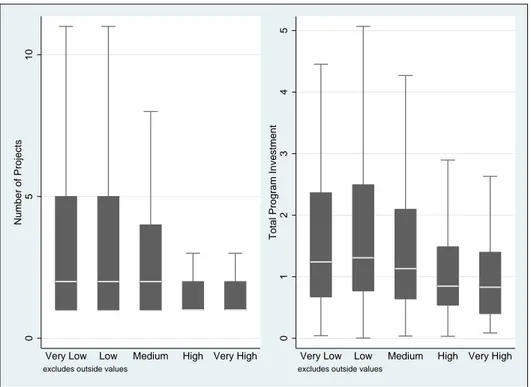
Figure 2 illustrates these relationships. The box plot graphs the number of projects
and the total amount of resources devoted by the program to municipalities of different
poverty levels during the 2002–2007 period. As expected, low- and medium-poverty
municipalities were awarded more projects and greater funding than those with high
poverty levels. By granting migrant organizations the initiative to self-select projects, the
program design seems to produce a perverse outcome: since organized migrants do not
come from the poorest Mexican municipalities, the program is biased against poor and very
poor communities despite the fact that its rules of operation state the objective to target
poor communities.
*** Figure 2 about here ***
If the program favors relatively well-off municipalities to the detriment of poor
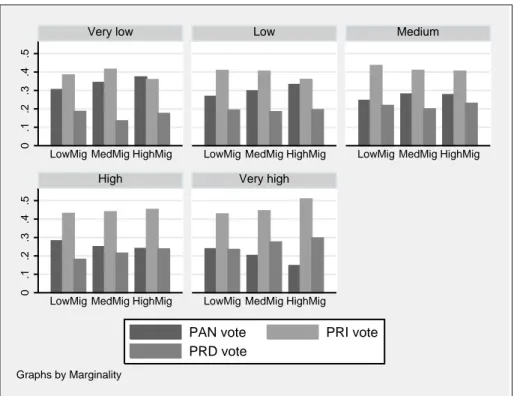
ones, can this bias be partly motivated by partisan or political reasons? Figure 3 depicts
municipal election returns for different migration and poverty categories. It suggests that
the PAN may have good reasons to actively use the program to reward its strongholds.
Whereas the PRI leadsin high-poverty municipalities regardless of their migration levels,
PAN voter support increases with migration intensity in municipalities with medium to very
low poverty. Thus, a political bias may in fact reinforce the self-selection bias that we have
hypothesized, yielding a more regressive outcome: if the program has a bias in favor of the
PAN, it will not only benefit high-migration municipalities but also favor the relatively
well-off ones.
Figures 1 and 2 lend support to our first hypothesis regarding the self-selection bias
of the 3x1 Program. And Figure 3 is suggestive of a potential partisan bias in the selection
of municipalities that participate in the program, to the advantage of municipalities where
PAN electoral support is stronger. However, these figures indicate only pair-wise
relationships, that is to say, they do not control for other factors that may determine
successful participation in the 3x1 Program. To verify which of our hypothesized biases is
supported by evidence in a more controlled setting, we turn now to multiple regression
analysis.
5. Results and discussion
To estimate the conditional effect of migration, poverty and political covariates on
participation in the 3x1 Program in Mexican municipalities, we estimate equations (1), (2)
and (3) with a series of multiple regression models using a panel dataset that comprises data
from more than 2,400 municipalities over the 2002–2007 period. TABLE 1 presents
descriptive statistics of our data for all municipalities in the sample period, and for the
subset of municipalities that participate in the program. About 11.4 percent of
municipalities have participated in the program, with an average investment of US$146,000
on 3.4 projects. As the table indicates, the poverty levels of participating municipalities are
below the full sample average (0.012 vs. -0.33), and their migration intensity is well above
average (0.038 vs. 0.89). Water, sewerage and electricity coverage is also higher than
average in participating municipalities. Relative to overall sample averages, states and
sample, whereas the PRI is underrepresented. Shared partisanship between local and state
governments is also higher than average, while electoral competitiveness is slightly lower.
*** Table 1 about here***
To test whether these differences remain significant when other factors are held
constant, we estimate a set of multiple regressions. TABLE 2 summarizes the results from
six different model specifications for our three measures of program participation: whether
the municipality participated in the program, the total amount of money received and the
number of projects awarded to a municipality in a given year. Our main independent
variables are migration and poverty levels, with other socio-demographic characteristics of
municipalities controlled for.
Model 1 in TABLE 2 presents a baseline logistic estimation of program
participation, coded as a binary outcome. Since we do not assume ex ante a monotonic nor
a linear relationship between program participation and migration or poverty levels, our
first specification includes indicator variables for each category of migration (coded from
no migration to very high migration), and for each level of poverty (coded from very low to
very high poverty). With state and year effects controlled for, the model indicates that the
likelihood of program participation significantly increases with migration intensity. On the
other hand, high and very high poverty municipalities are also more likely to participate
than localities with very low poverty levels. Program participation also increases with (the
log of) population size, a variable that is strongly correlated with municipal income – a
result that will prove to be robust in all other models. Also, water and sewerage coverage
In principle, the finding that program participation is increasing with poverty levels
seems to run against our hypothesis concerning the regressive character of the 3x1
Program. But focusing on participation as a binary outcome obscures the fact that some
municipalities receive more funds and projects than others. Thus, Model 2 directs attention
to the total amount of resources devoted by the program to a given municipality. This
model presents two-way fixed effect OLS estimates for the amounts awarded. As expected,
results indicate that municipalities with high or very high migration receive significantly
larger amounts of money (between US$18,000 and US$24,000 more) than those with very
low migration. However, now we find that low poverty municipalities receive larger
investments than high or very high poverty municipalities. In other words, the amounts
awarded by the program decrease with the relative backwardness of municipalities.
Given that migration intensity is not randomly or evenly distributed in Mexican
municipalities, it may be the case that our previous OLS results have a sample selection
problem: if some municipal or state features influence both program participation and the
amounts received, OLS estimates may be biased. Moreover, since we observe only the
amount of money awarded to participating municipalities, and zero otherwise, we need to
correct for the incidental truncation of the amount variable. Models 3 and 4 in TABLE 2
address this issue with a Heckman sample-selection estimation, where we use the migration
index and a quadratic poverty term to identify the selection equation.11 Once we control for
the selection process, we find evidence of a nonlinear relationship between poverty and
program selection. Indeed, the quadratic term has a negative and statistically significant
coefficient, which is consistent with the curvilinear relationship that we found in the
descriptive statistics, and suggestive of a regressive bias in program participation. The
in the medium income deciles. Moreover, we find again that poverty is negatively
correlated with the amounts received, significant at the 10 percent level.
Our third dependent variable measures the number of projects awarded to a
particular municipality. To assess whether our previous results hold if we focus on this
count variable instead of the amounts awarded, Models 5 and 6 in TABLE 2 present
estimates from a zero-inflated negative binomial regression (ZINB). As in our previous
Heckman model, we use migration index and poverty (with a quadratic term) to predict
program non-participation before estimating the count model.12 Model 5, which is the zero inflation equation, indicates that the probability of not being awarded a project decreases with migration but increases with poverty. In turn, the count equation in Model 6 indicates
that increasing poverty levels lead to fewer projects awarded, significant at the 1 percent
level, with population size, coverage of public services, and year effects controlled for. As
a robustness check, we also estimated a standard negative binomial model and our
substantive results hold: the number of projects awarded are increasing on migration and
decreasing on poverty.
To sum up, our regression estimates in TABLE 2 indicate that migration intensity
and population size are very good predictors of program participation for every one of our
three dependent variables. Poverty levels measured are positively correlated with the
likelihood of program participation as a binary outcome, but only up to a particular level of
marginality, after which the likelihood of program participation decreases. On the other
hand, poverty is negatively and significantly correlated with the amounts of money
received and the number of projects awarded to municipalities – a result that lends support
***Table 2 about here***
To test our political-bias hypotheses, TABLE 3 adds a number of political covariates to the
previous Heckman regression models. In Model 1, we included dummy variables that
indicate whether the PAN or the PRI controls the state and municipal government, using
PRD governments as the comparison group. Results indicate that, after migration, poverty,
and other covariates are controlled for, PAN municipalities in states ruled by the PAN are
significantly more likely to participate in the program. Once selected among the
participating municipalities, however, PAN governments are not awarded any more
resources than their PRI or PRD counterparts (Model 2).
To test whether the program favors any partisan strongholds, Models 3 and 4
include both PAN and PRI municipal vote shares. We find evidence suggesting that
municipalities with stronger PAN support among voters are more likely to participate in the
program. Also, PRI strongholds are less likely to participate than PRD strongholds, which is
the baseline in this specification. In contrast, Model 4 indicates that PAN electoral support
does not affect amounts any more than support for the PRD. PRI support is negatively
correlated with amounts awarded, though. This result means that, all else equal, larger
amounts are awarded in PAN or PRD strongholds, to the detriment of PRI core localities.
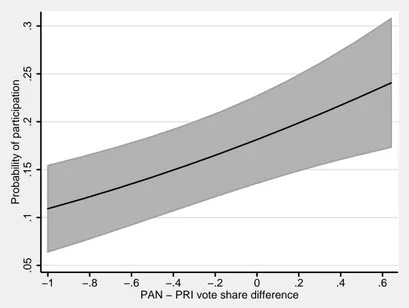
To further test the partisan bias in favor of the PAN, Models 5 and 6 include the margin of
difference between the PAN and PRI vote shares. We find that, controlling for poverty and
migration intensity, municipalities where the PAN vote share is particularly high relative to
the PRI are more likely to be selected in the program and to receive more resources.
Besides partisan biases and migrant self-selection, there are a number of covariates
in municipalities with more contested elections seek to participate and to attract more
program resources to improve public service provision in politically competitive settings.
Similarly, state governments may also try to target projects to highly contested locations.
Moreover, since municipal elections are held every three years in Mexico, the election year
might actually act as a spur to governments seeking to improve the provision of public
goods. Finally, as hypothesized above, there is also the possibility of a non-partisan effect
due to coordination problems. Since the program requires the collaboration of state and
municipal governments, it may be the case that when these two levels of government
belong to the same political party they are more likely to cooperate and to benefit from the
program, than under vertically divided government.
Models 7 and 8 in TABLE 3 test these three hypotheses by including the margin of
victory in municipal elections (a proxy of electoral competitiveness), as well as two
indicator variables for shared partisanship and municipal election years. As it turns out,
margin of victory and shared partisanship do not have an impact on the participation or
amount equations. These negative findings can be interpreted as evidence that the program
is not being used to target competitive localities or to punish juxtaposed governments but
rather to reward core PAN localities. Moreover, the partisan biases previously found are
not merely due to coordination problems between governments of different party labels.
Finally, election years are negatively correlated with program participation but have no
impact on the amounts received. This suggests that there are more projects funded in the
years before the election but their average cost is not affected by the election cycle.
TABLE 4 reproduce the previous analysis but direct attention to the number of
projects awarded, which we estimate with zero-inflated negative binomial models. The
migration and has nonlinear relationship with poverty (poorer municipalities are less likely
to participate than medium poverty ones). One robust result across all specifications is that
states governed by the PRI received significantly fewer projects than their PAN or PRD
counterparts. According to Model 4, municipalities with greater PAN support received more
projects than other party strongholds, a result that is also confirmed by Model 6. Finally,
Model 8 indicates that shared partisanship and the margin of victory in municipal elections
do not affect the number of projects awarded. As before, the results concerning migration
and poverty remain robust in these specifications: whereas high migration municipalities
receive more projects, poorer and less populated municipalities, where migrants are less
likely to be well organized, do worse.
In sum, we find evidence of significant partisan effects in the implementation of the
3x1 Program. We find that PAN states and municipalities are more likely to participate in
the program, but with no additional amounts or projects, than those governed by other
political parties. Municipalities with greater PAN support among voters are also more likely
to participate than others. Moreover, PRI strongholds receive smaller amounts than those of
the PAN or the PRD, after migration and poverty are controlled for. Non-partisan political
factors, such as juxtaposed governments, do not affect any measure of program
participation. All in all, the program could be used either to reward PAN core supporters or
to tilt the balance in favor of the PAN in those localities where political competition is
tighter. The finding that margins of victory are not significant, whereas PAN voter support
and PAN rule are relevant, is indicative that the program is being used as a rewarding tool
for core supporters rather than targeting competitive municipalities.13
It is important to remark that the political bias in favor of PAN states and
choosing to propose projects in PAN localities—or supply-driven, that is, if government
actors actively promote and use the program to reward their partisan supporters. We cannot
completely rule out either mechanism here. Indeed, recent studies suggest that migrants’
demographic characteristics make them likely to hold anti-PRI political preferences (Bravo
2007). If this is the case, the mechanism would not be one of PAN politicians biasing the
selection of projects in favor of their strongholds, but rather one of migrants selecting PAN
municipalities for their investments. Note that both mechanisms are plausible and likely to
operate in tandem. Yet regardless of which mechanism prevails, our substantial argument
concerning the regressive nature of the program holds: because high-migration PAN
strongholds are relatively affluent (see Figure 3), the political bias reinforces the
self-selection bias.14 Overall, geography and politics reinforce each other in producing a regressive outcome.
*** Table 3 about here***
Plotting predicted probabilities of participation may help clarify the relative impacts
of migration, poverty and partisan biases on the probability of participation as well as on
the amount of funds received. In order to do this, we rely on the Heckman selection model
1 from TABLE 3 to estimate predicted probabilities of participation. Figure 4 shows that
poverty has a curvilinear impact on the probability of program participation: rich and poor
municipalities have a lower probability of participating than those in the middle (the
simulated figure is for PAN municipalities located in PAN states). Figure 5 shows that
migration positively affects the probability of program participation. It also shows that PAN
On the other hand, Model 2 in TABLE 3 also reveals that a one-unit increase in the poverty
index decreases the amount of money awarded by about US$12,000. According to model 4 in TABLE 4, one standard deviation increase in the level of poverty reduces the expected number of projects in 27 percent. With all other factors held constant, a municipality in a
PRI state decreases the expected number of projects in half. Finally, a one standard
deviation increase in PAN vote share increases the expected number of projects in 9
percent.
*** Figures 4 and 5 about here ***
6. Concluding remarks
Remittances have become a crucial source of revenue in many developing countries.
Whereas some analysts (Durand et al. 1996) regard them as flows that can circumvent state
intervention – which is treated as an advantage in poorly institutionalized and often corrupt
political settings – the fact is that governments do intervene to influence the amount of
remittances that arrive in sending countries, the channels by which they arrive, and their
uses once they have arrived. These interventions are likely to increase as governments
become increasingly aware of their developmental potential. Precisely because of this
characterization of remittances as alien to political intervention, political economy research
on remittances has been rare (for exceptions see Bravo 2007; Pfutze 2007). In this paper,
we explore the 3x1 Program for Migrants, a well-publicized public policy program directed
at channeling collective remittances to “productive uses” in migrants’ communities of
We raised two main points. First, because the program design gives the initiative to
migrants, its capacity to target poor municipalities crucially depends on the relationship
between poverty and migration. If municipalities with the strongest and most long-standing
migration traditions are not among the poorest ones, as is the case in Mexico, the program
will be unlikely to reduce poverty due to self-selection bias. Second, the 3x1 Program for
Migrants was launched at the federal level under a PAN administration led by Vicente Fox.
The involvement of three different levels of government in addition to migrant
organizations in the allocation of projects raises concerns about partisan or political biases
in the actual implementation of the program.
Indeed, we found that, whereas medium poverty municipalities were more likely to
participate in the program than low poverty ones, poverty levels were negatively related to
the amount of money received and to the number of projects awarded. We also found
significant partisan biases in the implementation of the 3x1 Program. PAN states and
municipalities were more likely to participate in the program than those ruled by other
political parties. Municipalities with greater PAN electoral support were also more likely to
participate and to receive more projects. Moreover, the partisan bias reinforces the
self-selection bias of the program because high-migration and relatively well-off municipalities
tend to favor the PAN. Taken together, these results cast doubt on the ability of this kind of
policy to target the communities where Mexico’s public resources are most needed.
Two simple amendments to the programdesign might help increase the chances that
the poorest communities – where migrants are fewer in number and not very well organized
– are not excluded from its benefits. First, only communities below a particular poverty
threshold could be eligible to participate. Second, projects from medium- to low-poverty
from high-poverty areas, where migrant organizations may not be able to afford an equal
share of the project’s costs. Yet changing the rules of the program is bound to raise all
manner of political resistance from relatively well-off migrants whose political power has
References
Alarcón, R. 2006. Hacia la Construcción de una Política de Emigración en México. In Carlos Gonzáles (ed) Relaciones Estado-Diáspora: Aproximaciones desde Cuatro Continentes. Mexico: SER, IME, Universidad Autónoma de Zacatecas, ANUIES, Miguel Angel Porrúa, 157-79.
Aparicio, F., C. Maldonado and B. Beltrán. 2007. “Programa 3x1 para Migrantes. Datos Generales de la Evaluación Externa de Consistencia y Resultados 2007.” SEDESOL
Bravo, J. 2007. “Emigration and Political Engagement in Mexico.” Unpublished Manuscript, Nuffield College, Oxford University.
Bravo, J. 2008. “Mexico without (some) Mexicans: Migration and politics in Mexico.” Chapter 4. Unpublished Manuscript. Nuffield College, Oxford University.
Burguess, K. 2005. “Migrant Philanthropy and Local Governance in Mexico in Merz, Barbara.” New Patterns for Mexico. Remittances, Philanthropic Giving, and Equitable Development, Cambridge MA, Harvard University Press, Chapter 10. Burguess, K. 2006. El Impacto del 3x1 en la Gobernanza Local. In Rafael Fernández de
Castro, Rodolfo García Zamora and Ana Vila Freyer (ed). 2006. El programa 3x1 para migrantes. ¿Primera política transnacional en México? Mexico: ITAM, Miguel Angel Porrúa, Universidad de Zacatecas, 99-118.
Carling, J. 2004. “Policy Options for Increasing the Benefits of Remittances”, Documento presentado en el Workshop B9: Remittances and Development: Beyond Increasing Incomes at the Ninth International Metropolis Conference, Geneva, 27 September-1 October.
De Graauw, E. 2005. “Government Courtship of Migradollars: International Migrants’ Remittances and Policy Intervention in the Case of Contemporary Mexico”, 2nd Annual Political Science Graduate Student Conference, University of California at Berkeley, May 2nd.
Díaz Cayeros, A., F. Estévez and B. Magaloni. 2007. “Strategies of Vote Buying: Social Transfers, Democracy, and Welfare in Mexico.” Unpublished book manuscript, Stanford University.
Durand, J., E. Parrado and D. Massey. 1996. “Migradollars and Development: A
Reconsideration of the Mexican Case.” International Migration Review 30(2): 423-444.
Fernández de Castro, R, Rodolfo García Zamora and Ana Vila Freyer (ed). 2006. El programa 3x1 para migrantes. ¿Primera política transnacional en México? Mexico: ITAM, Miguel Angel Porrúa, Universidad de Zacatecas.
García Zamora, R. n.d. Las Lecciones del Programa 3x1 y los retos de las nuevas políticas públicas y de las organizaciones de migrantes para el desarrollo local en México.
García Zamora, R. 2006. “El Programa 3×1 y los retos de los proyectos productivos en Zacatecas” in Rafael Fernández de Castro, Rodolfo García Zamora, Ana Vila Freyer, coordinadores, El programa 3 x 1 para migrantes: ¿Primer política transnacional en México?, México, ITAM, UAZ, Miguel Angel Porrúa, 157-170.
Goodman, G. L. and J. Hiskey. 2008. “Exit without Leaving. Political Disengagement in High Migration Municipalities in Mexico.” Comparative Politics, January, 169-188. Fajnzylber, P and J. H. López. 2007. Close to Home: The Development Impact of
Remittances in Latin America. World Bank, Conference Edition.
Ghosh, B. 2006. Migrant´s Remittances and Development. Myths, Rhetoric and Realities.
Geneva: International Organization for Migration.
Goldring, L. 2004. “Family and Collective Remittances to Mexico: A Multi-dimensional Typology”, Development and Change 35(4), 799-840.
Hatton, T and J. Williamson. 2002. What Fundamentals Drive World Migration? Discussion Paper 3559. Center for Economic Policy Research, London.
Hernández, L. and C. A. Contreras. 2006. “Con Pesos y Dólares: Contribución del Programa 3x1 para Migrantes, al Desarrollo de la Región Ciénega de Jalisco”, 11° Encuentro Nacional Sobre Desarrollo Regional en México, del 7 al 10 de Noviembre.
Imaz, C. 2003. “Poder Político de las Organizaciones Transnacionales de Migrante
Mexicanos en sus Comunidades de Origen. Estudio Comparativo de Clubes Sociales de Migrantes,” en Nayarit-California y Puebla-Nueva York. In G. Lanly and M. B. Valenzuela (eds), Clubes de Migrantes Oriundos Mexicanos en los Estados Unidos.
Universidad de Guadalajara.
Iskander, N. 2005. “Social Learning as a Productive Project: The Tres por Uno (Three for One) experience at Zacatecas, Mexico,” in OECD, Migration, Remittances and Development. Chapter 14.Paris:OECD.
Jiménez, A. 2008. “Remittances and Votes: The Rise of the Migrants as a New Actor in Mexican Politics.” Paper prepared for delivery at the 66th MPSA Annual National Conference, Chicago 3-6 April.
Leite, P and L. Acevedo. 2006. Migración Internacional en México: Balance y Retos Políticos. Mexico: CONAPO.
López, G. 2006. “Las remesas en la conformación de prácticas y concepciones de bienestar comunitario: el rostro unidimensional de los vínculos transnacionales”, VII Congreso Latinoamericano de Sociología Rural, 20-24 de noviembre.
Moctezuma, M. and Ó. Pérez. 2006. “Remesas colectivas, Estado y formas organizativas de los mexicanos en Estados Unidos,” in Rafael Fernández de Castro, Rodolfo García Zamora and Ana Vila Freyer (eds), El programa 3 x 1 para migrantes: ¿primer política transnacional en México?, México, ITAM, UAZ, Miguel Ángel Porrúa, 119-138.
OECD. 2007. Policy Coherence for Development. Migration and DevelopingCountries. París: OECD Development Center.
Orozco, M. 2003. Hometown Associations and their Present and Future Partnerships: New Development Opportunities? Washington: USAID.
Orozco, M. and K. Welle. 2005. “Clubes de Migrantes y Desarrollo: Pertenencia, Concordancia, Sustentabilidad y Replicabilidad.” New Patterns for Mexico. Remittances, Philanthropic Giving, and Equitable Development, Cambridge, MA: Harvard University Press, Chapter 5.
Pfutze, T. 2007. “Do Remittances Promote Democratization? How International Migration Helps to Overcome Political Clientelism.” Unpublished Ms.
Shannon, A. 2006. “Las organizaciones transnacionales como agentes del desarrollo local. Retos y oportunidades del Programa 3×1 para Migrantes,” in Rafael Fernández de Castro, Rodolfo García Zamora and Ana Vila Freyer (eds), El programa 3 x 1 para migrantes: ¿primera política transnacional en México?, México, ITAM, UAZ, Miguel Ángel Porrúa.
Smith, M. P. 2003. “Transnationalism, the State, and the Extraterritorial Citizen,” Politics and Society 31(4), 467-502.
Soto, S and M. A. Velázquez. 2006. “El Proceso de institucionalización del Programa 3x1 para Migrantes,” in Rafael Fernández de Castro, Rodolfo García Zamora and Ana Vila Freyer (eds), El Programa 3x1 para Migrantes. ¿Primera Política Trasnacional en México? ITAM, Miguel Angel Porrúa, Universidad de Zacatecas, 11-44.
Spector A. R. and Els de Graauw. 2006. “Capitalizing on Remittances: A Cross-National Comparison of Remittance Actors and Policies.” Paper presented at the 2006 Annual Meeting of the American Political Science Association, Chicago August
31-September 3.
Spencer, S and B. Cooper. 2006. Social integration of Migrants in Europe: A Review of the European Literature 2000-2006. Paris: OECD Development Center.
Valenzuela, M. B. 2006. “La instauración del 3x1 en Jalisco. El Acomodo de los Gobiernos Locales a una Política Adoptada por el Gobierno del Estado,” in Rafael Fernández de Castro, Rodolfo García Zamora and Ana Vila Freyer (eds), El Programa 3x1 para Migrantes. ¿Primera Política Transnacional en México? México, ITAM, UAZ, Miguel Ángel Porrúa, 139-156.
World Bank. 2006. Global Economic Prospects: Economic Implications of Remittances and Migration. Washington, DC: World Bank.
Zárate, G. 2005. “The Development Impact of Migrant Remittances in Mexico,” in
Inter-American Development Bank, Beyond Small Change–Making Migrant Remittances
FIGURES
FIGURE 1. Migration and poverty levels in Mexican municipalities, 2002-2007 (box plot).
−1
0
1
2
3
4
Migration intensity index
Very Low Low Medium High Very High
excludes outside values
0
10
20
30
40
% Remittance recipient households
Very Low Low Medium High Very High
excludes outside values
FIGURE 2. Number of projects awarded and total investment of the 3x1 Program in Mexican municipalities by different poverty levels, 2002-2007 (box plot).
0
5
10
Number of Projects
Very Low Low Medium High Very High
excludes outside values
0
1
2
3
4
5
Total Program Investment
Very Low Low Medium High Very High
FIGURE 3. Municipal vote share for PAN, PRI and PRD by level of poverty and migration intensity, 2002-2007.
0
.1
.2
.3
.4
.5
0
.1
.2
.3
.4
.5
LowMig MedMig HighMig LowMig MedMig HighMig LowMig MedMig HighMig
LowMig MedMig HighMig LowMig MedMig HighMig
Very low Low Medium
High Very high
PAN vote PRI vote
PRD vote
Graphs by Marginality
FIGURE 4. Predicted probability of participation in the 3x1 Program in Mexican municipalities (PAN municipalities in PAN states) by degree of poverty. Estimates are based on Model 1 in Table 3, with all other covariates held at their mean values.
0
.2
.4
.6
.8
Probability of participation
0 5 10 15 20 25 30 35 40 45 50 55 60
FIGURE 5. Predicted probability of participation in the 3x1 Program in Mexican municipalities by PAN - PRI vote share difference. Estimates based on Model 5 in Table 3, with all other covariates held at their mean values.
.05
.1
.15
.2
.25
.3
Probability of participation
Mean Std. Dev Mean Std. Dev
Municipal Participation 0.114 0.318
Amount (in million constant pesos) 0.267 1.071 1.755 2.219
Number of Projects 0.512 2.292 3.362 4.992
Poverty Index 0.012 0.991 -0.333 0.754
Very Low Poverty 0.102 0.302 0.089 0.285
Low Poverty 0.173 0.378 0.281 0.450
Medium Poverty 0.203 0.402 0.296 0.457
High Poverty 0.368 0.482 0.281 0.449
Very High Poverty 0.154 0.361 0.054 0.225
Migration Intensity Index 0.038 0.986 0.895 1.083
No Migration 0.038 0.192 0.003 0.052
Very Low Migration 0.354 0.478 0.080 0.272
Low Migration 0.244 0.429 0.157 0.364
Medium Migration 0.162 0.368 0.225 0.418
High Migration 0.136 0.343 0.339 0.473
Very High Migration 0.067 0.250 0.196 0.397
Water Coverage 0.728 0.241 0.789 0.214
Sewerage Coverage 0.554 0.302 0.681 0.255
Electricity Coverage 0.874 0.183 0.886 0.203
Log (Population) -4.504 1.493 -4.063 1.215
PAN State 0.206 0.404 0.412 0.492
PRI State 0.674 0.469 0.276 0.447
PRD State 0.190 0.392 0.337 0.473
PAN Municipality 0.218 0.413 0.311 0.463
PRI Municipality 0.437 0.496 0.408 0.492
PRD Municipality 0.160 0.367 0.205 0.404
PAN vote share 0.226 0.187 0.277 0.175
PRI vote share 0.337 0.194 0.359 0.149
PRD vote share 0.170 0.177 0.208 0.175
PAN-PRI Vote Margin -0.111 0.206 -0.082 0.217
Margin of Victory 0.101 0.119 0.110 0.102
Municipal Election year 0.363 0.480 0.325 0.468
Shared Partisanship 0.425 0.494 0.478 0.500
Number of observations 14,557 2,222
2435 municipalities / 31 states/ 6 years
Note: t-tests for differences in means are statistically significant at the 5 percent level in all cases. All Municipalities
Participating Municipalities TABLE 1
Program Participacion Amount Program Participation Amount Program Participation Number of Projects
(1) (2) (3) (4) (5) (6)
Logit FE OLS
Migration
Very Low 1.006 -0.029
[0.424]** [0.008]***
Low 1.781 -0.005
[0.430]*** [0.014]
Medium 2.202 0.02
[0.431]*** [0.019]
High 2.798 0.289
[0.432]*** [0.033]***
Very High 3.03 0.212
[0.437]*** [0.056]***
Poverty
Low 0.565 0.074
[0.123]*** [0.040]*
Medium 0.538 -0.051
[0.138]*** [0.043]
High 1.099 -0.037
[0.158]*** [0.040]
Very High 1.267 -0.015
[0.210]*** [0.045]
Migration intensity index 0.264 -2.372 0.392
[0.018]*** [0.128]*** [0.044]***
Poverty 0.787 -0.142 -1.007 -0.397
[0.095]*** [0.082]* [0.213]*** [0.067]***
Squared Poverty -0.125 0.18
[0.017]*** [0.045]***
Water 0.606 0.072 0.252 -0.26 0.103
[0.157]*** [0.030]** [0.086]*** [0.185] [0.164]
Sewage 0.292 -0.051 0.206 -0.099 0.522
[0.156]* [0.034] [0.085]** [0.195] [0.147]***
Electricity 0.155 -0.001 0.015 -0.031 -0.617
[0.159] [0.045] [0.087] [0.180] [0.150]***
Log (Population) 0.239 0.064 0.15 0.361 0.471
[0.032]*** [0.007]*** [0.017]*** [0.048]*** [0.027]***
Constant 0.527 -0.577 3.072 1.194 2.846
[0.066]*** [0.237]** [0.413]*** [0.209]*** [0.317]***
Observations 14,142 14,534 14,534 14,534 14,534 14,534
Program participation is a binary outcome, amount awarded is measured in million pesos in constant prices. Robust Standard errors in brackets. * significant at 10%; ** significant at 5%; *** significant at 1%. All models include state and year effects, except models 5 and 6, which only include year effects.
TABLE 2
Participation in the 3x1 Program for Migrants in Mexican Municipalities, 2002 - 2007